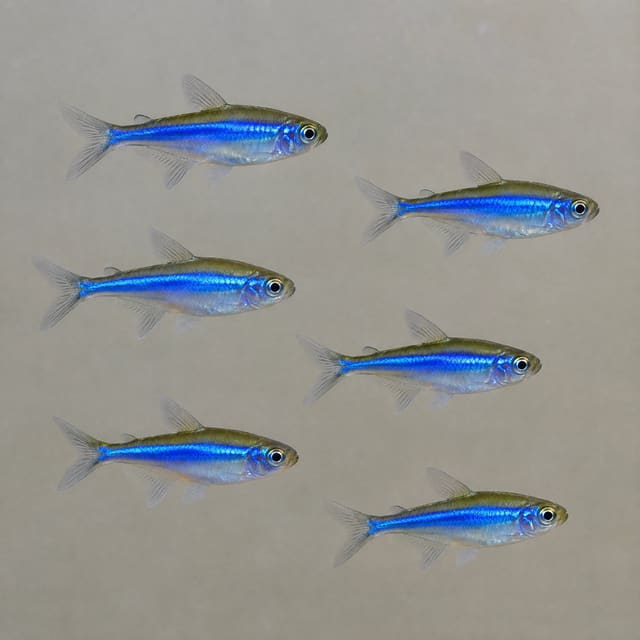
6 × Cochu’s Blue Tetras (Boehlkea fredcochui)
22–26°C · pH 6–8
£23.49
Assorted Tetras are a mixed selection of peaceful community tetras, chosen from the species available on the day of packing; the species and colour cannot be chosen. Keep ten or more in a planted, heated community tank of 80 litres or more at about 24–25°C with short-finned companions. Sold individually as one live tetra.
Characiformes (various species)
Quantity discounts are pricing offers, not a group-size recommendation. Check the full care guidance and your existing animals before choosing a quantity.
Assorted Tetras are a mixed selection of peaceful community tetras, chosen from the species available on the day of packing; the species and colour cannot be chosen. Keep ten or more in a planted, heated community tank of 80 litres or more at about 24–25°C with short-finned companions. Sold individually as one live tetra.
Read the full care guidance when planning conditions for your aquarium.
Assorted Tetras are a mixed selection of peaceful community tetras, chosen from the species we hold on the day your order is packed. They are an affordable way to fill a community aquarium with movement and colour, and many keepers enjoy seeing which species arrive. Each purchase quantity is one live tetra; order several and you will receive a varied group.
Tetras are small characins, egg-laying fish related to pencilfish and hatchetfish, and many of the best-known community species, such as the glowlight tetra from Guyana, come from South American rivers. OATA, the UK’s ornamental fish trade association, notes that most tetras stay between 2 and 5 cm long, that they are shoaling fish, and that with good water in a mature tank they can live for several years. That combination of small size, shoaling behaviour and steady habits is why tetras form the backbone of so many UK community tanks.
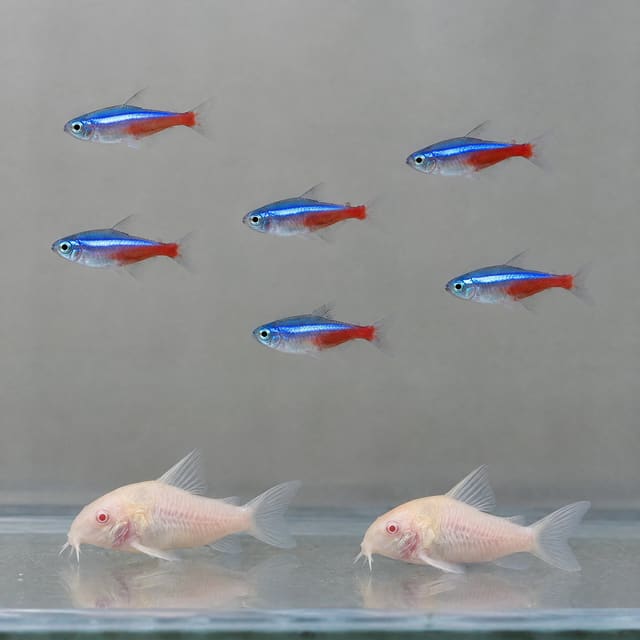
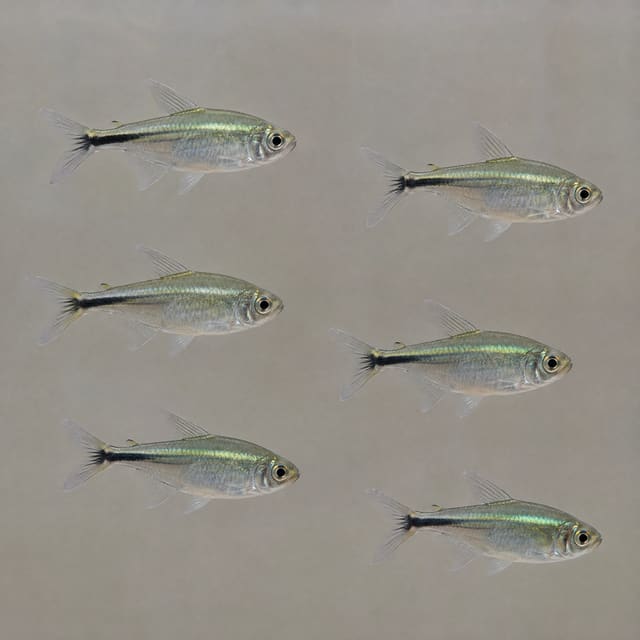
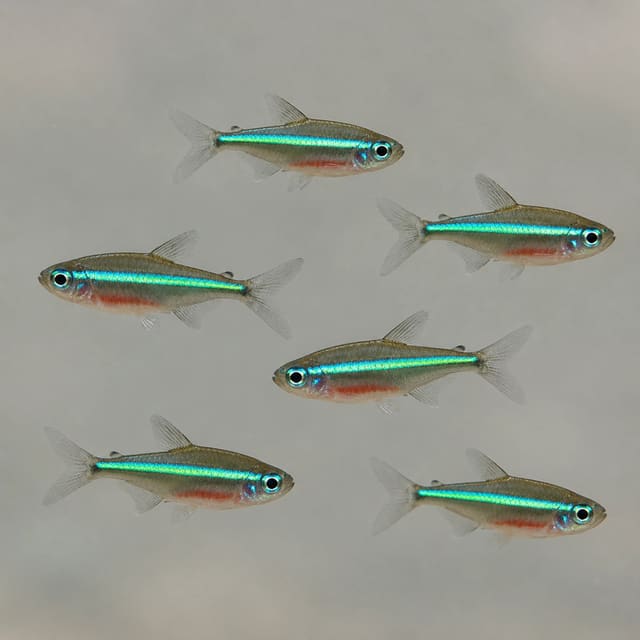
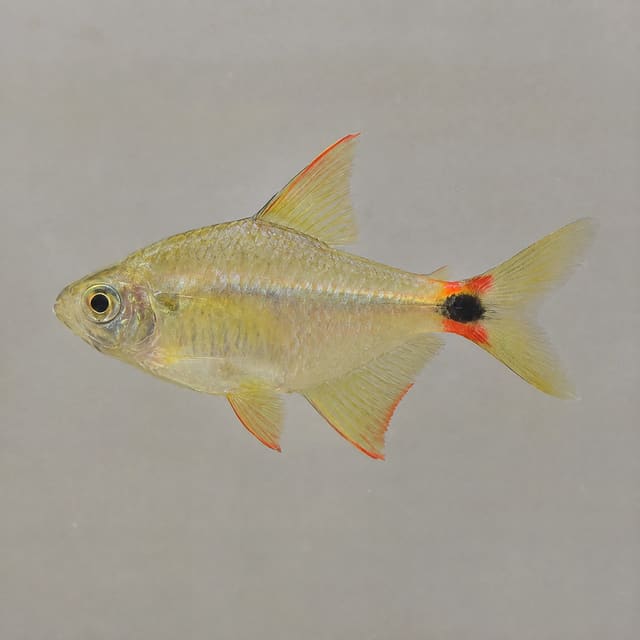
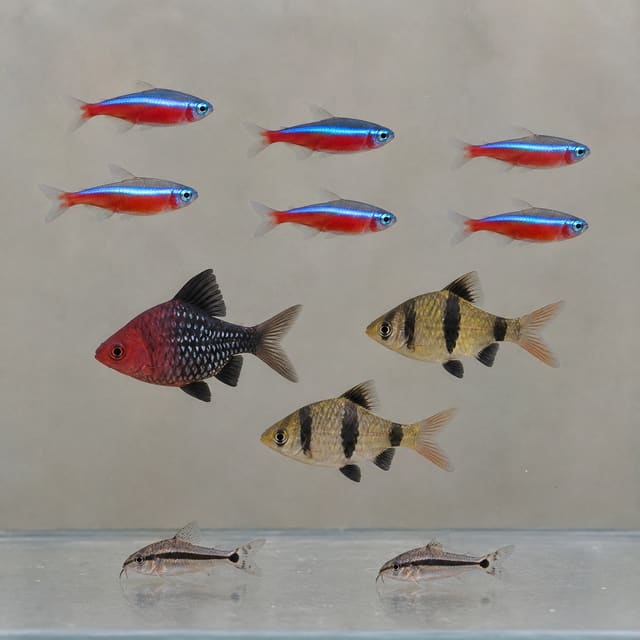
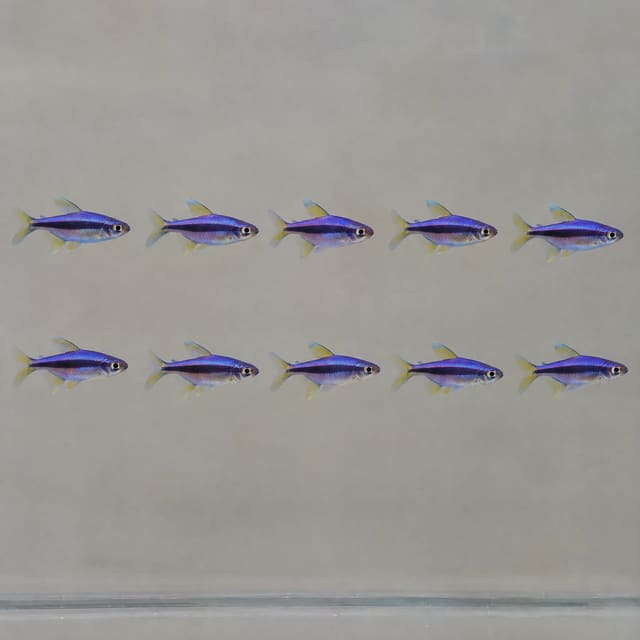
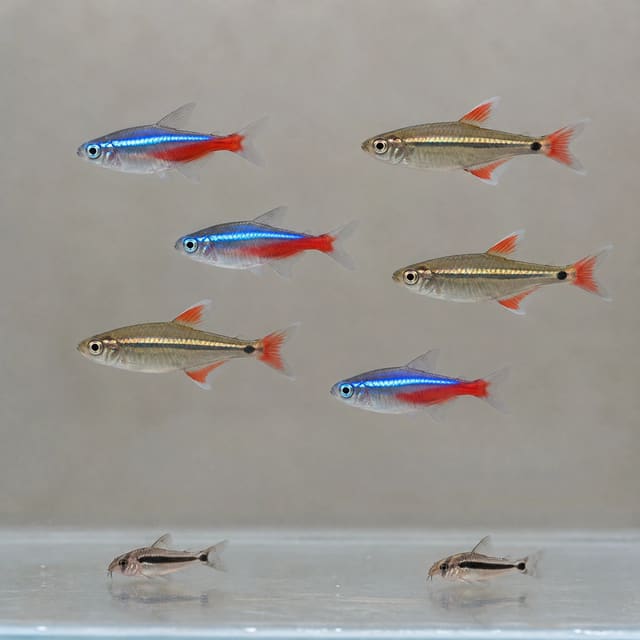
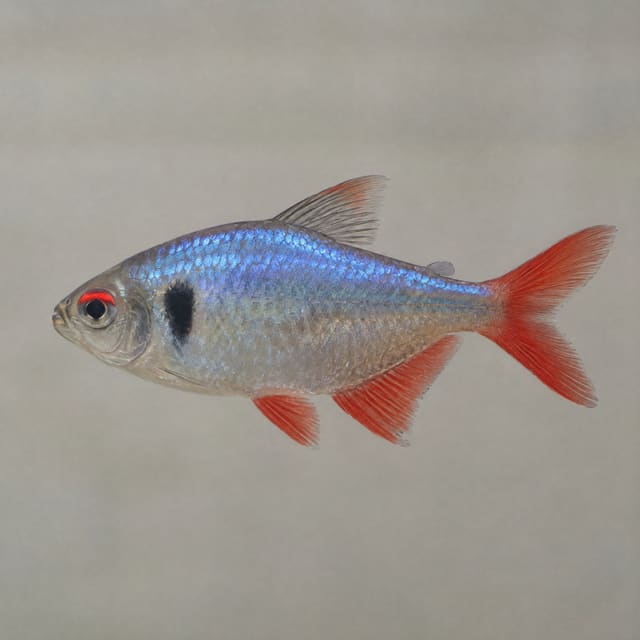
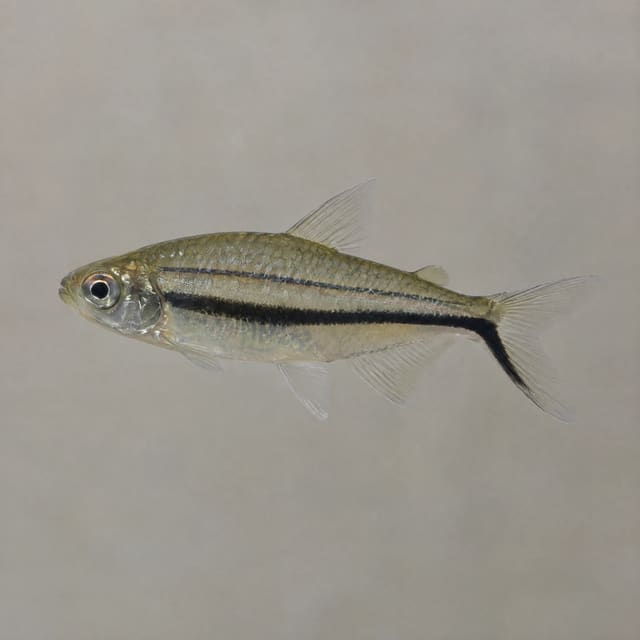
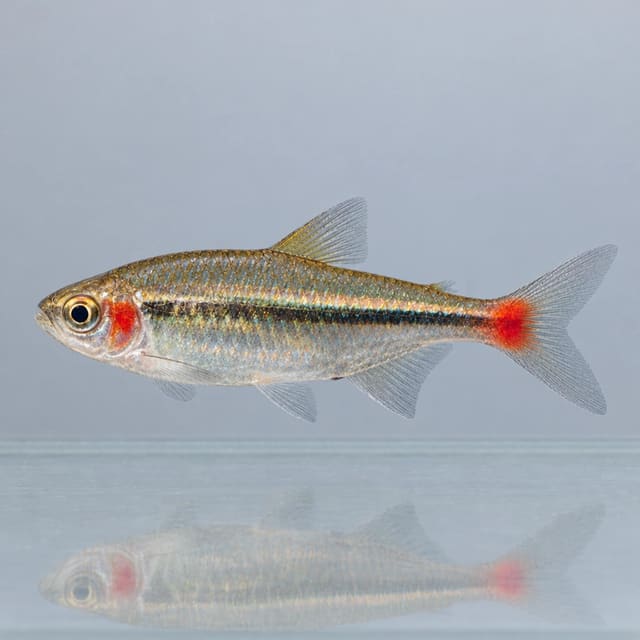
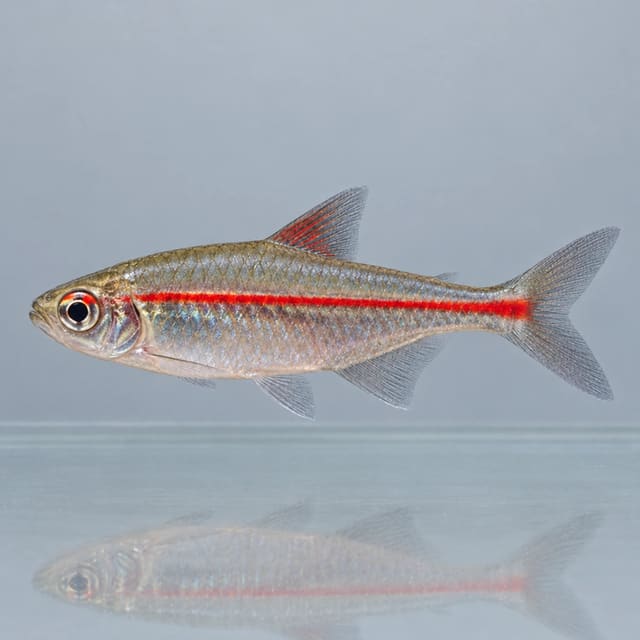
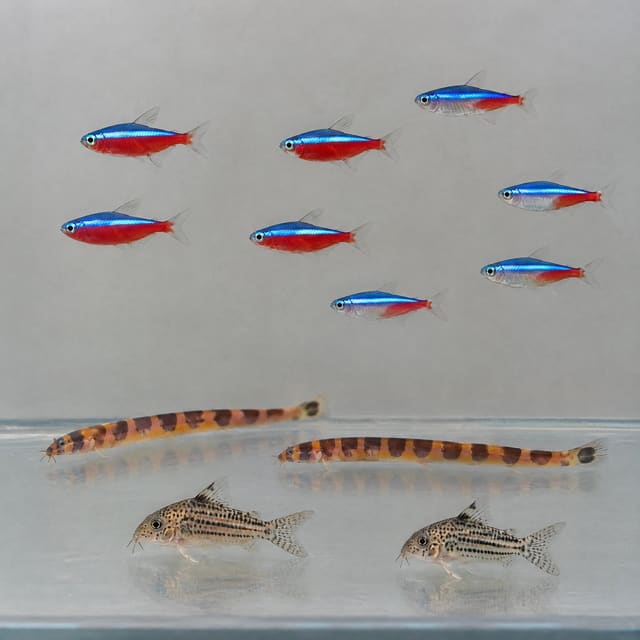
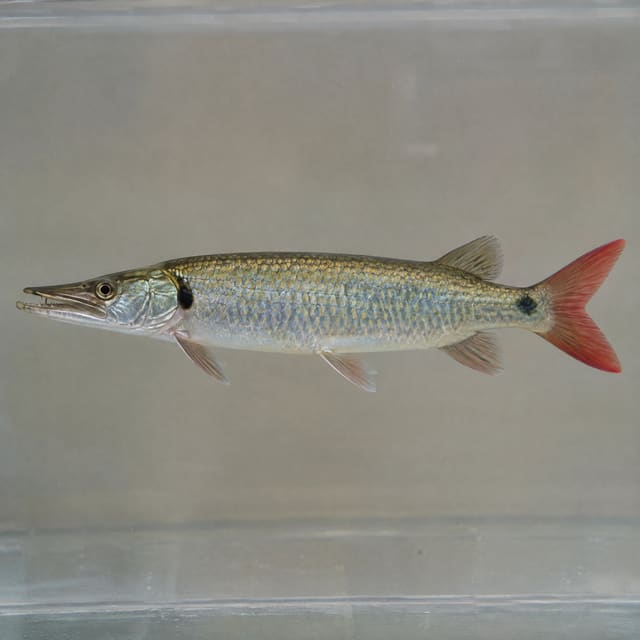
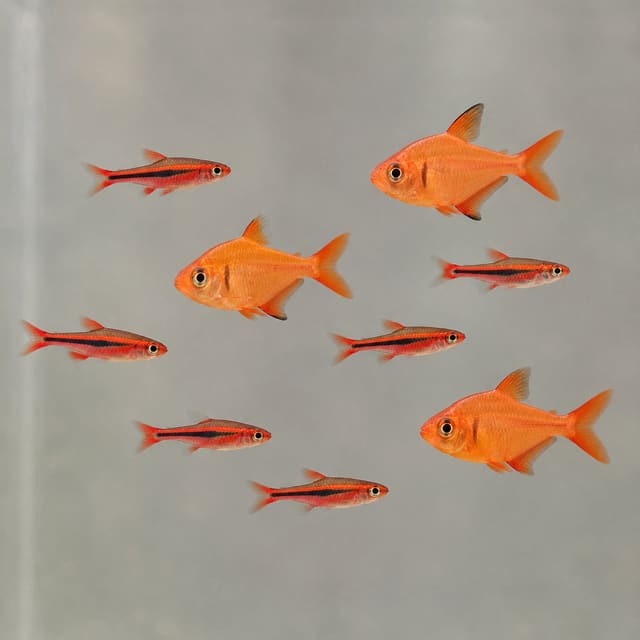
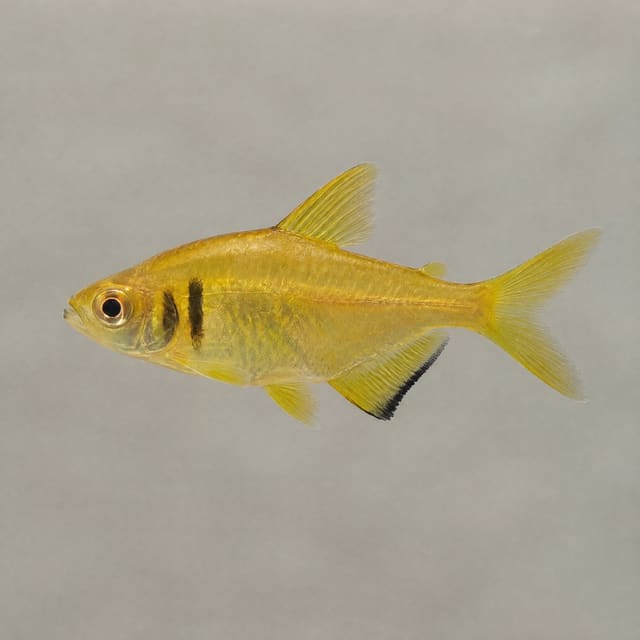
The photographs show one example of the kind of fish a mix can contain: a neon-type tetra with an iridescent blue stripe and a red rear body. They are not a picture of every fish in the mix. Please read the next sections before ordering, because buying a mix asks for a little more planning than buying a named species.
| Suits | Not suited to |
|---|---|
| A mature, planted community tank of 80 litres or more | A small nano tank where a larger species would be cramped |
| A keeper happy to receive whichever species are available | Anyone who needs one exact species or an even shoal |
| Short-finned companions: corydoras, platies, rasboras, danios | Long-finned fish such as bettas, angelfish and fancy guppies |
| Steady heated water at 24–25°C | Cold-water or unheated tanks |
| Buying ten or more so each species has company | Buying one or two fish |
If you would rather pick each species yourself, browse our tetras for sale and the South American tetra category, or choose a ready-made group from our shoal packs. For other peaceful fish that suit the same tank, see our community tank fish.
One purchase quantity supplies one live tetra in our Medium size grade, chosen from the tetra species available on the day. The species, colour and exact size cannot be chosen, and fish in a single order may be all one species or a mixture. Every fish is a peaceful community tetra suitable for a heated freshwater aquarium.
If you keep long-finned fish, have a tank under 80 litres or want to avoid a particular species, contact us before ordering and we will tell you what the mix contains at the time. Read our delivery days and Live Arrival Guarantee before you buy, and make sure your tank has finished cycling.
Once your fish have settled, identify each species so you can give it the right group size and check its needs. Look at the body shape, the colour of the stripe or spots, the fin colour and any dark mark near the tail, and compare them with the photographs on our named tetra pages. Our tetra guide introduces the common types, and if you are unsure, send us a clear photo and we will help.
We cannot promise which species a given mix contains, but the published needs of three well-known community tetras show why a steady middle range suits a mixed group.
| Seriously Fish figure | Neon Tetra | Glowlight Tetra | Bloodfin Tetra |
|---|---|---|---|
| Maximum standard length | 30 mm | 40 mm | 55 mm |
| Temperature | 21–25°C | 24–28°C | 18–28°C |
| pH | 4.0–7.5 | 5.5–7.5 | 6.0–8.0 |
| Hardness | 1–12 dGH | 2–15 dGH | 3–25 dGH |
| Minimum group | 8–10 | 6, preferably 10+ | 6 |
All three meet at 24–25°C, pH 6.5–7.5 and 4–12 dGH, which also sits inside OATA’s general tetra range. That is the water we recommend for an assorted group.
OATA advises buying the largest tank you reasonably can: at least 45 litres for a small shoal of smaller tetra species, and at least 80 litres for species of 5 cm and over. Because a mix can include species at the larger end of the community range, plan for 80 litres or more. A larger tank also holds its temperature and water quality more steadily, which matters when several species with slightly different preferences share it.
OATA recommends gravel or sand, live plants for cover, open swimming space and a gentle current for smaller species, with the tank kept away from draughts, direct sunlight, heat sources, noise and vibration, and lit on a regular day-night cycle. A tetra community looks its best with dense planting at the back and sides and open water at the front, where the different species can swim in their own groups.
Our aquarium plants include easy species for this layout. Wood and a few floating plants add shade, and give shyer species somewhere to settle while the group sorts itself out in the first weeks.
| Zone | What to put there | Why it helps |
|---|---|---|
| Back and sides | Tall stem plants and wood | Cover for shy species |
| Front and centre | Open water over sand or fine gravel | Room for each species to shoal |
| Surface | A few floating plants | Softer light and calmer fish |
| Filter outlet | A gentle, spread current | The light flow OATA suggests for small tetras |
OATA gives a general range for tetras in the UK trade and notes that wild-caught fish may need different values. A mixed group does best in the middle of that range, held steady, rather than at either extreme.
| Value | OATA range for tetras | Our target for a mix |
|---|---|---|
| Temperature | 22–27°C | 24–25°C |
| pH | 6.5–8.0 | 6.5–7.5 |
| General hardness | 4–12 dGH | 4–12 dGH |
| Carbonate hardness | 3–10 dKH | 3–10 dKH |
| Ammonia and nitrite | 0 mg/l | 0 mg/l |
| Nitrate | No more than 20 mg/l above tap water | As low as weekly changes allow |
UK tap water varies from soft to very hard, and your water company publishes the hardness for your postcode. If yours is harder than the target, mix in reverse-osmosis water. Compare your readings with our water matcher, and see our water chemistry guide for what each test means.
Temperature, pH and hardness describe the water the fish prefer. Ammonia, nitrite and nitrate tell you whether the tank is clean. OATA warns that even small amounts of ammonia or nitrite can stress tetras and lead to disease, so test weekly and more often during set-up and after adding fish.
OATA calls a filter essential, recommends a 25% water change every week with solid waste siphoned from the gravel, and advises treating new water with a conditioner that removes chlorine or chloramine. Never rinse filter media under the tap, because chlorine and chloramine kill the bacteria that break down waste; rinse it gently in old tank water instead.
OATA describes tetras as omnivores. Feed a good-quality flake or granule as the staple, add small live or frozen foods such as daphnia and small bloodworm, and feed once a day only what the fish finish within a few minutes. In a mixed group the smallest species have the smallest mouths, so choose a fine food that every fish can take.
| Day | Food | How much |
|---|---|---|
| Most days | Fine flake such as Supervit flakes or micro granules such as Pro Defence XXS | What the group clears in about two minutes |
| Two or three days a week | Frozen daphnia, thawed in tank water | A small piece for ten fish |
| Once a week | Freeze-dried bloodworm, crumbled | A pinch |
OATA advises confirming that ammonia and nitrite read zero before adding fish and adding them gradually, because the filter bacteria must grow to match the extra waste. Too many fish too quickly causes “new tank syndrome”. Our guide to the aquarium nitrogen cycle explains how to tell when a tank is ready.
Use OATA’s floating bag method: lights off, float the unopened bag for about 10 minutes, add small amounts of tank water over up to 20 minutes, then release the fish with as little bag water as possible. Our guide to acclimatising new fish shows each step.
OATA advises keeping small tetras away from fish large enough to eat them, warns that boisterous larger species such as the Buenos Aires Tetra may nip the fins of timid or long-finned fish, and says tetras do best with fish of similar size and temperament. Seriously Fish notes the same habit in the bloodfin tetra, which may nip long-finned or slow tank mates. In a mix you cannot rule those habits out, so choose short-finned, active companions. Check your list in our tank mates checker.
| Suits | Avoid |
|---|---|
| Bronze Corydoras and other corydoras | Bettas such as the Halfmoon Plakat Betta |
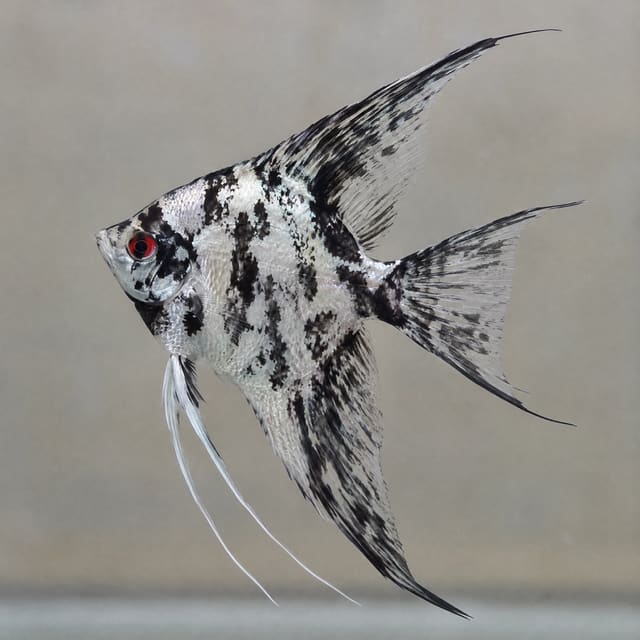
| Platies and other sturdy livebearers | Angelfish such as the Marble Angelfish |
| Rasboras such as the Harlequin | Fancy guppies and other long-finned fish |
| Danios such as the Golden Zebra Danio | Any fish large enough to swallow a small tetra |
| Small plecos such as the Bristlenose Pleco | Cold-water fish such as goldfish |
Healthy tetras have clear, bright eyes, undamaged fins and scales, steady breathing and normal swimming, the signs OATA lists when choosing fish. Learn what normal looks like for each species you receive, then act quickly on changes.
| If you see | Do this |
|---|---|
| Fish hanging at the surface or sitting on the bottom | Test ammonia, nitrite and temperature straight away |
| Clamped fins, flicking or shimmying | Test the water and watch for white spots |
| White spots like grains of salt | Follow our white spot treatment guide for the whole tank |
| Torn fins on one species | Find the nipper, add cover and rehome it if it persists; see our fin rot guide for damaged fins |
| A neon-type tetra that leaves the group, is restless and shows white patches | Isolate it at once (see below) |
| Weight loss or loss of appetite | Check food size and that small species get enough |
If your mix includes neon tetras, Seriously Fish describes neon tetra disease, caused by the microsporidian Pleistophora hyphessobryconis: affected fish become restless, develop white patches on the skin and separate from the shoal, and the disease is virtually untreatable once advanced. Seriously Fish adds that columnaris can look similar but is treatable with antibacterial products, so isolate any fish with these signs straight away and contact us with your water readings. Our neon tetra care guide covers the species in more detail.
OATA notes that breeding tetras at home is possible but unlikely to succeed, especially in a community tank. Heavy feeding with live or frozen food and a slightly lower temperature, mimicking the rainy season, can trigger spawning; tetras scatter eggs over plants, leaf litter and substrate, uneaten eggs hatch within a couple of days, and fry appear a few days later. Good results need a dedicated set-up and specialist fry food. If you want to breed, identify a species you received, build a group of it and set up a separate breeding tank.
OATA reminds keepers that releasing aquarium animals or plants into the wild is illegal and usually fatal to the fish, and that survivors can harm native wildlife. Dispose of old water, substrate and decorations carefully so that nothing can reach ponds, streams or rivers.
One tetra from the mix of species we have on the day of packing. You cannot choose the species or colour, and the photographs show one example, not the fish you will get. If you need to know what is in the mix before ordering, contact us and we will tell you what is available.
OATA advises at least five of any tetra and says more is better. Because a mix contains several species, we suggest ten or more so that each species is more likely to have company of its own kind. If you want one even shoal, choose a named species instead.
OATA notes that most tetras stay between 2 and 5 cm, while a few larger species approach 10 cm. Ask us before ordering if you have a small tank and need to rule out larger species.
Plan for at least 80 litres, which OATA recommends for tetras of 5 cm and over, because a mix can include bigger species. OATA’s 45-litre minimum applies only to small shoals of small species.
Keep within OATA’s tetra range of 22–27°C, pH 6.5–8.0 and 4–12 dGH. A steady 24–25°C, pH 6.5–7.5 and 4–12 dGH also falls inside the published ranges of the neon and glowlight tetras.
We advise against it. A mix can include boisterous species that nip long fins, and angelfish can eat small tetras. Choose short-finned companions of similar size, such as corydoras, platies and rasboras.
OATA describes tetras as omnivores. Feed a fine flake or small granule once a day, add small live or frozen foods such as daphnia a few times a week, and give only what the group finishes in a few minutes.
Yes. Once you know which species you received, you can build those up by buying the named species from our tetra range, so each one has a proper group.
No reviews for this item yet. Bought one? Honest reviews only, good or bad.
What customers say about ordering from us
Easy website plenty of info on fish your buying great to pick a time slot
TRACEY DURRANT · 7 Oct 2026
Got some lovely fish thank you
Kevin Mackie · 7 Oct 2026
Reviews of our shop, collected by Judge.me, an independent third-party review collector. Newest first.
Moved by UK carriers licensed to handle live animals
Hand-packed with oxygen bags, poly box, heat pack
Email photos the same day; an optional unboxing video helps us review problems faster — claim terms apply
Klarna & PayPal Pay in 3 at checkout