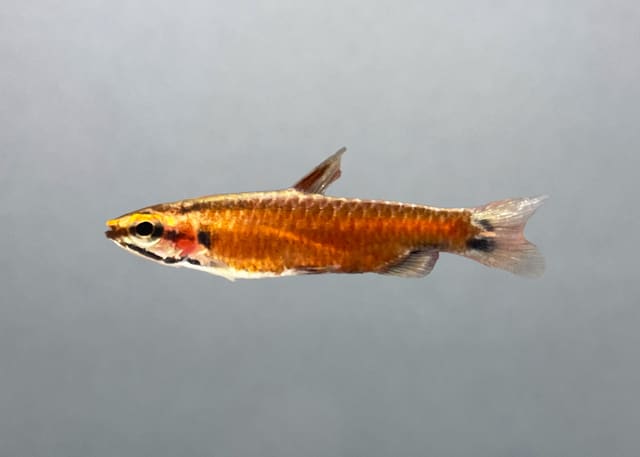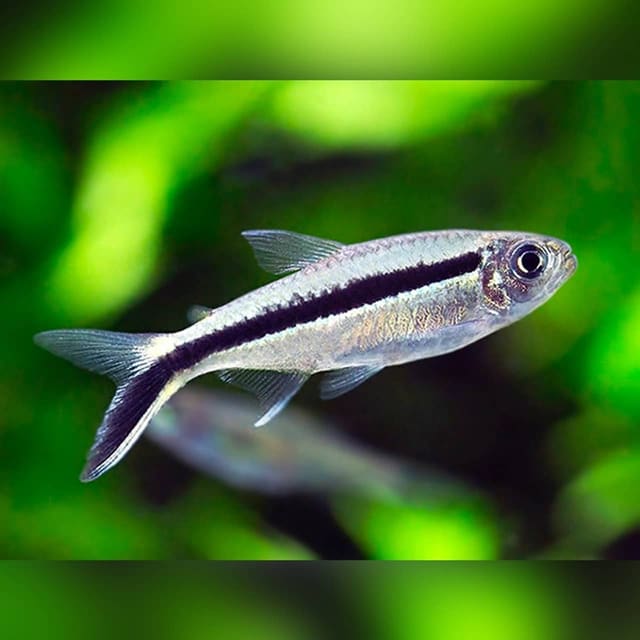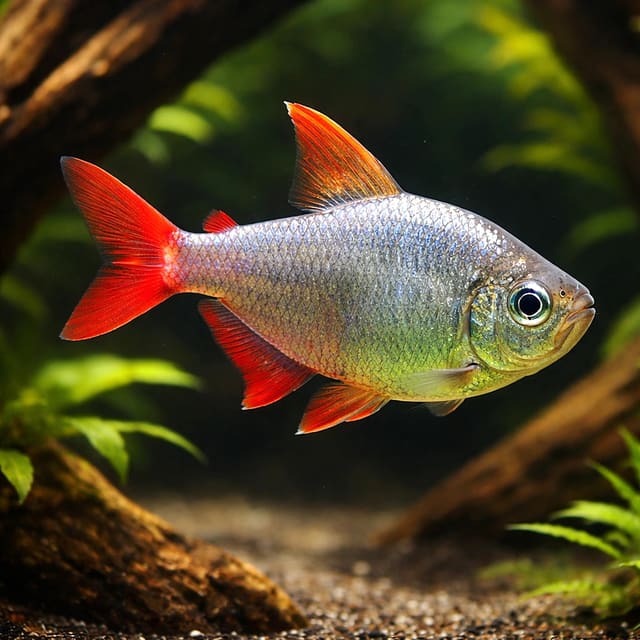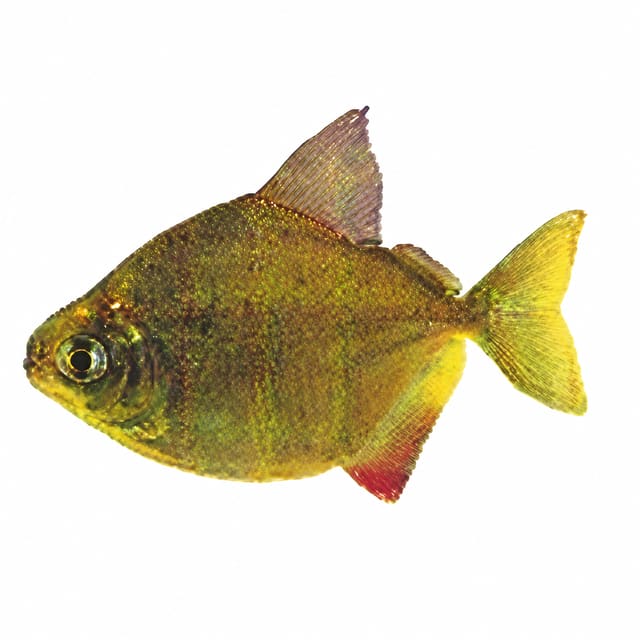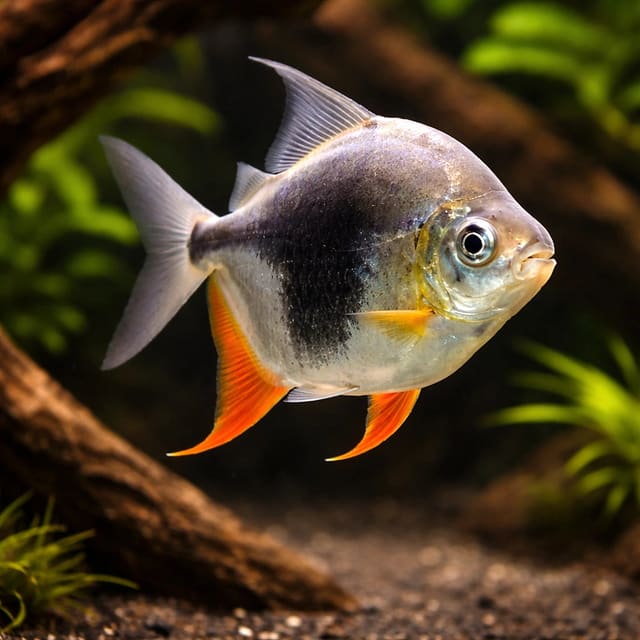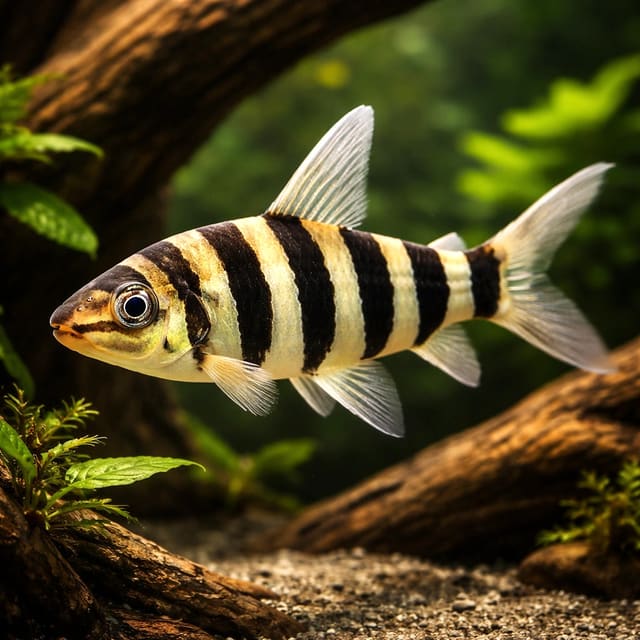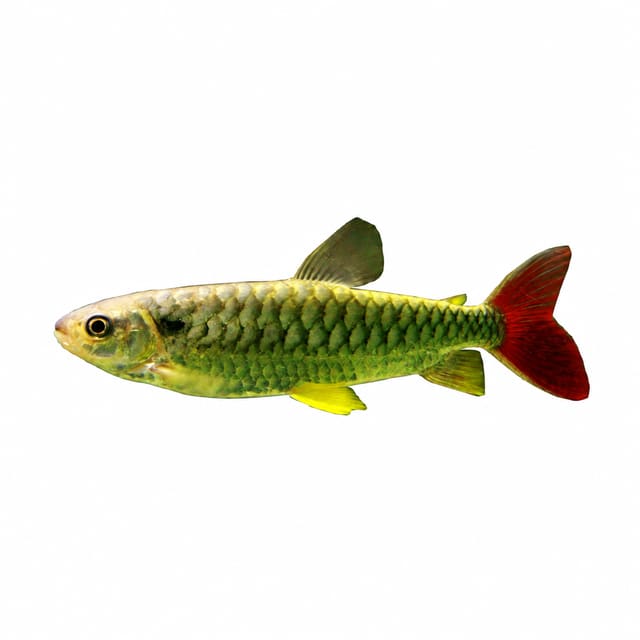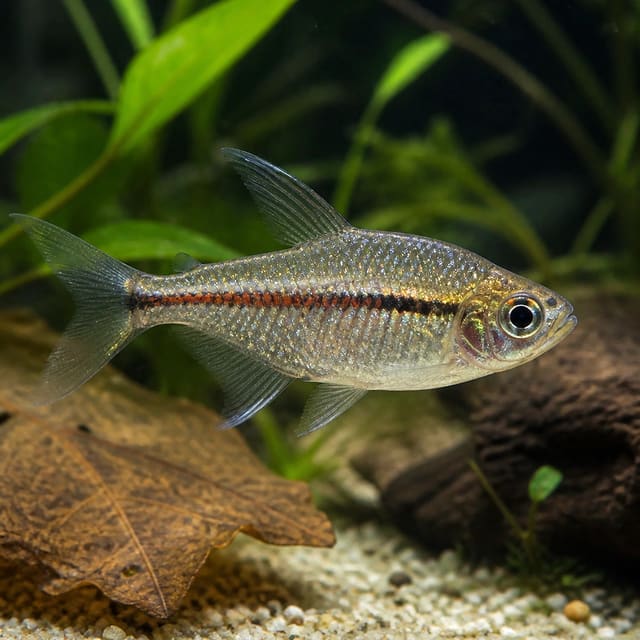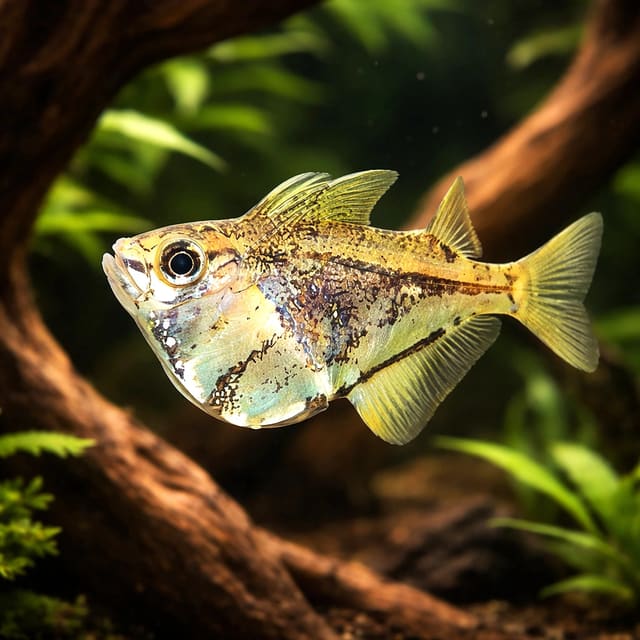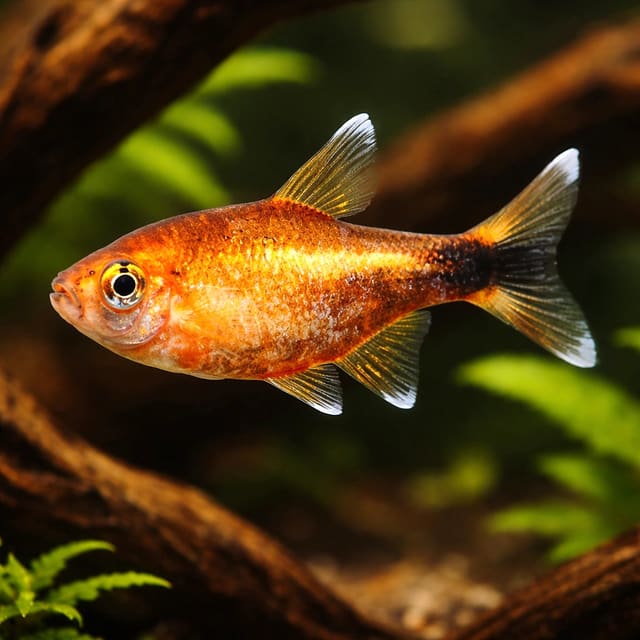
Silver Tip Tetra (Hasemania nana)
23–27°C · pH 6.5–8 · 68L
From £2.54Some sizes on sale
One live Silver Cachorro (Acestrorhynchus falcatus), a fast, fish-eating South American characin recorded to 30 cm. It needs a very large open aquarium with a tight lid, mature filtration, water at 22-28°C and pH 6.0-7.5, and tank mates too big to swallow.
Adult size is the maximum length this species reaches at full maturity (scientific sources). The livestock you receive will be younger and smaller. Product-photo provenance and any image-specific limitations are stated on the listing.
Acestrorhynchus falcatus
One live Silver Cachorro (Acestrorhynchus falcatus), a fast, fish-eating South American characin recorded to 30 cm. It needs a very large open aquarium with a tight lid, mature filtration, water at 22-28°C and pH 6.0-7.5, and tank mates too big to swallow.
Adult size is the maximum length this species reaches at full maturity (scientific sources). The livestock you receive will be younger and smaller. Product-photo provenance and any image-specific limitations are stated on the listing.
Maintain these water conditions for optimal health and vibrant colors
This listing is for one live Silver Cachorro, Acestrorhynchus falcatus, a South American predatory characin that the hobby also sells as the freshwater barracuda. The listing has a single option. There is no size grade, no sex choice and no group: you receive one fish.
Before you add it to your basket, here is the plain truth about what you would be taking on. FishBase gives this species a recorded maximum of 30 cm total length and a weight of 255 g, and describes it as a formidable predator that feeds exclusively on fish. Seriously Fish, the most detailed aquarium account we could find, sets the minimum aquarium for an adult at a base of 250 by 90 cm, which works out at roughly 2,025 litres. That is not a misprint. This is a fish for a keeper who already runs a very large, mature system, or who has one built and cycled before the fish arrives.
The fish you receive will be a dispatch-size animal, and dispatch size is not adult size. Every figure on this page that matters for planning, from tank length to tank mates, should be worked out from the adult, not from what is swimming in the bag. Because this listing carries no size grade, if the current size changes your plans (for example, how long you could keep it in a large holding system while a show tank is finished), email us at hello@tropicalfishco.co.uk before ordering and ask about the fish we would send.
So who is it for? Someone who has kept predatory fish before, who understands that this animal eats other fish, and who is prepared to work through the awkward first weeks when a newly imported cachorro may only recognise live prey as food. In return you get one of the more remarkable hunters in South American fresh water: a long, pike-shaped fish that lives in open water and moves at real speed. Seriously Fish calls these fish extremely fast swimmers, which is the single most important fact for planning their aquarium.
If you can tick every line, read on; the rest of this guide explains each point and the evidence behind it. If that is not you yet, there is no shame in waiting. A cachorro bought for the wrong aquarium tends to end badly for the fish, and we would rather you came back when the tank is ready.
The accepted scientific name is Acestrorhynchus falcatus (Bloch, 1794). Marcus Elieser Bloch described it in 1794 in the genus Salmo, and it is the type species of Acestrorhynchus, the species on which the genus name is based. Older literature also lists it under synonyms such as Salmo pulverulentus and Xiphorhamphus ferox, which is worth knowing if you go digging in old books.
It belongs to the family Acestrorhynchidae. According to Wikipedia, Acestrorhynchus currently holds 14 valid species, all from South America, with the greatest diversity in the Orinoco and Amazon basins, and it is the only genus in the subfamily Acestrorhynchinae. Recent family-level research has widened Acestrorhynchidae to take in some smaller characins known as biting tetras, so the family is broader than its big, toothy namesakes suggest.
Across South America the genus goes by cachorro, cachorrinho, pejezorro and dentudo, and in English by freshwater barracuda or pike characin. Seriously Fish lists several English names for this particular species, including red-tailed freshwater barracuda, redtail barracuda tetra, redtail cachorro and spotted cachorro. We list it as the Silver Cachorro. The catch is that freshwater barracuda is also used for other characins, so the Latin name is the only label you can rely on when comparing care advice.
Members of the genus have elongated, pike-like bodies and large conical teeth adapted for catching fish. The feature that marks out A. falcatus from its close relatives is a large black humeral spot, the mark on the shoulder just behind the gill cover. Seriously Fish describes it as shaped like an inverted tear drop, elongated vertically, and measuring at least a quarter of the body depth. If you are comparing fish in different tanks or photographs, that spot is the first thing to check.
The figures need a little care, because sources measure differently:
Those numbers sit comfortably together. Many fish will settle somewhere around 20 cm, while a well-grown specimen can approach 30 cm overall. Plan for the bigger figure. The tank, the lid, the filtration and every choice of companion should assume you will one day own a 30 cm fish-eater, because if you look after it properly, you might.
FishBase gives the range as the Amazon and Orinoco river basins together with the rivers of Guyana, Suriname and French Guiana. Seriously Fish narrows the Amazon part to the northern drainages in Peru and Brazil, adds the Río Orinoco in Venezuela and the coastal river basins of the three Guianas, and gives Suriname as the type locality, the place the original specimen came from.
FishBase lists it as a tropical, freshwater, benthopelagic fish, meaning it lives and feeds in the water column above the bottom rather than on it. That matches the Seriously Fish description of a near-exclusive open-water fish rather than one that hides among roots.
Seriously Fish says the species inhabits major river channels and tributaries and is said to prefer clear and black water over the turbid white waters that carry heavy loads of sediment. FishBase calls it ubiquitous and frequently found along the length of waters with moderate flow. Put those together and you have a fish of open, moving, relatively clear water that feeds on the smaller fish around it.
FishBase notes that reproduction begins with the onset of the rainy season. The species is assessed as Least Concern on the IUCN Red List (assessed 7 February 2020) and is of minor interest to commercial fisheries, according to both FishBase and Wikipedia. FishBase classes it as harmless to people.
Three things carry straight over. First, it needs swimming room in the open, not a crowded aquascape. Second, it comes from moving water, so gentle to moderate circulation suits it better than a still tank. Third, it comes from clear and blackwater systems and, as the water section explains, it does not tolerate dirty or unstable water well. Nothing here suggests it wants hard, alkaline water, and the published aquarium range sits on the soft side.
This is the section that decides whether a cachorro is right for you. Seriously Fish gives a minimum base of 250 by 90 cm (about 98 by 36 inches), roughly 2,025 litres. The reason is speed. These are extremely fast fish that need a long, clear run, and Seriously Fish warns that even juveniles need significant room so they do not injure themselves by hitting the glass.
That last point matters more than it first appears. The usual approach with a young predator is to start it in a smaller tank and move it up later. With a cachorro, a cramped grow-on tank is exactly where glass strikes and stress injuries happen. If you plan to grow one on before it goes into the final aquarium, that holding tank still needs real length and an uncluttered swimming lane.
| Requirement | What to plan for |
|---|---|
| Minimum footprint | 250 × 90 cm base (Seriously Fish) |
| Approximate volume | About 2,025 litres |
| Cover | Tightly fitting lid at all times; these are powerful jumpers |
| Swimming space | Open water in the middle and upper levels, kept clear |
| Substrate and decor | Sand, leaf litter and driftwood branches, mainly towards the edges |
| Filtration | Efficient external canister filtration and/or a sump |
It sounds backwards for a predator, but this fish does not want lots of cover. Seriously Fish describes it as a near-exclusive inhabitant of open water and notes that an excess of cover can actually stress it. Give it a long, unobstructed lane through the middle of the aquarium. A sandy floor with some leaf litter and a few driftwood branches works well, as long as the branches sit low or at the ends and do not cut across its swimming space. Think of the aquascape as a frame around open water rather than a forest for it to weave through.
Seriously Fish states that a tightly fitting cover should be used in all cases because acestrorhynchids tend to be powerful jumpers. On a tank of this size that means more than a hood with gaps. Check the cut-outs for heater cables and filter pipes, the joins between glass or acrylic panels, and any feeding hatch. A startled fish that clears the water will find the smallest gap you left, and a fish on the floor overnight is a fish lost.
Our sources give no specific lighting requirement, so we will not invent one. What they do stress is stress itself: the genus is sensitive to it and can injure itself in unsuitable conditions. In practice that means siting the aquarium away from slamming doors and heavy foot traffic, avoiding constant tapping and reaching in, and keeping routine work calm and predictable.
With wild fish found in waters of moderate flow, a steady current along the length of the tank is reasonable. Aim for good movement without turning the whole aquarium into a fast river; the fish should be able to hold position in open water without fighting the pumps all day.
FishBase does not publish water parameters for this species, so the aquarium figures here come from Seriously Fish:
Those ranges are broad, and you do not need to chase blackwater conditions to keep a healthy fish. What you do need is stability. Seriously Fish states that this species can be sensitive to organic pollutants and to swings in water chemistry, and that it must never be introduced to a biologically immature set-up. In other words, a brand-new aquarium that has just finished its first cycle is not ready for a cachorro. Run the system with other fish for a good while first and confirm it has handled a real bioload before this fish goes in.
Seriously Fish describes efficient external canister filtration and/or a sump as mandatory. A diet of whole fish produces a lot of waste, and scraps that go unnoticed in a 2,000-litre tank will rot. Size the filtration for the volume and the feeding, not just the volume. Biological capacity and mechanical capture both matter, and a sump makes it far easier to keep heaters and probes out of the display where a fast fish could hit them.
The published routine is a weekly change of 30–50%. On a tank of this size that is a significant volume of water, so plan the logistics before you buy: how you will treat that much tap water, how you will match its temperature, and how you will keep its chemistry close to the aquarium so the change itself does not cause the swing you are trying to avoid. Some keepers on very large systems store and condition water in a separate container for this reason.
Test ammonia, nitrite, nitrate, pH and hardness regularly, and always after a change in routine. Tap water across the country varies a great deal. If yours comes out much harder than 12 dGH, blending with reverse-osmosis water is a common way to bring it into range, but whatever you do, make the change gradually and keep it consistent week to week. A cachorro copes far better with steady water at the upper end of the hardness range than with water that lurches up and down.
Because this species is sensitive to organic pollution, uneaten food is a real risk. If a dead food item is refused, take it out within a short time rather than leaving it to break down. A long-handled net or tongs kept beside the tank make this easy.
There is no getting around this part. FishBase says the species feeds exclusively on fish, as its teeth and body shape suggest, and Seriously Fish calls it an obligate piscivore capable of consuming quite large prey for its body size. A cachorro is not an omnivore that happens to enjoy the odd fish. Fish is its food.
Seriously Fish reports that newly imported specimens often accept only live fish. Most can then be weaned onto dead alternatives once they recognise them as edible, and some even learn to accept dried foods. Please read those words carefully: often, most and some. They describe what usually happens, not a promise for every individual. Before you order, decide how you will feed the fish if it refuses everything but live prey for a while, and decide how you will move it on from there.
Seriously Fish warns that feeder fish carry disease risks and lack nutritional value unless they have been pre-conditioned. The safer route is to quarantine any live food fish yourself, keep them in good water and feed them well for a period before they are offered. Buying feeders and tipping them straight in is an easy way to bring disease into a large display that took months to mature. Use live food as a bridge, not a permanent habit.
The goal is a cachorro that takes dead fish-based foods reliably. Offer them when the fish is alert and hunting, let the current carry the food through its open swimming lane, and be patient. Remove anything not taken quickly; a refused item left on the sand is a water-quality problem in the making. Once the fish is eating dead food confidently, you can try dried foods too, but treat acceptance as a bonus rather than an expectation.
Seriously Fish advises against mammalian or avian meat, so leave out beef heart, chicken and similar meats, however convenient they look. Stick to foods built around fish.
Our sources do not give a fixed feeding schedule for this species, so judge by the fish itself. A healthy cachorro has a full but streamlined profile. A pinched, hollow belly means it needs more food or a better route to accepting food; a bloated fish and a tank full of leftovers mean you are overdoing it. Keep notes during the first months, including what was offered, what was taken and what was refused. Those notes make weaning far easier to manage.
Because it takes large prey relative to its size, any fish that fits in its mouth is potential food. That has a direct bearing on companions, covered next, and on food choice: offer items it can take comfortably, and adjust them as it grows.
The rule is simple to say and easy to get wrong: nothing that fits in its mouth, now or later. Seriously Fish describes the cachorro as relatively peaceful with anything too large to swallow and says it can be kept in a community if tank mates are chosen with care. That care has two parts: size and temperament.
A young cachorro may share a tank with a fish of similar length today, but this species can reach around 30 cm and takes large prey for its size. Companions have to stay out of reach as the predator grows. Small tetras, rasboras, livebearers, small barbs, pencilfish, small catfish and dwarf cichlids are all food. A shoal of something like our Silver Tip Tetras would simply be a series of meals, and this is exactly the mixed community that a cachorro must never go into.
Seriously Fish advises avoiding aggressive or highly competitive species and suggests placid fishes instead, such as Geophagus eartheaters and medium-sized doradid (thorny) catfish or loricariid catfish. Those suggestions share a theme: robust, calm fish that are too large to swallow, that mostly work the bottom, and that will not harass a nervous open-water predator or race it to every meal.
If you are also weighing up other large South American fish, such as our Silver Arowana, read that listing for its own aquarium needs. Our sources for the cachorro do not discuss that pairing, so we make no recommendation either way. If you are thinking of combining large predators, research each one on its own terms and make sure neither can swallow, outcompete or bully the other.
Seriously Fish notes that juveniles have a marked schooling instinct, while older individuals become more solitary. It also states plainly that acestrorhynchids are cannibalistic given the opportunity. If you want a group, the advice is four or more fish of comparable size, which multiplies the space you need. A single fish is the straightforward option, and this listing sells one fish.
It is worth noting what FishBase says about people: the species is classed as harmless. Even so, a fish with large conical teeth deserves respect. Use a net rather than your hands when you have to move it.
The risks our sources highlight come down to three things: not enough room, unstable water and unsafe food. All three are within your control before the fish arrives.
Seriously Fish warns that the genus is sensitive to stress and may injure itself in an inadequate set-up, and that even juveniles can damage themselves against the glass without enough space. Add the jumping risk, and you can see why the tank size and lid in this guide are requirements, not suggestions. Look out for scrapes or marks that appear after a fright; repeated injuries are a sign the aquarium is too small, too busy or too exposed to disturbance.
Because the species is sensitive to organic pollutants and swings in water chemistry, poor water often shows up before anything else. Warning signs worth acting on include rapid breathing, the fish hanging near the surface, a sudden loss of appetite in a fish that was feeding well, and cloudy or reddened patches on the body or fins. If you see any of these, test the water first and look for leftovers or a filter that has fallen behind.
Live feeder fish are a known route for disease into a predator tank, which is why Seriously Fish warns about them. If you must use live food during weaning, quarantine and condition it, and never use fish that look unwell.
Quarantine is good practice for any new fish, but it creates a tension with this species. A cramped quarantine tank invites glass strikes. If you quarantine a cachorro, the tank still needs length, a secure lid, mature filtration and a calm position. For many keepers the practical answer is to run the main aquarium with only robust, established companions and keep observation careful for the first weeks.
A cachorro that is doing well holds steady in open water, shows interest when food is offered, has clear fins and an even body shape, and does not bolt into the glass every time someone walks past. Some nervousness in the first days is to be expected; in a suitable aquarium it should settle as the fish learns its surroundings.
A cachorro bought at dispatch size changes its own requirements as it grows. Every few months, look again at three things: whether its companions are still clearly too large to swallow, whether the filtration and water changes are keeping up with a bigger fish eating bigger meals, and whether the food you offer is the right size for its mouth. Our sources give no lifespan or growth-rate figures for this species in aquaria, so we will not guess at either. What is certain is that the conditions you give it from the first week, rather than the size it arrives at, decide the fish you end up with.
This listing does not let you choose a sex, and our sources give no reliable way of sexing young fish. Seriously Fish notes that sexually mature females tend to grow a little larger and become deeper-bodied than males, which is only useful once fish are adult.
In the wild, FishBase records that reproduction begins with the onset of the rainy season. In aquaria, Seriously Fish reports that courtship and even spawning have been observed but no fry have been raised. The description of spawning is striking: it happens in midwater, with the female holding still while males swim around her in a figure-of-eight pattern. Eggs are scattered and there is no parental care.
That is as far as the published record goes. Breeding a 30 cm cannibalistic predator that needs a group of comparable-sized fish in a tank already over 2,000 litres is a project for public aquaria or very dedicated specialists, not something to plan around a single fish. Buy a cachorro for the pleasure of keeping it well, not with breeding in mind.
Please read our delivery and live-arrival information before you order. Your fish travels in an oxygen-filled bag inside insulated packaging, with heat packs when the weather calls for them, via a tracked courier licensed to carry live animals. We email you the confirmed delivery date and tracking, and someone must be at the address to receive the parcel. Live animals cannot be left on a doorstep.
The tank must be fully set up before the parcel arrives: filter running and mature, water tested, temperature matched to the 22–28°C range, and the lid fitted with every gap closed. For this species, mature really does mean mature, as Seriously Fish warns against ever adding it to a biologically immature set-up. Have a net large enough to move the fish without bending it.
Start a continuous video before you open the box, while the parcel is still sealed, and keep recording as you open it, showing the fish in its still-sealed bag. If the fish arrives dead, dying or clearly compromised, email hello@tropicalfishco.co.uk on the day of delivery with your order number and that video. Photos on their own do not meet the policy. The resolution is a replacement with your next order or a refund for the affected fish, subject to our guarantee terms.
Watch breathing, appetite and behaviour over the first week. A new cachorro may be nervous and may refuse food at first; that is not unusual after a journey. When you start offering food, remember that newly imported fish often accept only live prey, and have your quarantined, conditioned feeders or your weaning plan ready. Keep the area around the tank calm, avoid rearranging decor, and remove any refused food promptly. If you are worried about anything, email us and describe what you are seeing.
These are the sources we used for this guide. Each is worth reading in full if you are serious about keeping this fish:
Photo adapted (new background, slight change of angle) from a photo by Vassil (CC0, public domain), via Wikimedia Commons.
No reviews for this item yet. Bought one? Honest reviews only, good or bad.
What customers say about ordering from us
Easy website plenty of info on fish your buying great to pick a time slot
TRACEY DURRANT · 7 Oct 2026
Got some lovely fish thank you
Kevin Mackie · 7 Oct 2026
Reviews of our shop, collected by Judge.me, an independent third-party review collector. Newest first.