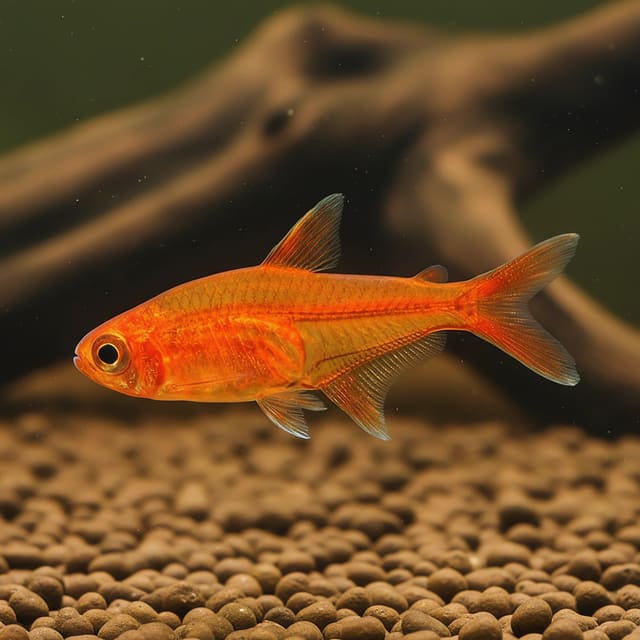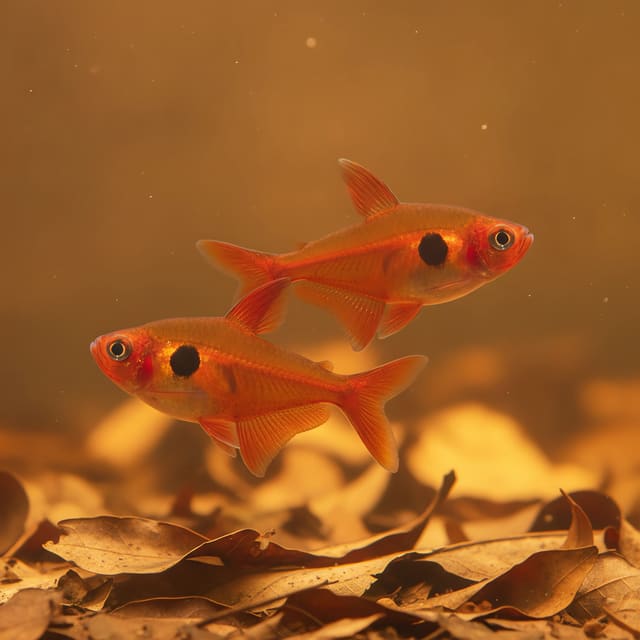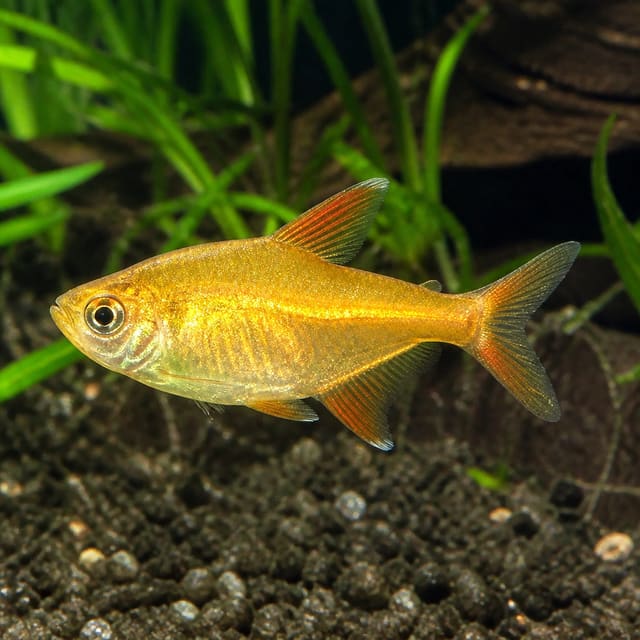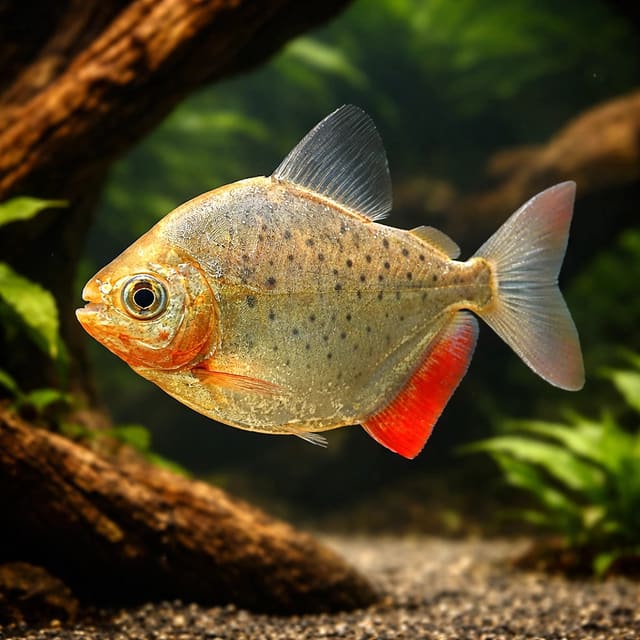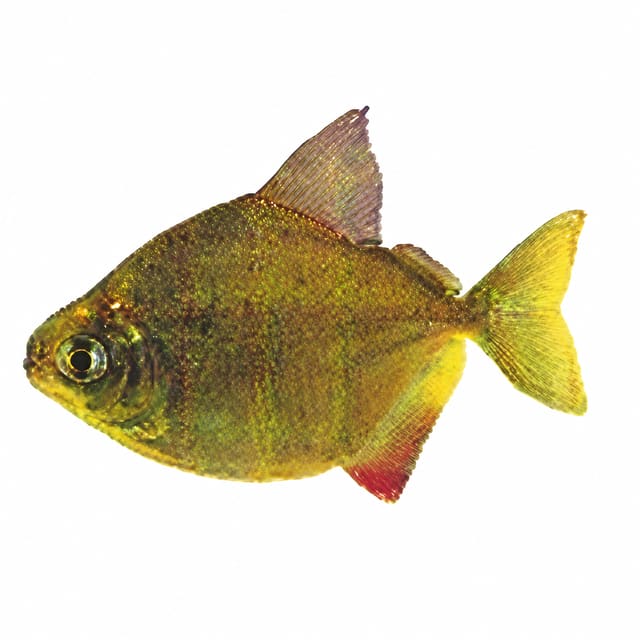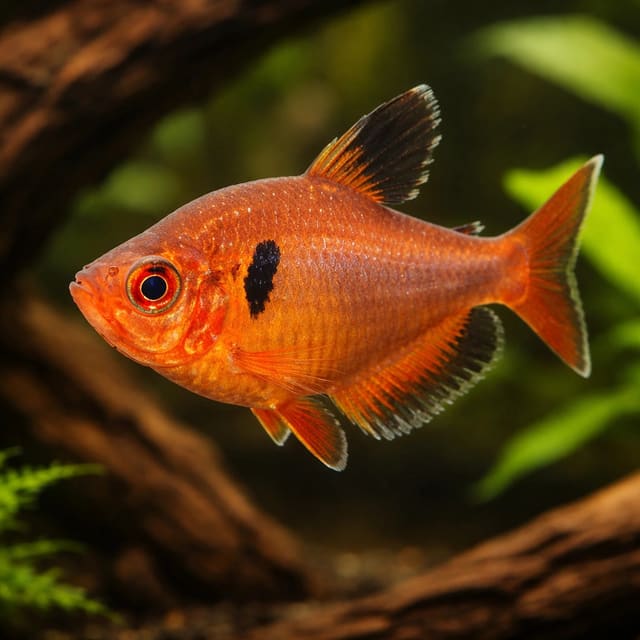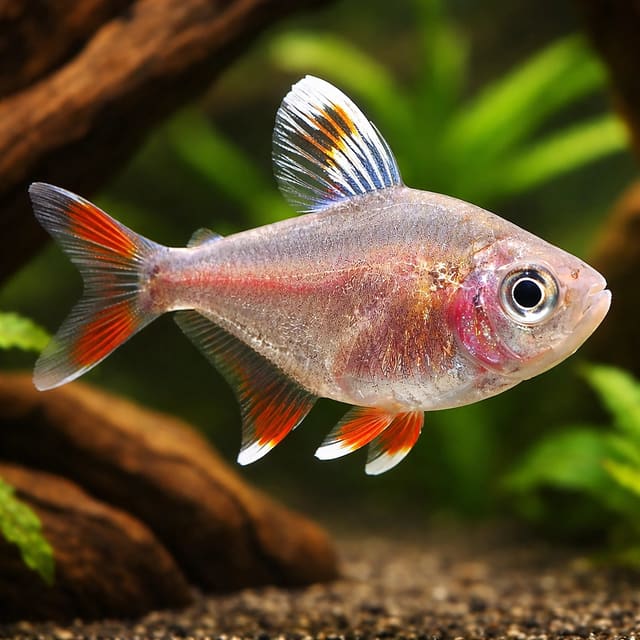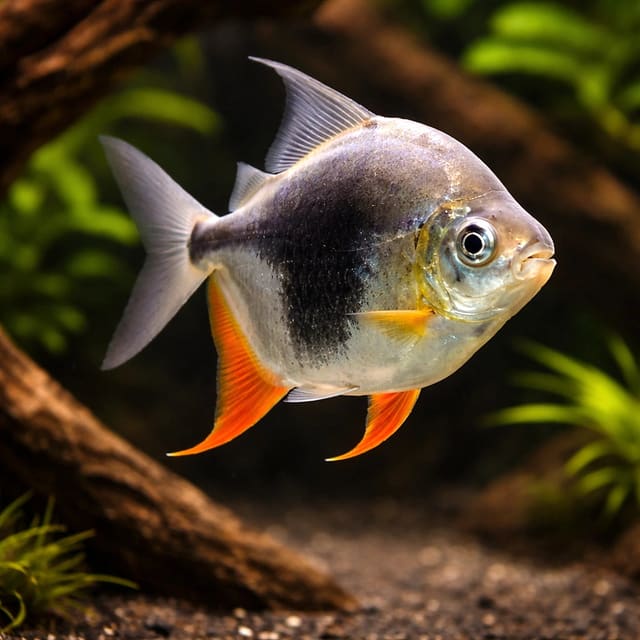
Blackwing hatchetfish (Carnegiella marthae)
23–27°C · pH 5.5–6.5 · 54L
£5.99

A peaceful blackwater hatchetfish from the Amazon and Orinoco, golden silver with dark brown marbling, growing to 3.5 cm standard length. Keep ten or more at the surface of a planted tank with a tight lid, 24–28°C, pH 5.0–7.0 and soft water. One unsexed fish per unit, sent at 2–3 cm.
Adult size is the maximum length this species reaches at full maturity (scientific sources). The livestock you receive will be younger and smaller. Product-photo provenance and any image-specific limitations are stated on the listing.
Carnegiella strigata
Shoaling fish: kept in a group they feel safer, stay calmer and show their best colour.
A peaceful blackwater hatchetfish from the Amazon and Orinoco, golden silver with dark brown marbling, growing to 3.5 cm standard length. Keep ten or more at the surface of a planted tank with a tight lid, 24–28°C, pH 5.0–7.0 and soft water. One unsexed fish per unit, sent at 2–3 cm.
Adult size is the maximum length this species reaches at full maturity (scientific sources). The livestock you receive will be younger and smaller. Product-photo provenance and any image-specific limitations are stated on the listing.
Maintain these water conditions for optimal health and vibrant colors
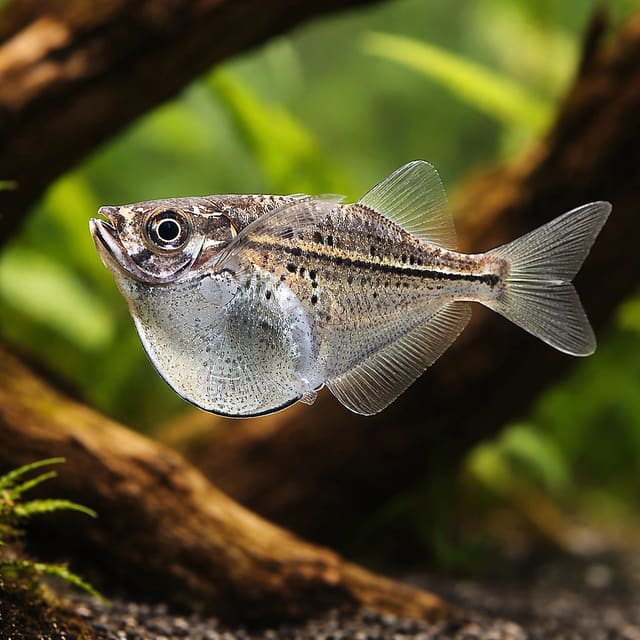
Put a group of marbled hatchetfish into a planted aquarium and the first thing you notice is where they sit: right up under the water surface, in a loose band, almost still until food lands. The second thing is the shape. From the side the fish looks like the head of a small axe, with a straight, nearly level back and a deep, rounded chest curving away beneath it. That keel is a hugely enlarged breastbone region, the trademark of the freshwater hatchetfish family, Gasteropelecidae, and it anchors a pair of long pectoral fins. Wikipedia's account of the family notes that the muscles driving those fins can make up as much as a quarter of a hatchetfish's total body weight, which tells you how much of this little fish is built for sudden movement.
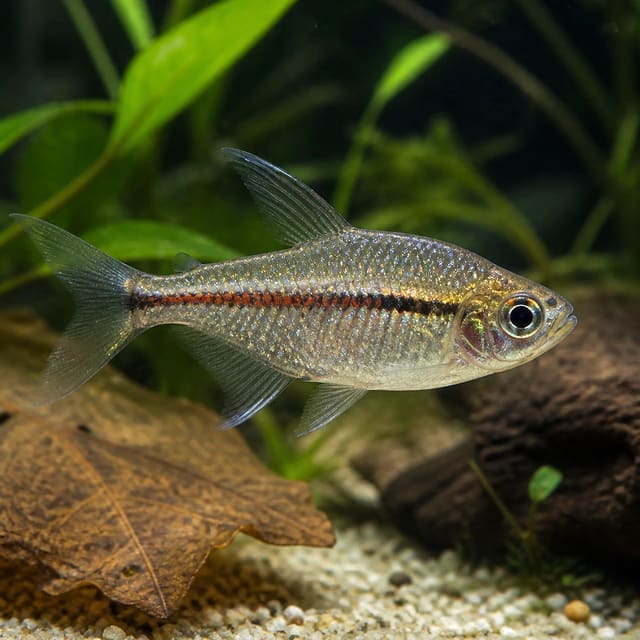
The colouring is what separates Carnegiella strigata from its relatives. The ground colour is a golden silver, with a pale line running from head to tail. Laid over that is a dark brown marbling that Seriously Fish describes as a series of dark and light stripes running diagonally across the body. The pattern is not identical from fish to fish. Wikipedia, drawing on Géry (1977), describes two broad forms: a "V-shaped" marbling in fish from the Guianas and the northern Amazon, and a "Y-shaped" one across most of the Amazon basin, with intermediate fish in the Orinoco and Rio Negro. Seriously Fish says most fish in the aquarium hobby come from the Rio Negro basin in Brazil, so a little variation within one group is normal.
Adults are small. FishBase, Seriously Fish and Wikipedia agree on a maximum of 3.5 cm standard length, which is measured from the tip of the snout to the base of the tail and leaves out the tail fin. Small as that is, it is large for the genus: Carnegiella holds four species, and Seriously Fish picks out the larger adult size and the dark marbled pattern as the easiest ways to tell this one from the other three. If you are weighing it against the blackwing hatchetfish (Carnegiella marthae), a close relative in the same genus, the all-over marbling is the feature to look for.
The wider family is small. Wikipedia's account of Gasteropelecidae lists three genera: Carnegiella with four species, Gasteropelecus with three and Thoracocharax with two. Most hatchetfish measure 2.5–6.4 cm, the giant hatchetfish reaches about 8.9 cm, and the pygmy and dwarf hatchetfish stay at around 2.5 cm or a little under. All of them come from Panama and South America, and all share the deep keel and large pectoral fins that define the family. The marbled hatchetfish sits towards the small end of that range, which is part of the reason it suits a modest planted aquarium.
The name has a longer history than most aquarium fish. Albert Günther described the species in 1864 as Gasteropelecus strigatus, and Carl Eigenmann moved it into Carnegiella in 1909. Along the way it has collected several other names that are now treated as the same fish, including Gastropelecus fasciatus (Garman, 1890), Carnegiella strigata vesca and C. vesca (Fraser-Brunner, 1950), and C. s. marowini and C. s. surinamensis (Hoedeman, 1952). FishBase gives Carnegiella strigata (Günther, 1864) as the accepted name. Seriously Fish adds a caveat worth knowing: molecular studies suggest there may be more than one species hiding under this name, so the classification could be revised one day.
The main identification points, side by side:
| Feature | What to look for |
|---|---|
| Body shape | Straight back, deep rounded keel under the chest, long pectoral fins |
| Colour | Golden silver base with a pale line from head to tail |
| Pattern | Dark brown marbling in diagonal bands; V- or Y-shaped depending on origin |
| Adult size | 3.5 cm standard length |
| Family | Gasteropelecidae, the freshwater hatchetfishes |
| Where it swims | At or just below the surface, in groups |
Each unit on this listing is one live marbled hatchetfish, sent at a dispatch size of 2–3 cm. To build a group, set the quantity to the number of fish you want. With an adult maximum of 3.5 cm standard length, fish at this grade are not far off full size, so what arrives already looks like a hatchetfish shoal rather than a bag of youngsters.
The fish are not sexed. Seriously Fish calls the differences between males and females subtle, and the mix in any order comes down to chance. There is more on those small differences in the breeding section further down.
How many to order is the most important decision on this page. FishBase recommends keeping marbled hatchetfish in groups of five or more. Seriously Fish goes further and advises buying as many as you can, ideally ten or more, because this is a highly gregarious fish and bigger groups behave more naturally and squabble less among themselves. We would go with the larger number. A timid, sociable fish like this one is simply happier with plenty of its own kind around it, and ten hatchetfish spread across the top of an 80 cm aquarium make a far better display than a handful.
It is also worth knowing where hatchetfish in the hobby come from. Seriously Fish states that Carnegiella strigata is not bred on a commercial basis and that the fish offered in the trade are collected in the wild, and Wikipedia notes that most are caught in Brazil. A wild-collected fish has had a long journey before it reaches a home aquarium. That is the main reason we keep stressing a mature, ready tank, a well-fitted lid and a quiet first week in the sections below.
This is a widespread South American fish. FishBase records it through the lower, middle and upper Amazon basin, in areas south of the Amazon, and in the Caquetá River in Colombia. Seriously Fish lists Amazonian Bolivia, Brazil, Peru and Colombia, the Río Orinoco system in Venezuela and coastal drainages in Guyana and Suriname, and Wikipedia's country list adds Ecuador and French Guiana. FishBase reports that the IUCN Red List assessed the species as Least Concern on 20 October 2020.
Across all that ground it keeps to one kind of water. Seriously Fish calls it an exclusive inhabitant of blackwater, found in the forest streams and seasonally flooded forest known in Brazil as igarapé and igapó. The water there is stained brown by humic substances, it is typically acidic, and it carries almost no dissolved hardness, so its conductivity is low. The banks are thick with vegetation that often hangs right over the water, and the stream beds are covered in fallen branches, tree roots and leaf litter.
If you have never kept blackwater fish, the term sounds more exotic than it is. The "black" is really the colour of strong tea, from humic substances released by decaying plant matter, and "low conductivity" simply means that very little mineral content is dissolved in the water. Hard tap water is close to the opposite: plenty of dissolved minerals, and usually a pH above neutral. An aquarium does not have to copy a forest stream exactly, but the nearer you are to soft, acidic water, the more at home a wild-collected hatchetfish will be.
Within that habitat FishBase describes the species as pelagic, meaning it lives in the water column rather than on the bottom, and Wikipedia is more specific: it lives in groups near the surface. Its food matches its position. FishBase lists crustaceans and insects, and Seriously Fish describes a diet of terrestrial and aquatic invertebrates and other zooplankton. Land insects on the menu make sense for a fish living beneath overhanging plants, where small creatures regularly end up on the water.
The year is shaped by rain. Wikipedia notes that in the rainy season these fish move upstream into tributaries and into the flooded forest to feed and spawn, and Seriously Fish describes the same seasonal move into the forest.
Three things from that wild home carry straight across to the aquarium: soft, acidic water; a shaded surface with cover overhead; and food that arrives at the top of the water rather than on the floor. Provide those and you have covered most of what this fish needs.
Most aquarium advice starts with volume. For a hatchetfish, surface area is the more useful measure, because Seriously Fish notes that the species spends almost all of its time at or towards the surface. A long tank with a broad footprint gives a shoal far more usable room than a tall tank holding the same number of litres.
The sources give similar minimums. Seriously Fish suggests a base of at least 75 × 30 cm, which works out at roughly 68 litres, and FishBase's aquarium note gives a minimum aquarium size of 80 cm. For a group of ten we would treat 80 cm in length as the starting point and go longer if you have the space, particularly if the hatchetfish are sharing with other species.
Seriously Fish describes a tight-fitting lid as essential because marbled hatchetfish may jump when startled, and FishBase's aquarium note carries the same warning. In practice the gaps are where fish get out: the cut-outs for filter pipes and heater cables, a feeding flap left up, or a cover not pushed fully home after maintenance. Close those openings with mesh or offcuts before the fish go in, and check the lid every time you put it back.
Seriously Fish recommends a heavily planted set-up, preferably over a dark substrate, with patches of floating vegetation. The floating plants matter most for this species. They shade the surface, they give the fish cover overhead much as riverside growth does in the wild, and they break the open water into areas a shoal can settle in. Leave clear lanes between the patches so the fish can move freely and you can see food land.
Driftwood and a scattering of dried leaves are worth adding as well. Seriously Fish suggests they encourage the growth of microbial life, and that the tannins released by decaying leaves are thought to be beneficial for fish from this kind of water. They also tint the water towards the tea colour of a blackwater stream. Leaves break down over a few weeks, so top them up as they go.
Water movement should be gentle to moderate, according to Seriously Fish. Avoid a spray bar or outlet that churns the top of the tank, because that is the very zone these fish live in; angle the return along the glass or set it a little below the surface. Floating plants take the edge off bright lighting without the need for anything more elaborate.
| Element | Suggestion |
|---|---|
| Footprint | At least 75 × 30 cm (Seriously Fish); 80 cm minimum length (FishBase) |
| Volume | About 68 litres or more |
| Cover | Tight-fitting lid with every gap closed |
| Substrate | Dark |
| Plants | Dense planting with patches of floating plants and open lanes |
| Décor | Driftwood and dried leaf litter |
| Flow | Gentle to moderate, with a calm surface |
The two main references give different water figures, and it helps to see them together before deciding what to aim for.
| Parameter | FishBase | Seriously Fish | What we suggest |
|---|---|---|---|
| Temperature | 24–28°C | 20–28°C | 24–28°C |
| pH | 5.0–8.0 | 4.0–7.0 | 5.0–7.0 |
| Hardness | 5–19 dH | 1–10 dGH | 1–10 dGH |
FishBase's ranges are wider; Seriously Fish's sit closer to the soft, acidic water of the blackwater habitat. Our suggested range takes the overlap between the two for temperature and pH, and uses the Seriously Fish hardness figure because it matches what the species lives in naturally. We would not keep this fish at the 20°C bottom end of the Seriously Fish range for long. That is cool for a tropical blackwater species, and 24–28°C gives you room for the small swings every heated aquarium has.
In many parts of the UK the tap water is harder and more alkaline than this. The dependable way to soften it is to blend reverse-osmosis water with tap water until hardness and pH come down into the range you want, then make up every water change to the same recipe so conditions do not jump about. Driftwood and leaf litter will tint the water, but do not rely on them to fix hard water on their own.
Stability matters more than hitting an exact number. A pH that sits steadily at 6.5 is far kinder than one bouncing between 5.5 and 7.5 because chemicals are being added after every test. If you do adjust, adjust slowly and in the replacement water rather than in the tank.
A word on testing. Measure general hardness (GH) as well as pH, because pH on its own tells you nothing about how soft the water is. FishBase quotes hardness in dH and Seriously Fish in dGH; both mean degrees of German hardness, so the figures can be compared directly. If you blend reverse-osmosis and tap water, a TDS meter is a quick way to confirm that each new batch matches the last.
The basics apply whatever your chemistry:
Wild-collected blackwater fish should not go into a newly set-up aquarium. Give the tank time to mature and the plants time to grow in first.
Everything about this fish's diet points upwards. In the wild FishBase records crustaceans and insects, and gives a trophic level of 3.3, a figure that marks it out as an eater of small animals rather than of plants or algae. Seriously Fish describes it as primarily a surface feeder, taking terrestrial and aquatic invertebrates and other zooplankton.
In the aquarium, Seriously Fish says marbled hatchetfish will accept dried foods but should also get regular meals of small live and frozen foods: Artemia nauplii (newly hatched brine shrimp), Daphnia, Moina and grindal worm. It also lists small insects such as young crickets and Drosophila fruit flies. Fruit flies dropped onto the water are about as close to the wild diet as indoor feeding gets, and a culture kept going at home gives you a steady supply.
Some practical points from the shop floor:
A simple weekly pattern that covers the variety Seriously Fish recommends might look like this:
| Meal | What to offer |
|---|---|
| Most mornings | A small pinch of flake, crumbled so it stays on the surface |
| Three or four evenings a week | Frozen or live Daphnia, Moina or brine shrimp nauplii |
| Once or twice a week | Grindal worm, or fruit flies dropped onto the surface |
| Any day | Keep portions small enough that nothing drifts down uneaten |
A well-fed marbled hatchetfish has a full, rounded line behind the keel. Check the group from the side after a meal every few days, especially in the first month; a fish that looks pinched is telling you the feeding routine needs changing.
Seriously Fish sums the species up well: very peaceful, but not an ideal community fish, because it is small and rather timid. It will not bother other fish. The risk runs the other way, since anything large, boisterous or quick to the food can leave a shoal of hatchetfish stressed and underfed.
Group size matters here more than with many small fish. FishBase says five or more; Seriously Fish says as many as possible, ideally ten or more, and notes that larger groups behave more naturally. Keep the group generous and the other occupants of the tank modest.
Seriously Fish suggests similarly sized, peaceful characins, small catfishes, and dwarf cichlids, for which hatchetfish make a useful dither fish. A dither fish is a calm, visible species whose presence reassures shyer fish that it is safe to come out; in this case the hatchetfish hold the surface while the cichlids use the lower levels of the tank.
Among the fish on our site, the Ember Tetra (Hyphessobrycon amandae) and the Green Neon Tetra (Paracheirodon simulans) fit the description of small, peaceful characins. As with any mix, read each species' own water requirements before combining them, and keep both groups at a good size so neither is outnumbered.
The easiest way to plan a hatchetfish community is by level. The hatchetfish own the top few centimetres. Small, peaceful characins can fill the open water in the middle, small catfishes can work the floor, and in a larger set-up a pair of dwarf cichlids can take the lower levels with the hatchetfish acting as their dither fish. All of those groups come from the companions Seriously Fish suggests, and stocking by level means no single zone of the tank becomes crowded. Whatever you choose, it has to suit soft, acidic water, and it should be added gradually so the filter keeps pace.
Hatchetfish have a reputation as freshwater "flying fish", and the anatomy explains why: a deep chest and pectoral muscles that can make up as much as a quarter of body weight. Wikipedia's account of the family says quick beats of the pectoral fins let hatchetfish lift themselves half out of the water and glide along the surface, and that some can leave the water briefly.
Seriously Fish takes a more sceptical line. It cites research by Wiest (1995) showing that the pectoral fins are used to leave the water but not while the fish is in the air, so what looks like flight is really a powerful jump, which Seriously Fish describes as a modified threat response. It also notes that field evidence suggests hatchetfish rarely jump, even in aquaria.
For a keeper the debate changes nothing. A startled hatchetfish can clear the water, so the lid stays on, and you keep sudden shocks to a minimum: no tapping on the glass, no bright lights snapping on in a dark room, and a slow, calm hand during maintenance.
The weeks after arrival are when a new group needs the closest eye. Wild-collected fish are adjusting to new water, new food and new surroundings all at once, and small problems are much easier to put right if you spot them early.
A healthy marbled hatchetfish holds station near the surface with its fins open, keeps loosely with the group and rises to food quickly. Changes from that picture are your early warning:
If you have the space, a small quarantine tank for new arrivals is good practice, set up to the same water values as the main display. For this species it still needs a tight lid and some floating cover.
A short, regular routine catches most problems before they grow:
| How often | What to do |
|---|---|
| Every feed | Count the fish and check the lid is closed. If one is missing, look behind and around the tank straight away. |
| Weekly | Partial water change with matched, dechlorinated water; test pH, GH and nitrate. |
| Monthly | Rinse filter media in old tank water, replace broken-down leaves, and thin the floating plants so open surface remains. |
After that, most trouble is prevented by steadiness: a stable temperature, a pH that does not swing, clean water and a feeding routine the fish can rely on.
Breeding is where the sources part company, so it is worth setting out what each one says.
FishBase and Wikipedia describe the eggs: they fall to the bottom or into vegetation, and at 25°C they hatch after 36 hours. Wikipedia adds that in the wild the fish move into tributaries and flooded forest during the rainy season to feed and spawn. Seriously Fish, on the other hand, describes aquarium breeding as unrecorded and says the species is not bred commercially, which is why fish in the hobby are wild-collected.
Sexing is subtle. FishBase notes that females have larger abdomens than males, and Seriously Fish says some fish grow larger and rounder-bodied than others, presumably the adult females. You may be able to pick these out in a mature group seen side-on, but it is not something that can be done reliably at dispatch size, which is one reason this listing is sold unsexed.
So buy marbled hatchetfish for the shoal at the top of your aquarium rather than as a breeding project. If a group of yours does spawn, keep notes and photographs. With Seriously Fish describing aquarium breeding as unrecorded, a well-documented spawning would be genuinely useful to other keepers.
Have the aquarium ready before the parcel arrives: filter running, water tested, temperature matched, lid fitted and every gap closed. Please read our delivery and live-arrival information before ordering. Someone must be at the delivery address to receive the parcel, because live animals cannot be left unattended. We email the confirmed delivery date and tracking details.
Your fish travel in oxygen-filled bags inside insulated packaging, with heat packs when conditions call for them, carried by a tracked courier licensed to carry live animals.
For the first week keep the lights low and watch breathing, appetite and behaviour. Give the fish a few hours before offering a small first feed, and keep the room quiet around the tank while they find their place at the surface.
No reviews for this item yet. Bought one? Honest reviews only, good or bad.
What customers say about ordering from us
I have a small group of long finned mountain minnows. So was delighted to be able to order ten of this variety to increase the genetics in my tank . The ones I recieved are healthy but it’s to early to give a verdict on wether they are of a long finned type since they are small currently.
Gordon Walker · 23 Sept 2026
100% success travel and "installation". Pleased with quality of purchase. The Siamese fighter a bit "shy" so have not yet seen him at his best yet but looking good. Happy customer. GG
George E Garratt · 21 Sept 2026
Reviews of our shop, collected by Judge.me, an independent third-party review collector. Newest first.