−14%
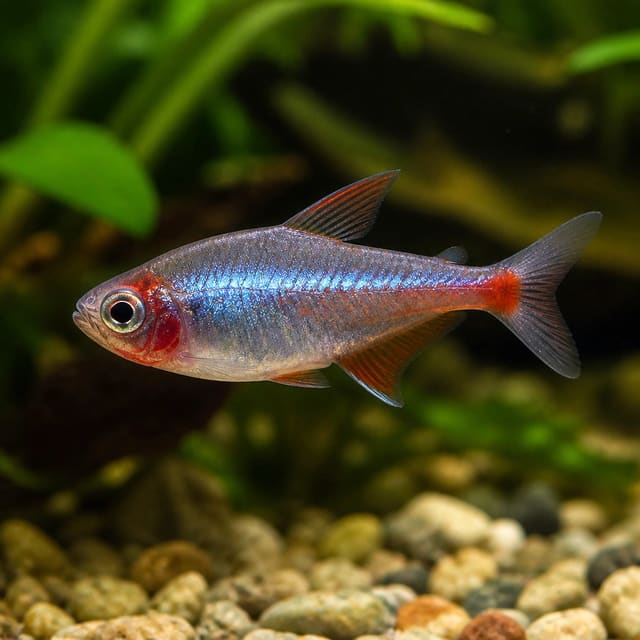
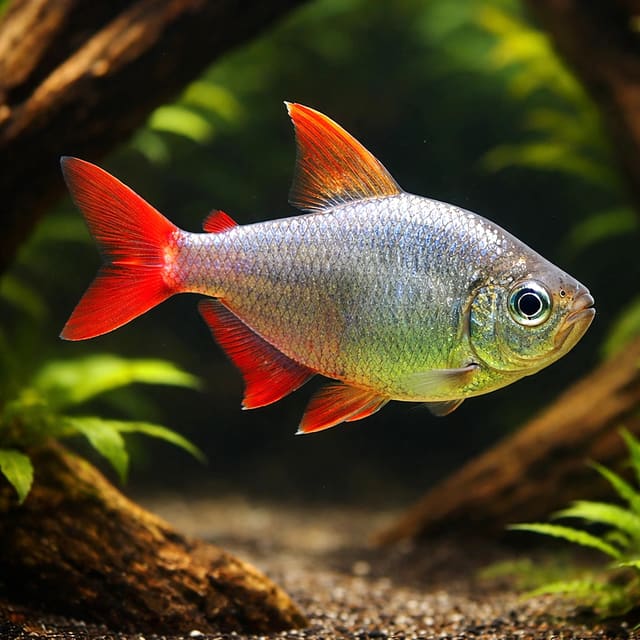
Red-Blue Colombian Tetra (Hyphessobrycon columbianus)
20–28°C · pH 5–7.5 · 81L
£2.57£2.99

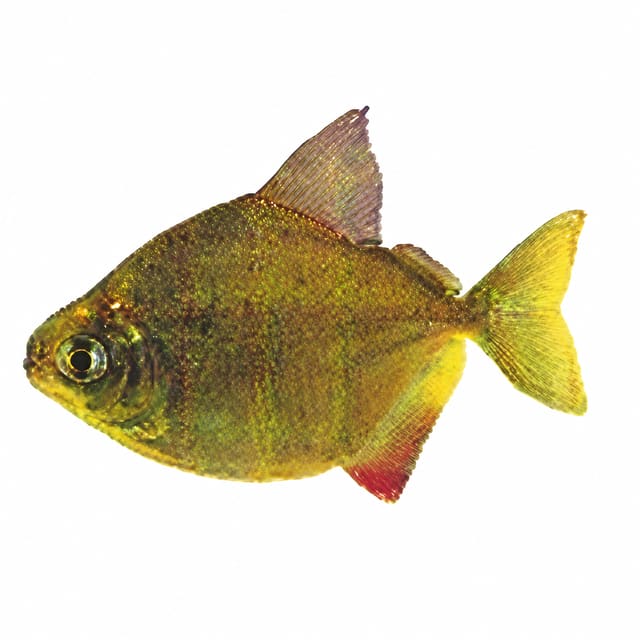
One live, unsexed Spotted Silver Dollar (Metynnis maculatus) at approximately 4-5 cm. Keep at least six in a mature 360L+ aquarium with at least 150 cm length; all four gallery images are representative illustrations.
Metynnis maculatus
Shoaling fish: kept in a group they feel safer, stay calmer and show their best colour.
One live, unsexed Spotted Silver Dollar (Metynnis maculatus) at approximately 4-5 cm. Keep at least six in a mature 360L+ aquarium with at least 150 cm length; all four gallery images are representative illustrations.
Maintain these water conditions for optimal health and vibrant colors
Spotted Silver Dollar (Metynnis maculatus) is a deep-bodied South American shoaling fish for a large, mature freshwater aquarium. Its metallic flanks, scattered dark markings and fast, coordinated movement make a group visually impressive, but the small fish offered today must be planned for as adults that can reach about 18 cm. This is not a small tetra for a starter tank.
This product is one live, unsexed fish at approximately 4-5 cm. Natural variation means an individual may sit slightly outside that band. Set the basket quantity for the number required and plan a group of at least six.
One selection adds one live, unsexed Metynnis maculatus to the basket. The approximate supplied length is 4-5 cm. There is no pair, trio or sexed option on the current product. To build the minimum group of six, choose a basket quantity of six, subject to live availability and the capacity of the intended aquarium.
| Listing detail | Current meaning | What it does not mean |
|---|---|---|
| Quantity 1 | One live fish | Not a pair or group |
| Approximate size | About 4-5 cm at supply | Not the adult size |
| Sex | Unsexed | No male or female guarantee |
| Gallery | Four representative illustrations | Not exact-stock photographs |
| Availability | Controlled by live Shopify inventory | Not guaranteed until checkout completes |
At 4-5 cm, body depth, spot contrast, fin colour and sheen are still developing. Lighting, background, stress, feeding and age can change how reflective the flanks appear. The fish that arrives may be paler during transport and darken after settling. Natural variation is expected, so the listing does not promise a particular number of spots, exact red intensity, body depth or sex.
The accepted identity used for this product is Metynnis maculatus, commonly called the Spotted Silver Dollar or spotted metynnis. The NCBI Taxonomy record places it in order Characiformes and family Serrasalmidae. That family includes silver dollars, pacus and piranhas. It is therefore a characiform fish, rather than a small community tetra.
Several spotted members of Metynnis appear in the aquarium trade, and retailers sometimes apply "spotted silver dollar" to M. maculatus, M. lippincottianus or even other similar fish. This listing follows the current supplier identity of M. maculatus. It does not claim a precise wild collection locality or use appearance alone to create a more specific identity than the source supports.
The FishBase species account reports an adult maximum of 18 cm total length, occurrence in the Amazon and Paraguay river basins, water records of 20-28 C and pH 6.0-7.2, and a diet in which fruits and plants are important. A separate US Fish and Wildlife Service species summary provides independent identity and distribution context. The aquarium recommendations below interpret those facts conservatively rather than pretending one field record is a complete care manual.
| Evidence point | Published context | Aquarium consequence |
|---|---|---|
| Family | Serrasalmidae | Do not present it as a true tetra |
| Adult maximum | About 18 cm total length | Plan a large adult footprint |
| Distribution | Amazon and Paraguay basins | Use South American context without inventing a locality |
| Published temperature | 20-28 C | Use a stable tropical target within that range |
| Published pH | 6.0-7.2 | Avoid alkaline extremes and sudden changes |
| Feeding evidence | Fruits and plants, with opportunistic animal food | Build the diet around plant-rich foods |
| Care point | Practical recommendation |
|---|---|
| Scientific name | Metynnis maculatus |
| Family | Serrasalmidae |
| Supplied size | Approximately 4-5 cm |
| Adult planning size | Up to about 18 cm total length |
| Minimum same-species group | Six |
| Practical adult aquarium | 360L+, at least 150 cm long; 180 cm preferred |
| Practical temperature target | 24-28 C |
| pH | 6.0-7.2 |
| Hardness | Approximately 1-10 dGH |
| Diet | Plant-rich omnivore |
| Temperament | Social and generally peaceful, but large and very active |
| Care level | Moderate to advanced |
The 360-litre and 150 cm aquarium recommendation is an adult welfare plan for six active fish, not a claim that every smaller juvenile instantly requires that water volume. A grow-out arrangement is only responsible when the larger mature aquarium already exists or has a credible, time-bound plan. Buying small fish does not remove their adult requirements.
This fish suits an aquarist with a long, mature aquarium, strong filtration, stable water and room for a proper group. It is an excellent choice when the aim is a large moving shoal rather than one solitary centrepiece. The keeper should be comfortable feeding substantial herbivorous fish, managing a meaningful waste load and accepting that live plants may be browsed.
Do not choose it for a nano aquarium, a new cycling system, a carefully aquascaped soft-plant display or a tank containing tiny, delicate fish. It is also a poor impulse purchase when only one or two fish fit the current budget or space. The social group, adult footprint and long-term maintenance must be affordable together.
| Your setup | Suitability | Reason |
|---|---|---|
| Mature 360L+ long aquarium | Potentially suitable | Check group number, water and tank mates |
| 180-250L community | Not a long-term adult plan | Insufficient group swimming footprint |
| Nano or 100L starter tank | Unsuitable | Adult size and social needs are too large |
| Delicate planted aquascape | Poor match | Soft plants are likely to be sampled |
| Robust South American display | Potentially suitable | Match adult sizes and water carefully |
| Uncycled aquarium | Unsuitable | Ammonia and nitrite must remain at zero |
The supplied 4-5 cm fish can make a tank look empty, which encourages overstocking. That visual gap disappears as six deep-bodied adults grow. Estimate future body mass, turning room and filtration demand before adding companion fish. The same principle applies to decor: a narrow passage that suits a juvenile may become a collision point for an adult group.
Use at least 360 litres with 150 cm or more aquarium length for six adults. Where the room and budget allow, a 180 cm tank gives better cruising distance, more escape space and easier separation from robust companions. Volume alone is not enough: a short, tall aquarium can hold many litres while providing poor horizontal swimming room.
A single 18 cm fish is not the unit of planning. Six deep-bodied fish must turn, feed and retreat without repeatedly colliding or pinning one another against the glass. Add space for filtration equipment, hardscape and any tank mates. A group larger than six can look more natural, but it also needs a larger footprint and stronger waste management.
| Planning scenario | Minimum direction | Important note |
|---|---|---|
| Six adults, species-led display | 360L+, 150 cm length | 180 cm length preferred |
| Eight or more adults | Increase volume and length | Base the final choice on body mass and filtration |
| Six adults with other large fish | Increase footprint substantially | Account for each species' social group |
| Temporary juvenile grow-out | Only with a prepared adult destination | Do not rely on an indefinite future upgrade |
Reserve the centre and front of the aquarium as a broad, uninterrupted lane. Put tall wood and sturdy plants toward the back or ends rather than creating a maze. Round off hard edges and keep gaps wide enough for adult bodies. These fish can accelerate quickly when startled, so an attractive but congested layout can become a physical hazard.
Plan a same-species group of six or more. A proper group spreads attention, supports coordinated movement and gives a nervous individual social cues. One fish cannot display normal shoaling behaviour, and a pair can leave one individual receiving too much pursuit. A larger group may work well in a correspondingly larger aquarium.
The species is generally peaceful, but "peaceful" should not be confused with slow or unobtrusive. Adults are powerful, quick feeders that can unsettle timid fish and outcompete slow species without deliberately attacking them. Compatibility depends on movement, feeding speed and body size as much as direct aggression.
Silver dollars are alert open-water fish. Sudden movement, lights switching on in a dark room, banging doors or a hand entering from above can trigger a rapid dash. Use a secure lid, provide shaded refuge, switch room lighting on before aquarium lighting, and approach predictably. Persistent frantic movement is a prompt to check group size, cover, water quality and disturbance.
A useful home-aquarium target is 24-28 C, pH 6.0-7.2 and approximately 1-10 dGH. The published species temperature envelope is broader at 20-28 C, but a stable tropical range is easier to match with many suitable companions. Stability, oxygen and waste control matter more than forcing the water to one perfect decimal.
| Parameter | Target | Management priority |
|---|---|---|
| Temperature | 24-28 C | Avoid sudden changes and low oxygen at the warm end |
| pH | 6.0-7.2 | Keep stable; do not chase pH with abrupt chemical corrections |
| General hardness | About 1-10 dGH | Match source and destination gradually |
| Ammonia | 0 | Any detectable reading requires action |
| Nitrite | 0 | Any detectable reading requires action |
| Nitrate | Keep low and stable | Control with stocking, feeding and water changes |
Before ordering, test the aquarium and source water rather than assuming local water is suitable. The water matcher can help compare a planned range with your measured conditions. If the aquarium sits outside the recommended chemistry, choose a fish suited to the existing stable water or design a reliable remineralised-water method before livestock arrives.
Use regular partial water changes sized to the real nitrate trend and stocking level. Match temperature closely and avoid sudden shifts in hardness or pH. Six growing herbivorous fish produce a substantial load, especially when vegetables are offered. Remove uneaten fresh food before it breaks down and adjust the schedule from test results, not a generic calendar alone.
Choose filtration for adult biomass, not the initial juveniles. The system needs mature biological media, reliable circulation and easy mechanical cleaning. A large external filter or appropriately designed sump is often practical, but filter type matters less than real flow, oxygen transfer, maintenance access and enough established media.
Spread return flow across the aquarium so there are oxygenated swimming areas without forcing the group to fight one narrow jet. Guard intakes where a small juvenile could be trapped. Keep cables and rigid pipework secure because a startled group can strike loose equipment. After maintenance, confirm every valve, lid and intake cover is back in place.
Warm water carries less dissolved oxygen. Surface agitation, clean filter media and sensible stocking are especially important near 28 C. Rapid gill movement, prolonged gathering at the surface or a sudden loss of appetite requires immediate checks of temperature, oxygenation, ammonia, nitrite and equipment operation.
Count the fish, confirm the filter return is moving normally, compare breathing across the group and look for food left from the previous meal. Check the cover whenever it has been moved. A quick daily look is more valuable than repeatedly handling fish or changing settings. Record anything unusual so a gradual trend is not dismissed as a one-day impression.
Test nitrate and any parameter that has been unstable, inspect the pre-filter or mechanical stage, clean the viewing panes and remove trapped vegetable fragments. Make a partial water change appropriate to the measured waste trend. Vacuum accessible debris without turning every maintenance session into a complete habitat disruption. Match replacement-water temperature and chemistry closely.
Inspect hoses, seals, intake guards, heater operation, lid gaps and hardscape stability. Compare fish body condition and estimate whether swimming room remains appropriate as the group grows. Rinse biological media only when necessary and use removed aquarium water or another method that avoids chlorine exposure. Never replace all mature media at once merely because it looks stained.
| Interval | Core checks | Purpose |
|---|---|---|
| Daily | Fish count, breathing, appetite, flow, cover | Detect change early |
| Weekly | Water tests, partial change, waste removal | Control dissolved and physical waste |
| Monthly | Equipment, seals, media, hardscape, growth | Prevent mechanical and space problems |
| After any fault | Re-test water and watch the complete group | Confirm recovery instead of assuming it |
| Zone | Design purpose | Avoid |
|---|---|---|
| Front and centre | Wide open swimming lane | Sharp rock piles and narrow gaps |
| Back and ends | Wood, shade and visual refuge | Unstable hardscape |
| Surface | Good gas exchange and secure cover | Fully sealed stagnant air or open escape gaps |
| Substrate | Easy cleaning and visual contrast | Traps where vegetable matter decays |
| Feeding area | Several accessible food stations | One cramped corner dominated by the fastest fish |
Dark backing, floating cover at the margins and tall decor near the ends can make the group feel secure. Keep the central lane open. Tannin-stained water is optional, not compulsory; if botanicals are used, introduce them gradually and monitor pH. Secure every piece of wood so a collision cannot shift it.
A close-fitting cover is essential. Check gaps around hoses, cables and automatic feeders. A cover should prevent escape while allowing ventilation and normal gas exchange. Condensation trays and lid panels need routine inspection because warping can create an opening that was not present when the aquarium was first assembled.
Moderate lighting with dimmer margins usually shows the metallic body well without leaving the fish exposed. Use a gradual ramp where the light supports it, or switch room lights on first. Very bright illumination over a bare tank can amplify nervous behaviour. Appearance should follow welfare: a slightly shaded fish displaying calmly is better than a brilliantly lit group that spends the day fleeing.
Plant material is a natural part of the diet, so soft leaves and new shoots may be bitten. Feeding vegetables does not guarantee that aquarium plants will be ignored. A customer building a carefully manicured stem-plant aquascape should choose a different fish or accept ongoing damage as part of this species' behaviour.
Tough, bitter or thick-leaved plants attached to wood or rock may last better than delicate stems, but no plant should be sold as bite-proof. Artificial plants, smooth branches and leaf litter can provide structure without requiring a living plant collection. Any artificial material must be aquarium-safe and free from sharp moulding seams.
Reducing food in the hope of saving leaves is poor husbandry. Offer a nutritionally complete plant-rich diet and treat any surviving plants as a bonus. If browsing becomes destructive, redesign the display rather than withholding food. Remove large torn leaves before they decay and block filter intakes.
Use a good-quality complete flake, granule or pellet with a meaningful plant component as the regular staple. Supplement with algae- or spirulina-based foods and suitable vegetables. Animal protein can be offered in modest variety, but a high-meat-only diet does not reflect the available feeding evidence for this species.
| Food role | Examples | How to use it |
|---|---|---|
| Complete staple | Plant-rich flake, granule or pellet | Most routine meals |
| Vegetable variety | Blanched courgette, spinach or shelled pea pieces | Small portions; remove leftovers |
| Algal component | Spirulina or algae-based prepared food | Rotate with the complete staple |
| Animal supplement | Appropriate frozen or live invertebrate foods | Modest portions, not the entire diet |
| Foods to avoid | Unbalanced mammalian meat or excessive treats | Do not use as routine nutrition |
Distribute food across more than one area so a dominant or confident individual cannot take everything. Watch each body profile over time. A fish that remains thin while the others grow may be excluded, unwell or carrying an internal problem. More food is not automatically the answer; first confirm access, social pressure and water quality.
Offer a measured portion and remove uneaten fresh food after the fish have had a reasonable feeding window. Soft vegetables can disappear into decor and degrade water quickly. A feeding clip or smooth removable dish makes recovery easier. Record what the group actually consumes and reduce the next portion rather than leaving excess overnight.
A rounded, deep body is normal for silver dollars, but constant abdominal swelling, stringy waste or a sudden appetite change is not. Use varied complete nutrition and consistent portions. Avoid using colour-enhancing foods as a substitute for balanced feeding, and do not chase faster growth by pushing more food through an immature filter.
Potential companions should be robust, peaceful, too large to be treated as food, and comfortable in the same water. They also need enough feeding confidence to live with a fast shoal. A familiar species name is not enough: compare adult length, temperament, temperature, chemistry, social group and use of swimming space.
| Companion type | Guidance | Main question |
|---|---|---|
| Similar robust characiform fish | Often possible in a larger aquarium | Are both full social groups accommodated? |
| Peaceful medium catfish | Often possible with floor space | Can every fish feed without conflict? |
| Calm South American cichlids | Case-by-case caution | Will breeding territory create aggression? |
| Tiny tetras, fry or dwarf shrimp | Avoid | Could they be swallowed or persistently stressed? |
| Long-finned slow fish | Usually a poor match | Will they be outcompeted or unsettled? |
| Large predators or aggressive cichlids | Avoid | Is injury or chronic fear likely? |
You can browse the wider Metynnis category, but shared navigation does not mean every listed fish should live together. The store taxonomy helps discovery; the scientific family, adult needs and individual aquarium decide compatibility.
The schooling fish collection can help compare alternatives, particularly when this species is too large for the available tank. Choose one appropriately sized full group before collecting small numbers from many shoaling species. A coherent shoal usually uses space more naturally than several incomplete groups.
After quarantine, introduce fish with lights reduced and the layout settled. Watch feeding access, repeated chasing and refuge use over several days. Compatibility can change with growth or maturity. Have a safe separation plan before combining large fish; waiting for an injury before finding spare equipment is not a plan.
The aquarium should be cycled, heated, covered and stable before dispatch. Test ammonia, nitrite, nitrate, temperature, pH and hardness. Have a clean net, bucket used only for aquariums, timer and quarantine tank ready. Do not order fish to "start" a biological cycle.
| Before arrival | Pass condition |
|---|---|
| Ammonia and nitrite | Both 0 |
| Temperature | Stable within the planned range |
| pH and hardness | Measured and suitable |
| Filter | Mature, flowing and recently checked |
| Cover | All cable and hose gaps secured |
| Group capacity | Adult plan supports at least six |
| Quarantine | Heated, filtered and ready |
Follow the arrival instructions supplied with the order and use the acclimation timer as a structured aid. Acclimation should not become an unnecessarily long exposure to opened shipping water. Temperature and chemistry differences, transit duration and the supplied instructions all matter. Never pour transport water into the display aquarium.
A separate observation period allows the new group to settle and feed without established fish dominating them. It also protects the display from introducing a problem and protects the newcomers from pathogens already present in the display. Use dedicated equipment where possible. Medication should respond to a diagnosis or clear clinical reason, not be mixed automatically "just in case".
Allow the fish to settle in dim conditions and offer a small, familiar-style meal when behaviour is calm. Remove leftovers. A brief delay in feeding after transport can occur, but repeated refusal, loss of balance, severe respiratory effort or progressive colour loss deserves prompt water checks and qualified aquatic-veterinary advice.
Observe the group before feeding so appetite does not hide other behaviour. Count all fish, compare breathing, look for one individual separated from the shoal, and inspect fins and body surfaces. Then watch food access. A simple repeatable routine detects change more reliably than occasional close inspection after a problem becomes obvious.
When several fish show distress at once, immediately check oxygenation, temperature, ammonia, nitrite, recent maintenance and equipment. Shared sudden symptoms often point to a shared environmental cause. Do not raise temperature or add mixed medication blindly; both actions can increase oxygen stress and complicate diagnosis.
Many fish conditions look similar in photographs. Confirm water quality and recent changes, isolate when appropriate, and seek advice from an aquatic-experienced veterinary professional for serious or persistent signs. This page supports husbandry planning; it is not a veterinary diagnosis.
Temperature, diet, water quality, sex, genetics and stocking all influence growth. The supplied 4-5 cm length does not predict a date at which the fish will reach adult size. Measure progress occasionally without chasing the fish for frequent handling. Aquarium and filtration upgrades must happen before crowding appears, not after.
Length alone understates the presence of an adult silver dollar. The body becomes tall and laterally compressed, increasing turning-space and visual-mass requirements. Six adults occupy far more water and present more surface area to flow than six slender fish of the same length. This is one reason a long 360-litre aquarium is the starting adult recommendation.
Do not purchase the group on the assumption that a future owner, larger tank or shop return will solve growth. Secure housing, energy use, filter maintenance, food and water-change capacity are part of the purchase decision. A responsible plan remains workable when every fish reaches adult size.
No male or female selection is offered. Sex differences can be subtle, especially in juveniles, and an approximate 4-5 cm fish should not be sold with a confident sex guarantee. A group may eventually show differences in body fullness or fin shape, but appearance is not reliable enough here to promise a particular ratio.
The species has documented reproductive biology, but successful spawning is not guaranteed in a home aquarium. Reproduction adds demands for condition, water control, egg protection, first foods and grow-out space. A general display should be designed for healthy adults first. Do not crowd juveniles in the hope that a pair will form and the rest can be moved later.
Online care pages often repeat exact temperatures, egg counts or "easy breeder" claims without explaining source populations or methods. Field observations do not provide a universal home-spawning recipe. Aquarists pursuing breeding should consult primary literature, record their own water and prepare separate rearing capacity.
| Feature | Spotted Silver Dollar | Typical small tetra |
|---|---|---|
| Family | Serrasalmidae | Usually Characidae or a related small-characin family |
| Adult planning length | Up to about 18 cm | Often far smaller, species dependent |
| Adult body mass | Deep and substantial | Usually slender or compact |
| Aquarium plan | 360L+ and long for a group | Varies; many suit smaller mature tanks |
| Plant safety | Soft plants may be eaten | Many species leave plants largely alone |
| Feeding | Plant-rich omnivorous plan | Often more invertebrate-focused, species dependent |
| Companions | Robust medium to large peaceful fish | Often small community species |
Calling this fish a tetra may attract a shopper looking for a small community species and hide the adult space requirement. The name helps distinguish its adult space needs from those of smaller community fish. The phrase "silver dollar" is not just decorative marketing; it signals a large, deep-bodied group fish with different feeding and aquascaping consequences.
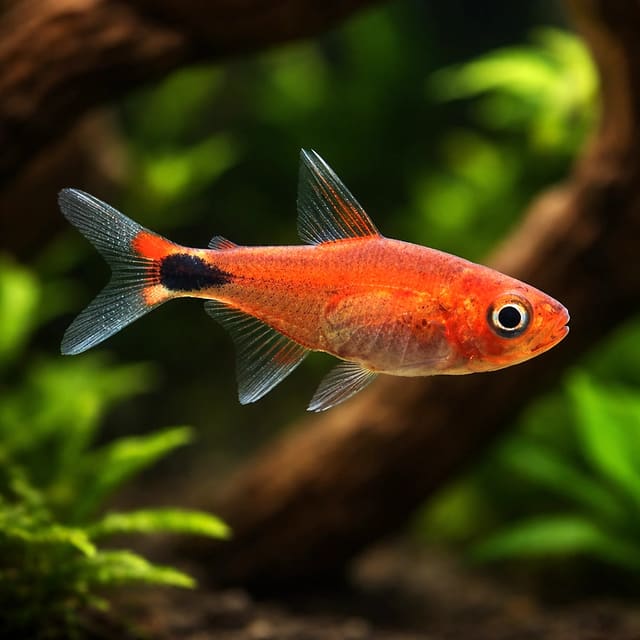
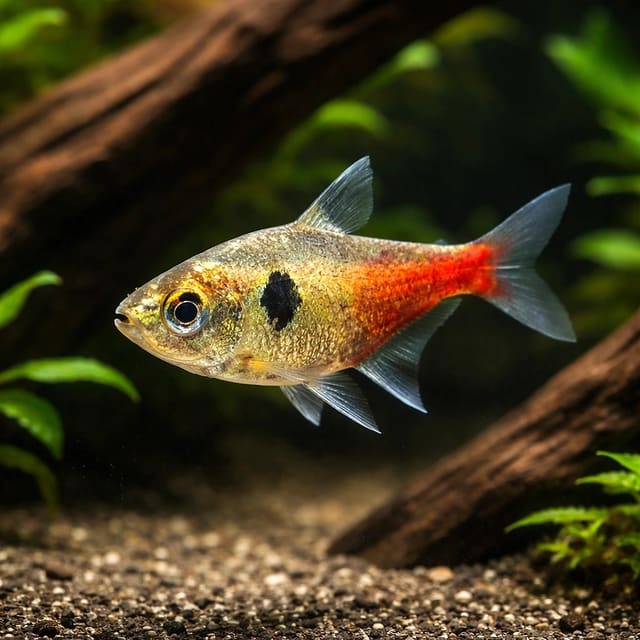
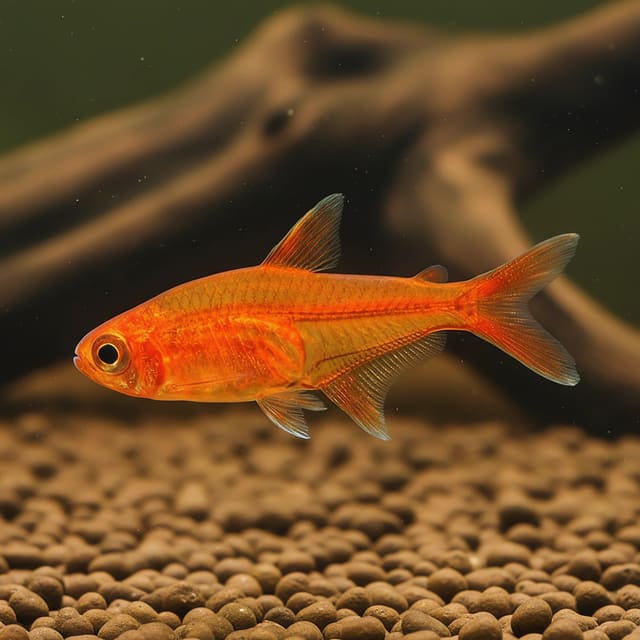
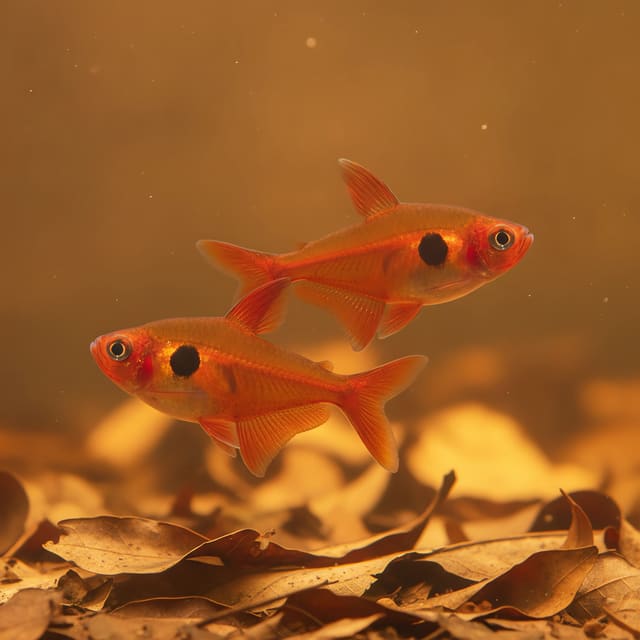
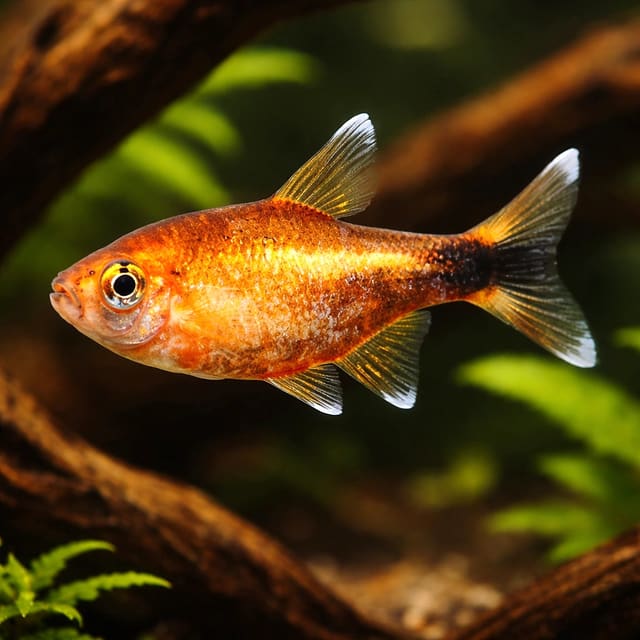
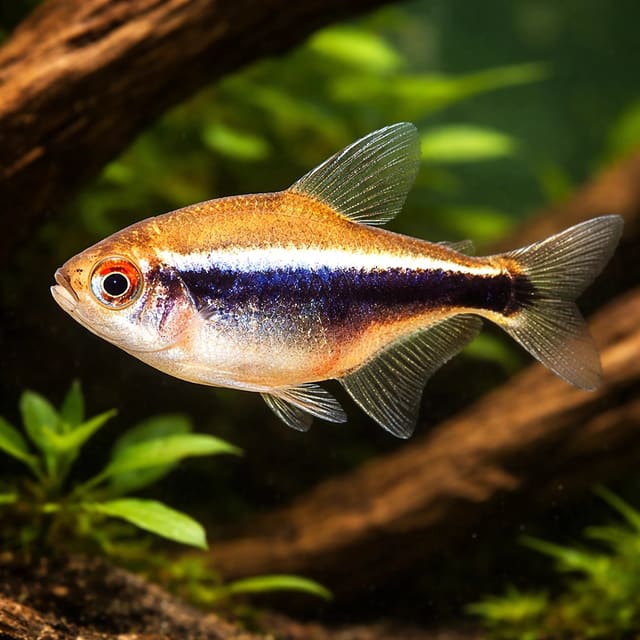
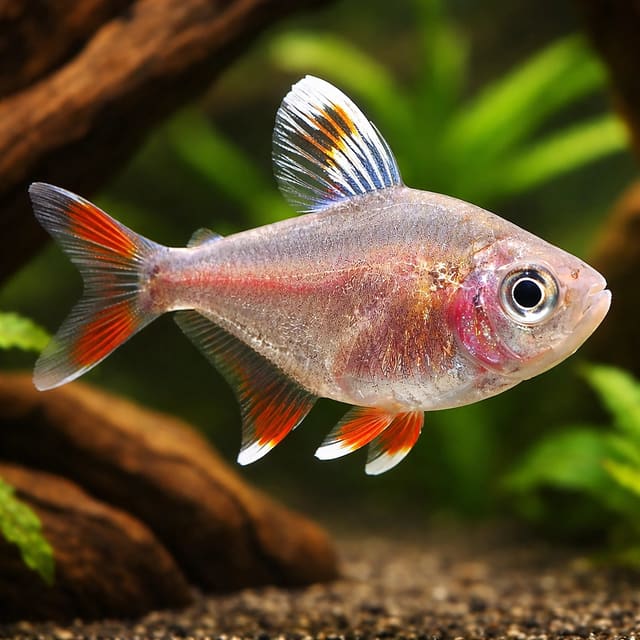
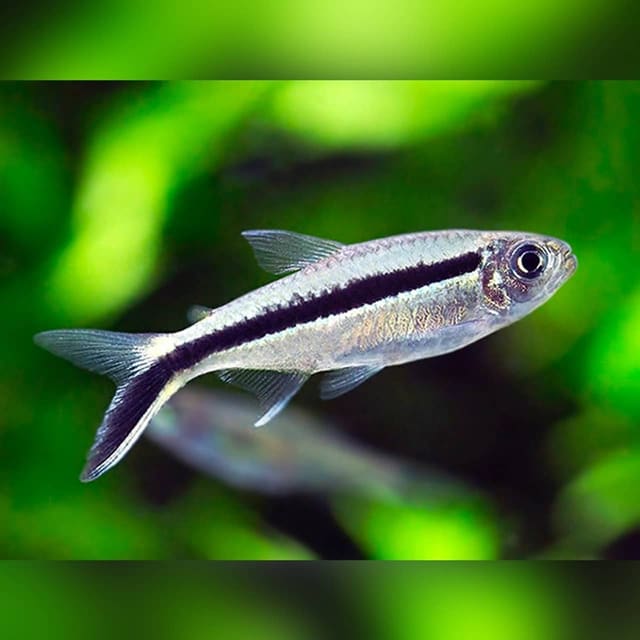
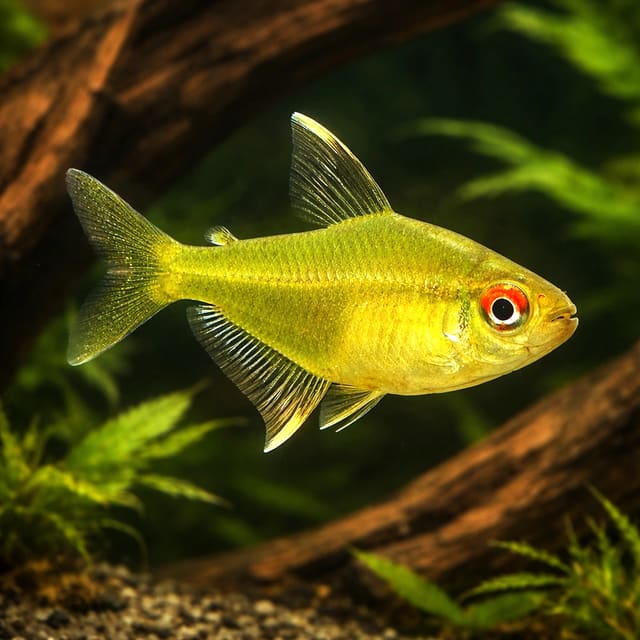
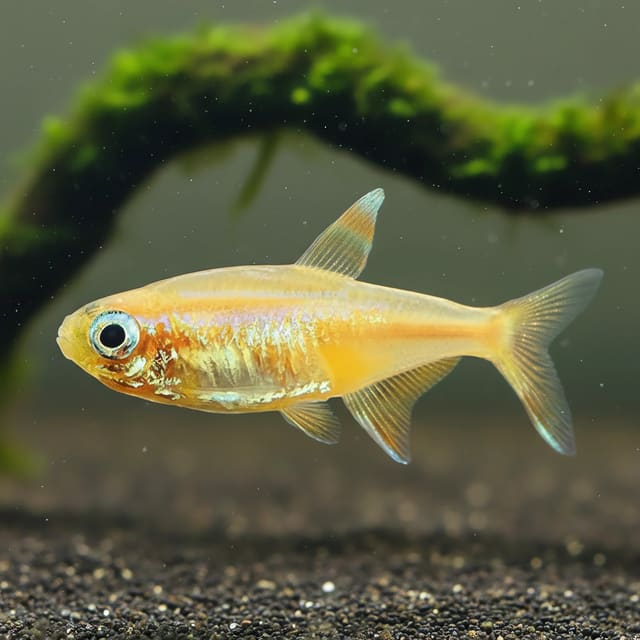
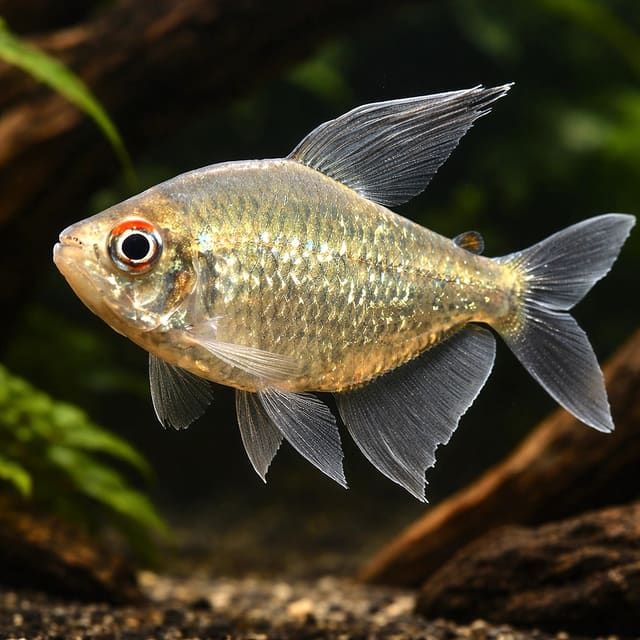
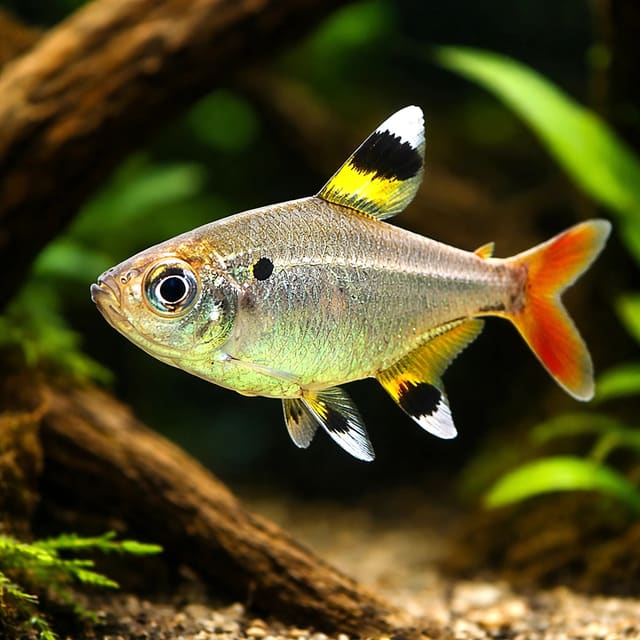
All four gallery images are representative illustrations created to show the labelled species in aquarium context. They are not photographs of the exact fish held for this order. The images should help with general body shape and visual planning, but they cannot guarantee spot placement, colour intensity, sex, age or the final adult appearance of an individual.
A planted background shows scale and contrast; it is not a claim that the fish will leave those plants untouched. Read the plant section before designing the aquarium. The same distinction applies to group scenes: an illustration of two fish demonstrates form and context, while the husbandry recommendation remains a group of at least six.
Base the decision on the stated identity, approximate supplied size, adult maximum, social group, water, diet and aquarium footprint. Do not buy only because one rendered fish matches a desired colour. Live animals vary naturally and may change appearance as they mature and settle.
Confirm that current stock supports the number required and that the adult aquarium can support the complete group. Check the current price and availability on this page before ordering. Quantity, delivery eligibility and any discount are confirmed during checkout.
Eligible livestock orders are covered by the Tropical Fish Co Live Arrival Guarantee when the published conditions are followed. Review the current delivery information and guarantee steps before choosing a date. Someone should be available to receive the parcel, inspect it promptly and follow the evidence/contact window stated in the policy.
One live, unsexed fish is included. The approximate supplied size is 4-5 cm. Set the basket quantity for the number required; the recommended minimum same-species group is six.
No. It belongs to Serrasalmidae, the family that includes silver dollars, pacus and piranhas. It is in the same broad order, Characiformes, as many tetras, which is why older retail taxonomies sometimes group them together.
Plan for a maximum around 18 cm total length. Its deep adult body means it needs more turning room and produces more waste than a slender fish of similar length.
For six adults, use at least 360 litres and 150 cm length. A 180 cm aquarium is preferable where space allows. Increase the footprint for a larger group or substantial companions.
A solitary fish is not recommended. Keep at least six of the same species so they can shoal and distribute social attention normally.
They may eat soft leaves and new growth because plant material is a normal part of their diet. Tough plants may fare better, but no live plant should be promised as bite-proof.
Use a complete plant-rich staple, algae- or spirulina-based foods and varied suitable vegetables, with modest frozen or live animal foods for variety. Remove uneaten fresh food before it decays.
A practical target is 24-28 C, pH 6.0-7.2 and approximately 1-10 dGH, with zero ammonia and nitrite. Stable chemistry and strong oxygenation matter more than chasing one exact number.
Tiny fish, fry and small shrimp are risky because an adult may swallow them or keep them under chronic pressure. Choose robust peaceful companions too large to be treated as food and provide enough space for every full social group.
No. The current product is unsexed, and juveniles at the supplied size cannot be sexed reliably enough for a guarantee.
No. All four gallery images are representative illustrations. Exact colour, spots, body shape, sex and developmental stage vary between live individuals.
Choose this species when you can provide a mature 360L+ long aquarium, a group of at least six, stable soft to moderately soft tropical water, a plant-rich diet and companions selected for adult size. Choose a smaller schooling species when any part of that plan is uncertain.
No reviews for this item yet. Bought one? Honest reviews only, good or bad.
What customers say about ordering from us
I have a small group of long finned mountain minnows. So was delighted to be able to order ten of this variety to increase the genetics in my tank . The ones I recieved are healthy but it’s to early to give a verdict on wether they are of a long finned type since they are small currently.
Gordon Walker · 23 Sept 2026
100% success travel and "installation". Pleased with quality of purchase. The Siamese fighter a bit "shy" so have not yet seen him at his best yet but looking good. Happy customer. GG
George E Garratt · 21 Sept 2026
Reviews of our shop, collected by Judge.me, an independent third-party review collector. Newest first.