Moderate
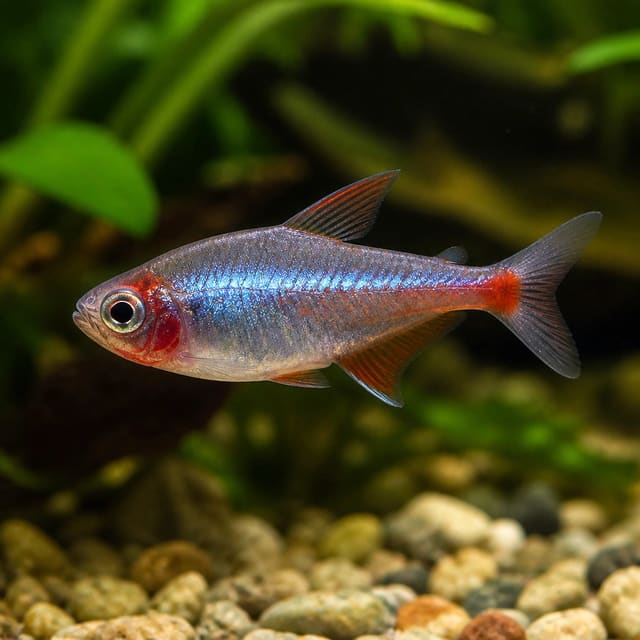
Neon Tetra (Paracheirodon innesi)
21–25°C · pH 5–7
£2.99

The Lemon Tetra (Hyphessobrycon pulchripinnis) is a peaceful freshwater shoaling fish suited to a well-planned community aquarium. One purchase supplies one fish in the selected dispatch size; plan for a group of 8–10 and an aquarium of at least 80 × 30 cm, approximately 72 litres.
Adult size is the maximum length this species reaches at full maturity (scientific sources). The livestock you receive will be younger and smaller — pick a size above for the actual shipping size. Product-photo provenance and any image-specific limitations are stated on the listing.
Hyphessobrycon pulchripinnis
Shoaling fish: kept in a group they feel safer, stay calmer and show their best colour.
Minimum of 2 per order.
The Lemon Tetra (Hyphessobrycon pulchripinnis) is a peaceful freshwater shoaling fish suited to a well-planned community aquarium. One purchase supplies one fish in the selected dispatch size; plan for a group of 8–10 and an aquarium of at least 80 × 30 cm, approximately 72 litres.
Adult size is the maximum length this species reaches at full maturity (scientific sources). The livestock you receive will be younger and smaller — pick a size above for the actual shipping size. Product-photo provenance and any image-specific limitations are stated on the listing.
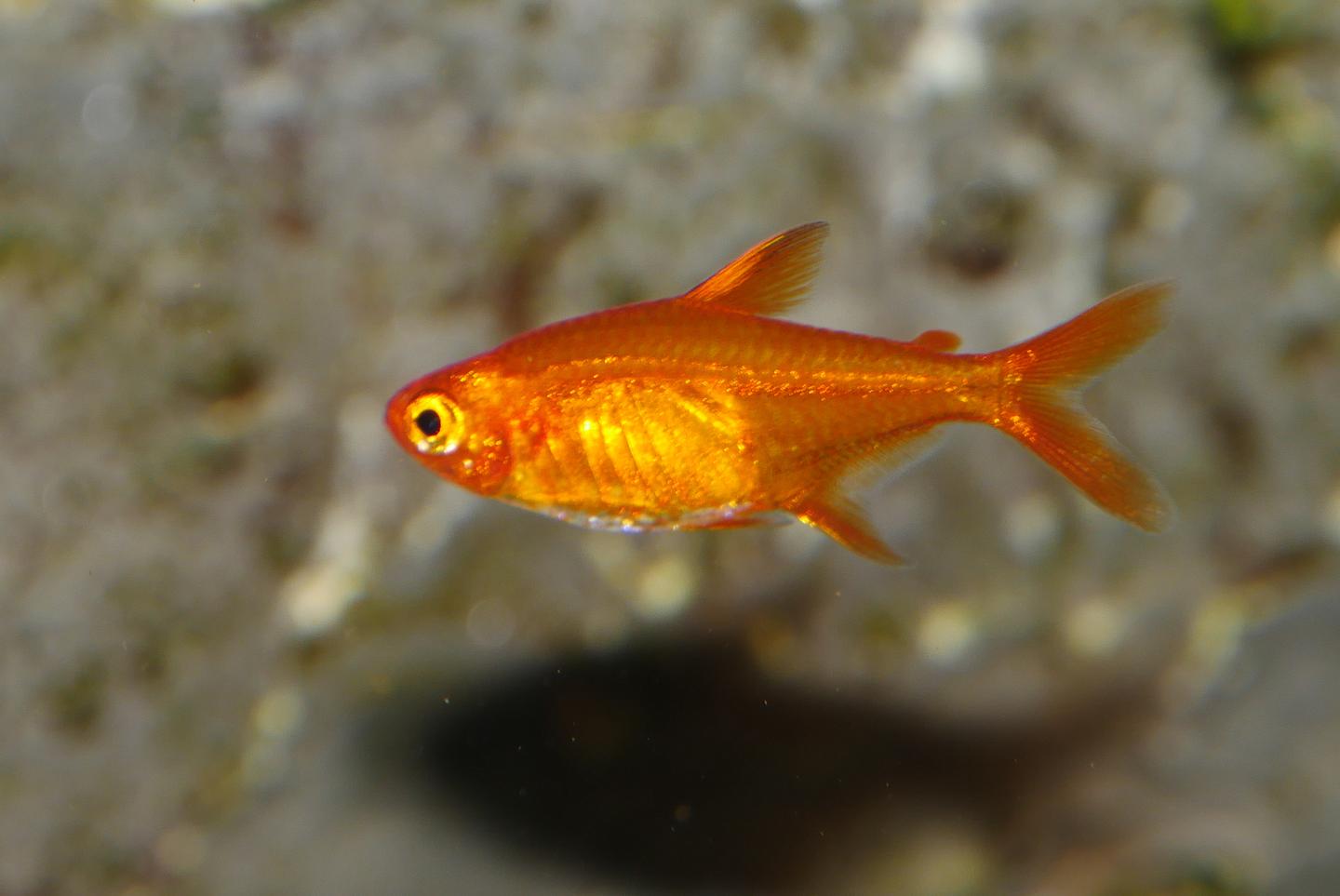
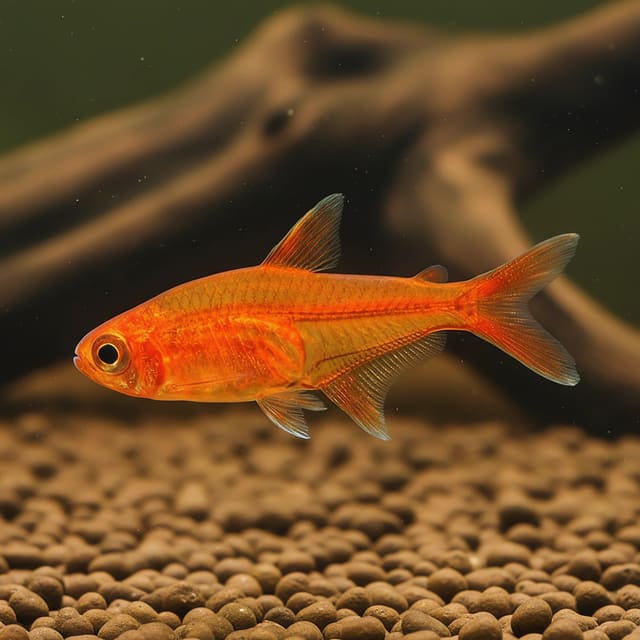
Ember tetras are very small Brazilian social fish, with a maximum recorded length of 2.0 cm excluding the tail. Keep them only in a fully cycled, stable aquarium. We recommend a group of at least 10 and about 45 litres with a 45 × 30 cm footprint rather than using a litres-per-fish formula.
Maintain these water conditions for optimal health and vibrant colors
The Lemon Tetra, Hyphessobrycon pulchripinnis, is a small freshwater American tetra for aquarists who want an active shoal without introducing a boisterous community fish. Its peaceful temperament makes it a practical candidate for a carefully researched community aquarium, while its social behaviour means the aquarium must be planned around a group rather than one isolated fish.
FishBase places the Lemon Tetra in Acestrorhamphidae and records it from the Tapajós River basin in South America. It is described as benthopelagic, meaning that wild fish use water close to the bottom as well as the open water above it. FishBase records worms, crustaceans and plant matter in the natural diet. Those details explain why aquarium care should combine swimming room, nearby cover and a varied omnivorous menu rather than treating the fish as a surface feeder.
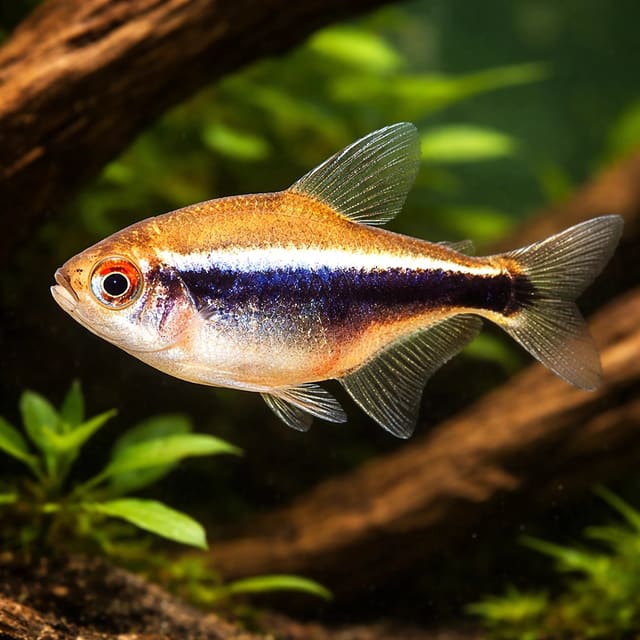
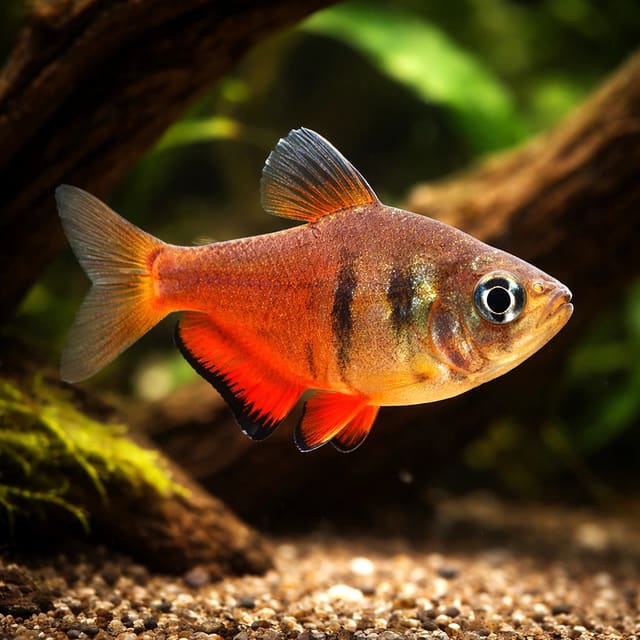
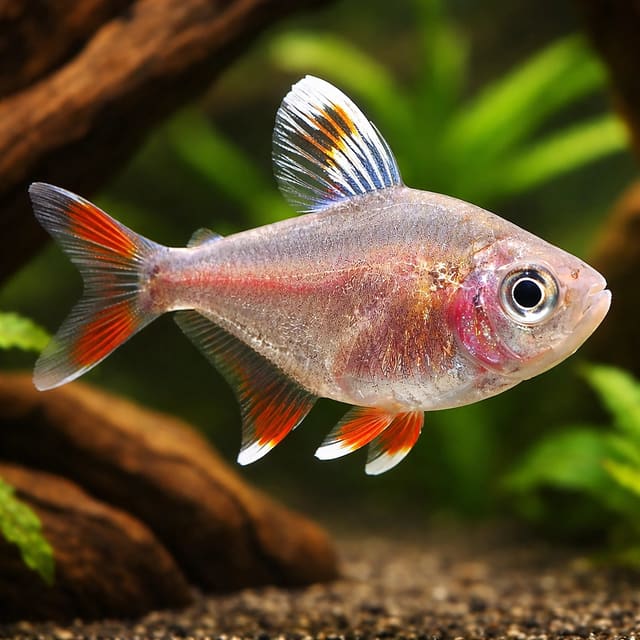
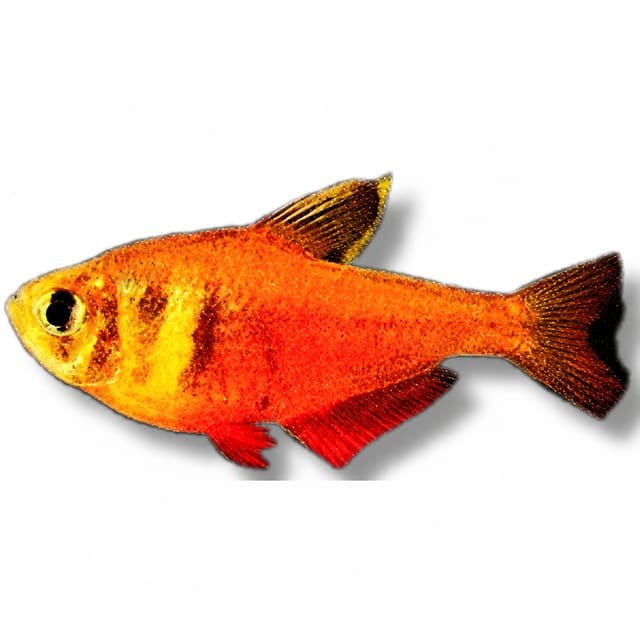
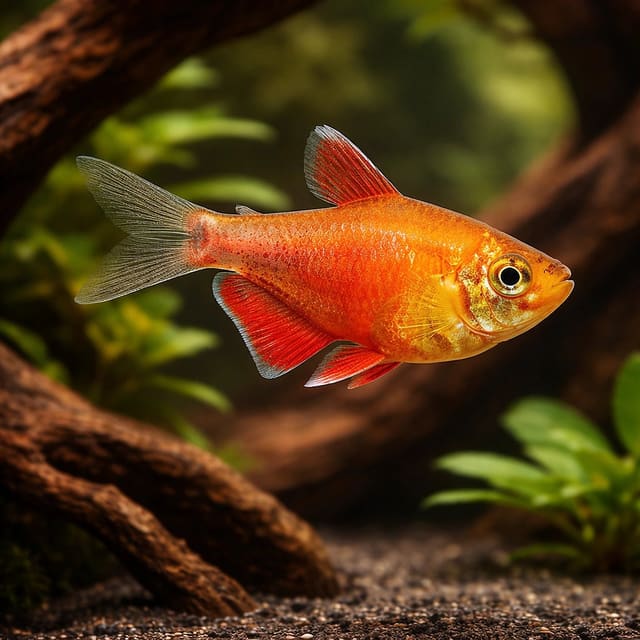
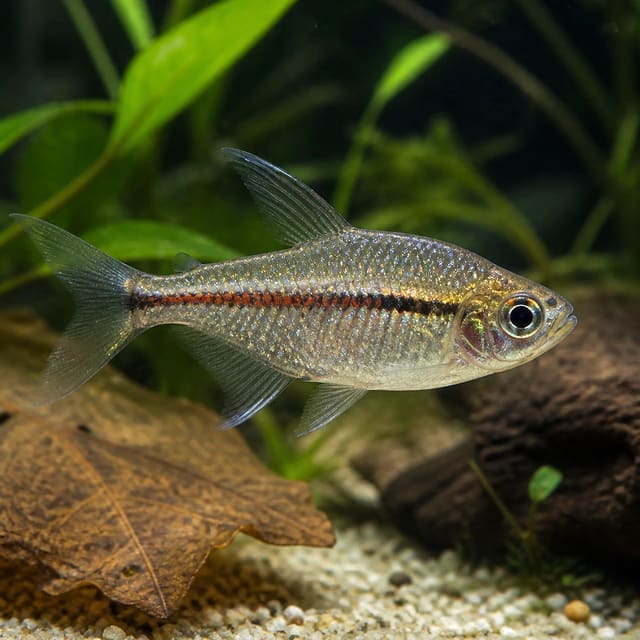
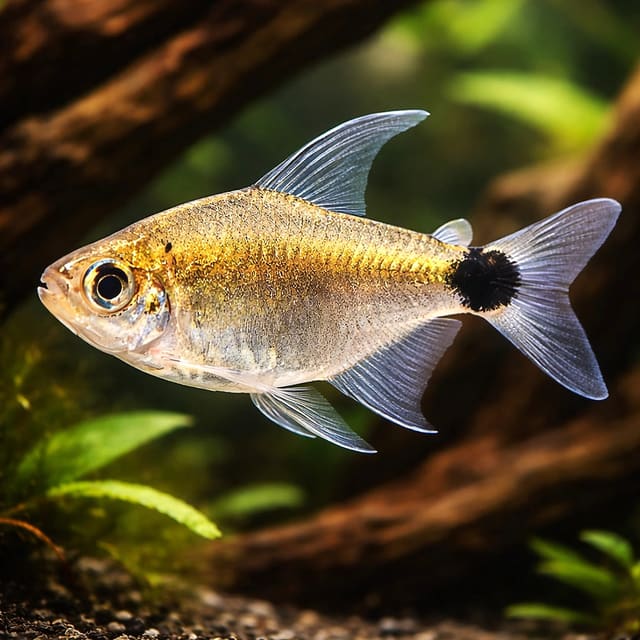
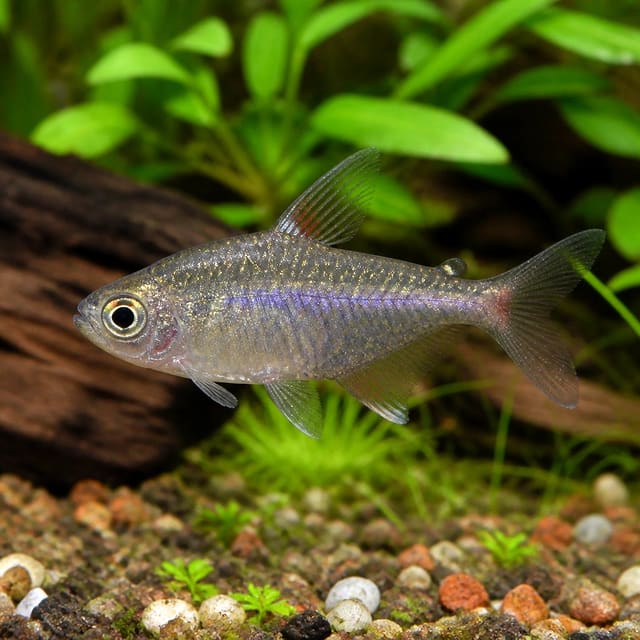
The gallery illustrates yellow-green fish with red-ringed eyes and dark translucent fins in planted aquarium scenes. Some gallery images have been digitally enhanced to improve image quality. They show the listed type of animal rather than guaranteeing the exact markings of the individual supplied, so natural colour and pattern can vary.
This fish suits a keeper prepared to maintain a filtered aquarium, test the water every week, feed measured portions and preserve enough room for a shoal. If you are comparing related fish before deciding, browse the tetras collection and compare adult size, group needs and water ranges rather than choosing by colour alone.
One purchase quantity supplies one Lemon Tetra from the option selected on the live size selector. The selector labels are “1,5-2 cm”, “2,5 - 3 cm”, “3 - 3,5 cm” and “3,5 - 4 cm”. Use the selector to make the final choice rather than relying on a static description.
The size you select is the size supplied, not the adult size. A dispatch measurement helps you coordinate introductions and assess whether existing fish could intimidate or swallow the newcomer. It does not identify sex, age or life stage, and it does not change the space required for the adult group.
Seriously Fish uses 40 mm standard length when planning for this species, while FishBase records a maximum of 3.8 cm standard length for male or unsexed fish. Standard length excludes the tail fin. Treat approximately 4 cm standard length as the practical planning reference, then provide the full footprint and group space from the outset instead of matching the aquarium to the dispatch grade.
| Decision | What to use |
|---|---|
| Fish received | The selected dispatch-size label |
| Long-term space | Approximately 4 cm standard length and a social group |
| Sex | Only an option that explicitly guarantees male or female |
| Life stage | Do not infer it from length or colour |
Seriously Fish recommends at least 8–10 specimens because the fish establish temporary dominance hierarchies and show more interesting behaviour and colour when maintained in numbers. FishBase gives five as an aquarium minimum, but 8–10 is the stronger planning choice for the species. One order line still represents one animal, so set the quantity deliberately when building or enlarging the group.
Sex is guaranteed only when the selected option explicitly states male or female. This Lemon Tetra listing has no sex-guaranteed option.
| Suits | Not suited to |
|---|---|
| Stable aquarium water maintained at 22–27°C and pH 6.5–7.5 | Water outside 22–27°C and pH 6.5–7.5 |
| Similarly sized peaceful characids with matching water needs | Fish large enough to eat a Lemon Tetra |
Use an aquarium with base dimensions of at least 80 × 30 cm or an equivalent footprint. Seriously Fish describes approximately 72 litres as the smallest aquarium to consider for this species. The footprint matters because Lemon Tetras need horizontal room to spread out, regroup and pass one another while maintaining their temporary social hierarchy.
Volume alone can hide an unsuitable shape. A tall aquarium may hold roughly 72 litres but provide less horizontal swimming distance than an 80 cm tank. Compare the length and front-to-back depth first, then confirm that the actual water volume, filtration and stocking plan remain suitable after substrate, wood and other décor take up space.
Start the plan with a group of at least 8–10 Lemon Tetras. Keeping one alone or using a token group works against the species’ social behaviour. A larger group can be considered only where the footprint, filtration capacity and total community stocking leave every fish adequate swimming room and stable water quality.
| Your situation | Planning decision |
|---|---|
| Tank shorter than 80 cm | Choose a fish whose adult space requirement fits that aquarium |
| 80 × 30 cm footprint | Treat it as the minimum starting point, not spare capacity |
| Existing community | Count every adult fish before adding the Lemon Tetra group |
| New aquarium | Mature the biological filter before livestock is introduced |
A larger aquarium usually gives more room to separate planting from the swimming lane and more water in which to dilute waste, but extra volume does not replace weekly testing or maintenance. Stock additions must remain gradual because every new fish and every extra meal increases the load placed on the biological filter.
When preparing a new system, follow our first tropical aquarium guide before selecting livestock. The practical finish line is a functioning biological filter and test results showing zero ammonia and zero nitrite, not simply a tank that has been filled and heated for a set number of days.
For routine aquarium care, use 22–27°C, pH 6.5–7.5 and 4–12°dGH. OATA’s tetra and pencilfish guidance gives 22–27°C, pH 6.5–8.0 and 4–12°dGH for the group. These are group values, not a species-specific optimum. The upper pH here is held at 7.5 because the Seriously Fish species profile gives 20–28°C, pH 5.0–7.5 and 1–12°dGH.
FishBase records the wild environmental range as 23–28°C and pH 5.5–8.0, with hardness extending up to 25°dH. Those figures describe where the species has been recorded rather than a routine target for a home aquarium. Keeping the everyday range within both the aquarium profile and the narrower tetra guidance gives a clear working plan without chasing the edges of the environmental range.
| Routine measurement | Working range |
|---|---|
| Temperature | 22–27°C |
| pH | 6.5–7.5 |
| General hardness | 4–12°dGH |
| Ammonia | 0 mg/l |
| Nitrite | 0 mg/l |
| Nitrate | Up to 20 mg/l above the normal tap-water level |
Test the source water and aquarium before choosing the fish, then compare the results with the working range. Our water chemistry guide explains what the principal readings mean, while the water matcher provides a direct way to compare measured values with the stated range.
Choose a stable point within the range that also suits every established tank mate. Avoid adjusting pH or hardness merely to reach the middle of the table when the aquarium is already stable and appropriate. Any deliberate change should be measured and gradual, because a stable compatible value is more useful than repeated movement in pursuit of a precise number.
A working biological filter is essential. The RSPCA explains that biological filtration supports bacteria that convert toxic ammonia into nitrite and then into the safer nitrate. That process protects the fish only when the filter is established, kept running and maintained without destroying the bacterial population.
For an aquarium of about 72 litres, Seriously Fish suggests turnover of four to five times the aquarium volume each hour, corresponding to a filter rated at roughly 290–360 litres per hour. Treat that rating as a planning guide for this tank size. The actual flow should keep the water moving and filtered without forcing the shoal to struggle continuously against the current.
If filter media needs cleaning, rinse it lightly in aquarium water removed during the water change. Do not wash biological media under the tap, because chlorine or chloramine may kill beneficial bacteria. Preserve established media whenever possible rather than replacing all of it during routine servicing.
| Observation | Immediate action |
|---|---|
| Ammonia or nitrite above zero | Stop further stocking, check filtration and feeding, and carry out appropriate water changes |
| Reduced filter flow | Check the intake and media for blockage |
| Uneaten food accumulating | Remove it and reduce the next portion |
| Nitrate rising between tests | Review stocking, feeding and the water-change routine |
Add fish gradually. The bacterial population must increase as stocking and feeding increase, and adding too much bioload at once can produce new tank syndrome. A large filter rating does not remove the need to pace introductions, test weekly and respond to the actual readings.
A Lemon Tetra aquarium can use a sandy substrate with driftwood roots and branches or a heavily planted layout. Seriously Fish presents both as suitable approaches. In either design, keep a clear horizontal route so the shoal can move through open water while remaining close to cover.
Place substantial planting around the back or sides rather than filling every part of the footprint. This creates a practical division between shelter and swimming space. A group that can move behind cover, emerge into open water and pass around wood has more usable choices than one kept in a bare aquarium or a dense layout with no continuous route.
| Layout element | Purpose |
|---|---|
| Sand or aquarium gravel | Provides a maintainable base for the layout |
| Live plants | Create cover while helping divide sheltered and open areas |
| Driftwood roots or branches | Add structure and sheltered routes |
| Dried leaf litter | Adds cover and supports microbial growth as it decomposes |
| Open water | Allows the group to travel, spread out and regroup |
Leaf litter can contribute to a natural-looking arrangement. Seriously Fish notes that decomposing leaves encourage microbe colonies that may provide an extra food source for adults and fry, while released humic substances are considered beneficial. Use aquarium-suitable materials and remove or replace them as part of a controlled maintenance plan rather than letting debris accumulate without observation.
The species forms temporary dominance hierarchies in which males may compete for female attention. Side-on displays and changes in spacing can therefore be part of normal group interaction. Provide enough fish and room for those interactions to be distributed across the group, then watch for any individual that is persistently excluded from food or confined to one corner.
Do not use decoration to compensate for an undersized aquarium. Cover supports security, but the 80 × 30 cm minimum footprint and the needs of the full 8–10-fish group remain the starting point.
Lemon Tetras are omnivorous. FishBase records worms, crustaceans and plant matter in the wild diet, while Seriously Fish also describes small invertebrates, crustacea, filamentous algae and fallen fruit among natural foods. In the aquarium, use a varied menu that combines a suitable dried food with small live or frozen items.
OATA recommends a good-quality flake or granule for tetras, supplemented with small live or frozen foods such as daphnia, small bloodworm or tubifex. Seriously Fish also names live or frozen chironomid larvae, mosquito larvae, Daphnia and Moina. Choose pieces that every fish can swallow readily and distribute the food where the group can reach it.
Feed once a day and offer only what the fish consume within a few minutes. Watch the entire group rather than measuring success by the quickest individuals. A portion is appropriate when fish across the shoal feed and little or nothing reaches the substrate uneaten.
| Feeding decision | Practical response |
|---|---|
| Food remains after a few minutes | Remove the excess and reduce the next portion |
| Food is too large to swallow | Use a smaller flake, granule or appropriately sized live or frozen item |
| One fish repeatedly misses food | Check social pressure, health and how food is distributed |
| The group loses interest | Test water quality and observe breathing, swimming and appearance |
Overfeeding is both a dietary and water-quality problem. Uneaten food decomposes and adds waste that the biological filter must process. Reducing the portion is safer than allowing food to settle in the hope that the fish will return to it later.
Variety means rotating suitable foods, not increasing the total amount. Dried food can form the regular base, with appropriately sized live or frozen foods used to broaden the menu. Keep the once-daily schedule and few-minutes portion rule unchanged when switching between food types.
Prepare the aquarium before the fish arrive. Confirm that temperature, pH and hardness are within the planned range and that ammonia and nitrite both read 0 mg/l. Make sure the filter is running normally and that the full group has an unobstructed swimming route as well as nearby cover.
These timings follow our delivery and acclimatisation policy. Read the policy before the delivery day so the receiving and Live Arrival Guarantee steps are understood in advance.
Introducing a group still adds a meaningful bioload, even though each Lemon Tetra is small. Test ammonia and nitrite after introduction and avoid adding another batch of fish immediately. Beneficial bacteria must respond to the increase in waste and feeding, so the next stocking decision should be based on stable readings rather than the calendar alone.
| Checkpoint | What to assess |
|---|---|
| First day | Breathing rate, swimming position, balance and access to cover |
| First feeds | Whether the group takes appropriately sized food within a few minutes |
| First week | Ammonia, nitrite, nitrate trend and filter flow |
| Before more livestock | Stable water readings and adequate adult swimming space |
Some temporary caution after transport can occur, so compare observations over time. Act promptly if behaviour or appearance worsens, several fish show the same change, or a fish cannot maintain normal swimming and breathing.
Learn the group’s normal feeding, swimming, colour and spacing once it has settled. A consistent baseline makes change easier to recognise than relying on a single visual feature. OATA recommends watching behaviour, colour, temperament, breathing, appearance, body condition and feeding response.
| Change seen | First response |
|---|---|
| Hanging at the surface or sitting on the bottom | Test ammonia and nitrite and inspect filter operation |
| Erratic swimming | Check water readings, temperature and whether another fish is causing pressure |
| Faster or slower gill movement | Test water immediately and compare other fish |
| Darker or paler colour | Review water quality, social pressure and recent changes |
| White spots, fluffy growths or damaged scales | Separate equipment where practical and seek a diagnosis before treatment |
| Reduced food intake | Check food size, access to food, water quality and body condition |
Water testing is the first response because ammonia and nitrite are toxic and may affect several fish before a clear external symptom develops. Correct the environmental problem rather than hiding it with extra food or an unselected treatment. If you are concerned about a health change, test the water and contact us with the readings and a clear description of what has changed.
Do not combine medications or alter temperature as a generic reaction. A white spot, damaged fin, pale colour or unusual swimming pattern can have different causes, and the appropriate response depends on identifying the problem. Keep routine husbandry stable while arranging the next step unless an immediate water-quality correction is required.
The most useful social plan is a group of at least 8–10 fish with room for temporary dominance hierarchies. Seriously Fish reports that males compete for female attention and that maintaining the species in numbers can produce more interesting behaviour and better colour. Brief displays are therefore different from a fish being continually chased away from food or shelter.
Adult males tend to be slightly smaller, less deep-bodied and more intensely coloured than females, particularly in the dorsal and anal fins. These are tendencies among mature fish, not a reliable promise for an individual selected by dispatch size. Do not use the gallery, body depth, colour or length to decide what sex will be received.
This species is an egg-scattering free spawner and does not provide parental care. Seriously Fish notes that conditioned adults may spawn in a mature aquarium and that small numbers of fry may sometimes appear without intervention. Treat that as possible natural behaviour rather than a promised outcome from the group.
Do not build the routine care plan around breeding. Stable water, an established filter, adequate space, a proper group and a varied measured diet remain the priorities whether spawning occurs or not. Any fry increase the biological load and require the same disciplined attention to water quality as the adults.
Seriously Fish describes the Lemon Tetra as very peaceful and suitable for a well-researched community aquarium. It suggests similarly sized characids, hatchetfishes, pencilfishes, smaller callichthyid or loricariid catfishes and non-predatory small-to-medium cichlids. These are candidate groups, not automatic matches: the exact species, adult size, behaviour and environmental requirements must still align.
OATA advises mixing tetras with species of a similar size and temperament and warns that smaller tetras should not be kept with fish large enough to eat them. This gives a direct exclusion rule for predators while leaving room to assess peaceful candidates individually.
| Candidate | Decision |
|---|---|
| Similarly sized peaceful fish with matching water needs | Consider after checking adult stocking and feeding access |
| Fish large enough to swallow the tetra | Avoid |
| Peaceful bottom-associated fish | Consider only if footprint and total bioload remain suitable |
| Non-predatory small-to-medium cichlid | Assess the exact species and individual behaviour carefully |
| Fish requiring different temperature or chemistry | Choose a different combination |
Compatibility retains some uncertainty because individual behaviour, sex ratios, territory and aquarium layout can alter an otherwise plausible match. Observe the community at feeding time and during normal swimming, and be prepared to revise the plan if one fish is repeatedly excluded or harassed.
Begin with the non-negotiable needs of the Lemon Tetra group: at least 8–10 fish, an aquarium footprint of at least 80 × 30 cm, approximately 72 litres or more, a working biological filter and stable water within the routine range. Only then assess whether the aquarium has room and filtration capacity for another species.
| Planning case | Result |
|---|---|
| One Lemon Tetra in a community | Do not proceed; this is a social fish that should be planned as a group |
| Eight to ten in an 80 × 30 cm aquarium | Meets the starting footprint and group recommendation; assess actual volume and filtration |
| Eight to ten plus an existing shoal | Recalculate adult space, feeding competition and biological load before adding fish |
| Matching water but a predatory companion | Avoid the pairing because chemistry does not remove predation risk |
| Peaceful companion with conflicting water needs | Choose species that share one stable range instead |
Do not treat the 72-litre reference as a universal community allowance. It is the smallest aquarium Seriously Fish recommends considering for the Lemon Tetra itself. Other groups and territorial fish add their own spatial requirements, and décor reduces the open footprint that remains usable.
Check feeding as carefully as temperament. A companion can appear peaceful yet prevent the shoal from taking enough food. During the first meals after a community change, watch whether Lemon Tetras across the group obtain suitably sized food within a few minutes. Adjust distribution rather than increasing the total portion indiscriminately.
Watch how fish use space outside feeding time as well. Repeated hiding, crowding into one corner, surface hanging or exclusion from cover calls for water tests and a review of the stocking plan. Loose spacing can be normal in a settled group; persistent displacement by another fish is not the same behaviour.
Leave room for the adult community rather than relying on the dispatch size of a new arrival. The selector measurement describes the fish sent, while compatibility must be judged using every species’ adult size, final group number and long-term environmental needs.
It is the Lemon Tetra, a peaceful freshwater American tetra recorded from the Tapajós River basin in South America. FishBase places it in the family Acestrorhamphidae.
One purchase quantity supplies one fish from the selected option. Set the quantity deliberately when planning the recommended group of at least 8–10 fish.
The Lemon Tetra selector uses “1,5-2 cm”, “2,5 - 3 cm”, “3 - 3,5 cm” and “3,5 - 4 cm”. These are dispatch measurements rather than adult-size or life-stage labels.
Use an aquarium with a base of at least 80 × 30 cm or an equivalent footprint, approximately 72 litres. Retain open horizontal swimming room alongside plants or other cover.
No. Plan for at least 8–10 because this social fish forms temporary dominance hierarchies and shows more natural behaviour when maintained in numbers.
Keep it at 22–27°C, pH 6.5–7.5 and 4–12°dGH, with ammonia and nitrite at 0 mg/l. Test at least weekly and keep the chosen values stable.
Feed a good-quality flake or granule with small live or frozen foods such as daphnia or small bloodworm. Offer once daily and only as much as the fish consume within a few minutes.
Start filming before opening the sealed parcel, then open it in one continuous take and show the fish inside the sealed bag. Float the bag for 20–30 minutes before releasing the fish, and do not pour bag water into the aquarium.
Consider similarly sized peaceful fish that share 22–27°C, pH 6.5–7.5 and 4–12°dGH. Avoid any fish large enough to eat it, and assess adult stocking, feeding access and temperament before combining species.
No reviews for this item yet. Bought one? Honest reviews only, good or bad.
What customers say about ordering from us
I have a small group of long finned mountain minnows. So was delighted to be able to order ten of this variety to increase the genetics in my tank . The ones I recieved are healthy but it’s to early to give a verdict on wether they are of a long finned type since they are small currently.
Gordon Walker · 23 Sept 2026
100% success travel and "installation". Pleased with quality of purchase. The Siamese fighter a bit "shy" so have not yet seen him at his best yet but looking good. Happy customer. GG
George E Garratt · 21 Sept 2026
Reviews of our shop, collected by Judge.me, an independent third-party review collector. Newest first.