Asia Form Ram Cichlid (Mikrogeophagus ramirezi)
27–30°C · pH 4–7 · 54L
£5.99

The Apistogramma agassizii Alenquer Red Tail (Apistogramma agassizii) is a South American dwarf cichlid from the Amazon basin that reaches 4.4 cm standard length. It suits a mature, structured aquarium; keep 26–27°C, the FishBase, Seriously Fish and OATA overlap, pH 6.0–7.0, the FishBase and OATA overlap, and 4–10 dGH. Sold individually in 3–3.5 cm and 4–5 cm sizes.
Adult size is the maximum length this species reaches at full maturity (scientific sources). The livestock you receive will be younger and smaller — pick a size above for the actual shipping size. Product-photo provenance and any image-specific limitations are stated on the listing.
Apistogramma agassizii
Save when buying multiple fish. Each quantity is one fish; sex and pair formation are not guaranteed unless the selected variant explicitly states them.
The Apistogramma agassizii Alenquer Red Tail (Apistogramma agassizii) is a South American dwarf cichlid from the Amazon basin that reaches 4.4 cm standard length. It suits a mature, structured aquarium; keep 26–27°C, the FishBase, Seriously Fish and OATA overlap, pH 6.0–7.0, the FishBase and OATA overlap, and 4–10 dGH. Sold individually in 3–3.5 cm and 4–5 cm sizes.
Adult size is the maximum length this species reaches at full maturity (scientific sources). The livestock you receive will be younger and smaller — pick a size above for the actual shipping size. Product-photo provenance and any image-specific limitations are stated on the listing.

Cichlids are a family of roughly 1,800 accepted species, not one care type. Before buying, identify the exact species and source, then compare adult measurement, usable tank dimensions, social system, territory, tested water, diet and an exit plan. No family-wide minimum tank, water range or tank-mate list is safe.
Maintain these water conditions for optimal health and vibrant colors
Apistogramma agassizii Alenquer Red Tail (Apistogramma agassizii) is a freshwater dwarf cichlid from South America. FishBase places the species in the Amazon River basin along the Amazon–Solimões system from Peru through Brazil to the Capim River basin. It reaches 4.4 cm standard length in that reference and suits keepers prepared to provide a mature, filtered aquarium with warm, soft, acidic water, shelter and a deliberate territorial plan.
Adults are benthopelagic and inhabit clear, black and white water in nature. Their lower-level way of life makes the aquarium base, caves and visual cover more useful planning measures than height alone. The Alenquer Red Tail wording identifies the ornamental trade form; aquarium colour forms of this species are numerous, so use the scientific name to anchor care and compatibility decisions.
Keep routine water at 26–27°C. This is the overlap between FishBase’s 26–29°C environmental range, the Seriously Fish aquarium range of 22–29°C and OATA’s dwarf-cichlid guidance of 22–27°C. Keep pH at 6.0–7.0, the FishBase and OATA overlap, and general hardness at 4–10 dGH, the overlap across all three. OATA’s figures are group guidance, not a species-specific optimum.
For a pair, provide a base of at least 60 × 30 cm and plan for at least 60 litres. A group needs larger quarters, while OATA recommends at least 80 litres when dwarf cichlids are mixed with other fish. Space must also include separate covered areas so one fish can leave another’s line of sight.
One purchase supplies one live fish in the size chosen through the live size selector. The choices are 3–3.5 cm and 4–5 cm. These are dispatch measurements used to select the fish supplied; they do not predict its sex or eventual individual measurements. The size you select is the size supplied, not the adult size.
Sex is guaranteed only when the selected option explicitly states male or female. This Apistogramma agassizii Alenquer Red Tail listing has no sex-guaranteed option. Plan any pair, harem or breeding arrangement with known-sex fish rather than assuming that two independently selected animals will form the intended combination.
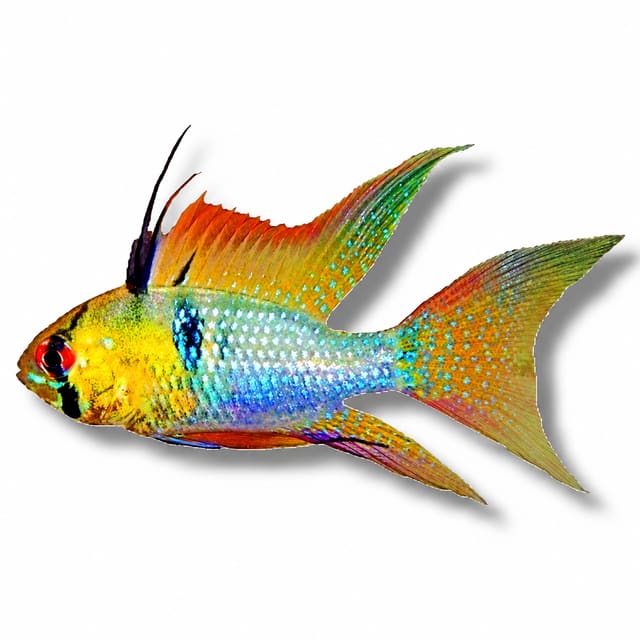
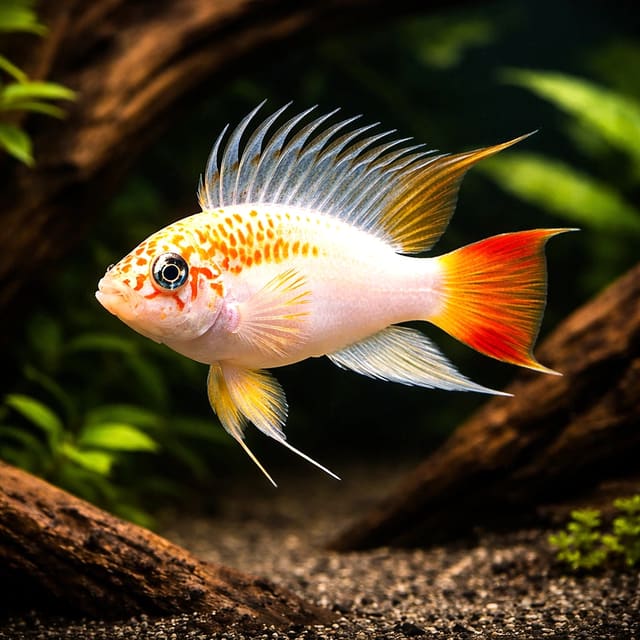
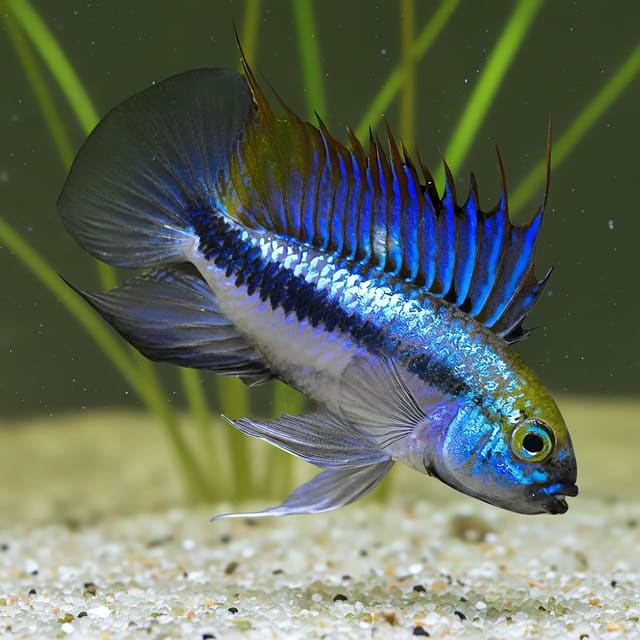
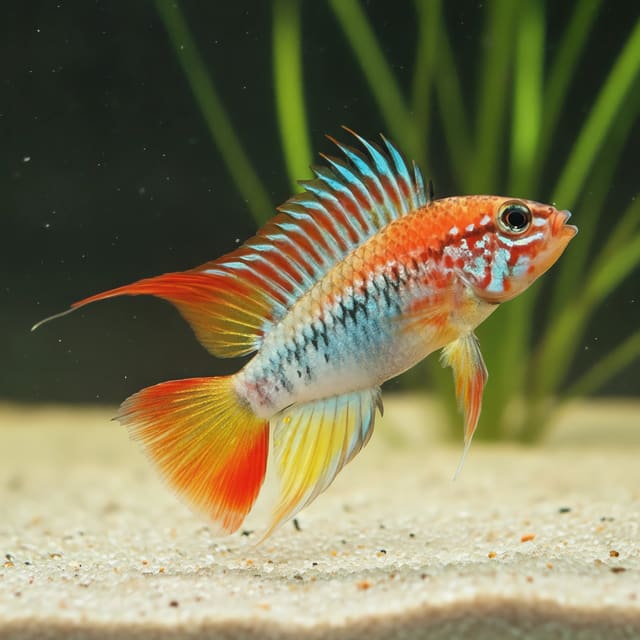
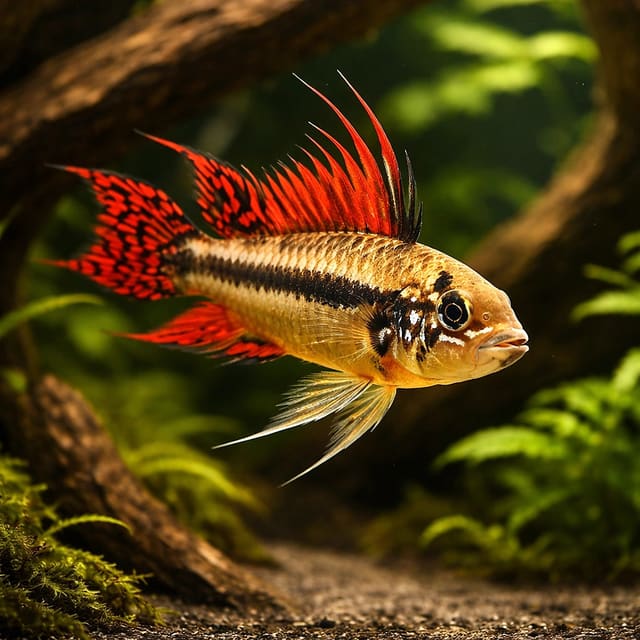
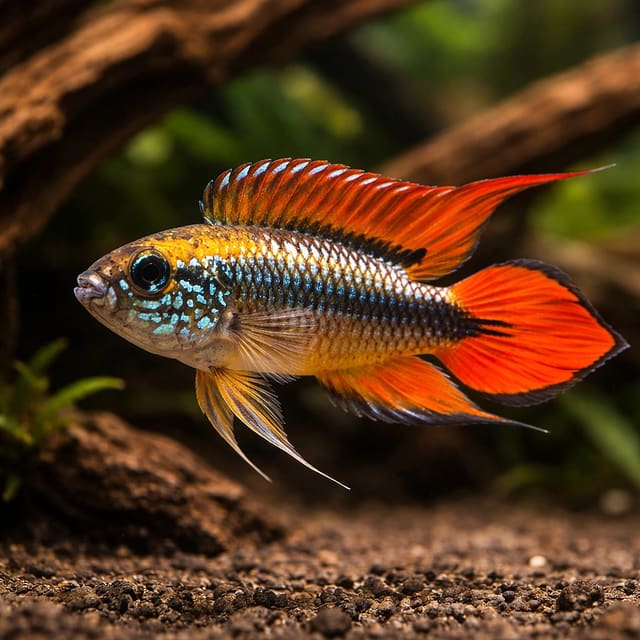
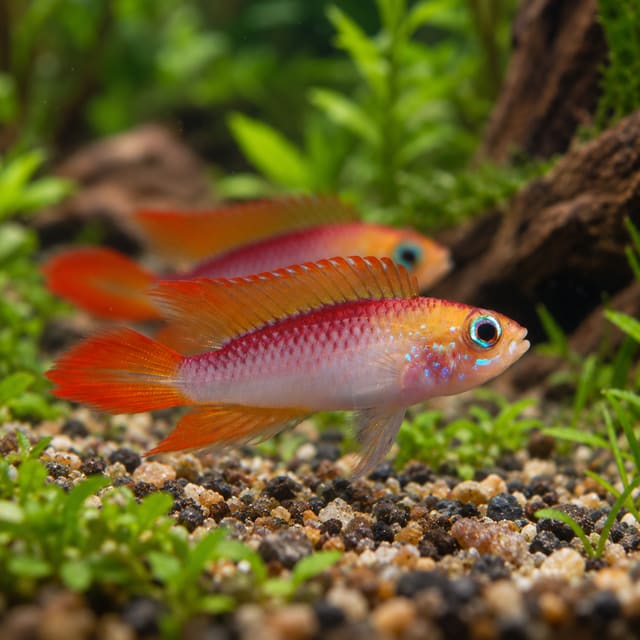
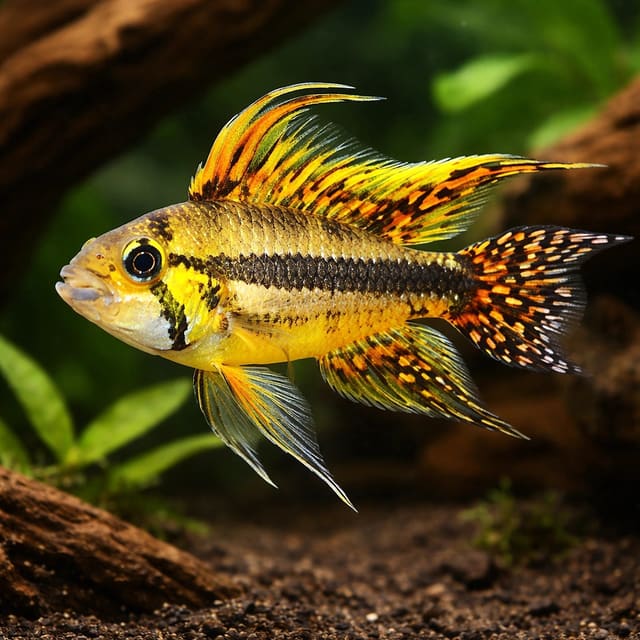
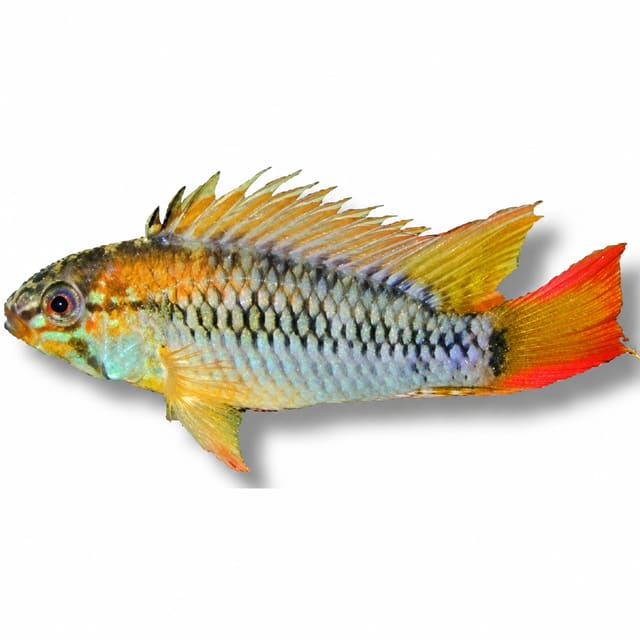
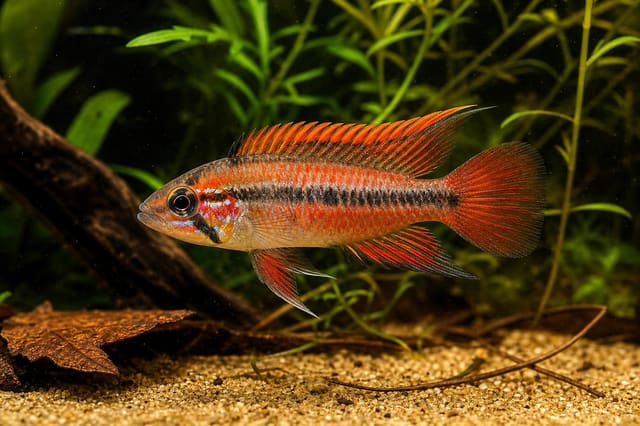
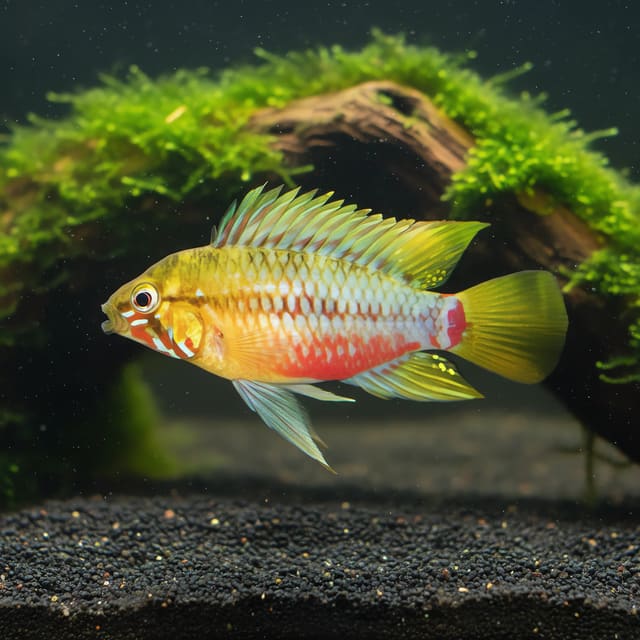
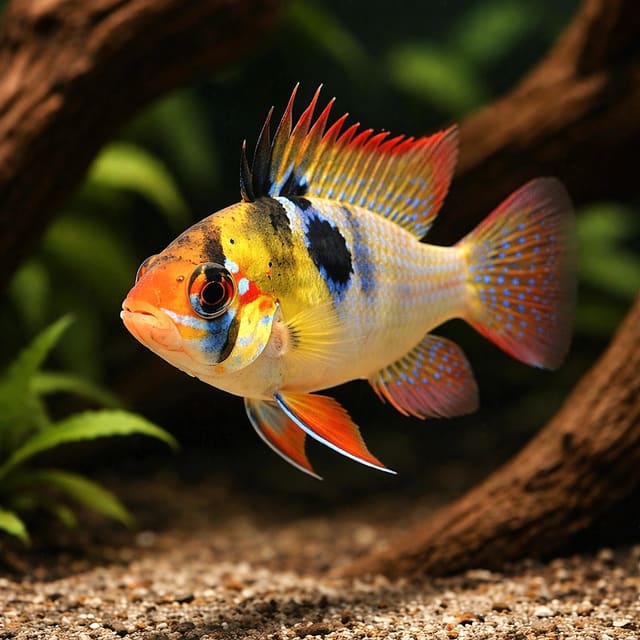
The gallery images are representative illustrations of this type of animal, not photographs of the animal supplied, so pattern and colours can differ from the live animal. The illustrations show dwarf-cichlid shapes and aquarium scenes, but their yellow, black and white tail patterns should not be used as a colour chart for the Red Tail form.
Check the selected dispatch size against the fish already in the aquarium, the base area and the number of sheltered territories. A larger dispatch fish is still the same species with the same adult care plan. Do not use a smaller dispatch grade as a reason to reduce the permanent aquarium footprint, filtration or number of shelters.
Make the decision from measured water, usable base area and companion behaviour. This fish needs a mature biological filter, stable warm water, caves and enough cover for territorial fish to separate. A community plan also needs more volume than a pair-only layout and calm companions that will not overwhelm a shy Apistogramma.
| Suits | Not suited to |
|---|---|
| A mature aquarium kept at 26–27°C | An immature aquarium or unstable biological filter |
| pH 6.0–7.0 and 4–10 dGH | Water outside the planned routine range |
| A 60 × 30 cm base or larger for a pair | A pair layout with less usable base area |
| Caves, wood, plants and shaded cover | An exposed layout without separate shelters |
| Small dither fish after water and space screening | Very active or boisterous companions |
| A keeper able to watch territorial changes | Mixing with other Apistogramma |
Use the aquarium’s permanent conditions rather than a temporary reading. Temperature, pH and hardness should be measured before introduction and then kept steady through routine maintenance. Community candidates must fit the same range and leave the lower caves and spawning areas usable.
If these requirements fit your plan, compare the fish within our South American cichlid collection by adult care needs rather than appearance alone. Similar body size does not make two territorial cichlids compatible.
Plan around an adult figure of 4.4 cm standard length, as recorded by FishBase. Standard length excludes the tail fin. Seriously Fish lists a larger male figure of 7.5 cm standard length, so do not estimate the eventual adult measurement from the dispatch grade or from the appearance of a juvenile.
Seriously Fish considers base dimensions of 60 × 30 cm or more, approximately 54 litres, acceptable for a single pair and states that a group needs larger quarters. OATA’s dwarf-cichlid sheet recommends at least 60 litres for a pair. Use an aquarium that meets the 60 × 30 cm base and at least 60-litre group-planning recommendation rather than choosing between footprint and volume.
For a community, use at least 80 litres as OATA’s group-level starting point. That figure does not replace behavioural screening: a larger aquarium still needs covered retreats, appropriate water and companions that will not crowd the caves. More water helps environmental stability, while more usable floor area allows structure to divide the aquarium into separate spaces.
FishBase advises several females for one male in aquarium keeping. Seriously Fish also states that a group requires larger quarters than a pair. Treat those as deliberate known-sex arrangements, not as a reason to add several fish and wait for a suitable ratio to emerge.
Before adding another dwarf cichlid, identify where each fish can shelter and how it can move out of sight. A cave count alone is not enough if every entrance faces the same open area. Place wood, branches, plants or other structures between shelters so the aquarium provides distinct covered zones.
Use a soft sandy substrate with wood roots, branches and several shaded caves for a natural-looking arrangement. Seriously Fish also permits practical shelters such as ceramic flowerpots and lengths of plastic piping, so function takes priority over a particular decorative style. Every shelter must be aquarium-safe and positioned securely.
Leaf litter can remain to break down fully or be removed and replaced every few weeks. As it decomposes, beneficial microbe colonies may develop and provide a secondary food source for fry. Leaves also release tannins and other compounds appreciated by many populations. Keep this feature within the aquarium’s maintenance capacity rather than allowing accumulated waste to compromise water quality.
Even settled dwarf-cichlid pairs will often chase one another, and territorial behaviour can become stronger during breeding. Arrange more covered choices than the fish need at any one moment. A fish entering one cave should not have to cross every other cave entrance to leave the area.
Check the layout from the front and both ends. If every lower shelter is visible from one position, add wood, plants or branches to divide the view. Keep enough open space for normal swimming while ensuring that a shy or subordinate fish can move behind structure. Secure all hardscape before introduction so routine cleaning does not collapse a cave or trap a fish.
Keep the aquarium at 26–27°C, pH 6.0–7.0 and 4–10 dGH. Temperature and hardness sit within FishBase, Seriously Fish and OATA figures; the pH target is the overlap between FishBase and OATA. These routine values suit planning for the named species while retaining OATA’s narrower group limits.
Seriously Fish associates pH 3.0–4.0 with some wild populations that may require very acidic conditions for breeding, while commercially produced fish are described as relatively unfussy. Use pH 6.0–7.0 as the routine target here. Reserve specialist low-pH breeding conditions for a deliberate plan involving fish whose needs and origin are known.
Measure the aquarium rather than judging softness or acidity from appearance. Our water chemistry guide explains the values to test, and the water matcher helps compare measured results with this routine range. Take readings after the aquarium has reached its normal temperature and before selecting companions.
Maintain ammonia at zero mg per litre and nitrite at zero mg per litre. OATA advises keeping nitrate from exceeding 20 mg per litre above the normal tap-water level. Test regularly because clear water can still contain harmful dissolved waste.
Stability matters alongside the target numbers. Treat replacement tap water with conditioner to remove chlorine or chloramine before it enters the aquarium. Match routine replacement water to the aquarium plan and avoid abrupt swings during a water change. If a test moves away from the established pattern, check the result, feeding, waste accumulation and filter function before adding more fish.
Run a well-established biological filter at all times. The RSPCA explains that fish release toxic ammonia, which filter bacteria convert first to nitrite and then to the safer nitrate. A filter is therefore part of the fish’s life-support system, not simply a device for making the water look clear.
If this is your first aquarium, complete the cycling and maturation work in our first tropical tank guide before livestock is introduced. OATA warns that increasing the fish population too quickly can leave too few nitrifying bacteria to process the additional waste, causing unhealthy ammonia and nitrite levels.
If the filter needs cleaning, do not run it under the tap. Rinse it lightly in aquarium water removed during the partial water change, reducing the number of beneficial bacteria lost. Do not clean every item and disturb every sheltered area together; preserve the stable biological system while removing waste.
Add fish gradually and test after the biological load changes. If ammonia or nitrite rises above zero, pause further additions, check filter flow and remove uneaten food. The first-month priorities are stable water, normal feeding and consistent behaviour rather than expanding the community quickly.
Offer appropriately sized animal-based foods that reflect a primarily carnivorous fish feeding mostly on benthic invertebrates in nature. Seriously Fish recommends live and frozen foods such as Artemia, Daphnia and chironomid larvae, commonly sold as bloodworm, on a regular basis. Most specimens may also learn to accept dried alternatives, with pellets generally preferred to flake.
Watch the fish eat. Its lower-level feeding behaviour means the meal must reach the area it uses rather than disappearing before it can feed. Confirm consumption directly and remove persistent uneaten food, because decomposing food releases waste and can raise ammonia or nitrite.
Adjust the portion from observed intake rather than adding a second full portion immediately. If food remains after a few minutes, reduce the next serving and check that the item is the right size. If the fish repeatedly ignores food, test water quality and compare its behaviour, breathing, colour and body condition with its normal pattern.
Reduced intake or loss of interest in food is one of OATA’s warning signs. Test ammonia and nitrite first, confirm temperature and pH, and look for changes in swimming, breathing, hiding or appearance. Do not compensate for poor appetite by leaving extra food in the aquarium, because that adds waste while the cause remains unresolved.
Prepare the mature aquarium before the parcel arrives. Confirm 26–27°C, pH 6.0–7.0, 4–10 dGH, zero ammonia and zero nitrite. Check that the filter is working and that caves and covered areas are secure. Do not make major layout or stocking changes immediately before introduction.
The fish is hand-packed in pure oxygen inside an insulated poly box, with a heat pack when the weather calls for it, and carried by a licensed live-animal courier. Read the full delivery and Live Arrival Guarantee policy before the delivery date so the recipient and recording device are ready.
Open and inspect the parcel on the same day it arrives. For a Live Arrival Guarantee claim, contact us the same day with the order number and continuous unboxing video showing the sealed parcel, its opening and the fish still in the sealed bag.
After release, observe breathing, swimming and access to cover without repeatedly disturbing the caves. General settling advice from OATA is to confirm suitable water, add fish gradually and avoid overstocking. Continue the normal test routine during the first week because the filter bacteria must respond whenever stocking and feeding increase.
Learn the fish’s normal swimming, colour, appetite, breathing and use of cover. OATA advises watching for changes because an early difference can reveal a problem before it becomes severe. Compare the fish with its own established pattern rather than expecting every individual to behave identically.
| What you see | What to do |
|---|---|
| Hanging at the surface, sitting on the bottom or erratic swimming | Test ammonia, nitrite, temperature and pH; check filter flow. |
| Faster or slower gill movement | Check water quality and observe whether the change continues. |
| Darker or paler colour than normal | Check water and look for increased hiding or aggression. |
| White spots, fluffy growths, missing scales or damaged fins | Record the change, test the aquarium and seek health guidance. |
| Reduced appetite or declining body condition | Remove uneaten food and check water and behaviour. |
| More aggression or hiding | Review cover, sight breaks, companion activity and breeding behaviour. |
Start with measured water because ammonia and nitrite can harm fish even when the aquarium looks clear. Check whether maintenance, a blocked filter, uneaten food or a recent livestock addition coincides with the change. Correct the environmental cause promptly and keep the aquarium stable.
During the first week, confirm daily that the fish is breathing normally, reaching a sheltered area and taking an appropriate food. Continue weekly tests and the weekly 25% water change. During the first month, compare its appetite, body condition and territorial pattern from week to week before considering further livestock.
If health concerns continue after water and equipment checks, contact an OATA retailer for further guidance. Keep the measured results and a short description of the change ready so the advice can address the aquarium conditions as well as the visible symptom.
Choose companions by behaviour, water range and use of space rather than by body size alone. OATA states that dwarf cichlids can be kept in community aquariums but may become territorial, especially when breeding. It favours shoals of dither fish, which can give cichlids a sense of security and move away when territorial behaviour begins.
Seriously Fish recommends captive-raised examples for a general community. Wild examples are better maintained alone or with small dither fish such as Nannostomus species and ideally should not be mixed with other Apistogramma. Because community behaviour can differ between captive-raised and wild fish, use the conservative screening rule for this animal and watch its response closely.
A community needs at least 80 litres under OATA’s dwarf-cichlid guidance, but volume alone cannot make an unsuitable combination safe. Check that companions leave enough usable room around caves and that feeding reaches this lower-level fish. Watch whether the Apistogramma feeds, uses cover normally and can move without repeated confrontation.
If a proposed companion falls outside the named examples, ask us for a stocking assessment using the aquarium dimensions, measured water, existing livestock and number of caves. The honest decision may remain uncertain until individual behaviour is observed, so retain a practical separation plan.
Expect territorial behaviour to intensify around caves and breeding. FishBase describes eggs being deposited on cave ceilings and tended by the female. Seriously Fish similarly describes a substrate spawner using crevices or cavities and states that the female handles post-spawning care of the eggs and fry.
In smaller aquariums, the female may become hyper-aggressive and the male may need to be removed. This makes a spare separation plan important before any known-sex pair or group is assembled. Do not wait for sustained aggression before deciding where a displaced fish could go.
OATA notes that even well-settled pairs often chase one another, which is why plentiful cover is essential. Brief movement away from a defended cave can be managed by space and visual barriers. Repeated pursuit without access to shelter, interrupted feeding or a fish remaining hidden more than normal calls for immediate review of the arrangement.
First check whether every fish can reach a separate covered area. Add or reposition suitable cover only when it can be done without trapping or injuring the fish. If the target fish cannot feed or escape repeated confrontation, separate the animals rather than assuming that a larger number of caves will solve an incompatible pairing.
When breeding is intended, avoid companions that may disturb the spawning site or predate fry. Keep the lower cave area calm and ensure that maintenance can be completed without dismantling every shelter. Leaf-litter microbe colonies may provide secondary food for fry, but they do not replace the routine water-quality work or an appropriate feeding plan.
Never infer a pair from purchase quantity, colour or illustrated fin shape. Build a breeding arrangement only from fish whose sexes are known and provide larger quarters for a group. Continue to judge each fish by feeding, body condition, hiding and aggression because reproductive behaviour can change an otherwise settled social arrangement.
It reaches 4.4 cm standard length according to FishBase. Plan from that adult figure rather than the dispatch size.
Use a base of at least 60 × 30 cm and at least 60 litres for a pair. Seriously Fish gives approximately 54 litres for that base, while OATA recommends at least 60 litres for a pair and at least 80 litres for a community; a group needs larger quarters.
FishBase advises several females per male, while Seriously Fish permits a single pair in a 60 × 30 cm base and requires larger quarters for a group. Build such arrangements only with known-sex fish and enough separate cover.
It suits a keeper who can mature a filtered aquarium, maintain 26–27°C and soft acidic water, test weekly and manage changing territory. Complete those preparations before choosing it for a first aquarium.
It is primarily carnivorous and feeds mostly on benthic invertebrates in nature. Offer suitably sized live or frozen Artemia, Daphnia and chironomid larvae regularly; accepted pellets can provide a dried alternative, with only one few-minute portion each day.
Keep it at 26–27°C and 4–10 dGH, the FishBase, Seriously Fish and OATA overlap, with pH 6.0–7.0, the FishBase and OATA overlap. Maintain ammonia and nitrite at zero mg per litre.
Expect territorial behaviour, especially around breeding and caves. Treat fin-nipping as an individual compatibility check rather than a species promise, and provide shelters, visual barriers and a separation plan.
Small dither fish such as Nannostomus species can be considered after matching water, space and behaviour. Avoid other Apistogramma, very active or boisterous fish, and companions that may disturb spawning sites or predate fry when breeding is intended.
Start filming the sealed parcel before opening or floating the bag. It is hand-packed in pure oxygen inside an insulated poly box, with a heat pack when weather calls for it, and carried by a licensed live-animal courier; be present, film opening and the fish in its sealed bag continuously, then float the bag for 20–30 minutes before release.
No reviews for this item yet. Bought one? Honest reviews only, good or bad.
What customers say about ordering from us
I have a small group of long finned mountain minnows. So was delighted to be able to order ten of this variety to increase the genetics in my tank . The ones I recieved are healthy but it’s to early to give a verdict on wether they are of a long finned type since they are small currently.
Gordon Walker · 23 Sept 2026
100% success travel and "installation". Pleased with quality of purchase. The Siamese fighter a bit "shy" so have not yet seen him at his best yet but looking good. Happy customer. GG
George E Garratt · 21 Sept 2026
Reviews of our shop, collected by Judge.me, an independent third-party review collector. Newest first.