

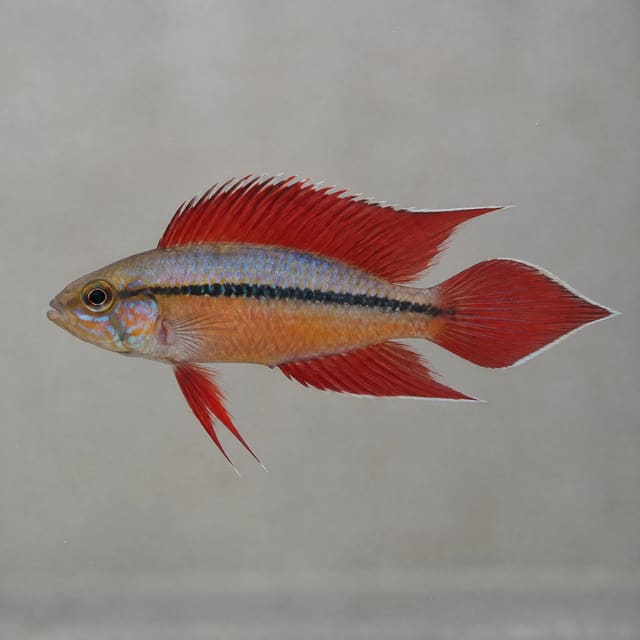
The Fire Red is a selectively bred red colour form of Agassiz's dwarf cichlid, Apistogramma agassizii, an Amazon leaf-litter cichlid that FishBase records to 4.4 cm standard length. Keep one male with several females in 54 litres or more with caves, at 26–27°C, pH 6.0–7.0 and 4–10 dGH. Sold as one unsexed fish per quantity, 3–4 cm or XL.
Care at a Glance
Scientific Name
Apistogramma agassizii
Care Level
Moderate
Temperament
Peaceful but territorial males
Temperature
26–27°C
pH Range
6–7
Hardness
4–10 dGH
Minimum Tank
54L
Diet
Micro-predator: small frozen and live foods with small granules
Water Parameters
Temperature
26–27°C
26°CGuidance range27°C
pH Level
6–7
6Guidance range7
Water Hardness
4–10 dGH
4 dGHGuidance range10 dGH
Apistogramma agassizii
Fire Red Agassiz's Dwarf Cichlid (Apistogramma agassizii 'Fire Red')
Moderate Care
Territorial
£18.99
Multi-Buy Pricing
— from £15.20 eachSave when buying multiple fish. Each quantity is one fish; sex and pair formation are not guaranteed unless the selected variant explicitly states them.
Selected fish
£34.96You save £3.02
- Live arrival guaranteed. Email photos the same day if anything is wrong. An unboxing video is optional; we recommend one when practical to help us review problems faster. How it works
- £19.95 delivery, half price from £100, free from £200, or free on the whole order with free delivery fish packs.
- Check our reviews (opens Google Business Profile in a new tab) on Google.
The Fire Red is a selectively bred red colour form of Agassiz's dwarf cichlid, Apistogramma agassizii, an Amazon leaf-litter cichlid that FishBase records to 4.4 cm standard length. Keep one male with several females in 54 litres or more with caves, at 26–27°C, pH 6.0–7.0 and 4–10 dGH. Sold as one unsexed fish per quantity, 3–4 cm or XL.
Care at a Glance
Scientific Name
Apistogramma agassizii
Care Level
Moderate
Temperament
Peaceful but territorial males
Temperature
26–27°C
pH Range
6–7
Hardness
4–10 dGH
Minimum Tank
54L
Diet
Micro-predator: small frozen and live foods with small granules
Full Care Guide
Cichlids: Types, Care & Tank Planning
Cichlids are a family of roughly 1,800 accepted species, not one care type. Before buying, identify the exact species and source, then compare adult measurement, usable tank dimensions, social system, territory, tested water, diet and an exit plan. No family-wide minimum tank, water range or tank-mate list is safe.
14 min readRead guide
Water Parameters
Read the full care guidance when planning conditions for your aquarium.
Temperature
26–27°C
26°CGuidance range27°C
pH Level
6–7
6Guidance range7
Water Hardness
4–10 dGH
4 dGHGuidance range10 dGH
A selectively bred red form of Agassiz's dwarf cichlid
The Fire Red is a colour form of Agassiz's dwarf cichlid, Apistogramma agassizii, a small cichlid from the Amazon basin that aquarists have developed into several colour forms. Biologically it is the same animal Franz Steindachner described in 1875, originally under the name Geophagus agassizii, so everything the species needs, this fish needs: warm, soft and clean water, a floor broken up with caves and leaf litter, and calm company. What has changed is the colour. Seriously Fish notes that numerous ornamental forms of this species have been selectively bred for the aquarium trade, and Wikipedia names A. agassizii among the few Apistogramma that aquarists have bred for brighter colours than the wild fish show. Fire Red is a trade name for one of those forms rather than a scientific one, which is why it sits in quotation marks after the binomial.
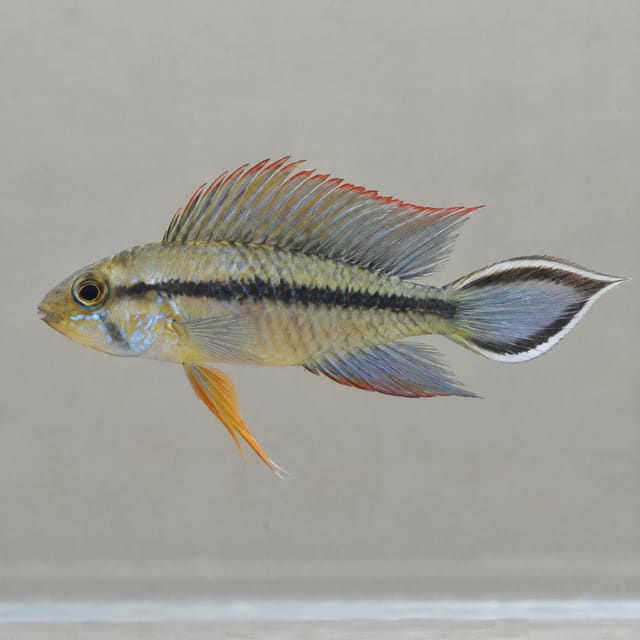
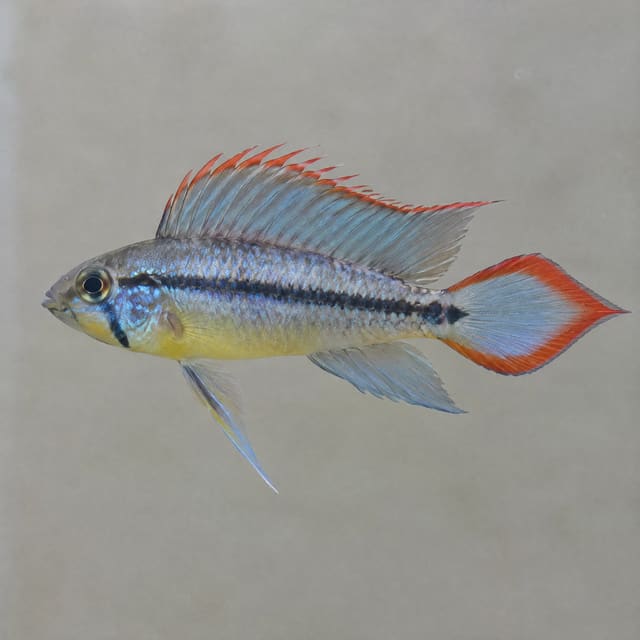
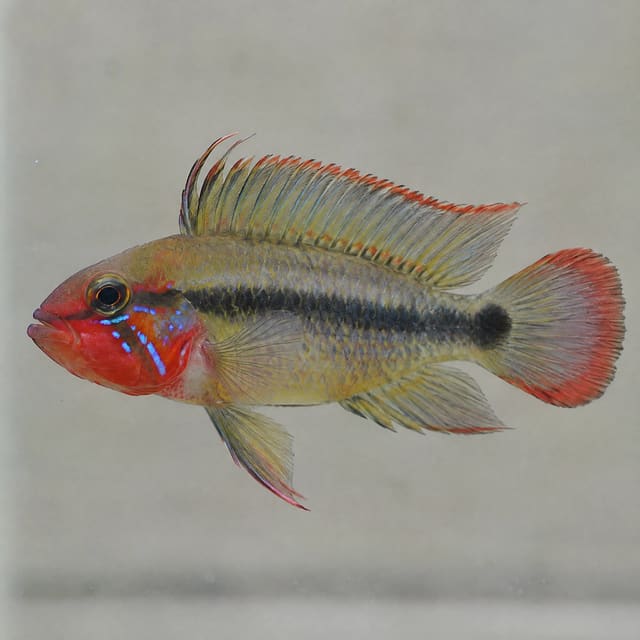
The photos on this listing show what the name refers to. The back and upper flanks are a rosy, raspberry red that fades into a pale, silvery belly. The head and gill cover are washed in orange-gold, the dorsal fin is orange with a vivid red margin, and the tail and lower fins glow flame red-orange. Small, bright blue specks are scattered across the cheek below the eye, and the eye itself is circled in turquoise. Both photographs show two fish together, one in a planted aquarium over fine gravel and one against a plain dark background, so you can judge the colour in two very different settings.
FishBase places the species in the family Cichlidae, subfamily Geophaginae, and records it as a freshwater, benthopelagic fish. In plain terms that means it lives in the lower part of the water column and spends most of its day close to the floor, picking through the bottom and patrolling a small patch of it, without being a true bottom-dweller like a loach or a catfish. The species name honours Louis Agassiz (1807–1873), the Swiss-American ichthyologist.
| Quick fact | Fire Red Agassiz's Dwarf Cichlid |
|---|---|
| Scientific name | Apistogramma agassizii (Steindachner, 1875), colour form 'Fire Red' |
| Family | Cichlidae, subfamily Geophaginae |
| Wild range of the species | Amazon basin: Peru and Brazil |
| Recorded maximum length | 4.4 cm standard length (FishBase); Seriously Fish gives males up to 7.5 cm and females up to 5 cm SL |
| Temperature we suggest | 26–27°C |
| pH | 6.0–7.0 |
| General hardness | 4–10 dGH |
| Aquarium | About 54 litres (60 × 30 cm base) for a pair; more for a harem |
| Social set-up | One male with several females |
| Care level | Moderate |
| What one quantity buys | One live fish, sex not guaranteed, in the size you choose (3–4 cm or XL) |
How big they grow and how to tell males from females
The two main sources give rather different size figures, and it is worth seeing both before you plan a tank. FishBase gives a maximum length of 4.4 cm standard length for Apistogramma agassizii. Seriously Fish lists males at up to 75 mm and females at up to 50 mm standard length. Standard length is measured from the tip of the snout to the end of the body where the tail fin starts, so the tail adds a little more on top of either number. We record the FishBase figure as the species maximum on this page because it is the published figure for the accepted name, but we would plan the aquarium around the larger Seriously Fish figure for males. A fish that turns out a little smaller than expected costs you nothing; one that outgrows a cramped layout costs you peace in the tank.
Agassiz's dwarf cichlid is clearly sexually dimorphic once mature. Seriously Fish and Wikipedia describe the same pattern: males are larger, more colourful and develop longer, more extended fins than females. Wikipedia also notes that buyers of ornamental fish tend to prefer the larger, more colourful males. That is understandable, but this is a harem species, and the set-up described further down needs females as much as it needs a male.
The key word in all of that is mature. The fin extension and full colour of a male develop as the fish grows, so at our 3–4 cm dispatch size, and to a lesser extent in the larger XL grade, you should not expect to sex every fish at a glance. That is the honest reason this listing is sold unsexed: one quantity is one fish, and we cannot promise which sex it will turn out to be. If you want to build the classic arrangement of one male with several females, buy a small group, let them grow on together, and be ready to rehome a spare male if two of them turn out to be boys in a tank that only has room for one territory-holder.
Other red forms of the same species
Breeders have produced several red forms of this cichlid and the names are not standardised between farms, so judge each fish by its own photos rather than its label. If you are comparing, we also list the Super Red Agassiz's Dwarf Cichlid, the Double Red Agassiz's Dwarf Cichlid and the Gold Red Agassiz's Dwarf Cichlid, the plainer, more natural-looking Agassiz's Dwarf Cichlid, and the Alenquer Red Tail form, a form name Seriously Fish also lists for this species. These are alternatives to choose between, not a mixed set: the social rules further down still apply, and we would suggest one colour form per aquarium so you know what any youngsters will look like.
Where the wild species lives in the Amazon
Wild Agassiz's dwarf cichlids cover an unusually large part of the Amazon basin. FishBase describes the range as running along the Amazon-Solimões from Peru through Brazil to the Capim River basin. Seriously Fish fills in the edges: the Río Ucayali in Peru marks the western limit and the Capim, a tributary of the Guamá, the eastern one, with records in between from places such as Lake Manacapuru and the Tefé area in Amazonas. Wikipedia adds the Marañón in Peru and points out that this is one of relatively few Apistogramma with such a broad distribution. Most of the genus is far more local.
It is not a fish of open, fast rivers. Seriously Fish describes it living in slower tributaries, backwaters and creeks where fallen leaf litter collects. Wikipedia describes shallow water with little current, in places where plant debris, particularly dead leaves, builds up and gives shelter from predators, and says the genus as a whole favours sheltered spots with leaf litter on the bottom and water up to about 40 cm deep. Think of a shaded forest stream that you could wade across, its bed a brown carpet of leaves, twigs and sunken branches, and you have the picture. Every hollow under a leaf or crack in a branch is a potential hiding place or nest.
The water in these places is not all alike. FishBase records adults in clear, black and white water, and Seriously Fish adds that the type can change with locality and season. It also helps explain why some wild populations are much fussier than others. Seriously Fish notes that certain wild populations may need a pH as low as 3.0 to 4.0, whereas commercially produced fish are relatively unfussy. The Fire Red is a selectively bred aquarium form, so it belongs firmly in the second group.
In the wild this is a small hunter of invertebrates. Seriously Fish says it feeds mostly on benthic invertebrates, the tiny animals living on and in the bottom. Wikipedia, drawing on field studies, reports that diet changes with the surroundings: fish from forest streams take mainly adult insects and insect fragments, while those living where streams run through pasture prefer the larvae of flies (Diptera). That is a useful guide to feeding, and we come back to it below.
FishBase lists the species as Least Concern on the IUCN Red List, assessed in November 2020, and as harmless to people. Wikipedia lists pressures on wild populations all the same: warming water linked to climate change, deforestation that affects water quality, and fishing with barbasco, a plant-derived fish poison. Buying an aquarium-bred colour form such as the Fire Red puts no demand on those wild stocks.
Setting up the aquarium: floor space, caves and soft light
The published minimums are close together. Seriously Fish suggests a base of 60 × 30 cm, roughly 54 litres, for a single pair, and says larger tanks are needed for groups. FishBase gives 60 cm as the minimum aquarium length and recommends several females for each male. The UK trade body OATA, in its dwarf cichlid care sheet, asks for at least 60 litres for a pair and at least 80 litres when other species share the tank. Wikipedia quotes a 10-gallon minimum, about 38 litres, which we would treat as a bare floor for one pair and nothing more.
Our own recommendation follows the more generous figures. Allow 54 to 60 litres for one male with one or two females, and move up to a longer tank of 80 litres or more once you add a third female or a shoal of companion fish. With this species it is the footprint that counts rather than the height. Each fish lays claim to a patch of floor, so a long, shallow tank gives more usable territory than a tall one of the same volume.
Floor and furnishings
Seriously Fish recommends a soft, sandy substrate, which suits a fish that picks food from the bottom, together with wood roots and branches. Caves are essential, since this is a cave spawner and females use them as a base. Ceramic flowerpots laid on their side and short lengths of plastic piping work just as well as anything sold for the purpose. We like to give every female her own cave with a spare or two besides, spaced so that one cannot be seen from the next. Wikipedia makes the same point about visual barriers: bogwood and plants that break the line of sight let a subordinate fish get out of view of a dominant one, and that alone defuses a good deal of squabbling.
Dried leaves are worth adding. Seriously Fish suggests beech, oak or Ketapang (Indian almond) leaves, which release tannins as they break down and act as a secondary source of food. They also recreate the brown, littered floor the fish come from and add more cover at ground level. Replace leaves as they soften and fall apart.
Plants, light and flow
Seriously Fish recommends fairly dim lighting and suggests plants that cope with it, naming Microsorum (Java fern), Taxiphyllum (Java moss), Cryptocoryne and Anubias, along with floating plants to diffuse the light. Ferns and Anubias tied to wood leave the sand free for the fish, and a layer of floating plants takes the glare off the surface. Together they give the shaded, sheltered conditions of a forest stream rather than the glare of an open river.
Filtration should be efficient but gentle. Seriously Fish advises that filtration, or at least water flow, should not be very strong, and for a tank of this size it gives a filter rated at about 110–160 litres per hour and a heater of 75–100 watts. A sponge filter or a small internal filter with its outflow turned against the glass both suit. Whatever you use, have it running and fully matured before the fish arrive: a newly set-up aquarium is the wrong home for any dwarf cichlid.
Water: warm, soft and above all steady
Published water figures for this species vary more than for most fish, largely because wild populations come from such different water types. The table below sets them side by side, with the targets we suggest for this aquarium-bred form in the last row.
| Source | Temperature | pH | Hardness |
|---|---|---|---|
| FishBase | 26–29°C | 5.0–7.0 | 0–12 dH |
| Seriously Fish | 22–29°C | Commercially produced fish relatively unfussy; some wild populations 3.0–4.0 | 0–10 dGH |
| OATA dwarf cichlid care sheet | 22–27°C | 6.0–8.0 | 4–12 dGH |
| Our suggested target | 26–27°C | 6.0–7.0 | 4–10 dGH |
The suggested target is simply the band where those sources agree. A steady 26–27°C sits inside every published range. A pH of 6.0 to 7.0 is inside FishBase's range and the OATA guidance, and is where Wikipedia's 6.0 preference falls. Hardness of 4 to 10 dGH is soft to moderately soft and fits all three. Treat these as targets rather than cliff edges: aim for the middle of the band and, more importantly, keep the water there week after week.
Before you order, test your tap water for pH and general hardness. If your readings sit well outside the target band, get in touch and we will talk through the options with you. It is far easier to sort out a water source before fish arrive than after.
Water quality matters more than the exact pH
The figures that really matter day to day are the waste products. OATA's guidance for dwarf cichlids is zero ammonia, zero nitrite, and nitrate no more than 20 mg per litre above the level in your tap water, with carbonate hardness in the soft to medium range of 3–10 dKH. Wikipedia makes the same point about nitrate control and recommends weekly partial water changes to manage it.
How you change water matters as much as how often. Seriously Fish suggests that 10–15% a week is adequate in a lightly stocked tank and warns against large water changes. The reasoning is straightforward: a big change can swing temperature, pH and hardness in one go, and that kind of sudden shift is what the advice is guarding against. Little and often, with new water matched to the tank's temperature, keeps the conditions steady. Keep stocking light, too, because a lightly stocked tank is what that 10–15% figure assumes.
Temperature has one more effect worth knowing about, though it only matters if you plan to breed: in Apistogramma studied so far, warmer water produces more male fry. We explain that in the breeding section.
Feeding a small hunter of the leaf litter
Agassiz's dwarf cichlid is a micro-predator. Seriously Fish describes it as primarily carnivorous and says it feeds mostly on benthic invertebrates in nature, and the field studies Wikipedia cites found wild fish eating adult insects, insect fragments and fly larvae depending on where they lived. In the aquarium that translates into a diet built around small meaty foods, served in mouthfuls a fish of this size can manage.
Seriously Fish lists live or frozen Artemia (brine shrimp), Daphnia and chironomid larvae (bloodworm) as suitable foods, and notes that among dried foods, pellets are preferred over flake. OATA's guidance for dwarf cichlids is along the same lines: a good quality flake or granule, supplemented with live or frozen food such as daphnia, brine shrimp or tubifex. Bloodworm is itself a fly larva, which neatly mirrors what the wild fish were recorded eating.
A sensible weekly routine looks like this:
- a small, sinking micro-granule or crumbled pellet as the everyday staple;
- thawed frozen brine shrimp, daphnia or bloodworm on several days a week, rinsed before feeding;
- live daphnia or brine shrimp now and then, which give the fish something to hunt;
- a fast day each week, when nothing goes in.
OATA suggests feeding what the fish can eat within a few minutes, once a day. With this species it pays to watch that the food actually reaches the bottom. Lively midwater companions can intercept most of a meal before the cichlids get to it, so drop food near the caves or feed the dither fish at the surface first and then put the cichlids' share in lower down. Anything still lying on the sand after a few minutes should come out; uneaten frozen food breaks down quickly and adds to the nitrate problem described above.
For the first few meals after arrival, offer a little frozen food rather than dried, keep the lights low, and do not try to make up for a refused meal by feeding more next time.
Apistogramma agassizii tank mates, temperament and harems
Wikipedia describes A. agassizii as small, sexually dimorphic and territorial, and that territorial streak governs how you stock the tank. Across the genus, Wikipedia says some species form polygamous harems while others form monogamous pairs, and the usual division of labour is that the female looks after eggs and fry while the male defends the territory around them. FishBase recommends several females for one male in the aquarium, OATA says dwarf cichlids do well as male-female pairs or as one male with several females, and our own care specification for this fish follows the same rule: one male with several females.
The aim when you set up a harem is for each female to have a cave and a small patch of floor around it, with the male's wider territory taking in several of those patches. Two males in a small aquarium is the arrangement to avoid, because both are territorial and both will want the same ground. If a group you have grown on turns out to hold two males, the reliable answer is to rehome one.
Females are not always the gentle ones. Seriously Fish warns that in smaller aquaria, females guarding eggs or fry can become hyper-aggressive, to the point where the male may need to be removed. That is one more reason to choose the larger end of the tank sizes above and to put plenty of cover between the caves.
Suitable companions
Seriously Fish notes that captive-raised fish are the recommended choice for the general community aquarium, and the Fire Red is a captive-bred form. It recommends small dither fishes, and names pencilfish (Nannostomus species) as an example; OATA likewise recommends shoals of dither fish. Dither fish are small, peaceful shoaling fish that swim openly in the middle and upper water. OATA's point is that a shoal like this gives the cichlids a sense of security without competing with them for territory.
- Good choices: a shoal of pencilfish, or similar small, peaceful midwater shoaling fish that enjoy the same warm, soft water.
- Use with care: small bottom-dwelling fish, which share the floor the cichlids defend; they need a tank large enough for everyone to have space, and plenty of cover.
- Avoid: other Apistogramma species, which Seriously Fish says this species should not be mixed with; and large, boisterous or nippy fish that would either eat small cichlids or stress them into hiding.
We suggest adding the dither fish first and letting them settle, so the cichlids arrive in an aquarium that already has calm, established company swimming in the open water.
Breeding: cave spawning and a guarding mother
The breeding pattern of Agassiz's dwarf cichlid is well documented. Seriously Fish describes a substrate spawner that normally lays its eggs in crevices or cavities among the décor. FishBase is more specific: eggs are deposited on the ceiling of caves and are tended by the female, and it records clutches of up to 150 eggs. Wikipedia's account of the genus agrees that nearly all Apistogramma spawn in small caves, in holes in sunken wood or among leaf litter, with the female giving most of the direct care to eggs and fry while the male guards the territory.
Once the eggs are laid, the female's job is the brood: Seriously Fish states that she is responsible for the care of eggs and fry after spawning. The male's role, in the genus pattern Wikipedia describes, is to defend the surrounding territory. This is the stage at which Seriously Fish warns that, in a small aquarium, a guarding female can become hyper-aggressive and the male may need to come out.
Temperature, pH and the sex of the fry
One of the more surprising things about Apistogramma is that water conditions affect the sex of the young. Wikipedia, citing a 1996 study by Römer and Beisenherz, states that in all species where it has been studied, warmer water results in more males, and, citing Ospina-Álvarez and Piferrer (2008), that in some species more acidic water also produces more males. The practical lesson for anyone hoping to raise a balanced brood is to avoid running a breeding tank at the very top of the temperature range. Our suggested 26–27°C sits inside every published range.
A note on wild populations
Wikipedia's account of field studies notes that wild females release a single batch of eggs once in each breeding season, and that spawning is staggered, with not every female spawning at the same time. Seriously Fish adds that some wild populations may need lower pH and hardness for breeding than commercially produced fish do. Those are records of wild fish, not targets for the aquarium, and Seriously Fish's wider point is that commercially produced fish are far less demanding than some wild populations.
If you plan to raise fry, give the breeding female the quietest corner of the tank, keep up the small regular water changes, and be prepared to move the companions or the male if she has run out of space to defend. A leaf-littered floor gives the fry cover and a source of tiny food from the start.
Health, stress signs and what to watch
Water quality, stress and bullying are the three things you control most directly, and all three are easier to prevent than to treat. OATA's care sheet lists the signs worth watching for: changes in swimming behaviour such as hanging at the surface, sitting on the bottom or swimming erratically; changes in colour; changes in aggression; a change in breathing rate; and the development of white spots or fluffy growths on the body or fins. A short look at the tank every day, ideally at feeding time, is the best early-warning system there is.
If something looks wrong, test the water before reaching for a remedy. If ammonia or nitrite reads above zero, or nitrate has crept well above your tap level, put that right first; a modest water change is often the most useful single step. Avoid the temptation of a very large change, for the reasons Seriously Fish gives: sudden swings in temperature and chemistry stress this fish more than gradual ones.
Be careful with copper
Wikipedia notes that Apistogramma agassizii is highly sensitive to copper exposure. Copper turns up as an ingredient in some aquarium treatments. Read the label of any medicine before you dose a tank holding these fish, and if in doubt, ask us first. The same caution applies to plant fertilisers and other additives that list copper among their ingredients.
Bullying in a harem
Watch the females as well as the male. A female who never leaves the top corner, has split or ragged fins, or is chased the moment she appears is being pushed out of the floor space. The fix is more space and more cover: another cave, more plants or wood to break the sightlines, or a larger tank. If one particular fish is behind most of the trouble, moving that fish usually settles the rest.
OATA lists a change in colour among the signs to note. When a fish looks washed out, run through the same checks in order: test the water, look for a bully, check the lighting and cover, and only then think about disease.
What you receive, and settling your fish in
This listing sells one live Fire Red Agassiz's Dwarf Cichlid per quantity. Choose the size option first, either 3–4 cm or XL, then set the quantity to the number of fish you want. The size you choose is the size of the fish we send, not the size it will reach as an adult, and XL is simply our larger dispatch grade of the same colour form. Sex is not guaranteed. If you are hoping to set up one male with several females, buy several fish so the group can sort itself out as they mature.
Before the parcel arrives
Please read our delivery and live-arrival information before ordering. The aquarium must be ready before the fish come: filter running and matured, water tested, and temperature already at the level the fish will live in. Someone needs to be at the delivery address to receive the parcel, because live animals cannot be left on a doorstep. We email your confirmed delivery date and tracking details so you know when to expect it.
The fish travel in oxygen-filled bags inside insulated packaging, with heat packs when the weather calls for them, and are carried by a tracked courier licensed to transport live animals.
Opening the box
Start a continuous video on your phone while the parcel is still sealed, then open it in the same take and show the fish in their bag before the bag is opened. That unbroken video is what our live-arrival guarantee relies on; photos alone do not meet the policy. If a fish arrives dead, dying or clearly compromised, email hello@tropicalfishco.co.uk on the day of delivery with your order number and the video. Depending on the guarantee terms, we will replace the affected fish with your next order or refund it.
Acclimation and the first week
- Turn the aquarium lights off or down.
- Float the sealed bag in the aquarium for 20–30 minutes so the water temperature evens out. This matches temperature only, not pH or hardness, so if your tank water is very different from what this page suggests, ask us for advice before the fish arrive.
- Net the fish out of the bag and into the aquarium.
- Discard the bag water. Never pour it into the tank.
Keep the lights low after release and over the first week watch three things closely: breathing, appetite and behaviour. Fast or laboured breathing, refusing food for several days, or a fish that stays pinned in one corner are reasons to test the water and get in touch. A fish that is eating and exploring the floor is settling in well.
Further reading
These are the sources we used for the facts on this page. They are worth reading in full if you want to go further with this species.
- FishBase: Apistogramma agassizii: accepted name, family, recorded length, environment, temperature, pH and hardness ranges, distribution, cave spawning and conservation status.
- Seriously Fish: Apistogramma agassizii: wild habitat, aquarium size and furnishing, water, diet, behaviour, sexual differences and reproduction.
- Wikipedia: Apistogramma agassizii: range, habitat, wild diet, breeding biology of wild females, copper sensitivity and threats.
- Wikipedia: Apistogramma: genus habitat, cave spawning, parental roles and the effect of temperature and pH on the sex of fry.
- OATA: How to look after dwarf cichlids: UK trade guidance on water quality, feeding, social groups and health signs.
Customer Reviews
No reviews for this item yet. Bought one? Honest reviews only, good or bad.
What customers say about ordering from us
4.6 on Google Maps, rated 4.6 out of 5 (opens in a new tab)4.4 · 123 shop reviews read them, rated 4.4 out of 5
- 5 out of 5Verified buyer
Easy website plenty of info on fish your buying great to pick a time slot
TRACEY DURRANT · 7 Oct 2026
- 4 out of 5Verified buyer
Got some lovely fish thank you
Kevin Mackie · 7 Oct 2026
Reviews of our shop, collected by Judge.me, an independent third-party review collector. Newest first.
Licensed Courier
Moved by UK carriers licensed to handle live animals
Trained Packing
Hand-packed with oxygen bags, poly box, heat pack
Live Arrival Guarantee
Email photos the same day; an optional unboxing video helps us review problems faster — claim terms apply
Pay Later Available
Klarna & PayPal Pay in 3 at checkout
You Might Also Like
Moderate
Moderate
Moderate
More in This Category
Advanced
Moderate

Moderate
Moderate

Moderate
Best Sellers

Easy

Moderate


Moderate
Black Venezuela Corydoras (Corydoras sp. Black Venezuela)
22–26°C · pH 6–7.8 · 75L
From £7.99Some sizes on sale


Moderate

Moderate

Moderate