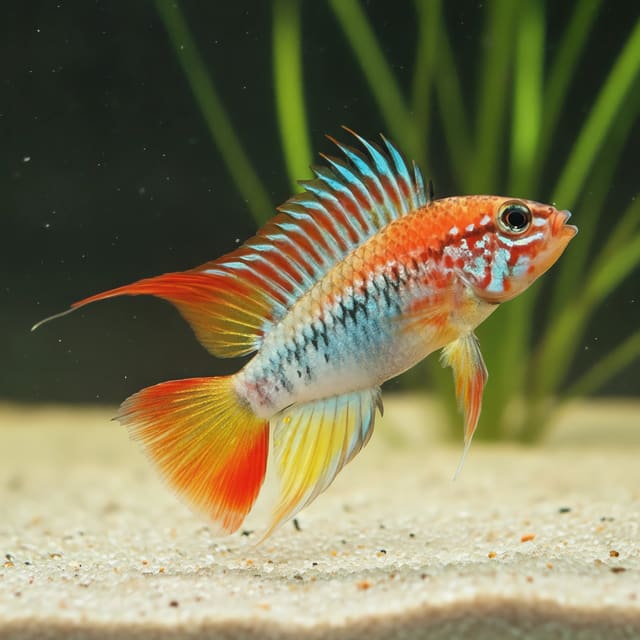
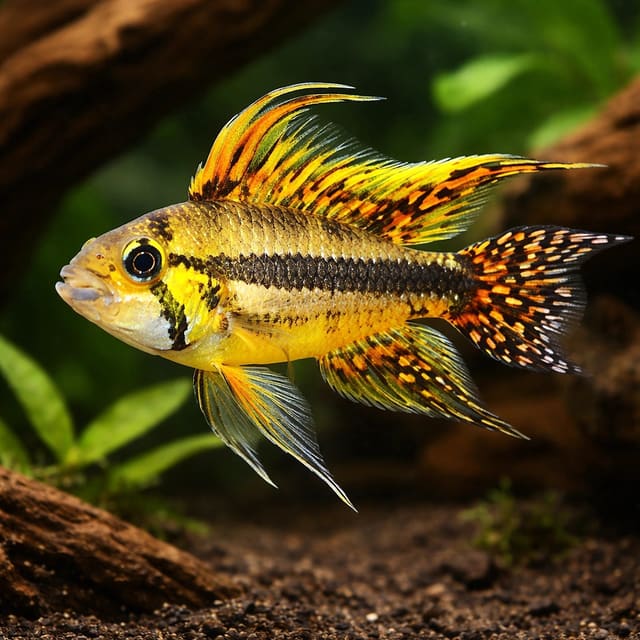
Pandurini Dwarf Cichlid (Apistogramma panduro)
22–27°C · pH 6–6.5 · 54L
£15.99

Hoignei Dwarf Cichlid (Apistogramma hoignei) is a cave-spawning Orinoco cichlid reaching about 6 cm standard length. Provide a mature 60 L+ aquarium, stable soft water, fine foods, several caves and separation if pair or breeding aggression develops.
Apistogramma hoignei
Save when buying multiple fish. Each quantity is one fish; sex and pair formation are not guaranteed unless the selected variant explicitly states them.
Confirm your email, then we’ll send an availability message for this exact item if it returns within 180 days.
This request is only for this product—no newsletter or other promotions. A mail-provider retry may very rarely duplicate the same availability message. Unconfirmed addresses are removed after 48 hours. See our privacy policy.
Hoignei Dwarf Cichlid (Apistogramma hoignei) is a cave-spawning Orinoco cichlid reaching about 6 cm standard length. Provide a mature 60 L+ aquarium, stable soft water, fine foods, several caves and separation if pair or breeding aggression develops.
Cichlids are a family of roughly 1,800 accepted species, not one care type. Before buying, identify the exact species and source, then compare adult measurement, usable tank dimensions, social system, territory, tested water, diet and an exit plan. No family-wide minimum tank, water range or tank-mate list is safe.
Maintain these water conditions for optimal health and vibrant colors
Hoignei Dwarf Cichlid (Apistogramma hoignei) is a small cave-spawning cichlid from the Orinoco River basin. Males can reach about 6 cm standard length, while females are generally smaller and become strongly territorial around eggs and fry. This is a compact fish, but it still needs a mature aquarium with floor space, visual barriers, stable warm water and carefully chosen companions.
The species suits an aquarist who enjoys subtle behaviour as much as colour. A settled fish explores wood, leaves and cave entrances, watches activity above it and responds quickly at feeding time. During breeding, a female can defend a surprisingly large area for her size. Plan the social layout before choosing the dispatch size or adding other bottom-dwelling fish.
| Accepted scientific name | Apistogramma hoignei Meinken, 1965 |
|---|---|
| Family | Cichlidae |
| Natural range | Orinoco basin, including Portuguesa, Aracua, lower Caura and lower-mainstream drainages |
| Published maximum | 6 cm standard length for male/unsexed fish |
| Lower aquarium plan | About 60 L for one fish or a carefully observed compatible pair |
| Practical temperature | 24-28 C; FishBase publishes 23-29 C |
| Practical pH | 5.5-7.0, stable |
| Practical hardness | 2-10 dGH |
| Temperament | Measured outside breeding; strongly territorial around caves and fry |
| Diet | Small sinking pellets plus varied frozen or trusted live invertebrate foods |
| Breeding | Eggs attached to cave ceilings; female guards eggs and larvae |
The pH and hardness figures are practical aquarium targets rather than a claim that every Orinoco locality is identical. Test source water, keep ammonia and nitrite at zero and avoid sudden chemical adjustment. Stable conditions within a sensible range are safer than repeatedly chasing an exact number.
Apistogramma hoignei is an accepted species in FishBase and the GBIF taxonomic backbone. The species was described by Meinken in 1965 and is named for aquarist and collector Emil “Leo” Hoigne. It should not be presented as a colour morph of a more common Apistogramma or as a generic “South American dwarf cichlid.”
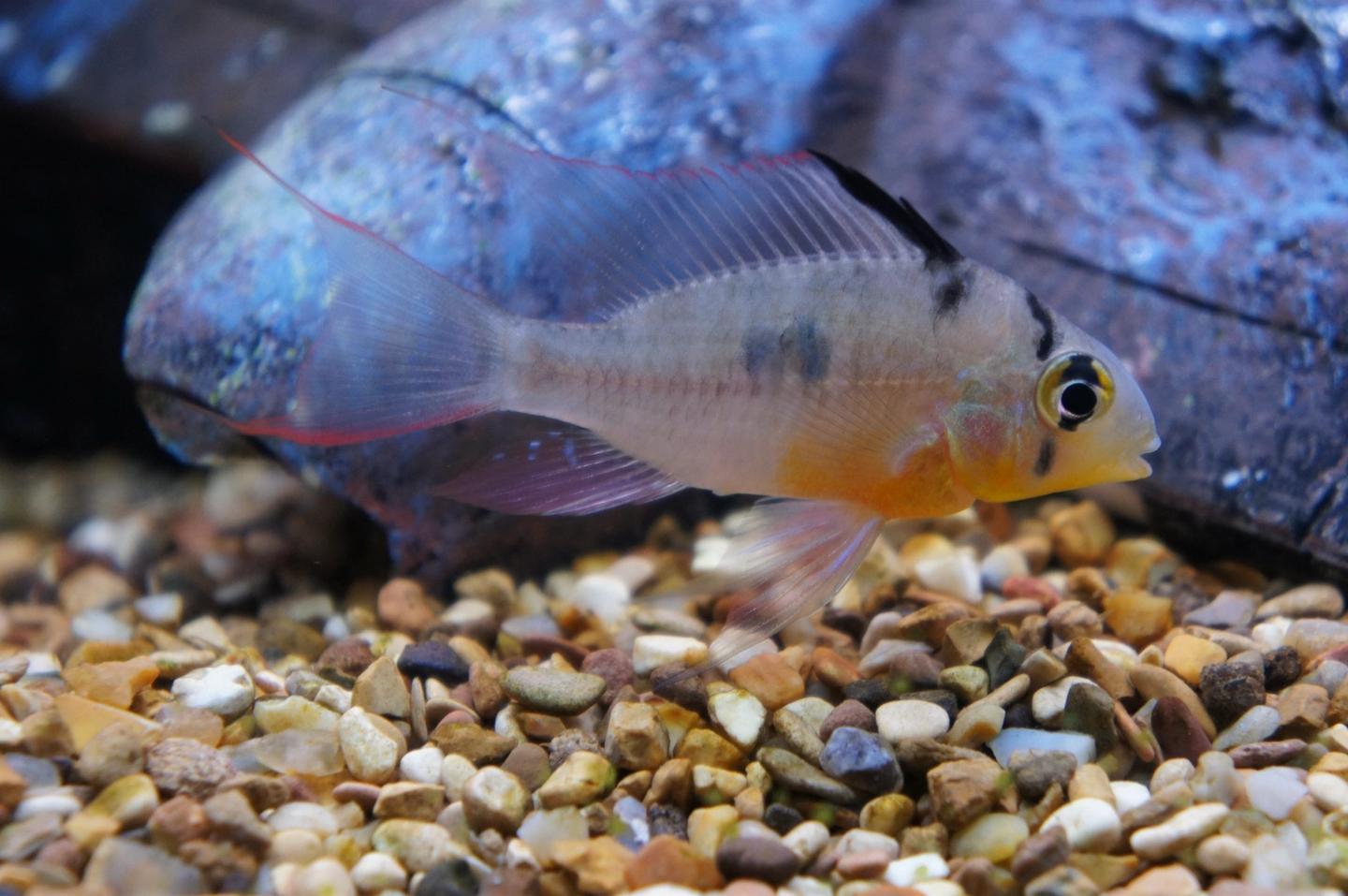
Trade photographs can show differences in colour, fin extension and body pattern because age, sex, mood, lighting, social status and collection or breeding line all affect appearance. The listing identifies the species, but it cannot guarantee sex, an identical pattern, pair compatibility or future breeding colour.
FishBase records the species from the Orinoco River basin in the Portuguesa, Aracua and lower Caura drainages, as well as the lower main channel towards Barrancas. This is a geographic identity, not permission to label every shop fish with a precise locality or wild-caught status. No locality, generation or collection claim is made unless it is specifically documented for the batch.
For aquarium design, focus on features that support small territorial cichlids: subdued zones, fine substrate, leaf litter suitable for aquarium use, wood, plants and several cave-like shelters. Keep open lanes for feeding and inspection. A tank packed with one solid wall of decor can look natural while leaving no useful territories or escape routes.
Botanical materials can release tannins and create cover, but they also decompose. Add them gradually, use aquarium-safe leaves and remove material that is fouling the water. Darker water is not automatically clean water; filtration, oxygenation and testing still matter.
The published maximum is 6 cm standard length, measured without the tail fin. Total visual length can therefore appear greater. Males are usually larger and may develop longer fins and stronger colour, while mature females are generally smaller and can become yellow when guarding a brood. Juveniles and stressed fish can be difficult to sex reliably.
Do not select a social plan solely from an assumed sex in a dealer aquarium. A supposed pair may prove to be two males, two females or simply incompatible individuals. Keep cycled separation available and assess behaviour after the fish settle.
| Observation | Possible meaning | Responsible response |
|---|---|---|
| Both fish feed and use separate cover without relentless pursuit | Compatibility may be developing | Continue observation and preserve escape routes |
| One fish remains pale, clamped or hidden | Persistent social pressure or illness | Check water and separate before weight loss or injury |
| Female colours strongly and guards a cave | Breeding territory may be active | Protect the defended zone and monitor every tank mate |
| Brief display without injury | Normal assessment can be possible | Watch duration and access to food rather than assuming all display is harmless |
The selector describes approximate dispatch size, not adult size. A 3-4 cm fish needs fine foods, protected filter intakes and close body-condition checks. An XL fish still needs gradual acclimation and the same long-term territory. The larger variant does not guarantee male sex, dominant status or breeding readiness.
Natural live-fish measurements are approximate because the animal does not hold still against a ruler. Individuals within one band may differ slightly in length and colour. Choose the size that suits the established aquarium and companions, not a temporary tank.
About 60 litres is a lower plan for a single fish or a carefully monitored compatible pair in a well-designed aquarium. Floor dimensions and territory are more important than height alone. A longer aquarium offers more scope for separate caves and broken sight lines than a narrow tall tank with the same volume.
A trio or group should not be treated as an automatic 60-litre setup. Multiple females need distinct territories and the ability to avoid the male and one another. Use a substantially larger footprint, several cave clusters and backup accommodation. Individual behaviour varies, so no stocking formula can guarantee peace.
| Social plan | Space guidance | Main risk |
|---|---|---|
| Single specimen | About 60 L with cover and calm companions | Choosing boisterous fish that prevent feeding |
| Compatible pair | 60 L lower plan; larger is easier to manage | Pair rejection or breeding aggression |
| One male with multiple females | Substantially larger footprint with separate cave territories | One female being trapped between territories |
| Mixed dwarf cichlids | Specialist large layout only | Overlapping lower-level territories |
Use the tank-volume tool to estimate filled volume after substrate and hardscape. Then judge floor area, cave placement and adult stocking rather than treating the calculated litres as the entire answer.
The cycle tracker can organise test evidence. Bottled bacteria may help establish a filter, but the aquarium is not ready until testing shows that waste is being processed consistently.
Use moderate or subdued lighting with shaded areas beneath wood, floating plants or broad leaves. Bright light across the entire floor can make a small cichlid reluctant to leave cover. A gradual lighting schedule is preferable to an abrupt switch from complete darkness to intense light.
Plants such as Anubias, Java fern, Cryptocoryne and suitable floating species can divide sight lines without using all the floor area. Choose plants that suit the water chemistry and lighting rather than adding them only as decoration. Keep roots and rockwork stable because a fish inspecting a cave should not be able to undermine a heavy structure.
Leaf litter can support natural foraging and visual cover, but it requires maintenance. Use known aquarium-safe leaves, rinse or prepare them appropriately and add a small amount at first. Decomposition consumes oxygen and creates fine debris, so observe filter flow and remove material that becomes foul rather than assuming every brown layer is a healthy biotope.
| Feature | Benefit | Management point |
|---|---|---|
| Floating plants | Shade and security | Prevent complete surface coverage and stagnant areas |
| Rooted plants | Territory boundaries | Protect roots from digging and retain open feeding lanes |
| Wood | Caves, shade and structure | Make every piece stable and avoid trapping gaps |
| Leaf litter | Cover and foraging complexity | Add gradually and remove fouling material |
| Dark background | Reduces visual exposure | Still provide enough light to inspect health |
Provide more caves than fish. Coconut shells, ceramic caves, wood gaps and stone structures can work when stable and smooth. Entrances should allow the fish to enter without becoming trapped, and the structure must not collapse during maintenance or digging.
Place caves so one fish cannot watch every entrance from a single central position. Wood, dense plants or leaf clusters can divide the floor into visual zones. Keep at least one retreat away from the main feeding area so a subordinate fish does not have to cross a dominant individual's territory for shelter.
Breeding females often defend a tight area around a cave, but the effective territory can expand after fry become free swimming. A layout that works for a non-breeding pair may fail once a brood is mobile. Reassess rather than blaming a chased tank mate for entering the wrong place.
Do not place a new fish directly into an established individual's only cave territory. Rearrange some boundaries, add extra shelters and introduce fish with lights dimmed after confirming water compatibility. Watch from a distance at first, then check repeatedly through the day rather than deciding the introduction succeeded after ten quiet minutes.
Brief display, fin spreading or short pursuit can occur while fish assess one another. Continuous chasing, blocking access to food, pinning a fish near the surface or forcing it to remain dark and clamped is not a healthy hierarchy. Separate before physical injury or prolonged starvation.
A trio needs still more preparation. Two females may not divide the aquarium neatly, and the male may focus attention on one individual. More fish do not automatically spread aggression safely; sometimes they create overlapping conflicts.
Maintain a practical 24-28 C, pH 5.5-7.0 and 2-10 dGH. FishBase publishes a 23-29 C temperature range, but using the extremes as a permanent target provides less margin for mistakes. Warm water holds less oxygen, so filtration and surface movement become increasingly important at the upper end.
| Ammonia | 0 mg/L |
|---|---|
| Nitrite | 0 mg/L |
| Nitrate | Controlled through stocking, feeding and measured water changes |
| Temperature | 24-28 C practical target |
| pH | 5.5-7.0, stable |
| Hardness | 2-10 dGH practical target |
| Flow | Gentle to moderate with no stagnant waste pockets |
Use the water matcher to compare source water. If tap water is far outside the target, plan a repeatable water-preparation method before buying the fish. Sudden pH changes are more dangerous than a stable value that is slightly away from an imagined optimum.
Start with weekly partial water changes and adjust from nitrate, stocking and feeding. Match replacement water closely for temperature and chemistry. Siphon visible waste from open sand while leaving biological media and established territories as undisturbed as practical.
Deep-cleaning the filter, replacing substrate and making a large chemistry change on the same day can remove biological stability and territory cues together. Stagger major work and monitor afterwards.
A mature sponge, internal or external filter can work. Choose the system for the aquarium's total bioload, not the fish's small body size. Position the outlet to move waste towards the intake without blasting cave entrances or forcing the fish to swim constantly.
Keep the surface moving and the lower aquarium free from stagnant debris. During hot weather or medication, additional aeration can add resilience. An air stone does not correct ammonia or an overloaded filter, so investigate the cause of rapid breathing rather than treating bubbles as a complete solution.
Use a quality small sinking cichlid pellet or soft micro granule as a prepared base. Rotate frozen or trusted live foods such as cyclops, daphnia, brine shrimp, mosquito larvae and appropriately sized bloodworm. The fish's small mouth and deliberate feeding style make particle size and tank-mate competition important.
| Food | Role | Use |
|---|---|---|
| Small sinking cichlid pellet | Regular complete base | Choose a particle the fish can take cleanly |
| Frozen cyclops, daphnia or brine shrimp | Variety and conditioning | Rotate small thawed portions |
| Suitable bloodworm or mosquito larvae | Occasional richer food | Use as part of a varied diet, not the sole staple |
| Trusted live food | Natural feeding enrichment | Use only from a reliable source |
| Large hard pellets | Poor fit | Avoid pieces that cannot be swallowed easily |
Feed adults once or twice daily in modest portions, spreading food near more than one territory. Remove leftovers. In a community, watch the fish eat rather than assuming food reaching the bottom is enough. Persistent refusal, spitting, weight loss or a hollow abdomen needs investigation.
There is no universal number of pellets because brands vary in density and size. Start with a measured small amount, observe how quickly it is eaten and adjust the next meal. Food should not remain inside caves or beneath wood after the fish stop feeding.
View the fish from the side and above at regular intervals. A healthy abdomen should not remain pinched, while sudden swelling is not normal growth. Compare photographs taken from a similar angle each month; slow weight loss can be hidden by colour and fins.
| Observation | Possible cause | First response |
|---|---|---|
| One fish rushes out but spits every pellet | Particle too large, food not accepted or mouth problem | Offer a smaller appropriate food and inspect closely |
| Subordinate fish never reaches food | Territorial exclusion | Use another feeding point and prepare separation |
| Persistent hollow abdomen | Underfeeding, competition or illness | Observe eating, test water and investigate in quarantine |
| Food remains after ten minutes | Portion too large or fish stressed | Remove it and reassess before the next meal |
| Rapid weight gain and rising nitrate | Overfeeding | Reduce portions and review maintenance |
Conditioning food for breeding should increase variety, not create chronic excess. Heavy feeding without matching water changes can produce exactly the unstable conditions that cause eggs, adults and fry to fail.
Outside breeding, this species can be measured and suitable for a carefully planned community. It is still a cichlid. Males may defend space from similar fish, and females guarding eggs or fry can attack bottom dwellers that repeatedly approach the cave.
| Companion | Assessment | Condition |
|---|---|---|
| Small peaceful tetras | Often suitable | Match water and choose fish too large to be viewed as food |
| Peaceful pencilfish or hatchetfish | Often suitable | Provide a secure lid and appropriate group size |
| Corydoras | Conditional | They may enter breeding territories and be attacked |
| Other Apistogramma | Usually avoid in modest aquariums | Territories overlap at the same level |
| Large aggressive cichlids | Avoid | Bullying and predation risk |
| Fast boisterous feeders | Avoid or manage carefully | Hoignei may lose access to food |
Use the tank-mates tool as an initial screen, then judge actual adult size, swimming level, water range and breeding behaviour. The South American dwarf-cichlid collection helps compare identities, but species in the same category are not automatically compatible.
Stocking examples illustrate decisions, not guaranteed recipes. Aquarium dimensions, source water, filtration and individual behaviour can change the result. Add fish gradually and quarantine each group.
In a mature 60-litre-plus long aquarium, one male may share with a restrained group of small peaceful tetras that use the middle water. Provide caves and keep the lower zone free from another territorial cichlid. This is simpler than forcing an unverified pair and can still show confident natural behaviour.
A pair can use a well-divided 60-litre aquarium, but a larger footprint gives more safety. Limit other bottom fish, provide several caves and monitor the male if the female spawns. A small upper-level dither group may be possible where water and space suit.
Use substantially more floor area with separate cave clusters that cannot all be watched from one point. Observe whether both females feed and hold viable territories. Move a fish if it remains excluded; do not wait for torn fins to prove the layout failed.
This can work outside breeding in a larger aquarium, but risk increases when a female guards eggs or fry. Corydoras forage without recognising her boundary. Provide distance between caves and open sand, then be ready to relocate the catfish or cichlid family.
A modest aquarium is unsuitable because similar fish compete for the same lower territories. A specialist keeper may design a much larger complex layout, but the safer general recommendation is one dwarf-cichlid species per territorial zone.
Small shrimp and shrimplets can be hunted. Adult shrimp may survive in dense cover, but this is not a shrimp-safe guarantee. Snails are usually ignored, although eggs and very small individuals may be sampled.
Bottom fish create the greatest territorial conflict. Corydoras do not recognise cave boundaries and may repeatedly enter a brooding female's area. Plecos can compete for caves, while loaches may be too active. If bottom companions are important, provide a larger footprint and be prepared to separate them during breeding.
FishBase records eggs attached to cave ceilings and female care of eggs and larvae. A receptive female chooses or prepares a sheltered site. After spawning, she may exclude the male and aggressively defend the cave. The male needs enough room to retreat.
Do not assume a male and female will form a compatible pair. Fertility, hatch time and brood survival vary with maturity, water, temperature and disturbance. Avoid repeatedly opening the cave to check eggs; stress can cause abandonment or egg loss.
Once fry are free swimming, the female may lead them around the lower aquarium. Use gentle filtration and fine foods such as suitable rotifers, microworms or newly hatched brine shrimp according to fry size. Feed small amounts several times daily while protecting water quality.
Remove uneaten food carefully and monitor growth differences. Larger fry can outcompete smaller siblings. As juveniles mature, territories and sex ratios become important; do not assume the family can remain indefinitely in the breeding aquarium.
Successful breeding begins with healthy mature fish, not a sudden attempt to crash pH or temperature. If source water is harder than the intended breeding range, prepare softer water through a controlled repeatable method and confirm mineral content. Large abrupt changes can stress or kill the adults even if a forum labels them a spawning trigger.
Condition fish over time with varied small foods and frequent observation. A female inspecting caves is not proof that spawning is imminent. Avoid repeatedly lifting caves, shining bright lights inside or moving the aquascape around her.
If eggs fail, review fertility, water quality, temperature, disturbance and fungal spread before applying treatment. Some failed eggs in a clutch do not justify dosing the entire display aquarium. A separate breeding setup makes observation and fry-safe filtration easier.
| Stage | Keeper priority | Avoid |
|---|---|---|
| Conditioning | Varied food and stable water | Chronic heavy feeding |
| Cave selection | Privacy and multiple options | Opening the cave repeatedly |
| Egg care | Female security and oxygenated clean water | Unnecessary medication |
| Larvae | Stable conditions and protected intake | Large maintenance disturbance |
| Free-swimming fry | Correct food size and frequent small feeds | Allowing waste to accumulate |
Colour depends on sex, maturity, social status and environment. Males may show stronger body and fin markings, while brooding females can become bright yellow with dark patterning. Newly arrived fish often look subdued. Stable water, cover and appropriate companions allow natural colour to develop.
Dark substrate and tannin-stained water can change photographic appearance. Store images show representative views, not a promise of identical hue or fin length. Assess health from body condition, breathing, fins and behaviour rather than colour alone.
A healthy fish feeds deliberately, holds its fins open and moves between cover without continuous panic. Warning signs include rapid breathing, clamped fins, white spots, frayed fins, hollow abdomen, swelling, flashing or persistent isolation.
Test water before medication. Ammonia, nitrite, low oxygen, temperature swings and aggression can resemble disease. Correct environmental problems safely, then seek an informed diagnosis. Do not combine medicines without evidence that the mixture is appropriate.
Quarantine new fish in a heated, filtered, fully cycled aquarium with matched water, cover and observation access. Use separate nets and siphons where possible. Quarantine is not punishment; it is a controlled period to verify feeding, breathing, faeces, skin and fins.
When several fish suddenly breathe rapidly, lose balance, clamp their fins or crowd the surface, check ammonia, nitrite, temperature, oxygenation, filter operation and recent chemical exposure immediately. Increase safe aeration and prepare matched dechlorinated water while identifying the cause.
If only one fish is affected, compare its body condition, skin, fins, faeces and social access with the others. Moving it can improve observation, but an uncycled hospital container may make the problem worse. Isolation needs mature filtration and matched water.
After a long power cut, water inside a closed external filter may be oxygen-depleted and foul. Assess it before restarting full flow into the aquarium. Once filtration returns, monitor ammonia and nitrite because biological capacity may have fallen.
The species has a published 23-29 C range, but sustained heat near the upper end reduces oxygen margin and increases metabolism. During a heatwave, measure the aquarium, improve surface movement, reduce unnecessary lighting heat and feed conservatively.
A fan can cool by evaporation, but evaporation removes water rather than minerals. Top up appropriately and continue normal water changes. Do not add loose ice or create a sudden cold shock. In winter, use a reliable guarded heater and verify it with an independent thermometer.
| Claim | Better guidance |
|---|---|
| “Dwarf cichlid means nano fish” | Small length does not remove territory, water-quality or group-planning needs |
| “One male and three females fit in 60 litres” | A trio needs substantially more floor area and multiple defensible territories |
| “Corydoras are always ideal tank mates” | They can be attacked when they enter a breeding cave territory |
| “Soft-water fish need sudden pH lowering” | Use a stable repeatable preparation method and avoid abrupt chemistry changes |
| “Yellow colour always proves female sex” | Sex, maturity, mood and breeding condition all affect appearance |
| “Cave spawning means the male and female stay together” | The brooding female may exclude the male and require separation |
Prepare the aquarium before delivery. Dim the lights, confirm temperature and water chemistry, and ensure the filter is working. Follow the supplied acclimation instructions and do not add transport water to the aquarium.
Release the fish near calm cover, then allow it to choose shelter. Offer a small meal once it has settled and remove leftovers. Check access to food and watch whether an existing territorial fish blocks the new arrival.
Use the acclimation timer to organise the process. Review packing, eligible routes and claim requirements on the live-fish delivery page.
Choose by water, adult size, behaviour and available territory rather than colour alone. The Red Hongsloi Dwarf Cichlid offers another species from the wider Orinoco region. The Apistogramma cf. viejita II pair listing illustrates why trade identity needs cautious wording.
For different body patterns and social planning, compare Pandurini Dwarf Cichlid, Red-Tailed Dwarf Cichlid and Yellow Head Borelli Dwarf Cichlid. Each still needs its own researched care range and cannot be mixed automatically.
This fish suits a keeper with a mature aquarium, stable soft to moderately soft water, fine foods and time to watch territorial behaviour. It is a poor fit for a new uncycled tank, a hard-water community with no preparation method, a crowded bottom zone or a setup with no way to separate an incompatible pair.
Before ordering, confirm actual filled volume, pH, hardness, temperature, existing bottom stock, cave layout and quarantine plan. A small adult length does not remove the need for territory and observation.
FishBase reports a maximum of 6 cm standard length for male or unsexed fish. Females are generally smaller, and total length including the tail can look greater.
About 60 litres is a lower plan for a single fish or carefully monitored pair. A trio or mixed dwarf-cichlid setup needs substantially more floor space and separate territories.
A practical stable target is 24-28 C. FishBase publishes 23-29 C, but the extremes leave less margin for error.
Sometimes, but Corydoras may enter a breeding cave territory and be attacked. Use a larger footprint and prepare separation if breeding aggression develops.
Only in a substantially larger, well-divided aquarium with separate cave territories. Do not treat a 60-litre tank as a guaranteed trio setup.
Use small sinking cichlid pellets with varied frozen or trusted live foods such as cyclops, daphnia and brine shrimp.
Yes. Provide several stable cave options plus wood, plants or leaves that break sight lines.
Eggs are attached to cave ceilings and the female cares for eggs and larvae. She may become strongly territorial and exclude the male.
It can be measured outside breeding, but males defend space and brooding females can be aggressive. Compatibility cannot be guaranteed.
It is better for a prepared keeper who understands cycling, water chemistry, small-food feeding and territorial cichlid behaviour.
No reviews for this item yet. Bought one? Honest reviews only, good or bad.
What customers say about ordering from us
I have a small group of long finned mountain minnows. So was delighted to be able to order ten of this variety to increase the genetics in my tank . The ones I recieved are healthy but it’s to early to give a verdict on wether they are of a long finned type since they are small currently.
Gordon Walker · 23 Sept 2026
100% success travel and "installation". Pleased with quality of purchase. The Siamese fighter a bit "shy" so have not yet seen him at his best yet but looking good. Happy customer. GG
George E Garratt · 21 Sept 2026
Reviews of our shop, collected by Judge.me, an independent third-party review collector. Newest first.