Blue Neon Tiger Parrot Cichlid
22–27°C · pH 6.5–8
£15.99

The Electric Blue Acara (Andinoacara pulcher) is a cichlid from Trinidad and Venezuela that reaches 16 cm. It suits a prepared beginner with at least 100 cm aquarium length; OATA says most American cichlids do better singly or in pairs, and the FishBase, Seriously Fish and OATA overlap is 22–23°C and pH 6.5–8.0. Sold individually in 2–2.5 cm, 4–5 cm and 6–7 cm dispatch sizes.
Adult size is the maximum length this species reaches at full maturity (scientific sources). The livestock you receive will be younger and smaller — pick a size above for the actual shipping size. Product-photo provenance and any image-specific limitations are stated on the listing.
Save when buying multiple fish. Each quantity is one fish; sex and pair formation are not guaranteed unless the selected variant explicitly states them.
The Electric Blue Acara (Andinoacara pulcher) is a cichlid from Trinidad and Venezuela that reaches 16 cm. It suits a prepared beginner with at least 100 cm aquarium length; OATA says most American cichlids do better singly or in pairs, and the FishBase, Seriously Fish and OATA overlap is 22–23°C and pH 6.5–8.0. Sold individually in 2–2.5 cm, 4–5 cm and 6–7 cm dispatch sizes.
Adult size is the maximum length this species reaches at full maturity (scientific sources). The livestock you receive will be younger and smaller — pick a size above for the actual shipping size. Product-photo provenance and any image-specific limitations are stated on the listing.
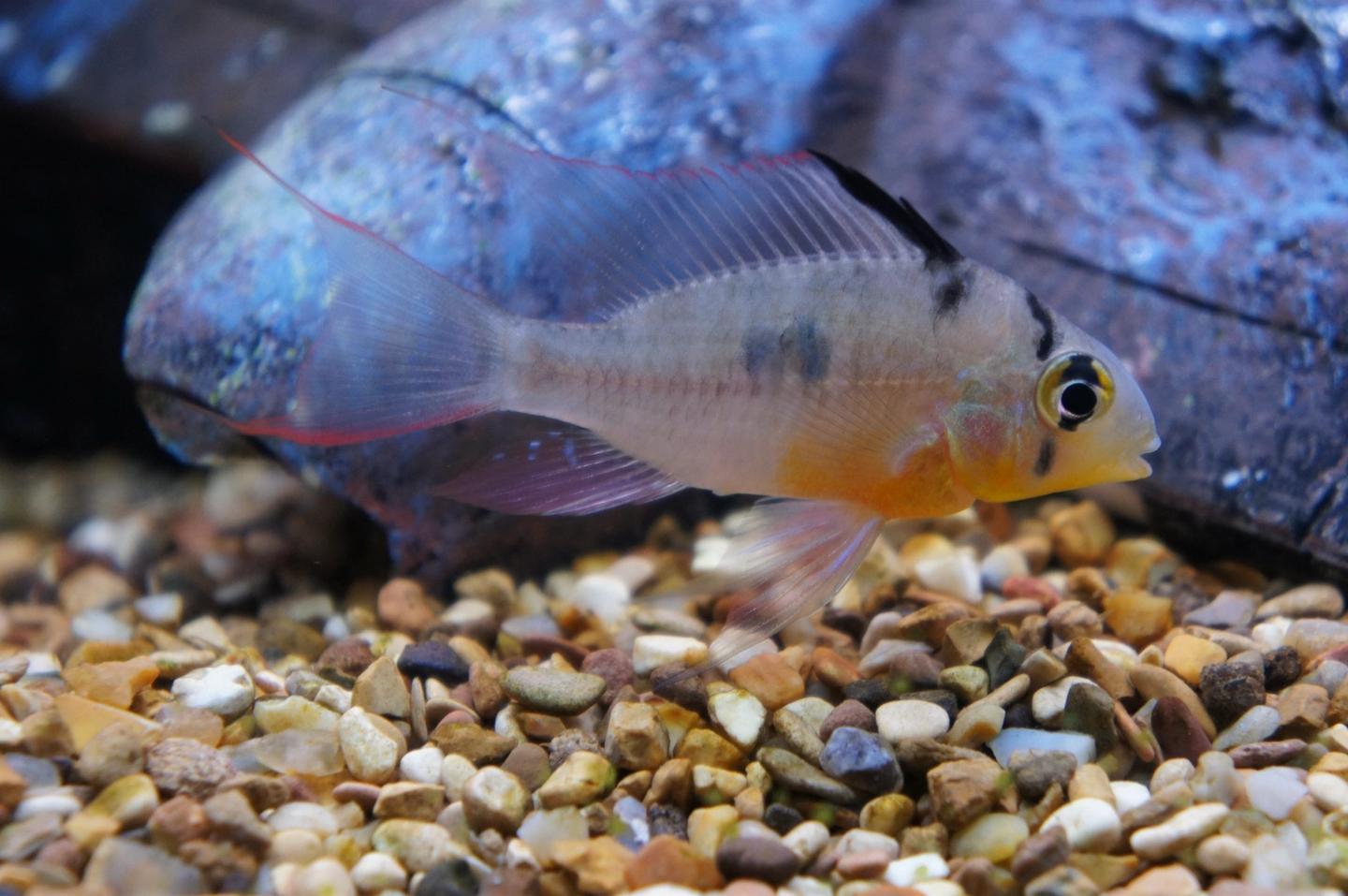
Cichlids are a family of roughly 1,800 accepted species, not one care type. Before buying, identify the exact species and source, then compare adult measurement, usable tank dimensions, social system, territory, tested water, diet and an exit plan. No family-wide minimum tank, water range or tank-mate list is safe.
Maintain these water conditions for optimal health and vibrant colors
The Electric Blue Acara (Andinoacara pulcher) is a freshwater cichlid associated with the Blue Acara species from Trinidad and Venezuela. FishBase records a maximum length of 16 cm total length. This Neon Blue form suits a beginner who is prepared to provide the space, filtration, maintenance and carefully screened companions required by a medium-sized cichlid.
Keep it at 22–23°C and pH 6.5–8.0. These routine values are the overlap of FishBase’s recorded environment, the Seriously Fish species profile and OATA’s American-cichlid guidance. Use 5–12 dGH, the overlap of Seriously Fish and OATA. OATA’s figures are group guidance, not a species-specific optimum.
FishBase describes wild adults in turbid standing waters and clear, flowing streams, where they eat worms, crustaceans and insects. In the aquarium, provide a quality dried food suited to a mainly carnivorous cichlid, varied with appropriate meaty foods. The species is described as peaceful for a cichlid of this size, but companions must be too large to swallow and able to share the same water conditions.
Plan for a well-established aquarium rather than treating the bright colour form as a dwarf cichlid. You can also browse our South American cichlid collection when comparing aquarium footprints and care requirements.
Allow at least 100 cm of aquarium length. FishBase records this as the minimum aquarium size, while Seriously Fish says a base measuring 120 × 30 cm or equivalent is just about sufficient for a pair. Since the recorded adult size is over 15 cm, OATA’s broader American-cichlid guidance places it in the category requiring at least 300 litres. That volume is a group planning figure rather than an individual guarantee of compatibility.
OATA says most American cichlids do better singly or in pairs, while FishBase records aquarium keeping in pairs. A pair must be compatible and needs the larger footprint described above. One fish can instead be planned as the cichlid presence in a community whose other inhabitants pass the adult-size, temperament and water-value checks.
| Suits | Not suited to |
|---|---|
| A prepared beginner willing to maintain a medium cichlid aquarium | An aquarium shorter than the recorded 100 cm minimum |
| Single-fish or compatible-pair planning | Assuming two selected fish will form a compatible pair |
| Water maintained at 22–23°C, pH 6.5–8.0 and 5–12 dGH | Water outside the shared routine ranges |
| Medium-sized companions too large to swallow | Fish small enough to swallow |
| A well-set-up and maintained biological filter | An aquarium without an established working filter |
One purchase supplies one Electric Blue Acara in the size selected from the live size selector. The choices are 2–2.5 cm, 4–5 cm and 6–7 cm. Match the selected size to the mouths, behaviour and feeding access of the fish already in the aquarium, while reserving the permanent space required by a 16 cm adult.
The size you select is the size supplied, not the adult size. A dispatch measurement does not change the adult aquarium requirement. Use the same minimum 100 cm aquarium length and the same adult compatibility screen whichever size you select.
Sex is guaranteed only when the selected option explicitly states male or female. This Electric Blue Acara listing has no sex-guaranteed option.
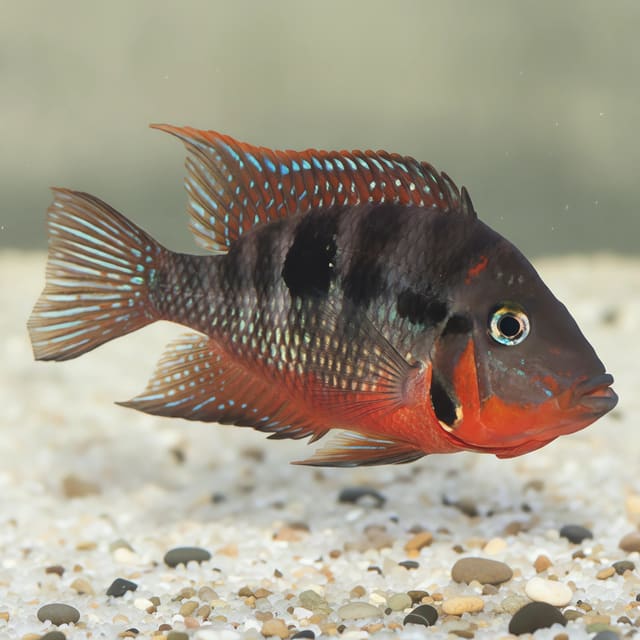
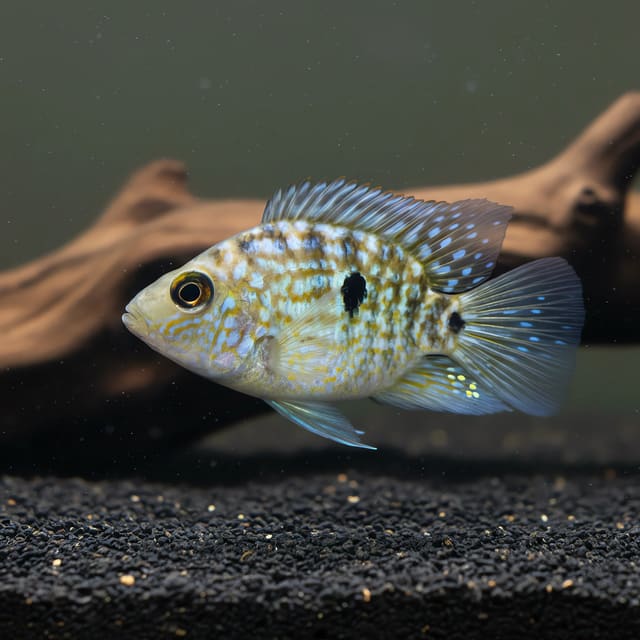
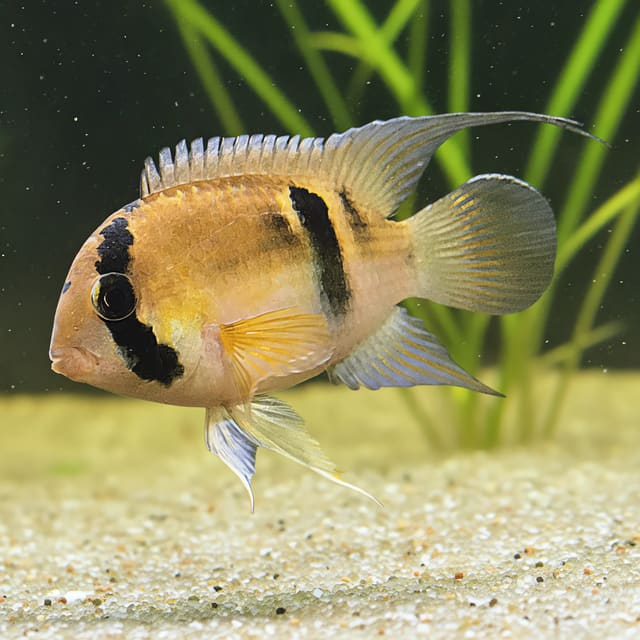
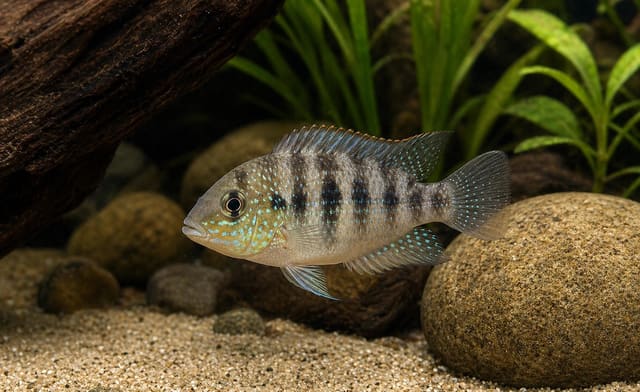
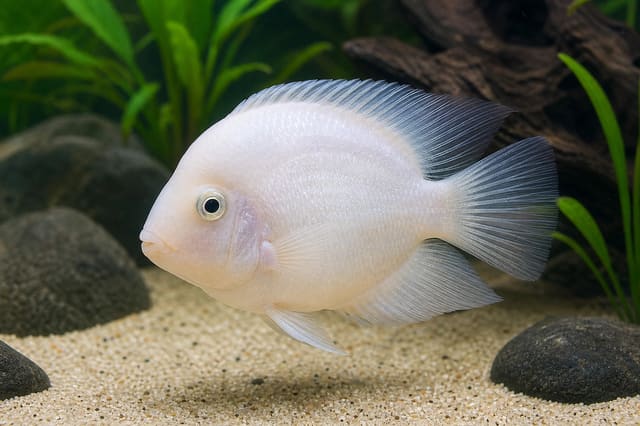
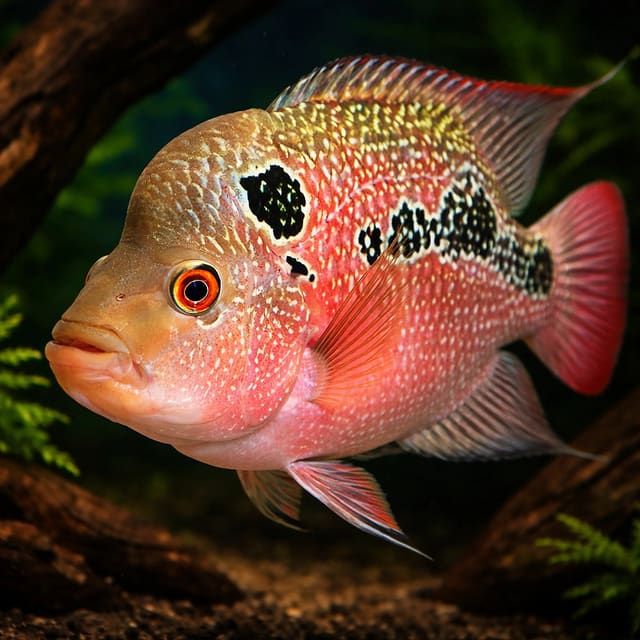
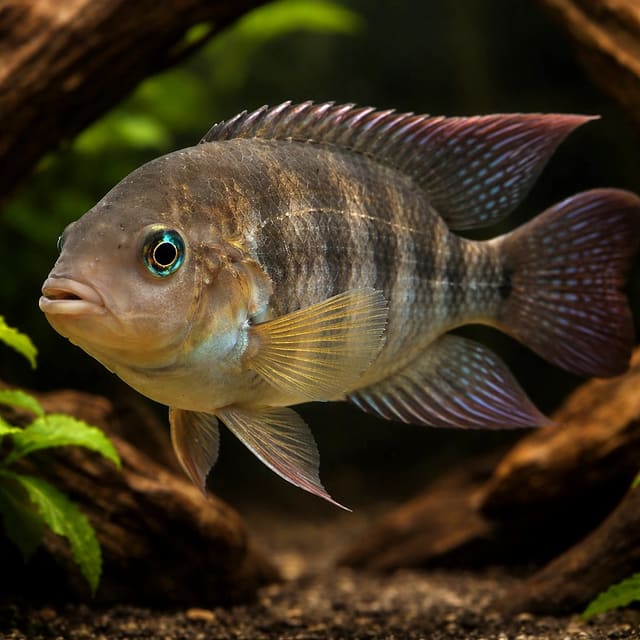
Some gallery images have been digitally enhanced to improve image quality. They show the listed type of animal rather than guaranteeing the exact markings of the individual supplied, so natural colour and pattern can vary.
Plan for an adult length of 16 cm total length. Seriously Fish lists 15 cm standard length, but the 16 cm FishBase maximum is the planning figure used throughout this page. Neither figure is a dispatch measurement.
Use an aquarium at least 100 cm long. For a pair, provide a base measuring 120 × 30 cm or equivalent; Seriously Fish describes that footprint as just about sufficient. Meeting a length figure does not remove the need for adequate water volume, filtration or compatible stocking.
OATA divides its American-cichlid volume guidance by adult size. Because this fish reaches over 15 cm, use at least 300 litres under that broad framework. A longer, larger aquarium also gives the keeper more flexibility when arranging the sandy substrate, driftwood, shaded areas and feeding locations described in the species profile.
Measure the usable aquarium itself rather than relying only on a model name. Décor should not consume so much of the base that the fish loses the footprint on which the recommendation depends.
Work through length, footprint, volume and stocking as separate decisions. A 100 cm aquarium passes the recorded minimum-length check, but a pair still needs the 120 × 30 cm base or equivalent. The OATA volume figure then supplies a broader planning threshold for a fish whose recorded adult length is over 15 cm.
For example, do not treat a deep but short aquarium as interchangeable with a longer aquarium solely because both hold the same number of litres. The stated length and pair footprint concern usable horizontal space, while the volume guidance helps plan environmental stability and the waste load. Check all applicable measurements before deciding that an aquarium is suitable.
Reassess stocking when the fish approaches its adult size. The aquarium must still accommodate every companion at its own adult dimensions, with enough filtration to process the combined feeding and waste. If adding the acara would cause any length, volume, water-value or compatibility check to fail, choose a different stocking plan rather than relying on its smaller dispatch measurement.
Use soft sand or fine aquarium gravel. Seriously Fish recommends a soft, sandy substrate, while OATA notes that American cichlids may dig or sift the surface when feeding or breeding. Avoid designing a layout whose success depends on the substrate remaining perfectly level.
Add driftwood branches and leave enough clear base for the fish to move and feed. Floating plants can provide shade. Rooted plants are less dependable because this fish is described as an avid digger, so species attached to décor, including Anubias and Java fern, have a better chance of remaining in place.
| Area | Practical use |
|---|---|
| Open sand or fine gravel | Allows normal movement, feeding and substrate investigation |
| Driftwood | Provides the structure recommended in the species profile |
| Floating cover | Creates shaded water without relying on rooted plants |
| Attached plants | Anubias or Java fern can be fixed to décor rather than planted in disturbed substrate |
Inspect the layout during routine maintenance. If digging exposes a plant root or shifts loose material into the filter intake, restore a safe arrangement without removing all established surfaces at the same time. The aim is a functional cichlid aquarium that can tolerate repeated investigation of the bottom.
Do not rely on planting to compensate for inadequate space. The aquarium still needs at least 100 cm of length, and a pair still needs the larger base. Décor, plants and open substrate must all fit inside that adult plan.
Maintain 22–23°C, pH 6.5–8.0 and 5–12 dGH. The temperature and pH sit inside the FishBase, Seriously Fish and OATA ranges, while the hardness range is shared by Seriously Fish and OATA. Set and test these values before introducing the fish.
Keep ammonia at zero mg per litre and nitrite at zero mg per litre. Nitrate should not exceed 20 mg per litre above the normal tap-water level. These OATA targets give direct thresholds for deciding whether the aquarium is ready and whether maintenance is keeping pace with feeding and waste.
| Result | Action |
|---|---|
| Temperature below 22°C or above 23°C | Set the aquarium within the routine range before adding the fish |
| pH below 6.5 or above 8.0 | Resolve the mismatch before choosing this cichlid for the aquarium |
| Hardness below 5 dGH or above 12 dGH | Use a fish whose care range matches the measured water or prepare suitable water consistently |
| Any ammonia or nitrite | Do not increase livestock; restore biological filtration and retest |
| Nitrate over the stated limit | Review water changes, stocking and feeding |
Our water chemistry guide explains what the main aquarium tests measure. Enter the actual results into the water matcher to compare the aquarium with the stated ranges rather than choosing fish from tap-water assumptions.
Take measurements from the aquarium the acara will enter, not from tap water alone. Temperature, pH and hardness must describe the maintained aquarium after heating, conditioning and normal operation. Record more than one set of results when the aquarium is newly established so that a single reading does not hide a developing problem.
A reading of 22°C, pH 7.2 and 8 dGH passes the routine range check, provided ammonia and nitrite are both zero and nitrate remains within the stated limit. A reading of 24°C fails the selected routine-temperature range even though the pH and hardness may fit. Correct the failed value and retest rather than averaging several measurements into one overall judgement.
Apply the same check to every proposed companion. Sharing an acceptable pH does not make two fish compatible when their temperature or hardness requirements conflict. Water compatibility is one part of the decision; adult size, aquarium space and behaviour still need their own checks.
Run a well-set-up and maintained biological filter at all times. The RSPCA explains that fish release toxic ammonia, which filter bacteria convert first to toxic nitrite and then to safer nitrate. Seriously Fish also describes the Blue Acara as sensitive to deteriorating water quality and calls for efficient biological filtration with a stringent maintenance regime.
At least once every week, carry out a 25% partial water change. Use a siphon to remove solid waste from accessible substrate, and treat replacement tap water with conditioner to remove chlorine or chloramine before it enters the aquarium.
Test ammonia and nitrite at least once per week, alongside the temperature, pH, hardness and nitrate checks needed to keep this aquarium inside its working ranges. Testing also belongs at the start of any investigation into altered breathing, swimming, colour, feeding or behaviour.
Increase the aquarium’s fish population slowly. OATA warns that adding livestock and food faster than the beneficial bacteria can respond may cause new tank syndrome, allowing ammonia and nitrite to rise to harmful levels.
If ammonia or nitrite rises above zero, stop increasing livestock and feeding pressure. Check that the filter is running, inspect it for a blockage and test again after addressing the cause. A clear-looking aquarium can still contain toxic dissolved waste, so appearance never replaces a measured result.
Use the weekly 25% change as the routine baseline, then judge whether feeding and stocking are allowing nitrate to stay within the OATA limit. Repeatedly rising nitrate indicates that waste production is outpacing the maintenance routine. Review portion size and the total fish load rather than cleaning biological media aggressively, because damaging the bacterial population can worsen ammonia and nitrite control.
When behaviour changes, test first even if the filter appears to be operating. Hanging at the surface, sitting on the bottom, erratic swimming, altered breathing, reduced feeding or unusual hiding can accompany a water-quality problem. A prompt set of results separates an environmental failure from a compatibility issue and gives you a concrete next action.
Use a quality dried product as the staple and add suitable meaty variety. Seriously Fish describes this cichlid as mainly carnivorous and names bloodworm, brine shrimp, chopped mussel or prawn and earthworms. FishBase records worms, crustaceans and insects in the wild diet, so those animal-based foods fit the species’ feeding biology.
Feed only what the fish can eat within a few minutes, once a day. This timing and portion rule comes from OATA’s American-cichlid guidance. Remove the incentive to add more simply because the fish continues to approach the feeding area.
| Role | Food choice |
|---|---|
| Regular staple | A quality dried product accepted by the fish |
| Small meaty variety | Bloodworm or brine shrimp |
| Larger meaty variety | Chopped mussel, prawn or earthworms in suitable pieces |
Watch the whole portion disappear within a few minutes. Uneaten food and excess faeces increase the waste that the biological filter must process, and OATA warns that overfeeding can release toxic waste into the water. If food remains, reduce the next portion rather than relying on the filter to absorb repeated excess.
In a community, confirm that the acara actually takes its share and that companions are not excluded. Feeding observation is also a useful opportunity to notice reduced appetite, altered body condition or a change in normal behaviour.
Begin with a measured amount that the fish can finish within a few minutes. If food remains on the substrate after that period, the portion was too large; remove the excess and reduce the next feed. If companions take everything before the acara can feed, change how the allowed portion is distributed rather than adding an uncontrolled second quantity.
Rotate the named foods to provide variety without making every meal rich or oversized. A quality dried product remains the regular staple, while bloodworm, brine shrimp, chopped mussel, prawn or earthworms supply suitable meaty alternatives. Cut larger items into pieces the fish can take and confirm that none remains hidden among wood or substrate.
Treat a reduced appetite as an observation prompt, not a reason to keep adding different foods. Check ammonia, nitrite, temperature and interactions with companions. The weekly records and feeding observations together show whether the change follows deteriorating water quality, restricted feeding access or a broader change in the fish’s condition.
Have the aquarium established, heated, filtered and tested before the fish arrives. Ammonia and nitrite must both read zero, and the aquarium should already be within 22–23°C, pH 6.5–8.0 and 5–12 dGH. If this is your first setup, follow our first tropical aquarium guide before adding livestock.
Review the adult plan before the parcel is due. Confirm at least 100 cm of aquarium length, the applicable volume and pair footprint, and companions too large to swallow. Check that the filter is operating normally and that the substrate, wood and attached plants are arranged without removing the required open base.
Keep the unboxing video and order number. The complete conditions are in the delivery and Live Arrival Guarantee policy.
After release, compare swimming, breathing and body condition with the health indicators below. Any investigation should begin with water tests and a check that the biological filter is working.
Do these checks before receiving the parcel rather than while the bag is floating. The arrival procedure then remains simple: record the sealed parcel and continuous opening, show the fish inside the sealed bag, float the bag for 20–30 minutes and release without adding bag water to the aquarium.
Build routine care around feeding observation, weekly testing and a weekly partial water change. The purpose is to identify a change while the fish still has clear eyes, intact scales and fins, an appropriate swimming pattern and a normal interest in food.
White spots, fluffy growths, lost scales, damaged fins, ulcers, bumps, weight change or a reduced appetite all require prompt attention. Test the water first and inspect filtration, feeding access and interactions with companions. If the change continues after those checks, contact us for guidance.
Record repeated test results if that helps you spot a trend. A single acceptable result should not replace the weekly routine, especially in an aquarium holding a well-fed medium-sized cichlid.
Choose companions that are too large for the Electric Blue Acara to swallow. Seriously Fish describes it as peaceful for a cichlid of this size and names medium-sized characins, Corydoras, loricariids and, in a big enough aquarium, other relatively peaceful cichlids as good tank-mate categories.
Avoid fish small enough to swallow. This is an adult-size decision, so judge the eventual size of both animals rather than relying only on their dispatch measurements. All companions must also fit the acara’s 22–23°C, pH 6.5–8.0 and 5–12 dGH routine.
| Screening category | Decision |
|---|---|
| Medium-sized characins | Suitable when too large to swallow and compatible with the same water values |
| Corydoras | Suitable after the adult-size, water and aquarium-space checks |
| Loricariids | Suitable after the adult-size, water and aquarium-space checks |
| Other relatively peaceful cichlids | Consider only in a big enough aquarium and monitor interactions closely |
| Fish small enough to swallow | Avoid |
These are screening categories rather than universal promises. American cichlids vary in temperament, and FishBase records that both Blue Acara parents guard eggs and larvae. A combination that passes the species-name check still requires enough aquarium space and direct observation.
Watch for a fish being denied food, hiding more than normal, showing damaged fins or scales, changing colour or swimming abnormally. Those signs trigger water tests and a reassessment of the stocking plan rather than an assumption that all fish named in a compatible category will always coexist.
A medium-sized characin, Corydoras or loricariid passes only when all of those checks succeed. A named category does not override a size mismatch, unsuitable water or inadequate aquarium space. Fish small enough to swallow remain an unconditional avoid.
After introduction, use feeding and routine observation to test the plan in practice. A companion that cannot reach food, hides more than normal or develops damaged fins or scales is not coping successfully. Test the water as well, because altered behaviour can coincide with an environmental problem rather than arising from interaction alone.
Keep a compatible pair only when the aquarium provides the required footprint and the two fish coexist without persistent welfare problems. FishBase records aquarium keeping in pairs, and Seriously Fish says a 120 × 30 cm base or equivalent is just about sufficient for a pair.
Two individually selected fish are not automatically a compatible pair. Build the aquarium plan around the animals’ observed behaviour rather than the hope that two fish will bond. The broader OATA guidance also allows single-fish planning for most American cichlids, so pairing is not required for every aquarium.
FishBase records that both parents guard eggs and larvae. Seriously Fish describes the species as a substrate-spawning cichlid and notes that a pair cleans a spawning site within its territory. A pair that reaches this stage needs close observation because defence of the site introduces a different compatibility pressure from ordinary community swimming.
For a single acara, apply the same adult-size and water screening to every companion. For a pair, add the 120 × 30 cm base requirement and the need to manage parental guarding without moving prohibited companions into a caution category.
The Electric Blue Acara reaches 16 cm total length according to FishBase. Plan every dispatch size around that adult figure.
Use at least 100 cm of aquarium length, the FishBase minimum. Seriously Fish says 120 × 30 cm or equivalent is just about sufficient for a pair, while OATA’s American-cichlid guidance uses at least 300 litres for fish over 15 cm.
FishBase records pair keeping, while OATA says most American cichlids do better singly or in pairs. Keep two only as a compatible pair with the required 120 × 30 cm base or equivalent.
Yes. Seriously Fish describes it as a beginner’s cichlid, provided the keeper supplies at least 100 cm of aquarium length, efficient biological filtration and the stated maintenance routine.
Feed a quality dried product with meaty variety such as bloodworm, brine shrimp, chopped mussel or prawn and earthworms. OATA’s American-cichlid guidance says to feed only what it can eat within a few minutes, once a day.
Keep it at 22–23°C and pH 6.5–8.0, the FishBase, Seriously Fish and OATA overlap. Use 5–12 dGH, the overlap of Seriously Fish and OATA.
Seriously Fish describes it as peaceful for a cichlid of this size. Both parents guard eggs and larvae, so monitor feeding, hiding, swimming and fin condition when a pair occupies a breeding site.
Consider medium-sized characins, Corydoras, loricariids and, in a big enough aquarium, other relatively peaceful cichlids. Avoid fish small enough to swallow, and screen every companion for 22–23°C, pH 6.5–8.0 and 5–12 dGH.
Start filming the sealed parcel before opening it, continue through opening and show the fish in the sealed bag before floating it. Be present to receive the parcel, float the bag for 20–30 minutes before release and do not pour bag water into the aquarium.
Independently collected by Judge.me from customers who bought this item. All reviews are shown.
Happy with these, good size came in excellent condition.