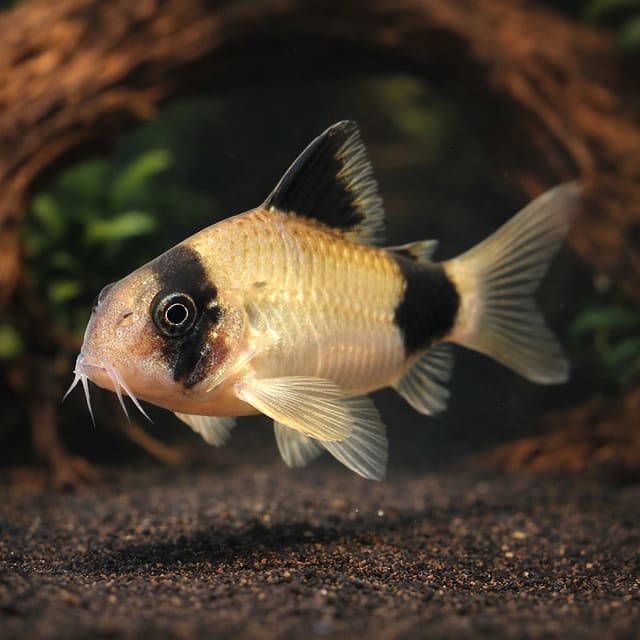
Panda Cory Catfish (Corydoras panda)
22–25°C · pH 6–7.4
From £8.69Some sizes on sale

The Horseman Cory (Corydoras eques) is an armoured catfish from South America's Amazon River basin that reaches 5.4 cm. It suits a mature, peaceful aquarium with 4–6 at minimum; 24–26°C and pH 6.0–8.0 are the overlap of FishBase, Seriously Fish and OATA guidance. Sold individually in dispatch sizes from 3–3.5 cm to over 4.5 cm.
Adult size is the maximum length this species reaches at full maturity (scientific sources). The livestock you receive will be younger and smaller — pick a size above for the actual shipping size. Product-photo provenance and any image-specific limitations are stated on the listing.
Corydoras eques
Shoaling fish: kept in a group they feel safer, stay calmer and show their best colour.
The Horseman Cory (Corydoras eques) is an armoured catfish from South America's Amazon River basin that reaches 5.4 cm. It suits a mature, peaceful aquarium with 4–6 at minimum; 24–26°C and pH 6.0–8.0 are the overlap of FishBase, Seriously Fish and OATA guidance. Sold individually in dispatch sizes from 3–3.5 cm to over 4.5 cm.
Adult size is the maximum length this species reaches at full maturity (scientific sources). The livestock you receive will be younger and smaller — pick a size above for the actual shipping size. Product-photo provenance and any image-specific limitations are stated on the listing.
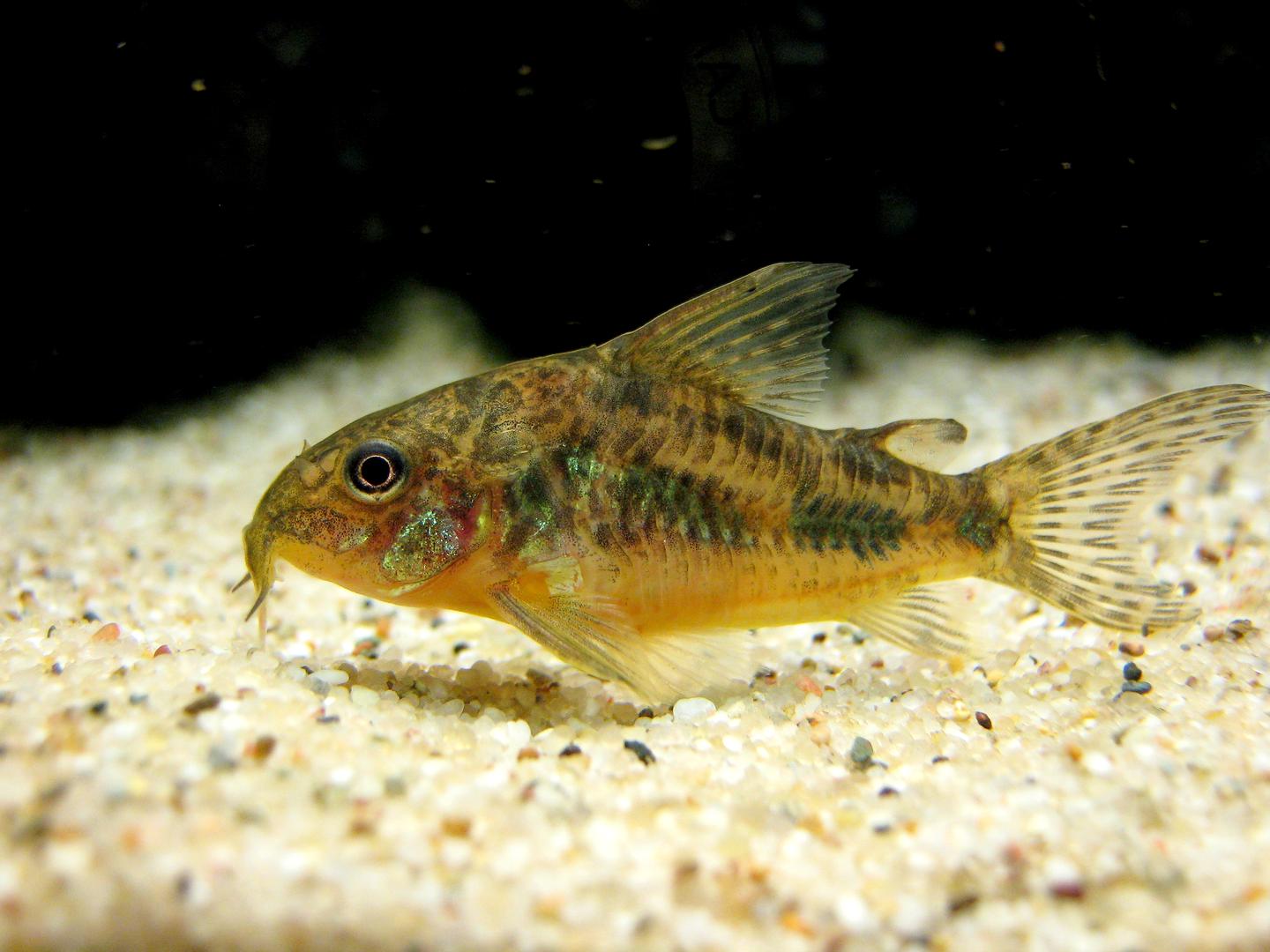
Identify the exact cory catfish before choosing care. Our starting policy for many common medium species is six compatible conspecifics, a mature 60 x 30 cm aquarium of about 60 litres, smooth fine sand and measured species-appropriate water.
Maintain these water conditions for optimal health and vibrant colors
The Horseman Cory (Corydoras eques) is a small, peaceful armoured catfish from the Amazon River basin in South America. It belongs to the Callichthyidae family, lives close to the bottom and reaches a recorded maximum of 5.4 cm standard length. It suits keepers who can provide a mature filtered aquarium, a group of its own kind, clean substrate and direct access to food. A lone ornamental bottom fish, an undersized aquarium or an expectation that it will live on scraps is the wrong plan.
FishBase records the species as a freshwater, demersal and facultative air-breathing fish. FishBase now lists it as Osteogaster eques. The familiar Corydoras eques name remains the scientific label used here, while Horseman Cory and Horseman Catfish are established common names.
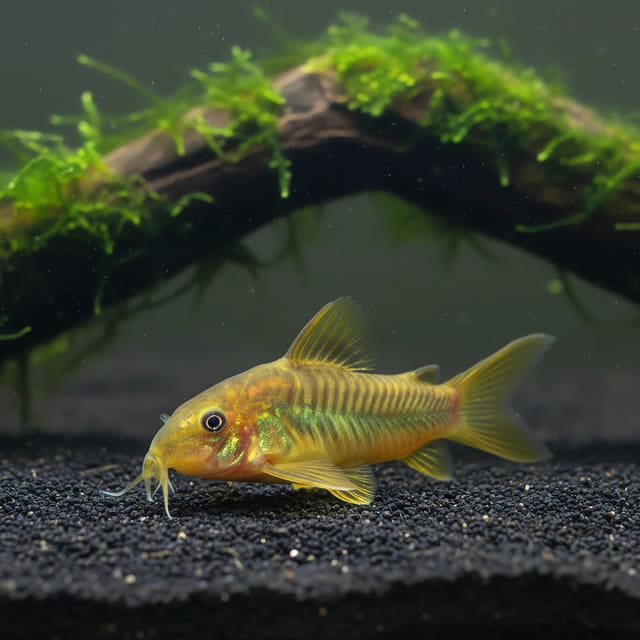
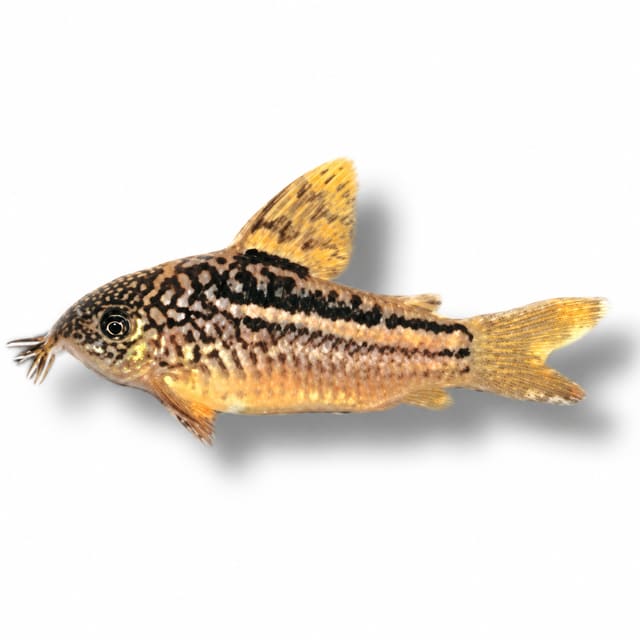
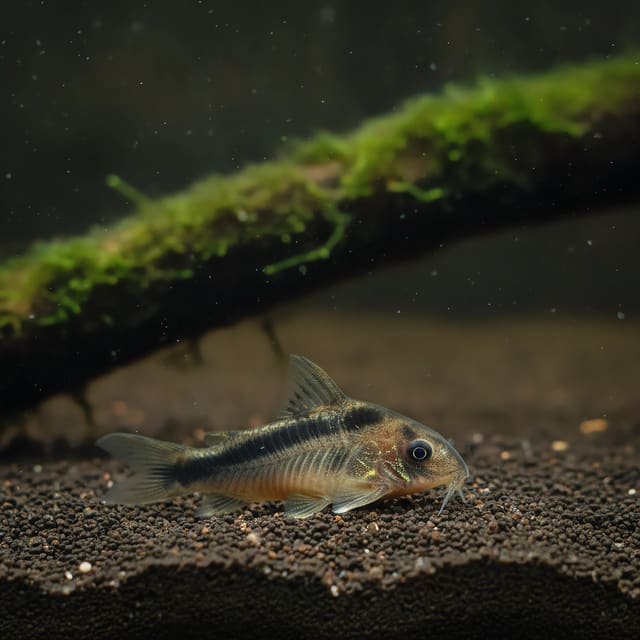
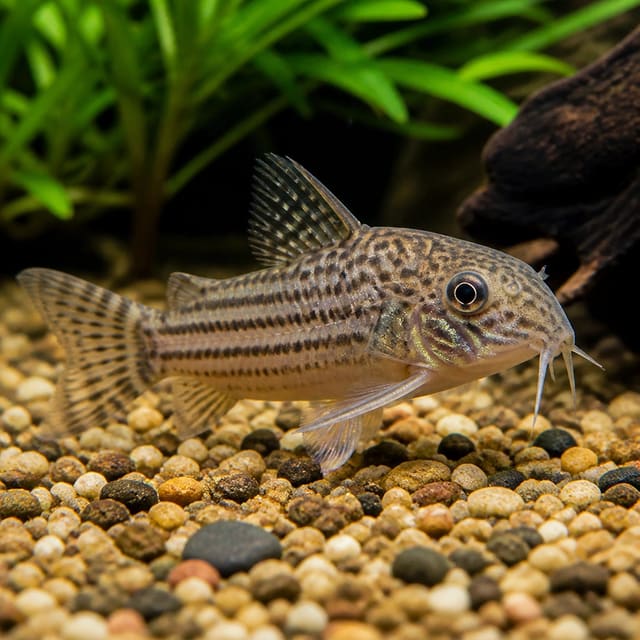
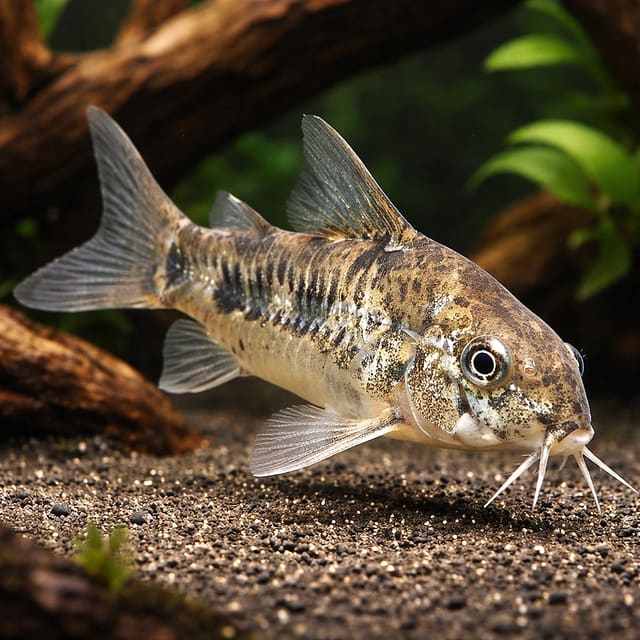
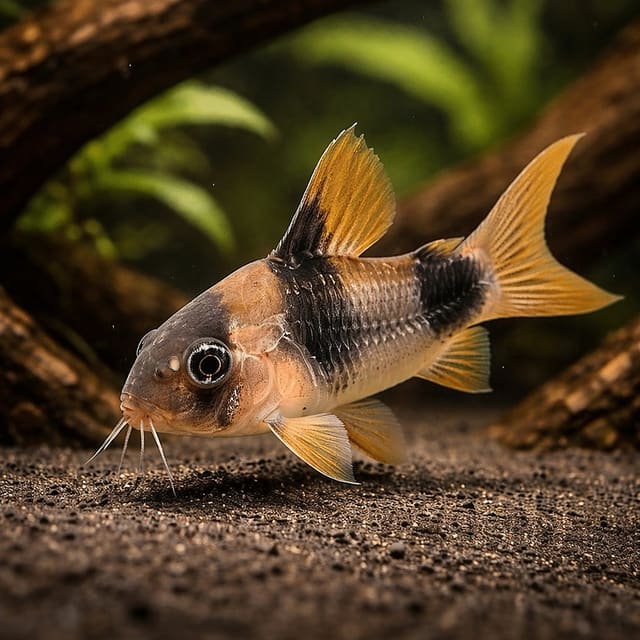
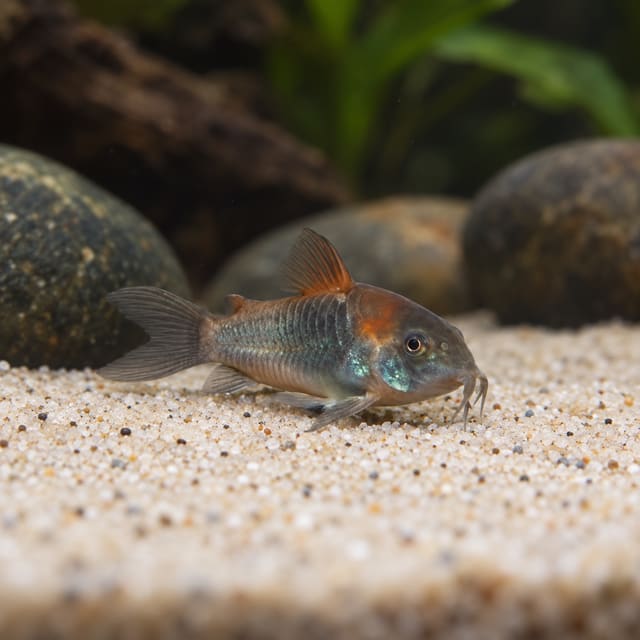
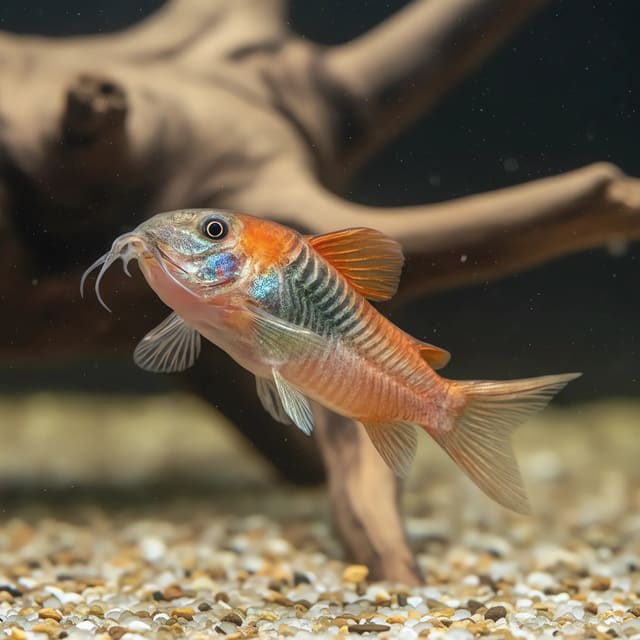
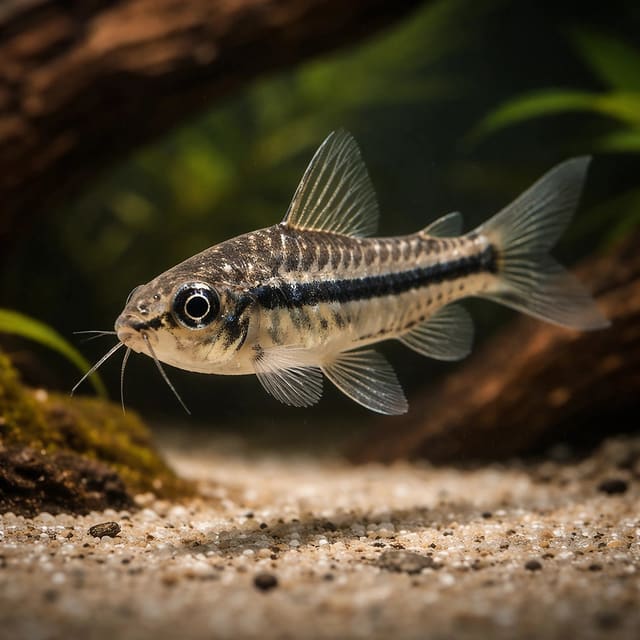
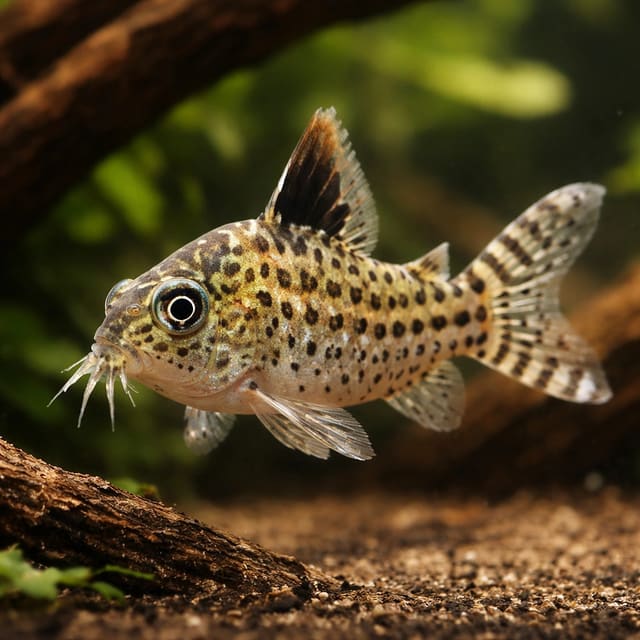
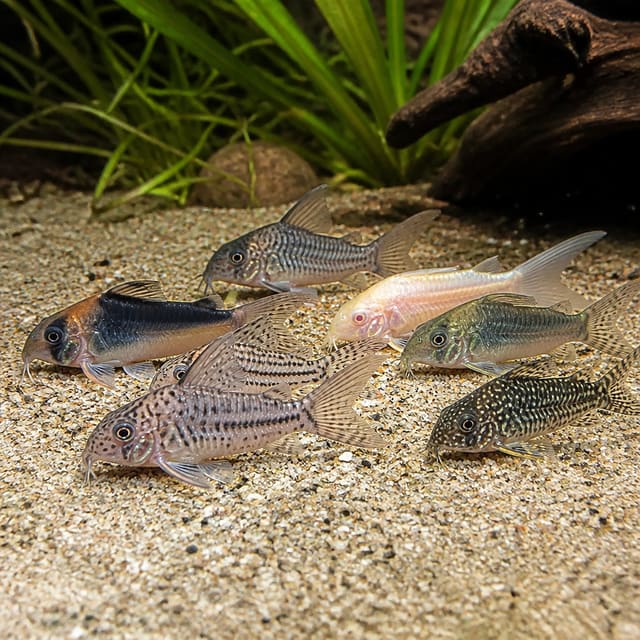
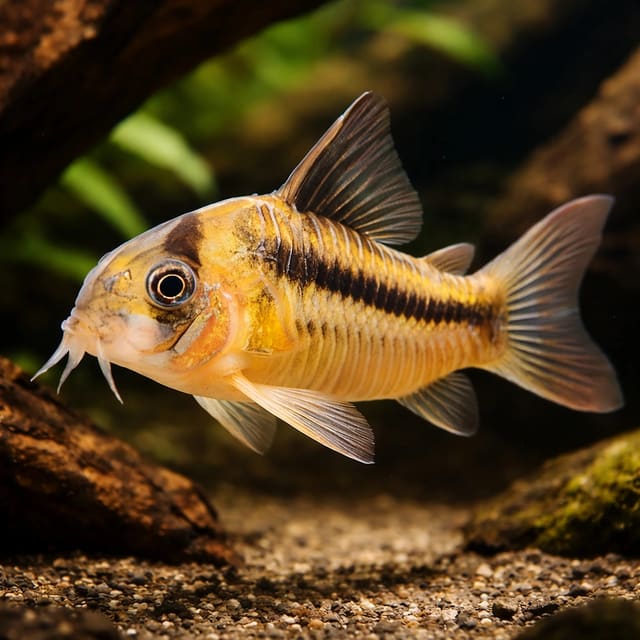
The representative gallery shows the recognised aquarium appearance: an armoured Corydoras form with mouth barbels, dark flanks, translucent fins and an orange or orange-gold area behind the head. Use those features as a visual introduction rather than as a promise that every individual will show identical colour under every aquarium setting.
| Suits | Not suited to |
|---|---|
| A mature, filtered freshwater aquarium | A new aquarium without established biological filtration |
| A group of 4–6 fish at minimum | A plan to keep one fish alone |
| At least a 90 × 30 cm base and about 81 litres | An aquarium without the required floor space |
| Fine sand or scrupulously clean rounded gravel | Substrate that cannot be kept clean |
| A peaceful community planned around shared water needs | A community where bottom food is routinely missed |
Plan first for the group and the aquarium footprint. Its compact body does not remove the need for horizontal foraging space, cover and stable water. When those essentials are in place, this is a peaceful community catfish whose care can be managed through regular testing, measured feeding and a consistent weekly routine.
One purchase supplies one Horseman Cory of the selected size. The live size selector shows 3 - 3,5 cm, 3,5 - 4 cm and > 4.5 cm. The size you select is the size supplied, not the adult size. Use the selector to choose the dispatch size, then plan the aquarium around the 5.4 cm recorded adult figure and the space needed by a proper group.
Size does not replace social number. A larger individual still needs other Horseman Corys, while smaller fish still need the full aquarium footprint and direct feeding. If you are building a new group, decide how the complete group will fit before choosing the dispatch size. This prevents a single fish being treated as a decorative cleaner and keeps the social and space decisions together.
Sex is guaranteed only when the selected option explicitly states male or female. This Horseman Cory listing has no sex-guaranteed option.
Some gallery images have been digitally enhanced to improve image quality. They show the listed type of animal rather than guaranteeing the exact markings of the individual supplied, so natural colour and pattern can vary.
If you are comparing this fish with other armoured catfish, browse the current Corydoras collection. Compare adult size, group requirement, aquarium base, water range and feeding needs before comparing colour. Those decisions determine whether a fish fits the aquarium long after its dispatch size has changed.
Plan for an adult maximum of 5.4 cm standard length. That is the figure to use for long-term stocking, summaries and aquarium planning. Seriously Fish gives 50 mm standard length and recommends minimum base dimensions of 90 × 30 cm, with an approximate volume of 81 litres. FishBase records the slightly larger 5.4 cm maximum, so 5.4 cm is the safer single planning figure.
The base measurement is decisive because this is a demersal forager. An aquarium can hold roughly 81 litres while having unsuitable proportions, so check both volume and floor dimensions. Treat 90 × 30 cm as a minimum base, not a target that becomes optional when the tank is tall. Additional height does not replace usable substrate area.
| Check | Decision |
|---|---|
| Base below 90 × 30 cm | Choose a larger aquarium before planning the group |
| Base at least 90 × 30 cm | Check actual volume, filtration, cover and total stocking |
| About 81 litres | Use the species guidance for filtration and group planning |
| Tall tank with little floor area | Do not count height as a substitute for the minimum base |
For an aquarium of about 81 litres, Seriously Fish suggests a turnover of four to five times the volume each hour and gives a corresponding filter rating of 325–405 litres per hour. This is a practical filter-selection figure for that example aquarium, not a reason to force the fish through a concentrated jet. Arrange the outlet so the whole aquarium is filtered and waste does not simply remain where the group feeds.
The same guidance estimates roughly 50 W of heating for an aquarium of that size when the room is around 20°C. Heater demand changes with room conditions and aquarium construction, so select equipment for the actual installation while keeping the water itself at 24–26°C.
Floor space must also remain usable. Cover is important, but an aquarium packed so tightly that food cannot reach observable feeding areas makes routine care harder. Preserve open substrate where the group can forage and where you can check that each fish is eating.
Use fine sand as the ideal substrate. Rounded gravel is an acceptable alternative when it is kept scrupulously clean. This choice matters because the fish spends much of its time close to the floor, investigating sinking food with its mouth and barbels. Choose the surface for cleanliness and access before choosing it for colour.
Provide cover so the group has secure places around its open feeding area. Seriously Fish leaves most décor to personal choice but calls for some cover, while OATA recommends live plants for smaller or shy catfish and also identifies wood, pots or caves as useful shelter. Combine those elements without filling every part of the base.
| Area | Purpose |
|---|---|
| Open sand or rounded gravel | Creates an observable place for sinking food and foraging |
| Planted margin | Provides cover without removing all floor space |
| Wood, pot or cave | Adds shelter where the fish can settle |
| Accessible cleaning route | Lets you remove solid waste during water changes |
Keep the arrangement stable and easy to maintain. Wood or ornaments should sit securely, and feeding areas should remain reachable with a siphon. OATA notes that some catfish may eat or dig up plants, so monitor planting rather than assuming every layout will remain unchanged. Artificial plants and suitable ornaments can add cover where live planting is impractical.
Rounded gravel requires particular discipline because waste can settle between the grains. Siphon it during the weekly partial water change and check the areas under food stations and beside shelter. Fine sand still needs cleaning; its advantage does not make maintenance optional.
A simple layout is often the most functional: cover around part of the perimeter, shelter placed away from the filter intake, and enough open floor to distribute food. That arrangement lets a group feed without every fish crowding one point. It also makes body condition, activity and food intake easier to compare.
Do not expect décor to compensate for an aquarium that is too small. Cover supports security, while the 90 × 30 cm minimum base supports movement and group space. Both requirements apply at the same time.
Keep the aquarium at 24–26°C, pH 6.0–8.0 and 4–15 dGH. These routine values sit inside every relevant range: FishBase records 24–26°C, pH 6.0–8.0 and 2–25 dGH; Seriously Fish gives 20–26°C, pH 6.0–8.0 and 2–15 dGH; and OATA's freshwater-catfish guidance gives 22–27°C, pH 6.0–8.0 and 4–18 dGH for the broad group. The chosen range is the overlap, with the group figures narrowing rather than widening the species values.
Set the temperature within 24–26°C before introduction and measure it with a reliable aquarium thermometer. For pH and hardness, test the aquarium and replacement water rather than estimating from local tap-water reputation. Our aquarium water chemistry guide explains the values, while the water matcher helps compare your measurements with this range.
| Result | Action |
|---|---|
| Temperature below 24°C or above 26°C | Correct the setup before introducing the fish |
| pH within 6.0–8.0 | Keep maintenance consistent and continue testing |
| Hardness within 4–15 dGH | Use it as the routine aquarium range |
| Ammonia or nitrite detected | Pause further stocking and correct water quality |
Ammonia and nitrite should each remain at zero milligrams per litre. OATA also says nitrate should not exceed 20 mg per litre above the normal tap-water level. Test at least weekly and use a 25% partial water change as the standard weekly maintenance action.
Do not chase pH or hardness through repeated abrupt adjustments. First establish what comes from the tap, what remains stable in the aquarium and whether the result sits inside the stated range. If it does, regular conditioned water changes and a functioning biological filter provide a more repeatable routine than constant alteration.
Check values again whenever fish behaviour changes, feeding falls or filter flow is reduced. A written note of temperature, pH, hardness, ammonia, nitrite and nitrate makes a trend easier to recognise than isolated readings.
Run a well-established biological filter at all times. The RSPCA explains that aquarium filtration supports beneficial bacteria that convert toxic ammonia first to toxic nitrite and then to the safer nitrate. Clear-looking water is not a substitute for those biological processes, so test ammonia and nitrite even when the aquarium appears clean.
Increase stocking slowly because the bacterial population must respond whenever fish numbers and feeding increase. OATA warns that adding too many fish too quickly can cause new tank syndrome, with ammonia and nitrite rising beyond what the filter can process. Plan the Horseman Cory group alongside the aquarium's existing livestock and filter capacity rather than treating its modest body size as negligible.
In an aquarium of approximately 81 litres, a 25% change is about 20.25 litres. Measure the actual working volume of your aquarium when planning containers and conditioner, because substrate and décor affect the amount of water present.
When filter media needs cleaning, rinse it lightly in aquarium water removed during the partial water change. Do not rinse established media under the tap: OATA explains that chlorine or chloramine may kill beneficial bacteria. Clean only what is necessary to restore flow rather than stripping all media at once.
Keep feeding and maintenance connected. Food left uneaten breaks down into waste, while too little direct food leaves the Cory group underfed. Remove excess, reassess the portion and preserve the filter's capacity by making small corrections early.
If ammonia or nitrite rises above zero, deal with water quality before adding livestock. Test replacement water, carry out an appropriate conditioned water change, inspect filter operation and reduce waste entering the system. Continue measuring until both values return to zero.
Feed a varied omnivorous diet that reaches the aquarium floor. Seriously Fish describes Corydoras as foraging omnivores that accept most sinking dried foods together with small live and frozen foods such as bloodworm and Tubifex. Use a quality sinking dried food as the routine base, then rotate suitable live or frozen varieties for diversity.
Offer only what the fish can eat within a few minutes, once a day. That schedule comes from OATA's freshwater-catfish guidance. Watch the group throughout the feeding period so you can see whether every individual reaches food and whether uneaten pieces remain after the fish lose interest.
| Decision | Action |
|---|---|
| Daily base food | Use a quality sinking dried product |
| Dietary variety | Add suitably small live or frozen bloodworm or Tubifex |
| Portion size | Give only what is eaten within a few minutes |
| Food misses part of the group | Divide the same measured portion between feeding points |
| Food remains uneaten | Remove the excess and reduce the next portion |
Do not rely on leftovers from midwater fish. Seriously Fish explicitly warns that Corydoras should neither be expected to survive on other inhabitants' scraps nor be treated as aquarium cleaners. Food reaching the bottom accidentally is impossible to portion and may not reach every member of the group.
Use body condition and feeding response as practical checks. OATA lists changes in weight or condition and reduced interest in food among signs that deserve attention. Compare individuals during the same feeding period: a fish that repeatedly hangs back needs prompt investigation of competition, health and water quality.
Variety does not mean adding several full portions. Keep the daily quantity within what can be consumed promptly and rotate foods across the routine. This limits waste while still preventing the diet from depending on one product.
Place food where it can be observed and recovered. An open patch of clean substrate allows you to count feeding fish, identify a missed meal and siphon remnants. If companions intercept everything, reconsider feeding distribution and compatibility rather than continually increasing the total amount.
Prepare and mature the aquarium before the fish arrives. OATA says ammonia and nitrite must be zero before fish are added, and the temperature, pH and hardness should sit within the intended ranges. The filter must also be functioning. If this is your first setup, follow our guide to preparing and maturing a tropical aquarium before adding livestock.
Be home to receive the parcel because live fish must not be left unattended. The fish is hand-bagged in pure oxygen, placed in an insulated poly box and given a heat pack when the weather calls for it. Read the current delivery and Live Arrival Guarantee policy before the delivery window.
After introduction, use observation rather than assumptions. OATA identifies clear bright eyes, undamaged fins, intact body covering, appropriate swimming and a normal feeding response as useful healthy signs. The Horseman Cory may visit the surface because FishBase records facultative air breathing, but a new pattern of hanging at the surface or altered gill movement should trigger immediate water-quality checks.
| Checkpoint | What to do |
|---|---|
| Every feeding | Confirm that each fish finds sinking food |
| Daily observation | Compare swimming, breathing, colour and hiding with the group's normal pattern |
| Water testing | Keep ammonia and nitrite at zero and check temperature stability |
| Filter check | Confirm normal flow and inspect for blockages |
| Substrate check | Remove uneaten food and visible solid waste |
Do not increase the aquarium population faster than the filter can adjust. The fish needs companions, but group planning and biological capacity must be considered together. If a test shows ammonia or nitrite, pause further introductions and restore water quality before changing anything else.
Learn the group's normal behaviour and act when it changes. OATA recommends watching swimming, colour, temperament, breathing, appearance, condition and feeding. A single observation is most useful when compared with how the same fish looked and behaved during previous feeding and maintenance checks.
| Change noticed | First response |
|---|---|
| Hanging at the surface or erratic swimming | Test temperature, ammonia and nitrite and inspect filter operation |
| Faster or slower gill movement | Check water quality and compare the whole group |
| Darker or paler colour | Look for simultaneous changes in hiding, feeding or breathing |
| More hiding than normal | Check group number, cover, companion pressure and water values |
| Reduced food intake | Test the water and confirm that sinking food reaches the fish |
| White spots, fluffy growths or damaged fins | Record the signs, test the water and seek prompt help |
Water quality comes first because ammonia and nitrite are toxic and should remain at zero. Check the filter for a blockage, measure the temperature and inspect recent feeding for uneaten food. A partial conditioned water change is part of normal maintenance, but continue testing rather than assuming one action has settled the cause.
Look at condition as well as activity. OATA includes increases or decreases in body weight and condition among warning signs. During feeding, compare the fullness and response of each individual. Repeatedly missed meals can reveal competition before the fish shows a major physical change.
Do not select a treatment merely from a general symptom. White marks, damaged fins, altered breathing and loss of appetite can occur alongside different water or health problems. Record what changed, when it began, the measured water values and whether one fish or the whole group is affected. Contact us for guidance when a health change persists or a fish develops visible lesions, growths or marked breathing difficulty.
Keep the weekly log simple enough to use: date, temperature, pH, ammonia, nitrite, nitrate, water changed, feeding response and unusual behaviour. A consistent record helps distinguish a one-off observation from a developing trend.
Choose calm community fish only after checking shared water requirements, space and access to food. Seriously Fish describes the Horseman Cory as peaceful and gregarious, while OATA identifies Corydoras as suitable community aquarium fish. Neither statement makes every community combination automatic, so assess each intended companion against the aquarium you actually keep.
| Suitable signs | Reasons to pause |
|---|---|
| Shared water range | One species would be kept outside its stated range |
| Enough room for a 4–6 Cory group | The base is already fully occupied |
| Calm community behaviour | The Cory group is displaced from feeding areas |
| Food reaches the bottom predictably | Companions consume every portion before it sinks |
| Filtration handles the total stocking | Ammonia or nitrite rises after additions |
Use the screening rule for fish and invertebrates alike. A peaceful label alone does not answer differences in water, adult size, feeding or use of the aquarium floor. Invertebrate compatibility needs the same individual assessment because this fish is a foraging omnivore and the intended invertebrate may have different requirements.
Observe the community at feeding time and during normal activity. If the Cory group stops reaching food, hides more than usual or shows altered breathing, test the water and review the latest stocking change. Correct the cause rather than masking it with extra food.
When an intended companion does not fit all four checks, ask us for a stocking and compatibility assessment using the aquarium dimensions, measured water values, existing livestock and planned group number. Those details produce a more useful answer than a universal tank-mate list.
Keep 4–6 Horseman Corys at minimum. Seriously Fish describes the species as gregarious and says it should be maintained in a group of at least 4–6 individuals. OATA separately says Corydoras are shoaling fish that should be kept in groups of at least five and will often become stressed when kept singly or in groups that are too small. Planning for six satisfies both instructions while preserving the species wording.
Count the group before allocating community space. Six small catfish still need the stated base dimensions, filtration capacity, shelter and open feeding floor. Do not plan the rest of the community first and leave whatever substrate remains for the Corys.
| Group decision | Practical check |
|---|---|
| Number | Plan for six where space and filtration permit, never fewer than the stated 4–6 minimum |
| Floor area | Retain at least a 90 × 30 cm aquarium base |
| Cover | Provide plants, wood, pots or caves without removing every open feeding area |
| Food access | Watch every individual reach sinking food |
| Biological capacity | Keep ammonia and nitrite at zero as stocking increases |
Use multiple feeding points only to distribute the same measured portion, not to multiply the daily ration. This helps when part of the group hangs back or when community fish gather above one spot. Remove leftovers and reduce the next portion if food remains after a few minutes.
When one fish repeatedly separates from the group, do not assume the cause is social number alone. Check water values, breathing, body condition, visible marks and whether the fish ate. Group size, health, cover and companion pressure are separate decisions that can produce similar outward changes.
Replace social losses thoughtfully, with the aquarium's filtration and total stocking in mind. OATA advises increasing fish numbers slowly because beneficial bacteria need to adjust as waste and feeding rise. Maintain the social requirement without adding more livestock than the filter can process safely.
It reaches a recorded maximum of 5.4 cm standard length. Plan its aquarium, group and community around that adult figure.
Use an aquarium with a base of at least 90 × 30 cm and an approximate minimum volume of 81 litres. Floor dimensions matter because it is a demersal group fish.
Keep 4–6 individuals at minimum. Seriously Fish gives that species instruction, while OATA recommends at least five for Corydoras, so planning for six satisfies both.
It can suit a prepared beginner who can mature and filter the aquarium, keep ammonia and nitrite at zero, provide the full group and feed sinking food directly.
Feed a quality sinking dried food as the routine base, with suitably small live or frozen foods such as bloodworm or Tubifex for variety. Give only what is eaten within a few minutes, once daily.
Keep it at 24–26°C, pH 6.0–8.0 and 4–15 dGH. Those values overlap FishBase, Seriously Fish and OATA guidance, with OATA contributing broad freshwater-catfish ranges.
Seriously Fish describes it as peaceful and gregarious. Build the community around calm fish that share its water range and do not prevent the group reaching sinking food.
OATA identifies Corydoras as community aquarium fish. Choose peaceful community fish only after checking shared water needs, enough floor space and reliable access to sinking food; assess invertebrates individually by the same rules.
It is hand-bagged in pure oxygen, placed in an insulated poly box and given a heat pack when the weather calls for it. Start filming before opening the sealed parcel, show the opening and the fish still in the bag, be home to receive it, float the bag for 20–30 minutes, then release the fish without pouring bag water into the aquarium.
No reviews for this item yet. Bought one? Honest reviews only, good or bad.
What customers say about ordering from us
I have a small group of long finned mountain minnows. So was delighted to be able to order ten of this variety to increase the genetics in my tank . The ones I recieved are healthy but it’s to early to give a verdict on wether they are of a long finned type since they are small currently.
Gordon Walker · 23 Sept 2026
100% success travel and "installation". Pleased with quality of purchase. The Siamese fighter a bit "shy" so have not yet seen him at his best yet but looking good. Happy customer. GG
George E Garratt · 21 Sept 2026
Reviews of our shop, collected by Judge.me, an independent third-party review collector. Newest first.