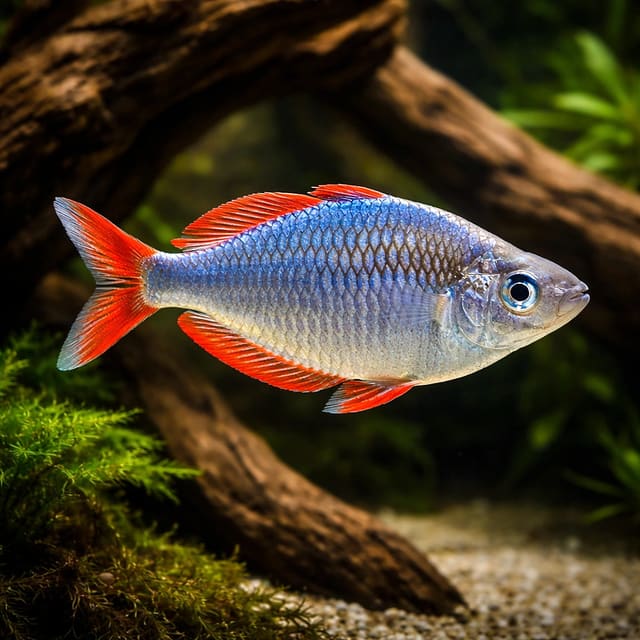
Easy
Neon Dwarf Rainbowfish (Melanotaenia praecox)
23–27°C · pH 6.8–7.5 · 54L
£5.99

The Lake Kurumoi Rainbowfish (Melanotaenia parva) is a freshwater rainbowfish from Lake Kurumoi in West Papua, Indonesia, that reaches 6.7 cm standard length. It suits a mature, filtered aquarium with open swimming space; OATA advises at least five at 22–27°C, pH 6.5–8.0 and 4–12°dH. Sold individually in 3.5-4.5 cm and 5-6 cm sizes.
Adult size is the maximum length this species reaches at full maturity (scientific sources). The livestock you receive will be younger and smaller — pick a size above for the actual shipping size. Product-photo provenance and any image-specific limitations are stated on the listing.
Shoaling fish: kept in a group they feel safer, stay calmer and show their best colour.
The Lake Kurumoi Rainbowfish (Melanotaenia parva) is a freshwater rainbowfish from Lake Kurumoi in West Papua, Indonesia, that reaches 6.7 cm standard length. It suits a mature, filtered aquarium with open swimming space; OATA advises at least five at 22–27°C, pH 6.5–8.0 and 4–12°dH. Sold individually in 3.5-4.5 cm and 5-6 cm sizes.
Adult size is the maximum length this species reaches at full maturity (scientific sources). The livestock you receive will be younger and smaller — pick a size above for the actual shipping size. Product-photo provenance and any image-specific limitations are stated on the listing.
Maintain these water conditions for optimal health and vibrant colors
The Lake Kurumoi Rainbowfish (Melanotaenia parva) is a freshwater member of the rainbowfish family, Melanotaeniidae. Its natural range was restricted to Lake Kurumoi in the Bird’s Head Peninsula of West Papua, Indonesia, and FishBase records a maximum of 6.7 cm standard length. This compact species suits a keeper who can provide a mature, filtered aquarium, preserve open swimming space and keep a social group rather than a lone specimen.
Lake Kurumoi lies within the Yakati River watershed in mountainous terrain at about 400 m elevation. FishBase describes the fish as freshwater and benthopelagic. A natural-history account of Lake Kurumoi Rainbowfish describes the lake as its only native habitat and reports that habitat loss has placed the wild population in grave danger. FishBase categorises the species as Critically Endangered. That status belongs to the wild species and should not be used to infer how an aquarium fish was produced or where an individual specimen came from.
Plan around the recorded adult length before choosing the dispatch size. A 3.5-4.5 cm fish or a 5-6 cm fish still needs a long-term plan for 6.7 cm standard length, a shoal and unobstructed swimming room. Its relatively compact recorded length does not turn it into a solitary or confined-space fish.
OATA’s rainbowfish guidance covers the group rather than this one species; it advises keeping at least five, with more being better. Rainbowfish kept alone or in groups that are too small will often become stressed. Build the aquarium around the complete group and its waste load, not around the dimensions of one newly received fish.
Keep the scientific identity attached to any care plan. The name distinguishes this fish from other rainbowfish that may reach different sizes or need a different amount of space. You can also browse the rainbowfish collection when comparing identities, but compare each animal’s own adult size and keeping requirements separately.
One purchase supplies one Lake Kurumoi Rainbowfish in the size selected on the live size selector. The labelled choices are 3.5-4.5 cm and 5-6 cm. These are dispatch measurements rather than different adult forms. The size you select is the size supplied, not the adult size.
Sex is guaranteed only when the selected option explicitly states male or female. This Lake Kurumoi Rainbowfish listing has no sex-guaranteed option. Do not use body size, colour or gallery appearance to plan a guaranteed sex ratio.
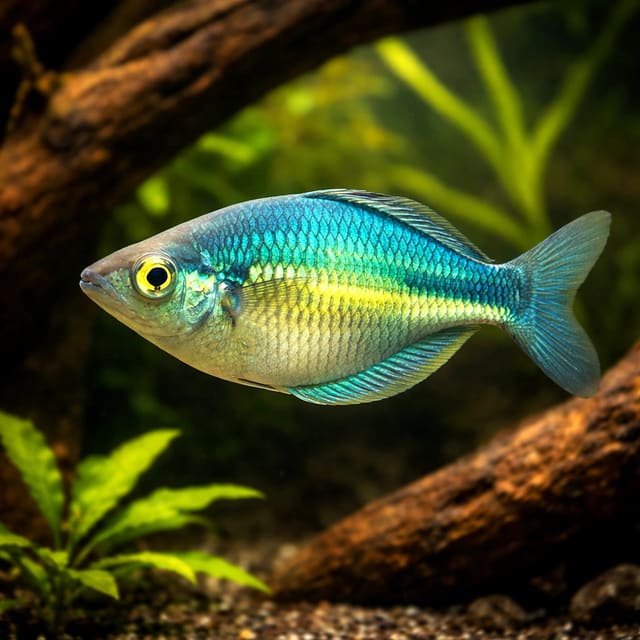
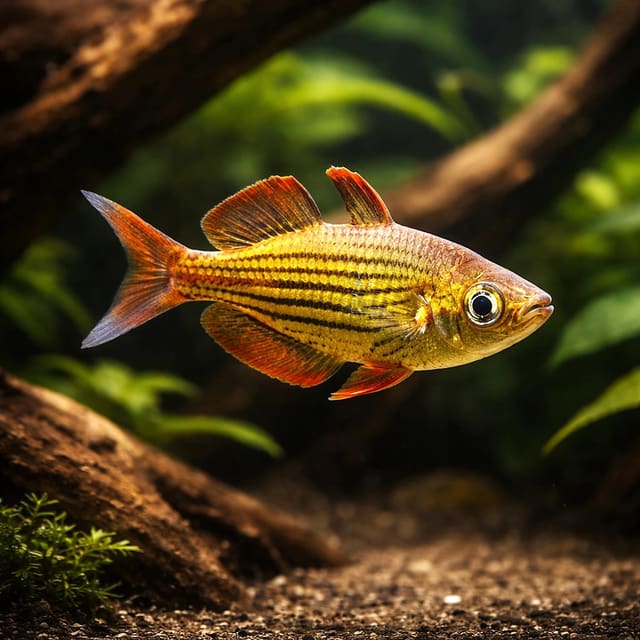
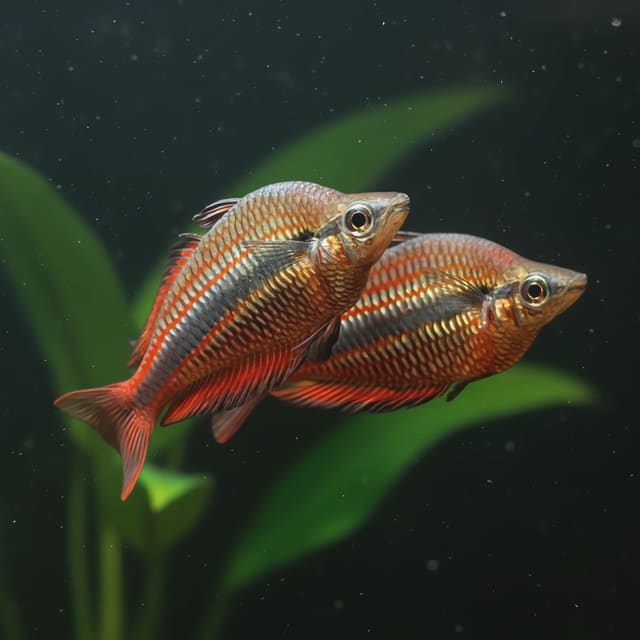
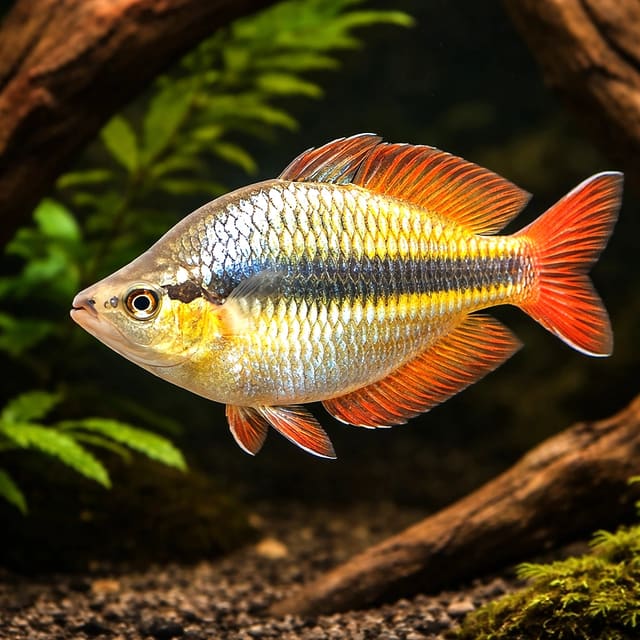
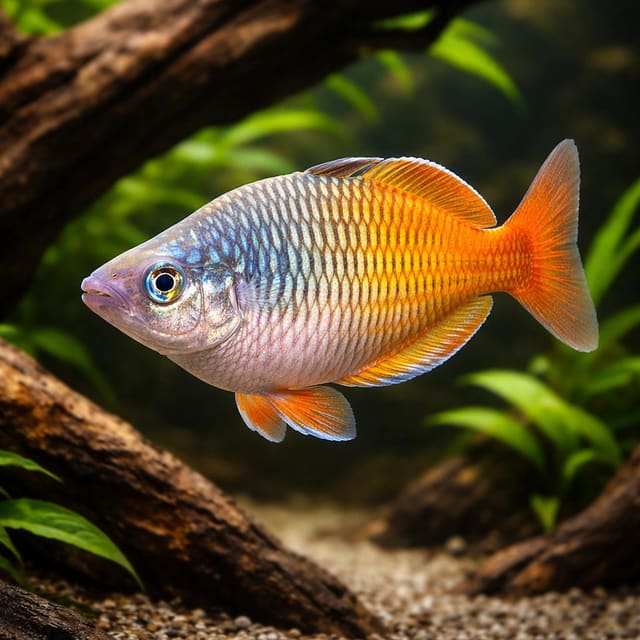
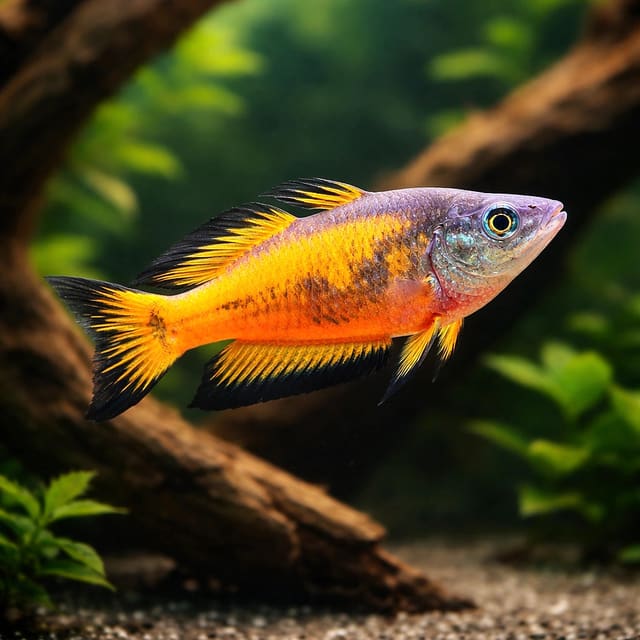
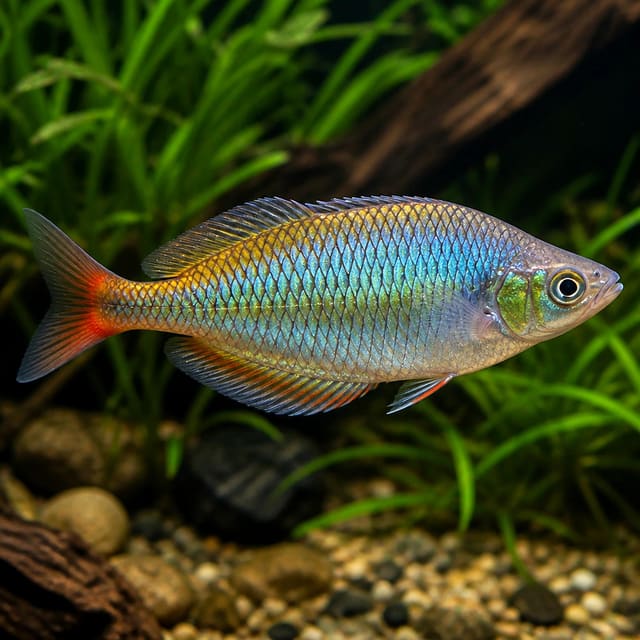
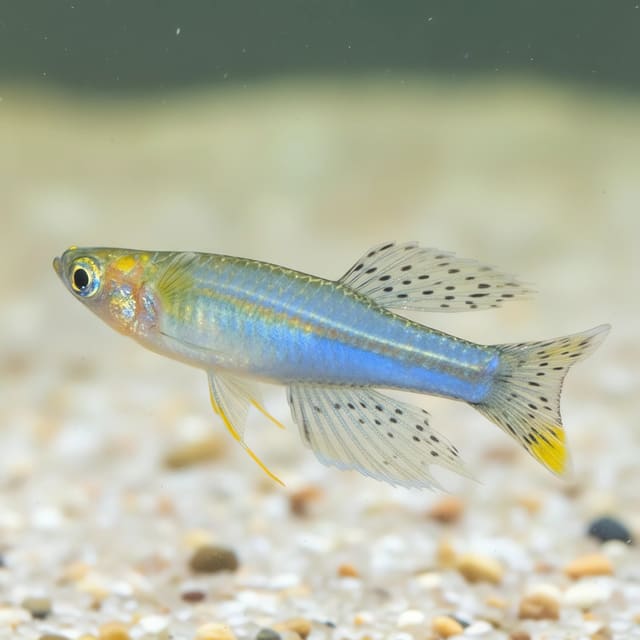
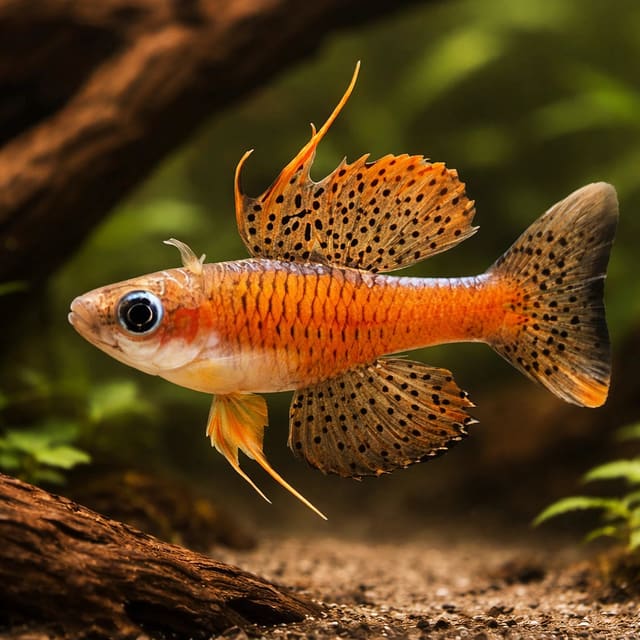
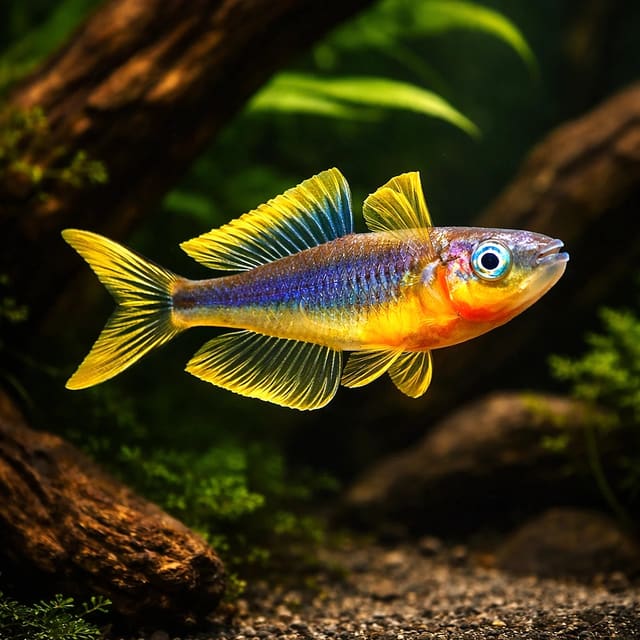
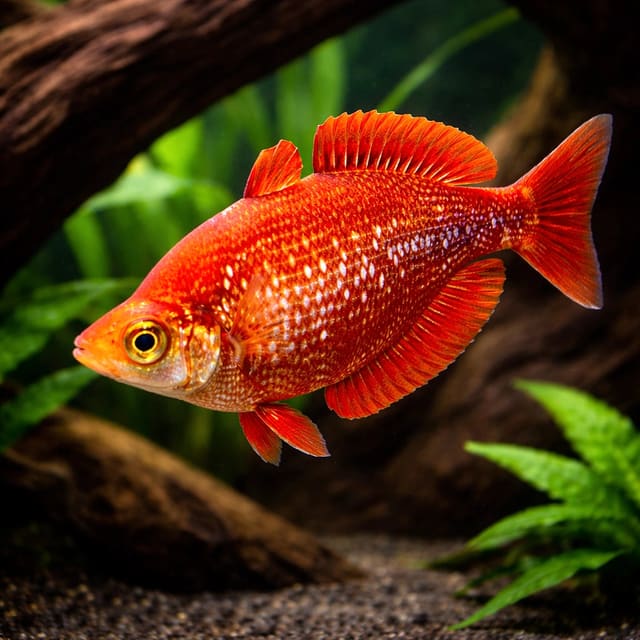
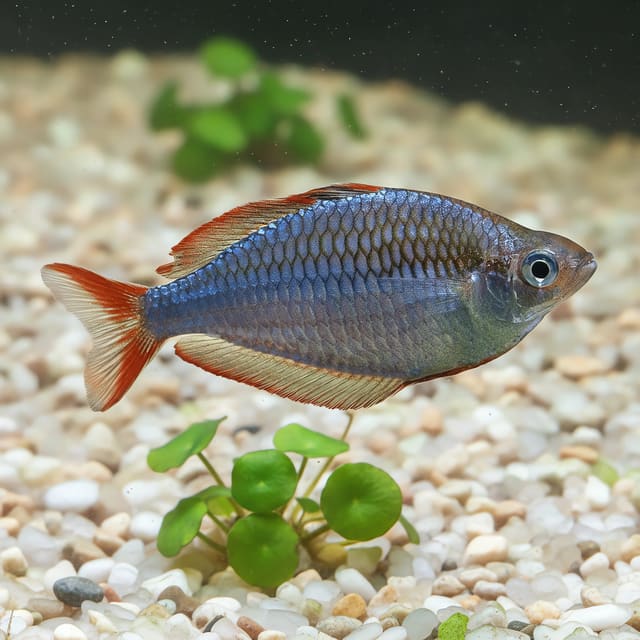
The gallery images are representative of this type of animal rather than photographs of the exact animal supplied, so colours can look slightly different from the live animal. Use the pictures for a general visual introduction while basing the aquarium plan on the recorded identity, adult length and care requirements.
Keep the fish at 22–27°C, pH 6.5–8.0 and 4–12°dH, with carbonate hardness of 3–10°dKH. OATA’s rainbowfish sheet gives those figures for the group, not a species-specific optimum. Maintain ammonia and nitrite at zero, and do not allow nitrate to rise more than 20 mg/l above the normal level in the tap water used for the aquarium.
| Suits | Not suited to |
|---|---|
| A keeper able to maintain at least five rainbowfish | A plan for one fish or a group below five |
| A mature aquarium with an established biological filter | An unfiltered or newly prepared aquarium |
| A layout with plants or other shelter and open swimming space | A layout that leaves no clear swimming area |
| Water maintained at 22–27°C, pH 6.5–8.0 and 4–12°dH | Water outside those OATA rainbowfish values |
| Community planning that excludes timid or much smaller animals when activity creates a mismatch | Automatic mixing without comparing behaviour, size and water needs |
OATA describes rainbowfish as usually easy-going and generally easy to keep, but success still depends on completing the practical work: mature the filter, test the water, provide the full shoal, feed controlled portions and preserve swimming room. The adult length is modest; the social and water-quality responsibilities remain substantial.
Start with an aquarium that can hold at least five Lake Kurumoi Rainbowfish without sacrificing open swimming space. OATA recommends an aquarium of at least 45 litres for a shoal of the smallest rainbowfish species and advises choosing as large an aquarium as reasonably possible. Treat 45 litres as a starting point for evaluating a compact rainbowfish shoal, then increase space whenever the full stocking plan, layout or water stability calls for it.
The recorded 6.7 cm standard length is the decisive growth figure. Assess whether the aquarium can accommodate five or more fish at that length alongside every other intended occupant. Do not calculate space from a 3.5-4.5 cm dispatch fish and assume that its arrival measurement is permanent.
Use aquarium gravel or sand. Add live plants where practical, especially where cover will help fish settle, but leave plenty of open space in which the rainbowfish can swim. If live plants are not used, OATA recommends plastic plants and suitable ornaments such as plant pots or model caves to provide shelter.
A useful layout test is to look across the aquarium before adding livestock. If plants and ornaments create shelter while retaining an obvious open route, the design serves both needs. If decoration fills nearly every clear area, remove or reposition some of it before increasing the fish population. Litres alone do not show whether a shoal has usable swimming room.
Complete and mature the aquarium before the fish arrive. The beneficial bacteria in the filter must process the added waste, and their population must increase as fish numbers and feeding rise. Add fish gradually rather than making a sudden large increase that the filter cannot process.
For a first setup, follow our guide to preparing and maturing a tropical aquarium before livestock is introduced. Confirm zero ammonia and zero nitrite before adding fish. A large vessel is helpful only when the filter, stocking pace and maintenance routine are also sound.
Keep the aquarium at 22–27°C, pH 6.5–8.0 and 4–12°dH. Keep carbonate hardness at 3–10°dKH. Select a point within those values that can be maintained consistently rather than allowing temperature or chemistry to move repeatedly between the limits.
Ammonia and nitrite must remain at zero. Nitrate should not exceed 20 mg/l above the normal nitrate level of the tap water used for the aquarium. The nitrate instruction is relative to the source water: if the tap water contains nitrate, use that measured baseline when judging how much the aquarium has risen.
Measure the aquarium rather than estimating from appearance. Test ammonia, nitrite and nitrate at least once a week, and check temperature, pH and hardness whenever preparing the aquarium, assessing a new water source or investigating a change in fish behaviour. Our water chemistry guide explains the purpose of the main measurements, while the water matcher helps compare measured values with the stated range.
| Measurement | Action |
|---|---|
| Temperature below 22°C or above 27°C | Correct the aquarium towards a stable point inside 22–27°C |
| pH below 6.5 or above 8.0 | Review the source water and aquarium before adding fish |
| General hardness outside 4–12°dH | Choose livestock only after resolving the mismatch |
| Ammonia or nitrite above zero | Pause further stocking and address biological filtration and waste |
| Nitrate more than 20 mg/l above tap-water levels | Review water changes, feeding and stocking pressure |
Do not respond to one poor result by adding more livestock. First check the test method, repeat the measurement and address the cause. A value returning temporarily to range is not a reason to accelerate stocking if the filter has recently struggled.
Compare replacement water with the aquarium before carrying out routine maintenance. Treat tap water with conditioner to remove chlorine or chloramine before it enters the tank. Stable preparation reduces the chance of introducing an avoidable chemical change during a water change.
Run a well-established filter continuously and keep it free of blockages. The RSPCA explains that biological filtration supports bacteria that convert toxic ammonia into nitrite and then into the safer nitrate form. That process makes the filter a living part of the aquarium rather than a device that should be stripped clean.
Carry out a 25% partial water change at least once every week. Use a siphon where useful to remove solid waste from the gravel, and prepare replacement water with tap-water conditioner before adding it.
Tap water may contain chlorine or chloramine that can kill beneficial bacteria living in the media. Rinsing lightly in removed aquarium water reduces bacterial loss while clearing debris. Avoid turning routine maintenance into a complete filter reset.
Test ammonia, nitrite and nitrate at least weekly rather than assuming that clear-looking water is safe. If ammonia or nitrite appears, review feeding, recent stocking changes, filter operation and accumulated waste. Do not add more fish while the filter is failing to hold both measurements at zero.
A nitrate rise of more than 20 mg/l above the normal tap-water level signals that the balance between waste production and removal needs attention. Confirm the source-water reading, complete the scheduled partial water change and reassess whether feeding or stocking is placing too much pressure on the aquarium.
Keep a simple written record of results if several people maintain the aquarium. Dates, water values and maintenance actions make a developing pattern easier to notice. The purpose is practical: consistent records show whether the aquarium is holding stable conditions for the shoal or repeatedly moving towards a harmful result.
Feed a good-quality flake or granule as the regular food. OATA describes rainbowfish as omnivorous and also recommends small live or frozen items such as daphnia, small bloodworm or tubifex. Use those foods to add variety while retaining a straightforward, nutritionally complete dry food in the routine.
Offer only what the fish can eat within a few minutes, once a day. This instruction controls both portion and frequency. A fast feeding response is not a reason to continue adding food after the planned amount has been consumed.
Watch the whole group during feeding. The correct total portion still needs to reach the fish rather than being taken by one fast individual or by incompatible tank mates. Spread an appropriate small portion so that the group can feed, then stop when the food has been consumed within a few minutes.
If food remains after that period, remove what can be removed and reduce the next portion. Uneaten food breaks down and releases waste into the water, adding pressure to the biological filter and increasing the risk of harmful water results.
| What you observe | What to do |
|---|---|
| Food remains after a few minutes | Reduce the next once-daily portion |
| One fish repeatedly misses food | Review distribution, group interactions and competing tank mates |
| Interest in food drops | Test water and check breathing, swimming and appearance |
| Ammonia, nitrite or nitrate rises | Review portion size, leftover food, maintenance and filter performance |
Do not use feeding as the only health check. Appetite is useful when read alongside swimming behaviour, breathing, body condition, fins, scales and water tests. A fish that eats but shows an abnormal change still needs the aquarium conditions reviewed.
Keep food pieces suitable for a compact rainbowfish and observe whether they are taken promptly. OATA mentions larger food such as brine shrimp for larger rainbowfish species; for this fish, concentrate on good flake or granule and the named small live or frozen foods.
Keep at least five Lake Kurumoi Rainbowfish together, and choose a larger group when the aquarium can support it. OATA describes rainbowfish as shoaling and social, with individuals kept alone or in undersized groups often becoming stressed.
Group size is not a substitute for adequate space. Five fish in an aquarium with poor filtration or no open swimming room do not have an appropriate setup merely because the numerical threshold has been reached. Check adult dimensions, filter capacity, décor and all other occupants at the same time.
Learn the group’s normal swimming, feeding, colour, breathing and hiding patterns after it has settled. OATA advises watching for hanging at the surface, sitting on the bottom, erratic swimming, unusual hiding, altered aggression, faster or slower gill movement, darker or paler colour and reduced interest in food.
A single change does not identify a disease or its treatment. It does provide a reason to test the water promptly and review recent changes to stocking, feeding, maintenance and filter operation. Begin with ammonia, nitrite, nitrate and temperature because those measurements can reveal an immediate environmental problem.
| Planning question | Decision |
|---|---|
| Can the aquarium hold fewer than five? | Choose a different animal rather than keeping this rainbowfish alone |
| Can it hold five but loses open swimming space? | Use a larger aquarium or revise the complete stocking plan |
| Can it hold more than five with stable water? | A larger shoal is consistent with OATA’s advice that more is better |
| Does one fish begin hiding or missing food? | Test water and examine group and tank-mate interactions |
OATA notes that males may fight and expresses a preference for more females than males. This offer does not provide a guaranteed sex selection, so do not design a plan that depends on receiving a particular ratio. Provide enough group space and observe interactions instead of assigning sex from colour, size or behaviour.
When adding any further fish, increase the aquarium population slowly. The filter’s beneficial bacterial population needs time to respond to the increased waste and feeding. A social group still has to be introduced at a pace the biological system can support.
Plan for 6.7 cm standard length throughout the fish’s life in the aquarium. FishBase uses standard length for this maximum, so treat it as the recorded planning figure rather than comparing it casually with a total-length measurement that includes the tail fin.
The 3.5-4.5 cm and 5-6 cm labels describe the fish supplied at dispatch. They do not create two adult-size categories, and the larger choice does not remove the need to plan for the same recorded maximum. Select according to the size that fits the established aquarium and its intended group, then maintain the adult plan from the start.
Look beyond the number of litres. As the fish grow, check whether the whole shoal can use the open area without decoration or other livestock crowding it. OATA notes that some rainbowfish become deeper-bodied with age, so an aquarium that appears generous around smaller fish should still be reassessed as body shape develops.
Do not use visible colour to estimate age, sex or final appearance. The offer carries no sex-guaranteed choice, and the gallery represents the type of animal rather than the exact individual supplied. Growth planning therefore rests on identity and recorded size, not on an assumed life stage.
A compact maximum can make this species easier to accommodate than a rainbowfish exceeding 8 cm, but it remains a shoaling fish. The correct comparison is between complete adult groups, their water needs and their swimming space—not between two individual dispatch measurements.
Prepare the mature, filtered aquarium before the parcel is received. Confirm 22–27°C, pH 6.5–8.0, zero ammonia and zero nitrite, and make sure the intended group and open swimming area have already been planned. Complete these checks before livestock reaches the aquarium.
The fish is hand-bagged in pure oxygen and placed in an insulated polystyrene box, with a heat pack used when weather conditions call for it. A licensed live-animal courier carries the parcel. The current delivery and Live Arrival Guarantee policy contains the full conditions that apply to the order.
For any Live Arrival Guarantee claim, retain the continuous video showing the sealed parcel, the opening and the fish still inside the sealed bag. Contact us on the day the fish arrives with the order number and video so the issue can be assessed promptly.
Once the fish has been introduced, follow OATA’s advice to increase livestock numbers slowly. Test ammonia and nitrite after a stocking change and watch the group’s swimming, breathing and feeding. The filter’s bacterial population needs to respond whenever fish numbers and feeding increase.
Feed only the normal controlled amount the group can consume within a few minutes once a day. More food will not make a newly changed biological load safer. If ammonia or nitrite appears, stop further stocking and address the water and filtration before making another change.
Check the fish every day for changes in swimming, breathing, appearance, body condition, temperament and feeding. Use the settled group’s usual behaviour as the comparison rather than expecting every movement or colour to remain identical.
| Change | First response |
|---|---|
| Hanging at the surface or sitting on the bottom | Test temperature, ammonia, nitrite and nitrate immediately |
| Erratic swimming or altered hiding | Check water and review recent stocking or aquarium changes |
| Gill covers moving faster or slower | Test water promptly and inspect filter operation |
| White spots, fluffy growths, damaged fins or lost scales | Record the change, test water and seek guidance before choosing a treatment |
| Reduced feeding or changing body condition | Check food access, group interactions and water results |
Do not diagnose a condition from one sign alone. Heavy breathing can coincide with a water-quality problem, while reduced feeding may also follow competition or an environmental change. Testing and observing the complete situation prevents a guess from replacing a measurable first step.
If ammonia or nitrite is above zero, do not add more livestock. Check the filter for blockages, review whether it was cleaned under the tap, remove accumulated waste through the normal maintenance routine and reassess feeding. Continue measuring the water while the biological system recovers.
If nitrate has risen more than 20 mg/l above the normal tap-water level, perform the scheduled partial water change with conditioned replacement water and review the rate at which waste is accumulating. Keep the weekly 25% change as the routine rather than waiting for a visible problem.
Contact us for guidance when a health change persists or the correct next action is unclear. Provide the observed signs, water-test results, aquarium size, group size, recent additions and maintenance history. Those details make the aquarium conditions easier to assess without choosing a treatment from appearance alone.
Treat the Lake Kurumoi Rainbowfish as a social rainbowfish that may fit a community aquarium only after the proposed companions have been screened. OATA describes rainbowfish as usually easy-going and seldom predatory or aggressive towards other species, but it also warns that many are active and should not be mixed with animals that are timid or much smaller.
Activity varies among rainbowfish, so assess this group’s behaviour instead of treating every community combination as automatic. The most useful rule is direct: avoid timid or much smaller animals when the rainbowfish’s activity would overwhelm them, and reject any candidate whose water requirements fall outside the aquarium’s stable values.
| Check | Pass condition |
|---|---|
| Water | All animals can be maintained at the chosen point within 22–27°C, pH 6.5–8.0 and 4–12°dH |
| Behaviour | The candidate is not timid in relation to an active rainbowfish group |
| Relative size | The candidate is not much smaller where that difference creates a mismatch |
| Space | The completed community leaves open swimming space for at least five rainbowfish |
Passing the water comparison does not automatically pass the behaviour or space checks. Two fish can share a temperature range while competing poorly at feeding time, and a nominally large aquarium can still lose its open area through dense décor or excessive stocking.
OATA gives extra warnings for certain other rainbowfish: threadfin rainbowfish need peaceful companions that will not nip their elongated fins, and larger rainbowfish should not be mixed with very small fish. Apply those statements to the animals they describe rather than turning them into claims about this compact species.
Contact us for a stocking assessment with the aquarium dimensions, measured water values, existing livestock and intended group size. A compatibility decision should describe the complete aquarium, not rely on a universal tank-mate label.
Begin with the Lake Kurumoi Rainbowfish group itself. Reserve capacity for at least five adults at 6.7 cm standard length, keep the filter mature and preserve open swimming space. Only then assess whether another kind of fish belongs in the same aquarium.
Do not make the decision from adult length alone. A similarly sized fish may still be too timid, require different water or compete badly in the intended layout. Conversely, a community label does not remove the need to compare the individual species involved.
Monitor food access after any introduction. The rainbowfish should receive its once-daily portion without one individual repeatedly missing food, while uneaten food should not remain after a few minutes. Feeding behaviour can reveal a mismatch that was not obvious during the planning stage.
Watch for increased hiding, altered aggression, surface hanging, bottom sitting or erratic swimming. Test the water when behaviour changes because a stocking addition changes both social conditions and biological load. Do not assume that every problem following an introduction is aggression.
Keep the distinction between “may fit” and “will fit”. OATA allows many rainbowfish to be mixed in community aquariums to some degree; it does not turn every community animal into a suitable companion. The final decision remains conditional on water, behaviour, relative size, group needs and usable space.
FishBase records a maximum of 6.7 cm standard length. Plan the aquarium, shoal and filtration around that adult figure rather than the 3.5-4.5 cm or 5-6 cm dispatch measurement.
OATA starts a shoal of the smallest rainbowfish at at least 45 litres and advises choosing as large an aquarium as reasonably possible. Plan enough mature, filtered space for at least five adults, with shelter and a clear swimming area.
OATA advises at least five rainbowfish, with more being better when space and filtration allow. Keeping one fish or too small a group may cause stress, so calculate the aquarium around the complete shoal.
It can suit a prepared beginner because OATA describes rainbowfish as usually easy to keep. Use a mature, filtered aquarium, maintain the stated water values, keep at least five and test ammonia and nitrite regularly.
OATA treats rainbowfish as omnivorous. Feed good-quality flake or granule, varied with small live or frozen daphnia, bloodworm or tubifex, once a day in an amount consumed within a few minutes.
Keep it at 22–27°C and pH 6.5–8.0. OATA’s rainbowfish guidance also gives 4–12°dH, with ammonia and nitrite at zero and nitrate no more than 20 mg/l above normal tap-water levels.
OATA describes rainbowfish as usually easy-going and seldom aggressive towards other species. Treat it as an active shoaling fish, screen companions carefully and watch for altered aggression, hiding or feeding exclusion after an introduction.
Consider community fish that share 22–27°C, pH 6.5–8.0 and 4–12°dH and are neither timid nor much smaller. OATA warns against those activity and size mismatches; every combination still needs an aquarium-wide assessment.
It is hand-bagged in pure oxygen, placed in an insulated box and carried by a licensed live-animal courier. Receive the parcel in person, film continuously from the sealed parcel, and float the bag for 20–30 minutes before release.
Independently collected by Judge.me from customers who bought this item. All reviews are shown.
all 4 received alive and waiting for the red colouring.
Reply from Tropical Fish Co
<p>Thank you. Kurumoi rainbows are worth the patience - the males take a few months to properly colour up, and they deepen a lot once they've matured and settled under decent lighting with a few others to compete with. All four arriving alive is the main thing though. - Tropical Fish Co</p>