Easy
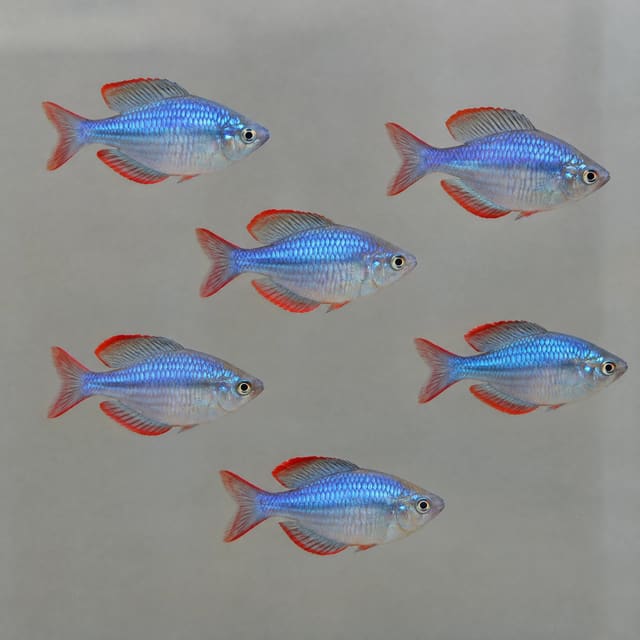
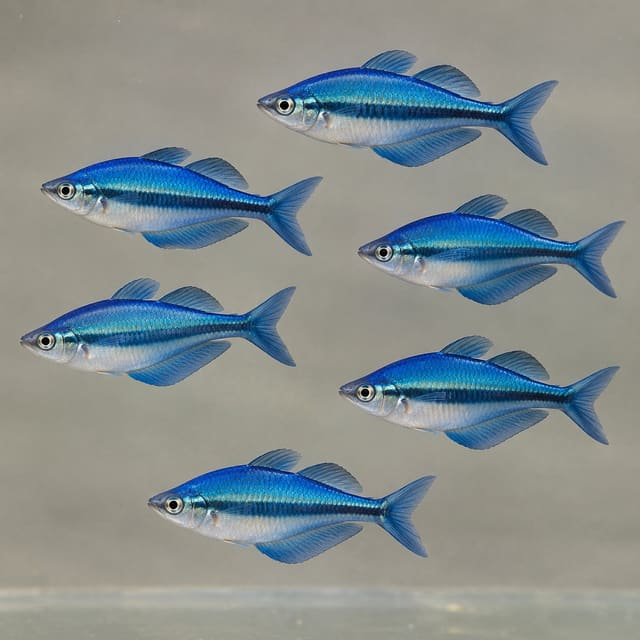
Neon Blue Dwarf Rainbowfish (Melanotaenia praecox)
23–28°C · pH 6.5–7.5 · 80L
£5.99
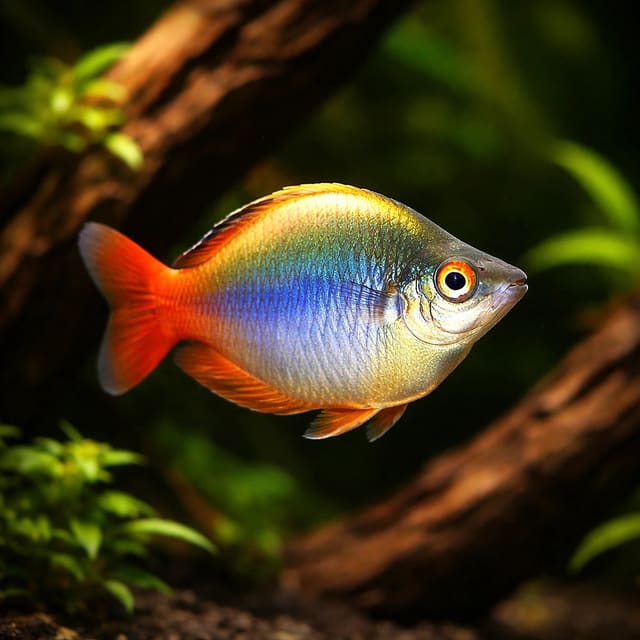
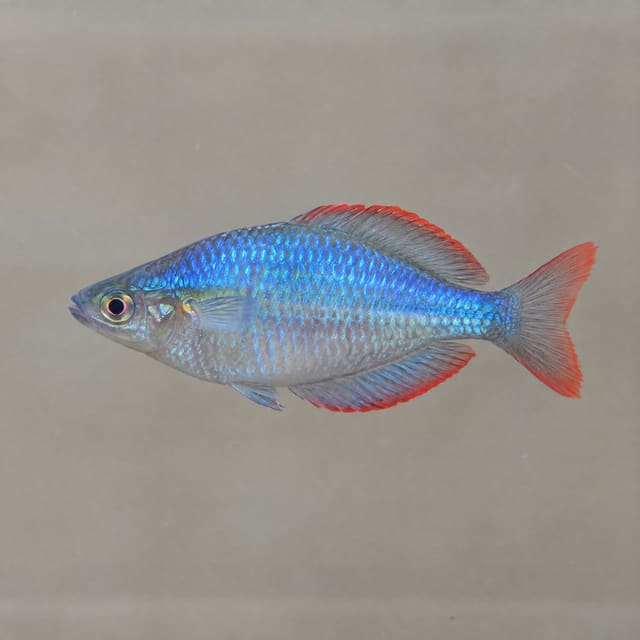
The Ajamaru Rainbowfish (Melanotaenia ajamaruensis) is a rare, critically endangered rainbowfish from the Ajamaru Lakes area of West Papua, with a metallic blue-silver body, orange rear and orange-red fins. It grows to about 10–11 cm and needs a 120 cm aquarium of at least 120 litres with a shoal of six or more. Sold individually as one live fish.
Adult size is the maximum length this species reaches at full maturity (scientific sources). The livestock you receive will be younger and smaller. Product-photo provenance and any image-specific limitations are stated on the listing.
Melanotaenia ajamaruensis
Quantity discounts are pricing offers, not a group-size recommendation. Check the full care guidance and your existing animals before choosing a quantity.
The Ajamaru Rainbowfish (Melanotaenia ajamaruensis) is a rare, critically endangered rainbowfish from the Ajamaru Lakes area of West Papua, with a metallic blue-silver body, orange rear and orange-red fins. It grows to about 10–11 cm and needs a 120 cm aquarium of at least 120 litres with a shoal of six or more. Sold individually as one live fish.
Adult size is the maximum length this species reaches at full maturity (scientific sources). The livestock you receive will be younger and smaller. Product-photo provenance and any image-specific limitations are stated on the listing.
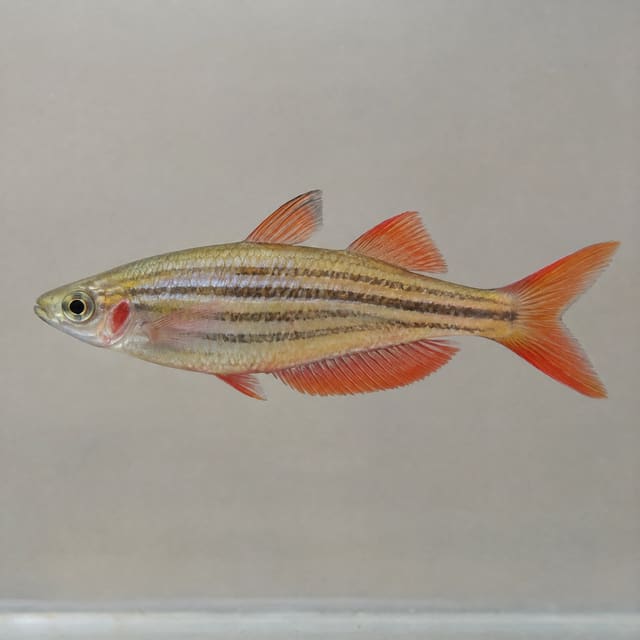
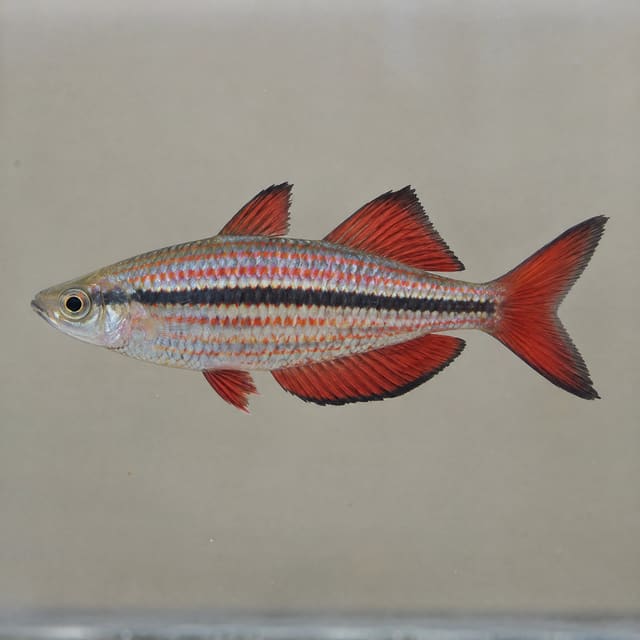
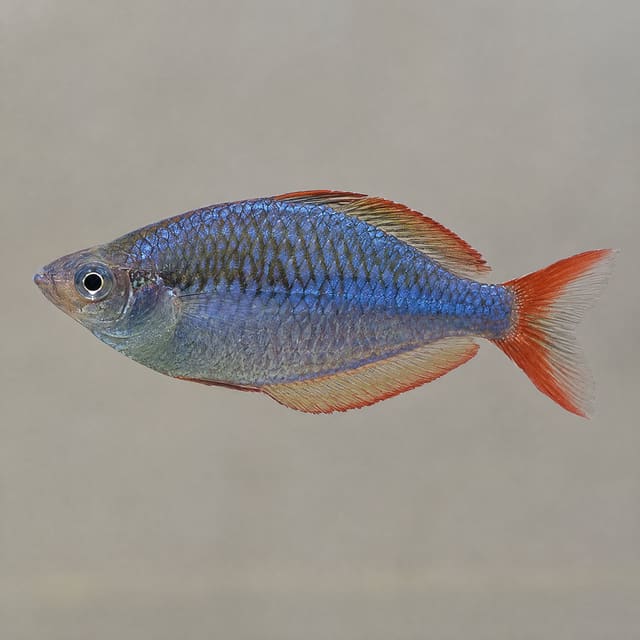
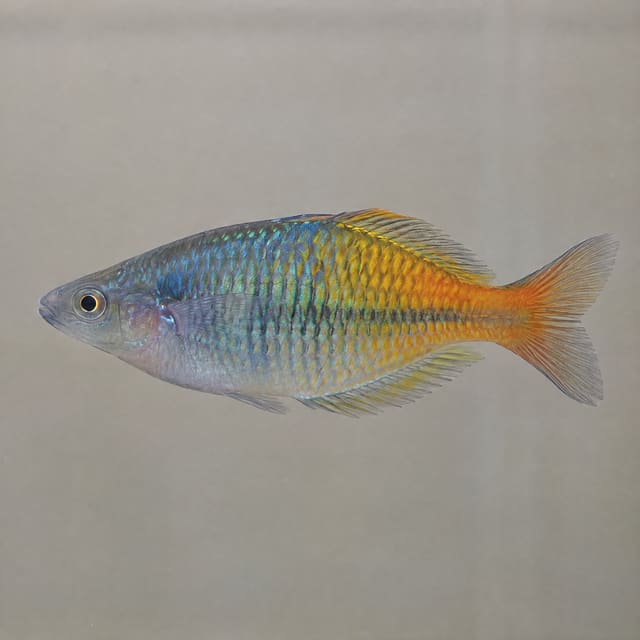
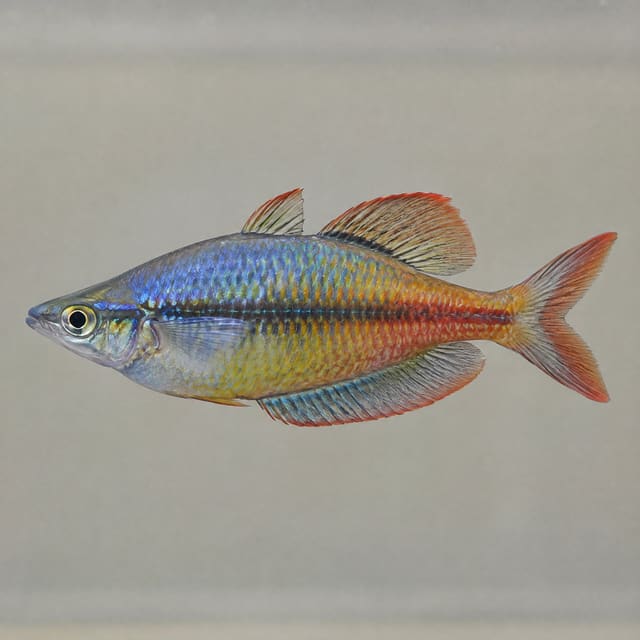
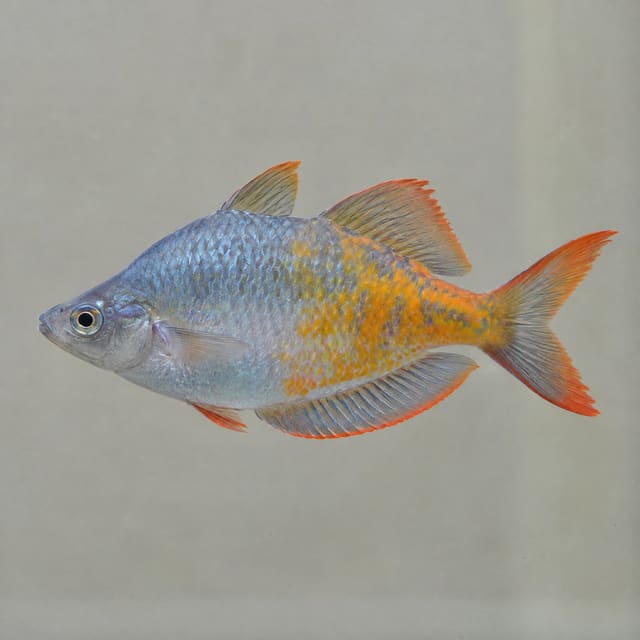
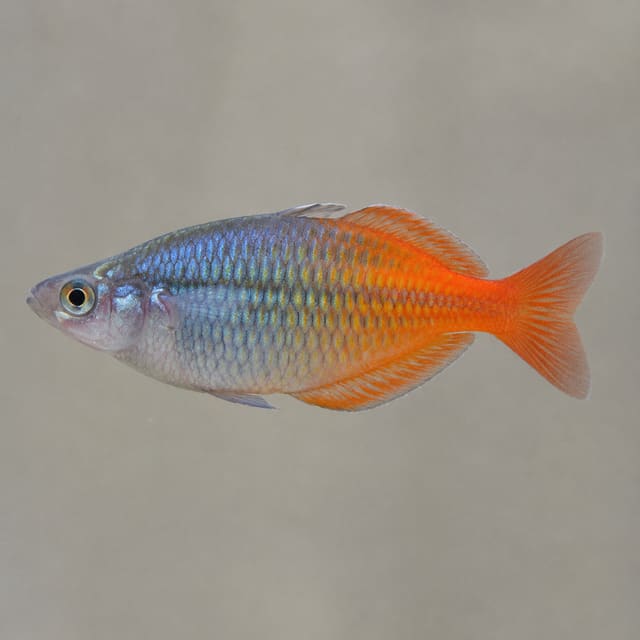
The Ajamaru Rainbowfish, Melanotaenia ajamaruensis, is one of the rarest rainbowfish you can keep. It comes from the Ajamaru (also spelt Ayamaru) Lakes area on the Vogelkop, or Bird's Head, Peninsula of West Papua, Indonesia, the same lakes that gave the hobby Boeseman's rainbowfish. Our fish shows a metallic blue-silver front half that turns warm orange towards the tail, an orange-red line along the side and orange-red fins edged with blue. If you want an unusual, peaceful shoaling fish for a long community aquarium, and a species worth keeping well, the Ajamaru Rainbowfish is a rewarding choice.
It is also a fish with a fragile wild future. FishBase gives its IUCN status as Critically Endangered, assessed in December 2019. ANGFA, the Australia New Guinea Fishes Association, reports that the only confirmed recent site is the upper Kaliwensi River, about 5 km west of Lake Ayamaru, where fish matching the original description were collected in 2007, and suggests the species may no longer live in the lake itself. Well-kept aquarium fish matter for a species like this.
| Need | What to plan |
|---|---|
| Aquarium | At least 120 cm long and 120 litres |
| Group | Six to eight or more, with more females than males |
| Water | Clean and steady, around 25–27°C, pH 7.0–8.0, moderately hard |
| Food | Flake or granules plus small live and frozen foods |
| Company | Peaceful fish of a similar size; no other Melanotaenia if you plan to breed |
ANGFA records that Allen and Cross described the species in 1980 from fish collected by Marinus Boeseman in 1954–55, at the same time as M. boesemani. The name comes from the type locality, the Ajamaru Lakes, about 120 km east-south-east of Sorong. FishBase knows it only from that area.
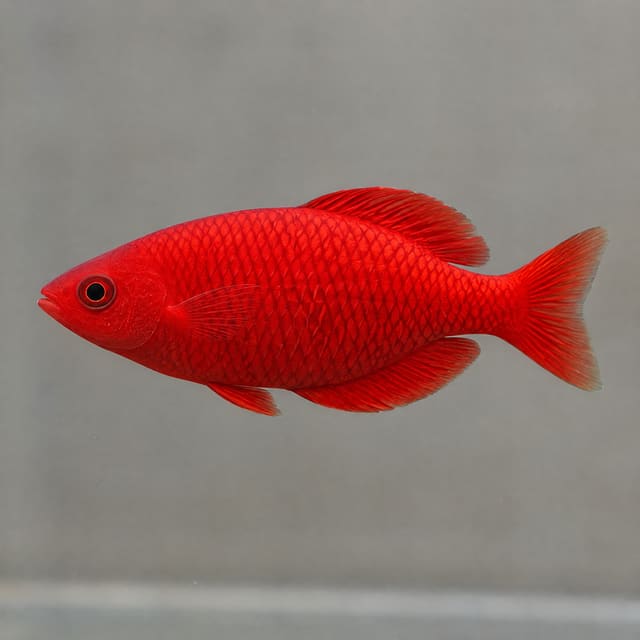
Descriptions of its colour vary. Field notes quoted by ANGFA describe a metallic blue to yellowish or green body with orange and yellow stripes along the side and dark-edged scales, while the original description gives reddish-brown on the back and front of the body, grading to yellow or tan behind. ANGFA adds that aquarium fish can be far more intense, a brilliant red to red-orange. Mature males are usually deeper-bodied than females, and their first dorsal fin is taller, reaching the start of the second dorsal fin when folded down.
| Feature (ANGFA) | Ajamaru Rainbowfish | Boeseman's rainbowfish |
|---|---|---|
| Second dorsal fin soft rays | 15–19, usually 15–17 | 10–14, usually 12–13 |
| Anal fin soft rays | 21–27, usually 22–24 | 17–23, usually 18–21 |
| Stripes along the side | More pronounced, especially the middle one | Less pronounced |
| Body shape | Slimmer | Deeper |
| First dorsal fin | Starts about half an eye-width ahead of the anal fin | Starts roughly level with the anal fin |
The two have been confused before: ANGFA notes that fish collected in 1982 were bred and sold as Boeseman's rainbowfish. Compare our Boeseman's Rainbowfish and read our Boeseman's rainbowfish guide, or browse all our Melanotaenia rainbowfish.
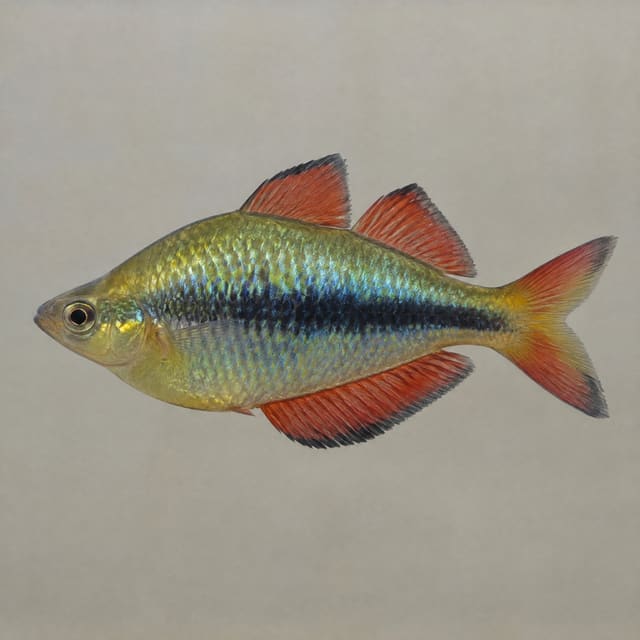
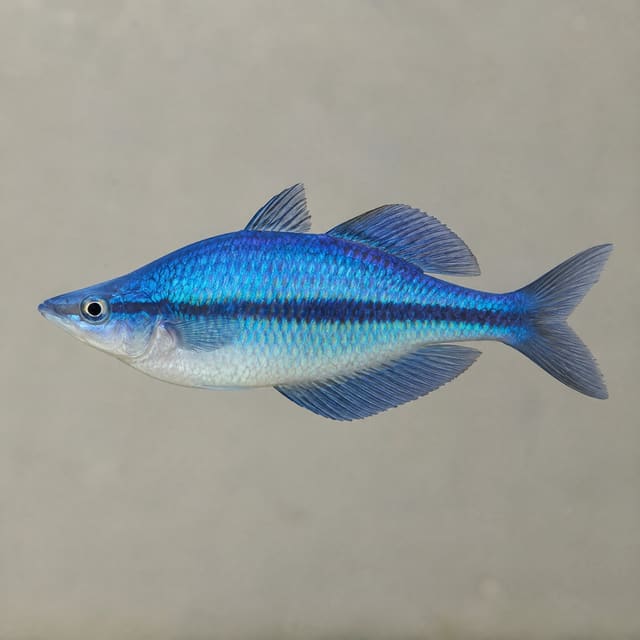
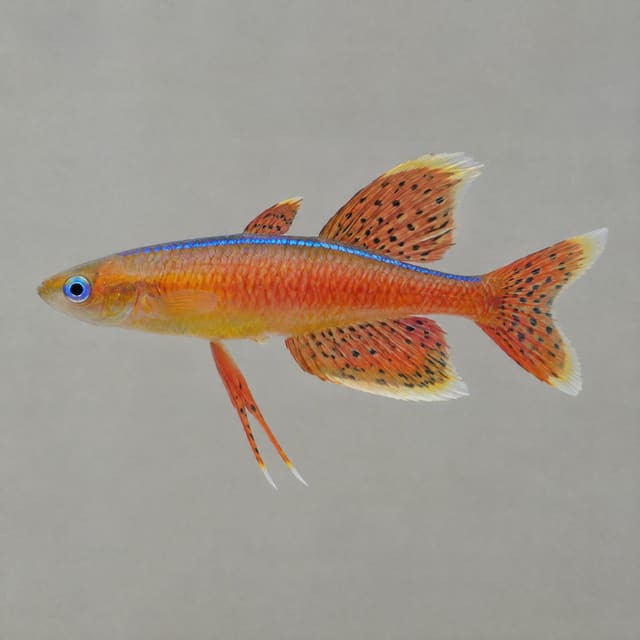
One purchase supplies one live Ajamaru Rainbowfish. Sex is not chosen or guaranteed. Like many rainbowfish, the full colour develops with age: Seriously Fish notes that young Boeseman's rainbowfish from the same lakes are drab and can take more than 12 months to colour up, so give young fish time. The photographs show the species, not the individual you will receive; colour varies between fish and develops with maturity.
FishBase gives a maximum of 9.7 cm standard length (measured without the tail), and ANGFA gives about 11 cm. No aquarium size has been published for this species, so the best guide is its close relative from the same lakes. Seriously Fish recommends a base of 120 × 30 cm, and an aquarium of at least 120 × 30 × 30 cm (about 108 litres), for Boeseman's rainbowfish, which reaches 110 mm standard length. OATA advises at least 120 litres for rainbowfish larger than 8 cm. A 120 cm aquarium holding 120 litres or more meets both.
ANGFA describes the habitat as lakes and streams with relatively clear, alkaline water and abundant aquatic plants. Lake Ajamaru covers roughly 22 square kilometres at about 250 m above sea level, and its level can rise by up to 5 m in the wet months of April to June. The 2007 site on the Kaliwensi River was different: a clear, fast-flowing stream 10–15 m wide and 1–3 m deep, running over gravel and boulders with no plants.
In the aquarium, combine the two. OATA suggests gravel or sand, live plants for shelter and plenty of open swimming space, with a reasonable current for larger, active rainbowfish.
| Area | Purpose |
|---|---|
| Dense planting along the back and sides | Shelter and a calm retreat for females |
| Open water along the front | Room for the shoal to swim and males to display |
| Fine-leaved plants or a spawning mop | Where eggs are laid if the fish spawn |
| A secure lid | OATA lists a secure lid as optional but recommended |
Few measurements exist from the wild, and they vary. ANGFA quotes pH 6.4–7.8 and 26–27°C from a 1962 survey of the lakes and streams, pH 9.0 with a hardness of 5 dGH from a later visit, pH 6.4–6.5 at the time of the first collection, and 24.7°C, pH 7.88 and a conductivity of 217 µS/cm in the Kaliwensi River in 2007. For aquarium care, OATA gives 22–27°C, pH 6.5–8.0 and 4–12 dGH for rainbowfish in general, and Seriously Fish gives 27–30°C, pH 7.0–8.0 and 10–20 dGH for Boeseman's rainbowfish, warning that it does poorly in soft, acidic water.
| Reading | Target | Why |
|---|---|---|
| Temperature | 25–27°C | Close to the wild readings and inside OATA's range |
| pH | 7.0–8.0 | Seriously Fish for its relative; inside OATA's range; the 2007 river reading was 7.88 |
| General hardness | 10–12 dGH | Where OATA (4–12) and Seriously Fish (10–20) overlap |
| Ammonia and nitrite | 0 mg/l | OATA |
| Nitrate | No more than 20 mg/l above your tap water | OATA |
UK tap water varies a lot from area to area, so check your water company's report for your postcode and compare it with the range using our water matcher. Treat every water change with a tap water conditioner and keep the temperature steady with a heater. Our water chemistry guide explains each reading.
OATA says a filter is always essential and that larger, more active rainbowfish appreciate a reasonable current. A shoal of fish this size produces steady waste, so keep to a weekly routine.
Seriously Fish describes Boeseman's rainbowfish as unfussy, taking dried, frozen and live foods, and says regular live food helps the fish show their best colours. OATA advises feeding rainbowfish once a day, only what they eat within a few minutes, with a good flake or granule as the staple and small live or frozen foods such as daphnia or bloodworm as extras; larger species may prefer brine shrimp.
| Part of the meal | Example |
|---|---|
| Staple | Quality flake or small granules |
| Colour boost | Frozen daphnia or frozen artemia, thawed first |
| Amount | What the whole shoal clears in a few minutes |
Add the fish to an aquarium that is fully cycled. OATA's floating-bag method works well: switch the aquarium lights off, float the sealed bag for about 10 minutes to match the temperature, then add small amounts of aquarium water to the bag over up to 20 minutes, and net the fish across with as little bag water as possible. See our guide on how to acclimatise new fish.
| When | Check |
|---|---|
| Day 1 | Lights low and no food; let the shoal find the plants |
| Day 2 | Offer a small meal; remove leftovers |
| Days 1–7 | Watch for clamped fins, hiding or rapid breathing; test ammonia and nitrite |
| End of week 1 | Routine water change; the shoal should be swimming in open water |
Seriously Fish describes Boeseman's rainbowfish as very peaceful, but notes that its speed and size can unsettle smaller or slow-moving fish. It suggests similarly sized rainbowfish, characins, danios, barbs and Corydoras as companions. OATA adds that rainbowfish are seldom predatory or aggressive, but that active species should not be mixed with timid or much smaller fish.
One extra point matters for a rare species. ANGFA notes that rainbowfish which share a habitat in the wild can produce fertile hybrids in aquaria, and that hybrids are not easy to spot, so serious breeders keep each variety in a separate aquarium. If you plan to breed your Ajamaru Rainbowfish, keep them as the only Melanotaenia in that aquarium.
| Suits | Avoid |
|---|---|
| Other rainbowfish in a display aquarium, such as the Lake Kutubu Rainbowfish | Other Melanotaenia in a breeding aquarium |
| Peppered Corydoras and other peaceful bottom-dwellers | Very small, slow or timid fish |
| Similarly sized peaceful characins, danios and barbs | Aggressive or fin-nipping fish |
Check any mix in our tank mates tool. For other New Guinea rainbowfish, compare the Lake Tebera Rainbowfish and the New Guinea Red Rainbowfish, or read our neon rainbowfish guide.
OATA describes a healthy rainbowfish as having clear, bright eyes, undamaged fins, intact scales, normal swimming and steady breathing. Early warnings include hanging at the surface, sitting on the bottom, erratic swimming, colour change, more hiding, white spots or fluffy growths, weight loss and poor appetite.
| You see | What to do |
|---|---|
| Fish hanging at the surface or gasping | Test ammonia and nitrite and check the filter and aeration |
| Pale, hiding fish | Check the group size and look for bullying |
| White spots or fluffy patches | Test the water and treat promptly |
| Thin fish despite feeding | Make sure each fish gets a share; feed small amounts across the surface |
FishBase records distinct pairing in this species, but no detailed breeding account has been published for it, so the notes below come from its close relative and from rainbowfish in general. Seriously Fish describes Boeseman's rainbowfish as an egg-scatterer that is not difficult to breed, although the fry can be tricky to raise. It suggests a spawning aquarium of at least 30 inches (about 76 cm), pH around 7.5, 26.5–29°C, a small air-powered filter and fine-leaved plants such as java moss or nylon spawning mops. The eggs hang from surfaces by a small thread; check daily and move them to a raising aquarium with water from the spawning tank. OATA notes that females lay two or three eggs at a time over the course of a day.
Seriously Fish gives a hatching time of 7–12 days, depending on temperature, and OATA about seven days. The fry stay near the surface, so they need infusoria first and then newly hatched brine shrimp after about a week; sinking foods are unsuitable. ANGFA recommends boiling spawning mops before reusing them, so stray eggs from another species cannot hatch, and keeping the location name with your fish so the line stays traceable.
In England and Wales the government's non-native fish guidance links to a checklist that lists Melanotaenia for indoor aquaria only. Never release aquarium fish: OATA points out that it is illegal and usually fatal to the fish. Browse our full range of rainbowfish and rainbow fish, and before you order, read our delivery and Live Arrival Guarantee information.
It is Melanotaenia ajamaruensis, a rainbowfish from the Ajamaru (Ayamaru) Lakes area on the Bird's Head (Vogelkop) Peninsula of West Papua, Indonesia. It was described in 1980 from fish collected in 1954–55, together with its better-known neighbour, Boeseman's rainbowfish.
Yes. FishBase gives its IUCN status as Critically Endangered, assessed in December 2019. ANGFA reports that the only confirmed recent site is the upper Kaliwensi River, where fish were found in 2007, and that it may no longer live in Lake Ajamaru itself. Never release aquarium fish.
ANGFA explains that the Ajamaru Rainbowfish has more soft rays in its second dorsal fin (15–19 against 10–14) and anal fin (21–27 against 17–23), stronger stripes along the side and a slimmer body. Early aquarium fish of the two species were mixed up, so buy from a named source.
FishBase gives a maximum of 9.7 cm standard length and ANGFA about 11 cm. Males are deeper-bodied than females, with a taller first dorsal fin.
At least five, as OATA advises for rainbowfish, and preferably six to eight or more; Seriously Fish recommends a shoal of at least six to eight for its close relative. Keep more females than males.
Clean, steady water around 25–27°C, pH 7.0–8.0 and moderate hardness, with zero ammonia and nitrite. Wild readings range from pH 6.4 to 9.0, so stability matters more than a perfect figure.
Yes, in a community kept for display. ANGFA notes that rainbowfish can produce fertile hybrids in aquaria, so if you plan to breed Ajamaru Rainbowfish, keep them as the only Melanotaenia in that aquarium.
One live Ajamaru Rainbowfish. Sex is not chosen, and colour develops as the fish matures. Order several to start a shoal.
No reviews for this item yet. Bought one? Honest reviews only, good or bad.
What customers say about ordering from us
Easy website plenty of info on fish your buying great to pick a time slot
TRACEY DURRANT · 7 Oct 2026
Got some lovely fish thank you
Kevin Mackie · 7 Oct 2026
Reviews of our shop, collected by Judge.me, an independent third-party review collector. Newest first.
Moved by UK carriers licensed to handle live animals
Hand-packed with oxygen bags, poly box, heat pack
Email photos the same day; an optional unboxing video helps us review problems faster — claim terms apply
Klarna & PayPal Pay in 3 at checkout