Easy
Neon Dwarf Rainbowfish (Melanotaenia praecox)
23–27°C · pH 6.8–7.5 · 54L
£5.99

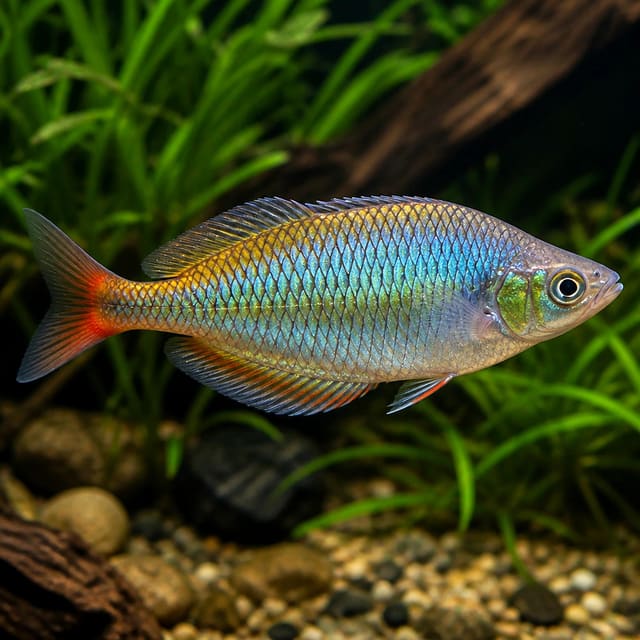
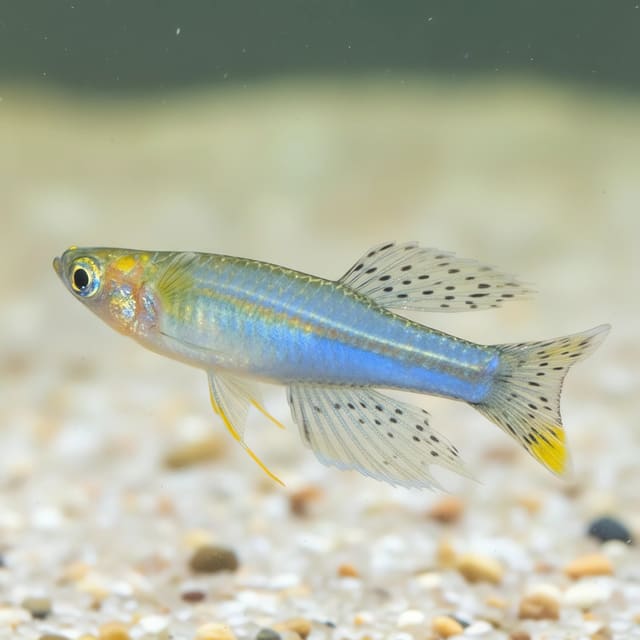
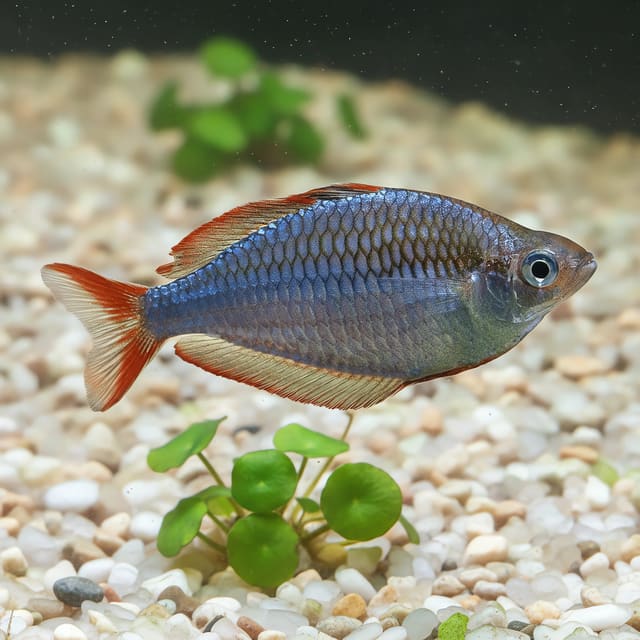
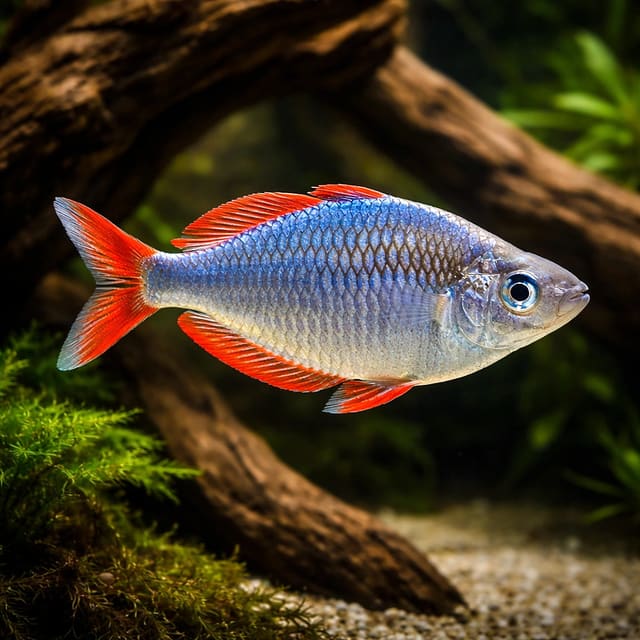
The Dwarf Australian Rainbow (Melanotaenia maccullochi) is a peaceful freshwater rainbowfish from north-eastern Australia that reaches 7 cm standard length. It suits planted aquariums planned for a shoal of at least 6–8 at 20–30°C and pH 5.5–8.0. Sold individually in 4.5–5 cm and >6 cm dispatch sizes.
Adult size is the maximum length this species reaches at full maturity (scientific sources). The livestock you receive will be younger and smaller — pick a size above for the actual shipping size. Product-photo provenance and any image-specific limitations are stated on the listing.
Melanotaenia maccullochi
Shoaling fish: kept in a group they feel safer, stay calmer and show their best colour.
The Dwarf Australian Rainbow (Melanotaenia maccullochi) is a peaceful freshwater rainbowfish from north-eastern Australia that reaches 7 cm standard length. It suits planted aquariums planned for a shoal of at least 6–8 at 20–30°C and pH 5.5–8.0. Sold individually in 4.5–5 cm and >6 cm dispatch sizes.
Adult size is the maximum length this species reaches at full maturity (scientific sources). The livestock you receive will be younger and smaller — pick a size above for the actual shipping size. Product-photo provenance and any image-specific limitations are stated on the listing.
Maintain these water conditions for optimal health and vibrant colors
The Dwarf Australian Rainbow, Melanotaenia maccullochi, is a small freshwater rainbowfish from north-eastern Australia. It is also known as Macculloch’s rainbowfish and belongs to the family Melanotaeniidae. Its peaceful temperament and active social behaviour make it a candidate for planted species aquariums and carefully planned communities rather than solitary display.
FishBase records a maximum of 7 cm standard length for male or unsexed fish. Plan the aquarium around that adult measurement, the space needed by a complete shoal and the swimming activity of the group. A small body does not turn a social fish into a suitable single inhabitant for a small container.
| Decision | Planning figure |
|---|---|
| Adult length | Maximum recorded length of 7 cm standard length |
| Species aquarium | About 54 litres with a 60 × 30 cm base |
| Social group | At least 6–8, preferably more |
| Aquarium water | 20–30°C, pH 5.5–8.0 and 8–15 dGH |
| Layout | Heavy planting, open swimming areas and slow flow |
The aquarium figures above come from the Seriously Fish species account for Melanotaenia maccullochi. The pH can vary with collection locality, so measure your aquarium and tap water rather than choosing companions from a temperature figure alone.
| Suits | Not suited to |
|---|---|
| A planted aquarium with open swimming areas and slow flow | A solitary display or an aquarium that cannot hold at least 6–8 |
| A peaceful community screened for water, size and feeding pace | Forceful flow throughout or a layout without adequate cover |
| A keeper able to test water and make regular partial changes | An immature or unfiltered aquarium |
This fish suits a keeper who can maintain a mature biological filter, perform weekly partial water changes and reserve enough room for a proper shoal. It is a less suitable choice when the aquarium cannot accommodate six fish, has forceful flow throughout, lacks cover or already contains companions that would be overwhelmed by an active group.
Before choosing this species, compare the adult dimensions, social needs and water requirements of the whole planned community. You can also browse the current rainbowfish collection when deciding whether this smaller species or a different rainbowfish better matches the aquarium.
One purchase supplies one Dwarf Australian Rainbow in the size selected. The live size selector carries 4.5–5 cm and >6 cm dispatch sizes. Check the selector when choosing the size rather than relying on static text about a particular selection.
The size you select is the size supplied, not the adult size. Dispatch size describes the animal at fulfilment, while the recorded adult maximum is 7 cm standard length. The >6 cm label is open-ended and should not be read as a promise of a particular age, sex or eventual measurement.
Because each purchase supplies one animal, a planned group of six requires a total quantity of six. A planned group of eight requires a total quantity of eight. If you combine dispatch sizes, count every selected animal towards the total group while keeping the aquarium’s space, filtration and existing livestock in view.
Sex is guaranteed only when the selected option explicitly states male or female. This Dwarf Australian Rainbow listing has no sex-guaranteed option.
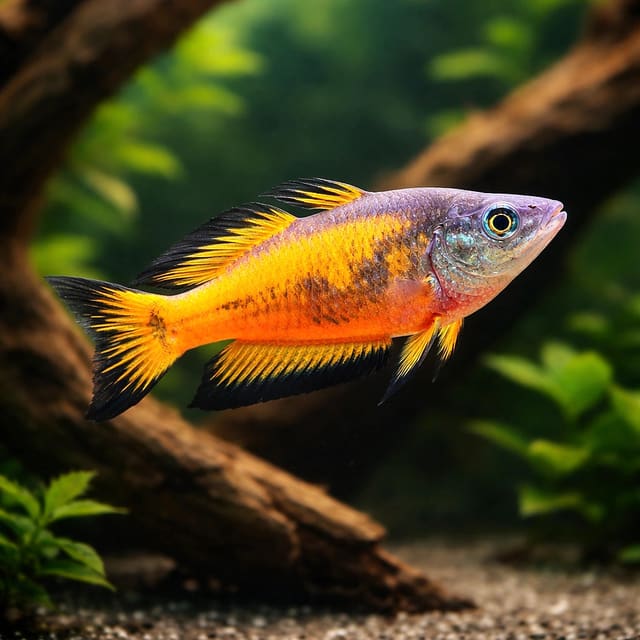
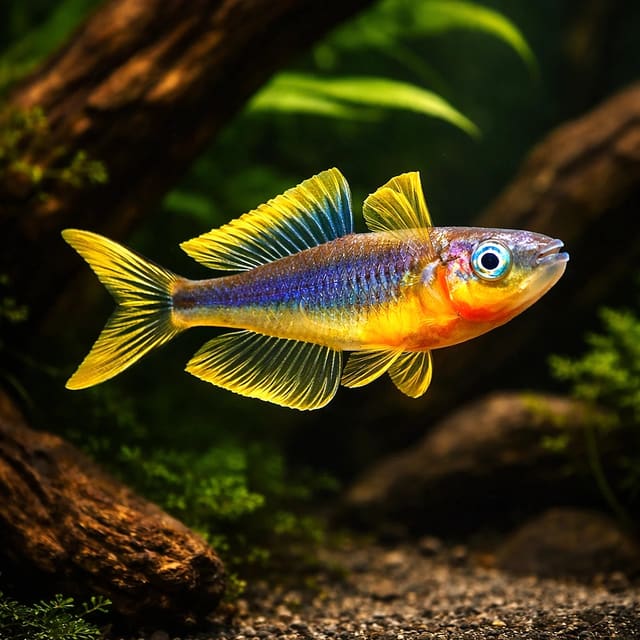
Do not infer sex or life stage from dispatch size, colour or gallery appearance. Mature males may become more colourful and develop longer dorsal and anal fins than deeper-bodied females, but those mature traits are observational differences rather than a promise about the animal supplied.
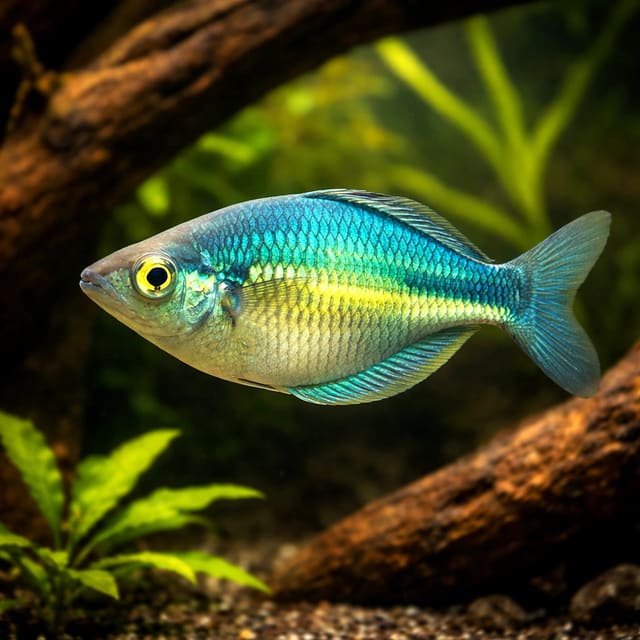
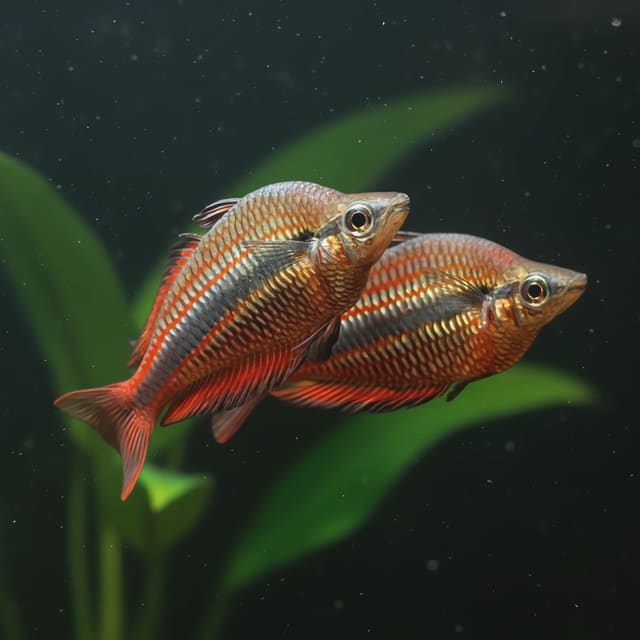
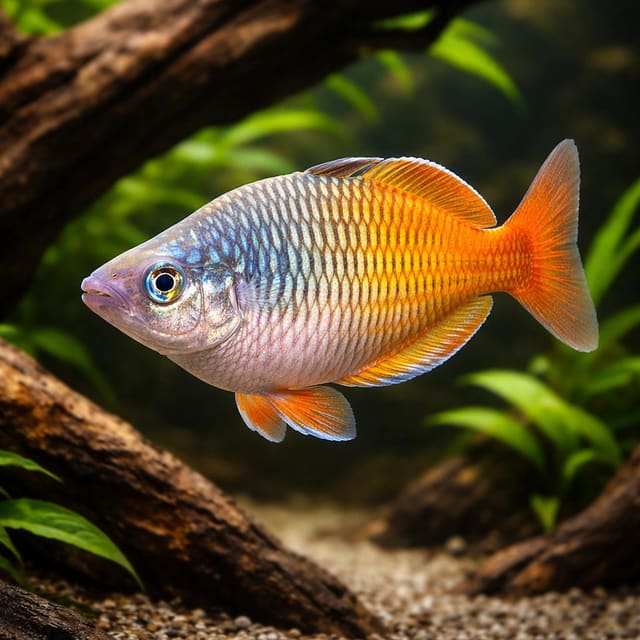
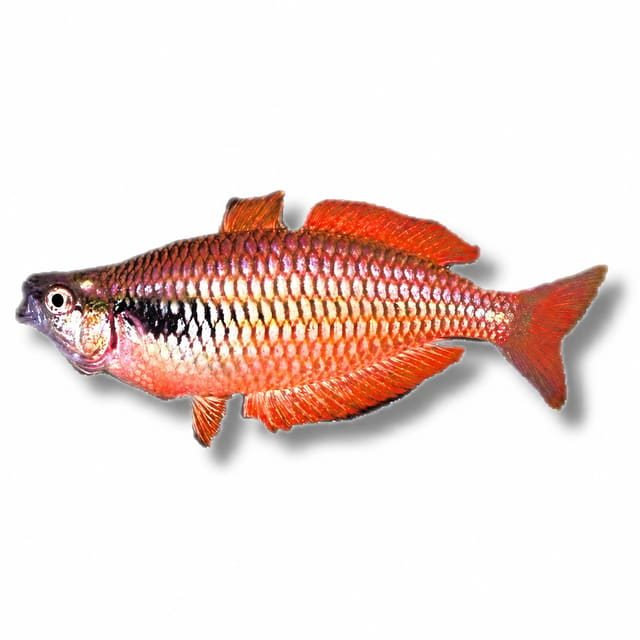
These representative gallery images have been digitally enhanced for presentation, so colours can look slightly different from the live animal.
Prepare the aquarium for the full quantity before completing your selection. For timing, coverage and claims procedures, read our current delivery and Live Arrival Guarantee policy.
Use an aquarium with a base of at least 60 × 30 cm and a volume of about 54 litres for the species setup described by Seriously Fish. Treat both measurements as part of the decision. A nominal volume in a tall or unusually shaped aquarium does not automatically create the same horizontal layout.
Build heavy planting around open water rather than filling every part of the aquarium with stems or ornaments. This arrangement gives the shoal cover while preserving clear areas for swimming and male display. Keep flow quite slow across those open lanes and position the filter return so the entire aquarium is not dominated by a forceful current.
| Zone | Purpose |
|---|---|
| Planted areas | Cover for a social fish that may be skittish |
| Open lanes | Unobstructed group swimming and display space |
| Filter area | Waste processing without excessive current |
| Maintenance access | Room to siphon waste and inspect equipment |
Aquarium gravel or sand can form the base. Live plants are the preferred way to supply cover, particularly because this species is ideally suited to a heavily planted setup. If live planting is not used throughout, suitable artificial plants and aquarium ornaments can supply shelter, but they should not consume the swimming area required by the shoal.
Keep the group requirement in view as you place every object. Six to eight active fish need connected swimming space, not several small pockets divided by solid décor. Leave visible routes through the centre and between planted sections, then inspect the layout from both ends to check that dense planting has not created dead ends.
The 54-litre figure is a species aquarium reference, not a promise that every community combination will fit. Existing fish, additional shoals and bottom-dwelling companions all add demands on footprint, filtration and water quality. Increase aquarium size when the complete stocking plan cannot preserve cover and open water at the same time.
Finish the physical layout before adding livestock so plants, equipment and access points can be adjusted without disturbing the group. A stable arrangement also makes later changes in hiding, swimming route or social behaviour easier to notice.
Set aquarium temperature within 20–30°C, pH within 5.5–8.0 and general hardness within 8–15 dGH. The pH range varies with collection locality, so use measured values and consistency when selecting the aquarium and its companions. Do not choose a target only because it sits somewhere inside a broad temperature overlap.
| Measurement | Target |
|---|---|
| Temperature | 20–30°C |
| pH | 5.5–8.0 |
| General hardness | 8–15 dGH |
| Ammonia | Zero mg per litre |
| Nitrite | Zero mg per litre |
| Nitrate | Not more than 20 mg per litre above the normal tap-water level |
OATA’s rainbowfish guidance is broad group guidance: it gives ammonia and nitrite at zero mg per litre and nitrate at no more than 20 mg per litre above the normal tap-water level. These waste targets support the high water quality required by Melanotaenia maccullochi.
Measure the aquarium before introducing the shoal, then test at least weekly as part of routine maintenance. Record the result rather than relying on clear-looking water. Ammonia and nitrite are invisible, and a change in fish behaviour may be the first noticeable sign that waste processing has fallen behind.
Use our aquarium water chemistry guide to understand what each measurement means. Once you have actual readings, the water matcher can help compare them with the stated aquarium range.
If ammonia or nitrite is detected, pause further stocking and check the filter, feeding and maintenance routine. When nitrate rises beyond its target, carry out the planned partial water change and review whether waste, feeding or total stocking is increasing faster than the aquarium can manage.
Test the replacement water as well when tap-water conditions vary. The aim is an aquarium that remains inside the chosen part of the species range while biological waste stays controlled, not a series of abrupt reactions to isolated readings.
A working biological filter is essential. The RSPCA explains that biological filtration supports beneficial bacteria that convert toxic ammonia to toxic nitrite and then to safer nitrate. That process is why a clean-looking but immature aquarium is not ready for a shoal.
For the species setup of about 54 litres, Seriously Fish uses a turnover of four to five times the aquarium volume per hour and gives a filter rating of roughly 215–270 litres per hour. The calculation is straightforward: 54 litres multiplied by four is about 216 litres per hour, while 54 multiplied by five is 270 litres per hour.
| Decision | Action |
|---|---|
| Biological capacity | Use a mature filter able to process the waste from the complete shoal |
| Rated turnover | Aim for about 215–270 litres per hour in a 54-litre example |
| Current | Arrange the outlet so open swimming areas retain quite slow flow |
Filter ratings and experienced flow are not the same decision. A unit can meet its nominal turnover while its outlet creates a concentrated jet. Position or diffuse the return so water continues moving through the filter without forcing the fish to swim continuously against a strong current.
Check the filter for blockages during weekly maintenance. When its media needs cleaning, rinse it lightly in aquarium water removed during the partial water change. Do not rinse mature biological media under the tap because chlorine or chloramine may damage the beneficial bacterial population.
Seriously Fish also gives a heater example of roughly 75–100 W for a 54-litre aquarium when the room is around 20°C. Treat that as a worked example under the stated room condition. Select and set equipment to hold the aquarium inside 20–30°C, then confirm the result with measurement rather than wattage alone.
After any filter cleaning or equipment adjustment, confirm that flow remains slow enough for the planted layout and continue checking ammonia and nitrite. A filter must satisfy both parts of the job: biological waste processing and a current that suits the fish.
Keep Melanotaenia maccullochi in a shoal of at least 6–8, preferably more. This species can be skittish and performs much better in a proper social group. Conspecific company also encourages males to display their stronger mature colours.
Six should be treated as the lower edge of the species recommendation, not a target to divide across separate aquariums. If an existing group falls below that threshold, assess aquarium space, filtration and compatibility before increasing it. More fish may improve the social setting, but only when the aquarium can support the resulting total load.
| Group plan | Decision |
|---|---|
| One fish | Do not plan this species as a solitary display animal |
| Fewer than six | Below the species shoal recommendation |
| Six to eight | Starting group described for the species |
| More than eight | Preferred socially when aquarium capacity supports it |
Watch how the group uses the aquarium. Coordinated swimming through open areas, regular feeding and normal social display are useful reference behaviours. Repeated hiding, isolation, unusual bottom-sitting or hanging at the surface should prompt an immediate water test and a review of group pressure, current and tank mates.
Mature males may be more colourful and have longer dorsal and anal fins, while mature females may be deeper-bodied. Use those distinctions only when observing mature fish. They do not create a dependable way to select sex from a dispatch measurement or a representative image.
Do not force a preferred male-to-female ratio when the chosen option carries no sex selection. Build the aquarium around the number of animals, their adult size and the group’s social needs. If the sexes later become apparent, continue to watch whether every fish can feed and use cover without persistent pressure.
A complete shoal is one stocking component. Community companions do not replace members of the same species, even when they swim in a similar part of the aquarium. Reserve the first share of space and filtration for the Dwarf Australian Rainbow group before considering additional species.
The Dwarf Australian Rainbow is an omnivore that accepts most dried, frozen and live aquarium foods. Use a good-quality flake or granule as the regular dried food, then include suitable small live or frozen items such as daphnia, small bloodworm or tubifex. Regular live and frozen food can help the fish display their best colours.
Feed once a day and offer only what the group can consume within a few minutes. This limit is more useful than a fixed pinch because the correct amount changes with group size, food form and feeding response. Stop adding food when the fish no longer take it promptly.
| Food decision | Purpose |
|---|---|
| Quality flake or granule | Regular dried staple |
| Small live food | Dietary variation and active feeding response |
| Small frozen food | Convenient variation alongside the staple |
| Uneaten food | Signal to stop and reduce the next portion |
Distribute the meal so the whole shoal has an opportunity to feed. Watch for an individual that repeatedly misses food, withdraws from the group or loses condition. That observation can reveal social pressure, illness or an unsuitable feeding pace before the problem becomes severe.
Do not respond to enthusiastic feeding by extending the meal. Rainbowfish may continue to show interest after an adequate portion, while uneaten food breaks down and releases waste into the water. Overfeeding therefore affects both body condition and the ammonia, nitrite and nitrate load managed by the filter.
At each meal, check that the food form can be taken readily and that leftovers are not settling among plants or into the substrate. Remove visible excess during maintenance and reduce the next portion rather than allowing a repeated accumulation.
Use dietary variety without turning every day into several separate feeds. One measured daily meal remains the schedule, and the food offered within that meal can vary between the dried staple and appropriate live or frozen choices. This keeps the feeding rule simple enough to apply consistently across the whole shoal.
Carry out a partial water change of 25% at least once every week. Use a siphon to remove solid waste from the gravel or sand, and treat replacement tap water with a suitable conditioner to remove harmful chlorine or chloramine before it enters the aquarium.
Test the water at least weekly and compare the results with the targets already set for the aquarium. High water quality is essential for this species, so the change and test should remain scheduled even when the water looks clear and the fish are feeding.
Changes worth acting on include hanging at the surface, sitting on the bottom, erratic swimming, a marked change in colour, increased aggression, unusual hiding, faster or slower gill movement, white spots, fluffy growths, damaged fins or scales, weight change and reduced interest in food.
If you see one of these changes, test water quality first and compare the affected fish with the normal behaviour of the rest of the group. Correct any husbandry problem identified and contact us for further guidance on health changes. Do not choose medication from a symptom name alone.
Weekly records help separate a one-off observation from a continuing trend. For example, a rising nitrate result across successive tests points towards a growing waste load, while a change immediately after filter maintenance directs attention to filtration and water conditions.
Keep maintenance proportionate but consistent. A 25% change at least once a week is the stated baseline, while measured water quality, accumulated waste and the condition of the shoal show whether the aquarium needs closer attention.
Prepare and mature the aquarium before the fish arrive. A mature biological filter needs an established bacterial population capable of converting ammonia and nitrite, and both compounds should test at zero mg per litre before livestock is introduced. Our first tropical aquarium guide explains how to prepare the system before livestock.
Increase the aquarium population slowly. Every additional fish and every increase in feeding creates more waste, while the beneficial bacteria in the mature filter need to support that increased load. Adding livestock faster than the filter can respond can lead to new tank syndrome and harmful ammonia or nitrite.
Use the daily feed as an observation point. Check whether all fish take food, swim with the group and use both cover and open water. Look for clear eyes, intact scales and fins, appropriate swimming and the absence of bumps or ulcerated areas. Test immediately if a fish hangs at the surface, remains on the bottom or becomes erratic.
Continue the same weekly testing and 25% partial water changes at least once a week. Record food intake, group cohesion and any changes in hiding, breathing or colour. Keep further livestock additions on hold until the filter continues to return zero ammonia and zero nitrite with the existing population.
If the shoal remains withdrawn, assess water values, current, cover, group size and the behaviour of companions rather than assuming the fish simply need more time. Each of those factors has a direct care action: correct the water, soften excessive flow, restore cover, complete the social group or reconsider a stressful community combination.
Melanotaenia maccullochi is described as very peaceful and suitable for many community aquariums. That does not make any fish an automatic companion. Screen each proposed combination for adult size, temperament, activity, feeding pace, water requirements and the space left after the rainbowfish shoal is counted.
Conditional candidates include similarly sized rainbowfish, characins, danios, barbs, dwarf cichlids, freshwater gobies and Corydoras. These groups are starting points for assessment, not universal matches. Individual species within them can differ in adult size, behaviour and water needs.
Avoid mixing geographical variants of Melanotaenia maccullochi because they may hybridise. Plan a single variant as one complete shoal rather than combining visibly different forms.
| Check | Required decision |
|---|---|
| Water | The companion’s aquarium range must overlap 20–30°C, pH 5.5–8.0 and 8–15 dGH |
| Adult size | Compare mature dimensions rather than dispatch measurements |
| Temperament | Choose peaceful behaviour that will not place persistent pressure on the shoal |
| Activity | Use caution with timid or much smaller fish around an active rainbowfish group |
| Feeding | Every species must be able to take its food without being repeatedly displaced |
| Space | Preserve planting, cover and open swimming room after all groups are counted |
Do not treat a shared temperature as a complete match. A fish can overlap at 24°C while falling outside the required hardness, using the same crowded swimming area or feeding too slowly beside an active shoal. All parts of the screen must work together.
Watch the community after introduction. Increased hiding, reduced feeding, isolation or persistent displacement from open water indicates that the practical combination needs reassessment even when both species fit the measured water range.
For a stocking and compatibility assessment, contact us with aquarium dimensions, measured temperature, pH and hardness, filter details, current livestock and the number of Dwarf Australian Rainbows planned. Those details allow a specific assessment without turning a conditional candidate into a blanket recommendation.
Start the stocking plan with the Dwarf Australian Rainbow shoal rather than fitting it into space left by other fish. Reserve a 60 × 30 cm base, about 54 litres, heavy planting, open swimming room and capacity for at least 6–8 individuals. Only then assess what additional livestock the aquarium can support.
For a species-focused plan, begin with the stated 54-litre and 60 × 30 cm setup, then count a complete shoal of at least six. Arrange planting around connected open lanes, set slow flow and size the filter around the whole group. Increasing the shoal beyond the starting band may improve the social setting, but it also increases the demand on space and filtration.
For a community plan, do not subtract the rainbowfish from a simple litre allowance and assume the remainder can be filled. List every species with its adult size, group requirement, water range, swimming area and feeding pace. Reject a proposed combination if it removes the open water, pushes a companion outside its preferred water or creates more waste than the mature filter can process.
Measure the existing aquarium and test its water before selecting a quantity. Confirm that the current temperature, pH and hardness fit the rainbowfish, then observe whether existing fish are timid, substantially smaller or slow at feeding. Review recent ammonia, nitrite and nitrate results rather than assuming past stability will continue after a new shoal is added.
| Planning question | Proceed only when |
|---|---|
| Can the full shoal fit? | At least 6–8 can be kept together with open swimming room |
| Can the filter respond? | The aquarium is mature and stocking can increase slowly |
| Do the water ranges overlap? | Temperature, pH and hardness suit every species |
| Can every fish feed? | No group is repeatedly displaced at the daily meal |
| Can maintenance control waste? | Weekly testing and water changes keep waste targets in range |
A larger aquarium generally gives more stable environmental conditions, but volume alone does not resolve an unsuitable social or water match. Use extra space to protect group size, cover and swimming room rather than simply increasing the number of species.
The Dwarf Australian Rainbow reaches a recorded maximum of 7 cm standard length, so plan its aquarium and complete shoal around that adult figure rather than its dispatch size.
Plan about 54 litres with a base of at least 60 × 30 cm, heavy planting, connected open swimming areas, slow flow and mature biological filtration.
Keep a shoal of at least 6–8 Dwarf Australian Rainbows, preferably more, because this social species can be skittish and performs better with its own kind.
It can suit a beginner who prepares a mature filtered aquarium, keeps the complete shoal, tests water at least weekly and carries out a 25% partial water change at least once a week.
Feed a quality flake or granule once daily, vary it with suitable small frozen or live foods, and limit the meal to what the shoal eats within a few minutes.
Keep the Dwarf Australian Rainbow at 20–30°C and pH 5.5–8.0, with general hardness of 8–15 dGH and ammonia and nitrite at zero mg per litre.
It is described as very peaceful. Keep a complete shoal and choose peaceful companions whose adult size, activity and feeding pace will not place persistent pressure on the group.
Conditional candidates include similarly sized rainbowfish, characins, danios, barbs, dwarf cichlids, freshwater gobies and Corydoras when their water, adult size, temperament, feeding pace and space needs align; avoid mixing geographical variants of this species.
Have someone present to receive the parcel. For every delivery, start filming continuously while the parcel is still sealed, then show it being opened and the fish still inside the sealed bag; float the bag for 20–30 minutes before releasing the fish, and never pour the bag water into the aquarium.
No reviews for this item yet. Bought one? Honest reviews only, good or bad.
What customers say about ordering from us
I have a small group of long finned mountain minnows. So was delighted to be able to order ten of this variety to increase the genetics in my tank . The ones I recieved are healthy but it’s to early to give a verdict on wether they are of a long finned type since they are small currently.
Gordon Walker · 23 Sept 2026
100% success travel and "installation". Pleased with quality of purchase. The Siamese fighter a bit "shy" so have not yet seen him at his best yet but looking good. Happy customer. GG
George E Garratt · 21 Sept 2026
Reviews of our shop, collected by Judge.me, an independent third-party review collector. Newest first.