Easy
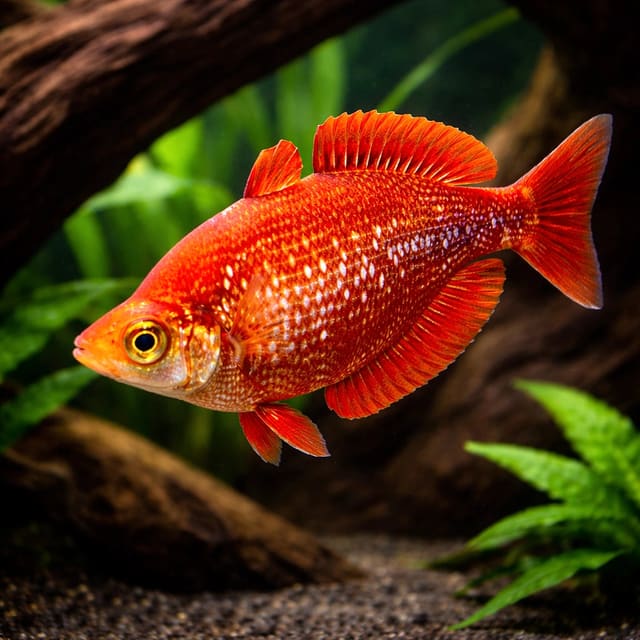
Neon Dwarf Rainbowfish (Melanotaenia praecox)
23–27°C · pH 6.8–7.5 · 54L
£5.99

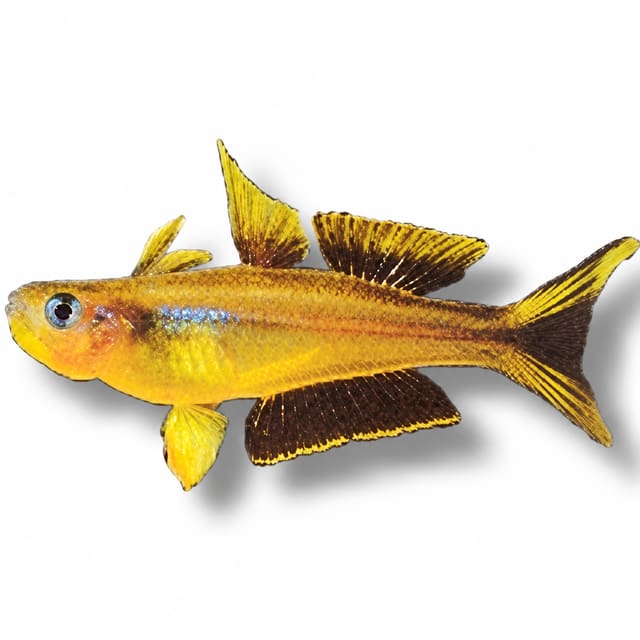
The Forked-Tail Rainbowfish (Pseudomugil furcatus) is a peaceful shoaling blue-eye from eastern Papua New Guinea that reaches 5.0 cm standard length. It suits keepers with a mature, densely planted aquarium; keep at least 8–10 at 24–28°C and pH 7.0–8.0. Sold individually in sizes from 1–1.5 cm to 2.5–3.5 cm.
Adult size is the maximum length this species reaches at full maturity (scientific sources). The livestock you receive will be younger and smaller — pick a size above for the actual shipping size. Product-photo provenance and any image-specific limitations are stated on the listing.
Pseudomugil furcatus
Shoaling fish: kept in a group they feel safer, stay calmer and show their best colour.
The Forked-Tail Rainbowfish (Pseudomugil furcatus) is a peaceful shoaling blue-eye from eastern Papua New Guinea that reaches 5.0 cm standard length. It suits keepers with a mature, densely planted aquarium; keep at least 8–10 at 24–28°C and pH 7.0–8.0. Sold individually in sizes from 1–1.5 cm to 2.5–3.5 cm.
Adult size is the maximum length this species reaches at full maturity (scientific sources). The livestock you receive will be younger and smaller — pick a size above for the actual shipping size. Product-photo provenance and any image-specific limitations are stated on the listing.
Maintain these water conditions for optimal health and vibrant colors
The Forked-Tail Rainbowfish, also known as the Forktail Rainbowfish or Yellow Forktail, is a small freshwater blue-eye for a carefully planned community aquarium. FishBase records Pseudomugil furcatus in the family Pseudomugilidae and places its natural distribution in the lowlands of eastern Papua New Guinea, between Dyke Ackland Bay and Collingwood Bay.
FishBase records a maximum of 5.0 cm standard length for male or unsexed fish. Do not use the dispatch measurement as the final space requirement. Seriously Fish’s species profile records 60 mm standard length and recommends a 60 × 30 cm aquarium base with a volume of about 54 litres as the smallest arrangement to consider.
This is a peaceful shoaling species rather than a fish to keep as a single decorative specimen. Plan for a group of at least 8–10 fish. Those numbers help the fish behave with greater confidence and create the natural group display for which it is kept. Males may show stronger colour and display behaviour when competing for attention, but the aquarium still needs enough room and structure for the whole group.
| Suits | Not suited to |
|---|---|
| A biologically mature, densely planted aquarium | A biologically immature aquarium |
| A group of at least 8–10 fish | Keeping this shoaling fish alone or as a pair |
| A base of at least 60 × 30 cm and about 54 litres | An aquarium below the stated base and volume |
| Peaceful companions of comparable size, disposition and requirements | Unscreened community combinations |
The decisive question is whether your aquarium can support the full group within those water and space limits. A larger footprint gives you more freedom to preserve swimming room while adding plants, wood and compatible community fish. Browse our rainbowfish collection if you need to compare this compact blue-eye with other rainbowfish before deciding.
One purchase supplies one animal. Choose 1–1.5 cm, 2–2.5 cm or 2.5–3.5 cm using the live size selector. The size you select is the size supplied, not the adult size.
The supplied measurement helps you plan immediate feeding access and introduction. It does not describe sex, life stage or eventual length. Whichever size you choose, prepare the aquarium for the full group and the recorded 5.0 cm adult size rather than building the layout around the arrival measurement.
Sex is guaranteed only when the selected option explicitly states male or female. This Forked-Tail Rainbowfish listing has no sex-guaranteed option. Build the social group without relying on colour, fin shape, images or supplied size to establish its sex composition.
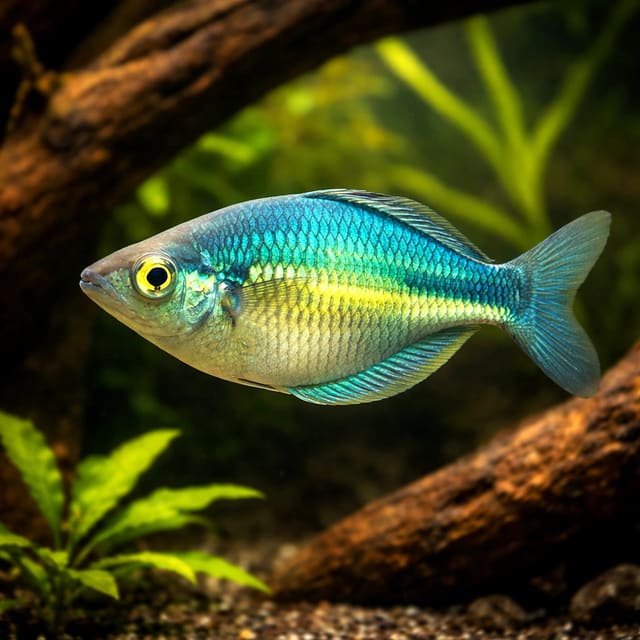
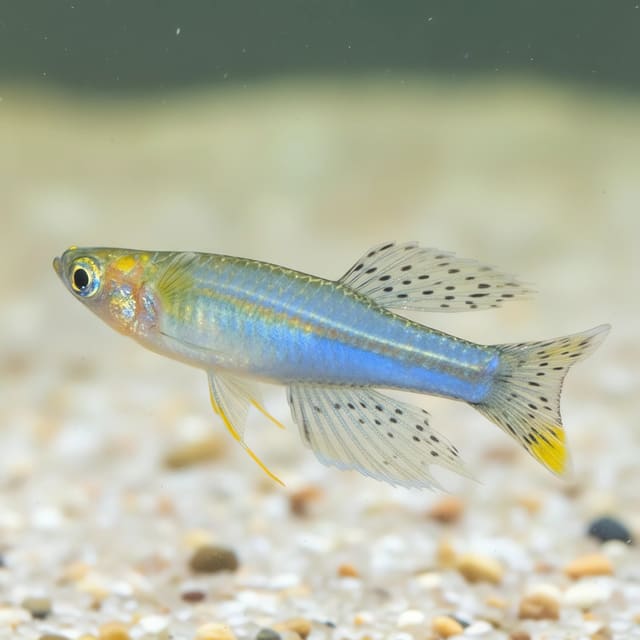
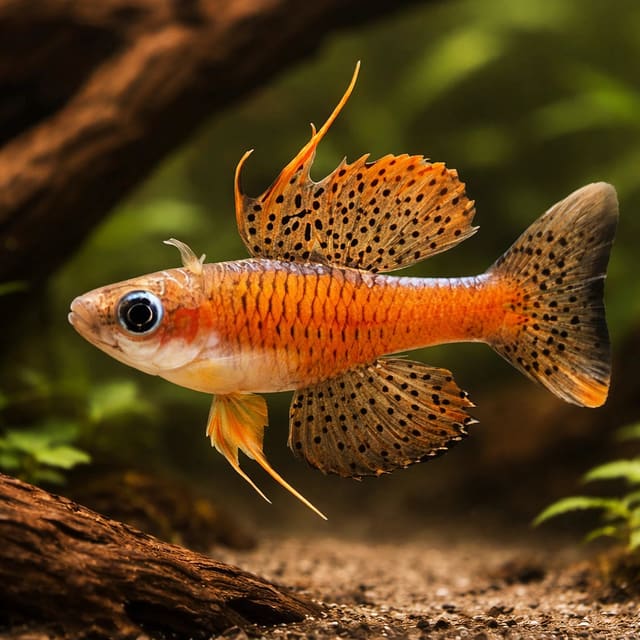
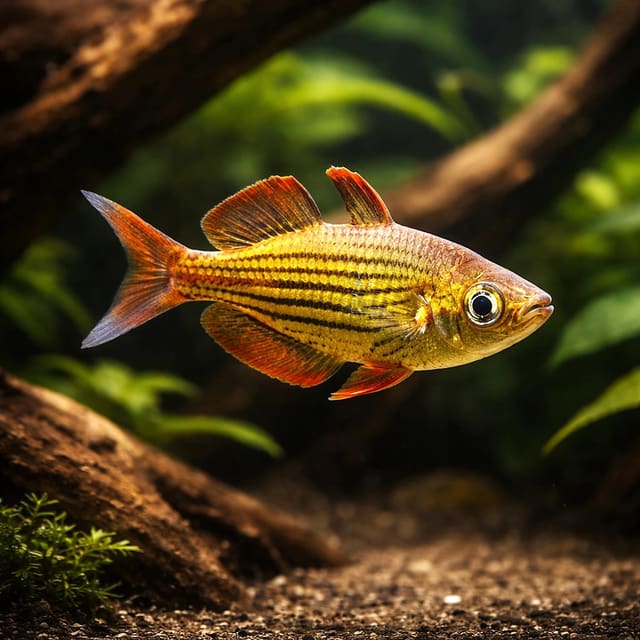
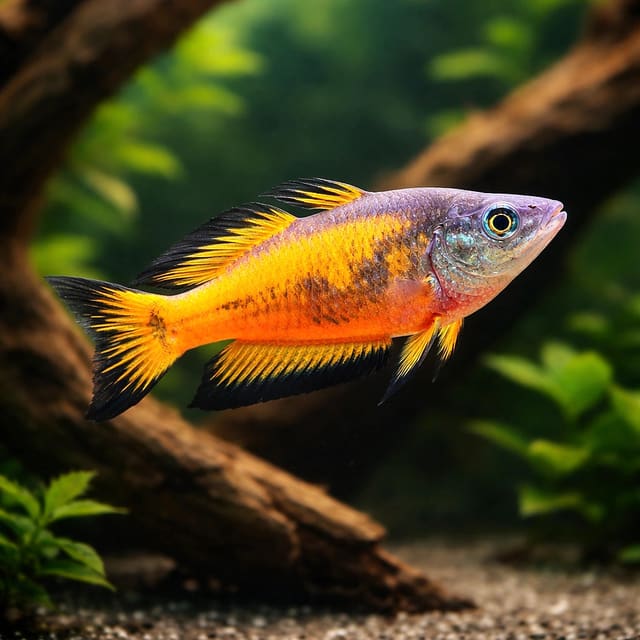
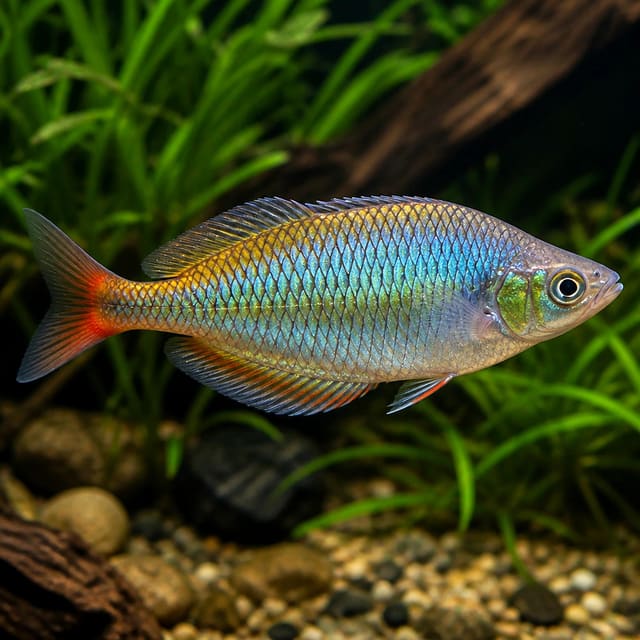
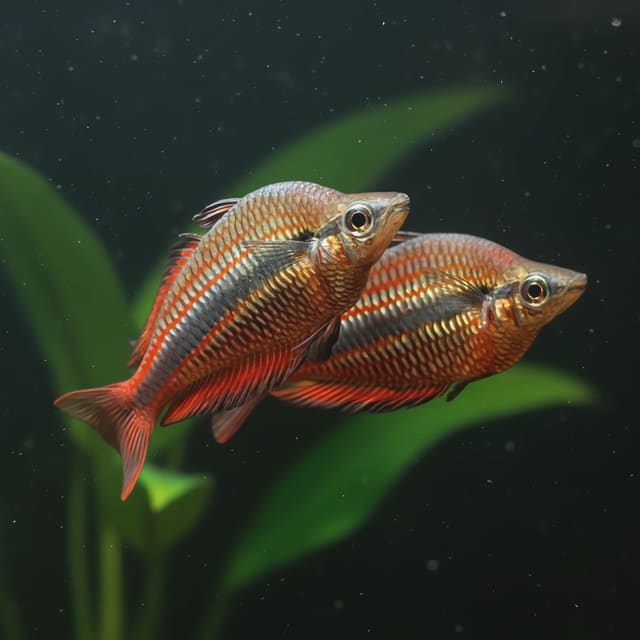
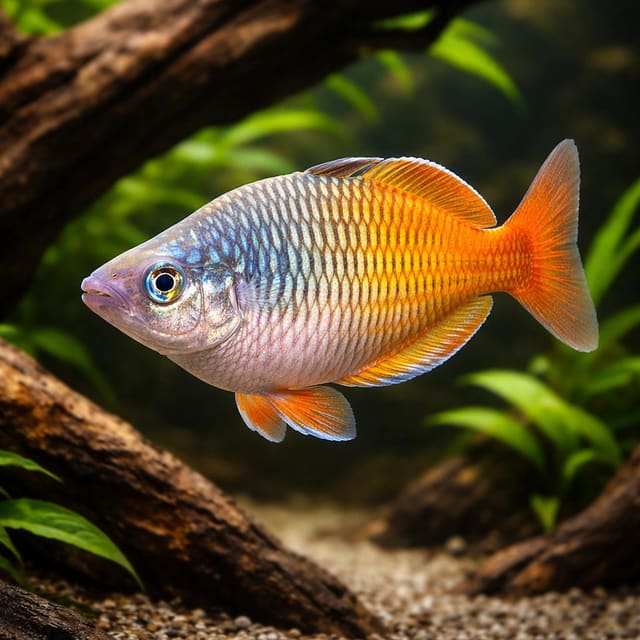
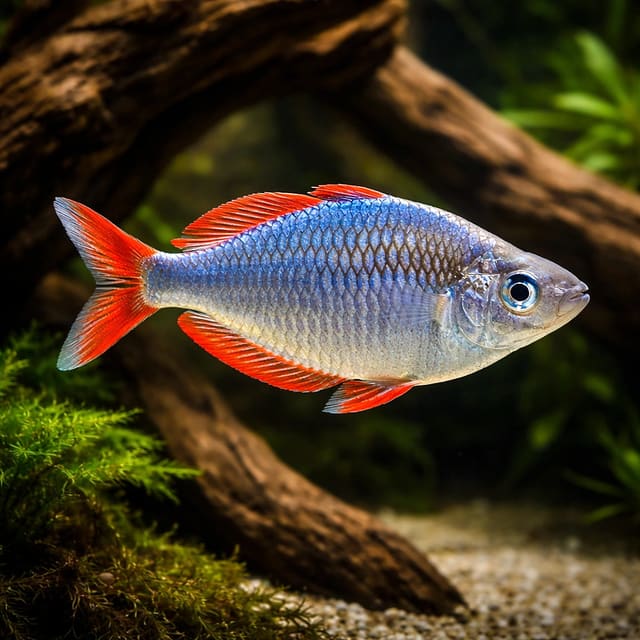
The gallery images are representative, based on reference photographs of this species, so colours can look slightly different from the live animal.
A group of eight requires a purchase quantity of eight because each purchase supplies one animal. A group of ten requires a quantity of ten. Check the live selector for the size you want, then confirm that the mature filter, aquarium footprint and existing livestock can support the complete addition. Do not reduce the social group simply to make an unsuitable aquarium appear workable.
Read our current delivery and Live Arrival Guarantee policy before preparing to receive livestock. Keep the aquarium ready beforehand so the fish can move into stable, suitable conditions without last-minute changes to temperature, filtration or décor.
Treat the 60 × 30 cm base and approximately 54-litre volume as the smallest arrangement to consider, not as a stocking formula. The base measurement matters because a shoaling fish needs shared movement space after plants, wood, filter equipment and other livestock have taken their share of the aquarium.
A nominal aquarium measuring 60 × 30 × 30 cm contains 54 litres before allowing for substrate, décor, equipment and the space above the waterline. Its working water volume will therefore be lower. This arithmetic explains why the base and the approximate volume should be considered together: a tall aquarium with a small base may hold a similar number of litres while providing a less useful group layout.
A larger aquarium can provide more stable environmental conditions and more choices for separating cover from movement space, but extra litres do not excuse excessive stocking. Every additional animal increases feeding demand and waste production. Increase livestock gradually so the biological filter can adjust to the increased load.
The aquarium should already be biologically mature before these fish arrive. If this is your first setup, follow our guide to preparing and maturing a tropical aquarium before setting a livestock date. A newly filled tank with a running filter is not automatically mature; beneficial bacteria must be established well enough to process the ammonia generated by the fish.
Recheck usable swimming space after the plants have grown. A layout that begins open can become crowded when floating plants spread or stems reach the surface. Thin or reposition growth when it blocks group movement, while retaining enough cover to diffuse light and help the fish feel secure.
Set the aquarium within 24–28°C, pH 7.0–8.0 and 15–30 dGH. Seriously Fish gives these aquarium ranges for this animal, and the fish tend to fare poorly when kept outside the stated temperature range. Test the aquarium rather than assuming that local tap water will fall within the pH and hardness limits.
| Measurement | Decision it supports |
|---|---|
| Temperature | Whether the heater and room conditions can hold 24–28°C |
| pH | Whether the aquarium remains between 7.0 and 8.0 |
| General hardness | Whether dissolved mineral content remains between 15 and 30 dGH |
| Ammonia and nitrite | Whether the biological filter is processing toxic waste |
| Nitrate | Whether maintenance and stocking control accumulating waste |
Measure source water and aquarium water separately when planning the setup. A suitable tap-water reading is useful, but the aquarium can change as biological activity, maintenance and décor interact. Record results with dates so you can recognise movement over time instead of reacting to one isolated reading.
Use our water chemistry guide to distinguish pH, hardness and nitrogen-cycle readings. Then enter the measured values into the aquarium water matcher to compare them with the stated range. Matching the number before purchase is safer than trying to force a rapid chemical adjustment after the fish arrive.
Avoid abrupt attempts to chase a preferred point inside the range. The target is a stable aquarium that remains within all three limits. For example, water at 25°C, pH 7.5 and 20 dGH sits within the stated aquarium ranges. Water at 25°C and pH 7.5 still needs attention if hardness is only 10 dGH, because two matching readings do not cancel a third reading outside the range.
Check the thermometer against actual water temperature rather than relying only on the heater dial. Place the heater and filter flow so warmed water circulates through the aquarium, then confirm that the chosen position does not create an excessively forceful current through the main group space.
A densely planted aquarium gives the Forked-Tail Rainbowfish cover and suits a carefully aquascaped display. Add floating plants and driftwood roots or branches to diffuse incoming light and create a more natural-feeling arrangement. Keep those features balanced with open water rather than allowing cover to occupy every possible movement route.
Plan the filter outlet at the same time as the décor. The water should be well oxygenated and a degree of flow is advisable, but flow should travel through the aquarium rather than striking one small area with excessive force. Watch how plants move: still pockets behind dense growth may need a layout adjustment, while plants bent flat against the substrate indicate that the outlet may be too concentrated.
Floating plants can diffuse light, but they can also reduce surface movement if they form an unbroken mat. Retain clear areas around the filter return so gas exchange and circulation continue. Remove excess growth during routine maintenance instead of making a large, disruptive change after the surface has become fully covered.
Do not choose décor solely for colour contrast. Every addition displaces water, changes the route of flow and occupies part of the minimum base. Set larger branches first, position plants around them and then inspect the aquarium from above as well as from the front. The overhead view makes blocked corridors and still corners easier to detect.
If you intend to raise fry with adults, fine-leaved aquatic moss such as a Taxiphylum species can provide additional structure. Adults may consume eggs and fry, so planting improves opportunity rather than guaranteeing survival. Keep breeding ambitions secondary to stable water, adequate group space and manageable maintenance access.
Never introduce this fish to a biologically immature aquarium. It can be susceptible to swings in water chemistry, so the filter must already support established beneficial bacteria and stable nitrogen-cycle readings before livestock is added.
The RSPCA’s aquarium welfare guidance explains why a working biological filter is essential: fish release toxic ammonia, bacteria convert it to toxic nitrite and further bacterial action converts nitrite to the safer nitrate form. A running pump alone does not complete that process; the biological media must be mature and maintained.
For an aquarium of about 54 litres, the species profile uses a turnover of four to five times the aquarium volume each hour. Multiplying 54 litres by four gives 216 litres per hour, while multiplying it by five gives 270 litres per hour. The corresponding filter guidance is approximately 215–270 litres per hour.
Use that calculation as a starting point, then consider the filter’s real performance after media, pipework and normal use reduce flow. Position the outlet to support oxygenation and circulation without creating one relentless jet. If the group repeatedly struggles in the same current, diffuse or redirect the outlet while preserving overall turnover.
For a tank of about 54 litres in a room around 20°C, the species profile estimates roughly 100–125 W of heating to hold 24–28°C. This estimate depends on room temperature, aquarium shape, equipment and heat loss, so confirm the result with a thermometer rather than treating wattage as a guarantee.
Check temperature at different times during the first days of operation. A reading immediately after adjustment does not show whether the system remains stable overnight or during a cooler part of the day. Resolve fluctuations before livestock arrives, and keep the thermometer easy to read once plants and décor are installed.
Do not switch off filtration as a routine response to feeding or quiet periods. Continuous biological processing and water movement protect the aquarium from waste accumulation. If flow stops unexpectedly, restore circulation promptly and test ammonia and nitrite before deciding whether the system remains safe.
In nature, this fish feeds chiefly on floating or suspended zooplankton, phytoplankton and invertebrates. In the aquarium, offer food particles small enough for the fish to take readily. Suitable choices include live Daphnia, Moina, Artemia nauplii and microworms, together with small or crushed floating dried foods. Freeze-dried Artemia and Daphnia can add further variety.
OATA’s rainbowfish sheet gives broad group guidance for feeding and routine maintenance, while the species profile determines the food size and choices above. Its schedule is one daily feed containing only what the fish can consume within a few minutes.
A practical rotation might use an appropriately sized dried product as the regular food and alternate suitable live or freeze-dried items for variety. The important decisions are particle size, access and portion control, not the number of different packets used. Introduce a new food in a small amount so you can see whether the group recognises and eats it.
Observe body condition and feeding participation rather than judging the ration only by enthusiasm. Eager feeding can tempt a keeper to overfeed, but excess food increases the biological load and can contribute to unhealthy ammonia or nitrite. A fish that repeatedly misses food may need a change in particle size or distribution even when the rest of the group feeds well.
When community fish share the aquarium, confirm that this group receives suitable particles before faster or larger fish consume everything. Compatibility includes feeding access as well as temperament and water chemistry. If a proposed combination cannot be fed without persistent competition or excess leftovers, reconsider the stocking plan.
Test the aquarium at least once each week and keep ammonia and nitrite at 0 mg per litre. Nitrate should not exceed 20 mg per litre above the normal level in the tap water. Compare aquarium and tap-water results on the same basis so the nitrate limit is interpreted correctly.
| Task | Action |
|---|---|
| Water testing | Check ammonia, nitrite and nitrate at least weekly |
| Water change | Make a 25% partial water change at least once a week |
| Replacement water | Treat it for chlorine or chloramine before use |
| Substrate | Siphon accessible solid waste during the change |
| Filter | Inspect for blockages and loss of flow |
| Filter media | Rinse lightly in removed aquarium water when cleaning is needed |
Do not run established biological media under the tap. Chlorine or chloramine may damage the beneficial bacterial population. A light rinse in water removed during the partial change clears loose debris while reducing bacterial loss.
Coordinate filter cleaning with the water change so removed aquarium water is ready before media leaves the filter. Clean only when needed to restore normal function; aggressive cleaning can remove more beneficial bacteria than necessary. Reassemble the filter promptly and confirm that flow has restarted through the planned circulation route.
A 25% change in a nominal 54-litre aquarium is 13.5 litres, but displacement means the actual working volume may be lower. Base the amount on the aquarium’s real water volume where possible, and use a clearly marked container to keep the routine consistent. Match replacement water to the aquarium’s established conditions closely enough to prevent an abrupt change.
Record water results before and after corrective maintenance. If ammonia or nitrite rises above zero, stop adding livestock and address the cause rather than masking the reading with extra food restriction or chemical adjustment. Check for overfeeding, blocked flow, disturbed filter media and an increase in biological load.
Weekly maintenance is the baseline, not a reason to ignore the aquarium between changes. Look at flow, temperature, feeding and behaviour every day. Early detection makes a small correction possible before water quality or oxygenation becomes a wider problem.
Before adding the group, confirm that the aquarium is biologically mature, temperature remains between 24 and 28°C, pH remains between 7.0 and 8.0, hardness remains between 15 and 30 dGH, and ammonia and nitrite both read 0 mg per litre. Complete those checks before opening transport packaging so no urgent aquarium adjustment is attempted during introduction.
Increase aquarium stocking gradually. Every addition increases waste and feeding, and the beneficial bacterial population needs to respond to the higher load. Adding several unrelated groups at once makes it harder to identify whether a change in water quality, social pressure or feeding competition is causing a problem.
Healthy fish should have clear, bright eyes, undamaged fins, intact scales and an appropriate swimming response. Watch for hanging at the surface, sitting on the bottom, erratic swimming, unusual hiding, a change in colour, faster or slower gill movement, white spots, fluffy growths, lost fins or scales, altered body condition and reduced interest in food.
If you see one of those changes, test temperature, ammonia, nitrite and nitrate first. Check the filter, recent stocking changes and food left in the aquarium. If the water results and equipment checks do not explain the change, contact us for guidance before choosing any treatment. Diagnosis matters because disease remedies and doses are not interchangeable.
At the end of the first month, compare the group with your first-week notes. The goal is consistent feeding participation, stable water readings and confident group movement. If plants have grown across movement routes or floating cover has blocked the filter return, make a small layout correction rather than redesigning the whole aquarium at once.
The Forked-Tail Rainbowfish is a shoaling species and should be kept in a group of at least 8–10 specimens. Keeping the full group is the first compatibility decision because an undersized social group may be more nervous and cannot be compensated for by the presence of unrelated community fish.
Group numbers also change the space and filtration calculation. Eight fish mean eight individual feeding opportunities, eight contributors to biological load and enough shared room for social movement. Ten fish require the same checks at a larger scale. Start with the complete adult plan rather than adding one or two fish and hoping to expand later.
| Question | Required decision |
|---|---|
| Is the group large enough? | Plan at least 8–10 fish |
| Is the base sufficient? | Use at least 60 × 30 cm and about 54 litres |
| Is food accessible? | Offer small particles across the group |
| Is cover balanced? | Combine dense planting with open movement routes |
| Is the filter ready? | Use a mature biological filter with suitable turnover |
Males may display stronger colours and interesting competitive behaviour when kept in numbers, but social display does not remove the need for peaceful conditions. Observe whether all members can move, rest and feed without persistent exclusion. A repeated problem at one location may indicate that the layout or feeding distribution needs adjustment.
Do not build the group around an assumed sex ratio. The offer does not guarantee sex, and appearance can change as the fish develop. Base the purchase quantity on the species’ group requirement and the aquarium’s carrying capacity rather than trying to identify males or females from supplied size or representative images.
If the aquarium cannot support eight fish at their planned adult-space allowance, choose a different stocking plan rather than keeping this shoaling species alone or as a pair. The minimum social requirement and minimum aquarium footprint operate together; meeting only one does not create a suitable setup.
This peaceful species can suit a well-chosen community aquarium with fish of comparable size, disposition and water requirements. Suitable candidates may occur among cyprinids, gobiids, eleotrids and smaller melanotaeniids. Tateurndina ocellicauda, an eleotrid that occurs with it in nature, is identified as a particularly appropriate candidate.
OATA’s rainbowfish guidance says active rainbowfish should not be mixed with timid or much smaller fish, so avoid those combinations. Screen every other proposed companion against adult size, activity, temperament, water range, group requirement, feeding method and the usable aquarium footprint. A fish can be peaceful yet still be a poor match if it cannot share the same water or feeding plan.
Do not use shared temperature alone as proof of compatibility. Two fish may overlap at 25°C while requiring different hardness, showing incompatible activity levels or competing for the same limited space. Likewise, a peaceful label does not show whether a companion will remain calm at adult size.
Observe the aquarium after each gradual addition. Warning signs include persistent hiding, a loss of feeding access, repeated displacement from cover, damaged fins or an abrupt change in swimming. Recheck water at the same time because social and environmental stress can produce similar visible changes.
For a mixed community, ask us for a stocking and compatibility assessment with the aquarium dimensions, measured water values, existing livestock and intended group sizes. Honest assessment depends on the complete plan; the common name of one proposed companion is not enough to judge the combination.
The Forked-Tail Rainbowfish reaches a recorded maximum of 5.0 cm standard length for male or unsexed fish. Plan its aquarium around that adult figure rather than the size supplied.
Use an aquarium with a base of at least 60 × 30 cm and a volume of about 54 litres. It should be biologically mature, densely planted, well oxygenated and arranged with open movement space.
Keep at least 8–10 Forked-Tail Rainbowfish together. Seriously Fish describes it as a shoaling species and says this group size helps the fish become less nervous and display more naturally.
The Forked-Tail Rainbowfish suits a keeper who can prepare a biologically mature aquarium and maintain stable water. Do not introduce it to an immature setup because it can be susceptible to swings in water chemistry.
Feed suitably small live foods such as Daphnia, Moina, Artemia nauplii or microworms, together with small or crushed floating dried foods. OATA’s rainbowfish guidance recommends one daily feed containing only what can be eaten within a few minutes.
Maintain 24–28°C, pH 7.0–8.0 and 15–30 dGH. Seriously Fish gives these aquarium ranges for this fish; also keep ammonia and nitrite at 0 mg per litre.
This fish is recorded as peaceful. Choose peaceful companions of comparable adult size, disposition and water requirements, and avoid timid or much smaller fish under OATA’s active-rainbowfish guidance.
Screen peaceful candidates among suitable cyprinids, gobiids, eleotrids and smaller melanotaeniids. Tateurndina ocellicauda is identified as particularly appropriate, but every combination must share compatible water, space and feeding requirements.
Be present to receive the parcel and start filming every delivery while it is still sealed. Continue filming as you open it, keeping the fish visible inside the sealed bag; then float the bag for 20–30 minutes before releasing the fish, and never pour the bag water into the aquarium.
No reviews for this item yet. Bought one? Honest reviews only, good or bad.
What customers say about ordering from us
I have a small group of long finned mountain minnows. So was delighted to be able to order ten of this variety to increase the genetics in my tank . The ones I recieved are healthy but it’s to early to give a verdict on wether they are of a long finned type since they are small currently.
Gordon Walker · 23 Sept 2026
100% success travel and "installation". Pleased with quality of purchase. The Siamese fighter a bit "shy" so have not yet seen him at his best yet but looking good. Happy customer. GG
George E Garratt · 21 Sept 2026
Reviews of our shop, collected by Judge.me, an independent third-party review collector. Newest first.