10 × Forked-Tail Rainbowfish (Popondetta furcata)
24–26°C · pH 7–8 · 54L
£40.99

The Forked-Tail Rainbowfish (Popondetta furcata) is a peaceful blue-eye fish from lowland eastern Papua New Guinea that reaches 6 cm. It suits intermediate keepers with a mature planted aquarium; keep at least 8–10 together at the FishBase/Seriously Fish overlap of 24–26°C and pH 7.0–8.0. Sold as a pack of six fish.
Adult size is the maximum length this species reaches at full maturity (scientific sources). The livestock you receive will be younger and smaller. Product-photo provenance and any image-specific limitations are stated on the listing.
Popondetta furcata
The Forked-Tail Rainbowfish (Popondetta furcata) is a peaceful blue-eye fish from lowland eastern Papua New Guinea that reaches 6 cm. It suits intermediate keepers with a mature planted aquarium; keep at least 8–10 together at the FishBase/Seriously Fish overlap of 24–26°C and pH 7.0–8.0. Sold as a pack of six fish.
Adult size is the maximum length this species reaches at full maturity (scientific sources). The livestock you receive will be younger and smaller. Product-photo provenance and any image-specific limitations are stated on the listing.
Maintain these water conditions for optimal health and vibrant colors
The Forked-Tail Rainbowfish (Popondetta furcata) is a small freshwater blue-eye fish in the family Pseudomugilidae. It comes from lowland eastern Papua New Guinea, between Dyke Ackland Bay and Collingwood Bay, and reaches 5 cm standard length. This peaceful shoaling fish suits an intermediate keeper who can provide a mature, stable aquarium, dense planting and room for at least 8–10 fish.
FishBase records rainforest streams with thick vegetative cover as its natural habitat. It also describes the fish as an omnivorous egg layer and peaceful community species. FishBase now lists it as Pseudomugil furcatus.
A group should contain at least 8–10 specimens. In suitable numbers, the fish are less nervous and produce a more natural-looking display. Males may compete for female attention through display behaviour, so the value of a larger group is not simply visual: it creates room for the species’ normal social interactions.
The fish belongs in a biologically mature aquarium rather than a newly established system. It can be susceptible to swings in water chemistry, making stable filtration, measured water values and gradual stocking more important than decorative complexity. A planted layout with floating cover, driftwood roots or branches and open swimming room combines shelter with usable space.
Its peaceful disposition supports a carefully planned community, but “peaceful” is not a universal compatibility guarantee. Companion fish should be comparable in size, share its disposition and match the aquarium’s temperature, pH and hardness plan. Establish the Forked-Tail Rainbowfish group first in the stocking calculation, then assess other animals against the remaining space and filtration capacity.
One purchase supplies a pack of six Forked-Tail Rainbowfish. The species should be kept in a group of at least 8–10, so this pack is a starting group rather than the complete minimum recommended by the species profile. Plan space and stocking capacity for at least two to four additional Forked-Tail Rainbowfish.
Use the live aquarium’s measured water values and existing livestock when deciding how the full group will be formed. Adding fish increases feeding and waste production, and the beneficial bacteria in the filter must cope with that increase. Build the population carefully rather than treating the small adult length as permission to crowd the aquarium.
Sex is guaranteed only when the selected option explicitly states male or female. This 6 × Forked-Tail Rainbowfish listing has no sex-guaranteed option.
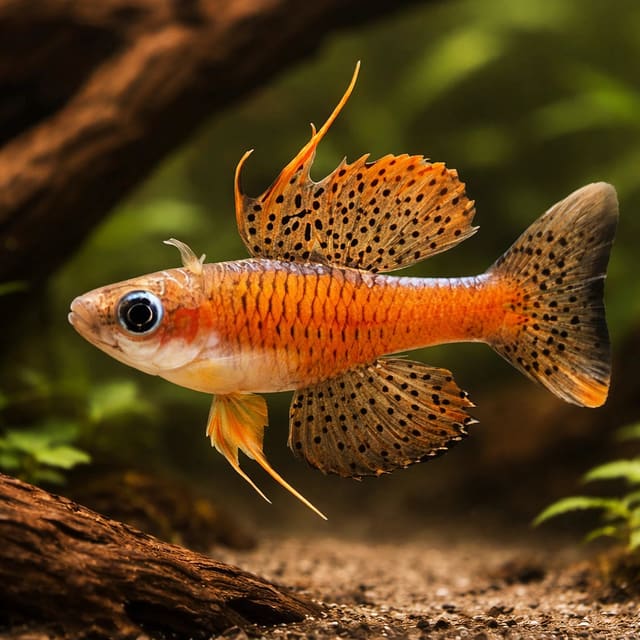
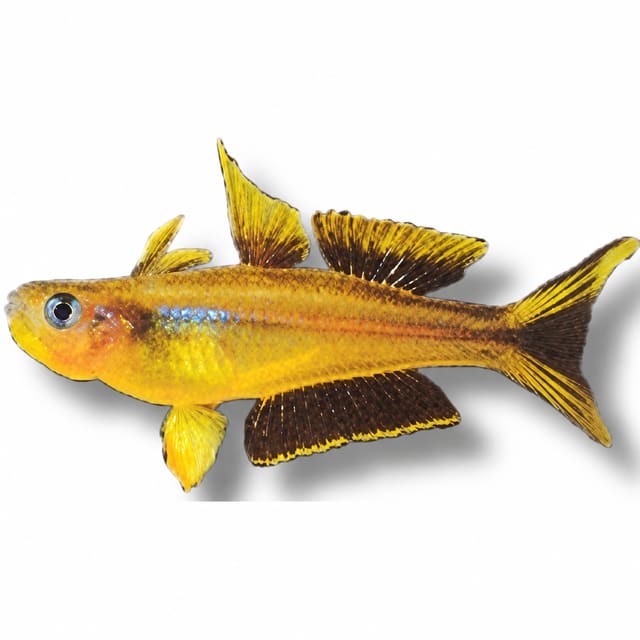
Male Forked-Tail Rainbowfish are described as more highly patterned and colourful than females, with unpaired fins that become noticeably extended as they mature. Those traits can help with observation of mature fish, but they do not change the terms of this mixed, unsexed pack offer.
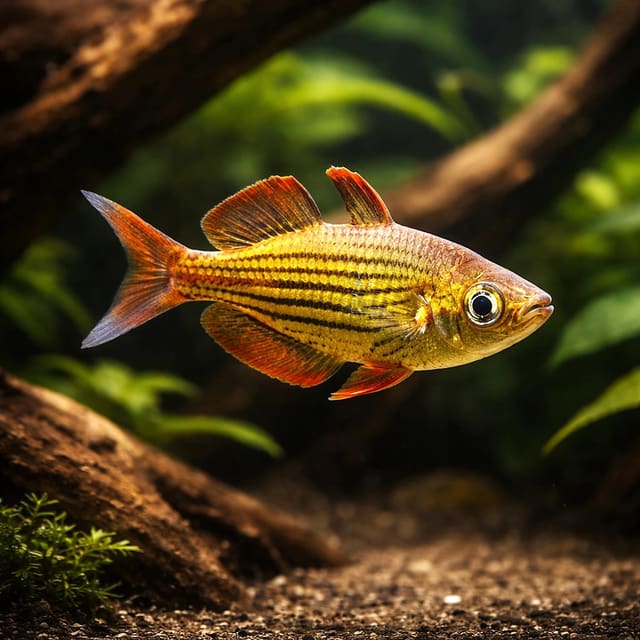
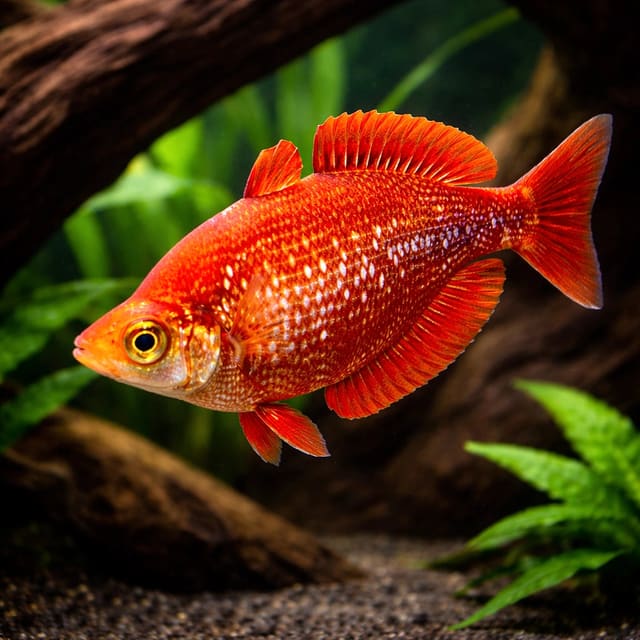
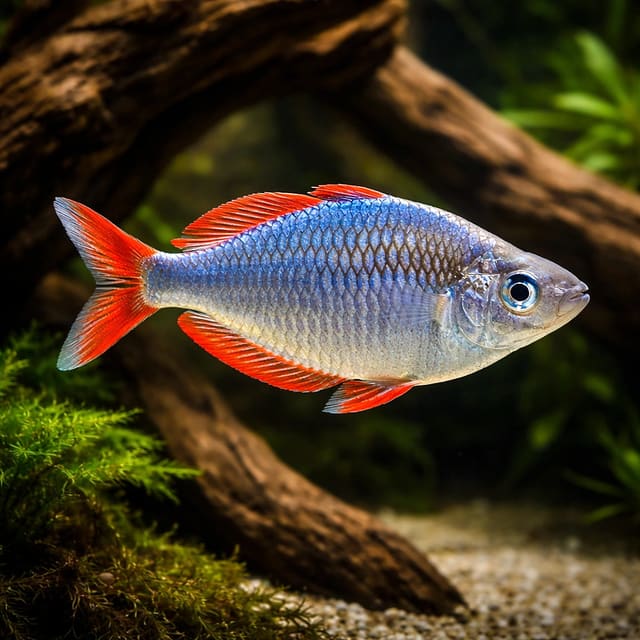
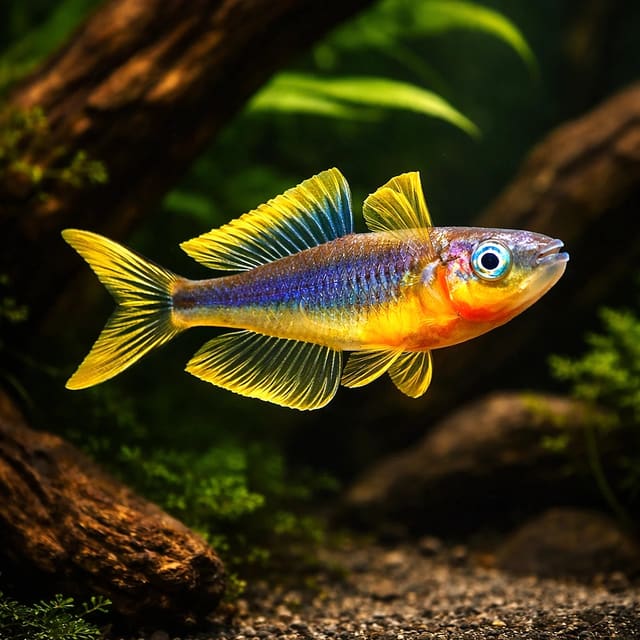
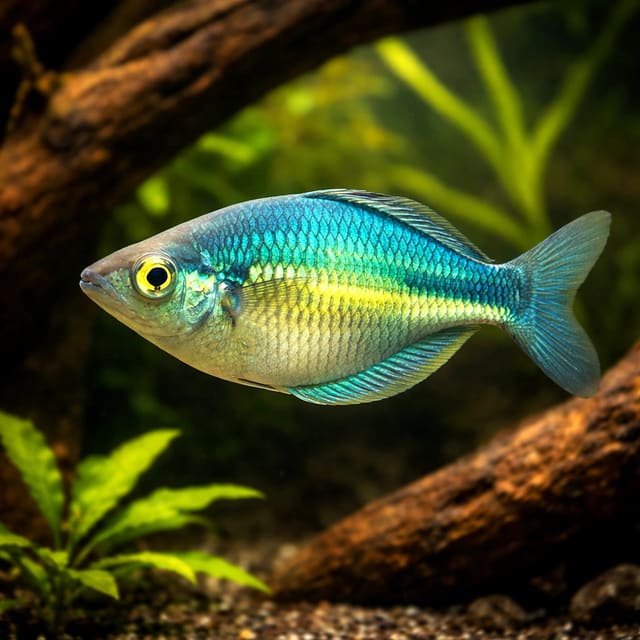
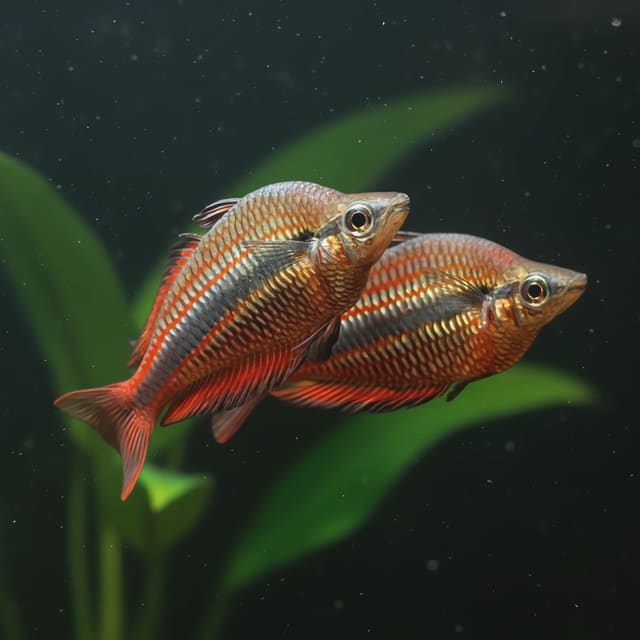
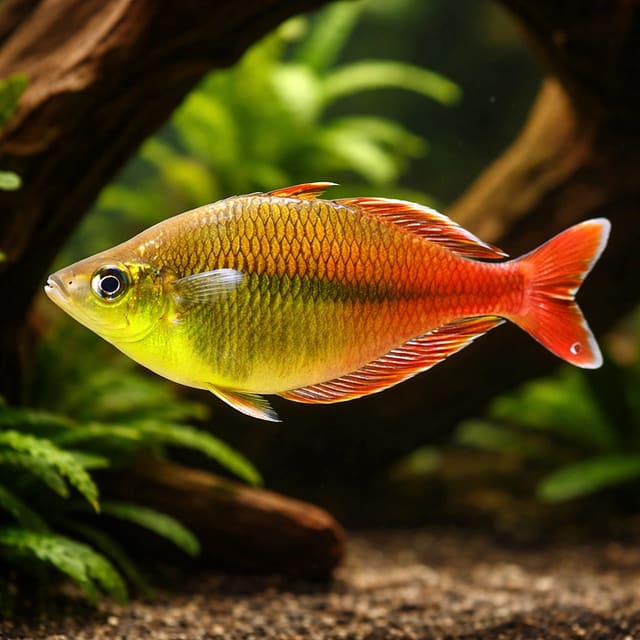
The gallery images are representative of this type of animal rather than photographs of the exact animal supplied, so colours can look slightly different from the live animal.
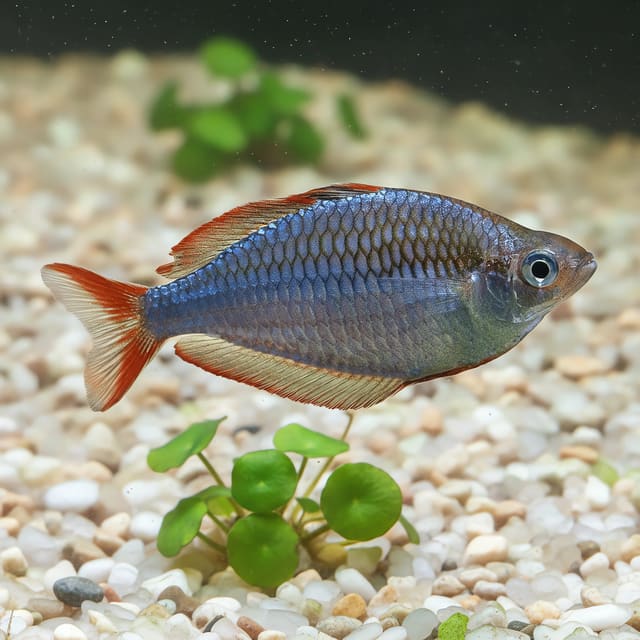
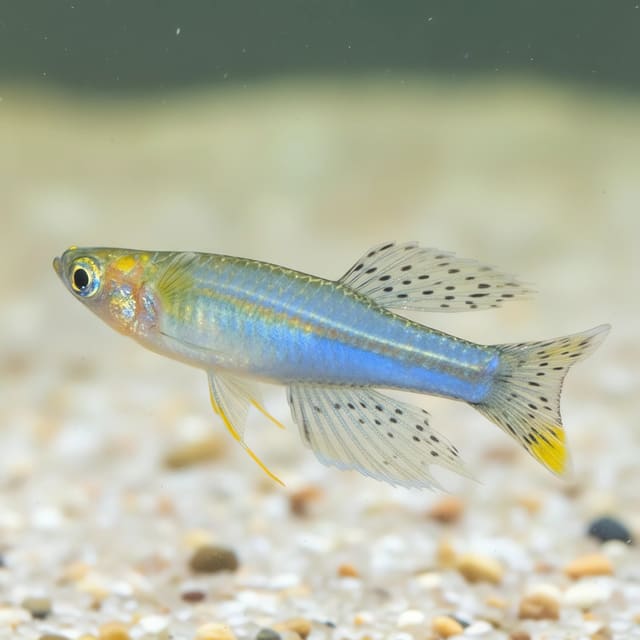
In the gallery scene, two fish swim to the right against a blurred grey aquarium background. The front fish is more sharply focused, and both visible fish have iridescent bodies, large blue eyes and yellow fins. That description applies to the pictured scene; plan care from the species’ adult size and husbandry requirements rather than judging the delivered fish against one image.
Start with four linked requirements: a group of at least 8–10, an aquarium base of at least 60 × 30 cm, a mature biological filter and stable water within the working targets below. The species profile associates the minimum footprint with approximately 54 litres, but the base dimensions remain important because these active shoaling fish need usable swimming room.
Seriously Fish recommends dense planting, floating plants and driftwood roots or branches to diffuse incoming light. It also calls for well-oxygenated water and some flow. Keep open water between planted areas so the group can move together without losing access to cover.
| Suits | Not suited to |
|---|---|
| A mature, planted freshwater aquarium | A biologically immature aquarium |
| A plan for at least 8–10 of its own kind | A plan that treats six fish as the complete recommended group |
| A base of at least 60 × 30 cm and approximately 54 litres | A smaller footprint than the species profile recommends |
| Comparable-sized peaceful fish with matching requirements | An unassessed community built only around visual preference |
| An intermediate keeper prepared to test and maintain stable water | A new system expected to tolerate swings in water chemistry |
The 5 cm adult figure is a planning length, not a reason to reduce the group’s footprint. Space must cover the whole shoal, planting, flow and any carefully screened companions. Confirm that the filter can process the combined stocking plan while ammonia and nitrite remain at zero.
Keep Forked-Tail Rainbowfish at 24–26°C and pH 7.0–8.0. Those ranges are the overlap between FishBase’s recorded environmental range and the Seriously Fish aquarium profile, so every point in the working target sits within both.
Use 15–30 dGH as the aquarium hardness target from Seriously Fish. FishBase records 5–12 dH in the wild environment, while the aquarium profile recommends 15–30 dGH; these hardness ranges do not overlap. Measure hardness before planning the group and make it a deliberate part of the aquarium choice rather than assuming temperature and pH alone establish a match.
OATA’s rainbowfish sheet gives zero ammonia, zero nitrite and nitrate not exceeding 20 mg per litre above normal tap-water levels for the group; these are not a species-specific optimum. Test ammonia and nitrite before adding fish and at least weekly afterwards.
A practical water check should answer five separate questions:
Use our water chemistry guide to understand what each test measures, then compare the actual results with these targets using the water matcher. Record the figures rather than relying on water looking clear; dissolved ammonia and nitrite cannot be judged by appearance.
A temperature of 25°C and pH of 7.5 both pass the working target, but those two results alone are not enough to approve the aquarium. Check hardness, ammonia, nitrite and nitrate before completing the decision. If ammonia or nitrite is above zero, do not add the fish while waiting for the other figures to compensate; neither temperature nor pH makes toxic waste acceptable.
Use repeated results to judge stability. When a later test differs from the aquarium’s normal record, check the result again and examine recent stocking, feeding and maintenance changes. This gives you a measured reason for the next action instead of reacting to a single visible symptom or assuming clear water is stable water.
Use an aquarium with base dimensions of at least 60 × 30 cm and a volume of approximately 54 litres. Seriously Fish describes that footprint as the smallest that should be considered. The minimum must accommodate the whole group of at least 8–10, not merely the six fish in this pack.
Plant the aquarium densely and include some floating plants. Driftwood roots or branches can diffuse light and add cover, while open lanes allow the shoal to move through the aquarium. OATA also recommends aquarium gravel or sand and shelter from live plants, artificial plants or suitable ornaments. Every decoration should leave the fish with both cover and unobstructed water.
Provide well-oxygenated water with a degree of flow. For a tank of approximately 54 litres, Seriously Fish uses a turnover of four to five times the aquarium volume per hour and gives a filter rating of about 215–270 litres per hour. Check the filter’s real flow after media and pipework are installed, and arrange the outlet so water circulates without eliminating quieter planted areas.
The RSPCA explains that fish release toxic ammonia and that a working biological filter houses bacteria which convert ammonia to nitrite and then nitrate. Never keep these fish without a well-set-up and maintained filter.
Do not add Forked-Tail Rainbowfish to a biologically immature aquarium. Prepare the system before livestock arrives, confirm zero ammonia and nitrite, and check that temperature, pH and hardness meet the plan. Our first tropical aquarium guide covers the preparation and maturation sequence.
For the reference 54-litre aquarium, Seriously Fish estimates a heater of roughly 100–125 W when the room is around 20°C. Treat that as a worked example tied to those conditions: select equipment that can hold the measured aquarium steadily at 24–26°C.
If one of these checks fails, adjust the layout or stocking plan before the fish arrive. Adding more decorations cannot correct an immature filter, and a larger quoted volume cannot compensate for a base shorter than the minimum footprint.
Feed suitably small floating or suspended foods once a day, offering only what the group can eat within a few minutes. Remove uneaten food and reduce the next portion if particles remain after the feeding window.
In nature, Forked-Tail Rainbowfish feed chiefly on floating or suspended zooplankton, phytoplankton and invertebrates. Build the aquarium diet around foods that match that feeding biology and mouth size. Seriously Fish recommends that much of the diet ideally comprise suitable live foods such as Daphnia, Moina, Artemia nauplii and microworms. Small or crushed floating dried foods are also accepted, including quality dried food, freeze-dried Artemia and freeze-dried Daphnia.
Rotate appropriate live and dried foods across feeds instead of combining several full portions at the same meal. OATA’s rainbowfish guidance allows good-quality flake or granules and small live or frozen foods such as daphnia, small bloodworm or tubifex, but the food still needs to be appropriately sized for this small species.
| What you observe | What to do next |
|---|---|
| Food is eaten within a few minutes | Keep the portion at that measured level |
| Food remains after the group stops feeding | Remove it and reduce the next portion |
| Larger fish take the food first | Reassess the companion plan and food distribution |
| The group ignores one food size | Offer a smaller suitable item at the next normal feed |
| Interest in food falls unexpectedly | Test water and check for other changes in behaviour or appearance |
Do not add extra meals to compensate for poor access caused by unsuitable companions. Solve the competition problem instead. Excess food breaks down and contributes toxic waste, while an accessible, measured portion lets the group feed without undermining water quality.
Carry out a 25% partial water change at least once every week. Treat replacement tap water with a suitable conditioner to remove chlorine or chloramine before adding it to the aquarium, and use a siphon to remove solid waste from the substrate where needed.
Test ammonia and nitrite at least weekly and keep both at zero. Measure nitrate against the OATA group limit of no more than 20 mg per litre above the normal tap-water level. Include temperature, pH and hardness in the routine so a stable-looking aquarium does not hide movement away from the planned values.
Check the filter for blockages. When the media needs cleaning, do not run it under the tap. Rinse it lightly in aquarium water removed during the partial water change; this reduces the loss of the beneficial bacteria established in the media.
Healthy fish should have clear, bright eyes, undamaged fins, intact scales and appropriate swimming behaviour. Warning changes include hanging at the surface, sitting on the bottom, erratic swimming, darker or paler colour, increased hiding, altered aggression, faster or slower gill movement, white spots, fluffy growths, loss of fins or scales, changing body condition and reduced feeding.
If any of these changes appear, test the water first and compare the result with the normal record for the aquarium. Correct husbandry problems promptly and seek fish-health guidance when the cause or response is unclear. Observation works best when it is linked to measured water values rather than appearance alone.
During the first weekly check, record the complete water result alongside feeding response, swimming and breathing. At the second check, compare the new figures with that starting point before carrying out the next 25% change. By the third and fourth checks, the record should make gradual movement in nitrate, pH or hardness easier to recognise.
If ammonia or nitrite rises above zero after the group is introduced, treat that result as an immediate water-quality problem rather than waiting for the next scheduled check. Review recent additions and feeding, complete the necessary maintenance and continue measuring until both return to zero. If nitrate approaches the stated limit sooner than expected, examine stocking and waste removal instead of simply allowing the weekly routine to repeat unchanged.
Keep maintenance consistent enough for comparisons to remain useful. Record whether filter media was rinsed, whether solid waste was removed and whether feeding changed. A written note separates a genuine trend from a reading taken after an unusual maintenance or stocking event.
Prepare the mature aquarium and confirm its water values before the parcel arrives. The following arrival sequence comes from the Tropical Fish Co delivery and Live Arrival Guarantee policy.
For a Live Arrival Guarantee claim, contact us the same day with the order number and the continuous video showing the sealed parcel, the opening and the fish still inside the sealed bag before release.
OATA’s introduction guidance says ammonia and nitrite should be zero before fish are added. Increase the aquarium population slowly because the beneficial bacteria in the filter must respond whenever fish numbers and feeding increase. Stocking too quickly can leave too few nitrifying bacteria to process the additional waste, allowing ammonia and nitrite to rise.
The fish are hand-bagged in pure oxygen and travel in an insulated box, with a heat pack used when the weather calls for it. These packing measures do not replace preparation at home: the destination aquarium still needs a functioning biological filter, appropriate temperature, measured chemistry and enough capacity for the planned group.
After release, use the same observable indicators applied during routine care: swimming, breathing, colour, body condition and feeding response. Test the water if behaviour changes, because arrival adds livestock and therefore waste to the biological system.
Use 5 cm standard length as the adult planning size. FishBase records a maximum of 5 cm standard length, while Seriously Fish gives 6 cm standard length; the care specifications use the FishBase identity figure, and the larger profile figure should reinforce rather than reduce the minimum space plan.
Do not turn the 5 cm figure into a stocking formula by multiplying body lengths against tank volume. The group needs an aquarium base of at least 60 × 30 cm, approximately 54 litres, with planting, cover, oxygenation and swimming room for at least 8–10 fish.
Seriously Fish describes the species as shoaling and says larger recommended groups make the fish less nervous. Males compete for female attention, producing colour and display behaviour within the group. Peaceful therefore means suitable for a carefully chosen community; it does not mean socially inactive.
Males are more highly patterned and colourful than females, and their unpaired fins become noticeably extended as they mature. Use those traits only to understand behaviour you observe. This pack carries no sex guarantee, and neither body size nor a gallery image changes that offer condition.
The species is an egg-scatterer with no parental care. Adults may consume their own eggs and fry, and females may deposit a few eggs daily over several days on aquatic vegetation or another substrate. Fine-leaved aquatic moss can provide spawning material when fry are intended to remain alongside adults, but the display aquarium should first be planned around adult welfare, group size and stable water.
Do not use warmer breeding conditions as the routine target. Keep the main aquarium at the established 24–26°C overlap and maintain the weekly testing and water-change schedule. The group’s normal behaviour, appetite and body condition provide better everyday checkpoints than attempting to induce reproduction.
Choose community fish of comparable size, peaceful disposition and compatible water requirements. Seriously Fish names many cyprinids, gobiids, eleotrids and smaller melanotaeniids as suitable kinds of companions when those conditions are met. It identifies the eleotrid Tateurndina ocellicauda, which occurs with this species in nature, as particularly appropriate.
Those names are a starting point for screening, not permission to combine any member of a broad family. Check the adult size, temperament, temperature, pH, hardness, social requirements and feeding behaviour of the exact companion before adding it.
Reserve capacity for at least 8–10 Forked-Tail Rainbowfish before adding another species. A six-fish pack does not reduce the group recommendation. The aquarium must also meet the minimum 60 × 30 cm base and approximately 54-litre volume before the needs of companions are added.
Use 24–26°C and pH 7.0–8.0 as the shared target for this fish. The hardness plan also matters: the aquarium profile recommends 15–30 dGH. A companion that fits the temperature but requires water outside the planned pH or hardness is not a complete match.
Forked-Tail Rainbowfish take small floating or suspended foods. Suitable companions should allow them reliable access to appropriately sized food without forcing extra portions into the aquarium. If another species consistently consumes the food first, reassess the stocking plan instead of overfeeding.
Compatibility beyond the named groups depends on the exact species and the complete aquarium plan. Observe every new combination for changes in hiding, swimming, aggression, breathing, colour and feeding, and test the water when behaviour changes.
Make each compatibility decision in the same order. This prevents a shared temperature or peaceful label from being mistaken for a complete match.
| Screen | Pass condition |
|---|---|
| Adult size | The companion is comparable in size to a 5 cm Forked-Tail Rainbowfish |
| Disposition | The exact species is peaceful and suited to a carefully chosen community |
| Water | It can share 24–26°C, pH 7.0–8.0 and the planned hardness |
| Social space | The aquarium retains capacity for at least 8–10 Forked-Tail Rainbowfish |
| Feeding | All fish can reach appropriately sized food within a few minutes |
| Filtration | Ammonia and nitrite remain at zero as stocking and feeding increase |
A compatibility decision continues after introduction. Increased hiding, altered aggression, surface hanging, bottom sitting, erratic swimming, changed colour or reduced feeding all justify an immediate water test and a review of social interactions.
Do not solve crowding or food competition by adding more food. Excess food increases waste, while the underlying mismatch remains. Restore access to food and usable space by changing the stocking plan.
Keep the minimum aquarium recommendation in perspective. The 60 × 30 cm base and approximately 54 litres are the smallest dimensions considered for this species’ own group. A community may require more space because every additional group brings its own swimming, cover and social requirements.
A Forked-Tail Rainbowfish reaches 5 cm standard length according to FishBase. Plan the aquarium around that adult figure and the space needed by its full shoal.
Use a base of at least 60 × 30 cm and approximately 54 litres. Seriously Fish describes this as the smallest aquarium that should be considered.
Keep at least 8–10 together. Seriously Fish says this shoaling species is less nervous and produces a more natural-looking display in those numbers.
We rate it intermediate because it needs a biologically mature aquarium, stable chemistry and a group of at least 8–10. A prepared keeper who tests water consistently can meet those needs.
Feed small floating or suspended foods once daily, limited to what is eaten within a few minutes. Use suitable live foods such as Daphnia, Moina or Artemia nauplii alongside small crushed floating dried foods.
Keep it at the FishBase/Seriously Fish overlap of 24–26°C and pH 7.0–8.0. Seriously Fish recommends 15–30 dGH for aquarium care, while FishBase records 5–12 dH in the wild environment.
A Forked-Tail Rainbowfish is described as peaceful. Keep a full shoal and choose comparable-sized companions with a peaceful disposition and matching water requirements.
Suitable kinds include comparable-sized peaceful cyprinids, gobiids, eleotrids and smaller melanotaeniids with matching requirements. Seriously Fish identifies Tateurndina ocellicauda as particularly appropriate.
Start filming the sealed parcel before opening it, then show the opening and fish inside the sealed bag in one continuous take. Float the bag for 20–30 minutes before release. For a claim, contact us the same day with the order number and video.
No reviews for this item yet. Bought one? Honest reviews only, good or bad.
What customers say about ordering from us
I have a small group of long finned mountain minnows. So was delighted to be able to order ten of this variety to increase the genetics in my tank . The ones I recieved are healthy but it’s to early to give a verdict on wether they are of a long finned type since they are small currently.
Gordon Walker · 23 Sept 2026
100% success travel and "installation". Pleased with quality of purchase. The Siamese fighter a bit "shy" so have not yet seen him at his best yet but looking good. Happy customer. GG
George E Garratt · 21 Sept 2026
Reviews of our shop, collected by Judge.me, an independent third-party review collector. Newest first.