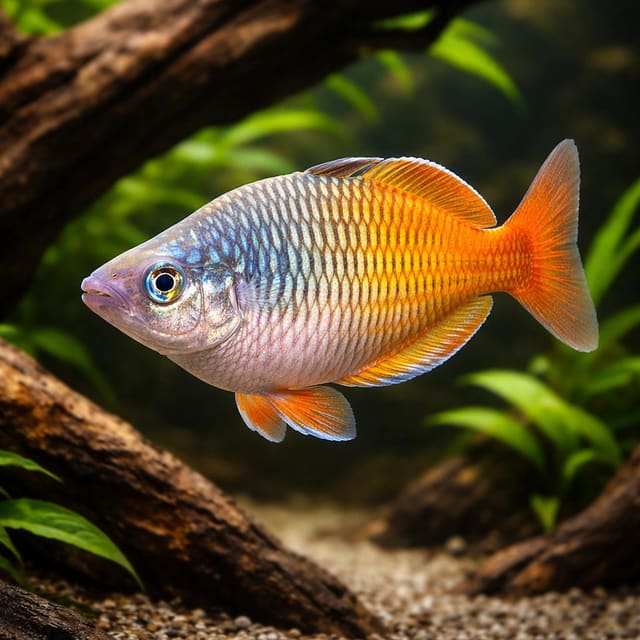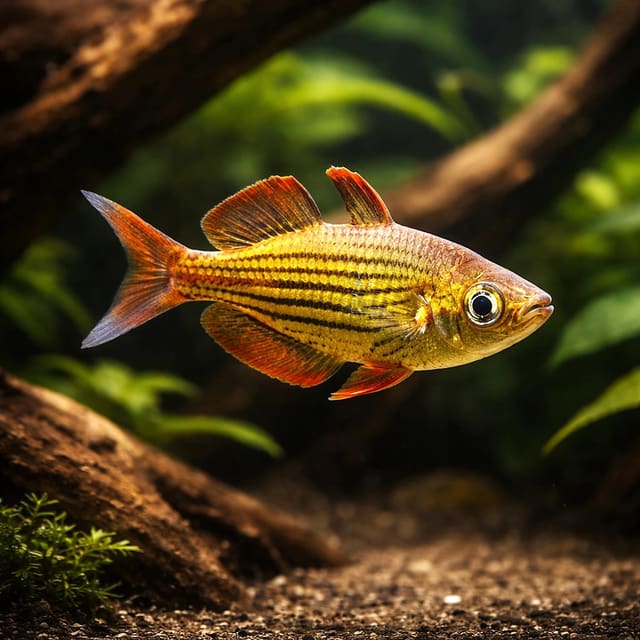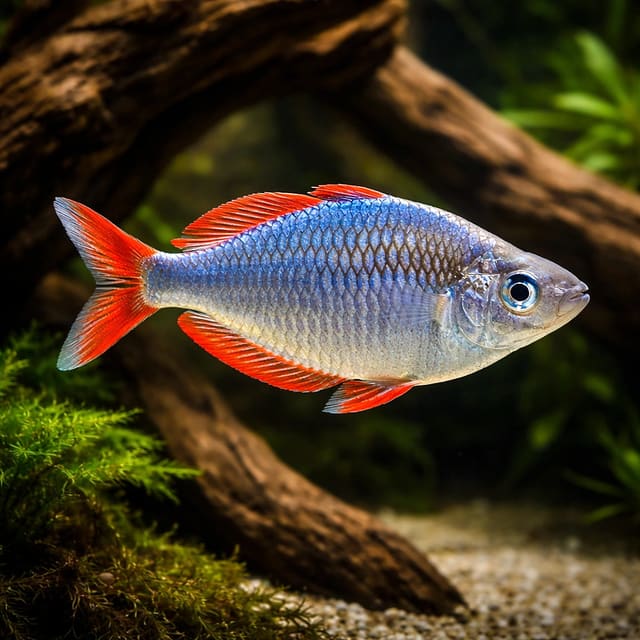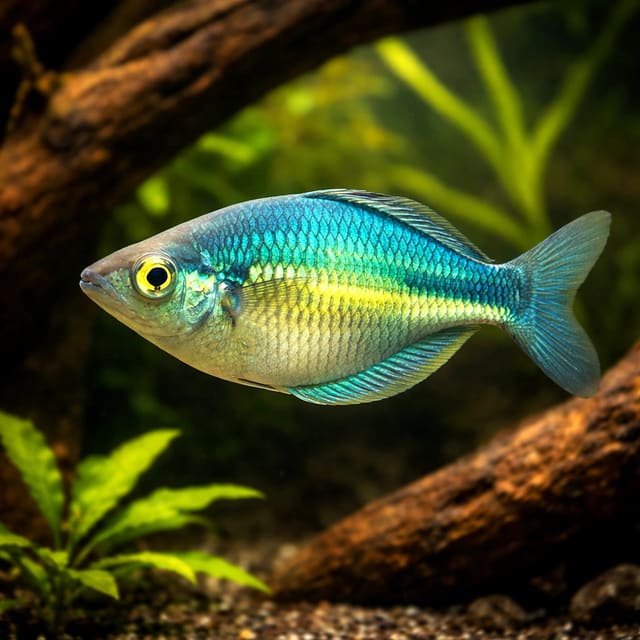
Lake Kutubu Rainbowfish (Melanotaenia lacustris) – 4–6cm+ Size Grades
22–24°C · pH 7–8 · 108L
£8.99

Western Rainbowfish (Melanotaenia australis) is a peaceful, active Australian shoaling fish for a long, mature aquarium with plants, open swimming room and a group of at least 6–8.
Melanotaenia australis
Shoaling fish: kept in a group they feel safer, stay calmer and show their best colour.
Confirm your email, then we’ll send an availability message for this exact item if it returns within 180 days.
This request is only for this product—no newsletter or other promotions. A mail-provider retry may very rarely duplicate the same availability message. Unconfirmed addresses are removed after 48 hours. See our privacy policy.
Western Rainbowfish (Melanotaenia australis) is a peaceful, active Australian shoaling fish for a long, mature aquarium with plants, open swimming room and a group of at least 6–8.
Maintain these water conditions for optimal health and vibrant colors
The Western Rainbowfish (Melanotaenia australis) is a freshwater rainbowfish from north-western Australia. It brings constant mid-to-upper-water movement to a planted display, with a silver-to-gold body, a strong dark lateral band and warm colour through the fins in well-conditioned mature fish. It is peaceful, but never static: the aquarium must suit a coordinated group of quick swimmers rather than one ornamental centrepiece.
This species is most useful to a keeper who wants an active shoal, has a long mature aquarium and enjoys balancing dense planting with open water. Seriously Fish recommends at least a 120 × 30 × 30 cm footprint, approximately 108 litres, because the fish needs room to travel. It also advises a group of at least 6–8, preferably more where the aquarium allows. Those two facts belong together: adding more fish without extending usable swimming space misses the point of the recommendation.
One purchase supplies one live fish of the selected size option. This listing has two size grades of the standard form; the Super Red colour form is sold as a separate listing. Use the live selector for the exact labels available when ordering rather than relying on a sentence that can become stale. The size you select is the size supplied, not the adult size.
FishBase records a maximum of 11 cm standard length for male/unsexed fish, while the Seriously Fish species profile gives 12 cm standard length. Standard length excludes the tail. Plan around the larger 12 cm profile value for space, while keeping the FishBase 11 cm SL record accurately labelled when it appears in structured care information.
Sex is guaranteed only when the selected option explicitly states male or female. This Western Rainbowfish listing has no sex-guaranteed option. Mature males can become larger, deeper-bodied and brighter, with longer dorsal and anal fins, but those species-level differences do not guarantee the sex of a young offered fish.
| Good fit when | You can keep at least 6–8, provide a 120 cm swimming length, maintain 22–27°C water and choose companions comfortable with fast movement. |
|---|---|
| Think again when | The aquarium is short, newly cycled, built around timid slow fish, or has room for only one Western Rainbowfish. |
| Main daily task | Feed a varied diet in portions the group finishes promptly and watch that every fish remains active, full-bodied and included in the shoal. |
Gallery images have been digitally enhanced to improve image quality. Natural colour, pattern, size and maturity can vary between live animals. Colour also varies with maturity, locality, condition, lighting and the stress of a recent move. Buy for the species’ care needs and group behaviour, not for a promise that a juvenile will match one photograph immediately.
If this is your first shoaling display, start with the mature-aquarium setup guide. To compare the wider family, browse the rainbowfish collection. Both are planning aids; the 120 cm footprint and 6–8 fish group remain the key screens for this species.
A Western Rainbowfish is not a solitary ornament. The useful buying unit for planning is the eventual shoal, even though each purchase supplies one fish. Count the adults, reserve the 120 cm swimming route, then check that plants, wood and companion species do not quietly consume that space.
| Core group | At least 6–8 Western Rainbowfish, with more only when the aquarium expands with them. |
|---|---|
| Core footprint | At least 120 × 30 × 30 cm, about 108 litres, with extra capacity for a larger shoal or community. |
| Core water | 22–27°C, pH 6.5–8.0 and 5–20 dGH, kept clean and stable. |
That combination is the clearest test of suitability. Colour is the reward for good planning, not a substitute for it.
Melanotaenia australis belongs to the rainbowfish family Melanotaeniidae. FishBase records it widely across north-western Australia, through the Pilbara and Kimberley and into north-western Northern Territory drainage systems. Its habitats are varied: rivers, creeks, swamps, marshy lagoons, lakes and reservoirs all appear in the species account.
FishBase also describes aggregations near the surface of rocky pools and along margins with vegetation, submerged logs and branches. That helps explain a good aquarium layout: secure cover at the margins, with a broad uncluttered route through the middle and upper water. The aim is not to copy one river scene literally; it is to give a shoal both refuge and usable movement.
Two species-level sources give closely related size records. FishBase lists 11 cm SL for male/unsexed fish. Seriously Fish gives 120 mm, or 12 cm, SL. ‘SL’ means standard length and excludes the tail fin. Use the larger profile value when checking swimming space rather than treating a dispatch-size juvenile as nearly grown.
Seriously Fish recommends an aquarium at least 120 × 30 × 30 cm, about 108 litres. Length is central because Western Rainbowfish are active. A deeper or taller tank can add useful water volume, but it should not be used to justify shortening the 120 cm swimming route. Larger groups deserve more space than the minimum profile.
OATA’s rainbowfish guide gives a broader group rule of at least 120 litres for larger rainbowfish over 8 cm. That is useful supporting context for the family. For this listing, the species profile’s 120 cm base and approximately 108 litres provide the direct starting point; choose the roomier option whenever stocking or décor reduces free water.
Seriously Fish says this species looks at home in a planted aquarium, with areas of dense vegetation and open swimming space. Plant the back, ends and selected margins rather than making the whole aquarium a thicket. Use smooth wood or branches to create structure, but leave a continuous lane long enough for the group to move together.
Slow to moderate water movement is suitable in the species profile. Aim for circulation that carries oxygen and waste towards the filter without forcing the shoal to fight a concentrated jet. Spread outlets if needed. Watch where the group chooses to rest and whether every fish can leave the flow.
A secure lid is prudent for fast surface-oriented fish. Keep maintenance openings covered and avoid gaps around cables. This is ordinary containment for an active aquarium, not a reason to reduce ventilation or access.
The species-level aquarium range from Seriously Fish is 22–27°C, pH 6.5–8.0 and 5–20 dGH. This is broad enough to suit many UK water supplies, but stability still matters. Acclimate to changes gradually and avoid repeatedly altering pH with short-lived chemical corrections.
Measure the actual aquarium and source water. The water chemistry guide explains the readings, and the water parameter matcher provides a practical comparison. Use the 22–27°C, pH 6.5–8.0 and 5–20 dGH species profile as one coherent recommendation rather than mixing the warmest value from one page with the hardest value from another.
OATA’s rainbowfish group sheet also gives ammonia at 0 mg/l, nitrite at 0 mg/l and nitrate no more than 20 mg/l above the tap-water level. Its general rainbowfish ranges are 22–27°C, pH 6.5–8.0, 4–12 dGH and 3–10 dKH. These are family-level context; the species-level 5–20 dGH profile is the hardness range used for this fish.
Filtration is essential. The RSPCA explains that fish release toxic ammonia, which a working biological filter converts first to nitrite and then to the less harmful nitrate. A Western Rainbowfish group adds waste as a group, so the aquarium should be fully matured before the whole shoal is introduced.
The Seriously Fish profile illustrates four to five filter turnovers per hour for its example 108-litre system, equivalent to a filter rating around 430–540 litres per hour. Treat that as equipment context for that tank size, not a universal pump prescription. Media volume, real flow after head loss, stocking, plant mass and outlet design all affect the result.
Check water before adding the fish. Increase stocking at a rate the filter can handle, and never assume that clear water proves ammonia and nitrite are safe. A liquid test and a written baseline are more useful than appearance alone.
Seriously Fish describes Western Rainbowfish as unfussy and willing to accept most dried, frozen and live foods. Use a good-quality flake or appropriately sized granule as the regular base, then rotate suitable live or frozen foods. Variety supports body condition and gives active fish a reason to feed across the water column.
OATA’s rainbowfish guidance names daphnia, small bloodworm and tubifex among suitable small live or frozen items, with brine shrimp useful for larger species. Feed only what the fish can eat within a few minutes once a day under that group guidance. Remove leftovers and adjust the portion before adding more; decomposing food becomes a water-quality problem.
Spread food across the shoal rather than dropping everything into one corner. Watch the smallest or least confident individual. A group can look energetic while one fish repeatedly misses meals. Healthy fish should maintain full bodies, intact fins, clear eyes and a regular place in the shoal.
Seriously Fish recommends at least 6–8 Western Rainbowfish, preferably more. A proper group reduces the pressure on a single fish, supports natural shoaling and encourages display. It also increases demand for swimming room and filtration, so group size and aquarium size must rise together.
Mature males can become larger, brighter and deeper-bodied, with longer dorsal and anal fins. Those traits are useful adult biological context, but they are not an offer guarantee. The current size options are not sold by sex, and a gallery image does not select a male or female.
OATA’s broader rainbowfish guidance suggests more females than males to reduce male conflict. Apply that only when adult sex can be identified reliably and the actual animals can be chosen on that basis. It does not change the unsexed offer on this product.
Tropical Fish Co hand-bags livestock in oxygen, uses an insulated poly box and includes a heat pack when the weather calls for it. A licensed live-animal courier delivers on the confirmed Thursday or Friday date, and tracking is sent by email. Read the delivery and Live Arrival Guarantee policy before the parcel is due so somebody is present to receive it.
Keep the aquarium ready before opening the box. Compare bag and tank conditions, and follow the store’s slow acclimation guidance. Release the fish without pouring bag water into the aquarium. Give the group quiet time to find cover and re-form rather than feeding a large meal immediately.
For any Live Arrival Guarantee claim, make one continuous unboxing video beginning with the parcel still sealed, then show it being opened and the fish still inside the sealed bag. Contact the team the same day with the order number. The video is evidence for the claim; it is not a biological care step.
At least once every week, a partial water change of 25% is strongly recommended under OATA’s rainbowfish guidance. Test the water at least weekly so ammonia and nitrite do not build up. Treat replacement water with conditioner before it enters the aquarium and keep its temperature reasonably close to the aquarium.
Check filters for blockages. If filter media needs cleaning, do not run it under the tap because chlorine or chloramine may kill beneficial bacteria. Rinse it lightly in the tank water removed during the partial water change. Stagger major filter work so the system keeps working biologically.
Look for changes in swimming, colour, temperament, breathing, fins, scales, body condition and appetite. A fish hanging at the surface, becoming unusually pale or dark, hiding, breathing differently or losing interest in food deserves a water test and closer inspection. Contact the retailer or an aquatic veterinary professional when concern persists.
Measure the aquarium’s clear swimming length after décor is installed, not before. A nominal 120 cm tank can lose useful route space to a large central root, oversized rockwork or dense plants across the front. Move cover towards the ends and back where necessary, leaving a broad continuous lane through the middle and upper water.
Run the complete filter and heater long enough to establish stable readings. Confirm 22–27°C, pH 6.5–8.0 and 5–20 dGH, then record ammonia, nitrite and nitrate. Ammonia and nitrite should both read 0 mg/l. This baseline gives the keeper something concrete to compare after the shoal is added.
Observe the group at three moments: shortly after the aquarium lights come on, during feeding and after the room quietens. Look for a consistent shoal, normal rapid swimming, intact fins and every fish reaching food. A single fish repeatedly separated at the back, breathing harder or missing meals deserves attention even if the rest appear bright.
Offer familiar food first and keep portions modest. Spread it along the swimming route so one confident fish cannot collect everything at a single point. Remove visible remains. The goal during settling is dependable intake and stable water, not maximum colour in the first few days.
At least once every week, a partial water change of 25% is strongly recommended under OATA’s rainbowfish guidance. Test ammonia and nitrite at least weekly, and watch the nitrate trend against the tap-water baseline. Condition replacement water and avoid a large temperature difference during the change.
Check filters for blockages. If filter media needs cleaning, do not run it under the tap because chlorine or chloramine may kill beneficial bacteria. Rinse it lightly in the aquarium water removed during the partial water change. If several filters are fitted, service them in stages so biological capacity is not stripped back at once.
Trim plants before they close the swimming lane. Check lid gaps, heater guards and filter intakes. A layout that was open at planting can become crowded after several weeks of growth, and an active shoal benefits from keeping its route predictable.
Compare photographs or written notes on body condition, fin quality and colour. Mature males may deepen and brighten over time, while juveniles can take patience. Judge progress across the group rather than selecting one dominant fish as the standard.
Review stocking as every species grows. Confirm that companions still share the same water range, that bottom feeders receive food and that slower fish are not permanently displaced. If the community has become busy, creating more open length is often more useful than adding another decoration.
Start with water tests, then consider recent maintenance, filter flow, temperature, feeding and social pressure. OATA’s warning signs include unusual surface hanging, bottom sitting, erratic swimming, darkening or paling, changed aggression or hiding, altered breathing, damaged fins or scales, white spots, fluffy growths, body-condition change and reduced feeding.
Contact the retailer or an aquatic veterinary professional when concern persists. Avoid guessing at treatment from appearance alone; the same outward behaviour can follow poor water, stress, injury or disease, and treatment should match the cause.
Revisit the original purchase screen whenever the shoal grows or the community changes: at least 6–8 fish, a 120 cm route, mature filtration and compatible water. These four checks are more dependable than judging success by colour alone. A bright fish may still be crowded, while a recently moved fish can be temporarily pale in an otherwise well-planned aquarium.
Seriously Fish calls Western Rainbowfish very peaceful, while warning that their rapid movement and relatively large size can disturb smaller or slow-moving fish. OATA gives the same practical direction for active rainbowfish as a group. Choose companions that are calm without being timid and robust enough to share open water with a fast shoal.
Species named in the Western Rainbowfish profile include similarly sized rainbowfish, characins, danios, barbs, freshwater gobies and catfish such as Corydoras. These are categories for comparison, not an automatic approval of every member. Check the exact companion’s adult size, temperature, pH, hardness, social needs and feeding style before combining them.
Avoid very small fish with this larger active rainbowfish. Tiny animals can be intimidated even when they are not pursued. Slow-moving or timid fish may also spend too much time hiding or lose food to the shoal. Long-finned fish need particular care if their pace or finnage makes them easy to disturb.
Do not use ‘peaceful’ to justify overcrowding. A 6–8 fish shoal needs open water, and every additional community species takes some of that space. Watch whether the group can travel without repeatedly turning around companions and whether bottom fish still receive food.
Display between males is part of the appeal of rainbowfish. Provide enough companions and room so attention is spread rather than focused on one individual. Brief positioning and colour display should not become persistent exclusion, torn fins or a fish pinned into a corner.
If one fish separates from the shoal, test water, check breathing and body condition, and observe interactions at feeding time. A social species can reveal a problem through a subtle change in spacing before obvious physical damage appears.
If a 120 cm aquarium and 12 cm adult profile are too large for the available space, compare the Neon Dwarf Rainbowfish (Melanotaenia praecox). It is linked as another rainbowfish to research, not as a guaranteed tank mate. Compare its own group, water and footprint needs before deciding.
FishBase records 11 cm standard length for male/unsexed fish, while Seriously Fish gives 12 cm standard length. Standard length excludes the tail; plan aquarium space around the larger 12 cm profile value.
Seriously Fish recommends at least 120 × 30 × 30 cm, about 108 litres, for this active species. Treat the 120 cm swimming length as important and choose more room for a larger shoal or community.
Keep at least 6–8, preferably more when the aquarium is large enough. A proper shoal supports natural movement and display, while the larger group also needs more open swimming room and filtration.
The store retains an Easy care assessment because the diet and species-level water range are manageable, but the fish still needs a mature aquarium, a 120 cm footprint and a group of at least 6–8. It is not suitable for a new uncycled tank.
They accept most good dried, frozen and live foods. Use quality flake or suitably sized granules as the regular base, add items such as daphnia, small bloodworm or brine shrimp, and feed only what the group finishes within a few minutes.
Use 22–27°C, pH 6.5–8.0 and 5–20 dGH from the species profile. Keep the values stable, match changes gradually and maintain 0 mg/l ammonia and nitrite.
They are described as very peaceful rather than predatory or routinely fin-nipping. Their rapid movement can still disturb smaller, timid or slow-moving fish, so activity level matters as much as aggression.
The species profile names similarly sized rainbowfish, characins, danios, barbs, freshwater gobies and catfish such as Corydoras. Check each exact species for matching adult size, water, group and feeding needs; the categories are not universal guarantees.
Tropical Fish Co hand-bags livestock in oxygen, uses an insulated poly box and a weather-dependent heat pack, and sends it by a licensed live-animal courier for the confirmed Thursday or Friday date. For a Live Arrival Guarantee claim, film continuously from the sealed parcel to the fish still in its sealed bag and contact the team the same day.
FishBase: Melanotaenia australis supports the accepted identity, family, north-western Australian distribution, habitats and 11 cm SL male/unsexed maximum.
Seriously Fish: Melanotaenia australis gives the species-level aquarium figures: 12 cm SL, at least 120 × 30 × 30 cm (about 108 litres), 22–27°C, pH 6.5–8.0, 5–20 dGH, planted/open layout, varied diet, peaceful activity, named companion categories and a shoal of at least 6–8.
OATA’s rainbowfish care sheet supports family-level water-quality, aquarium, social, feeding, maintenance and monitoring guidance. Its numerical figures are guidance for rainbowfish as a group.
RSPCA aquarium welfare guidance supports the explanation of biological filtration and toxic nitrogen waste.
No reviews for this item yet. Bought one? Honest reviews only, good or bad.
What customers say about ordering from us
I have a small group of long finned mountain minnows. So was delighted to be able to order ten of this variety to increase the genetics in my tank . The ones I recieved are healthy but it’s to early to give a verdict on wether they are of a long finned type since they are small currently.
Gordon Walker · 23 Sept 2026
100% success travel and "installation". Pleased with quality of purchase. The Siamese fighter a bit "shy" so have not yet seen him at his best yet but looking good. Happy customer. GG
George E Garratt · 21 Sept 2026
Reviews of our shop, collected by Judge.me, an independent third-party review collector. Newest first.