By Tropical Fish Co Editorial Team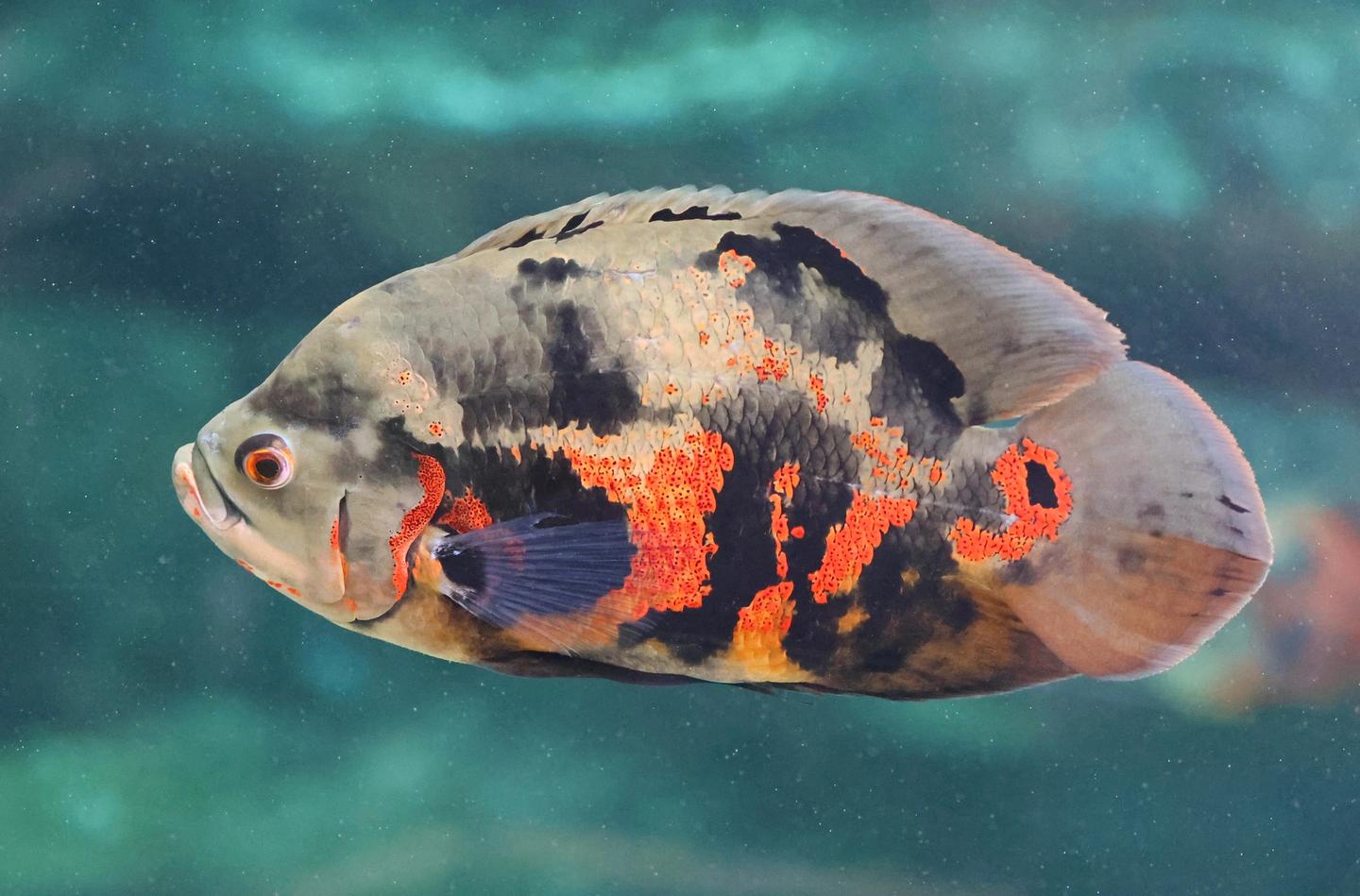
The eyespot is more than decoration
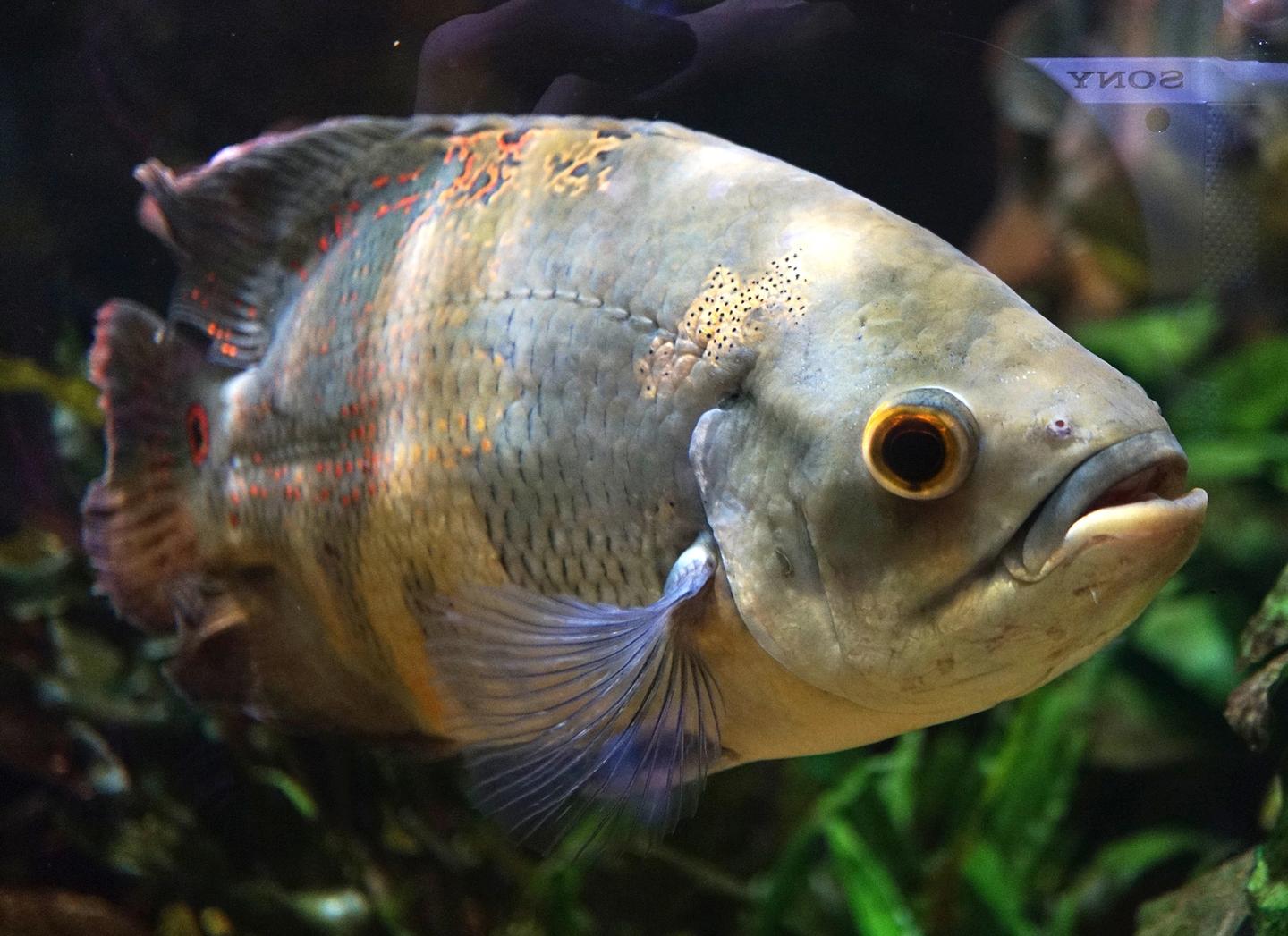
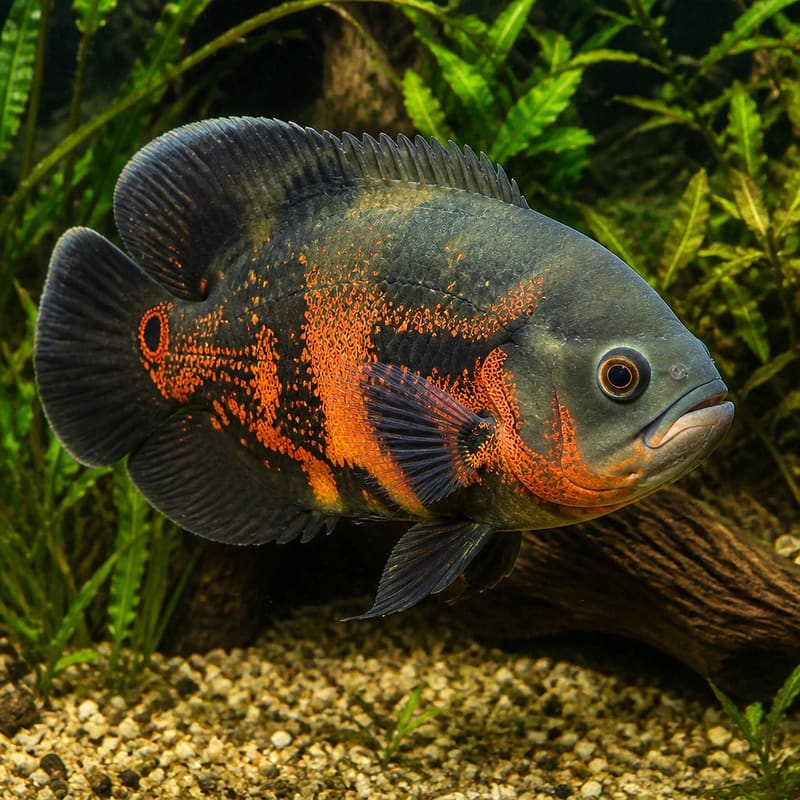
The orange-ringed mark near an Oscar's tail is a caudal ocellus—a false eye. Experimental field work found that this marking can deter fin attacks from piranhas, giving the pattern a biological role rather than making it just an aquarium colour feature [4].
That is the interesting part. The important part for a buyer is less glamorous: the small Oscar offered for sale is a juvenile version of a very large, strong fish. The adult aquarium, filtration, maintenance time and emergency separation space should exist in the plan before the fish enters the basket.
Is an Oscar right for your aquarium?
An Oscar is a reasonable choice when all of these statements are true:
- You can house one adult in a large aquarium with a broad, usable footprint.
- The floor and cabinet are suitable for the filled system's weight.
- Filtration, heating and maintenance access are sized for a heavy-bodied fish that produces substantial waste.
- You are willing to test water and change the maintenance schedule when results or behaviour demand it.
- If another fish is involved, you have a divider, spare aquarium or genuine rehoming route—not just hope that the fish will “sort it out”.
It is the wrong purchase for a small community aquarium, an uncycled upgrade, or a plan that depends on acquiring a bigger tank later. UK welfare guidance focuses on suitable space, a stable species-appropriate environment and usable care information; it does not provide one legal litres-per-fish formula [12][13].
For one adult Oscar, Tropical Fish Co uses a conservative buying threshold that requires both at least 450 litres and a base of at least 150 × 60 cm, and prefers larger where practical. This is our editorial welfare policy—not a universal scientific or legal minimum. Aquarium shape, usable swimming space, filtration, decor and the individual fish all affect suitability.
Identity, native range and adult size
The accepted name is Astronotus ocellatus (Agassiz, 1831), a cichlid from the Amazon basin [1]. Older sources often extend that range into the Orinoco and Gulf of Paria. A modern revision described those northern populations as Astronotus mikoljii, so repeating “Amazon and Orinoco” without qualification is no longer careful taxonomy [2].
Aquarium-trade fish are rarely voucher specimens. This page therefore uses A. ocellatus as the source-supported trade identity while acknowledging possible historic confusion; a photograph or supplier label cannot independently settle the taxonomy of every individual.
FishBase reports a 24 cm common total length and a 45.7 cm maximum total length [3]. Those figures describe records, not guaranteed aquarium outcomes. Common length is not an adult ceiling, so plan for a very large cichlid rather than the juvenile size offered for sale. We do not publish a fixed monthly growth rate: temperature, food, genetics, health and prior conditions make that look more precise than the evidence allows.
Tank layout: footprint first
Litres matter, but a tall narrow aquarium can still give a large Oscar poor turning room. Prioritise:
- A base of at least 150 × 60 cm for one adult.
- A strong, level cabinet and a floor suitable for the filled system.
- Stable rocks and wood that cannot topple when a fish digs or pushes.
- Protected heater placement and covered equipment.
- A secure lid with service access.
- Open turning space plus visual shelter, rather than filling the footprint with decoration.
American cichlid guidance from OATA supports adult-size planning, robust filtration and species-aware behaviour decisions [9]. It should not be converted into a universal “one Oscar equals exactly X litres” rule.
What about two Oscars?
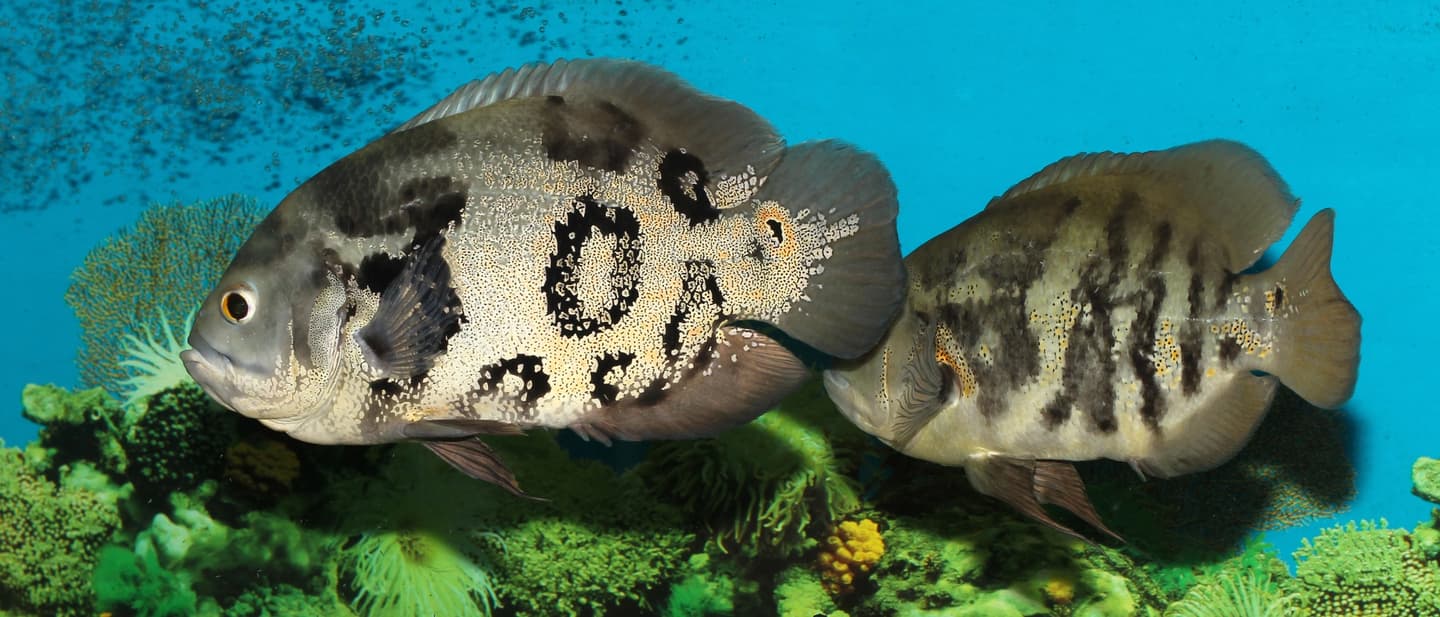
Two fish in one photograph—or two juveniles sharing a retailer's tank—does not prove a stable pair. Social conditions can affect aggressive behaviour even in juveniles [6]. Two Oscars require substantially more usable space than one, multiple sight breaks and an immediate separation option. We do not state a universal pair volume because body size, relationship, sex, layout and aggression differ. If the backup aquarium would be impossible, do not make the pairing experiment.
Water, oxygen and maintenance
FishBase gives a source range of 22–25 °C, pH 6.0–8.0 and 5–19 dH [3]. Use those as evidence-bounded reference points, then match changes gradually to the stable water in which the exact fish is currently held.
For a new or rebuilt system:
- complete the nitrogen cycle before adding the Oscar;
- use reliable tests for ammonia, nitrite, nitrate and pH;
- keep ammonia and nitrite at non-detectable test levels;
- provide continuous oxygenation and surface movement;
- size filtration for the actual waste load and maintain it without destroying all biological media at once;
- base water changes on test results, feeding, fish condition and debris—not an impressive-sounding fixed percentage.
OATA's freshwater setup guidance and the Merck Veterinary Manual both prioritise stable water, biological filtration, observation and controlled change [10][8]. Oscars can make physiological adjustments to low oxygen, but that is a survival response—not permission to run a poorly oxygenated aquarium [11].
Feeding without turning “carnivore” into a myth
A field study in the Middle Solimões examined 223 Oscars and found stomach contents in 182; fish and insects were important in that sampled várzea habitat [5]. That is useful ecology, but it does not prescribe a fish-only captive diet or a magic protein percentage.
A practical aquarium plan is:
- use a nutritionally complete food formulated for large cichlids as the staple;
- rotate suitable prepared or frozen items for variety;
- choose food size the fish can swallow without repeated spitting or waste;
- remove uneaten food and adjust the portion to condition and water results;
- avoid routine feeder fish, which can introduce pathogens and produce an unbalanced diet.
The Merck nutrition overview explains why a complete prepared diet and controlled variety are safer foundations than one live-food habit [7]. We deliberately do not prescribe a universal daily count or two-minute timer: juvenile and adult needs, food density and temperature differ.
Aggression and tank mates: there is no guaranteed list
“Can this fish live with an Oscar?” is not answered by naming three supposedly tough species. Compatibility can fail through predation, injury, chronic chasing, competition at meals or mismatched water requirements. A companion that works with one individual can fail with another as the fish matures.
Use this risk screen:
| Question | Why it matters |
|---|---|
| Could either fish fit in the other's mouth? | Predation can happen even after months without an incident. |
| Do both species suit the same stable temperature and chemistry? | “Tough” does not mean compatible water needs. |
| Can every fish feed without being displaced? | Hidden food competition can precede visible injury. |
| Are there sight breaks and more than one retreat? | Space should let a fish disengage. |
| Can you separate them today? | A future backup is not an emergency plan. |
The juvenile aggression study supports the narrower conclusion that social context can change behaviour; it does not prove that every Oscar is aggressive or that any named companion is safe [6].
Tiger, red, albino and mix: what the labels do—and do not—mean
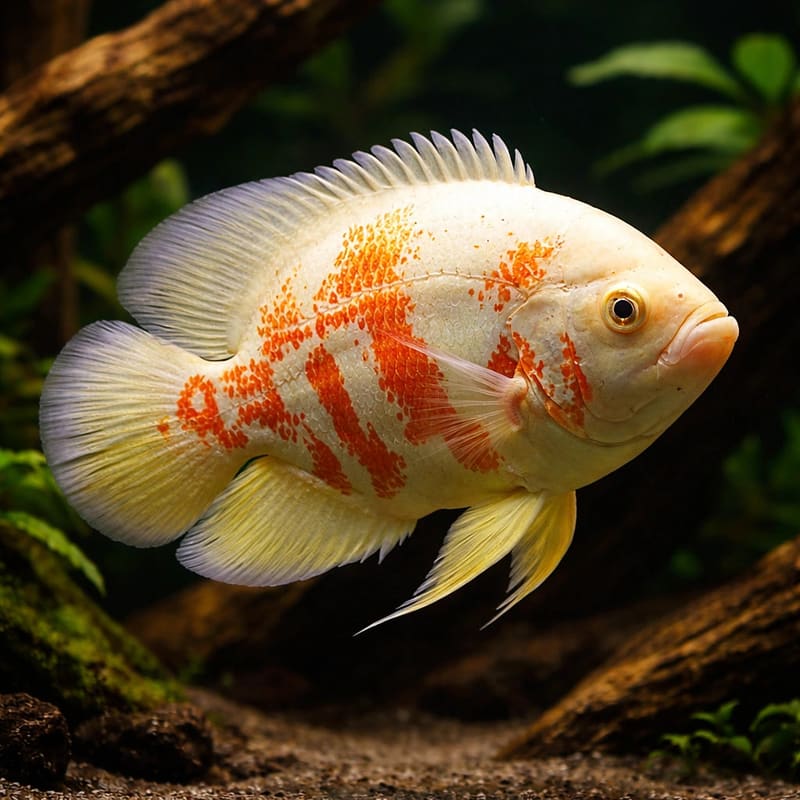
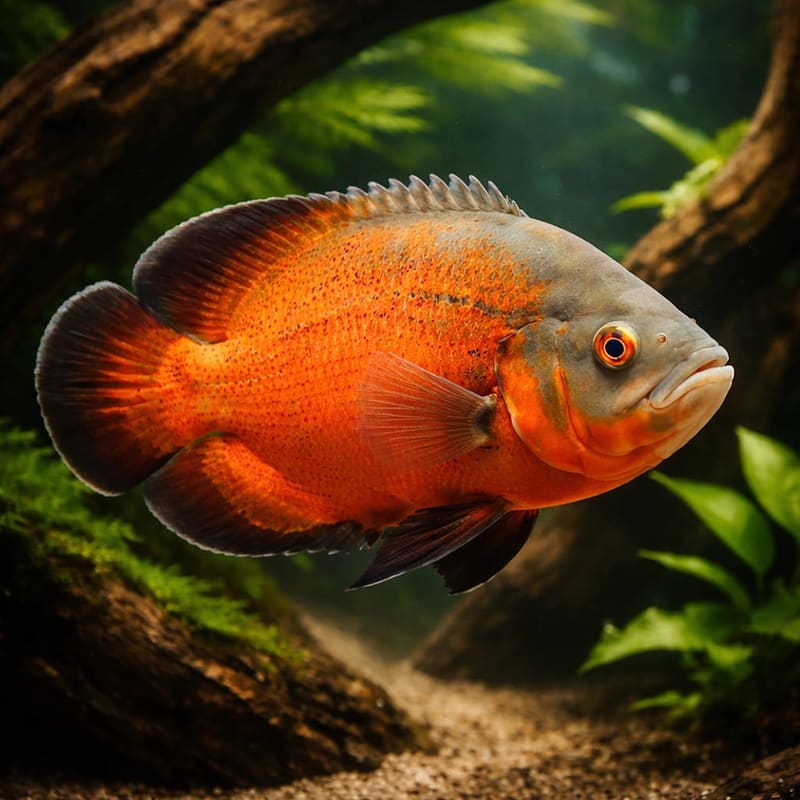
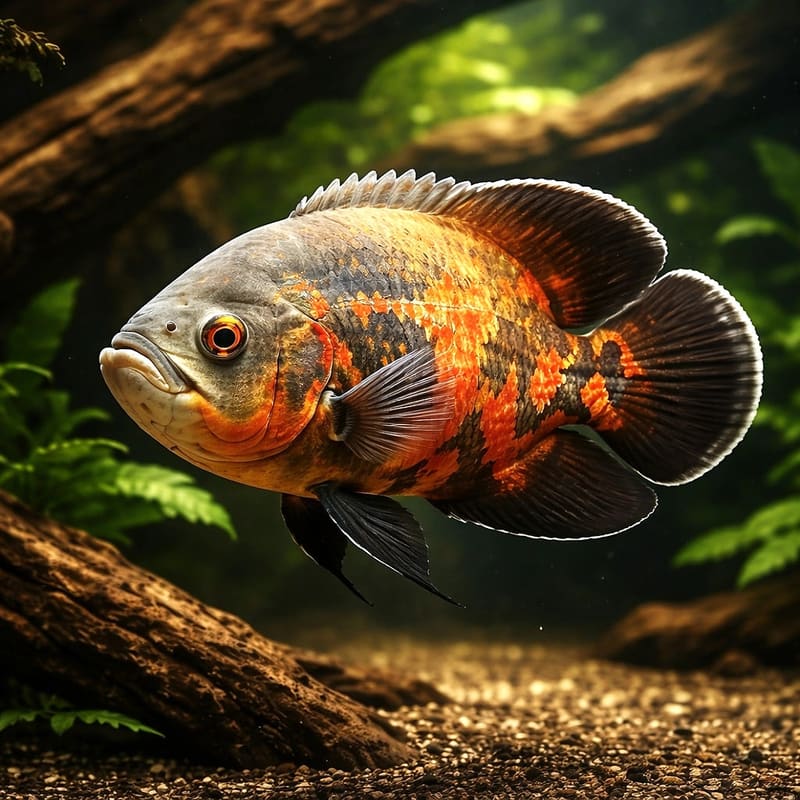
UK listings commonly use colour labels such as tiger, red, albino, albino tiger and mix. These labels are useful visual shorthand, but they are not a separate care system.
| Trade label | What it usually describes | What it cannot guarantee |
|---|---|---|
| Tiger | Dark base with broken orange or red patterning | Exact adult pattern or temperament |
| Red | A stronger red/orange area | Final colour under different light and diet |
| Albino / pale forms | Reduced dark pigment, often with orange patterning | A consistent genetic label across every seller |
| Mix | Unspecified or assorted young colour forms | Which adult pattern an individual will develop |
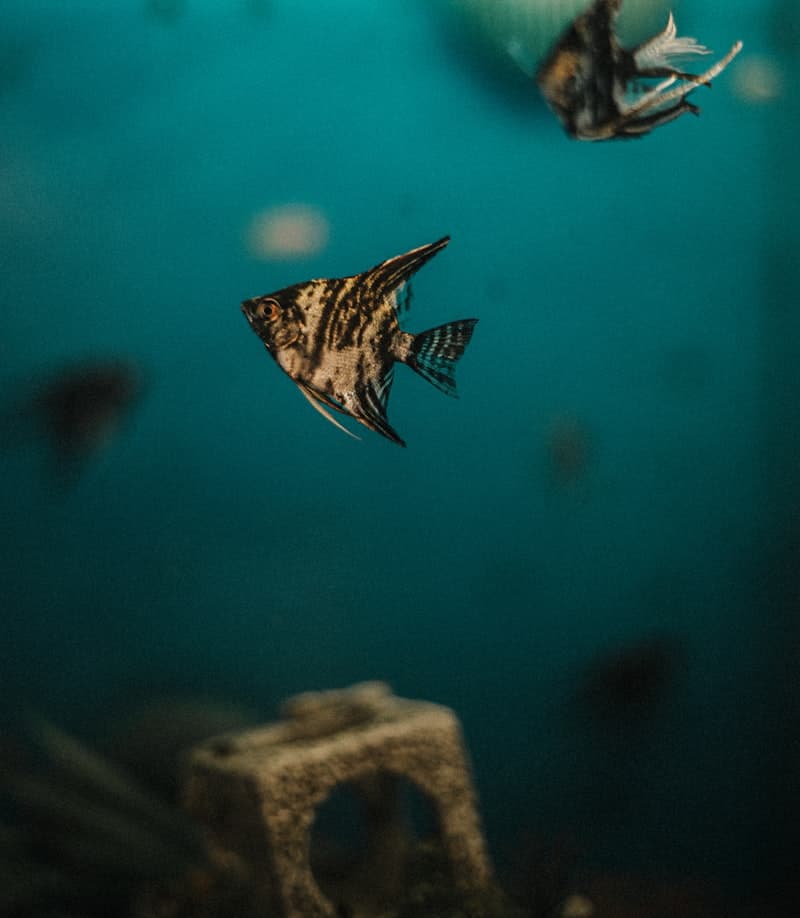
Do not pay for a colour name while overlooking body condition, breathing, fins, eyes, feeding response and the seller's water information. The three page photographs are intentionally labelled only as source-labelled Oscars; none is presented as proof of a trade morph or current shop stock.
Health checks and when to seek help
Before buying, look for steady swimming, normal breathing, clear eyes, intact fins and a body that is neither pinched nor abnormally swollen. Ask whether the fish is feeding and whether it has recently been moved or treated. After arrival, record a baseline photograph and observe appetite, waste, breathing and skin.
Escalate when you see persistent rapid breathing, loss of balance, repeated refusal of food, spreading lesions, deep pits around the head, severe fin damage or sudden behaviour change. Test the water immediately, but do not assume every visible problem is caused by water alone. A fish-experienced veterinary professional may need microscopy or other examination that a web page cannot provide [8].
The often-cited activated-carbon experiment involved marine surgeonfish, not Oscars [14]. It cannot prove that carbon caused an Oscar's head lesions or that removing carbon will cure them. Improve documented husbandry problems, preserve evidence and seek diagnosis rather than treating a cross-species study as a prescription.
Arrival and acclimation
Follow the seller's current arrival instructions because packing method, journey time and water can differ. Prepare the cycled aquarium in advance, dim the room, inspect the unopened bag and photograph any concern before proceeding. Avoid abrupt temperature or chemistry changes, but do not copy a fixed acclimation timer from an unrelated shipment. Quarantine and equipment separation are valuable where the keeper can operate them safely [8].
Check current Oscar fish availability
This section never assumes stock. A product card appears below only when that listing resolves at page render as available with a positive price and a usable image. If no card appears, none of the five reviewed Oscar listings met all three checks; browse current South American cichlids instead. A visible card is not a promise that every size or colour will remain available later, so check its product page before ordering: price and availability can change.
Do not ask only, “How small is this Oscar today?” Ask, “Can I responsibly house the adult if it grows to the upper end of the recorded range, and can I separate it from every other fish if behaviour changes?” If either answer is no, postpone the order.
Final decision checklist
- The adult aquarium and cabinet are already available or booked for installation.
- The usable footprint is suitable; litres are not coming from height alone.
- The filter, heater protection, lid and maintenance access suit a large cichlid.
- The tank is cycled and current test results are known.
- A complete staple diet and waste-control plan are ready.
- Every proposed companion has been assessed individually.
- A divider, spare aquarium or real rehoming route exists.
- The seller's current sale size, water and delivery instructions have been checked.
- Everyone responsible for the aquarium understands that this is a large-fish commitment, not a temporary juvenile display.
If all nine are genuinely in place, an Oscar can be a compelling centrepiece. If one of the structural items is missing, fixing that first is better husbandry—and usually cheaper—than trying to solve it after the fish arrives.