−11%
Chaetostoma thomsoni
22–22°C · pH 6–8
£28.47£31.99

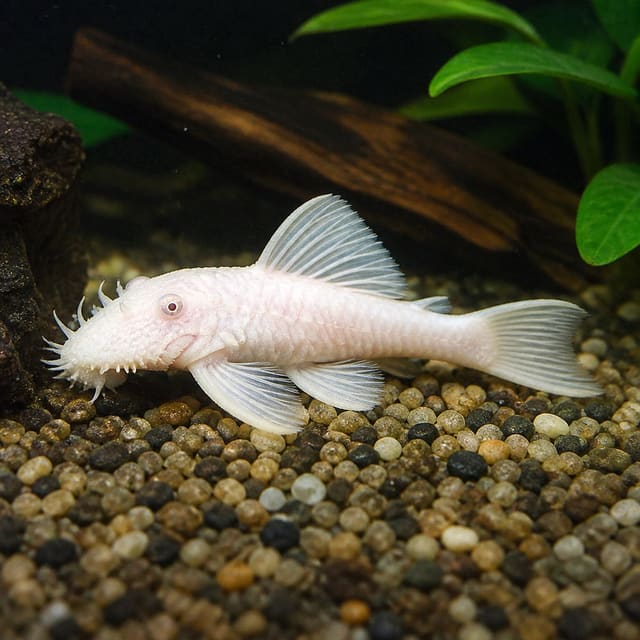
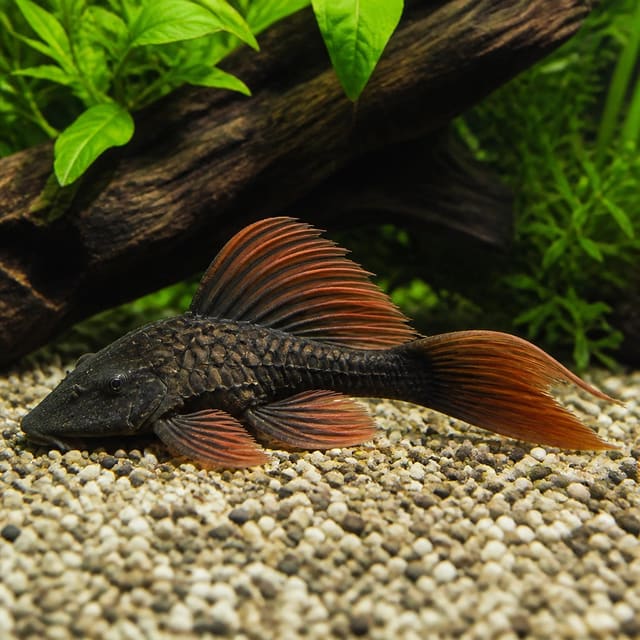
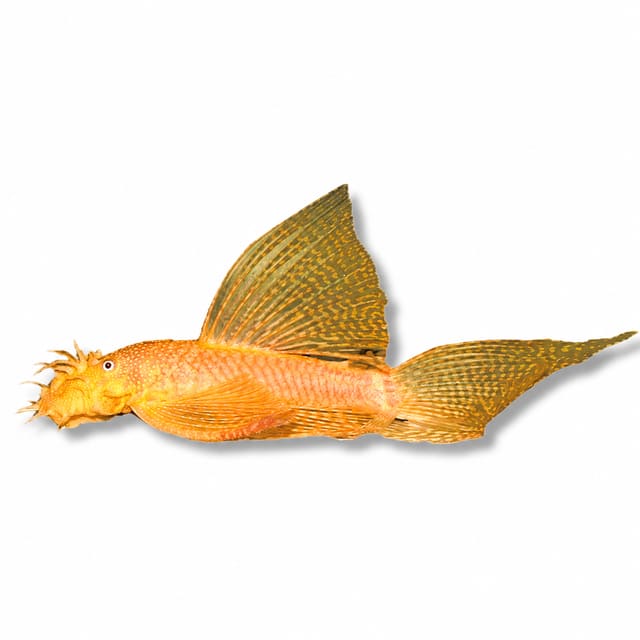
Suckermouth Catfish Gold (Hypostomus plecostomus) is a gold armoured catfish of the family Loricariidae, sold as one live fish per purchase in sizes from 4 cm to 10–12 cm. FishBase records the species at up to 25 cm standard length, so it needs a large, mature aquarium from the start; plan on 22–27 °C and pH 6.2–8.0, where OATA algae-eater guidance sits inside FishBase's wild range.
Adult size is the maximum length this species reaches at full maturity (scientific sources). The livestock you receive will be younger and smaller — pick a size above for the actual shipping size. Product-photo provenance and any image-specific limitations are stated on the listing.
Hypostomus plecostomus
Suckermouth Catfish Gold (Hypostomus plecostomus) is a gold armoured catfish of the family Loricariidae, sold as one live fish per purchase in sizes from 4 cm to 10–12 cm. FishBase records the species at up to 25 cm standard length, so it needs a large, mature aquarium from the start; plan on 22–27 °C and pH 6.2–8.0, where OATA algae-eater guidance sits inside FishBase's wild range.
Adult size is the maximum length this species reaches at full maturity (scientific sources). The livestock you receive will be younger and smaller — pick a size above for the actual shipping size. Product-photo provenance and any image-specific limitations are stated on the listing.
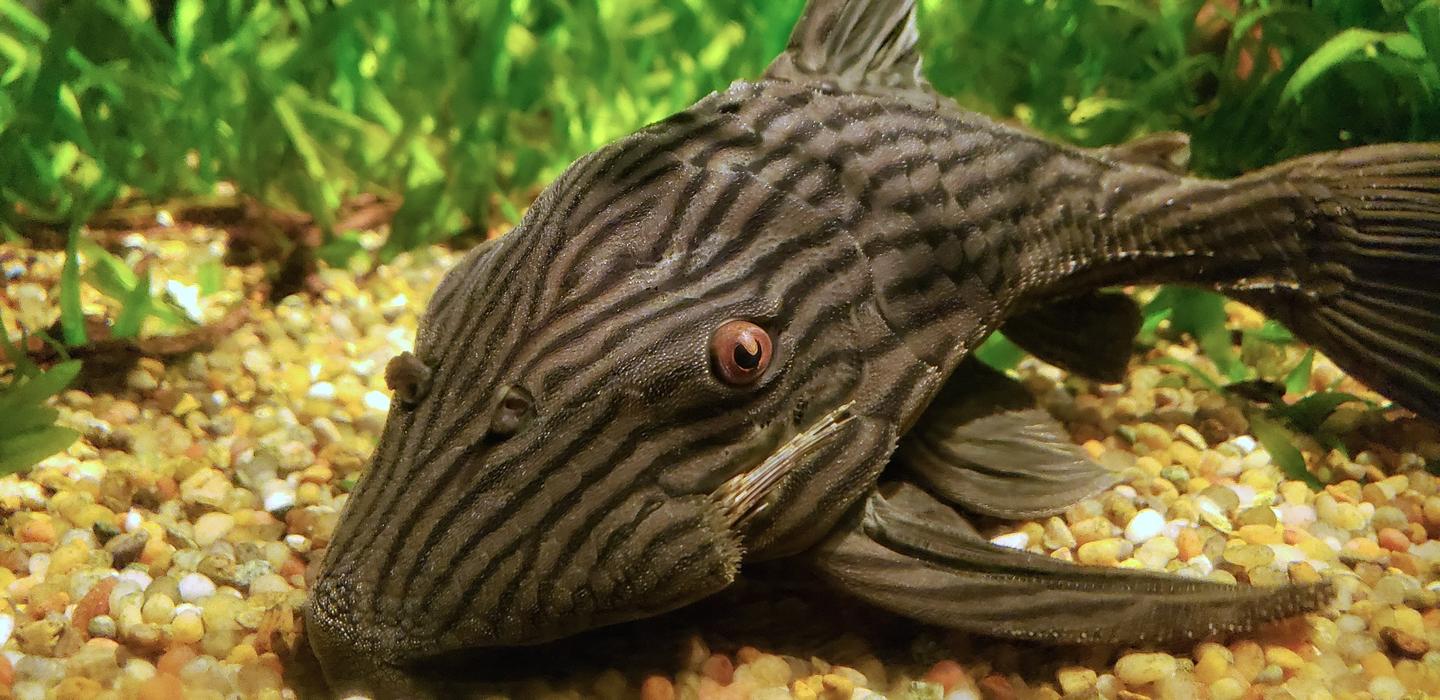
‘Pleco’ is a loose aquarium-trade label, not one species or one care sheet. Before buying, confirm the scientific name or defensible L-number, adult size and measurement method, required footprint, temperature and water, diet, social plan and source. No universal pleco tank size, menu or algae result is honest.
Maintain these water conditions for optimal health and vibrant colors
Suckermouth Catfish Gold is a gold colour form of Hypostomus plecostomus, an armoured catfish in the family Loricariidae. The family is named for the rows of armour-like scutes that cover the upper parts of the head and body, and this fish carries the underslung sucker mouth that gives it its common name. Each purchase is one live fish at the size you choose, from 4 cm up to 10–12 cm. The size you select is the size supplied, not the adult size.
That distinction is the heart of the buying decision. FishBase records a maximum of 25 cm standard length for the species, and the Wikipedia summary gives up to 50 cm. A 4 cm juvenile fits almost any aquarium; the adult does not. Buy it for a large, established aquarium you already have, or one you are building for it, rather than to solve an algae problem in a small community tank.
| Suits | Keepers with a large, matured, heated aquarium and room for one big bottom-dwelling catfish |
|---|---|
| Adult size | Up to 25 cm standard length on FishBase; up to 50 cm in the Wikipedia summary |
| Water plan | 22–27 °C and pH 6.2–8.0, held steady |
| Not suited to | Small tanks, unheated ponds or aquariums with small shrimp you want to keep |
FishBase describes a tropical freshwater and brackish catfish from the coastal rivers of the Guianas in South America, from the Oyapock to the Essequibo basins. It lives on the bottom in the lower reaches of rivers still under tidal influence, where water flows quietly over mud, and in swamps. It feeds on algae and small crustaceans and can breathe air when it needs to. FishBase also notes that it is cultured in ponds in Singapore and Hong Kong for the aquarium trade.
The gold colour is the reason this form is chosen, and it does not change what the fish needs. Its care is the care of Hypostomus plecostomus as a whole: space, clean and steady water, and a grazing diet. Expect the colour to vary a little from fish to fish, as it does in any live animal.
One naming point is worth knowing. Wikipedia notes that the name Hypostomus plecostomus is often used for the common plecos sold in aquarium shops, even though most of those belong to other genera. Whatever the label on a pleco elsewhere, the planning advice on this page is the same: allow for a large catfish.
You receive one live fish for each one you order, at the size named on your chosen option. Six sizes are offered:
Sizes are not always all open for ordering, so check the size menu on this page for the current choice. Whichever size you pick, the aquarium plan is the same, because every one of these fish is heading for the same adult size.
Sex is guaranteed only when the selected option explicitly states male or female. This Suckermouth Catfish Gold listing has no sex-guaranteed option.
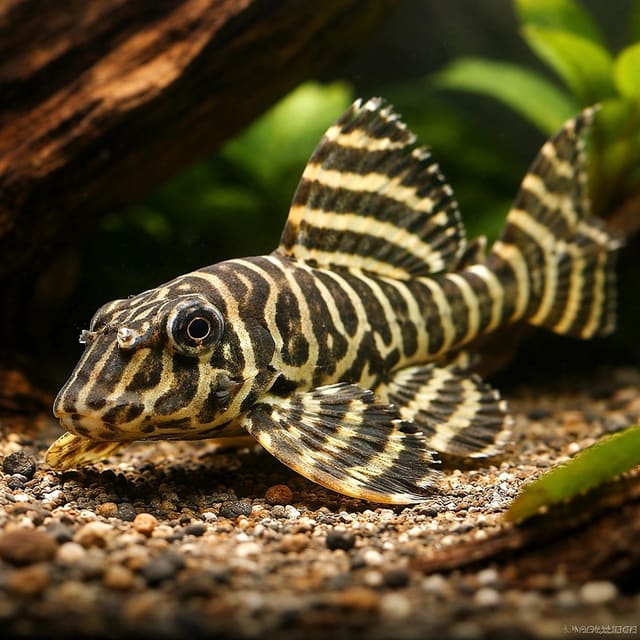
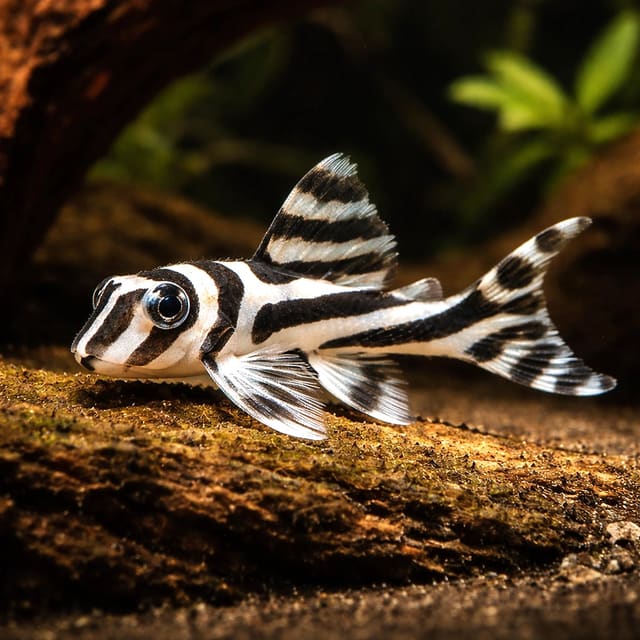
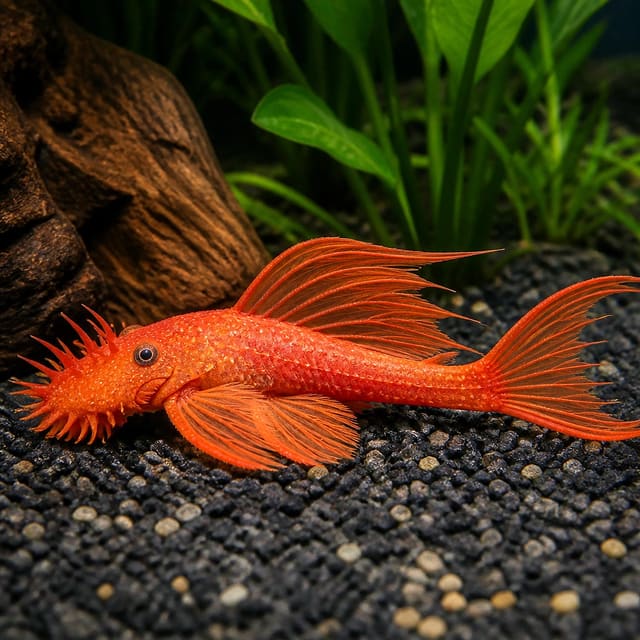
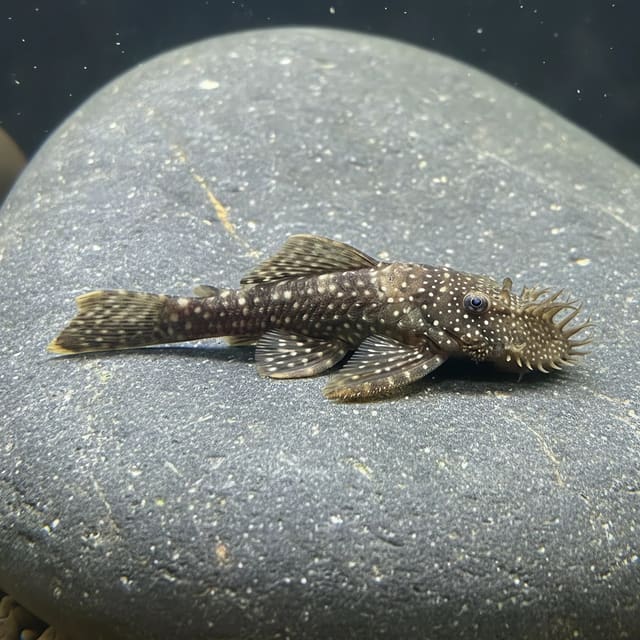
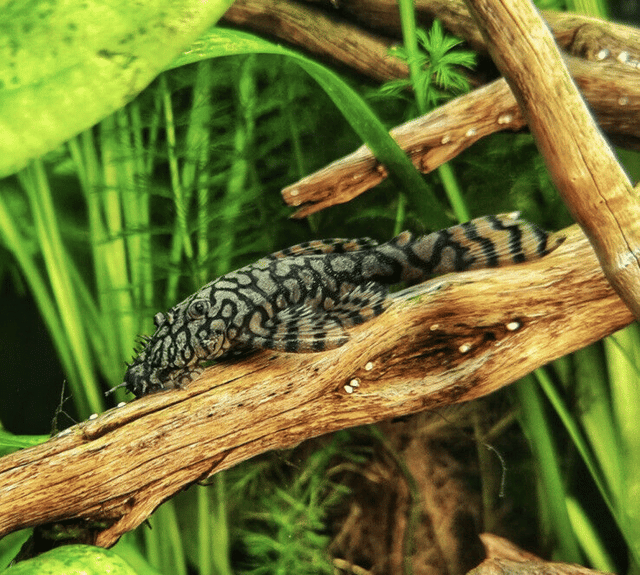
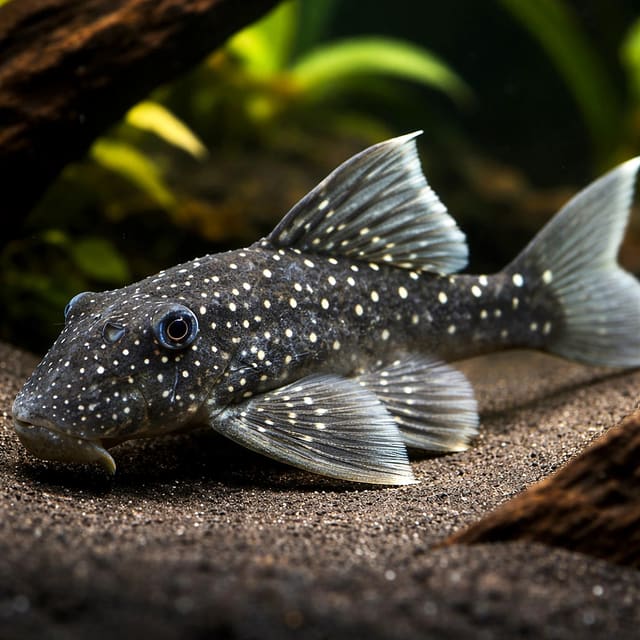
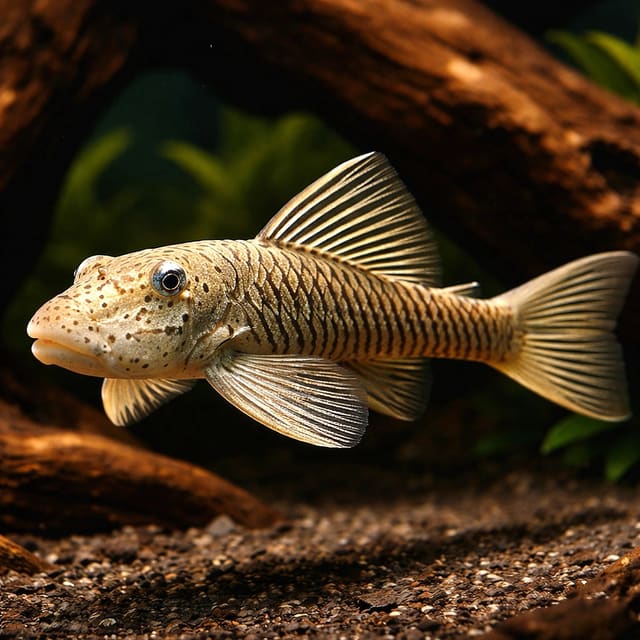
One of the photographs shows two fish together, but each purchase is a single fish. Gallery images have been digitally enhanced to improve image quality. Natural colour, pattern, size and maturity can vary between live animals.
If you are still deciding which bottom-dwelling fish suits your aquarium, you can compare our catfish and plecos, which range from small species to large ones like this.
OATA's care sheet for tropical algae eaters opens with a warning that fits this fish exactly: some species bought to deal with algae can grow too large for most aquariums. Its general rule is to buy an aquarium as large as you reasonably can, because a larger volume keeps temperature and water quality more stable.
If you are unsure whether your aquarium is large enough, send us its length, width and height before ordering and we will talk it through with you. It is far easier to change the plan now than to rehome a large catfish later.
FishBase gives a wild temperature range of 20–28 °C, so this catfish needs a heated indoor aquarium. It is not a fish for an outdoor pond in the UK climate, however often large plecos are suggested for algae in ponds.
OATA's general aquarium requirements apply here in full: a filter is always essential, the tank should have aquarium gravel or sand, and it should ideally have live plants for cover. If you do not use live plants, add plastic plants and suitable ornaments such as plant pots or model caves so the fish has shelter.
The RSPCA stresses that no fish should be kept without a well set up and maintained filter. Fish release ammonia, which is toxic. A working biological filter lets beneficial bacteria break waste down, turning ammonia into nitrite, which is also toxic, and then into nitrate, which is safer. With a large catfish the amount of waste grows as the fish does, so the filter that copes with a juvenile needs to be able to cope with the adult too.
Those bacteria take time to establish, so the aquarium should be running and matured, with ammonia and nitrite both reading zero, before the fish goes in. Our step-by-step guide to setting up a first tropical tank safely covers filling, heating and maturing in the right order.
Two kinds of figures describe this fish's water, and it helps to keep them apart. FishBase records the environment the species lives in; OATA gives recommended aquarium values for the algae-eating fish it covers. The routine aquarium target on this page is where the two agree.
| Value | Aquarium target |
|---|---|
| Temperature | 22–27 °C (FishBase wild range 20–28 °C) |
| pH | 6.2–8.0 (FishBase wild range 6.2–8.2) |
| General hardness | 4–12 °dH |
| Carbonate hardness | 3–10 °dKH |
| Ammonia and nitrite | Zero mg per litre |
| Nitrate | No more than 20 mg per litre above normal tap water levels |
The aquarium values come from the recommended parameters in the OATA algae-eater care sheet, which are group guidance for the algae-eating fish it describes rather than figures measured for this species alone. Keeping inside both sets of figures, and keeping the water steady from week to week, is the safest plan.
OATA calls water testing kits essential and recommends checking water quality regularly, once a week, so that it never slips outside the values above. Test the tap water too, because the nitrate limit is measured against it and because UK tap water varies widely in hardness and pH. Our guide to aquarium water parameters explains what each test tells you, and the water matcher tool compares your readings with a set of target values.
A heater with a thermostat and a thermometer you can read easily will hold 22–27 °C through a UK year. Check the thermometer daily during the first weeks and whenever the weather turns sharply hotter or colder.
FishBase records that this species feeds on algae and small crustaceans. In an aquarium, the algae growing on glass and decor is only a small part of what a catfish of this size needs. OATA is clear that algae-eating fish all need their diet supplemented with prepared feeds, such as algae-based wafers or flakes, and ideally fresh vegetables such as cucumber.
OATA warns against overfeeding, because uneaten food breaks down and releases toxic waste into the water. With a large catfish that effect is magnified, so let the water tests guide you: if nitrate climbs faster than usual, reduce portions before anything else.
OATA points out that persistent algae problems may point to underlying water chemistry issues caused by incorrect maintenance, and that algae-eating fish are not a substitute for regular maintenance and appropriate stocking levels. Enjoy the grazing, but feed the fish properly and deal with algae at its cause.
FishBase places this catfish in the lower parts of rivers that are still influenced by the tide, in quiet-flowing water over a muddy bottom, and in swamps. Wild conditions are a guide to what the fish meets in nature rather than a recipe for the aquarium, but they point to three practical choices.
The wild temperature range FishBase gives, 20–28 °C, spans the conditions the species meets across its range. In the aquarium the aim is the steadier middle of that span, which is why the target on this page is narrower.
Most of the sizes sold here are juveniles, and the fish you receive will keep growing for a long time. How well it grows depends on the same things as its health: steady water, enough food and enough space.
A healthy young catfish grazes steadily, holds on to surfaces well and shows a full, rounded body rather than a hollow belly. If growth seems to stall, check water quality first and then look at how much food is reaching it.
A small juvenile is an easy purchase; the aquarium it will need is the real commitment. Before ordering, check that you can provide each of these for the adult fish:
| Item | Why it matters |
|---|---|
| A large aquarium and a strong, level stand | Floor space for an adult recorded at up to 25 cm standard length, and support for the weight of the water |
| A filter sized for the adult | A big grazing fish produces a lot of waste |
| Heater and thermometer | Holding 22–27 °C through the UK year |
| Test kits and tap-water conditioner | Weekly checks and safe water changes |
| Algae-based wafers and fresh vegetables | The daily diet, beyond any algae in the tank |
| Time each week | Testing, water changes and filter care |
If any of these is not in place yet, it is worth waiting. The fish will be the same fish in a few months, and it will arrive into an aquarium that is ready for it.
We hand-pack each fish, bagged in pure oxygen inside an insulated poly box, with a heat pack when the weather calls for it, and a licensed live-animal courier carries the parcel. You receive a tracking number and your confirmed delivery date by email.
If anything has gone wrong, contact us the same day with your order number and that unboxing video; WhatsApp is the quickest way, and we will arrange a replacement or refund under the Live Arrival Guarantee. Our delivery and Live Arrival Guarantee terms set out the full conditions.
Have a cave or wood ready so a new catfish can find shelter straight away. Keep feeding light for the first few days and remove anything left uneaten, and test ammonia and nitrite more often than usual during the first fortnight, because a new fish adds waste the filter bacteria must catch up with.
A large catfish rewards a steady routine. The weekly check below keeps the basics under control:
FishBase describes this species as a facultative air-breather, meaning it can take air from the surface when it needs to. An occasional trip to the surface is part of its biology. Repeated gasping at the surface, or a fish that stops grazing and hides constantly, is different: test the water straight away, because a problem with ammonia, nitrite or temperature is the most common cause and the quickest to put right.
If a fish loses interest in food, shows damaged fins, marks on the body or changes in breathing, send us your water test results and a description or photo of what you are seeing, and we will help you work through the likely causes.
Compatibility for this fish is mainly a question of space and food. It grazes the bottom and, in the wild, feeds on algae and small crustaceans, so the companions that work best are those that fit the same large aquarium comfortably and are not small enough to be treated as food.
| Companion | Our advice |
|---|---|
| Fish that share 22–27 °C and pH 6.2–8.0 | Suitable when the aquarium has room for them and an adult catfish |
| Small shrimp such as cherry or bee shrimp | Take care; OATA says tank mates for these small shrimp should be chosen carefully |
| Other large bottom-dwellers | Only in a very large aquarium with separate shelter for each fish |
Every bottom-dwelling fish in the aquarium competes for the same floor space and the same sinking foods. Before adding another catfish or loach, ask whether the base of the tank can hold both at adult size, with a shelter each, and whether food will reach each of them.
Faster fish often reach food first. Sinking wafers placed near the catfish's shelter, and vegetables left for a longer grazing period, help make sure it eats well even when the midwater fish are busy.
OATA recommends checking with your retailer before adding any algae-eating fish, and that applies to this catfish as well as to anything you might add alongside it. Check with us before combining it with another pleco or algae eater, and tell us the aquarium size and the fish already living in it.
Choose sturdy plants and anchor them firmly, or attach them to wood and rock, because a large fish moving along the bottom can dislodge anything loosely planted. Space caves and wood so that each bottom-dwelling fish has its own shelter, and leave open water above for any midwater species.
Other products shown alongside this one are options to compare, not a recommendation to keep them together.
FishBase records the species at up to 25 cm standard length, and the Wikipedia summary gives up to 50 cm. Standard length is measured to the base of the tail, so the whole fish looks longer. Plan for a large catfish whichever size you buy, because the size you receive is only its length on the day it is packed.
Buy the largest aquarium you reasonably can, with a long, wide base for a bottom-living fish that is recorded at up to 25 cm standard length. OATA warns that some algae-eating fish grow too large for most aquariums, so send us your tank dimensions before ordering if you are unsure.
Plan on one per aquarium in most homes. Each adult needs a large share of floor space and adds a heavy load to the filter, so a second fish only makes sense in a genuinely large aquarium with room for two fully grown catfish.
It is straightforward to feed, but it suits beginners only when a large, matured and filtered aquarium is ready before it arrives. The commitment is space and steady maintenance for a fish recorded at up to 25 cm standard length, rather than any special skill.
In the wild it feeds on algae and small crustaceans. In the aquarium, OATA advises supplementing grazing with prepared feeds such as algae-based wafers or flakes, and ideally fresh vegetables such as cucumber, washed thoroughly or organic. Offer modest portions and remove leftovers, giving algal foods longer to be grazed.
Aim for 22–27 °C and pH 6.2–8.0, with general hardness around 4–12 °dH, zero ammonia and nitrite, and nitrate no more than 20 mg per litre above your tap water. This routine target combines OATA algae-eater guidance with the wild range FishBase gives for the species, 20–28 °C and pH 6.2–8.2.
Its natural food is algae and small crustaceans, so it is a grazer rather than a hunter of fish. The practical issues come from size: a large armoured catfish needs plenty of floor space, and very small tank mates such as shrimp can be treated as food.
Choose fish that are comfortable at 22–27 °C and pH 6.2–8.0 and that fit a large aquarium alongside a big bottom-dwelling catfish. Take particular care with small shrimp, because Hypostomus plecostomus feeds on small crustaceans in the wild.
Our team hand-packs each fish, bagged in pure oxygen inside an insulated poly box, with a heat pack when the weather calls for it, and a licensed live-animal courier carries the parcel. Be in to receive it, film one continuous unboxing video from the sealed parcel, open and inspect it the same day, float the bag for 20–30 minutes and release the fish without the bag water. For a Live Arrival Guarantee claim, contact us the same day with your order number and the video.
No reviews for this item yet. Bought one? Honest reviews only, good or bad.
What customers say about ordering from us
I have a small group of long finned mountain minnows. So was delighted to be able to order ten of this variety to increase the genetics in my tank . The ones I recieved are healthy but it’s to early to give a verdict on wether they are of a long finned type since they are small currently.
Gordon Walker · 23 Sept 2026
100% success travel and "installation". Pleased with quality of purchase. The Siamese fighter a bit "shy" so have not yet seen him at his best yet but looking good. Happy customer. GG
George E Garratt · 21 Sept 2026
Reviews of our shop, collected by Judge.me, an independent third-party review collector. Newest first.