
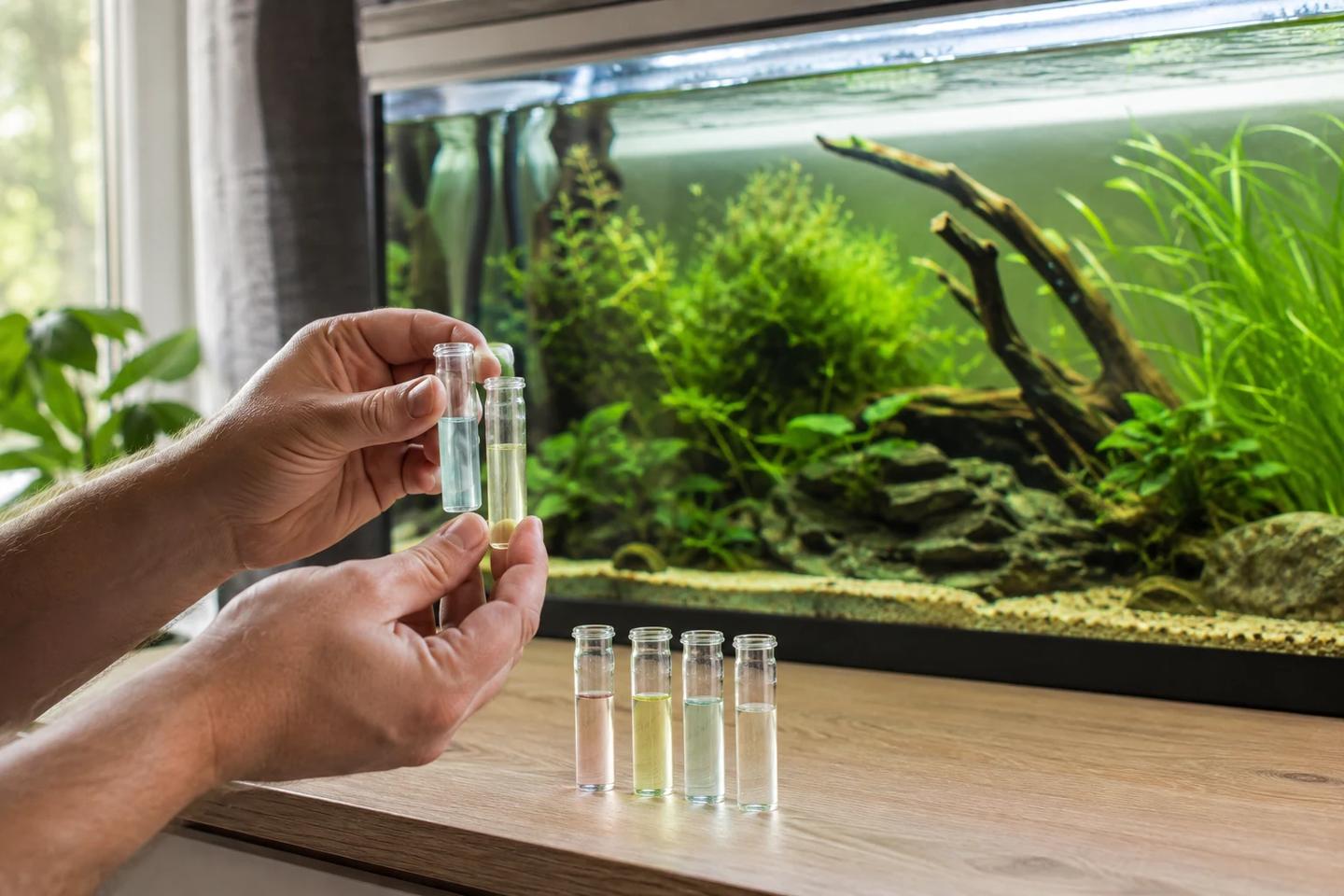
Aquarium Water Parameters: What to Test and Why

Clear water is not proof of safe water: ammonia, nitrite or disinfectant can be present without making an aquarium look dirty.
RSPCA fish environment guidanceThere is no universal set of perfect freshwater aquarium parameters. Identify the animals, learn what the test and unit actually report, establish your local source-water baseline, and compare repeat measurements. In an established aquarium, a confirmed ammonia or nitrite detection needs investigation; pH, GH, KH, temperature and nitrate decisions depend on the species, life stage and whole system.
Live stock
Water Care & Treatment for sale — see live stock & today’s prices
An aquarium water test does not produce a verdict. It produces a measurement that needs a name, unit, method and context. The same printed number can mean different things when one kit reports total ammonia nitrogen and another reports un-ionised ammonia, or when one nitrate result is expressed as nitrate and another as nitrate-nitrogen.
The safe starting point is therefore not a copied “perfect parameters” chart. It is a short chain of evidence: identify the animals, learn what the test actually reports, establish the source-water baseline, measure the aquarium consistently, confirm surprises, and only then decide whether to act.
- In an established freshwater aquarium, treat a confirmed detectable ammonia or nitrite result as a reason to investigate.
- Temperature, pH, GH, KH or alkalinity and nitrate must be assessed against the exact species, life stage, measured source water and whole system.
- Clear water can still be unsafe; visual appearance cannot rule out ammonia, nitrite, chlorine or low oxygen.[1]
- A large, rapid “correction” can add another stressor. Confirm the result and make the smallest justified change.
This guide concerns freshwater home aquariums. Marine and brackish systems use different chemistry, units and decision limits. It is also not a diagnosis, medication plan or substitute for an aquatic veterinarian.
Which aquarium water parameters should you test?
Testing priority depends on the aquarium. A new biofilter, a mature planted tank, a breeding setup and an aquarium with distressed fish do not need an identical schedule. The table below explains what each measurement can contribute without pretending that one value fits every fish.
| Measurement | What it tells you | Important limit | When it moves up the list |
|---|---|---|---|
| Temperature | The water temperature at that point and time | One reading may miss daily variation, heater error or warmer/cooler areas | New heater, heatwave, power interruption, water change or abnormal breathing |
| Chlorine/chloramine concern | Whether new source water needs appropriate treatment and verification | Supplier practice and test method matter; no conditioner brand or dose is universal | Every source-water change, supplier notice, unexplained post-change distress |
| Ammonia | A kit-specific ammonia result, often total ammonia nitrogen | NH3, NH3-N and TAN are not interchangeable; toxicity changes with pH and temperature | New tank, filter disruption, dead animal, overfeeding, sudden stock change or illness |
| Nitrite | Nitrite in the method's stated unit | Toxicity varies with species and water chemistry; chloride is a modifier, not a home dosing shortcut | Cycling, biofilter disruption, detectable ammonia, abnormal breathing or colour |
| Nitrate | One end product and trend within the nitrogen system | NO3 and NO3-N differ; no universal fish-safe ceiling applies to every system | Rising trend, source-water nitrate, heavy feeding, growth or breeding concern |
| pH | Acidity or alkalinity on a logarithmic scale | It is not GH or KH, and one sample may miss daily change | New source water, low buffering, CO2 use, unexplained toxicity or rapid change |
| GH | Mainly calcium and magnesium hardness in hobby use | Does not reveal every dissolved ion or buffering capacity | Choosing hard- or soft-water specialists, breeding or remineralising prepared water |
| KH/alkalinity | Acid-neutralising or buffering capacity | Hobby KH and laboratory alkalinity are related but not always identical reports | Low-buffer systems, pH instability, source-water or preparation changes |
| Dissolved oxygen | Oxygen available in the measured water at that time and place | Surface appearance and bubbles do not quantify it | Gasping, crowding, high temperature, power loss, night-time plant respiration or treatment |
| Conductivity/TDS | Broad change in dissolved ionic material | Cannot identify which substances are present and is not a direct GH or contaminant test | RO preparation, specialist breeding or detecting drift in a controlled routine |
The MSD Veterinary Manual recommends a fuller water analysis when fish are unwell and closer monitoring when ammonia or nitrite is detectable.[8][10] That is a triage principle, not permission to diagnose disease from one water number.
The unit warning that prevents false comparisons
Before comparing a result with a care sheet, copy the exact analyte and unit printed by the test or laboratory.
- TAN means total ammonia nitrogen: the combined nitrogen contribution of ionised ammonium and un-ionised ammonia in the sample.
- NH3 may mean un-ionised ammonia, while NH3-N means its nitrogen component. They are not the same numeric expression.
- NO2 and NO2-N, or NO3 and NO3-N, likewise use different molecular-versus-nitrogen reporting conventions.
- mg/L and ppm are often close in dilute freshwater, but that convenience does not repair an analyte mismatch.
- dGH/dKH and mg/L as CaCO3 require an explicit conversion and still describe different properties from pH.
Ammonia toxicity varies with pH, temperature and organism, which is why scientific criteria use more than one number.[11] A chart that omits the analyte, unit, pH and temperature is not safe evidence for waiting or dosing.
Do not copy “0.5 is safe” from a page unless it states 0.5 of what, in which unit, measured how, at what pH and temperature, for which animal. If your established tank shows a detectable ammonia or nitrite result, repeat the test correctly and investigate rather than shopping for the most reassuring chart.
UK tap water: use your postcode, not a regional map
UK water hardness reflects geology, but a county-coloured map only shows a broad pattern. The Drinking Water Inspectorate explicitly advises contacting the water company for accurate local hardness because results vary within regions.[2] Supplier testing results are available to customers, and Water UK's postcode service helps identify the responsible company.[3][4]
Use this postcode-to-tank workflow:
- Find the current supplier for the property's postcode.
- Download or request its current local water-quality report and note the sample area and date.
- Check the supplier's disinfectant information rather than assuming “the UK uses chlorine” or “London uses chloramine”. The DWI explains why chlorine is used, but supplier practice remains local.[5]
- Test a cold-water tap sample at the actual property with a suitable method. A building's plumbing, softener or storage arrangement can make that sample differ from a regional average.
- Record the aquarium result separately. Biological activity, substrate, décor, top-ups, food and water changes can change it.
Water Parameter Matcher
Enter your tap water readings to see if this species will thrive.
Open tool →Drinking-water compliance does not mean one water type suits every aquarium animal. The DWI's standards protect human drinking water; they are not fish nitrate, nitrite, pH or hardness targets.[7] Match verified animals to measured water, or create a controlled preparation plan for a genuine specialist need.
Ammonia, nitrite and nitrate: read the system, not three isolated colours
Fish and decomposing organic matter add nitrogen to the system. Biofilms in a functioning filter transform reduced nitrogen through nitrification, but the familiar sentence “Nitrosomonas turns ammonia into nitrite and Nitrobacter turns nitrite into nitrate” is too simple to describe every freshwater aquarium.
Aquarium-biofilter studies found different ammonia-oxidising groups and associated Nitrospira-like organisms with nitrite oxidation; later work also found ammonia-oxidising archaea important in the freshwater biofilters studied.[13][14][15] These papers support a diverse living biofilter, not a fixed four- or six-week completion promise.
If ammonia is detected
First repeat the test exactly as instructed: correct sample volume, reagent order, mixing, wait time, lighting and expiry. Then check the stated analyte and unit. Compare the aquarium with source water and look for a recent cause: a new or interrupted filter, loss of media, sudden stock increase, overfeeding, a dead organism, medication or a power failure.
If fish show breathing distress, collapse or marked behavioural change, make safety the priority: increase safe aeration or surface movement, stop adding food or chemicals while the cause is unclear, prepare appropriately conditioned temperature-compatible water, and seek competent aquatic help. The best immediate action depends on the confirmed result, species and system; this page cannot prescribe one percentage water change or conditioner dose.
If nitrite is detected
Use the same confirmation process and investigate the biofilter. Nitrite toxicity varies substantially between freshwater organisms, and chloride is an important modifier.[12] That scientific relationship does not justify adding an internet salt recipe: salt tolerance, existing chloride, plants, invertebrates and the actual nitrite result all matter. Raising KH does not directly erase a nitrite reading.
If nitrate is rising
Treat nitrate as a trend and system-management clue. Check whether the result is NO3 or NO3-N, compare it with source water, and review feeding, stocking, plant growth, detritus and water-change performance. There is no honest universal rule that “under 20 is ideal” or “under 40 is safe” for every fish, shrimp, egg, fry and aquarium.
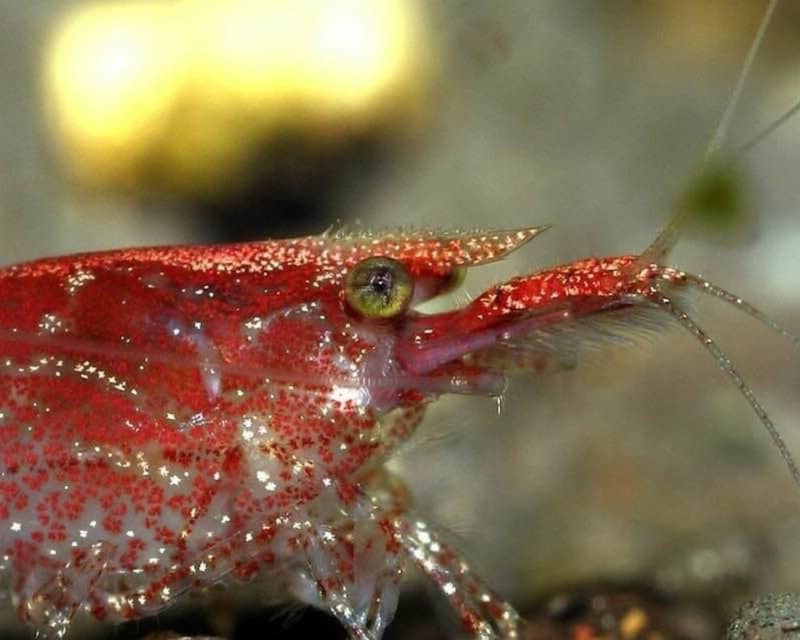
“Shrimp” is not one chemistry category: different taxa and life stages have different evidence limits, so use taxon-specific water checks instead of treating a broad shrimp label as a compatibility guarantee.
The fish-tank nitrogen-cycle guide explains the biological sequence in more depth. For a new aquarium, use a fishless preparation process rather than exposing animals to a test cycle; the first tropical tank guide covers that workflow.
Cycle Tracker
Log your daily ammonia, nitrite, and nitrate to track the nitrogen cycle.
Open tool →pH, GH and KH are connected questions—not interchangeable numbers
pH describes hydrogen-ion activity on a logarithmic scale. A one-unit shift is not a tiny linear step. GH is hobby shorthand for general hardness, largely calcium and magnesium. KH is commonly used for carbonate hardness and as a practical proxy for buffering; laboratories may instead report alkalinity. The DWI describes pH, hardness and alkalinity separately for good reason.[6]
Do not assume that all three always move together. Source treatment, natural geology, household softeners, substrates, rocks, acids and prepared water can break the familiar “hard water = high pH” pattern.
For a pH, GH or KH concern:
- Verify the exact species and life stage rather than using “community fish” as an identity.
- Measure source and aquarium water with the same documented method.
- Repeat at a comparable time; planted or CO2-managed systems can vary through the day.
- Check recent additions, top-ups, substrate, rocks, filter changes and prepared-water recipe.
- Prefer a gradual, repeatable source-water plan over dosing the display tank toward a single number.
A bottle labelled “pH up” or “pH down” does not tell you why pH differs or whether the fish need a change. Rapid movement can be harmful, and a one-off reading may be wrong or incomplete. Confirm pH, GH and buffering, then use species-relevant evidence before changing chemistry.[8]
Temperature and oxygen must be read together
Warm water holds less dissolved oxygen than cooler water under otherwise comparable conditions.[16] At the same time, temperature changes animal metabolism and ammonia toxicity. A heatwave, failed filter, power cut, medicine, crowded transport arrival or heavy night-time respiration can therefore change the risk even when yesterday's ammonia colour looked normal.
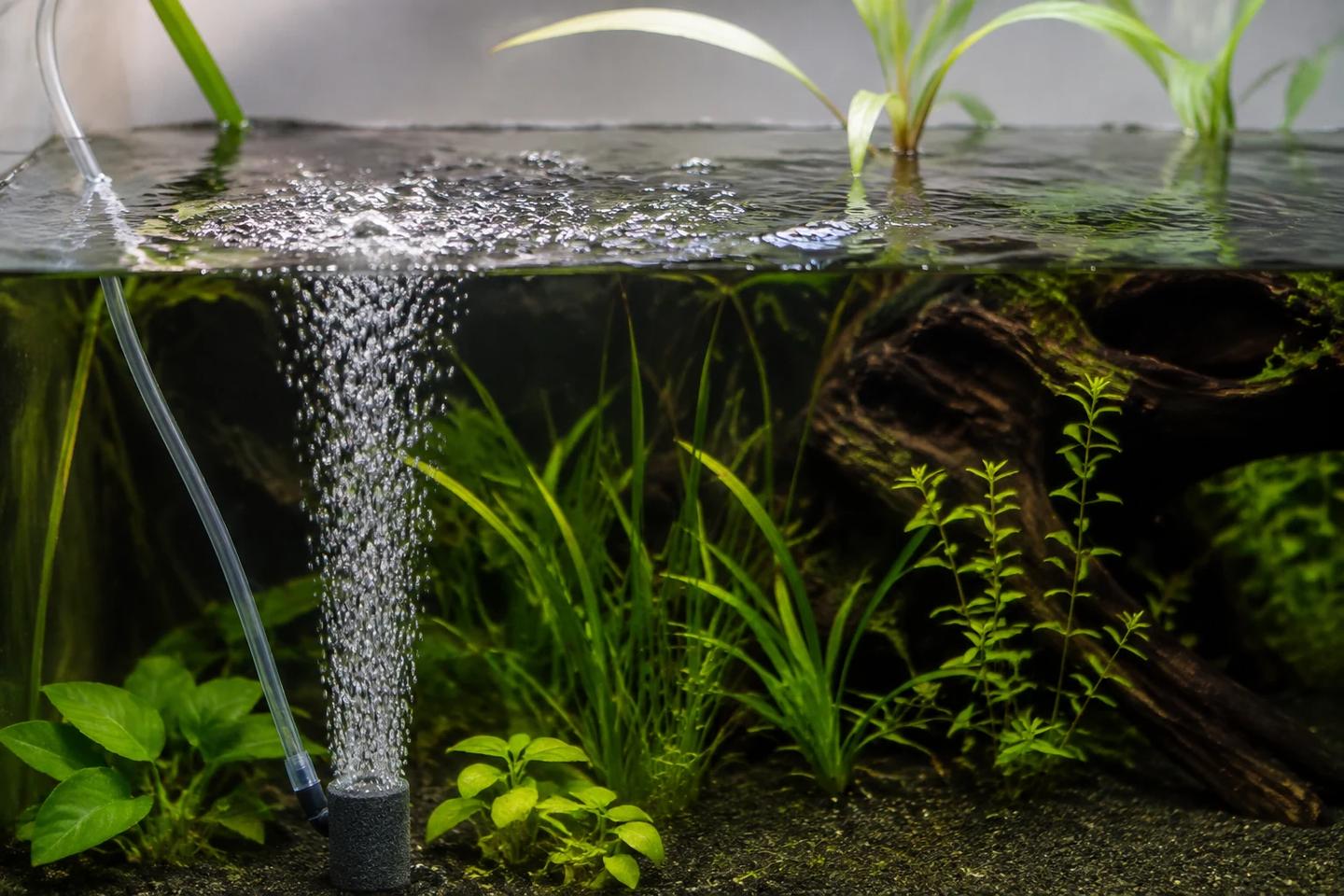
Surface ripples and bubbles can promote gas exchange, but they do not measure dissolved oxygen. If fish are gasping, several causes remain possible: low oxygen, gill damage, toxic nitrogen, disinfectant exposure, temperature stress or disease. Increase safe surface movement while checking equipment and water, but do not stop at “the air stone is on”.
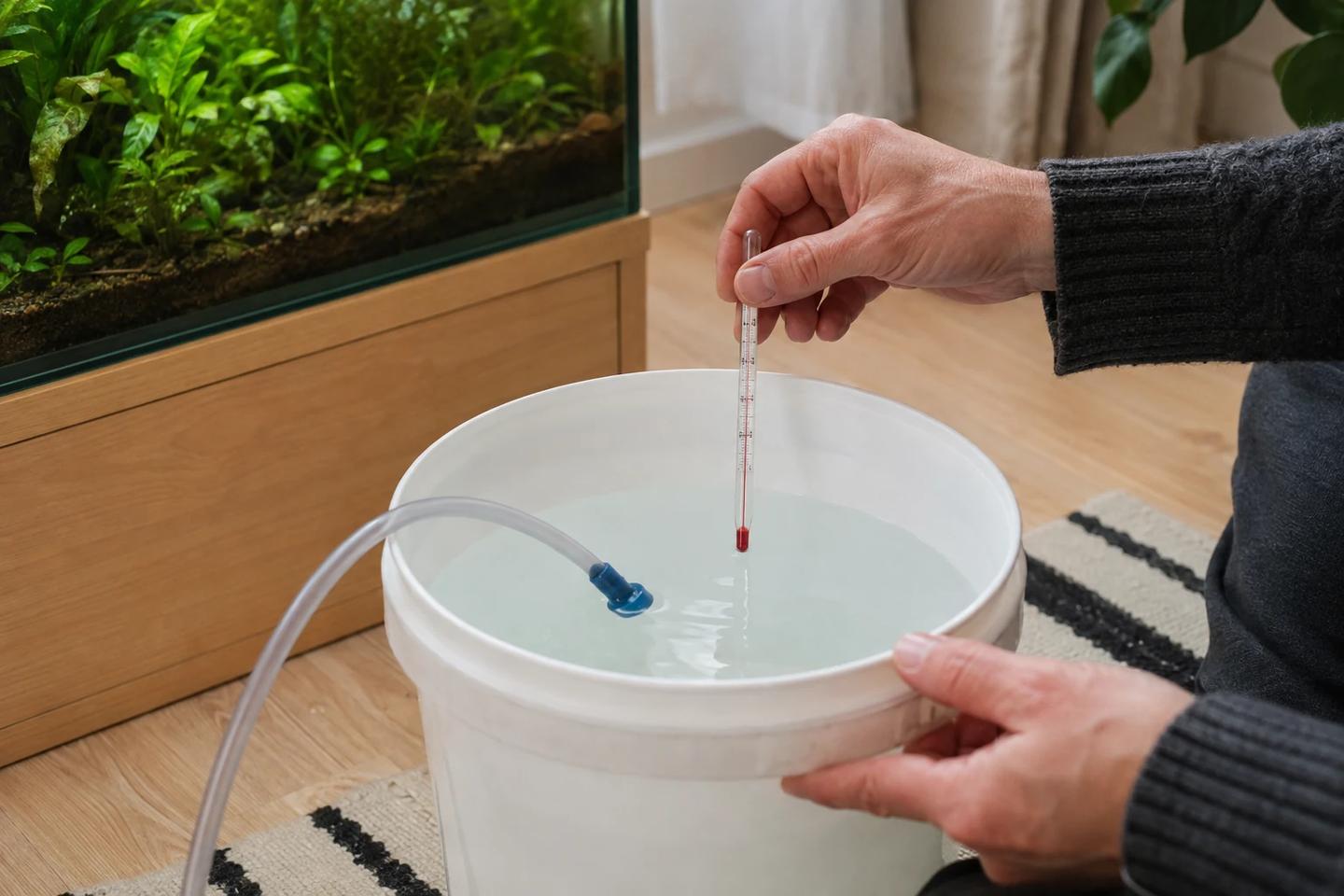
Record temperature at the time of every high-consequence ammonia result. If a heater display and a separate thermometer disagree, investigate the instruments rather than averaging them into a fictional value.
What a TDS meter can—and cannot—tell you
Most hobby “TDS meters” measure electrical conductivity and convert it to an estimated dissolved-solids value using an internal factor. Conductivity can correlate with dissolved solids, but the relationship varies with ionic composition.[17]
That means a TDS reading can be useful for detecting drift in a controlled, repeated process, such as preparing remineralised water. It cannot tell you whether the dissolved material is calcium, sodium, nitrate, conditioner or something else. It does not replace GH, KH, pH, ammonia, nitrite or contaminant-specific testing.
Top-offs deserve special attention: evaporated pure water leaves many dissolved substances behind. Replacing evaporation is not chemically equivalent to removing aquarium water and replacing it with prepared source water.
A repeatable testing method
The most useful test log needs only a few fields:
- aquarium and sample point;
- date and time;
- test brand or method and expiry date;
- exact analyte and unit;
- result, including “below method detection” rather than invented zero precision;
- temperature and pH when interpreting ammonia;
- recent water change, stock, feeding, filter, treatment or power event;
- fish behaviour and any action taken.
Test before changing several variables, then test again at a justified interval. If a result is surprising:
- Repeat it with clean equipment and fresh instructions.
- Check reagent expiry, storage, sample volume, timing and colour-light conditions.
- Test a known or source-water comparison where appropriate.
- Use a second suitable method or obtain competent laboratory or veterinary help when the consequence is high.
No format wins automatically. Liquid reagents can be expired, contaminated or misread; strips can be stored badly or used outside their range; digital probes need calibration and maintenance. The best method is one that measures the needed analyte over the relevant range and is used correctly.
How often should you test?
Use risk rather than a calendar slogan.
| Situation | Sensible focus |
|---|---|
| New or unproven biofilter | Ammonia and nitrite closely enough to avoid exposing animals; record pH and temperature context |
| Recently stocked or disrupted filter | Compare with the pre-change baseline and monitor for toxic-nitrogen movement |
| Stable established aquarium | Keep periodic baseline records and retest when animals, equipment, source water or routine changes |
| Heatwave or power failure | Temperature, aeration/flow, animal breathing and toxic nitrogen |
| Unwell or abnormal fish | Prompt broader water assessment plus competent diagnosis; do not infer disease from chemistry alone |
| Specialist prepared water | Every batch's relevant temperature, conductivity/TDS, GH, KH and pH before use |
Monthly, weekly or daily can each be too much or too little in the wrong context. The purpose is to catch a meaningful change while there is time to respond—not to collect numbers that never affect a decision.
Preparing replacement water without a universal recipe
For ordinary tap-water changes, establish the current local disinfectant practice and use a conditioner or treatment method whose current label covers it. Follow the exact label for the actual volume; this guide does not rank brands or invent a “double dose”. The RSPCA advises making tap water safe and testing aquarium water, while the DWI explains why disinfectants are present in supply water.[1][5]
Before the prepared water reaches animals, verify:
- the container is clean and dedicated to aquarium use;
- temperature is appropriately matched for the planned change;
- the disinfectant treatment is complete according to the current method;
- specialist GH, KH, pH or conductivity targets were reached by a repeatable process;
- no household softener or plumbing change has silently altered the source;
- the change volume is based on actual water, not the tank's box label.
Tank Volume Calculator
Enter length, width, and height to get your real water volume in litres.
Open tool →If reverse-osmosis water is genuinely needed, define the purpose first. Prepare and remineralise it consistently outside the aquarium, measure every batch, and keep a failure plan. Do not pour pure RO water into a populated freshwater aquarium or copy a 50:50 ratio without knowing both source-water chemistry and the animals' needs.
When a result needs urgent action
Seek prompt aquatic-veterinary or experienced specialist help when there is breathing distress, collapse, loss of balance, several animals affected, multiple deaths, a confirmed toxic-nitrogen result that persists, suspected disinfectant exposure, or uncertainty about a large chemistry change.
While arranging help:
- Check whether the heater, filter, return and aeration are operating safely.
- Increase safe surface movement if oxygen may be limited.
- Verify temperature, ammonia, nitrite and pH with stated units; compare source water when relevant.
- Stop adding food, buffers, salt, medicine or mixed remedies until their need and compatibility are clear.
- Prepare appropriately conditioned, temperature-compatible replacement water so an evidence-led change is possible.
- Record photos, behaviour, recent additions and every result for the person helping.
The MSD Veterinary Manual treats water history and analysis as central to assessing aquarium fish and warns against abrupt environmental change.[8][9] A normal-looking result on one kit does not rule out every environmental or medical cause.
A safer interpretation checklist
Before acting on any aquarium water parameter, ask:
- What exact substance or property was measured?
- Which unit and reporting convention does the result use?
- Was the method within date, range and instructions?
- Is the result confirmed?
- What changed before the result changed?
- How do source and aquarium water compare?
- Which exact species and life stages are exposed?
- Is anyone showing urgent signs?
- What evidence supports the proposed action?
- Can the change be made gradually, measured and reversed if it is wrong?
This approach is slower than reaching for a bottle, but faster than recovering from a chemistry swing. Use the references below to see which claims come from UK regulators, veterinary guidance, government science and aquarium-biofilter research. If a page, test label or seller gives a target without an analyte, unit or species context, ask for the missing information before relying on it.
Test, prepare and oxygenate aquarium water
Frequently asked questions
Shop everything in this guide
Shop all Water Care & Treatment
Shop Water Care & Treatment & related
From this care guide straight into our UK live-fish catalogue.
Fish Food
Tropical fish food for sale UK — pellets, flakes, frozen, live and freeze-dried from Tropical, Aquatropica and specialist brands.
Aquarium Lighting
Aquarium lighting for sale UK — Arcadia LED, T5 tubes, planted tank and reef systems. Grow light options for plant keepers.
Aquarium Filters & Pumps
Aquarium filters, pumps and flow equipment for sale UK — Aquael, internal, external, canister, powerhead and sump accessories.
Aquarium Accessories
Aquarium accessories and supplies UK — packaging, maintenance, vivarium and terrarium equipment from specialist brands. Careful UK dispatch.
Sources & further reading
Material factual claims cite the sources below; store policy and cautious inference are labelled in the article. Sources are grouped by type so you can judge their weight at a glance.
Peer-reviewed study (3)
- [13]Hovanec, T. A. & DeLong, E. F. (1996). Comparative analysis of nitrifying bacteria associated with freshwater and marine aquaria. Applied and Environmental Microbiology 62(8), 2888–2896. DOI: 10.1128/AEM.62.8.2888-2896.1996. View source
Primary aquarium-biofilter evidence that challenges a two-brand-name-bacteria account of nitrification.
- [14]Hovanec, T. A., Taylor, L. T., Blakis, A. & DeLong, E. F. (1998). Nitrospira-like bacteria associated with nitrite oxidation in freshwater aquaria. Applied and Environmental Microbiology 64(1), 258–264. DOI: 10.1128/AEM.64.1.258-264.1998. View source
Primary evidence for Nitrospira-like nitrite oxidation in sampled freshwater aquarium biofilters; not a promise about every filter or cycling time.
- [15]Sauder, L. A., Peterse, F., Schouten, S. & Neufeld, J. D. (2014). Temporal and spatial stability of ammonia-oxidizing archaea and bacteria in aquarium biofilters. PLOS ONE 9(12), e113515. DOI: 10.1371/journal.pone.0113515. View source
Primary evidence that ammonia-oxidising archaea were important in the freshwater aquarium biofilters studied. It does not identify the microbes in a reader's tank.
Veterinary reference (3)
- [8]Petty, B. D., Francis-Floyd, R. & Yanong, R. P. E.. Management of Aquarium Fish. MSD Veterinary Manual. View source
Veterinary guidance for history, complete water analysis, biofiltration and avoiding abrupt changes. It is not a remote diagnosis or a universal domestic-aquarium target table.
- [9]Petty, B. D., Francis-Floyd, R. & Yanong, R. P. E.. Environmental Diseases of Aquatic Animals in Aquatic Systems. MSD Veterinary Manual. View source
Supports toxicity context for ammonia, nitrite, chlorine and oxygen. Its broad reference values do not replace species, unit or system assessment.
- [10]MSD Veterinary Manual. A Summary of Water Quality Tests and Recommended Use. MSD Veterinary Manual. View source
Supports test selection and additional monitoring when toxic nitrogen is detected.
Animal-welfare charity (1)
- [1]Royal Society for the Prevention of Cruelty to Animals. Choosing an aquarium for pet fish. RSPCA. View source
UK welfare guidance for dechlorination, fishless cycling, routine testing, filtration and the fact that visual clarity does not establish water quality. Its standing-water wording is not converted into a universal chlorine or chloramine treatment rule.
Reference source (5)
- [2]Drinking Water Inspectorate. Water hardness: hard water. Drinking Water Inspectorate. View source
UK source for hardness definitions, geology and the warning that maps show typical rather than exact local hardness. Drinking-water information is not a fish-care range.
- [3]Drinking Water Inspectorate. Water testing. Drinking Water Inspectorate. View source
Supports obtaining local water-quality results from the responsible supplier. It does not describe the aquarium after storage, conditioning or biological use.
- [5]Drinking Water Inspectorate. Chlorine. Drinking Water Inspectorate. View source
Explains chlorine use in drinking-water supply. Supplier practice must be checked locally; the page does not approve an aquarium conditioner or dose.
- [6]Drinking Water Inspectorate. The physical and chemical properties of water. Drinking Water Inspectorate. View source
Definitions for pH, alkalinity and hardness. Drinking-water ranges are not repeated as aquarium targets.
- [7]Drinking Water Inspectorate. Drinking Water Standards and Regulations. Drinking Water Inspectorate. View source
Used only to distinguish human drinking-water standards from animal-specific aquarium limits.
Reference source (1)
- [4]Water UK. Find your supplier. Water UK. View source
Postcode route to the responsible UK water company; not an aquarium-care source.
Reference source (1)
- [11]United States Environmental Protection Agency (2013). Aquatic Life Ambient Water Quality Criteria for Ammonia—Freshwater. US EPA. View source
Scientific support that ammonia toxicity changes with pH, temperature and organism. Environmental criteria are not copied into a home-aquarium dose or threshold.
Reference source (1)
- [12]Kocour Kroupová, H., Valentová, O., Svobodová, Z., Šauer, P. & Máchová, J. (2018). Toxic effects of nitrite on freshwater organisms: a review. Reviews in Aquaculture 10(3), 525–542. DOI: 10.1111/raq.12184. View source
Supports species variation and chloride as an important modifier of nitrite toxicity. It does not justify an unsupervised aquarium salt recipe.
Reference source (2)
- [16]United States Geological Survey. Dissolved Oxygen and Water. USGS Water Science School. View source
Supports the relationship between water temperature and oxygen capacity. Natural-water context is used for the physical principle, not a domestic-aquarium target.
- [17]United States Geological Survey. National Water Conditions: Water-quality tables. USGS. View source
Supports the limited relation between specific conductance and dissolved solids. It does not make a TDS meter a composition test.
Spotted something that needs a fix?
Fishkeeping moves fast and we want every guide spot-on. If you think something here is wrong, out of date, or could be clearer, tell us — our team reads every message and updates the page.
Suggest an edit
Tropical Fish Co Editorial Team
Evidence-led aquarium editorial team
The Tropical Fish Co editorial team compiles care guidance from the sources cited on each page, separates published evidence from practical husbandry policy, and checks retail links against the current catalogue. First-hand experience is included only when a named contributor and the observation have been verified.
Keep exploring
Shop related
- Fish Food
Tropical fish food for sale UK — pellets, flakes, frozen, live and freeze-dried from Tropical, Aquatropica and specialist brands.
- Aquarium Lighting
Aquarium lighting for sale UK — Arcadia LED, T5 tubes, planted tank and reef systems. Grow light options for plant keepers.
- Aquarium Filters & Pumps
Aquarium filters, pumps and flow equipment for sale UK — Aquael, internal, external, canister, powerhead and sump accessories.
- Aquarium Accessories
Aquarium accessories and supplies UK — packaging, maintenance, vivarium and terrarium equipment from specialist brands. Careful UK dispatch.