
Celestial Pearl Danio Care Guide: Tank, Group and Water

Plan a mature, densely planted aquarium with at least a 45 × 30 cm base for a social group. Use 20–26°C, pH 6.5–7.5 and 5–15 dGH as published screening ranges, then hold a stable value inside the overlap for every animal in the tank.
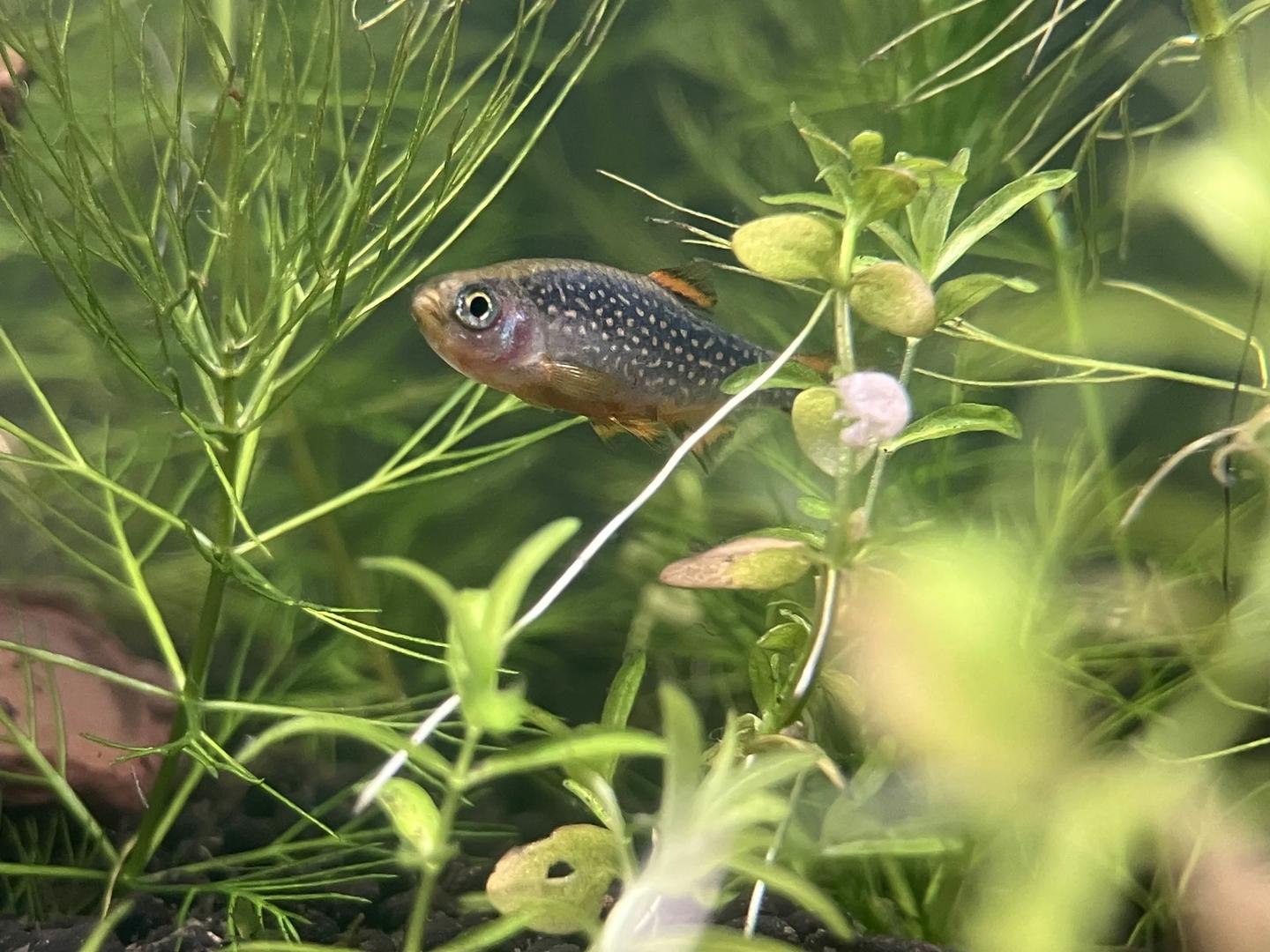
The fish sold as the galaxy rasbora was described in a new genus in 2007, then morphology and DNA evidence moved it into Danio in 2008; its familiar trade name survived both changes.
Read the taxonomy studyA 45 × 30 cm base (about 41 litres in the cited profile) is the useful space screen. Ten is Tropical Fish Co's cautious purchase floor, not a biological optimum; the cited profile favours larger groups and the aquarium must still fit the whole adult community.
For a celestial pearl danio group, plan a mature, densely planted aquarium with at least a 45 × 30 cm base. The cited specialist profile equates that footprint to roughly 41 litres and records 20–26°C, pH 6.5–7.5 and 5–15 dGH[6]. Those are screening ranges, not a target at every edge: choose stable conditions inside the overlap for the whole aquarium.
The scientific name is Danio margaritatus. “Galaxy rasbora” and “CPD” remain useful trade names, but this is a danio, not a true rasbora[1][3]. FishBase records a maximum of 2.1 cm standard length, which excludes the tail fin[5]. Its tiny body does not make a cramped pair or trio appropriate; social structure, male rivalry and feeding access still need space.
If the aquarium is ready and you are shopping rather than researching, use the live rasbora and danio shop. That page owns changing stock, sale units, prices and delivery choices. This evergreen guide does not promise that the photographed fish, a particular sex or any pack size is available today.
- Space: at least 45 × 30 cm base; add capacity for the complete adult community
- Water: 20–26°C, pH 6.5–7.5, 5–15 dGH as published screening ranges
- Group: social; ten is our cautious purchase floor, not a claimed optimum
- Layout: dense plants and broken sightlines, plus open feeding access
- Main risks: male-to-male sparring, food competition, unstable nano-tank water and unproven shrimp safety
Why is the galaxy rasbora now called Danio margaritatus?
Tyson Roberts described the species in 2007 as Celestichthys margaritatus, a new genus and species from pools near Hopong in Myanmar[2]. In 2008, Conway, Chen and Mayden compared skeletal characters and a 1,494-base-pair RAG1 gene dataset. Their analysis placed the fish within Danio and proposed the combination Danio margaritatus[3].
The current Catalog of Fishes accepts Danio margaritatus in Danionidae and retains the original name in its taxonomic history[1]. Older aquarium pages may still use Celestichthys, while shops use galaxy rasbora because customers recognise it. Both older names help identification; neither changes the care needs of the fish.
This history also explains why “pearl danio” alone is risky search language. The name can be confused with other danios. Confirm the complete scientific name—Danio margaritatus—on any listing.
What does the natural habitat actually tell us?
The original description reports shallow ponds, generally no more than about 30 cm deep, maintained by seepage or springs. Water was clear unless disturbed, dense submerged vegetation was present, and 22–24°C was measured during the January 2007 visit[2][5]. A later field survey describes the wider Hopong spring landscape and the pressure from road building and urban development[4].
These observations support a planted aquarium, sight breaks and moderate flow. They do not prove that 22–24°C is the only safe captive temperature, that every population has identical water, or that any fish in UK trade is wild caught. Likewise, a shallow wild pool is not evidence that a shallow, unstable desktop aquarium is suitable; glass boxes lack the scale, constant inflow and ecological complexity of a spring field.
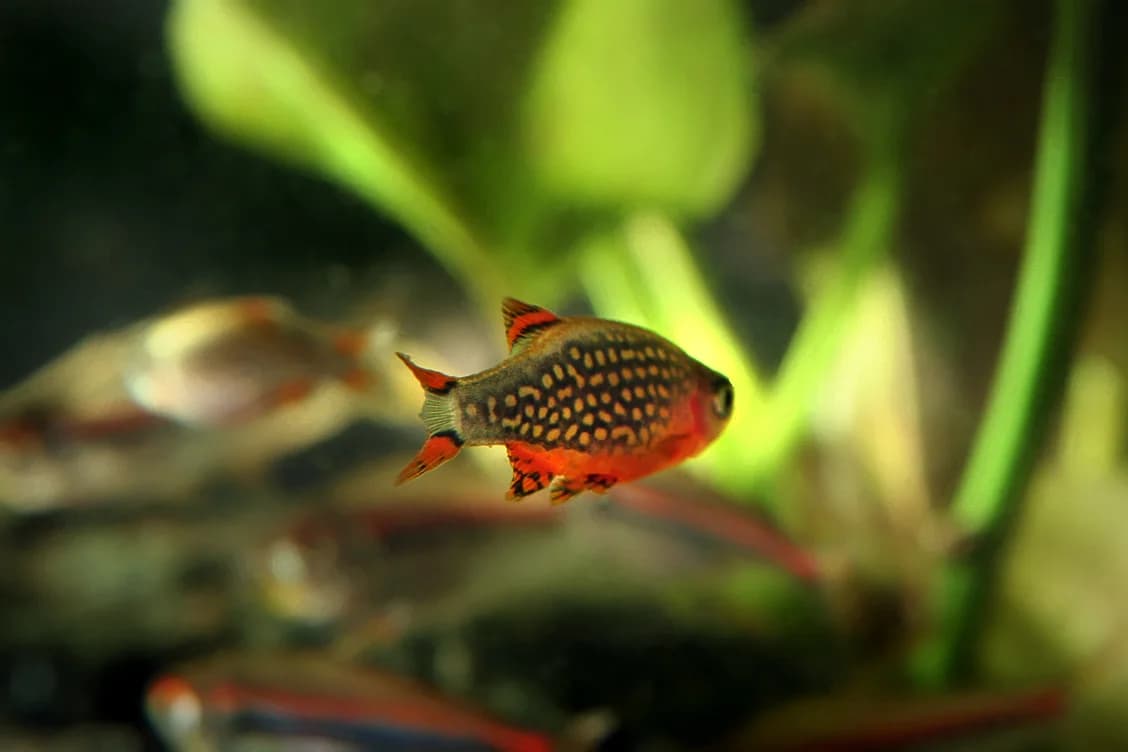
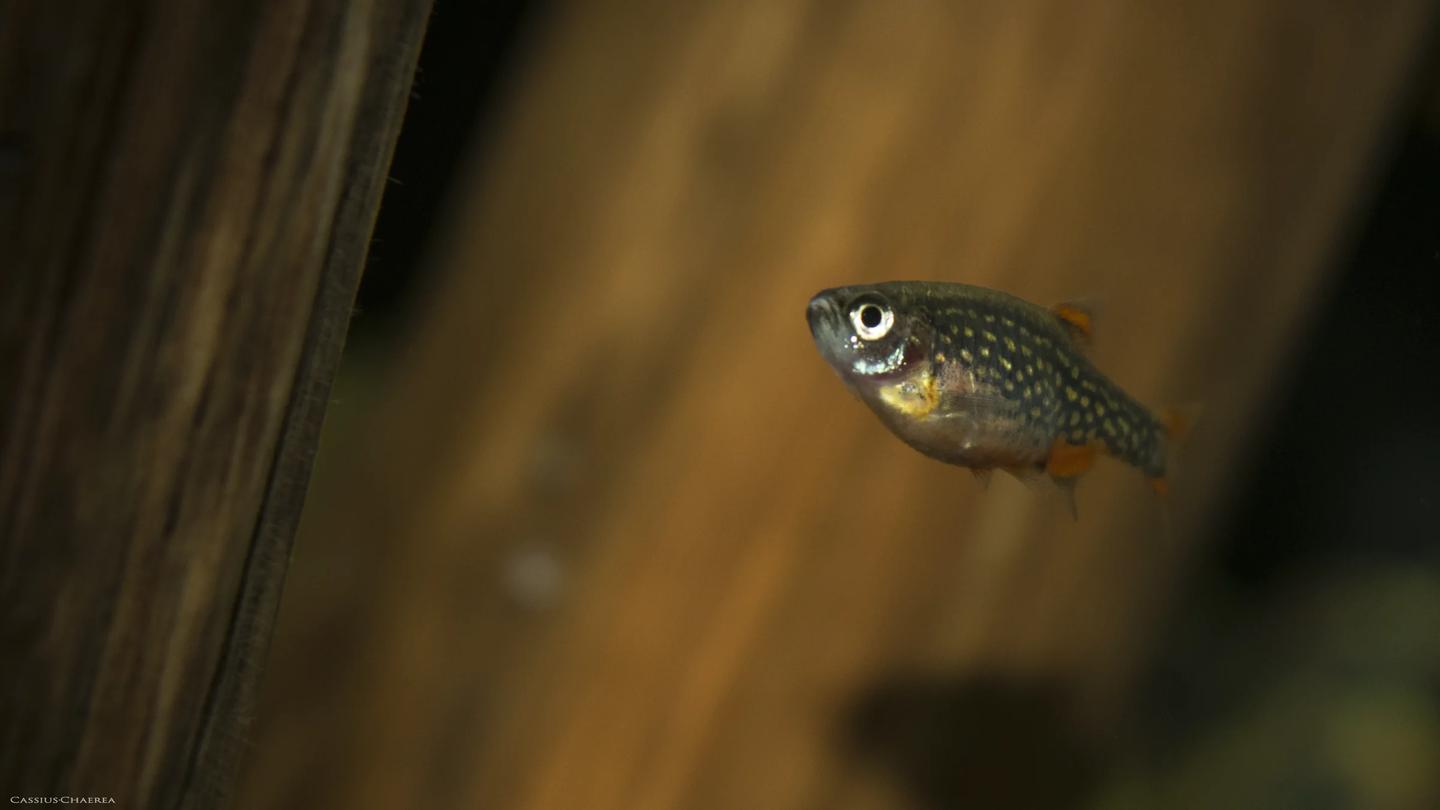
The white-to-cream spots and banded fins inspired the “galaxy” and “pearl” names, but colour varies with sex, condition, line and lighting. Do not reject a newly transported fish or diagnose disease from colour alone.
How much aquarium space does a CPD group need?
Use 45 × 30 cm as the minimum base dimension for a species group. The cited profile gives approximately 41 litres for that footprint and explains that dominant males may be combative[6]. A taller tank with the same litres can provide less useful horizontal area, while decor can reduce usable space.
Before buying, check all five:
- The aquarium is fully cycled and can hold ammonia and nitrite at zero.
- The base is at least 45 × 30 cm after allowing for internal equipment.
- Plants and hardscape break long sightlines without blocking the feeding area.
- Filtration suits the entire adult stocking, not just the CPDs.
- There is a spare cycled separation option if one fish is repeatedly targeted.
RSPCA guidance emphasises cycling, filtration, temperature control and routine testing before fish are added[7]. Nano aquariums can change quickly, so “small fish” is not the same as “low-maintenance water.”
Stocking Calculator
Check if your tank can support this species at a healthy bioload.
Open tool →How should a celestial pearl danio aquarium be arranged?
Dense planting is useful because it creates cover and divides the aquarium into small visual territories. Include fine-leaved areas, taller background growth and some open water where food can be seen. Floating plants can soften overhead light, but keep enough surface movement for gas exchange and enough access for maintenance.
A dark substrate can make pale spots easier for people to see, but it is an aesthetic choice, not a health treatment. Choose aquarium-safe materials that can be cleaned and that do not force the water outside the intended range. Gentle filtration is usually easier for these small fish to negotiate than a concentrated jet; distribute flow rather than leaving stagnant areas.
Observe behaviour after every layout change. More cover may help a nervous group, but a fish that remains isolated, breathes rapidly, clamps its fins or refuses food still needs a water-quality and health check. “Hiding” is a behaviour, not a diagnosis.
What water and temperature are suitable in the UK?
The species profile reports 20–26°C, pH 6.5–7.5 and 5–15 dGH[6]. Keep a stable point inside those ranges that also suits every tank mate. Never chase an exact pH with rapid chemical additions, and do not move a fish abruptly from the seller's water to a distant value just because both numbers appear inside a broad range.
UK tap water is not one chemistry. The Drinking Water Inspectorate directs consumers to their local supplier for source-water information[8]. Ask the seller for measured holding-water temperature, pH and hardness, check your own tap and aquarium, then plan a gradual acclimation method appropriate to the verified difference.
Do they need a heater?
Measure the water through the coldest overnight period and during hot weather. A centrally heated room is not a thermostat for an aquarium. A correctly sized, guarded thermostatic heater may be needed to prevent drops; in a reliably warm room it may operate rarely. Use an independent thermometer and have a summer cooling plan because a heater cannot protect against overheating.
Water Parameter Matcher
Enter your tap water readings to see if this species will thrive.
Open tool →How many celestial pearl danios should live together?
They are gregarious, but “peaceful shoaling fish” hides an important detail: rival males display and may spar or nip within the group. The specialist profile recommends buying as many as the setup can properly support and says groups of 20 or more can spread aggression and make the fish bolder[6].
Tropical Fish Co uses ten as a cautious purchase floor, not as a scientific optimum. Do not reduce the group to force the species into a small aquarium, and do not double the group merely because a care page says larger can be better. More fish also mean more waste, feeding competition and demand for retreat space.
Watch individuals rather than the group silhouette. Repeated pursuit, torn fins, a fish excluded from food or one animal pinned into a corner means the social arrangement is failing. Add sight breaks only if water and space remain adequate; otherwise separate the aggressor or victim.
What do celestial pearl danios eat?
Their mouths are small and they often feed below the surface. The cited profile recommends suitably sized dried food alongside small live or frozen foods such as Daphnia and Artemia rather than an exclusively dry diet[6].
Use particle size the fish can swallow and offer food where it reaches their feeding zone. In a community aquarium, faster surface fish can consume the ration before CPDs approach. Observe that every individual eats, remove uneaten food before it degrades, and adjust quantity from body condition and water tests rather than a fixed “one minute” rule.
Biofilm and small organisms in a mature planted aquarium may provide grazing opportunities, but they are not proof of a complete diet. Colour-enhancing claims on food packaging also do not diagnose nutrition or guarantee red fins.
Which tank mates are suitable—and are shrimp safe?
There is no universal “safe tank mate” list. Screen candidates for adult size, temperature and hardness overlap, swimming and feeding speed, territorial behaviour and the space used by the whole adult group. Avoid fish able to swallow CPDs and fish that repeatedly chase or outcompete them. A species-focused CPD aquarium is a complete option, not a failure to build a community.
Shrimp compatibility needs especially honest wording. An adult cherry shrimp may be too large for a CPD to swallow, but shrimplets, eggs and newly moulted shrimp can be vulnerable. Plants and moss provide refuge; they do not create a zero-loss breeding colony. A photograph of a fish and shrimp in one aquarium would prove only that they shared the frame at that moment.
If breeding shrimp is the priority, keep the nursery fish-free. If a mixed display is the priority, accept predation risk, provide cover and monitor both animals. Any new pairing needs a ready separation plan.
How can males and females be distinguished?
The specialist profile describes males as generally steel-to-deep blue with stronger red-and-black fin markings. Females tend to show a blue-green base, less intense fin colour, rounder form when mature and a different distribution of body spots[6]. The original description also documents colour differences between its measured males and females[2].
Use those as comparison features, not a guarantee from one glance. Juveniles, stressed arrivals, non-breeding adults and domestic lines may not match a textbook photograph. A retailer should not promise sex from colour alone when the evidence is unclear.
The gallery image labelled male by its photographer shows one spotted-fin pattern. It does not establish how every male should look or prove the sex of a separate shop fish.
How do celestial pearl danios breed?
They are egg-scattering spawners and provide no parental care. Specialist observations describe mildly adhesive eggs placed among fine plants or spawning material; adults may eat eggs they find. Incubation and time to free swimming vary with temperature, and newly free-swimming fry need extremely small first foods[6].
Breeding is not automatically “easy.” A spawn can occur in a mature planted display, but seeing eggs is different from raising healthy juveniles. A separate, cycled rearing container reduces predation, while small volumes increase the risk of unstable temperature and waste. Prepare live or appropriately graded first food before attempting a spawn, and avoid repeated handling or aggressive conditioning schedules.
Do not use fry production to justify crowding adults or to assume a self-sustaining population. Track welfare, water quality and homes for offspring first.
What should you do if a CPD hides, fades or becomes ill?
Start with observations and measurements: temperature, ammonia, nitrite, nitrate trend, pH stability, recent additions, appetite, breathing, faeces, skin, fins and which fish are affected. Similar signs can result from water problems, social pressure, parasites, infection, injury or transport stress.
Do not automatically raise the temperature or give a half dose of a random medicine. Treatment depends on the diagnosis, the active ingredient, the product label, the water volume and the other animals present. MSD Veterinary Manual guidance puts water quality and a full history at the centre of aquarium-fish investigation[9].
Quarantine new fish in a separate, suitable, established system when practical. If signs persist, worsen, spread or include severe breathing difficulty, ulcers, loss of balance or repeated deaths, seek a fish-experienced veterinary professional. OATA provides a UK fish-vet finder[10].
What should you check before buying?
Use this purchase screen rather than buying from colour alone:
- confirm the listing says Danio margaritatus, not only “pearl danio”;
- confirm the sale unit and whether it supports a responsible social group;
- ask for current holding-water temperature, pH and hardness;
- compare your 45 × 30 cm-or-larger mature aquarium with the whole planned stocking;
- confirm every resident fits the same stable water window;
- plan small food and a way to verify that slower individuals eat;
- accept that shrimp fry are not guaranteed safe;
- check the delivery date, live-arrival terms and your availability to receive the parcel;
- prepare a suitable quarantine or separation option before dispatch.
Then use the live rasbora and danio shop for current products. Editorial photographs illustrate source-labelled fish; they are not current inventory or a promise of sex, colour, size or condition.
Which common claims did this guide reject?
| Common claim | Evidence-led correction |
|---|---|
| “They only need 30 litres” | The cited footprint is 45 × 30 cm, roughly 41 litres; usable base area and total stocking matter. |
| “Any group of six is enough” | They are social and males may spar. Ten is our cautious floor; the cited profile favours larger groups where space allows. |
| “They are shrimp-safe” | No fish creates a zero-risk shrimp nursery; shrimplets and vulnerable animals may be eaten. |
| “UK tap water is perfect for them” | UK water varies. Check the local supplier, aquarium tests and seller's measured water. |
| “They never need a heater” | Decide from measured aquarium temperature, including overnight lows—not room assumptions. |
| “Raise heat and use half-dose medicine for white spots” | Diagnosis and labelled treatment come first; heat or arbitrary under-dosing can be harmful. |
| “They live exactly five years” | The selected evidence does not establish one dependable captive lifespan. |
| “Galaxy rasbora is a different species” | It is the familiar trade name for Danio margaritatus. |
How this guide was checked
Current nomenclature follows the Catalog of Fishes. The original 2007 description supports morphology, measurements and type-habitat observations; the 2008 Zootaxa study supports the move into Danio. FishBase is used for its labelled 2.1 cm standard-length record, and Seriously Fish supplies bounded aquarium guidance. UK cycling, water and health statements are separated into RSPCA, Drinking Water Inspectorate, MSD Veterinary Manual and OATA evidence.
Search Console and GA4 informed the page's wording and intent but not its biological facts. “Celestial pearl danio care” remains the informational focus; live stock belongs to the shop. If you spot an error or have stronger primary evidence, use the visible Suggest an edit route. Editorial feedback is not counted as a lead, add-to-cart event or purchase.
Celestial pearl danio form and planted-tank context
Frequently asked questions
Sources & further reading
Material factual claims cite the sources below; store policy and cautious inference are labelled in the article. Sources are grouped by type so you can judge their weight at a glance.
Peer-reviewed study (3)
- [2]Roberts, T. R. (2007). The 'celestial pearl danio', a new genus and species of colourful minute cyprinid fish from Myanmar. Raffles Bulletin of Zoology 55(1):131–140. View source
Original description, type locality, measured specimens, morphology, colour differences and observed habitat; not a captive-care experiment.
- [3]Conway, K. W.; Chen, W.-J. & Mayden, R. L. (2008). The 'Celestial Pearl danio' is a miniature Danio (s.s.): evidence from morphology and molecules. Zootaxa 1686:1–28. DOI: 10.11646/zootaxa.1686.1.1. View source
Morphological and RAG1 evidence supporting the Danio combination; not husbandry guidance.
- [4]Kano, Y. et al. (2022). Fish diversity of a spring field in Hopong Town, Taunggyi District, Shan State, Myanmar. Biodiversity Data Journal 10:e80101. DOI: 10.3897/BDJ.10.e80101. View source
Modern field survey of Hopong spring habitats and conservation context; not proof that a shop fish was collected there.
Scientific database (1)
- [5]Froese, R. & Pauly, D. (eds.). Danio margaritatus. FishBase. View source
Compiled record for 2.1 cm maximum standard length, Myanmar distribution and original shallow-pond observations. It does not supply a lifespan or community-stocking guarantee.
Veterinary reference (1)
- [9]MSD Veterinary Manual. Management of aquarium fish. MSD Veterinary Manual. View source
Veterinary reference for water-quality-led investigation, history, quarantine, diagnosis and targeted treatment; not remote diagnosis for one fish.
Animal-welfare charity (1)
- [7]Royal Society for the Prevention of Cruelty to Animals. Choosing an aquarium for pet fish. RSPCA. View source
UK welfare guidance for cycling, filtration, testing, heating and stable aquarium preparation; not species-specific CPD parameters.
Trade-body guidance (1)
- [10]Ornamental Aquatic Trade Association. Find a fish vet. OATA. View source
UK route for locating fish-health help; it is not a diagnosis service.
Reference source (1)
- [1]Fricke, R.; Eschmeyer, W. N. & Van der Laan, R. (eds.). Catalog of Fishes: Danio margaritatus. California Academy of Sciences. View source
Current accepted combination, family, type locality and freshwater distribution; not aquarium-care guidance or proof of retail provenance.
Reference source (1)
- [6]Seriously Fish editorial team. Celestichthys margaritatus — Celestial Pearl Danio. Seriously Fish. View source
Species-specific aquarium footprint, water, diet, social, sexing and reproduction guidance. Its genus treatment differs from the current Catalog of Fishes combination, so Danio controls here.
Reference source (1)
- [8]Drinking Water Inspectorate. Water hardness / hard water. Drinking Water Inspectorate. View source
UK source-water context and route to the local water supplier; tap-water information does not replace aquarium testing.
Spotted something that needs a fix?
Fishkeeping moves fast and we want every guide spot-on. If you think something here is wrong, out of date, or could be clearer, tell us — our team reads every message and updates the page.
Suggest an edit
Tropical Fish Co Editorial Team
Evidence-led aquarium editorial team
The Tropical Fish Co editorial team compiles care guidance from the sources cited on each page, separates published evidence from practical husbandry policy, and checks retail links against the current catalogue. First-hand experience is included only when a named contributor and the observation have been verified.
Keep exploring
Care guides
- Harlequin Rasbora Care Guide
Harlequin rasbora care for UK aquariums: check 60 cm tank length, group size, 5 cm adult size, water, tank mates and lookalike species before buying.
- Otocinclus Catfish Care: Tank Size, Food & Groups
Otocinclus catfish care for UK tanks: compare tank size, 22–25°C water, group planning, grazing foods, algae limits, tank mates and buying checks.
- Pleco Fish Guide: Types, Adult Size, Food & Tank Planning
Pleco fish guide for UK keepers: compare types, adult sizes, diets, tank planning, water and buying checks before choosing a suckermouth catfish.
Related care guides
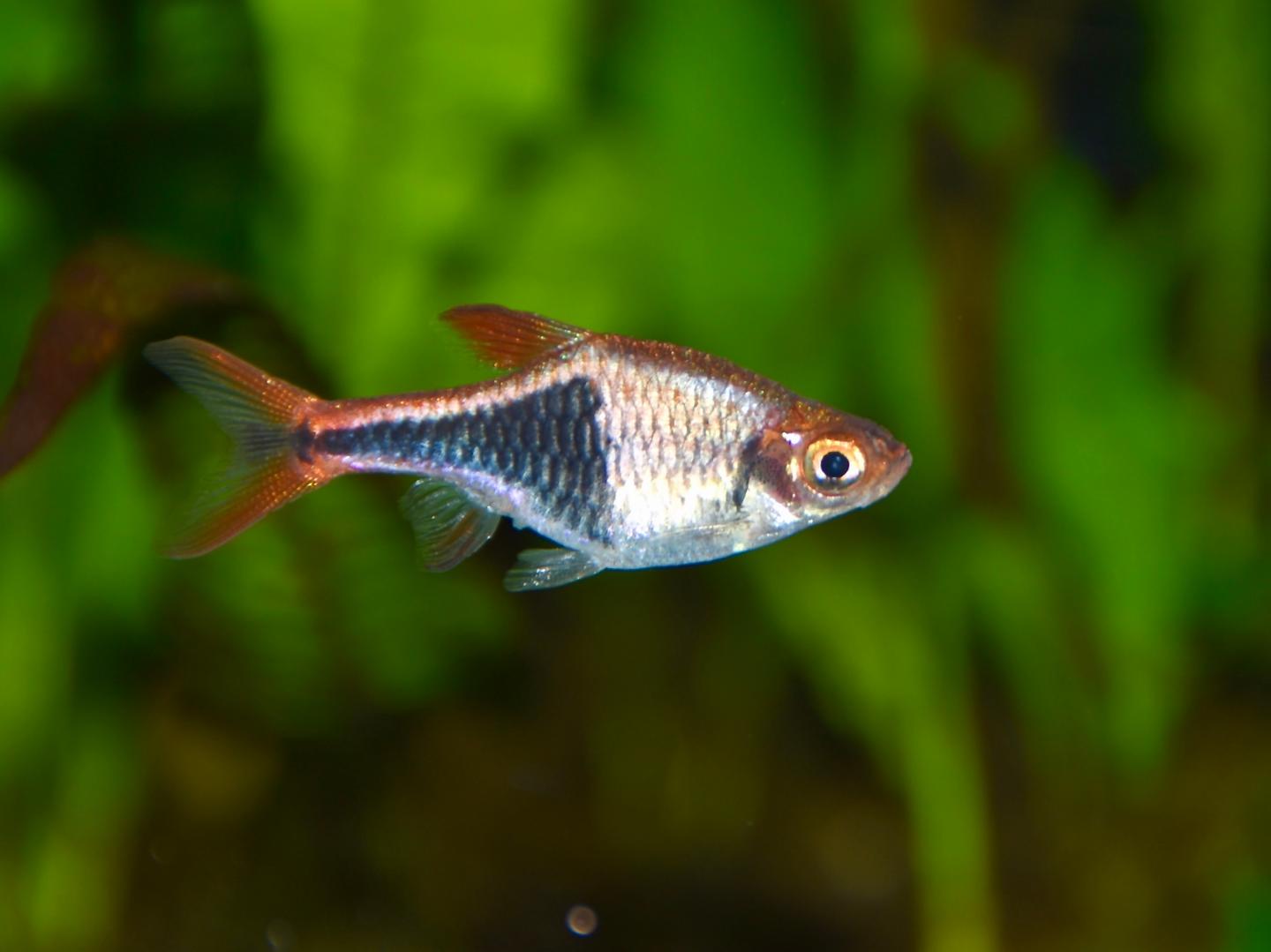
Harlequin Rasbora Care Guide
Our conservative starting policy is a mature, filtered aquarium at least 60 cm long and about 60 litres, eight or more fish, and measured water screened against 22-25 °C, pH 5-7 and 5-12 dGH.
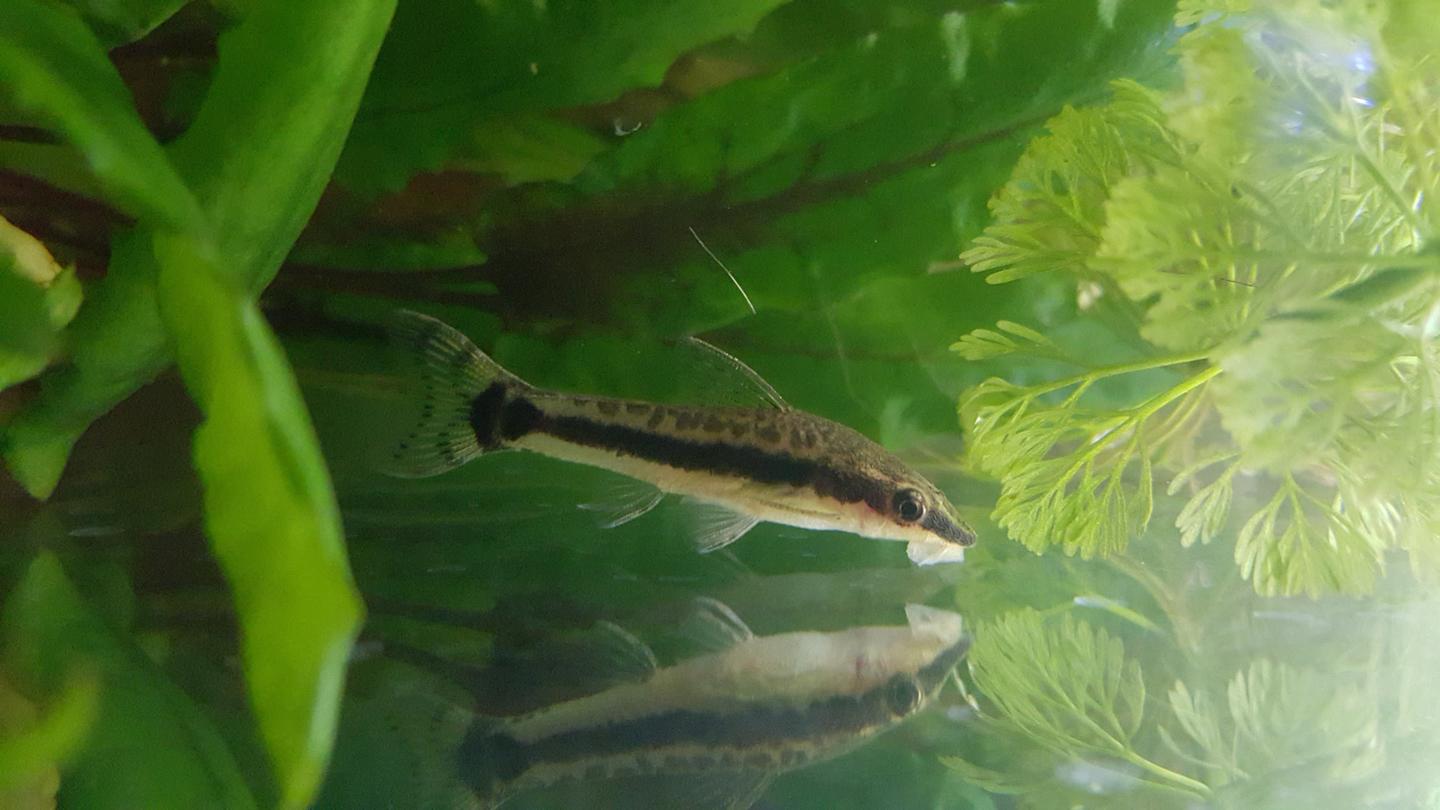
Otocinclus Catfish Care: Tank Size, Food & Groups
Otocinclus are small South American loricariid catfish, not disposable algae cleaners. Confirm the supplied species where possible; start with a mature, stable aquarium with ample grazing surfaces; plan a compatible social group; and provide suitable food even when algae is visible.
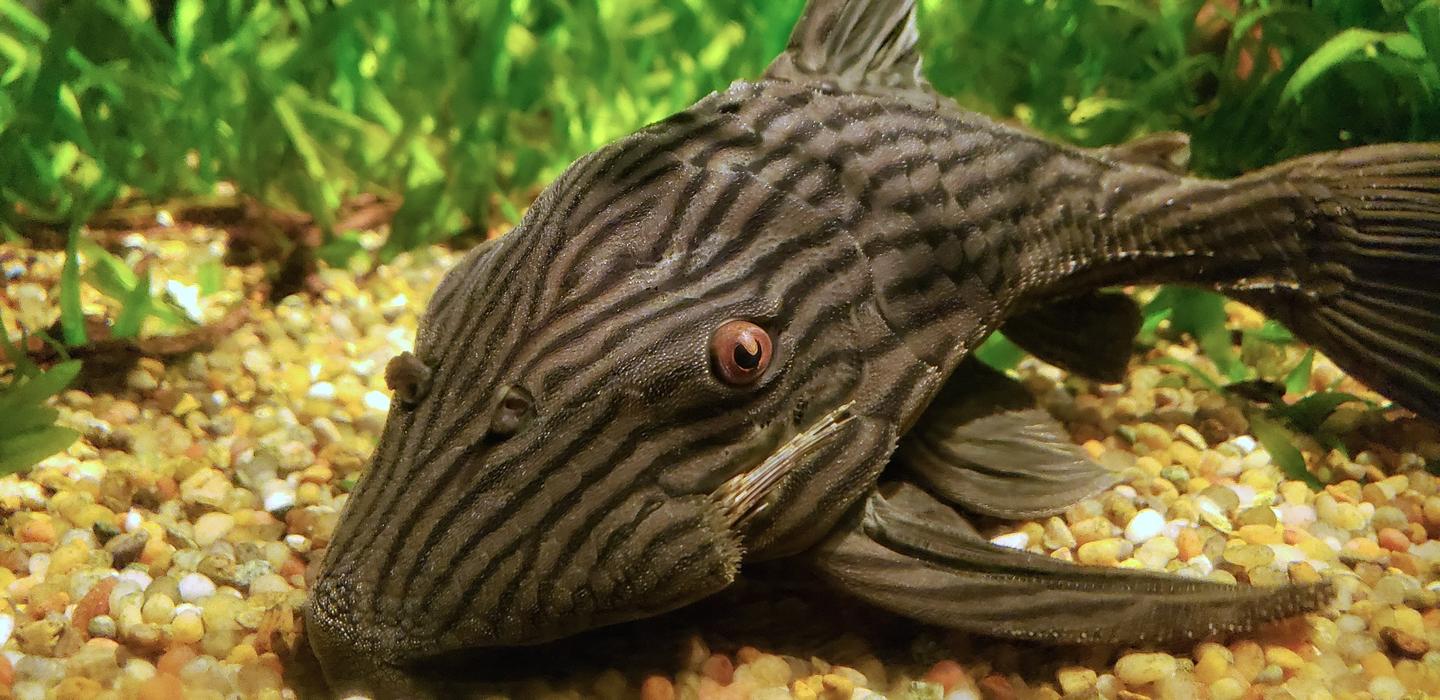
Pleco Fish Guide: Types, Adult Size, Food & Tank Planning
‘Pleco’ is a loose aquarium-trade label, not one species or one care sheet. Before buying, confirm the scientific name or defensible L-number, adult size and measurement method, required footprint, temperature and water, diet, social plan and source. No universal pleco tank size, menu or algae result is honest.