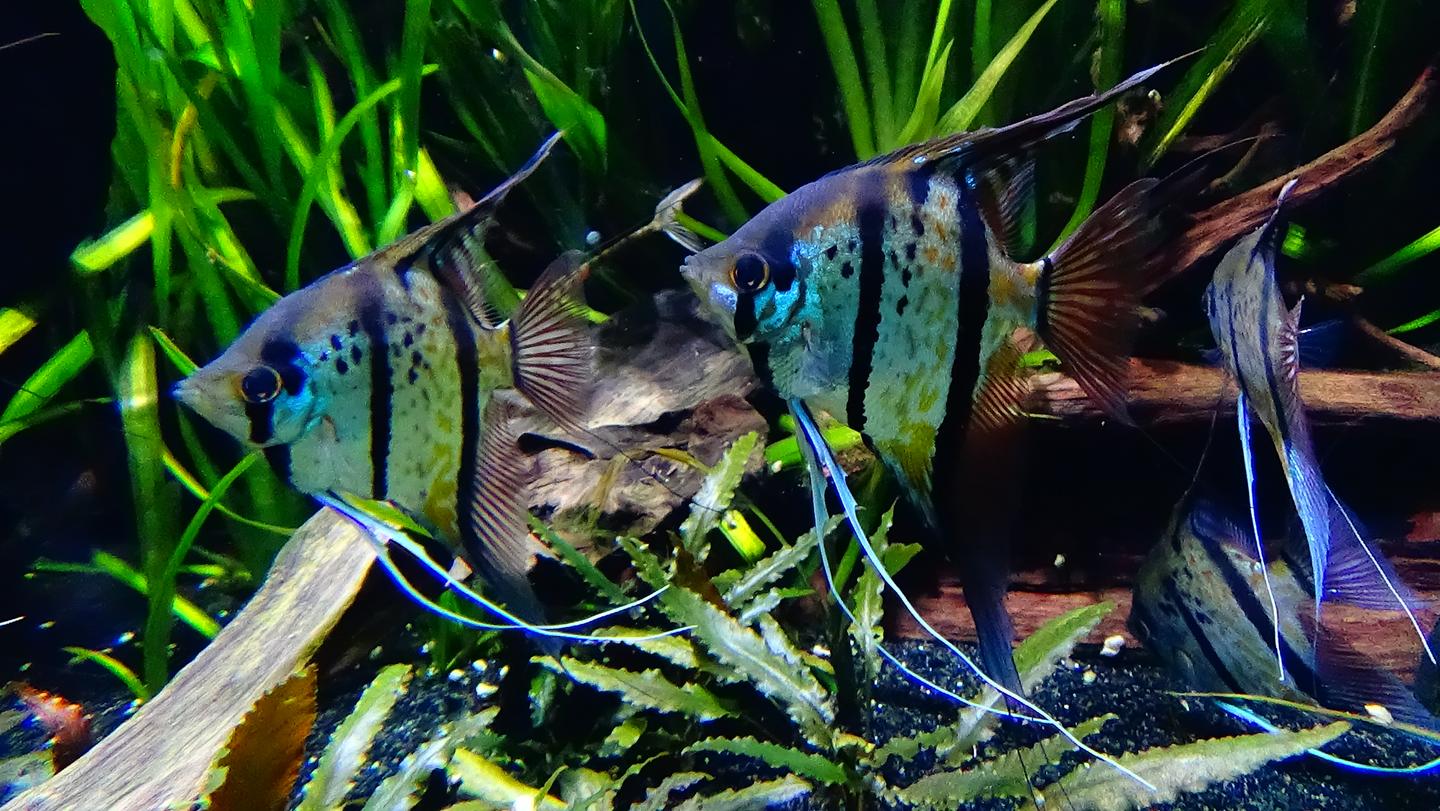
Cichlids: Types, Care & Tank Planning

Cichlids are a family of roughly 1,800 accepted species, not one care type. Before buying, identify the exact species and source, then compare adult measurement, usable tank dimensions, social system, territory, tested water, diet and an exit plan. No family-wide minimum tank, water range or tank-mate list is safe.
Cichlids are not one kind of aquarium fish. Cichlidae contains roughly 1,800 accepted species, spanning tiny shell-associated fish, open-water feeders and much larger territorial species[2]. A family-wide temperature, tank size, diet or tank-mate list will therefore be wrong for part of the family.
This page is the decision map: identify the exact species first, then build its care plan from species-level evidence. Current stock, sale sizes and prices stay on the relevant shop page rather than being frozen into this guide. After completing the care screen, use the African cichlid shop or South American cichlid shop for current availability.
- Get the exact scientific or precise trade identity and source.
- Compare the fish's measured adult size, noting whether a source uses standard length (SL) or total length (TL).
- Plan the complete social unit, territory and exit route, not one juvenile.
- Test your source and aquarium water; do not infer it from a UK region.
- Match the diet to the species, and verify what the actual fish is already eating.
What type of fish are cichlids?
Cichlids are mostly freshwater fishes in the family Cichlidae. FishBase records a very broad distribution and wide differences in size and ecology; Eschmeyer's Catalog is the nomenclatural authority when accepted names change[2][1]. Aquarium labels such as “African cichlid”, “dwarf cichlid” or “assorted cichlid” are starting points, not identities.
The family is famous for parental care, but even that is not one behaviour. Comparative research records substrate guarding and mouthbrooding, care by females, males or both parents, and multiple mating systems[13][14]. It is inaccurate to say that all cichlids pair for life, all females mouthbrood, or all parents behave alike.
Four cichlid types that should not share one recipe
These examples are deliberately different. The figures describe records in the cited sources; they are not a mixed-tank proposal or a substitute for a complete species guide.
| Example | What the cited record establishes | Planning consequence |
|---|---|---|
| Bolivian ram (Mikrogeophagus altispinosus) | South American identity; 5.6 cm maximum SL in the current record; 22–26 °C; substrate eggs with parental care[3] | A relatively small body does not answer pair compatibility, floor territory, community fit or source-water questions. |
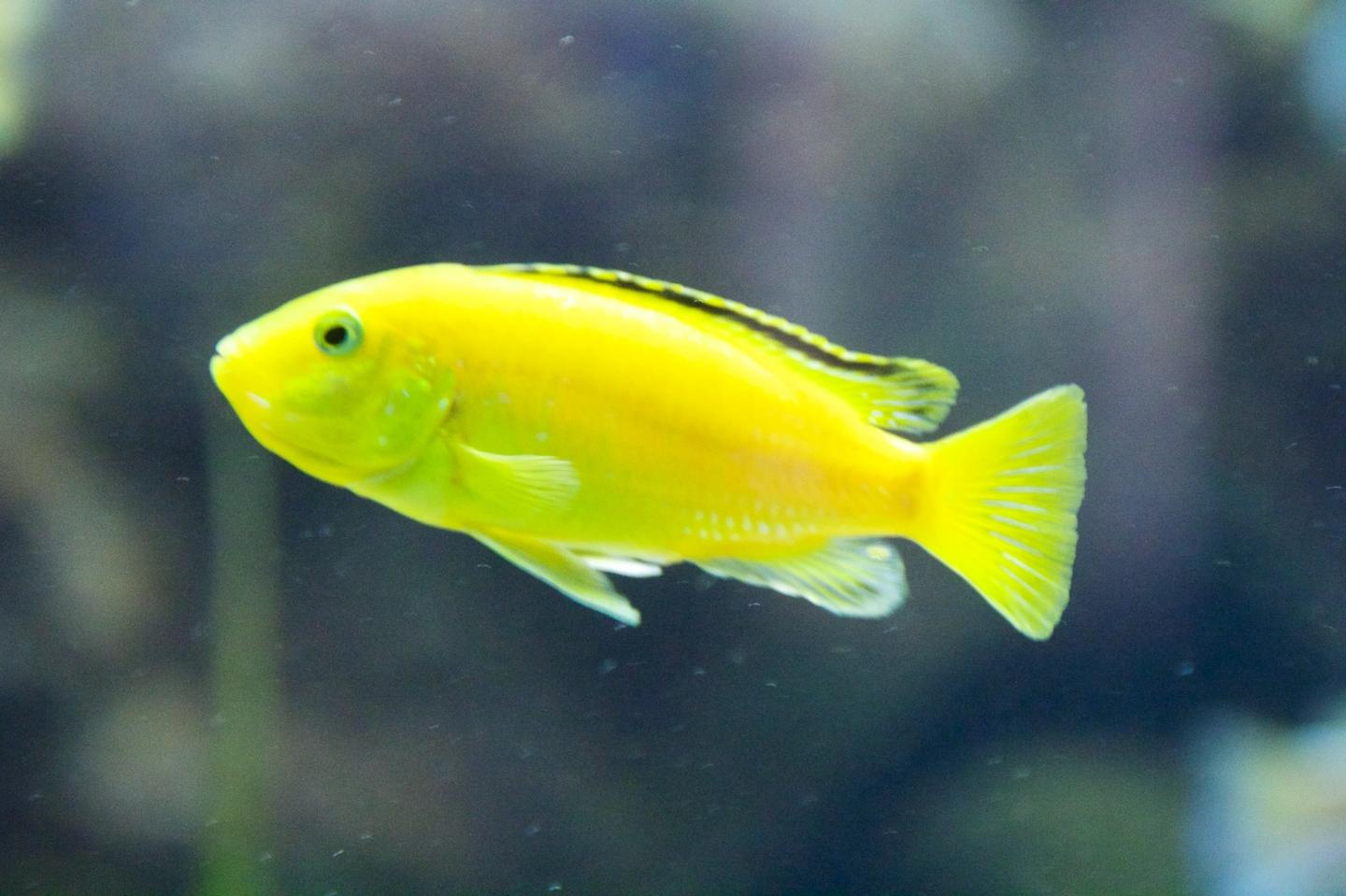
| Electric yellow lab (Labidochromis caeruleus) | Lake Malawi endemic; 8.1 cm maximum SL; 23–26 °C; maternal mouthbrooding[4] | “African” does not define the exact social group, sex plan or diet. Use a Malawi species plan, not a generic cichlid plan. |
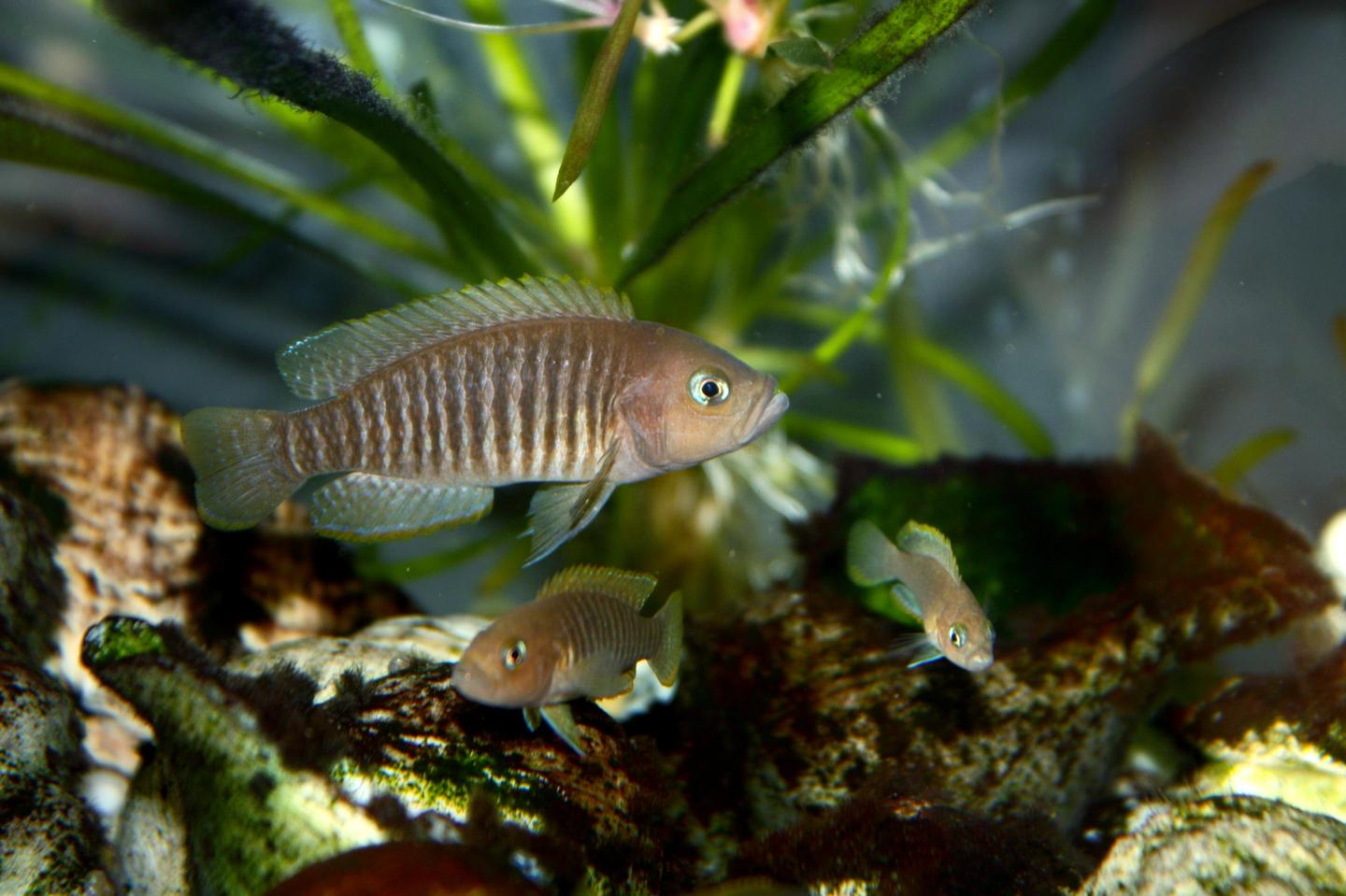
| Shell-dweller (Neolamprologus multifasciatus) | Lake Tanganyika endemic; 4 cm maximum TL; 24–26 °C; alkaline-water record and shell-associated colonial life[5] | Very small length does not make shells, bottom footprint, colony structure or hard alkaline water optional. |
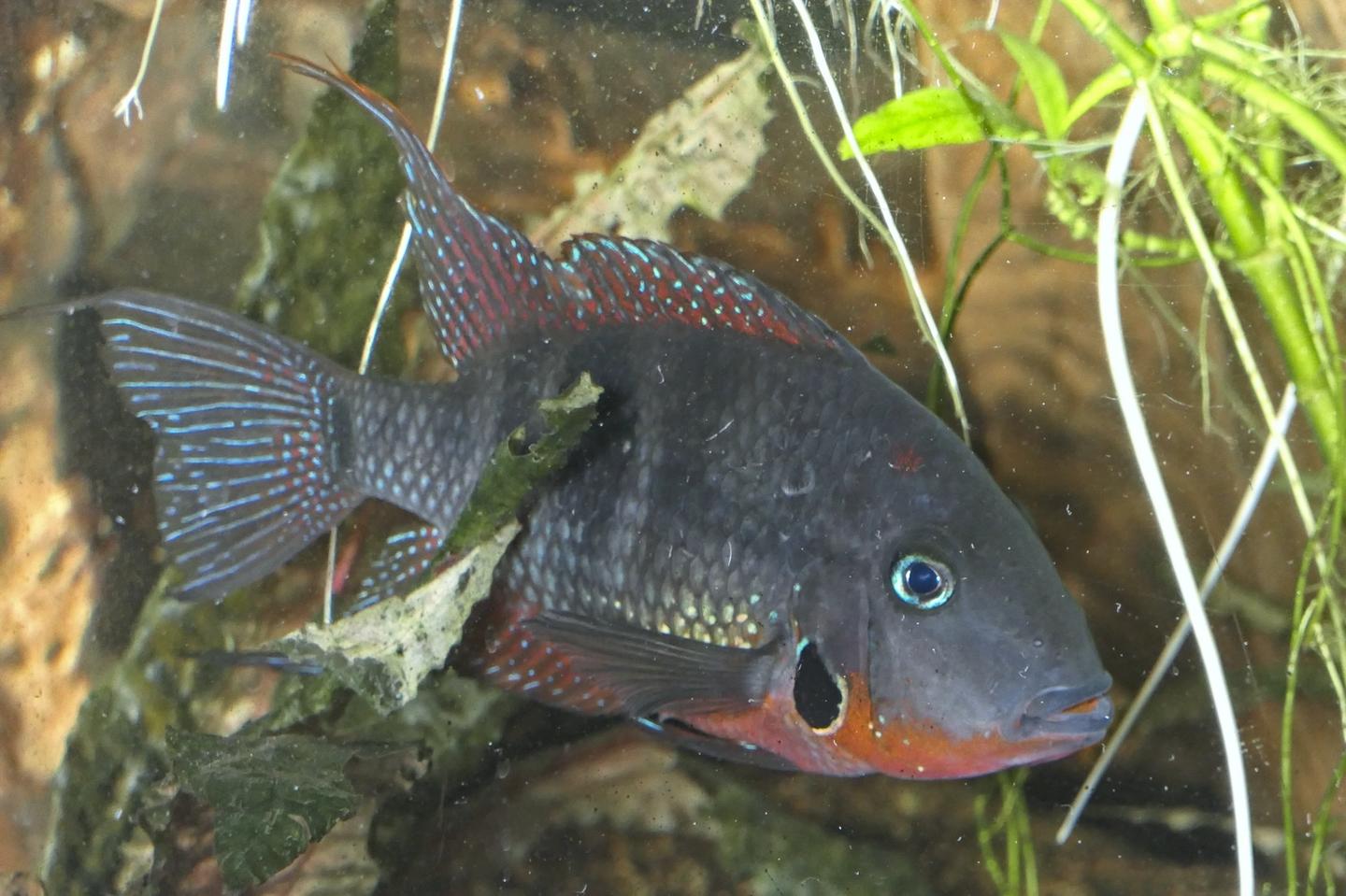
| Firemouth (Thorichthys meeki) | Central American identity; 17 cm maximum TL; 26–30 °C in the database record; biparental substrate guarding[6] | A larger adult and breeding territory create a different aquarium and companion decision from the three fish above. |
SL excludes the tail fin; TL includes it. Do not merge the measurements or rank aquarium suitability by the number alone. Line, locality, sex and captive history can matter too, so a source-labelled fish is more useful than a colour-led nickname.
African lake cichlids are not one group
Lake Malawi, Tanganyika and Victoria contain many ecological and social strategies. Even within one lake, rock-associated, shell-associated, sand-associated and open-water fish can require different space, food and group decisions. OATA's UK African lake guide explicitly says aquarium size, grouping and diet depend on the fish; its examples range from small shell-dwellers to much larger species[7].
Hard, alkaline water is a useful screen for many African lake species, not permission to mix every fish from a lake. “Overstock African cichlids” is not a safe default. OATA limits crowding language to some territorial species and still requires suitable filtration, oxygenation, water quality and species-specific advice[7]. Stocking beyond the aquarium's biological or welfare capacity is not aggression management.
The same boundary applies to food. African lake cichlids include different feeding ecologies; do not label every Mbuna a strict herbivore or every non-Mbuna a carnivore. Confirm the exact species and select an appropriate complete food.
South and Central American cichlids also vary
“South American” does not mean every fish needs very soft, acidic blackwater. “Central American” does not mean every fish is large or fits one hard-water target. OATA's American cichlid sheet describes broad guidance and tells keepers to research the exact species; its general range cannot replace a species record[8].
For depth on pages that already have their own owner, use the verified freshwater angelfish guide, Oscar guide and electric blue ram guide. Those pages should answer their exact species or trade-form questions; this family guide should not duplicate their numbers.
Match cichlids to the water you can maintain
UK tap water is not uniformly “hard in the south” or “soft in the north”. The Drinking Water Inspectorate explains that hardness varies with local geology and points consumers to their water company for the local result[9].
Use this sequence:
- Obtain the current water-company report for context.
- Test the source water you will actually use for pH, GH and KH.
- Test the established aquarium rather than assuming it matches the tap.
- Ask the seller for current holding-water measurements and how the fish was sourced.
- Compare those results with a current exact-species reference and change gradually when a justified change is needed.
A published range is not a target and not permission for repeated swings between its endpoints. Driftwood, leaves, limestone, rainwater or a fixed tap/RO percentage are not predictable substitutes for testing. If you cannot maintain suitable water safely and consistently, choose a different species.
Choose tank dimensions after the exact fish
There is no defensible minimum number of litres for “a cichlid”. A tank decision needs all of these inputs:
- the adult SL or TL, body depth and turning room;
- usable length, width and height, after substrate and decor;
- the complete pair, colony, harem or group structure supported for that species;
- territory, breeding state and visual barriers;
- waste production, oxygenation and tested filtration capacity;
- a spare divider, suitable separate aquarium or rehoming route if behaviour changes.
Litres describe water volume, not swimming length, floor territory or height. Use the tank-volume calculator to check real volume, then make the welfare decision from dimensions and species needs. UK licensed-seller guidance likewise treats stocking density as a needs-and-welfare decision and requires species-appropriate, stable water and temperature; it does not provide a universal litres-per-fish formula[11].
A label such as “mixed African”, “community cichlid” or “dwarf cichlid” does not reveal adult size, sex, water, social system or diet. Pause until the identity and source are specific enough to research.
Are cichlids aggressive?
Some cichlids defend feeding areas, shelter, a partner, eggs or fry; others live in groups with their own hierarchies. Risk changes with species, individual, sex, maturity, breeding state, tank dimensions and resource layout. “Peaceful for a cichlid” is not a compatibility guarantee.
Before combining fish:
- compare adult size, mouth size, water and temperature;
- account for bottom, cave, shell and open-water territories;
- use stable structures and real sight breaks without trapping a subordinate fish;
- watch every individual at feeding and at quiet times;
- define the behaviour that will trigger separation;
- have the separation equipment ready before introduction.
Adding more fish to “spread aggression” can add targets, waste and competition without solving the territorial cause. Rearranging decor can also intensify conflict or destabilise structures. Change one thing deliberately, measure water and supervise the result.
Can cichlids live with other fish?
Sometimes, but no family-wide tank-mate list is truthful. A smaller companion may be swallowed; a similarly sized fish may still be attacked, outcompeted or stressed; an apparently stable group may change at maturity or breeding. Shrimp, fry and snails can be vulnerable even with a smaller cichlid.
A responsible match needs overlapping water and temperature, enough adult space, compatible feeding speed and a plan for every territory. Treat the first weeks as observation, not proof of permanent safety. If the aquarium cannot support a separate outcome, do not attempt the mix.
What do cichlids eat?
Cichlid feeding ecologies include algae, plants, plankton, invertebrates and fish[2]. Choose a nutritionally complete aquarium food suitable for the exact species and mouth size, then use justified variety rather than projecting one diet across the family.
Ask what the actual fish accepts before purchase. Feed in a way that lets you observe every individual, and remove uneaten food. Refusal to eat is a welfare signal, not a reason to keep adding rich foods blindly. Never use feeder fish, meat from mammals or an internet “bloat cure” simply because the animal is a cichlid; diagnosis and treatment require qualified advice.
Breeding and parental care
Cichlids lay eggs; they are not livebearers. The eggs may be guarded on a surface, inside a cavity or in a parent's mouth. Depending on the species, care may be maternal, paternal or biparental, and the social system may change around reproduction[13][14].
Breeding can increase territorial pressure and rapidly create a rehoming problem. Do not induce spawning until you have a separate grow-out, feeding and destination plan. A photograph of a fish beside eggs also cannot prove that every aquarium individual will form a compatible pair or raise fry successfully.
Water quality and health checks
Cycle the aquarium by test results, not elapsed days. The Royal Veterinary College explains that ammonia and nitrite are harmful and that nitrate control includes appropriate partial water changes[10]. Test immediately when breathing, balance, colour, fins, appetite or social behaviour changes.
Use this order:
- Confirm temperature with a separate thermometer.
- Test ammonia, nitrite, nitrate and relevant source-water measures.
- Observe breathing, balance, injuries, waste and whether every fish eats.
- Isolate only when it can be done safely and without an abrupt chemistry change.
- Seek a fish-experienced veterinary professional or competent specialist for diagnosis; use treatments only for the diagnosed problem and exactly as labelled.
Hiding alone does not diagnose aggression, disease or “settling in”. Do not wait a fixed week if the fish is gasping, injured, losing balance or unable to feed. UK animal-welfare duties apply to vertebrate pets, while current seller guidance requires suitable water, diet, acclimatisation and expert or veterinary escalation where needed[12][11].
Before you buy a cichlid
Write down these answers first:
- exact scientific name or precise trade identity;
- captive-bred, wild-origin or unknown source, without guessing a locality;
- current sale unit, sex label and approximate dispatch size;
- cited adult measurement and measurement type;
- supported social structure and likely breeding behaviour;
- seller's current pH, GH, KH, temperature and accepted food;
- required adult dimensions, territory and filtration;
- separation and long-term rehoming plan.
Then compare the live listing with the plan. Browse African cichlids or South American cichlids only after the care screen. A shop category is an availability route, not evidence that every product inside it can share an aquarium.
How this guide was checked
Current names and family scope were separated from husbandry evidence. FishBase and Eschmeyer's Catalog support identity and biological context; exact FishBase species records illustrate differences without becoming universal prescriptions. OATA supplies bounded UK trade guidance, DWI supports only the local-water statement, RVC supports nitrogen-cycle principles, and GOV.UK provides the welfare and licensed-seller context. Comparative research supports the diversity of parental care.
The reference list below links to every record used. All four photographs retain their full frames and visible source, creator, licence and identity limits. No image proves care, temperament or stock. If a source, photograph or recommendation appears wrong, use the visible Suggest an edit link. Editorial feedback, email and forms are not counted as leads or ecommerce conversions; add-to-cart, checkout, purchase and revenue remain separate outcomes.
Four cichlids, four different care decisions
Frequently asked questions
Sources & further reading
Material factual claims cite the sources below; store policy and cautious inference are labelled in the article. Sources are grouped by type so you can judge their weight at a glance.
Peer-reviewed study (2)
- [13]Goodwin, N. B., Balshine-Earn, S. & Reynolds, J. D. (1998). Evolutionary transitions in parental care in cichlid fish. Proceedings of the Royal Society B. DOI: 10.1098/rspb.1998.0569. View source
Comparative evidence for diverse substrate-guarding, mouthbrooding and caregiver systems across cichlids.
- [14]Sefc, K. M. (2011). Mating and parental care in Lake Tanganyika's cichlids. International Journal of Evolutionary Biology. DOI: 10.4061/2011/470875. View source
Variation in mating and parental-care systems among Lake Tanganyika cichlids.
Scientific database (6)
- [1]Fricke, R., Eschmeyer, W. N. & Van der Laan, R. (eds.). Eschmeyer's Catalog of Fishes. California Academy of Sciences. View source
Current nomenclatural catalogue; used for the family and accepted-name boundary, not aquarium husbandry.
- [2]Froese, R. & Pauly, D. (eds.). FishBase: Cichlidae family summary. FishBase. View source
Current family scale, distribution, size and ecological diversity; the changing species count is rounded in visible copy.
- [3]Froese, R. & Pauly, D. (eds.). FishBase: Mikrogeophagus altispinosus. FishBase. View source
Accepted identity, distribution, measured size, temperature record and parental-care context.
- [4]Froese, R. & Pauly, D. (eds.). FishBase: Labidochromis caeruleus. FishBase. View source
Accepted identity, Lake Malawi distribution, measured size, temperature record and mouthbrooding context.
- [5]Froese, R. & Pauly, D. (eds.). FishBase: Neolamprologus multifasciatus. FishBase. View source
Accepted identity, Lake Tanganyika distribution, measured size, alkaline-water record and shell-associated ecology.
- [6]Froese, R. & Pauly, D. (eds.). FishBase: Thorichthys meeki. FishBase. View source
Accepted identity, Central American distribution, measured size, environment and biparental substrate-guarding record.
Veterinary reference (1)
- [10]Royal Veterinary College (2024). Aquarium health: nitrogen cycle. Royal Veterinary College. View source
Cycling, ammonia/nitrite risk, nitrate management and partial-water-change principles.
Trade-body guidance (2)
- [7]Ornamental Aquatic Trade Association. How to look after African lake cichlids. OATA. View source
UK general guidance that explicitly varies aquarium, diet and social needs by group and species.
- [8]Ornamental Aquatic Trade Association. How to look after American cichlids. OATA. View source
UK general guidance; its ranges and aquarium floor are not applied as universal species prescriptions.
Government / regulatory (3)
- [9]Drinking Water Inspectorate. Water hardness / hard water. Drinking Water Inspectorate. View source
Supports local-geology and water-supplier context, not a regional aquarium-water assumption.
- [11]Department for Environment, Food & Rural Affairs (2026). Selling animals as pets licensing: statutory guidance for local authorities. GOV.UK. View source
Current licensed-seller welfare context for water, temperature, diet, acclimatisation and stocking; not a home-aquarium litres formula.
- [12]Department for Environment, Food & Rural Affairs. Animal welfare. GOV.UK. View source
General UK duty-of-care context for vertebrate pets.
Spotted something that needs a fix?
Fishkeeping moves fast and we want every guide spot-on. If you think something here is wrong, out of date, or could be clearer, tell us — our team reads every message and updates the page.
Suggest an edit
Tropical Fish Co Editorial Team
Evidence-led aquarium editorial team
The Tropical Fish Co editorial team compiles care guidance from the sources cited on each page, separates published evidence from practical husbandry policy, and checks retail links against the current catalogue. First-hand experience is included only when a named contributor and the observation have been verified.