
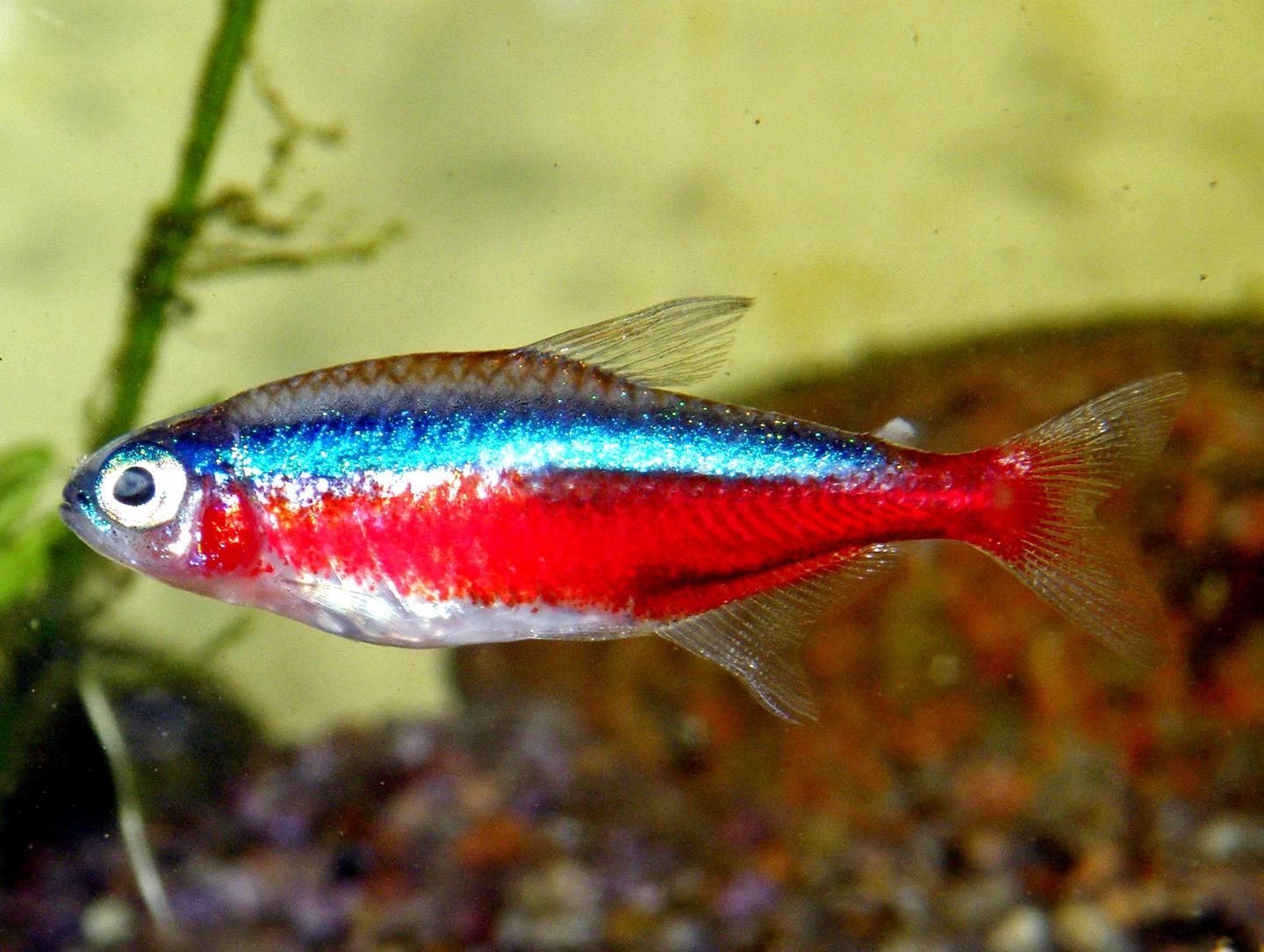
Cardinal Tetra Care Guide

A cardinal tetra's blue stripe is a structural optical effect rather than simple blue pigment. An exact-species experiment found that excessive illumination altered and faded its skin colour, turning a familiar aquarium observation into measurable biology.
Peer-reviewed cardinal tetra colour studyFishBase records 23-27 °C, pH 4-6, 5-12 dGH, a group of 5+ and a 60 cm aquarium, while OATA gives broader 22-27 °C, pH 6.5-8 and 4-12 dGH guidance for captive-bred tetras generally. Neither is an exact captive-tolerance experiment. Tropical Fish Co therefore uses 24-27 °C, pH 5.5-7, 1-8 dGH, about 60 L, at least 60 cm length and 10+ fish as a conservative retail screen, then requires measured source-water matching and individual monitoring.
Cardinal tetra care starts with three decisions: can you provide a proper group, a mature long aquarium and measured compatible water? Paracheirodon axelrodi is peaceful and small, but neither feature makes a new nano tank safe.
Tropical Fish Co sells live fish, so our commercial interest is explicit. Use the live tetra shop page to check current stock, sale unit and price; this guide keeps changing availability separate from care evidence. There is no hardcoded product card here because a care article should not invent stock, identity or price when the live catalogue is the source of truth.
- Start with a mature, filtered aquarium at least 60 cm long and about 60 litres under our conservative policy.
- Keep a group of at least 10 where total capacity allows; a larger shoal needs proportionally more room.
- Use 24-27 °C, pH 5.5-7 and 1-8 dGH as our routine target, then compare measured supplier and aquarium water.
- Choose calm companions that cannot swallow a 3 cm standard-length fish.
- Treat colour loss, isolation or unusual breathing as reasons to test and observe—not as diagnoses.
Is a cardinal tetra right for your aquarium?
A cardinal tetra group can suit a careful newer keeper who already understands cycling, testing and social stocking. It is a poor choice for a first-day setup, a vase or a tank selected only because ten small fish appear to fit on a calculator. OATA's UK tetra guidance requires filtration, a heater for suitable year-round temperature and a shoal; RSPCA guidance likewise makes mature biological filtration and testing central to fish welfare[14][15].
| A sensible starting plan | Reconsider or change the plan |
|---|---|
| Mature filter with repeated zero-ammonia and zero-nitrite tests | New aquarium judged ready only by elapsed days |
| At least 60 cm length and about 60 litres for the first group | Bowl, vase or short unstable nano aquarium |
| Ten or more cardinals under our house policy | One fish, a pair or a token group added for colour |
| Measured supplier, tap and aquarium water | Assuming every UK postcode or shop uses the same water |
| Calm companions screened at adult size | Adult predator or territorial fish chosen from a generic list |
Before buying, test ammonia, nitrite, nitrate, pH, GH and temperature, confirm the aquarium's usable length, and count every existing occupant. The first tropical tank guide explains the setup sequence, while the rest of this page deals with cardinal-specific decisions.
Identity, current family, size and range
The accepted scientific name is Paracheirodon axelrodi (Schultz, 1956). Eschmeyer's Catalog currently places it in Acestrorhamphidae, subfamily Megalamphodinae; older papers and many aquarium pages use Characidae because the family-level classification changed[1]. Hyphessobrycon cardinalis, described independently in 1956, is now treated as a synonym rather than a second cardinal tetra species[2].
FishBase records a maximum of 3.0 cm standard length[6]. Standard length is measured to the base of the tail, so the complete fish is somewhat longer. This distinction matters: repeating “5 cm adult size” without a measurement method makes comparison unreliable, while 3 cm SL should not be converted into a precise promised total length.
The documented range spans the upper Orinoco and Negro River basins in Brazil, Colombia and Venezuela[1]. A 2023 genetic study sampled eight locations and recovered three broad geographical population groups: Orinoco, Cucuí in the Negro headwaters, and the rest of the sampled Negro basin[3]. That finding shows why “cardinal tetra” does not mean every wild population is genetically identical.
The current global IUCN assessment is Least Concern[4]. This is a population-level conservation category, not a promise about the origin, welfare or legality of one retail fish. Ask the seller for the exact supply-chain information they possess rather than assuming every UK cardinal is wild-caught or every one is captive-bred.
Blackwater, flooded forest and the blue-stripe story
Cardinals are strongly associated with blackwater drainages. In the middle Negro system, seasonal flooding opens shaded forest and interfluvial wetland habitat, while falling water concentrates fish back into streams and other channels[10]. The 2023 phylogeographic research also treats P. axelrodi as adapted to blackwater connections between the Orinoco and Negro basins[3].
Wild cardinals use habitats that change across water levels, localities and seasons. Transfer the useful principles—shade, clean stable water, usable flow, cover and open midwater room—rather than copying one photograph of leaf litter.
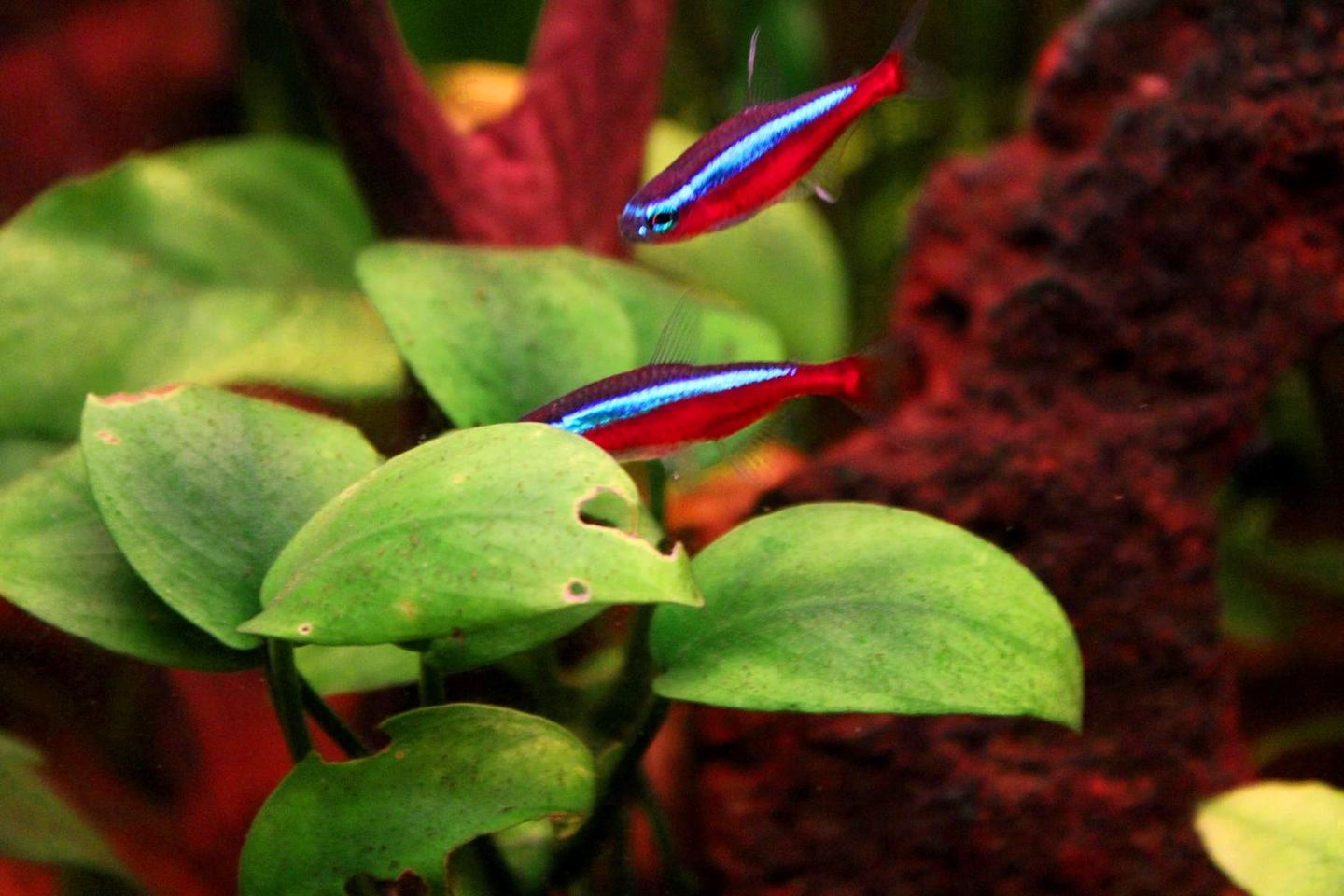
The colour is more than red and blue pigment. The blue lateral band is produced by reflective structures, and the arrangement of colour cells can change how the fish appears. In a controlled 72-hour experiment, excessive illumination altered skin-colour responses and faded cardinals[12]. That study supports moderating harsh light; it does not prove that light is the cause whenever one fish turns pale.
Wild diet is equally tied to habitat. Walker examined 80 fish from 14 Rio Negro basin sites and found predominantly animal material associated with submerged litter, roots and plants, especially microcrustaceans and chironomid larvae[8]. In other words, tannin-stained water is not a complete care explanation: the flooded structures also support the tiny prey and seasonal movements around which these fish evolved.
Cardinal tetra vs neon tetra
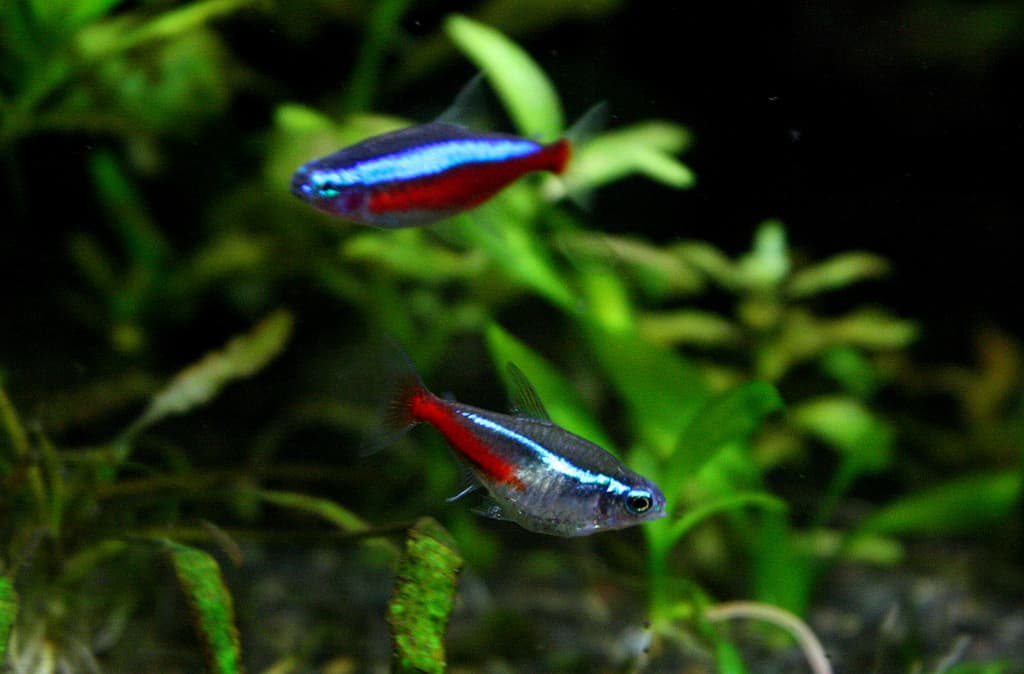
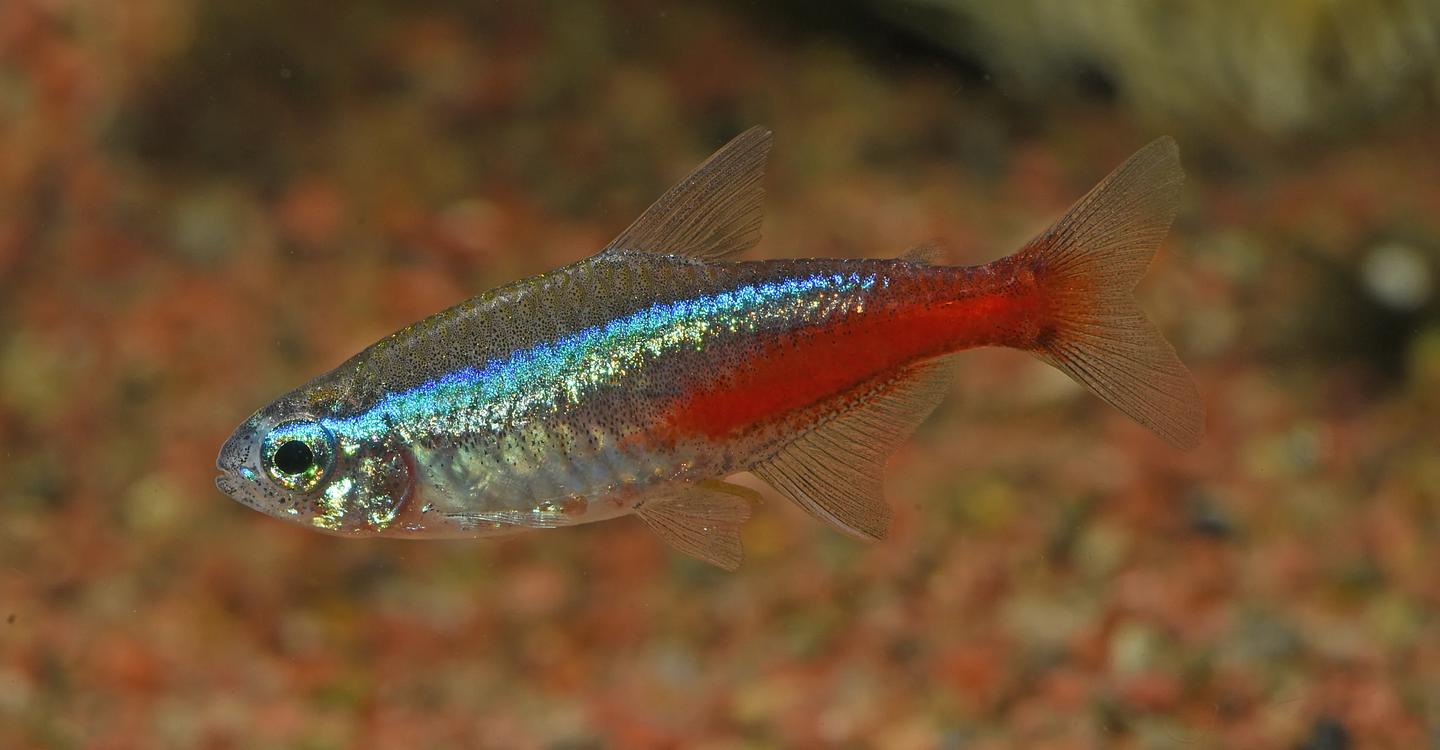
Cardinal and neon tetras are separate Paracheirodon species. The quickest visible comparison is the red band: on a cardinal, red extends along almost the full lower flank; on a neon, red begins around the middle of the body. The cardinal's full lower red field and blue structural stripe are described in exact-species colour work[12].
| Check | Cardinal tetra | Neon tetra |
|---|---|---|
| Scientific name | Paracheirodon axelrodi | Paracheirodon innesi |
| Red band | Almost full lower-body length | Mainly rear half of body |
| Size evidence | 3.0 cm maximum standard length | Check the measured-size note on the current Neon guide |
| Routine temperature on our guides | 24-27 °C house target | Check the current Neon guide; do not assume an identical target |
| Documented range | Upper Orinoco and Negro basins | Western Amazon records covered by the Neon guide |
Do not choose only by colour. Compare the actual water at the retailer with your tested aquarium, the adult group footprint, the other inhabitants and the maturity of the filter. A broad claim that one species is always “hardier” than the other ignores origin, handling, health and water difference.
They can share an aquarium only if the same measured conditions are suitable for both and there is enough space for their combined social groups. Mixing five cardinals and five neons does not necessarily give either species the same social setting as a coherent group of ten of its own kind. If the tank supports only one proper group, choose one species and give it the space rather than building two undersized collections.
Tank size, group size and stocking order
FishBase gives a minimum aquarium length of 60 cm and a group floor of five; OATA gives at least 45 litres for a small shoal of smaller tetras and says more than five is better[6][14]. These are useful screens, not controlled experiments establishing a universal welfare threshold.
Tropical Fish Co therefore applies a more conservative starting policy: at least 60 cm aquarium length, about 60 litres and 10 cardinals before adding companions. This is a retail welfare choice, clearly labelled as such. It is not a litres-per-fish formula and does not mean ten fish are automatically safe in every nominal 60-litre tank.
Usable capacity also depends on:
- horizontal swimming length after decor and equipment;
- mature filter capacity and oxygen exchange;
- the adult size and social needs of every companion;
- whether all cardinals can reach food;
- temperature and maintenance routine; and
- a separation plan if predation, disease or aggression appears.
Where practical, establish the aquarium and add the intended cardinal group together rather than buying a token group and repeatedly exposing it to new arrivals. That does not override quarantine or capacity: a mature separate system may be needed first. A group larger than ten can create a stronger display in a longer aquarium, but “more is better” stops where water quality, feeding access or swimming space worsens.
The stocking calculator below can flag obvious capacity problems; it is not permission to fill every theoretical unit. Tests, observation and aquarium shape still decide whether the plan works.
Stocking Calculator
Check if your tank can support this species at a healthy bioload.
Open tool →Water, heater and UK tap-water decisions
Published care ranges need source labels. FishBase lists 23-27 °C, pH 4-6 and 5-12 dGH, together with its aquarium references[6]. OATA's broader sheet for captive-bred tetras generally lists 22-27 °C, pH 6.5-8 and 4-12 dGH, while expressly telling readers to check species-specific and wild-caught requirements[14]. Neither source is an experiment that tested every safe limit for every cardinal population or retail supply chain.
Our routine house target is 24-27 °C, pH 5.5-7 and 1-8 dGH. It deliberately favours warm, soft-to-moderately-soft water while leaving space to match the actual retailer's holding water. Treat it as a screening policy, not proof that 5.4 or 8.1 dGH is instantly dangerous.
For a UK setup, ask the retailer for measured temperature, pH and hardness; test the aquarium and source water; compare GH and KH as well as pH; and make gradual, verified changes.
Do not use “London water,” “Scottish water” or a postcode as a measurement. Supplies vary, may be blended and can change. Reverse-osmosis water can be useful when a tested supply is unsuitable, but a fixed 50/50 or 70/30 recipe is unsafe guidance because starting GH, KH and remineralisation differ. The water chemistry guide explains how to measure before adjusting.
Most UK homes need a thermostatically controlled aquarium heater to hold this target year-round. Verify the water with an independent thermometer; a dial setting is not a measurement[15]. Avoid direct sun, draughts and rapid temperature changes.
Water Parameter Matcher
Enter your tap water readings to see if this species will thrive.
Open tool →Layout, filtration, flow and lighting
A good cardinal layout combines cover with a clear horizontal swimming lane. Plants, wood or other aquarium-safe structures around the sides and rear can create shade and visual security; the central route should remain open enough for the group to spread and turn. A dark background or substrate can improve the display, but colour-enhancing decor is not a substitute for healthy water.
Use gentle-to-moderate flow that maintains circulation without forcing the fish to swim continuously in one place. Protect filter intakes where small fish could be trapped. Maintain surface movement and avoid packing every part of the tank with decor. OATA recommends swimming room and gentle current for smaller tetras, while RSPCA guidance makes filtration, oxygenation and stable temperature basic environmental needs[14][15].
Cycle before stocking and prove it with tests rather than a fixed week count. OATA specifies zero ammonia and nitrite and nitrate no more than 20 mg/L above the normal tap-water level[14]. A planted aquarium is not automatically cycled.
Lighting should support viewing and plants without exposing the fish to continuous glare. The exact-species light experiment found fading under excessive luminosity, but it did not define one universal household lux setting[12]. Use a consistent day-night cycle, provide shaded areas and reassess if the group stays hidden, loses colour or avoids the brightest zone. Test water and behaviour at the same time; do not diagnose “too much light” from colour alone.
Feeding a wild microcarnivore in an aquarium
“Omnivore” is too vague to be a feeding plan. Walker's wild stomach-content work found that cardinals fed mainly on tiny animal prey, especially microcrustaceans and chironomid larvae, with algae comparatively infrequent[8]. A later anatomical study of 16 adults found a short digestive tract and other features consistent with primarily carnivorous feeding[9].
That evidence explains particle size and prey preference; it does not prove that aquarium fish should receive only live food. Use a reputable, suitably small complete micro-granule or finely prepared flake as the staple, then add compatible small frozen or cultured live variety where safe. Check the product label for completeness rather than assuming frozen bloodworm alone supplies every nutrient.
A practical routine is to:
- offer particles every fish can swallow without repeated spitting;
- spread food across the shoal instead of creating one crowded point;
- watch the smallest or least assertive fish receive food;
- remove recurring leftovers and adjust the next portion; and
- review feeding after adding faster companions or changing temperature.
OATA advises small regular feeds consumed within a few minutes and warns against overfeeding[14]. That is general household guidance, not a cardinal-specific frequency trial. Body condition, feeding response, water tests and the complete food's instructions should determine adjustment.
Do not collect live food from an unknown pond, overfeed to make fish grow faster or use visible algae as a complete diet. A sudden refusal to feed—especially with rapid breathing, isolation or balance change—should trigger water testing and health assessment, not larger portions.
Tank mates, predators and shrimp
Cardinals need peaceful companions that share their measured temperature and water needs and are not large enough to swallow them. Compatibility must be checked at adult size. A juvenile predator that ignores cardinals today may not be safe after growth.
Potentially workable categories include other calm small tetras, appropriately selected rasboras and peaceful bottom fish such as some Corydoradinae. Each exact species still needs its own assessment. For example, Corydoradinae care varies by species and temperature; the common name “corydoras” is not one set of requirements.
Avoid treating adult angelfish as guaranteed companions. Some keepers combine them, and the species can occur in broad overlapping South American regions, but an adult angelfish is physically capable of predating small tetras. The same caution applies to larger cichlids, territorial fish, persistent fin-nippers and any fast feeder that prevents the cardinal group from eating.
No fish should be marketed as shrimp-safe. Adult Amano or larger Neocaridina shrimp may coexist in a suitably planned tank, while shrimplets and small vulnerable shrimp can be eaten. Dense planting reduces exposure but cannot guarantee survival. Also check whether the shrimp's mineral requirements overlap with the water chosen for cardinals.
Use this sequence for any proposed tank mate:
- compare adult size and mouth size;
- compare routine temperature, pH and hardness;
- add the space required by every social group;
- compare feeding speed and aquarium level; and
- prepare a mature separation option.
Sex, spawning and why breeding is advanced
Sexing retail juveniles is not reliable from colour alone. Mature females may appear deeper-bodied when carrying developed ovaries, while males can look slimmer, but body shape changes with age, feeding and health. Buy a social group rather than asking a shop to promise a visually sexed pair unless the seller has stronger evidence.
Exact-species laboratory research confirms that cardinals are egg layers with adhesive eggs and batch development. In one study, manipulating water level, pH and conductivity stimulated spawning; eight sampled females contained 154-562 oocytes, with fecundity related to fish size[7]. At 26 ± 1 °C in that experiment, larvae emerged 19-20 hours after fertilisation and juvenile colour developed over subsequent days.
Those results describe one controlled research system. They do not support a universal home recipe, an exact egg promise or a fixed blackout instruction. Breeding remains specialist work, not an automatic outcome in a community aquarium.
A responsible breeding attempt requires a separate mature system, measured very soft water, safe egg and larval management, microscopic first-food planning, temperature control and a destination for juveniles. Do not experiment by sharply dropping pH or conductivity in a stocked display tank. Keep notes, change one controlled factor at a time, and seek current specialist guidance before attempting it.
For most households, the best plan is a healthy display group rather than trying to breed. The absence of spawning is not evidence that fish are unhealthy, and a rounded female is not proof of pregnancy—cardinals do not give birth to live young.
Health, quarantine and the lifespan question
A settled cardinal should maintain balance, swim with the group, breathe without obvious effort, hold its fins normally and respond to food. Persistent isolation, surface gasping, clamped fins, spots, wounds, swelling, weight loss or abrupt colour change are warning signs, not named diagnoses[16].
Test ammonia, nitrite, nitrate, pH and temperature first. Check the heater, filter flow, recent maintenance, food, new livestock and social pressure. Pale colour may follow excessive light in a controlled setting[12], but the same appearance can accompany water problems, transport or illness. Do not treat the colour study as a diagnostic shortcut.
Quarantine new fish in a separate mature system with dedicated equipment. The MSD Veterinary Manual recommends at least 30 days in its professional biosecurity guidance and longer where circumstances require[17]. That is general veterinary guidance, not a cardinal-specific trial. If illness is suspected, use OATA's UK fish-vet directory and follow qualified advice[18]. This guide deliberately gives no generic heat, salt or medicine dose; visible symptoms can have different causes, and UK medicine rules also apply[19].
The sources reviewed here do not support a fixed “normal captive lifespan” of five, eight or ten years. A wild middle-Negro study describes a 12-16 month life cycle in its population context[10]; it is not evidence that aquarium fish die after 16 months. Captive age at purchase, collection or breeding origin, transport, disease exposure and husbandry vary. Plan for years of responsible care, but do not turn an unsupported estimate into a guarantee.
Buying, delivery and stock identity
Check live tetra availability here. The live shop owns price, quantity and stock status; this guide intentionally publishes none of them. Before ordering, confirm:
- the exact listing says Paracheirodon axelrodi rather than relying only on “neon”;
- the sale unit is clear—one fish, a group or another quantity;
- the retailer can provide current holding temperature, pH and hardness;
- origin is described only to the level actually documented; and
- delivery coverage, guarantee and reporting deadlines are understood.
Do not assume an image proves the exact fish's source population, sex or body size. The 2023 genetics paper found geographic population structure across the range[3], while current UK stock may pass through different collection, breeding and wholesaling routes. “Rio Negro,” “tank-bred” or “sustainable” should be attached to evidence for the actual shipment, not copied from a species article.
Prepare and test the aquarium before dispatch. Use the current delivery information and the instructions supplied with the order. Transport water can accumulate carbon dioxide and ammonia, and its chemistry can differ from the receiving aquarium[20]. That is why a universal “drip for 45 minutes” rule is unsafe: opening the bag and raising pH can also change the proportion of toxic un-ionised ammonia. Follow the seller's current method, minimise delay and do not pour transport water into the display unless the directions explicitly require it.
On arrival, document the unopened package and fish condition, then observe breathing, balance and injuries. Keep the aquarium light subdued, avoid immediate crowding or feeding competition, and report serious concerns through the current order channel within its stated time. Feedback messages are customer service evidence, not ecommerce leads or conversions.
Conservation, trade and responsible non-release
Cardinal tetra history links aquarium keeping with the Rio Negro fishery. Project Piaba research describes a trade that supported local livelihoods and created an incentive to value standing forest and healthy water[11][13]. Later conservation work continues to treat freshwater fisheries and communities as connected rather than assuming all wild harvest has the same impact.
That context deserves care. It does not certify every seller, shipment or practice. Ask for traceability, prefer honest sourcing language and avoid claims such as “all cardinals are wild-caught sustainably” or “all UK cardinals are farmed.” Current evidence does not establish one UK-wide ratio, and the source behind a particular shop batch can change.
The species is currently assessed globally as Least Concern[4][5]. Least Concern does not mean habitat is invulnerable: seasonal wetlands, blackwater connectivity and local genetic structure remain biologically important[3][10].
Never release cardinals, other aquarium animals, plants, pathogens or aquarium water outdoors, into ponds, drains or natural watercourses. OATA warns against release and contaminated-water disposal, while UK government guidance explains legal controls on releasing non-native animals[14][21]. If circumstances change, contact a reputable retailer, aquarium society or experienced keeper early and arrange responsible permanent care or rehoming.
Cardinal tetra social context and identification
Frequently asked questions
Sources & further reading
Material factual claims cite the sources below; store policy and cautious inference are labelled in the article. Sources are grouped by type so you can judge their weight at a glance.
Peer-reviewed study (7)
- [3]Sánchez-Bernal, D. et al. (2023). Phylogeography and population genetic structure of the cardinal tetra (Paracheirodon axelrodi) in the Orinoco basin and Negro River (Amazon basin). PeerJ. DOI: 10.7717/peerj.15117. View source
Exact-species population sampling supports broad Orinoco and Negro basin distribution, blackwater adaptation and three geographically structured population groups; it is not an aquarium-care trial.
- [7]Anjos, H. D. B. & Anjos, C. R. (2006). Reproductive biology and embryonic and larval development of the cardinal tetra, Paracheirodon axelrodi, in laboratory. Boletim do Instituto de Pesca. View source
Laboratory spawning, eight-female fecundity sample and embryonic development under one regime; not a guaranteed home-breeding recipe.
- [8]Walker, I. (2004). The food spectrum of the cardinal tetra (Paracheirodon axelrodi) in its natural habitat. Acta Amazonica. DOI: 10.1590/S0044-59672004000100009. View source
Stomach and gut contents from 80 wild fish at 14 Rio Negro basin sites, supporting predominantly small-invertebrate prey; not a complete captive diet formulation.
- [9]Rincón, L., Redondo, F., Kobrinsky, W., Pandolfi, M. & Pozzi, A. G. (2023). Morphological study of the digestive tract of the cardinal tetra, Paracheirodon axelrodi. Neotropical Ichthyology. DOI: 10.1590/1982-0224-2022-0092. View source
Exact-species digestive anatomy from 16 adults is consistent with primarily carnivorous feeding; it does not establish an aquarium portion or feeding frequency.
- [10]Bittencourt, P. S., Marshall, B. G., Hrbek, T. & Farias, I. P. (2017). Life after the drought: temporal genetic structure of Paracheirodon axelrodi in the middle Negro River. Pan-American Journal of Aquatic Sciences. View source
Author-uploaded full-text record for the Pan-American Journal article: wild middle-Negro population context, seasonal habitat and a 12-16 month wild life-cycle estimate; not a captive lifespan study.
- [12]Linhares, R. M., Pinagé, C. M. M. F. & Duncan, W. P. (2018). Excessive luminosity fades the skin color of cardinal tetra. Boletim do Instituto de Pesca. DOI: 10.20950/1678-2305.2018.44.4.319. View source
Short controlled exact-species light-intensity experiment on chromatophore responses; not proof that every pale fish has excessive light exposure.
- [13]Chao, N. L. & Prang, G. (1997). Project Piaba - towards a sustainable ornamental fishery in the Amazon. Aquarium Sciences and Conservation. DOI: 10.1023/A:1018339718743. View source
Historical fishery and conservation model; not an automatic certification for any modern seller or fish.
Scientific database (3)
- [1]Fricke, R., Eschmeyer, W. N. & Van der Laan, R. (eds.). Eschmeyer's Catalog of Fishes: Paracheirodon axelrodi. California Academy of Sciences. View source
Current valid name, family and subfamily placement, original-description record, type locality and distribution; dynamic database checked 14 August 2026.
- [2]Fricke, R., Eschmeyer, W. N. & Van der Laan, R. (eds.). Eschmeyer's Catalog of Fishes: Hyphessobrycon cardinalis. California Academy of Sciences. View source
Records H. cardinalis as a junior synonym of P. axelrodi and confirms current Acestrorhamphidae: Megalamphodinae placement.
- [6]Froese, R. & Pauly, D. (eds.). FishBase: Paracheirodon axelrodi. FishBase. View source
Current classification, 3.0 cm maximum standard length, distribution, shoaling and aquarium-reference values. Its husbandry numbers are secondary guidance, not exact-species tolerance experiments.
University extension (1)
- [20]Cole, B. E. (1999). Shipping practices in the ornamental fish industry. Center for Tropical and Subtropical Aquaculture. View source
Transport-water and receiving principles; not support for one universal home acclimation timer.
Veterinary reference (1)
- [17]MSD Veterinary Manual. Management of aquarium fish. MSD Veterinary Manual. View source
Professional biosecurity, quarantine and water-quality guidance. US drug directions are not reproduced for UK shoppers.
Animal-welfare charity (2)
- [15]Royal Society for the Prevention of Cruelty to Animals. Choosing an aquarium for pet fish. RSPCA. View source
Current UK welfare guidance on mature filtration, heaters, thermometers, testing and aquarium environment; not cardinal-specific thresholds.
- [16]Royal Society for the Prevention of Cruelty to Animals. Pet fish health. RSPCA. View source
Current UK welfare guidance on normal and concerning signs, water-quality-first checks and veterinary escalation.
Trade-body guidance (2)
- [14]Ornamental Aquatic Trade Association (2022). How to look after tetras and pencilfish. OATA. View source
UK trade-body group-level husbandry guidance. OATA expressly says its ranges are general and species-specific requirements must also be checked.
- [18]Ornamental Aquatic Trade Association. Find a fish vet. OATA. View source
UK fish-vet directory for qualified diagnosis and treatment advice.
Conservation authority (2)
- [4]Lima, F. (2023). Paracheirodon axelrodi: The IUCN Red List of Threatened Species. International Union for Conservation of Nature. DOI: 10.2305/IUCN.UK.2023-1.RLTS.T164584363A164584373.en. View source
Current global Least Concern assessment; conservation status does not identify a retail fish's collection or breeding origin.
- [5]IUCN (2024). Freshwater fishes of potential interest for inclusion in CMS - information brief. International Union for Conservation of Nature. View source
Official conservation context for cardinal tetra populations and the ornamental trade; not household husbandry guidance.
Government / regulatory (2)
- [19]Veterinary Medicines Directorate. Exemption from authorisation for medicines for small pet animals. GOV.UK. View source
UK legal context for small-pet medicines; not a diagnosis or dosing source.
- [21]Department for Environment, Food & Rural Affairs. Guidance on section 14 of the Wildlife and Countryside Act. GOV.UK. View source
UK legal and environmental context for preventing release of non-native animals, plants and associated organisms.
Published book (1)
- [11]Chao, N. L. (2001). The fishery, diversity, and conservation of ornamental fishes in the Rio Negro Basin, Brazil - a review of Project Piaba (1989-99). Editora da Universidade do Amazonas. View source
Historical ecological, fishery and livelihood context. It cannot prove the origin or practices behind a present UK retail shipment.
Spotted something that needs a fix?
Fishkeeping moves fast and we want every guide spot-on. If you think something here is wrong, out of date, or could be clearer, tell us — our team reads every message and updates the page.
Suggest an edit
Tropical Fish Co Editorial Team
Evidence-led aquarium editorial team
The Tropical Fish Co editorial team compiles care guidance from the sources cited on each page, separates published evidence from practical husbandry policy, and checks retail links against the current catalogue. First-hand experience is included only when a named contributor and the observation have been verified.
Keep exploring
Care guides
- Neon Tetra Care Guide
Neon tetra care for UK aquariums: check 60 cm tank length, group size, heater, water, tank mates, feeding and mature-tank needs before buying.
- Ember Tetra Care Guide: Hyphessobrycon amandae
Evidence-checked Ember tetra care for UK tanks: adult size, group needs, tank footprint, temperature, feeding, tank mates and current availability.
- Corydoras Care Guide: Choose the Right Cory Catfish
Corydoras care for UK aquariums: compare popular cory catfish by adult size and temperature, then check tank, group, substrate, food and tank mates.
Related care guides
Neon Tetra Care Guide
Start here: use a mature, filtered aquarium at least 60 cm long. FishBase and OATA compile groups of five or more; our conservative planning screen starts at eight, then checks usable volume, water, filtration and every adult tank mate.
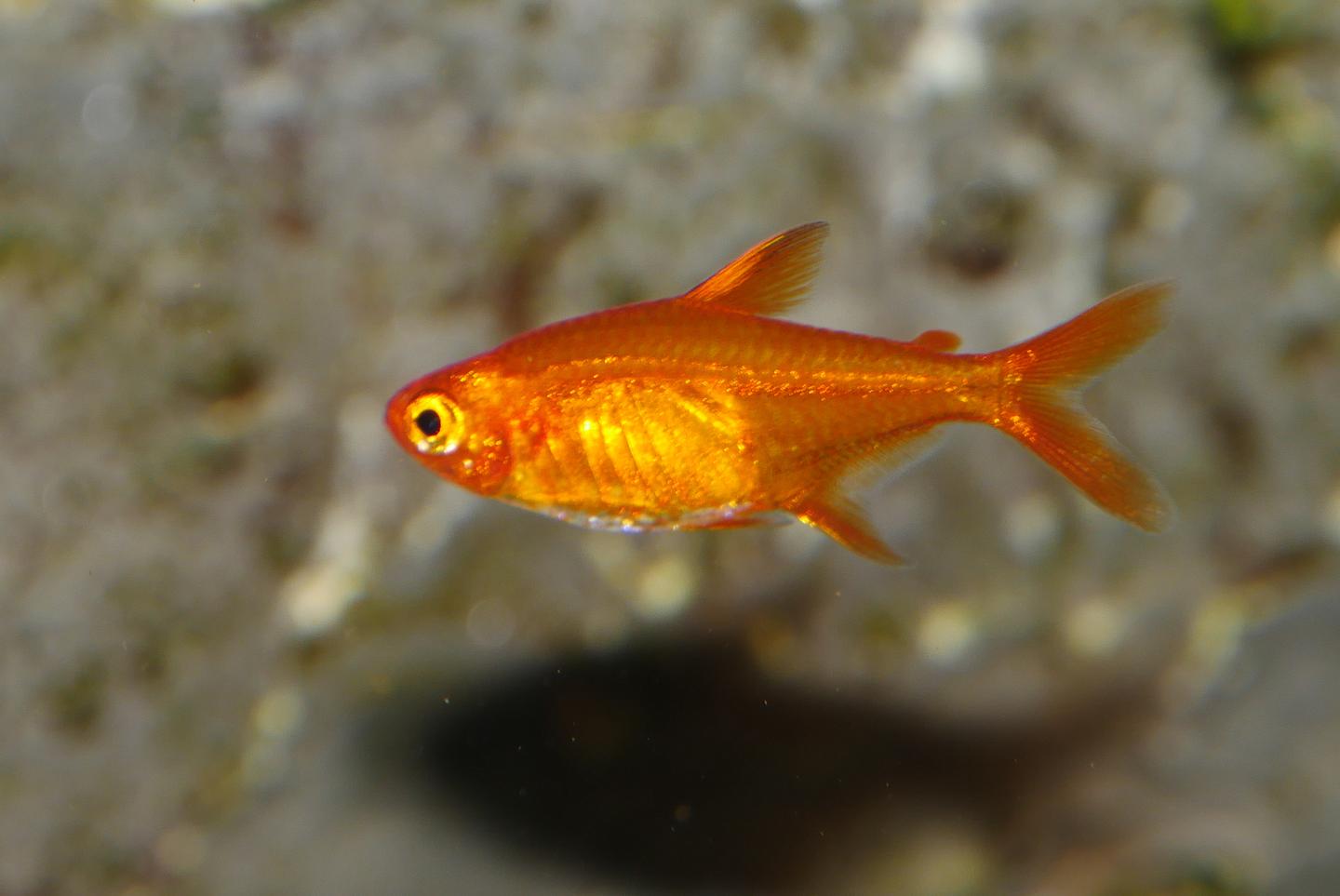
Ember Tetra Care Guide: Hyphessobrycon amandae
Ember tetras are very small Brazilian social fish, with a maximum recorded length of 2.0 cm excluding the tail. Keep them only in a fully cycled, stable aquarium. We recommend a group of at least 10 and about 45 litres with a 45 × 30 cm footprint rather than using a litres-per-fish formula.
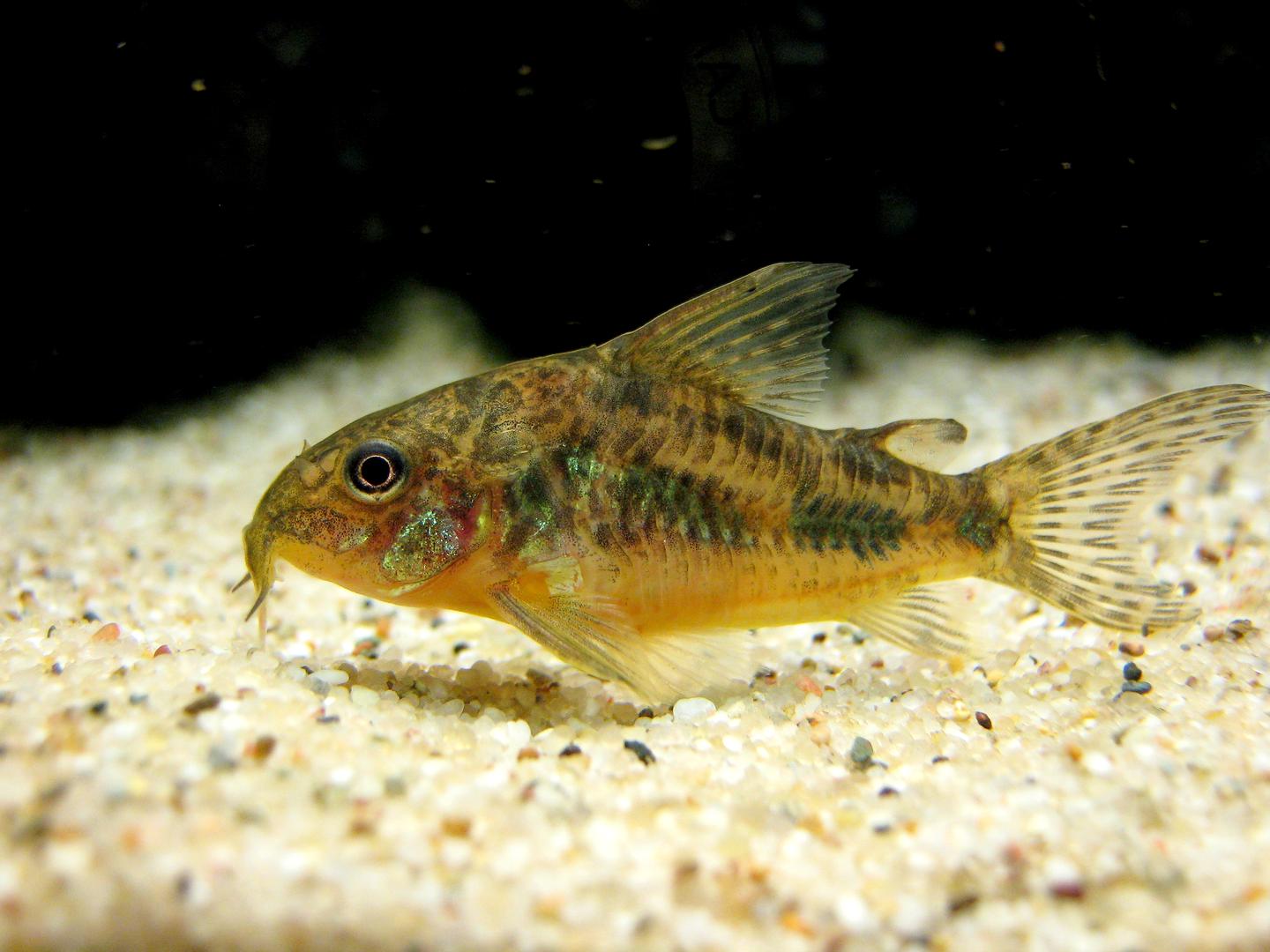
Corydoras Care Guide: Choose the Right Cory Catfish
Identify the exact cory catfish before choosing care. Our starting policy for many common medium species is six compatible conspecifics, a mature 60 x 30 cm aquarium of about 60 litres, smooth fine sand and measured species-appropriate water.