


Easy to intermediate
Chocolate Cherry Shrimp (Neocaridina davidi)
18–26°C · pH 6.5–8 · 30L
£13.99

Buy Cardinal Tetras for sale in the UK. Stunning schooling fish with bold red-blue colour, ideal for planted aquariums and peaceful community tanks.
Adult size is the maximum length this species reaches at full maturity (scientific sources). The livestock you receive will be younger and smaller — pick a size variant above for the actual shipping size. Photos are AI-enhanced, so the animal may show subtle colour or marking differences.
Cheirodon axelrodi CB
Cardinal Tetra are a shoaling species — they need 6+ to feel safe and show their full colour.
Buy Cardinal Tetras for sale in the UK. Stunning schooling fish with bold red-blue colour, ideal for planted aquariums and peaceful community tanks.
Adult size is the maximum length this species reaches at full maturity (scientific sources). The livestock you receive will be younger and smaller — pick a size variant above for the actual shipping size. Photos are AI-enhanced, so the animal may show subtle colour or marking differences.
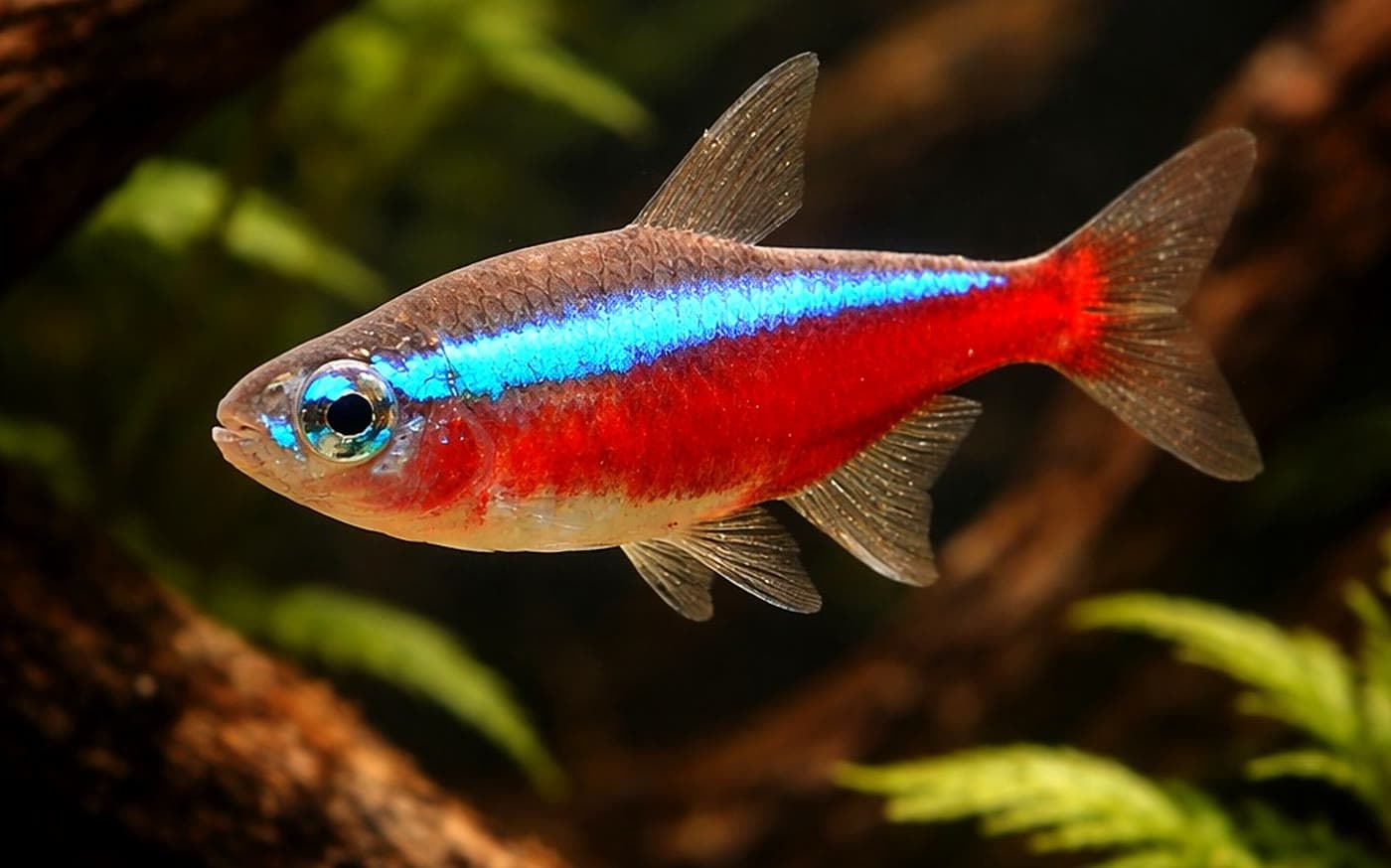
Cardinal tetras bring the deepest red-and-blue colour of any small community fish — a schooling centrepiece for soft, warm, planted aquariums. UK delivery available.
Maintain these water conditions for optimal health and vibrant colors
Cardinal Tetras are one of those rare aquarium fish that look almost unreal when the light catches them. The electric blue stripe and full-length red band of Paracheirodon axelrodi create a glowing effect that makes even a simple aquascape feel alive. Native to the blackwater streams of the upper Orinoco and Rio Negro, these peaceful South American tetras stay small, usually reaching a cardinal tetra size of around 3-5 cm, yet they make a huge visual impact when kept in a large school. If you have been researching cardinal tetra care, cardinal tetra lifespan, cardinal tetras minimum tank size, or the ideal cardinal tetras temperature, this guide covers the details that matter in real home aquariums. They are not the hardest fish to keep, but stable water quality, soft water, and a proper group size are essential. See our detailed photos showing the intense blue and red contrast in a planted aquarium, where these fish display their best colour and natural schooling behaviour. For fishkeepers who want a classic shoaling species with elegant movement, strong community-tank potential, and true Amazon character, Cardinal Tetras remain one of the best choices in the hobby.
Paracheirodon axelrodi is one of the best-known members of the South American tetra group and is closely associated with other popular aquarium species such as Paracheirodon innesi. In the hobby, cardinals are often chosen by aquarists who want a more vivid alternative to the common neon tetra. Their place in the aquarium trade is well established, and they remain a favourite in blackwater biotopes, planted aquariums, and peaceful community displays.
The natural cardinal tetras habitat is the upper Orinoco and Negro river systems in South America. These waters are famous for being soft, acidic, tannin-rich, and shaded by dense rainforest canopy. If you have ever wondered where do neon tetras live in the wild or explored the broader neon tetra habitat, Cardinal Tetras come from a similar style of environment: slow-moving tributaries, flooded forest margins, and leaf-litter zones where light is dim and the water chemistry is gentle.
This neon tetra native habitat style is why cardinals do best in calm, mature aquariums. In the wild, they forage among roots, submerged branches, and fine plants for tiny invertebrates, insect larvae, and micro-crustaceans. So while many hobbyists ask what do neon tetras eat in the wild, the answer also helps explain the ideal cardinal tetras diet: small, protein-rich foods with some plant matter and variety.
People often ask are neon tetras natural and where are neon tetras native to. The answer is yes, both neon and cardinal species are naturally occurring South American characins, though cardinals are specifically associated with warmer blackwater conditions. The neon tetra origin and neon tetra native range are often discussed alongside cardinals because the two species look similar, but cardinals generally prefer slightly warmer and softer water. That difference matters in long-term care.
In these rainforest waterways, fish gather in a large neon tetra school-style formation for safety, and Cardinal Tetras behave the same way. Their reflective stripe helps keep the group coordinated in low light. Recreating that shaded, root-filled neon tetra environment in the aquarium reduces stress and supports stronger colour.
Mimicking the natural blackwater habitat with dim lighting, dark substrate, leaf litter tones, and gentle flow improves colour, reduces skittish behaviour, and helps Cardinal Tetras settle much faster after introduction.
Good cardinal tetras tank setup starts with stability. Although these fish are often suggested as cardinal tetras for beginners, they are best kept by aquarists who understand cycling, water changes, and the importance of avoiding sudden shifts. The cardinal tetras tank size should be at least 60 litres, which is the accepted cardinal tetras minimum tank size for a proper group. In practice, a larger aquarium of 75-90 litres gives a much better result because it allows a bigger school and more stable water chemistry.
If you are comparing this to a 6 neon tetra tank size or researching neon tetra minimum tank size, remember that Cardinal Tetras should be kept in groups of 10 or more. That means the neon tetra recommended tank size often discussed online for a tiny shoal is not the ideal benchmark here. For anyone asking how many cardinal tetras in a tank, a 60-litre aquarium suits 10-12 fish, while larger tanks can support a more impressive school with compatible species.
The fish are active midwater swimmers, so horizontal swimming space matters more than height. A long tank with open central space and planting around the edges works better than a tall cube. Strong schooling behaviour becomes much more visible once the group reaches 10+. That is also the answer to how many neon tetras should be kept together: more is better, and the same rule applies to cardinals.
The ideal cardinal tetra temperature is 23-27°C, with 24-26°C being a sweet spot for most home aquariums. If you are searching cardinal tetras water temperature, cardinal tetras water parameters, or paracheirodon axelrodi temperature, aim for warm, stable conditions rather than chasing extremes. Soft water is strongly preferred, with hardness around 1-8 dGH and pH between 4.5 and 7.0. Many aquarists compare this to neon tetra temperature, neon tetra ideal temperature, neon tetra optimal temperature, and even paracheirodon innesi temperature. Cardinals generally like it a touch warmer than standard neons.
For those asking what temperature neon tetra or neon tetra minimum temperature, the answer for cardinals is simple: do not let them sit in cool water for long periods. And yes, do neon tetras need a heater? In most UK homes, absolutely. Cardinals do too. A reliable heater is not optional for year-round consistency.
Use a mature filter with gentle to moderate flow. Sponge filters, compact internal filters, or well-baffled external filters all work. Avoid blasting current across the full tank length. Cardinals come from slower water, so they appreciate circulation without being pinned in place.
A dark sand or fine gravel substrate helps the colours stand out. Cardinal tetras in planted tank layouts look especially striking, and dense planting also helps nervous fish feel secure. Fine-leaved plants, floating cover, driftwood, and root tangles are ideal. If you enjoy tetra communities, you can also browse Enhance Your Aquarium with 6 X for comparison, or add contrast with Glowlight Tetras - Hemigrammus Erythrozonus in a larger, carefully planned display of neons cardinals and glowlights.
Moderate to subdued lighting is best. Bright, exposed tanks often wash out colour and increase stress. Floating plants or tannin-stained water can soften the effect. This is one reason many aquarists prefer a natural blackwater look for cardinal tetras aquarium setup projects.
Always cycle the tank for 4-6 weeks before adding Cardinal Tetras. They are much less forgiving of ammonia and nitrite than hardier beginner fish, especially in newly set up aquariums.
The natural cardinal tetras diet is omnivorous but leans toward tiny live prey. In the aquarium, the best approach is a varied menu of quality micro pellets, crushed flakes, frozen foods, and occasional live foods. If you are asking what do cardinal tetras eat, think small, soft, and easy to swallow. Their mouths are tiny, so oversized foods are often ignored.
Many buyers search what neon tetra eat, what to feed neon tetras, and neon tetra diet because the care is similar. A good staple is a fine tropical micro pellet or crushed flake designed for small community fish. Supplement this with daphnia, cyclops, baby brine shrimp, and finely chopped bloodworm. Yes, can neon tetras eat bloodworms? They can, but only in very small portions because large bloodworms are too rich as a staple.
Questions like what time neon tetras eat, when to feed neon tetras, and even what day neon tetras eat come up surprisingly often. The practical answer is once or twice daily, at roughly the same times each day. Feed only what the school can finish in 30-60 seconds. A regular cardinal tetras feeding guide prevents bloat and keeps water quality high.
A few common myths are worth clearing up. Can neon tetras eat betta food? Sometimes, but most betta foods are too large and protein-heavy for regular use. Can neon tetras eat betta pellets? Only if crushed very finely, and still not as the main diet. Do neon tetras eat algae? Not in any useful way; they are not algae cleaners. Do neon tetras eat shrimp? Adult shrimp are usually safe, but shrimplets may be eaten. Does neon tetra eat guppy fry? Small fry may be taken if they fit in the mouth, so do not rely on cardinals as fully fry-safe fish.
| Time | Food | Amount |
|---|---|---|
| Morning | Micro pellet or crushed flake | Very small pinch, eaten within 30-60 seconds |
| Evening | Frozen daphnia, cyclops, or baby brine shrimp | Small portion, no leftovers |
Overfeeding causes ammonia spikes, cloudy water, and digestive stress. Small tetras do best with tiny portions offered consistently, not large meals dropped in all at once.
The classic appeal of Cardinal Tetras is their clean, high-contrast colour pattern. A brilliant blue iridescent stripe runs from the snout to the tail, while the red band extends along nearly the full lower half of the body. This full-length red is the easiest way to separate them in the cardinal tetra vs neon tetra debate. On a true neon tetra, the red usually covers only the rear half of the body.
Typical cardinal tetras size in home aquariums is around 3-5 cm, with neon tetra size usually slightly smaller on average. If you are comparing cardinal tetra size against other small tetras, cardinals have a more elongated, elegant look and often appear larger because of the bold colour coverage. In a dark aquascape, they can look almost luminous, which explains why people ask what makes neon tetras glow. The effect comes from structural iridescence in special reflective cells, not true bioluminescence.
There is only limited sexual dimorphism, but cardinal tetras male vs female can often be judged by body shape. Females are usually a little fuller, especially when carrying eggs, while males are slimmer and may appear slightly straighter along the belly line. If a fishkeeper asks why neon tetra is losing color, the most common causes are stress, transport, poor water quality, bright exposure, or illness.
Some hobbyists also compare cardinals to the green neon tetra, which is smaller and more subtle. Cardinals are the bolder show fish, especially in larger schools. Our photos show the intense red-blue contrast best achieved with dark substrate, soft lighting, and a settled group in a mature aquarium.
One reason Cardinal Tetras are often called the best tetra for community tank setups is their peaceful nature. They are not fin nippers in the way some larger or more boisterous tetras can be. So, are neon tetras aggressive? Usually no, and the same applies here. Is neon tetra aggressive is another common search, but in a proper group, cardinals are calm, social fish. A stressed or undersized shoal may become skittish, but not truly aggressive.
The best cardinal tetras tank mates are other peaceful fish that enjoy similar warm, soft water. Good examples include Corydoras, small rasboras, pencilfish, peaceful dwarf cichlids, and other gentle tetras. If you are asking what can neon tetras live with, the answer overlaps heavily with cardinal tetra tank mates. A well-planned neon tetra community tank can easily be adapted for cardinals.
Suitable companions from our range include Glowlight Tetras - Hemigrammus Erythrozonus, X-Ray Tetras - Pristella Maxillaris -, and Ember Tetras - Hyphessobrycon Amandae. If you want to compare closely related species, see Neon Blue Tetra Tropical Fish. For larger tetra mixes, use caution with Buenos Aires Tetra - Hyphessobrycon Anisitsi, as they are much more robust and can outcompete smaller fish.
Mixing neon and cardinal tetras is possible and often attractive, but make sure the tank is large enough and the water is warm enough for cardinals. This is one of the most common questions from keepers planning neons cardinals and glowlights together. It can work in a spacious, planted aquarium with stable parameters and careful stocking.
Specific compatibility questions come up all the time. Can neon tetras and guppies live together? Sometimes, but guppies prefer harder, more alkaline water than cardinals. Can neon tetras live with guppies? Possible, but not ideal if you are trying to keep cardinals in soft acidic conditions. Can neon tetras live with mollies? Usually not recommended for the same reason. Can neon tetras live with goldfish? No, goldfish need cooler water and may eat them. Can neon tetras live with angelfish? Only with caution; adult angels may prey on them. Can neon tetras live with bettas? Sometimes, if the betta is calm and the tank is spacious. Can neon tetras live with shrimp? Adult shrimp often do fine, but shrimplets may be hunted.
For those searching neon tetra 10 gallon tank mates, remember that Cardinal Tetras are better in 60 litres and above, especially if mixing species. They are much more impressive and secure in a larger shoal than in a cramped nano setup.
| Species | Compatible? | Notes |
|---|---|---|
| Ember Tetras - Hyphessobrycon Amandae | ✅ Yes | Peaceful, similar temperament, works well in planted soft-water tanks |
| Glowlight Tetras - Hemigrammus Erythrozonus | ✅ Yes | Excellent for larger shoaling displays with warm, calm conditions |
| Angelfish | ⚠️ Caution | May work when young, but adults can see small tetras as food |
| Goldfish | ❌ Avoid | Different temperature needs and predation risk |
Always quarantine new arrivals for 2-4 weeks before adding them to a community aquarium. This protects your Cardinal Tetras from parasites, bacterial infections, and stress-related losses.
Cardinal tetras breeding is considered difficult, which is why many aquarists ask do cardinal tetras breed easily. The honest answer is no, not compared with livebearers or many egg scatterers. Still, breeding cardinal tetras is possible with the right setup, patience, and very soft acidic water. If you want to breed cardinal tetras successfully, treat it as an advanced project rather than a casual side goal.
A separate spawning tank is strongly recommended. Use dim lighting, very soft water, pH around 5.0-6.0, and temperature near the upper end of the range. Fine-leaved plants or spawning mops give the pair a place to scatter eggs. This is the foundation of how to breed cardinal tetras and also mirrors advice given for neon tetra how to breed.
Paracheirodon axelrodi breeding behaviour usually begins after conditioning with live or frozen foods. Males pursue fuller females through plants. If you are wondering how do you know when a neon tetra is going to lay eggs, the same clues apply here: females become rounder, males intensify in colour, and the group becomes more active in the early hours. Many fishkeepers ask when do neon tetras breed, when do neon tetras lay eggs, when neon tetras lay eggs, what day neon tetras lay eggs, or what time neon tetras lay eggs. In practice, spawning usually happens at dawn or shortly after lights come on in a quiet, dim environment.
The eggs are light-sensitive, so keep the tank very dark. Adults should be removed after spawning because they may eat the eggs. This also answers where do neon tetras lay eggs: among fine plants, moss, or spawning media where the eggs can fall out of reach. Hatching normally occurs within about 24-36 hours, depending on temperature.
Newly hatched fry are tiny and need infusoria or specialist liquid fry food before moving on to baby brine shrimp. This is why neon tetra breeding and paracheirodon innesi breeding are often considered delicate. The fry are sensitive to sudden changes and need immaculate water quality.
For the best chance of success with paracheirodon axelrodi breeding, use reverse osmosis water remineralised very lightly, keep conductivity low, and shield the breeding tank from all direct light for the first few days after spawning.
The most common comparison is cardinal tetra vs neon tetra. Both are beautiful, peaceful shoaling fish, but they suit slightly different setups. Cardinals are often chosen by aquarists who want richer red colour, slightly warmer water, and a more dramatic blackwater display. Neons are a little more forgiving in cooler community tanks, though neither species likes unstable water.
| Feature | Cardinal Tetras | Neon Tetras |
|---|---|---|
| Max Size | Up to 5 cm | Around 4 cm |
| Care Level | Moderate | Easy to moderate |
| Temperature | 23-27°C | 21-25°C typical |
| Price | Varies by group size | Usually slightly lower |
| Best For | Warm planted or blackwater shoals | Classic community tanks |
If you want a stronger red band and a more luxurious Amazon look, choose Cardinals. If you are stocking a cooler mixed tetra aquarium, standard neons may be easier. For alternatives, Enhance Your Aquarium with 6 X offers the classic neon look, while Ember Tetras - Hyphessobrycon Amandae gives a warmer orange glow in nano-friendly planted layouts. Hobbyists also compare cardinals with the green neon tetra, which stays smaller and has a subtler, greener-blue shimmer.
For anyone building a visual schooling display, cardinals are often the better choice. They hold formation tightly, show stronger contrast over dark substrate, and create that unmistakable riverine flash that makes a mature tetra tank so compelling.
Strong cardinal tetras health starts with stable water, low stress, and careful acclimation. Healthy fish swim in a coordinated group, hold bright colour, feed eagerly, and do not clamp their fins. If they hide constantly, breathe rapidly, lose colour, or isolate themselves, check water quality first.
The issue most people ask about is what is neon tetra disease. This term is often used for a wasting condition linked to a microsporidian parasite, though hobbyists sometimes use it loosely for several similar-looking problems. Typical searches include what is neon tetra disease symptoms, what causes neon tetra disease, and does neon tetra disease affect other fish. Symptoms may include fading colour, bent spine, erratic swimming, cyst-like lumps, and progressive weakness. Unfortunately, true cases are difficult to treat and infected fish should be removed quickly.
Other cardinal tetras diseases include ich, bacterial fin damage, fungal infections after stress, and internal wasting caused by poor diet or parasites. Cardinal tetra disease is not a single diagnosis, so it is important to look at the full picture: water test results, recent additions, feeding response, and whether multiple species are affected.
If you are searching for which neon tetra care, the best care is preventative care. Keep the aquarium mature, avoid sudden pH swings, feed a varied diet, and do not crowd them with rough tank mates. Imported fish can be sensitive during the first week, so dim lighting and gentle acclimation make a big difference. Some keepers search terms like tetra neon ficha or tetra cardenal ficha for a quick species sheet; the key points are always the same: soft water, warmth, clean conditions, and a proper group size. For blackwater hobbyists, even tetra cardenal ph becomes a major focus because extremes of alkalinity can stress this species badly.
Never medicate blindly. Test water first, isolate sick fish when possible, and remember that many small tetras react poorly to overdosed treatments. If shrimp are present, NEVER use copper-based medications.
Cardinals are classic shoaling fish. They spend most of their time in the middle of the tank, weaving in and out of plants and tightening into a group when startled. If you want to see their best behaviour, keep them in a proper school rather than a token handful. This is the real answer to how many cardinal tetras should be kept together: 10 is the minimum, and more looks better.
They are peaceful, alert, and responsive to changes in light. In the morning, the group often colours up and becomes more active. In heavily planted aquariums, they move between cover and open water in a very natural rhythm. These fish are not flashy in an aggressive sense; their appeal comes from coordinated movement and colour contrast.
As a result, many aquarists consider them a centrepiece shoal rather than a single “feature fish.” If you enjoy observing natural schooling, subtle social cues, and the way fish use space in a planted tank, Cardinals are deeply rewarding. They are also a great species for anyone building a broader guide to tetras collection and wanting a true Amazon classic.
When people search cardinal tetra for sale, cardinal tetras for sale, buy cardinal tetras UK, or where to buy cardinal tetras UK, they are usually comparing more than just price. With Cardinals, condition on arrival matters enormously. This species can be sensitive to poor packing, temperature swings, and rough handling, so careful preparation is not a luxury; it is essential.
Our Cardinal Tetras are selected for strong body colour, intact finnage, and active schooling behaviour before dispatch. We do not treat them like a generic small tetra line. Groups are assessed for feeding response and overall balance so you receive fish that settle more predictably into a mature aquarium. If you are comparing cardinal tetras price UK against the real value of healthy stock, this is where quality shows.
For customers looking for cardinal tetras for sale UK, cardinal tetras online UK, order cardinal tetras UK, or cardinal tetras delivery UK, fish are packed in insulated boxes with professional bagging methods and seasonal heat protection when needed. Tracked delivery reduces transit uncertainty, and acclimation guidance is included so you can match temperature and water chemistry carefully on arrival.
Buyers also search cheap cardinal tetras UK and cardinal tetras shop UK, but the cheapest fish are rarely the best value if they arrive stressed or underconditioned. If you want to buy tetra UK with confidence, choose fish that have been handled with the needs of this species in mind. For expanding an established shoal, you can also view Cardinal Tetras - Paracheirodon Axelrodi or Cardinal Tetras as related options.
To build a balanced tetra community, compare these related species and shoaling options. For the classic close relative, see Neon Blue Tetra Tropical Fish. For warm orange contrast, Ember Tetras - Hyphessobrycon Amandae work beautifully in planted tanks. If you want a brighter line effect, Glowlight Tetras - Hemigrammus Erythrozonus are a natural partner in larger displays. X-Ray Tetras - Pristella Maxillaris - offer a slightly hardier mixed-community option, while Buenos Aires Tetra - Hyphessobrycon Anisitsi suit more robust setups. If you are ready to expand your shoal, return to Cardinal Tetras - Paracheirodon Axelrodi for a coordinated group.
18–26°C · pH 6.5–8 · 30L

23–27°C · pH 7.4–8.4 · 500L

20–27°C · pH 6–7 · 54L

23–27°C · pH 7.4–8.4 · 150L

24–28°C · pH 6.5–7.8 · 300L

20–24°C · pH 7–8 · 45L

24–28°C · pH 6.5–7.5 · 2000L

24–28°C · pH 7.5–8.5 · 200L

24–28°C · pH 5.5–7 · 60L

18–25°C · pH 6–8 · 100L

24–28°C · pH 7–8 · 120L

18–28°C · pH 6.5–8 · 20L

24–27°C · pH 7.5–8.8 · 150L

22–26°C · pH 6–7.5 · 60L

24–28°C · pH 7.5–8.5 · 40L

24–28°C · pH 7.5–8.5 · 500L