
Harlequin Rasbora Care Guide

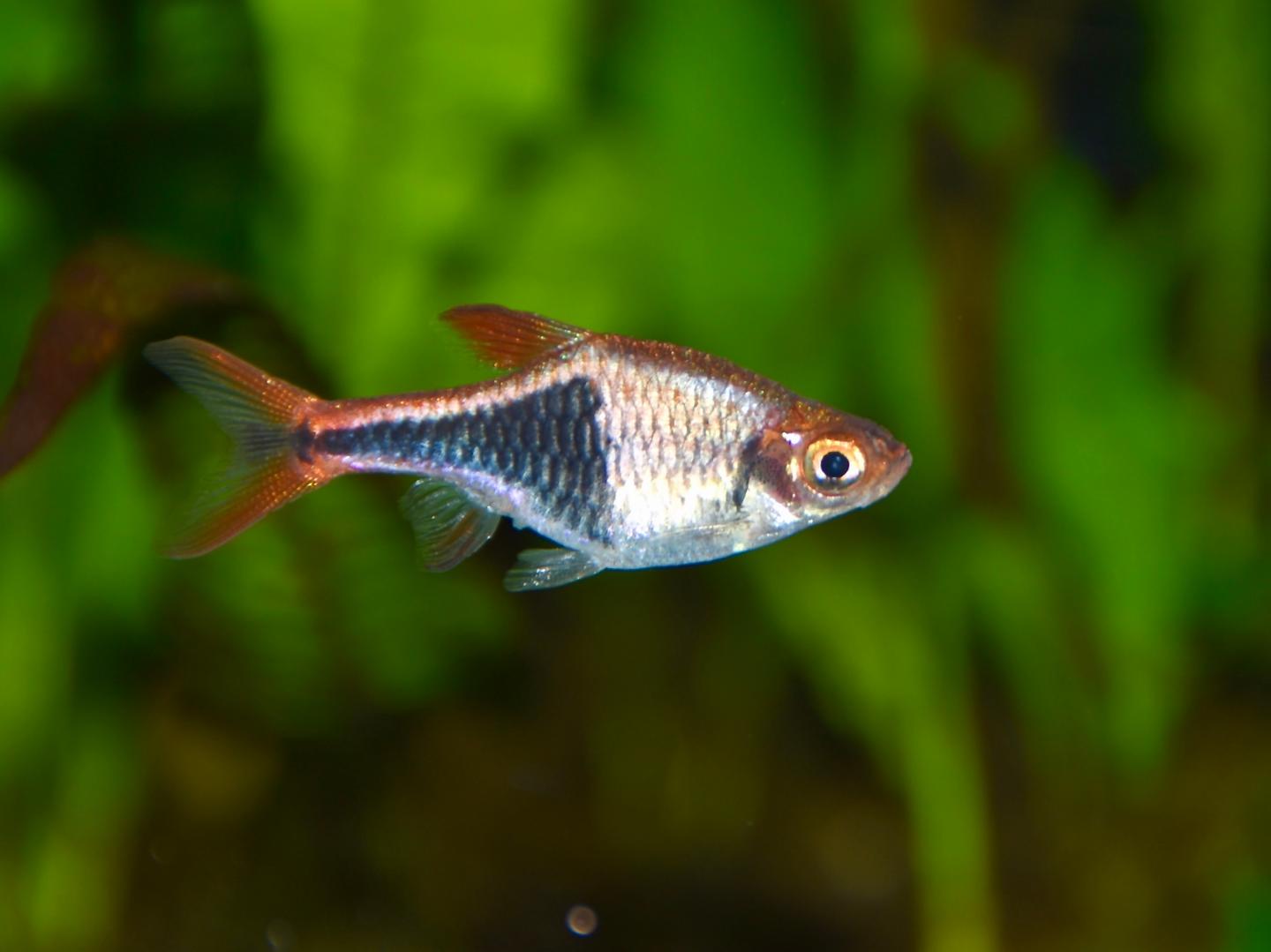
The familiar black triangle is an axine—Greek for wedge. In 2020, its shape, body form and fins helped separate Trigonostigma truncata from true harlequin rasboras.
Peer-reviewed Trigonostigma revisionFishBase compiles 22-25 °C, pH 5-7, 5-12 dGH, 5+ fish and 60 cm aquarium length; these are not tested limits. Our conservative house screen is 60 cm, about 60 L and 8+ fish, with measured source-water matching.
Live stock
Rasboras & Danios for sale — see live stock & today’s prices
Harlequin rasbora care starts with a direct answer: provide one proper group, at least 60 cm of swimming length, mature filtration and measured compatible water. Trigonostigma heteromorpha is usually peaceful, but a small body does not make a new nano aquarium suitable.
Tropical Fish Co sells live fish, so our commercial interest is explicit. Use the live rasbora and danio shop page to check current availability, sale unit and price. The shop owns changing stock information; this evidence page deliberately has no hardcoded product card, SKU, price or availability promise.
- Start with a mature, filtered aquarium at least 60 cm long and about 60 litres under our conservative house policy.
- Keep at least eight harlequin rasboras where the aquarium's total capacity allows; a larger group needs more room.
- Screen measured water against 22-25 °C, pH 5-7 and 5-12 dGH, then compare the retailer's current holding water with your aquarium.
- Treat hiding, isolation, unusual breathing or appetite loss as reasons to test and observe—not as diagnoses.
Is a harlequin rasbora right for your aquarium?
Harlequin rasboras can suit a prepared newer keeper who already understands cycling, testing and social stocking. They are not suitable for a bowl, an unfiltered container or an aquarium declared ready only because a fixed number of weeks has passed. OATA's UK rasbora guidance calls for a filtered aquarium, a shoal and regular water-quality checks; RSPCA guidance likewise makes adequate space, mature biological filtration, heating where needed and testing central to fish welfare[6][7].
| A sensible starting plan | Reconsider or change the plan |
|---|---|
| Repeated zero-ammonia and zero-nitrite results from a mature filter | A new setup judged safe from elapsed time alone |
| At least 60 cm length and about 60 litres for the first group | Bowl, vase or short unstable nano aquarium |
| Eight or more fish under our capacity-conditioned policy | One fish, a pair or a token mixed shoal |
| Measured retailer, tap and aquarium water | “UK tap water” treated as one national water type |
| Calm companions screened at adult size | Predator or territorial fish chosen from a generic list |
Before buying, test ammonia, nitrite, nitrate, pH, GH and temperature. Measure the aquarium's usable swimming length after decor, list every current occupant at adult size and decide where fish could be separated if the combination fails. The first tropical tank guide covers the setup sequence.
Identity, current family, size and natural range
The accepted name is Trigonostigma heteromorpha (Duncker, 1904). Eschmeyer's Catalog places it in order Cypriniformes, family Danionidae and subfamily Rasborinae[1]. It is therefore a danionid rasbora, not a tetra. Older aquarium books and websites often say Cyprinidae or use the former combination Rasbora heteromorpha; those names explain label history but do not replace the current classification.
FishBase records a maximum of 5.0 cm total length[4]. Total length reaches to the end of the tail fin. A paper may instead report standard length, which stops at the tail-fin base, so two numbers cannot be compared until the measurement convention is known. Five centimetres is also a maximum record, not a guaranteed adult size for every fish.
The defensible range is the Malay Peninsula, Singapore, northern Sumatra and nearby Sumatran islands[1][2]. Singapore's current biodiversity account records the species in local freshwater habitat[5]. Do not repeat “southern Thailand to Sumatra” as a simple harlequin range: populations from Narathiwat in southern Thailand south to Terengganu were described in 2020 as the separate T. truncata[2].
Tan's revision associates Trigonostigma with acidic swamp-forest freshwater habitats and redescribes true T. heteromorpha from its type-region evidence[2]. Useful aquarium principles include cover, subdued areas and stable clean water. A planted tank with leaves is not automatically a precise “Southeast Asian biotope”: retail plants, wood, substrate, fish origin and water may come from elsewhere.
Harlequin rasbora vs lambchop, glowlight and truncated rasboras
The bold dark mark is called an axine, a term introduced from the Greek word for wedge in Tan's 2020 revision[2]. Shape matters, but reliable identification uses several characters together. Camera angle, condition, age, selective breeding and lighting can all change apparent proportions.
| Check | T. heteromorpha | T. truncata | T. espei | T. hengeli |
|---|---|---|---|---|
| Body build in the taxonomic key | Deep-bodied; the key gives up to about 35 mm standard length | Shallower body with a more gently sloping head and nape | Smaller, slimmer-looking species | Smaller, slimmer-looking species |
| Black axine | Broad; more than two-thirds of body depth; reaches the caudal-fin base | Broad, but stops about 1-1.5 scales before the caudal-fin base | Shallower mark, no more than half body depth | Shallower mark, no more than half body depth |
| Anal-fin clue | Anterior black streak; orange faint or absent | Orange-red present; humeral streak faint | No anterior black streak | No anterior black streak |
| Colour distribution | Reddish or purplish sheen can occur | Bluish-lilac sheen described in life | Red-orange more broadly through the body | Orange concentrated above and in front of the axine |
| Documented range in the key | Malay Peninsula, northern Sumatra and Sumatran islands | East-coast Malay Peninsula from Narathiwat to Terengganu | Disjunct Thai, Cambodian and Vietnamese records | Central Sumatra and western Kalimantan records |
This is a shopper's screening table, not a substitute for a specimen examination. The peer-reviewed key also uses scale counts, fin positions and other morphology[2]. If a listing says “pork chop” or “lambchop rasbora,” do not automatically map it to harlequin: those names are widely associated with T. espei. Ask for the scientific name and current photographs of the stock.
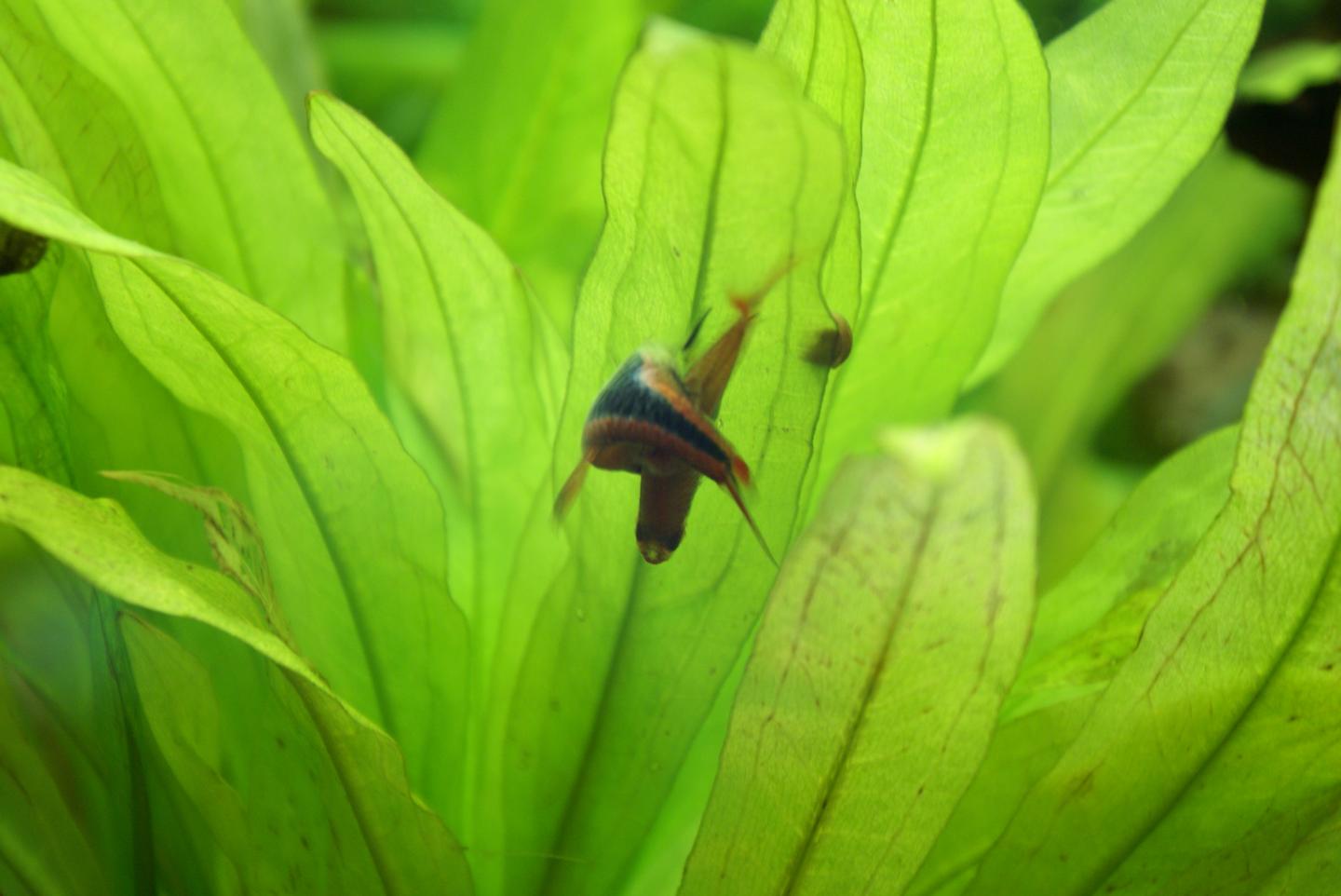
The genus-level feature is not merely decorative. Tan describes Trigonostigma spawning with both fish inverted and eggs attached to the underside of submerged leaves[2]. Harlequins are therefore egg layers, not livebearers. The behaviour helps explain our gallery's leaf posture, but one still photograph cannot establish that eggs were laid.
Tank length, group size and responsible stocking
FishBase compiles a 60 cm minimum aquarium length and a group floor of five or more[4]. OATA likewise treats rasboras as social fish that should be kept in a suitable shoal[6]. These are reference screens, not controlled experiments that discovered one universal welfare threshold.
Tropical Fish Co applies a more conservative starting policy: at least 60 cm length, about 60 litres and eight harlequin rasboras before companions. The 60-litre figure is our capacity screen, not a FishBase fact and not a guarantee that any nominal 60-litre aquarium is suitable.
Usable capacity depends on:
- horizontal swimming space left after decor, internal filters and hardscape;
- mature biological filtration, surface movement and oxygen availability;
- the adult size, territory and group needs of every companion;
- whether all eight fish can reach correctly sized food;
- temperature, maintenance routine and summer heat; and
- a mature separation plan for aggression, predation or disease.
Where practical, add the intended group together after any required quarantine rather than keeping two fish and repeatedly adding newcomers. A larger group may look more cohesive, but “more is better” ends when crowding, food competition or water quality deteriorates. Do not split limited space among several token shoals merely to increase variety.
The stocking calculator below can expose obvious conflicts, but it cannot assess hierarchy, infection risk, actual filter maturity or swimming geometry. Treat its output as one checkpoint, never as permission to fill every theoretical unit.
Stocking Calculator
Check if your tank can support this species at a healthy bioload.
Open tool →Water, heater and UK tap-water decisions
FishBase compiles 22-25 °C, pH 5-7 and 5-12 dGH for aquarium keeping[4]. These values come through secondary aquarium references. They are not an experiment that exposed every population or commercial strain to every limit, so a reading just inside the range is not proof of safety and one just outside is not a diagnosis.
Use those numbers as our routine screen, then compare the exact retailer's holding water with your tested aquarium. Ask for temperature, pH and hardness close to dispatch; test your tap and aquarium; compare GH and KH as well as pH; and make necessary adjustments gradually.
There is no single “UK tap water.” The Drinking Water Inspectorate explains that hardness varies according to geology and supply, and suppliers publish regulated results for their areas[9][10]. A report is helpful context, but the water entering a home can vary or pass through private plumbing and treatment. Measure the water you will actually use.
Avoid fixed reverse-osmosis-to-tap recipes. Starting GH, KH, sodium, source treatment and remineralisation products differ. Domestic ion-exchange softeners can also change water chemistry in ways that do not make the output equivalent to naturally soft water; DWI recommends retaining an unsoftened drinking-water supply in relevant installations[11]. The water chemistry guide explains GH, KH, pH and measured adjustment.
Use a thermostatically controlled aquarium heater unless repeated measurements show the water remains within 22-25 °C year-round. Verify the water with an independent thermometer, because the heater dial is a setting rather than a measurement[7]. During hot weather, also watch maximum temperature, breathing and surface movement; a heater cannot cool an overheated aquarium.
Water Parameter Matcher
Enter your tap water readings to see if this species will thrive.
Open tool →Planted layout, filtration, flow and light
A practical layout offers cover around the sides and rear plus an open horizontal midwater lane. Broad-leaved and fine-leaved plants can both contribute shelter; wood or other aquarium-safe structures can interrupt sight lines. Leave enough clear area for the whole group to spread, turn and feed.
Use filtration sized for the aquarium's real bioload and maintain surface movement. Gentle-to-moderate circulation is a sensible starting point: avoid a stagnant corner, but do not force every fish to hold position against a concentrated jet. Protect intakes that could trap a small fish and keep maintenance accessible after plants grow.
Cycle the aquarium and prove biological function through results, not a four- or six-week calendar rule. OATA advises zero ammonia and nitrite, regular testing and water changes appropriate to the measured result[6]. RSPCA guidance also treats mature filtration and water testing as essential[7]. Plants can assist a system, but planting alone does not prove it is cycled.
Subdued areas may reflect the species' swamp-forest context, and a dark background can make the copper body easier to see. Still, colour is not a direct welfare meter. Harsh continuous light can reduce cover use, while very low light may not suit selected plants. Use a consistent day-night schedule, provide shade and judge fish behaviour alongside water tests rather than promising that one light duration produces better colour.
Leaves and tannins are optional tools, not requirements or medicines. Use aquarium-safe material from a traceable source; added botanicals can affect colour, pH, oxygen demand and maintenance. Do not drop an unmeasured collection of leaves or cones into an occupied tank to chase a “blackwater” label.
Feeding harlequin rasboras without a rigid menu
FishBase records worms, small crustaceans and insects in the wild diet[4]. That supports offering animal-based variety at a suitable scale; it does not demonstrate that aquarium fish can thrive on frozen prey alone or that one brand or feeding frequency is uniquely correct.
Use a reputable, suitably small complete aquarium food as the staple. Fine flakes or micro-granules may work if the product is nutritionally complete and every fish can swallow them. Safe, appropriately sourced frozen or cultured live items can add variety where they fit the overall diet. Do not collect live food from an unknown pond.
A useful feeding check is to:
- distribute food across the group instead of making one crowded point;
- watch the smallest or least assertive fish receive a fair share;
- use particles swallowed without repeated spitting;
- remove recurring leftovers and reduce the next portion; and
- reassess after adding faster companions or changing temperature.
OATA recommends small feeds consumed promptly and warns that excess food degrades water quality[6]. That is group-level husbandry advice, not an exact-species twice-daily trial. Follow the complete food's label, then adjust from body condition, feeding response and water results. A sudden refusal to eat alongside isolation, rapid breathing or balance change calls for a health and water check, not richer food.
Tank mates, bettas and shrimp
Harlequin rasboras are generally peaceful, but the word peaceful is not a compatibility guarantee. Select companions by adult body and mouth size, measured water, activity, territory, social-group size, feeding speed and the aquarium's total footprint.
Potentially workable categories include calm small rasboras, some small tetras and carefully selected bottom fish. Each exact species still needs its own screen. For example, Corydoras care varies by species and temperature; “corydoras” is not one universal requirement. A mixed-origin community can be responsible if the animals' actual needs overlap—it should not be marketed as a geographic biotope.
Avoid fish capable of swallowing a 5 cm total-length rasbora, persistent fin-nippers, highly territorial species and companions that prevent the group from feeding. Check adult size, not the juvenile size in a shop. Prepare a mature backup aquarium because an apparently calm pairing can change with growth, spawning condition or rearranged territory.
A betta and harlequin group may coexist, but “best betta tank mate” is too certain. Individual bettas vary, and the combination needs enough space for surface territory and midwater swimming, visual cover, compatible measured water and feeding access. Watch for stalking, repeated flaring, chasing, torn fins, hiding or missed meals. Separate promptly if welfare deteriorates.
No fish is completely shrimp-safe. Adult Amano or larger Neocaridina shrimp may coexist, while shrimplets and small vulnerable individuals can be eaten. Plants reduce exposure but cannot guarantee survival. Also compare the shrimp's mineral needs with the softer, acidic side of the rasbora screen before combining them.
Sex, leaf spawning and the lifespan question
Do not promise the sex of ordinary retail juveniles from colour or body shape alone. Mature females may look fuller and males may appear slimmer or more intensely coloured, but age, feeding, health, viewing angle and selective breeding can produce the same impressions. A 2026 comparative survey found small dark breeding tubercles on the dorsal side of the pectoral fins in examined male T. heteromorpha[3]. That is a microscopic or close-examination research observation, not permission to sex every juvenile or retail photograph by eye.
The genus is unusual among familiar aquarium cypriniforms because a pair can invert under submerged leaves and attach eggs beneath them[2]. FishBase also records underside-of-leaf egg placement for T. heteromorpha[4]. These sources establish the behaviour, not a guaranteed household recipe.
Breeding is advanced work. A responsible attempt needs a separate mature system, measured water, controlled light and temperature, a plan to protect eggs and larvae, suitable first food and permanent homes for juveniles. Do not use an exact pH drop, fixed egg count or calendar hatch time copied from an unrelated setup as a promise. An inverted fish in a photograph is not proof that eggs are present, and absence of spawning is not evidence of poor health.
The authoritative sources reviewed here do not establish a reliable fixed normal captive lifespan. Repeated claims of “five to six years” generally omit exact-species cohort data, age at purchase and survival methods. Plan for a long-term commitment, but do not turn an unsourced estimate into a guarantee. Genetics, origin, transport, infection history and husbandry all affect survival.
Health, quarantine, arrival and responsible buying
A settled fish should maintain balance, move with or near the group, breathe without obvious effort, hold its fins normally and respond to suitable food. Persistent isolation, gasping, clamped fins, spots, wounds, swelling, weight loss, erratic swimming or appetite loss are warning signs, not diagnoses[8].
Test ammonia, nitrite, nitrate, pH and temperature first. Check oxygenation, heater operation, filter flow, recent cleaning, new livestock, feeding and aggression. Similar signs can have different causes, so this guide deliberately gives no generic salt, heat or medicine dose. UK medicine rules apply, and an incorrect treatment can delay diagnosis or harm fish[14].
Quarantine new fish in a separate mature system with dedicated equipment. The MSD Veterinary Manual recommends at least 30 days in professional biosecurity guidance and longer when circumstances require[12]. That is general veterinary guidance rather than a harlequin-specific experiment. If illness is suspected, use OATA's UK fish-vet directory and follow qualified advice[13].
Check the live rasbora and danio shop page for current availability. This guide never promises that T. heteromorpha is in stock. Before ordering, confirm:
- the live listing gives the exact scientific name rather than only “harlequin”;
- the sale unit states whether the price covers one fish or a group;
- current holding temperature, pH and hardness are available;
- origin is described only to the level documented for that batch; and
- delivery coverage, guarantee and reporting deadlines are understood.
Prepare and test the aquarium before dispatch. Our current delivery information says to keep the bag sealed and float it for 20-30 minutes before release; follow the instructions supplied with the order. Do not replace that specific instruction with a generic open-bag drip timer. Transport water changes during a journey and may differ from the aquarium, so chemistry-aware receiving matters[15]. Minimise delay and follow the seller's current method.
Document the unopened package and fish condition on arrival. Observe breathing, balance and injury, keep lighting subdued, and report serious concerns through the current order channel within its stated time. Customer-service messages, feedback and emails are not ecommerce leads or conversions.
Never release harlequin rasboras, other aquarium livestock, plants, pathogens or aquarium water outdoors, into drains, ponds or natural watercourses. UK government guidance explains controls on releasing non-native animals, while OATA warns against releasing aquarium organisms[16][6]. If circumstances change, arrange responsible permanent care or rehoming through a reputable retailer, aquarium society or experienced keeper.
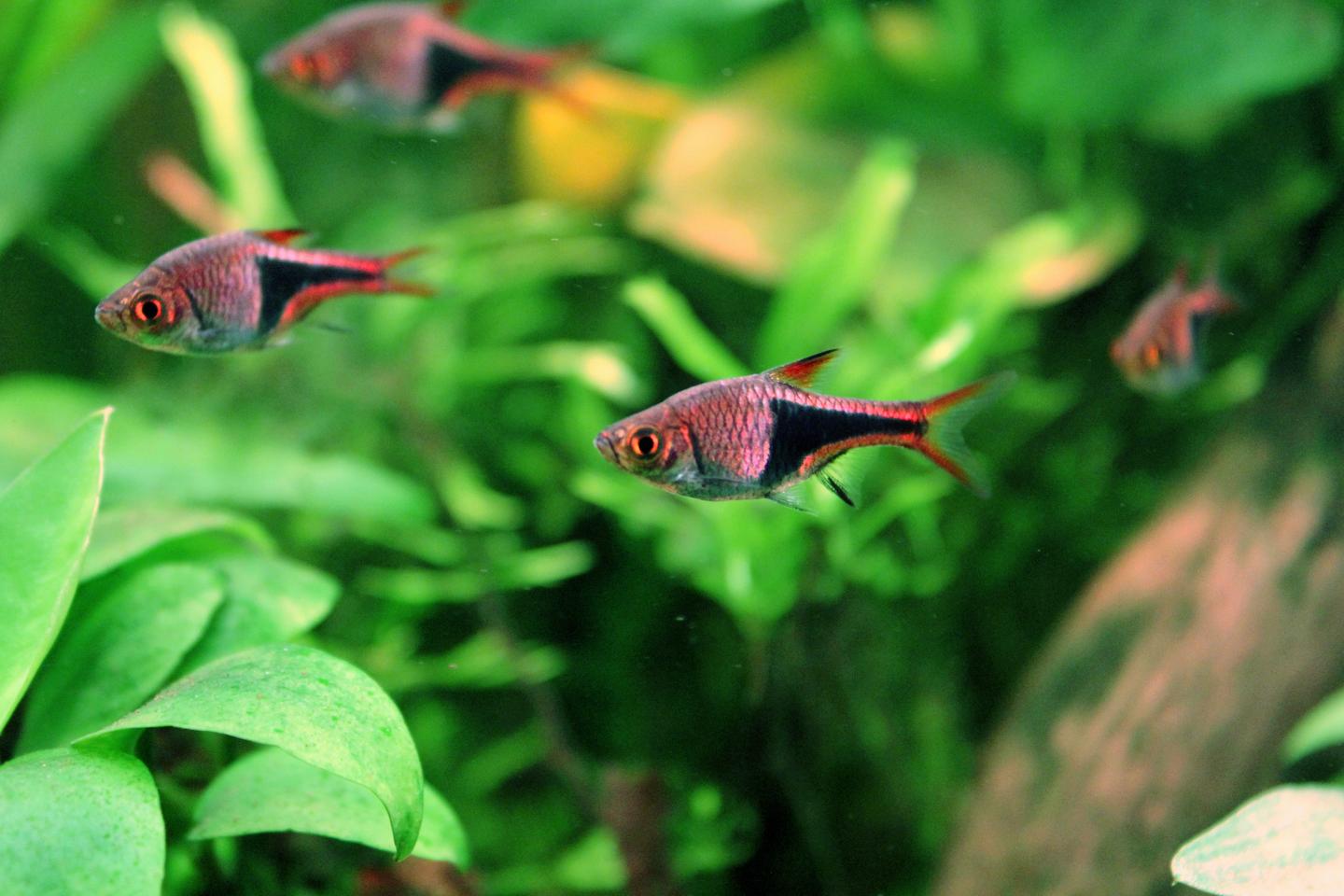
Harlequin rasbora group and leaf posture
Frequently asked questions
Shop Rasboras & Danios & related
From this care guide straight into our UK live-fish catalogue.
Tetras
Premium Tetras for sale UK — Cardinal, Ember, Black Neon, Rummy Nose, Serpae, Diamond, Glowlight and more. Peaceful community schoolers.
African Cichlids
Explore African cichlids and compare their adult needs, supplied sizes and current prices. Distinguish Rift Lake species from riverine fish before choosing.
South American Cichlids
South American Cichlids for sale UK — Apistogramma, Rams, Oscars, Severums, Geophagus, Pikes, Discus and Angelfish.
Catfish & Plecos
Corydoras, Bristlenose, L-number plecos, Synodontis and Otocinclus for clean-up and character — supplied and adult size on each listing so the tank fits.
Livebearers
Livebearer fish for sale UK — Guppies, Mollies, Platies, Swordtails, Endlers, Limias. Easy-breeding community favourites.
Gouramis & Labyrinth Fish
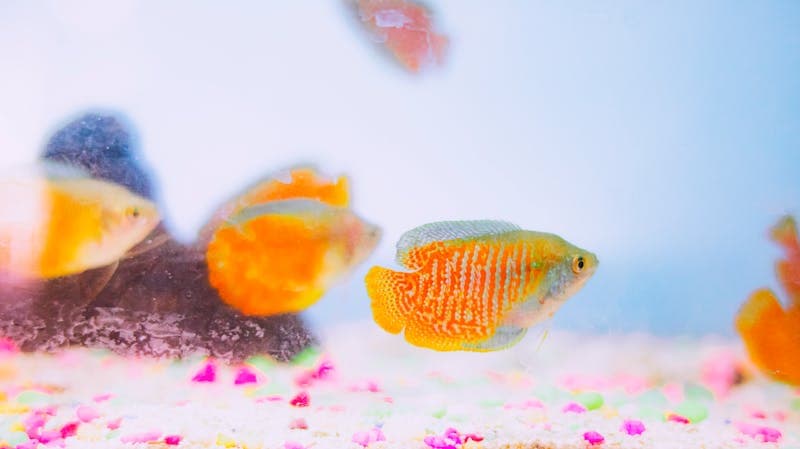
Gouramis and labyrinth fish for sale UK — Pearl, Dwarf, Honey, Kissing, Giant and rare species. Peaceful surface-breathers.
Barbs
Aquarium barbs for sale UK — Cherry, Tiger, Rosy, Denison, Gold, Odessa. Hardy community fish, perfect for beginners.
Sources & further reading
Material factual claims cite the sources below; store policy and cautious inference are labelled in the article. Sources are grouped by type so you can judge their weight at a glance.
Peer-reviewed study (2)
- [2]Tan, H. H. (2020). Trigonostigma truncata, a new species of harlequin rasbora from Malay Peninsula (Teleostei: Danionidae). Raffles Bulletin of Zoology. DOI: 10.26107/RBZ-2020-0058. View source
- [3]Xu, Z. et al. (2026). 5α-Reductase underscores the development of pectoral fin breeding tubercles in zebrafish. Communications Biology. DOI: 10.1038/s42003-026-10140-z. View source
Scientific database (2)
- [1]Fricke, R., Eschmeyer, W. N. & Van der Laan, R. (eds.). Eschmeyer's Catalog of Fishes: Trigonostigma heteromorpha. California Academy of Sciences. View source
- [4]
University extension (1)
- [15]Cole, B. E. (1999). Shipping practices in the ornamental fish industry. Center for Tropical and Subtropical Aquaculture. View source
Veterinary reference (1)
- [12]
Animal-welfare charity (2)
- [7]Royal Society for the Prevention of Cruelty to Animals. Choosing an aquarium for pet fish. RSPCA. View source
- [8]
Trade-body guidance (2)
- [6]
- [13]
Government / regulatory (6)
- [5]
- [9]Drinking Water Inspectorate. Water hardness and hard water. Drinking Water Inspectorate. View source
- [10]
- [11]Drinking Water Inspectorate. Domestic water filters and softeners. Drinking Water Inspectorate. View source
- [14]Veterinary Medicines Directorate. Exemption from authorisation for medicines for small pet animals. GOV.UK. View source
- [16]Department for Environment, Food & Rural Affairs. Guidance on section 14 of the Wildlife and Countryside Act. GOV.UK. View source
Spotted something that needs a fix?
Fishkeeping moves fast and we want every guide spot-on. If you think something here is wrong, out of date, or could be clearer, tell us — our team reads every message and updates the page.
Suggest an edit
Tropical Fish Co Editorial Team
Evidence-led aquarium editorial team
The Tropical Fish Co editorial team compiles care guidance from the sources cited on each page, separates published evidence from practical husbandry policy, and checks retail links against the current catalogue. First-hand experience is included only when a named contributor and the observation have been verified.
Keep exploring
Shop related
- Tetras
Premium Tetras for sale UK — Cardinal, Ember, Black Neon, Rummy Nose, Serpae, Diamond, Glowlight and more. Peaceful community schoolers.
- African Cichlids
Explore African cichlids and compare their adult needs, supplied sizes and current prices. Distinguish Rift Lake species from riverine fish before choosing.
- South American Cichlids
South American Cichlids for sale UK — Apistogramma, Rams, Oscars, Severums, Geophagus, Pikes, Discus and Angelfish.
- Catfish & Plecos
Corydoras, Bristlenose, L-number plecos, Synodontis and Otocinclus for clean-up and character — supplied and adult size on each listing so the tank fits.
Care guides
- Celestial Pearl Danio Care Guide: Tank, Group and Water
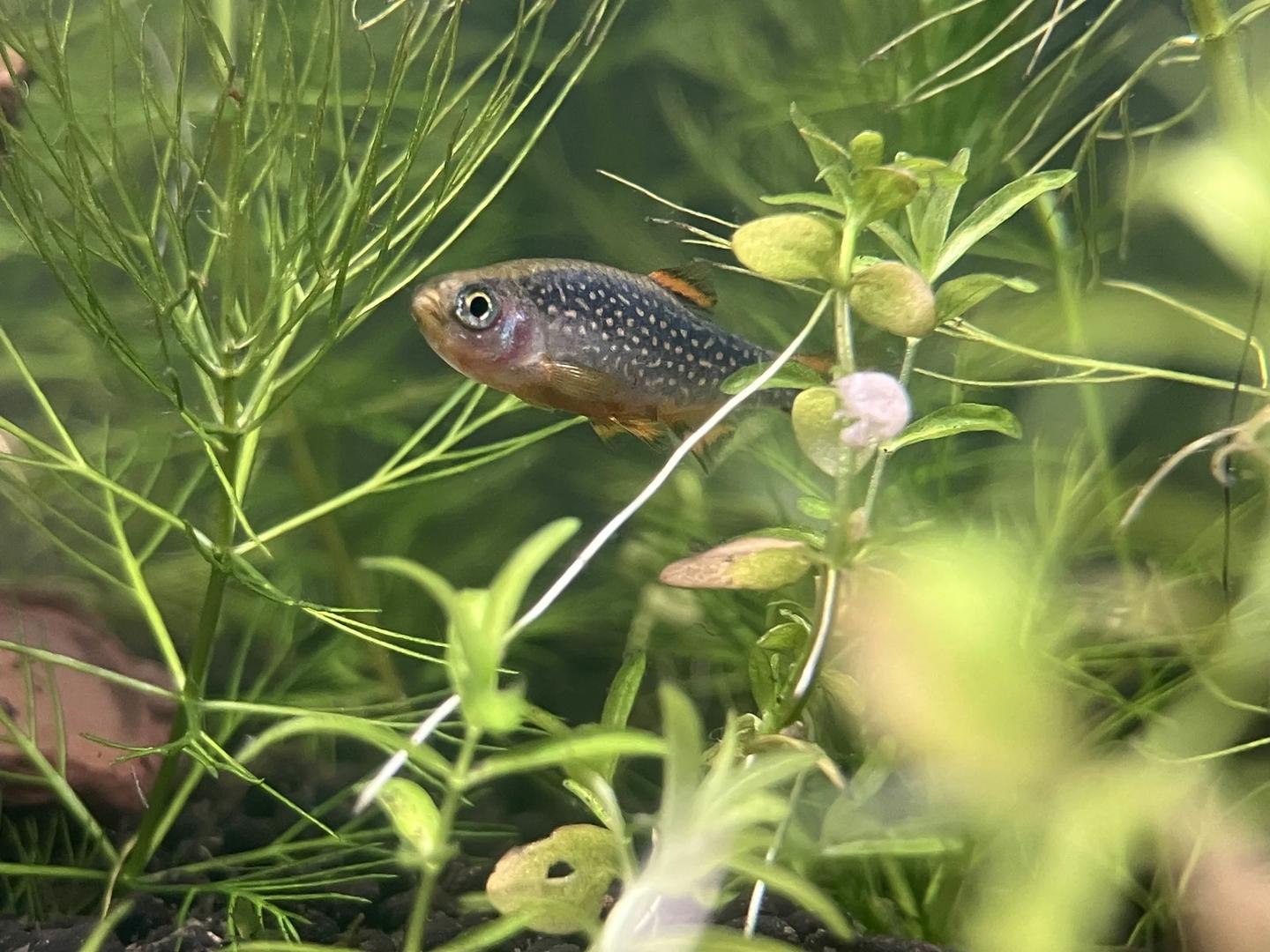
Celestial pearl danio care for UK aquariums: 45 × 30 cm footprint, 20–26°C water, group behaviour, food, shrimp risk, sexing and breeding.
- How to Set Up a Tropical Fish Tank: 10 Safe Steps
Set up a tropical fish tank in 10 evidence-led steps: choose the tank, install filter and heater, cycle safely, test the water and add fish carefully.
- Aquarium Water Parameters: What to Test and Why
Learn which freshwater aquarium water parameters to test, how to read ammonia, nitrite, nitrate, pH, GH and KH, and when a result needs action.
Related care guides
Celestial Pearl Danio Care Guide: Tank, Group and Water
Plan a mature, densely planted aquarium with at least a 45 × 30 cm base for a social group. Use 20–26°C, pH 6.5–7.5 and 5–15 dGH as published screening ranges, then hold a stable value inside the overlap for every animal in the tank.
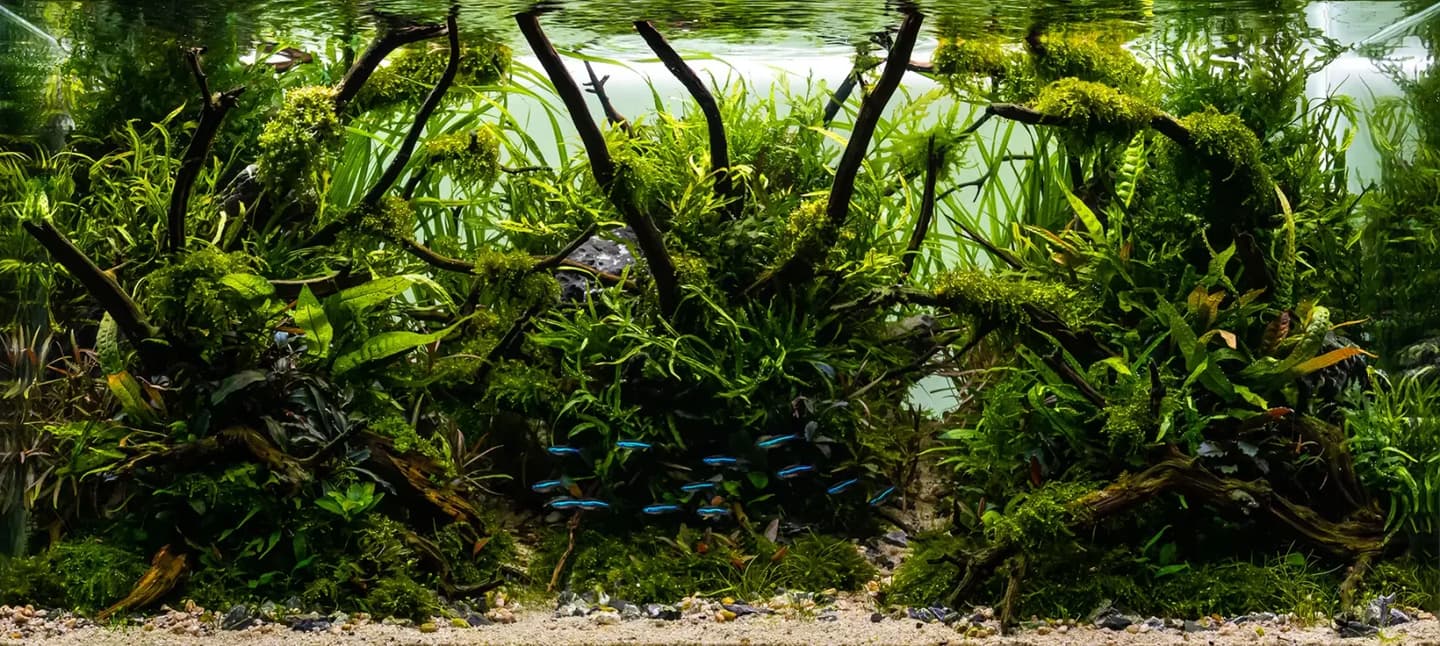
How to Set Up a Tropical Fish Tank: 10 Safe Steps
Choose the intended fish before the aquarium, place the tank on a suitable level support, install a filter and thermostatic heater, condition and test the water, then complete a fishless cycle. Add fish only after the chosen maturation process reaches its defined endpoint and repeated tests show zero ammonia and zero nitrite; elapsed days alone do not prove readiness.
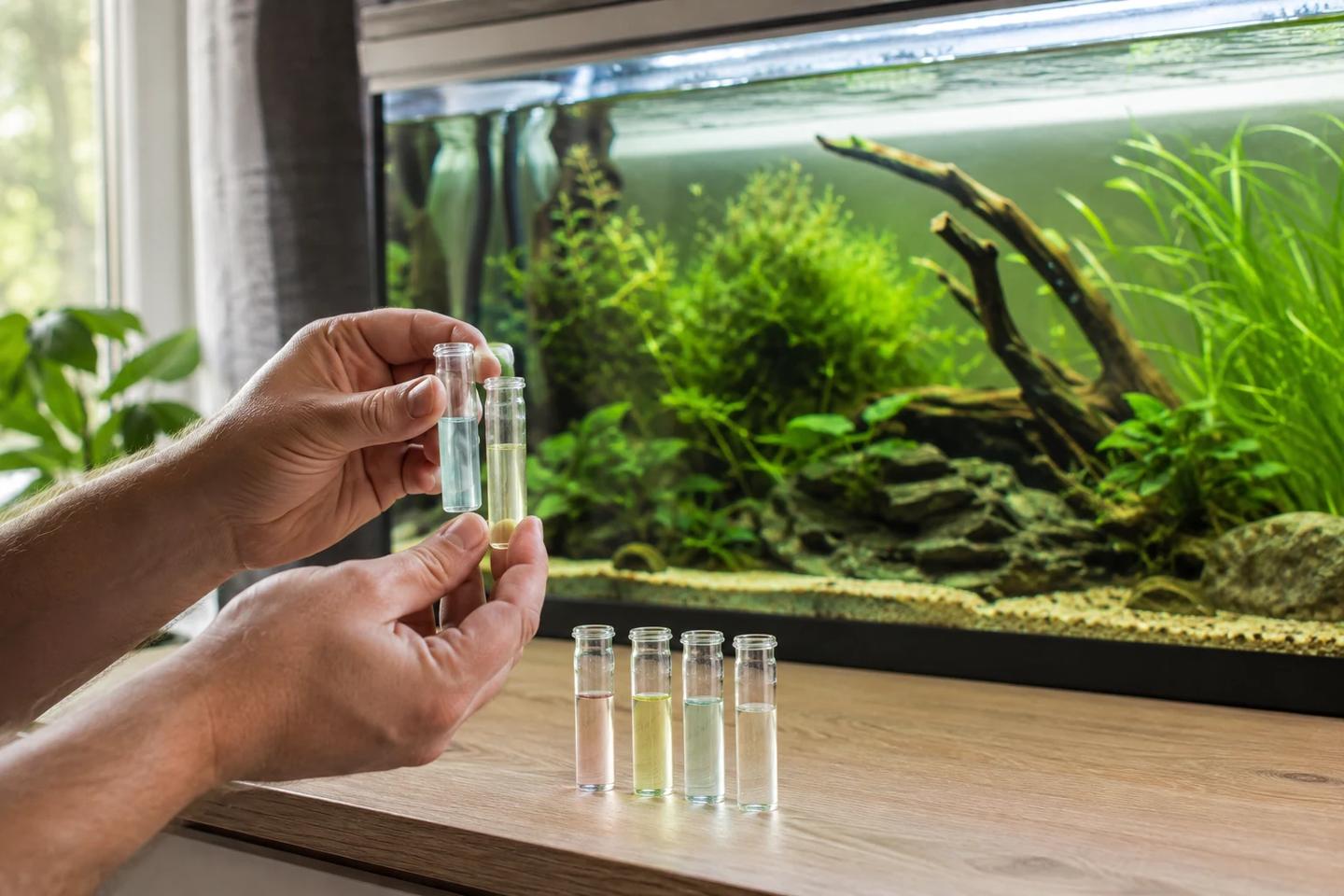
Aquarium Water Parameters: What to Test and Why
There is no universal set of perfect freshwater aquarium parameters. Identify the animals, learn what the test and unit actually report, establish your local source-water baseline, and compare repeat measurements. In an established aquarium, a confirmed ammonia or nitrite detection needs investigation; pH, GH, KH, temperature and nitrate decisions depend on the species, life stage and whole system.