
Amano Shrimp Care Guide

Start with a mature, filtered aquarium. OATA's broad UK guidance suggests approximately 20 litres for Amano Shrimp and at least five for social shrimp, with a larger aquarium when fish are present. Treat those as cautious planning screens—not biological minima or a per-litre formula. Match the complete adult community, test your water, protect the filter inlet and never buy them as a guaranteed algae cure.
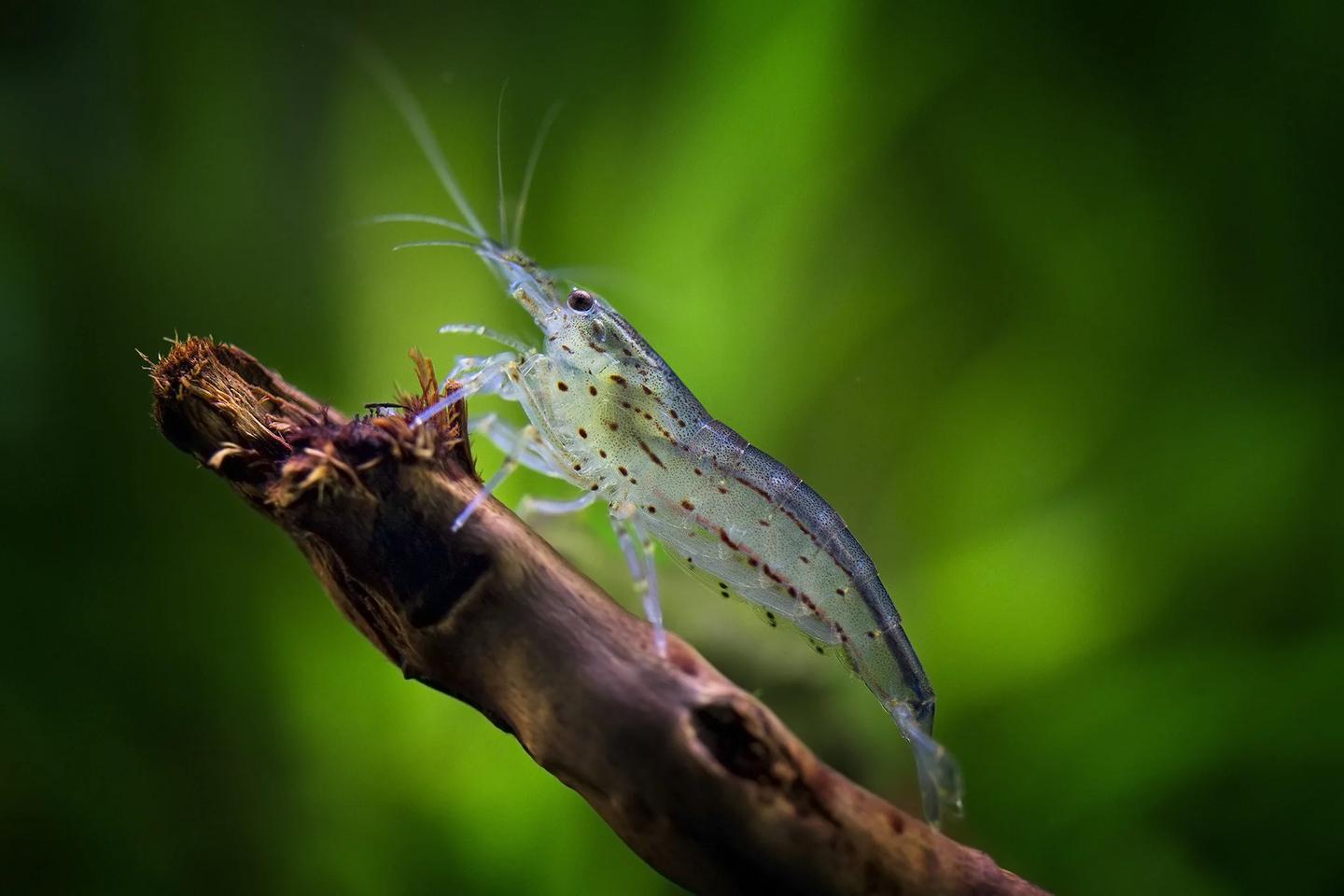
Amano Shrimp adults live in freshwater, yet a controlled larval study found juvenile development across saline treatments of 17–34 ppt—a life-cycle split that explains why eggs do not mean easy freshwater breeding.
Peer-reviewed larval salinity studyThe 17–27°C, pH 6.5–8, 4–18 dGH, approximately 20-litre and five-shrimp figures come from OATA's broad UK shrimp-and-snail guidance, not controlled Caridina multidentata tolerance or density trials. Use a larger aquarium with fish, compare the seller's measured holding water and keep changes gradual.
Start with a mature, filtered aquarium and a planned group, not a shrimp-per-litre calculator. OATA's broad UK guide suggests an aquarium of approximately 20 litres for Amano Shrimp, says social shrimp should usually be kept in groups of at least five, and advises a larger aquarium when fish are included[7]. Those are cautious planning screens, not controlled Caridina multidentata minima or proof that five fit every 20-litre setup.
The guide and the shop have different jobs. This page explains long-term care. For current availability and prices, use the separate Amano Shrimp shop page or shrimp and crustacean shop hub. A care photograph does not prove that the pictured animal, size or pack is in stock.
- Confirm the scientific name is Caridina multidentata, not only “Amano-like” or an old trade label.
- Use a mature filter and measured zero ammonia and nitrite before adding shrimp.
- Start the plan at approximately 20 litres and five shrimp under OATA's broad guidance, then increase space for fish and the full adult community.
- Provide cover, protected filter intakes, established grazing surfaces and appropriate food.
- Treat every fish pairing and every medicine as a risk decision, not a “safe” list.
Identity: Amano Shrimp and Caridina japonica
The accepted name is Caridina multidentata Stimpson, 1860, in the family Atyidae. Cai and colleagues re-examined the type material and concluded that the familiar older aquarium name Caridina japonica is a junior synonym[1]. DecaNet and NCBI both use C. multidentata as the current name, with NCBI listing C. japonica as a synonym[2][3].
The 2006 revision records the main islands of Japan, Ogasawara and Ryukyu Islands, Taiwan, Fiji and Madagascar, and describes the species from large rivers with big rocks on the substrate[1]. That distribution record does not mean a shop specimen is wild-caught from any named place. Ask the seller what is known about the actual batch.
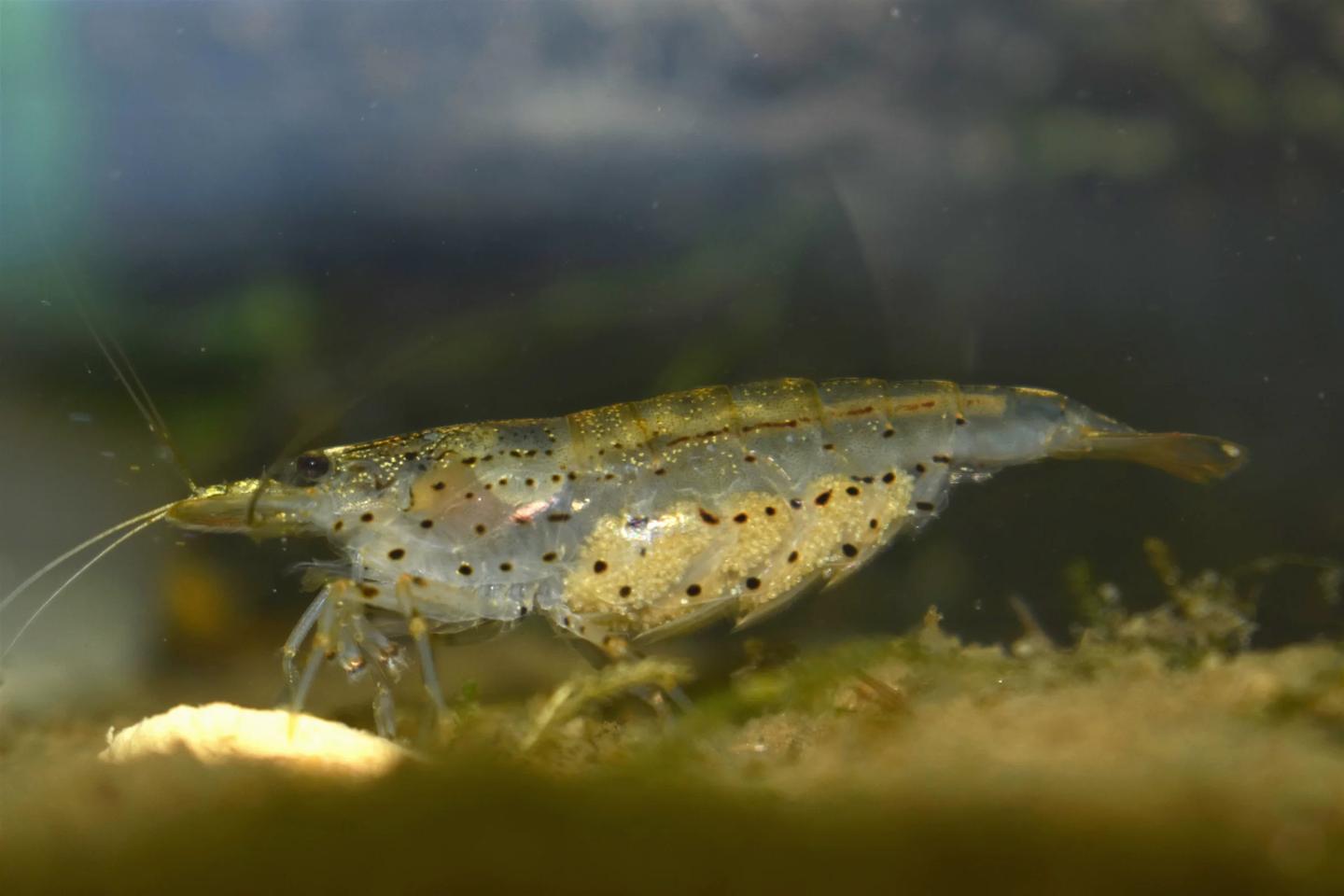
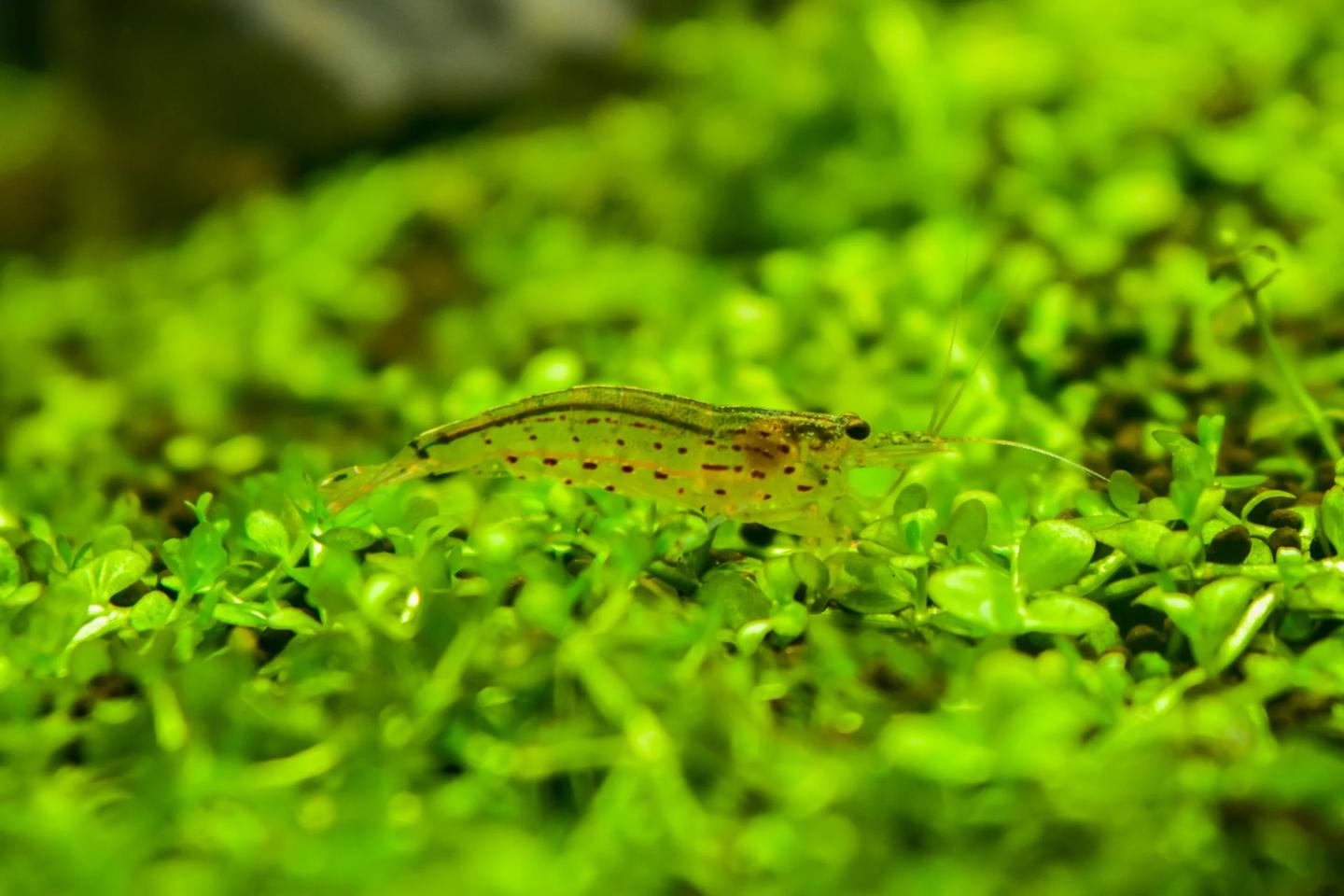
Source-labelled aquarium photographs can help show the translucent body and lateral dots or dashes, but those marks alone do not authenticate a shipment. Identity should begin with the supplier's scientific name and traceable stock information.
Tank size and group: no per-litre formula
OATA's broad invertebrate guide recommends approximately 20 litres for larger shrimp such as Amanos and at least five for social shrimp[7]. It also says the tank should be larger with fish. The source combines several shrimp and snail groups, so this page does not promote “one Amano per four litres”, “eight in 40 litres” or any other universal density equation.
Plan in this order:
- Confirm biological filtration is mature for the intended load.
- Measure real usable water and footprint after substrate, wood and equipment.
- Reserve cover and feeding access for a group of at least five under the broad OATA screen.
- Add every adult fish, snail and other shrimp to the capacity decision.
- Leave headroom for feeding, maintenance errors and summer temperature.
One surviving shrimp does not create an emergency purchase. Test the system and understand why the group was lost or reduced before adding more animals. Conversely, reaching five does not make an overcrowded aquarium suitable.
Starting with a litre label, multiplying by a shrimp ratio and ignoring fish. Filtration, footprint, mature biomass, grazing area, feeding competition and adult tank mates do not scale through one simple number.
Water and temperature in a UK aquarium
OATA's general shrimp-and-snail table gives 17–27°C, pH 6.5–8 and 4–18 dGH, with ammonia and nitrite at zero[7]. Use those as broad UK trade guidance, not a controlled species-specific tolerance experiment.
| Evidence | Temperature | pH | General hardness | Correct use |
|---|---|---|---|---|
| OATA shrimp-and-snail guide | 17–27°C | 6.5–8 | 4–18 dGH | Broad captive guidance; check the actual species and seller water |
| Ohara laboratory reproduction study | 20, 23 and 26°C treatments | not a care range | not a care range | Evidence about reproduction under those test conditions, not a universal adult target |
| Your source and aquarium | measured | measured | measured | Compare before purchase and avoid abrupt change |
In the reproduction study, females laid eggs at all three tested temperatures, but C. multidentata hatching rates were low at 26°C and newly hatched larvae per female declined as temperature increased[5]. That result is useful evidence that temperature affects biology; it does not prove a single ideal household setting or justify pushing an established aquarium rapidly to 20°C.
UK tap water is not one chemistry. The Drinking Water Inspectorate explains that hardness varies with geology and supply and directs customers to their water company for local information[9]. Test the aquarium as well: substrate, rocks, top-ups and water treatment can change it. A domestic ion-exchange softener replaces calcium and magnesium with sodium, so “softened” does not automatically mean suitable for shrimp[10].
Water Parameter Matcher
Enter your tap water readings to see if this species will thrive.
Open tool →Aquarium setup: mature surfaces, cover and safe flow
“Mature” means the biological filter can process the planned waste and testing confirms ammonia and nitrite remain at zero—not that a calendar reached a fixed number of weeks. OATA recommends testing and warns that stocking too quickly can overwhelm the bacterial population[8].
Provide aquarium-safe wood, rock and planting or other structure that creates grazing surfaces and sheltered areas. Protect filter intakes with an appropriate guard so shrimp cannot enter or become trapped, and keep access for inspection and cleaning. A secure cover also reduces escape risk; seal cable and pipe gaps without blocking required ventilation.
A 2025 laboratory choice study found that C. multidentata preferred a current and avoided light in the tested apparatus[6]. This supports offering flowing water and shaded options, but it does not prescribe a filter turnover rate or lighting schedule. Maintain gas exchange, avoid blasting the animals around the aquarium, and give them a choice of exposed and sheltered surfaces.
Feeding and honest algae expectations
Amano Shrimp graze surfaces and are used as nuisance-algae helpers, but they are animals, not maintenance equipment. OATA says shrimp can help control nuisance algae and warns that overfeeding leaves waste that degrades water quality[7]. Neither point establishes that one shrimp will clear hair algae, black beard algae or a whole aquarium on schedule.
Use a suitable complete sinking food as the nutritional base, then provide appropriate variety according to the food maker and the rest of the community. Watch whether every shrimp reaches food. Remove recurring excess and adjust the amount rather than assuming the shrimp will consume all leftovers.
If algae is increasing, investigate the system:
- lighting duration and intensity;
- decaying material and uneaten food;
- plant growth and nutrient balance;
- maintenance and water-test trends;
- whether the “algae” has been identified correctly.
Shrimp may graze some of it while ignoring other growth. Correct the underlying conditions and continue feeding the animals; a spotless-looking aquarium is not evidence that they no longer need nutrition.
Tank mates: risk-screen every adult animal
OATA warns that freshwater shrimp may be eaten by common aquarium fish and advises against fish able to fit them in the mouth or known predators[7]. Mouth size is only the first screen. A fish can injure, chase or outcompete a shrimp without swallowing an adult, and a newly moulted animal may be more exposed.
Compare:
- adult body and mouth size, not juvenile shop size;
- predatory, territorial and foraging behaviour;
- temperature, pH and hardness overlap;
- feeding speed and whether shrimp can access food;
- hiding choices without trapping the animal;
- group requirements and the actual footprint;
- a workable separation plan if behaviour changes.
Related Neon Tetra, Honey Gourami, Betta and Corydoradinae guides can help compare requirements; none is an endorsement or a promise of shrimp safety. Individual behaviour and aquarium design still matter.
Moulting, hiding and health checks
Shrimp shed an exoskeleton as they grow. OATA notes that an empty moult can resemble a dead shrimp[7]. Do not diagnose an animal from one shell or from hiding alone. Check whether the shrimp itself is present, observe movement and feeding, and review the entire environment.
When behaviour changes:
- Measure temperature, ammonia and nitrite immediately, then review nitrate, pH and hardness in context.
- Check filters, heaters, aeration and recent maintenance.
- Review new animals, plants, decor, food, sprays and treatments.
- Compare the affected shrimp with the rest of the group.
- Record photographs and times; seek specialist aquatic or veterinary help when signs persist or are severe.
OATA provides a UK fish-vet directory[12]. A page cannot distinguish a normal moult, failed moult, poisoning, predation or disease from “lying on its back”, colour or disappearance alone.
Copper and medicines: read the actual label
Copper toxicity is real, but an absolute internet threshold is not. Ravaux and colleagues measured an acute median lethal concentration of 1.15 mg/L under their particular laboratory conditions and found that sublethal pre-exposure impaired food-odour detection[6]. LC50 means the concentration associated with 50% mortality in that experiment. It is not a safe household target and cannot be copied across water chemistry, exposure time, product formulations or mixed invertebrates.
Before any treatment:
- identify the problem rather than medicating from one symptom;
- read the current product particulars and every invertebrate warning;
- check compatibility with all animals in the system;
- never improvise a half dose or mix treatments;
- obtain qualified advice when the diagnosis or product choice is unclear.
The VMD Product Information Database holds current information for authorised veterinary medicines in Great Britain and Northern Ireland[11]. It does not make an unspecified aquarium remedy safe for shrimp. Follow the exact current label and professional direction where relevant.
Breeding: freshwater adults, saline larval development
Seeing eggs does not mean a freshwater colony will follow. C. multidentata is amphidromous: adults occupy freshwater, while larvae develop through a saline phase. In a controlled experiment, larvae completed development to juveniles across 17–34 ppt treatments under the study's particular temperature and culture conditions[4]. OATA consequently describes Amano breeding as requiring a specialised brackish setup and specific larval food[7].
This page deliberately gives no “set salinity to X on day Y” recipe. The research tested combinations under laboratory management; home water source, mixing accuracy, larval density, food culture, temperature and water quality can change the result. A community aquarium is not a controlled larval system.
An egg-carrying female can still be observed without treating her as a production project. Avoid unnecessary disturbance, keep the adult freshwater environment stable and understand that larval survival requires separate specialist planning.
Arrival, biosecurity and acclimation
Prepare the mature aquarium before purchase and ask the seller for measured holding temperature and water chemistry. Compare those values with your aquarium so that any transition is condition-led. There is no universal drip time that works for every journey, bag condition and water difference; follow the seller's current animal-specific arrival instructions.
Keep transport water out of the display where the seller's method advises, use dedicated wet equipment where practical and monitor new arrivals closely. Cefas professional guidance records water quality, health observations, movements and disinfection as core aquatic biosecurity controls[14]. Those principles support careful separation and hygiene, but they do not create a universal household quarantine duration.
The cited English licensing guidance places environmental-conditions and water-quality advice in its fish section; it does not establish the same shrimp-specific statutory duty[13]. Still ask the seller for current batch conditions before buying; measured information is more useful than an old generic dispatch promise.
Never release shrimp, aquarium water, plants or equipment contents into a pond, river or drain that can reach the wild. The GB Non-native Species Secretariat's pet code recommends secure rehoming or suitable disposal instead[15].
Before you buy
- Confirm Caridina multidentata and ask what is known about the batch.
- Test the aquarium and confirm mature filtration, zero ammonia and zero nitrite.
- Start from OATA's approximate 20-litre and five-shrimp screens, then plan more space for fish and the full adult community.
- Compare the seller's measured water with yours and obtain current acclimation instructions.
- Protect filter intakes, close escape gaps and provide cover plus established surfaces.
- Plan appropriate food; do not buy shrimp as a guaranteed algae treatment.
- Screen every tank mate and retain a separation option.
- Check every medicine and treatment for invertebrate warnings before use.
For commercial intent, go to the Amano Shrimp shop page. For broader planning, continue with the freshwater shrimp guide, water chemistry guide, nitrogen-cycle guide and tank volume calculator.
Amano Shrimp appearance, eggs and planted-aquarium context
Frequently asked questions
Sources & further reading
Material factual claims cite the sources below; store policy and cautious inference are labelled in the article. Sources are grouped by type so you can judge their weight at a glance.
Peer-reviewed study (4)
- [1]Cai, Y., Ng, P. K. L., Shokita, S. & Satake, K. (2006). On the species of Japanese atyid shrimps (Decapoda: Caridea) described by William Stimpson (1860). Journal of Crustacean Biology 26(3). View source
Primary taxonomic revision supporting the accepted name, C. japonica synonymy, recorded distribution and large-river rocky habitat; not an aquarium-care trial.
- [4]Kondo, S., Hamasaki, K. & Dan, S. (2021). Larval performance of three amphidromous shrimp species in the genus Caridina (Decapoda: Caridea: Atyidae) under different temperature and salinity conditions. Crustacean Research 50. DOI: 10.18353/crustacea.50.0_41. View source
Controlled larval study used to explain amphidromous development and uncertainty; not a home breeding recipe or adult care range.
- [5]Ohara, R., Nakamoto, Y., Dan, S. & Hamasaki, K. (2024). Effects of temperature on reproduction of the atyid shrimp species Caridina multidentata and Caridina typus (Decapoda: Caridea: Atyidae) under laboratory conditions. Aquatic Animals 2024. DOI: 10.34394/aquaticanimals.2024.0_AA2024-5. View source
Laboratory reproduction experiment at 20, 23 and 26°C; not a universal adult aquarium temperature recommendation.
- [6]Ravaux, J. et al. (2025). Habitat selection and copper toxicity in the freshwater amphidromous shrimp Caridina multidentata Stimpson, 1860 (Decapoda: Caridea: Atyidae). Journal of Crustacean Biology 45(2). DOI: 10.1093/jcbiol/ruaf020. View source
Species-specific laboratory evidence for current, light and copper responses; its LC50 is conditional experimental evidence, not a household safety threshold.
Scientific database (2)
- [2]DecaNet editors. Caridina multidentata Stimpson, 1860. DecaNet via World Register of Marine Species. View source
Current taxonomic record; not evidence for captive tank size or water parameters.
- [3]National Center for Biotechnology Information. Taxonomy Browser: Caridina multidentata. NCBI Taxonomy. View source
Independent current-name and synonym cross-check; NCBI itself advises consulting the primary nomenclatural literature.
Trade-body guidance (3)
- [7]Ornamental Aquatic Trade Association. How to look after freshwater shrimp and snails. OATA. View source
Broad UK trade guidance for shrimp and snails; species-specific evidence and actual seller conditions still take priority.
- [8]Ornamental Aquatic Trade Association. How to set up and look after a freshwater tank or aquarium. OATA. View source
General UK aquarium guidance for biological readiness, testing and maintenance; not an Amano-specific acclimation schedule.
- [12]Ornamental Aquatic Trade Association. Find a fish vet. OATA. View source
UK directory for seeking appropriate veterinary help; not a diagnosis service.
Government / regulatory (6)
- [9]Drinking Water Inspectorate. Water Hardness / Hard Water. Drinking Water Inspectorate. View source
UK supply hardness varies; supplier figures do not replace testing the aquarium.
- [10]Drinking Water Inspectorate. Domestic water filters and softeners. Drinking Water Inspectorate. View source
Ion-exchange softeners replace calcium and magnesium with sodium, so softened water is not automatically suitable aquarium water.
- [11]Veterinary Medicines Directorate. Product Information Database. VMD. View source
Current authorised product particulars and warnings; it does not declare every aquarium product safe for invertebrates.
- [13]Department for Environment, Food & Rural Affairs (2026). Selling animals as pets licensing: statutory guidance for local authorities. GOV.UK. View source
Current English statutory retail guidance on suitable environments, water quality, monitoring and buyer care information.
- [14]Centre for Environment, Fisheries and Aquaculture Science (2023). Biosecurity Measure Plans: information and templates. GOV.UK. View source
Professional aquatic-animal biosecurity principles; not a fixed household quarantine duration.
- [15]Great Britain Non-native Species Secretariat (2014). Pet Code of Practice: helping to prevent the spread of invasive non-native species. GB Non-native Species Secretariat. View source
Government-backed prevention guidance: never release aquarium animals, water, plants or equipment contents into the wild.
Spotted something that needs a fix?
Fishkeeping moves fast and we want every guide spot-on. If you think something here is wrong, out of date, or could be clearer, tell us — our team reads every message and updates the page.
Suggest an edit
Tropical Fish Co Editorial Team
Evidence-led aquarium editorial team
The Tropical Fish Co editorial team compiles care guidance from the sources cited on each page, separates published evidence from practical husbandry policy, and checks retail links against the current catalogue. First-hand experience is included only when a named contributor and the observation have been verified.
Keep exploring
Care guides
- Cherry Shrimp Care Guide
Cherry shrimp care for UK aquariums: plan a mature 20L-plus tank, test your water, protect shrimplets and understand feeding, moulting and breeding.
- Otocinclus Catfish Care: Tank Size, Food & Groups
Otocinclus catfish care for UK tanks: compare tank size, 22–25°C water, group planning, grazing foods, algae limits, tank mates and buying checks.
- Pleco Fish Guide: Types, Adult Size, Food & Tank Planning
Pleco fish guide for UK keepers: compare types, adult sizes, diets, tank planning, water and buying checks before choosing a suckermouth catfish.
Related care guides
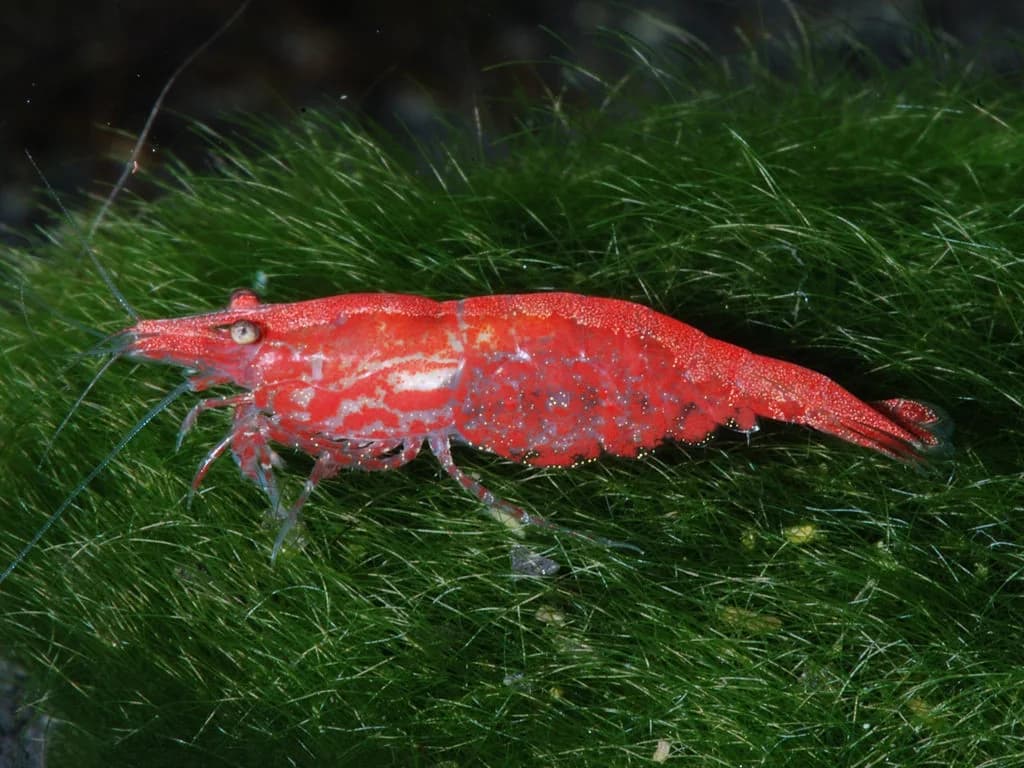
Cherry Shrimp Care Guide
Use a mature, filtered aquarium and measured water—not a shrimp-per-litre rule. Tropical Fish Co uses 20 litres as a cautious starting policy for a small Cherry Shrimp group, above OATA's general 10-litre screen for small shrimp. Provide established grazing surfaces, cover and a protected filter inlet. No fish is guaranteed shrimplet-safe, and breeding should never be promised.
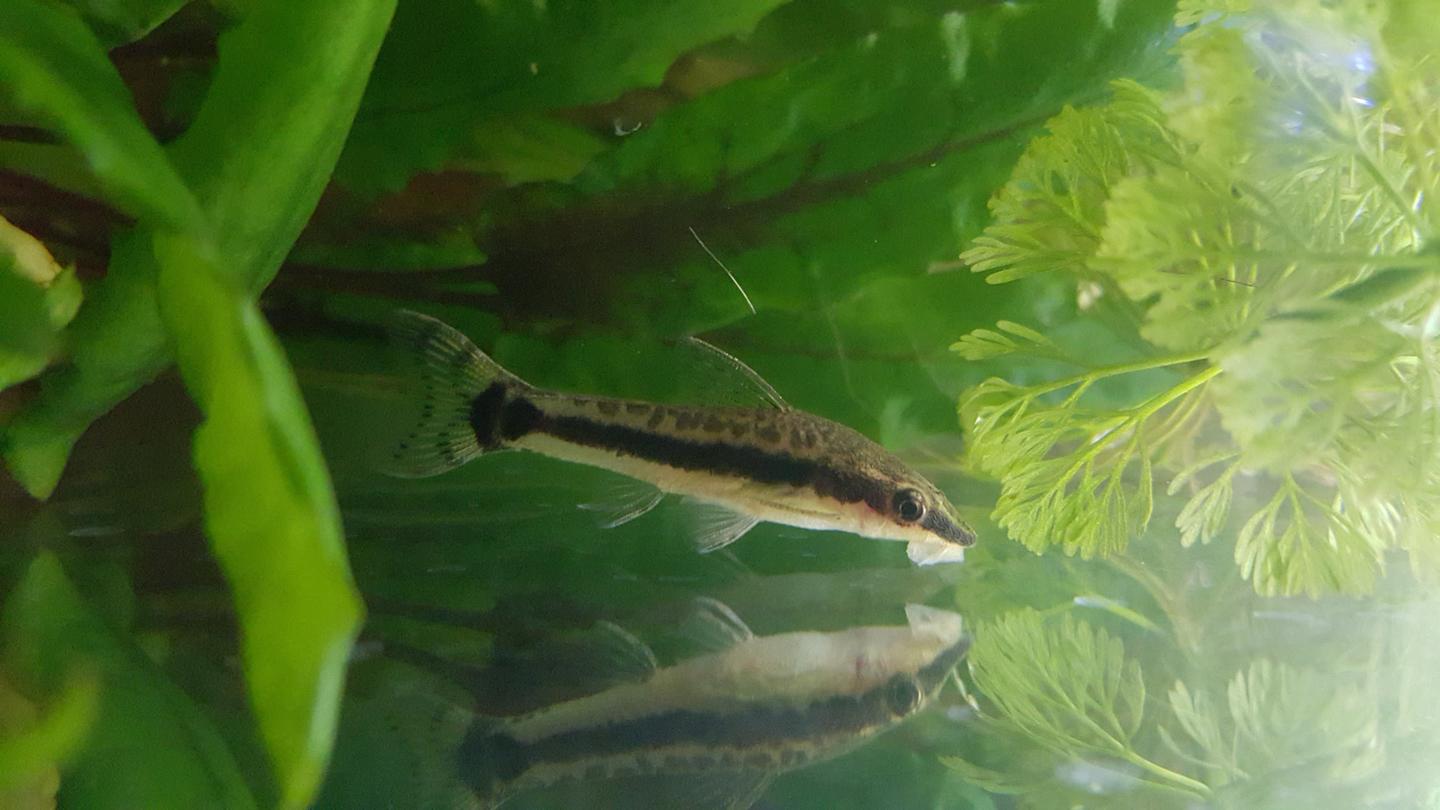
Otocinclus Catfish Care: Tank Size, Food & Groups
Otocinclus are small South American loricariid catfish, not disposable algae cleaners. Confirm the supplied species where possible; start with a mature, stable aquarium with ample grazing surfaces; plan a compatible social group; and provide suitable food even when algae is visible.
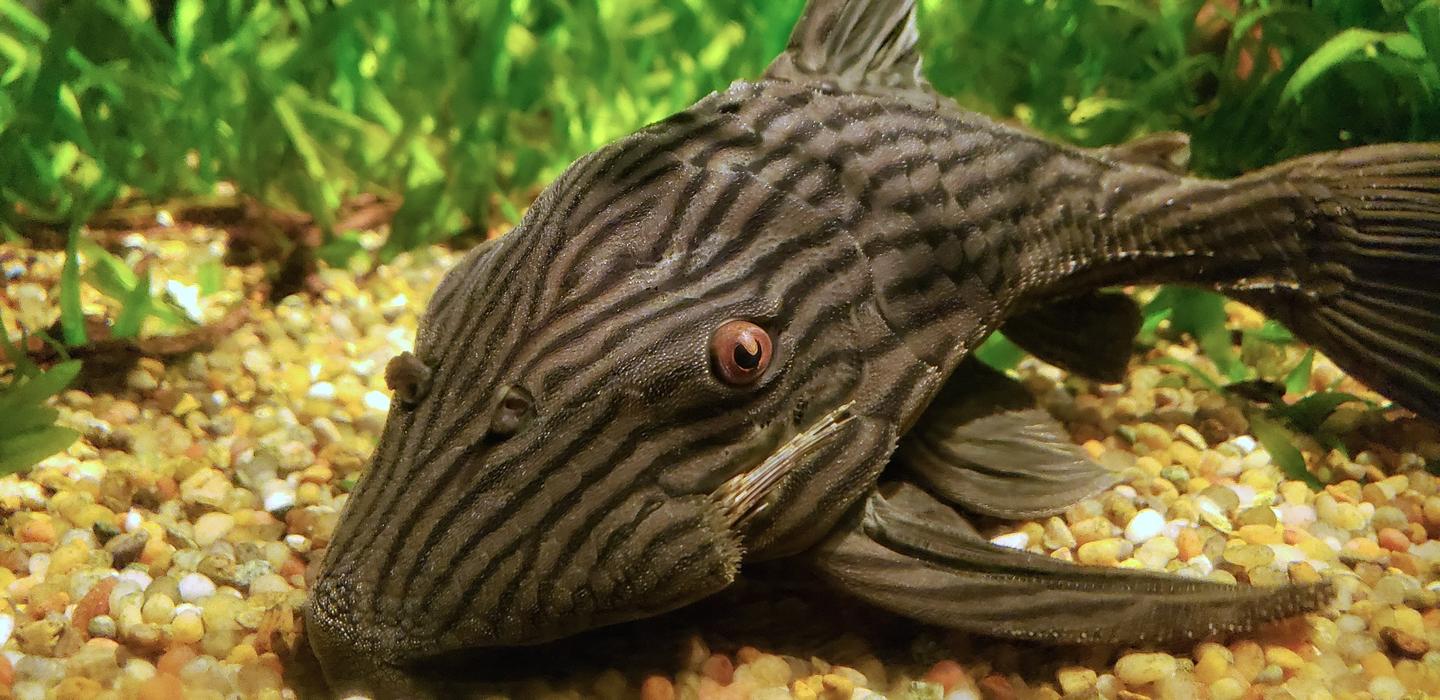
Pleco Fish Guide: Types, Adult Size, Food & Tank Planning
‘Pleco’ is a loose aquarium-trade label, not one species or one care sheet. Before buying, confirm the scientific name or defensible L-number, adult size and measurement method, required footprint, temperature and water, diet, social plan and source. No universal pleco tank size, menu or algae result is honest.