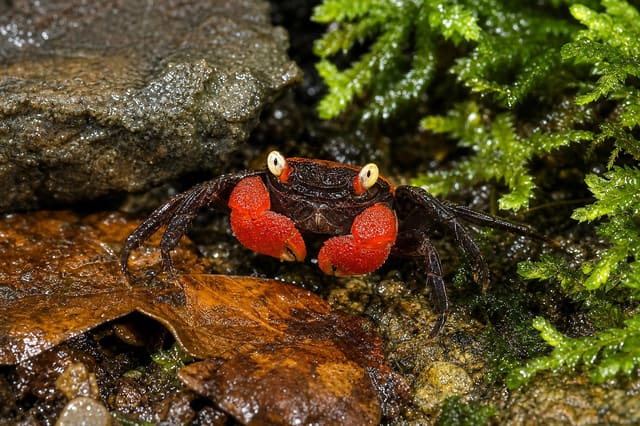
Red Devil Vampire Crab (Geosesarma hagen)
£9.99

Land Hermit Crab (Coenobita sp.) is a terrestrial hermit crab, supplied as one live crab at a 2.5–3 cm size grade, for a heated, humid glass enclosure with deep moist sand and coir, spare natural shells and dishes of fresh and marine salt water. Keep at least two together; it never lives in an aquarium.
Coenobita sp.
Land Hermit Crab (Coenobita sp.) is a terrestrial hermit crab, supplied as one live crab at a 2.5–3 cm size grade, for a heated, humid glass enclosure with deep moist sand and coir, spare natural shells and dishes of fresh and marine salt water. Keep at least two together; it never lives in an aquarium.
Maintain these water conditions for optimal health and vibrant colors
This is a land hermit crab of the genus Coenobita, one of the hermit crabs that live on land rather than in water. One purchase supplies one live crab, sent at a 2.5–3 cm size grade. The most important decision before ordering is housing: it needs a heated, humid land enclosure with deep, moist substrate, spare shells and dishes of both fresh and marine salt water that it can climb into and out of. It cannot live in a fish tank, and it should not live alone.
The exact species has not been identified, so the care advice here follows the genus Coenobita and its care group. The World Register of Marine Species accepts Coenobita as a genus in the family Coenobitidae, and the Wikipedia genus summary describes it as 21 species of terrestrial hermit crabs, several of which are kept as pets. The Tree of Life Exotic Pet Medical Center lists the Caribbean hermit crab (Coenobita clypeatus), the Ecuadorian hermit crab (C. compressus) and the strawberry hermit crab (C. perlatus) among the commonly kept kinds. Which of these, or which other member of the genus, this crab belongs to is not known, so its eventual size and colouring cannot be predicted precisely.
| Suits | Keepers ready to run a heated, humid glass enclosure and check it every day |
|---|---|
| Not suited to | Aquariums, life as a lone pet, or release outdoors |
| Supplied | One live crab at a 2.5–3 cm size grade |
| Keep with | At least one other land hermit crab of a similar size |
| Climate | 24–29°C air with 70–80% humidity, from veterinary care guidance |
| Activity | Mainly nocturnal; digs, climbs and scavenges |
The 2.5–3 cm figure is the size at dispatch, not an adult size, and it is not stated whether it measures the body or the shell. Treat it as a guide to how small the crab will be on arrival: small enough to need crushed food, shallow water dishes and shells scaled to it, and young enough to grow and change shells many times.
Land hermit crabs are mainly nocturnal. By day you may see little more than a shell half-buried in the substrate; after dark they dig, climb, scavenge and investigate empty shells, sometimes moving into a new one. They are animals to watch rather than to handle, and PetMD notes that they can pinch painfully.
The commitment is daily rather than weekly. Temperature and humidity need checking every day, fresh food goes in at night and comes out in the morning, and both water dishes must stay clean and easy to leave. Moulting adds long, quiet spells when a crab stays buried and must be left alone. Because these crabs are social, plan from the start for at least two and a tank sized for the group.
A land hermit crab is a small animal with a surprisingly long equipment list. Set the enclosure up and run it at temperature and humidity before you order, so that the crab goes straight into stable conditions.
Sex is guaranteed only when the selected option explicitly states male or female. This Land Hermit Crab listing has no sex-guaranteed option. Sex makes no difference to the enclosure, companionship or diet described on this page.
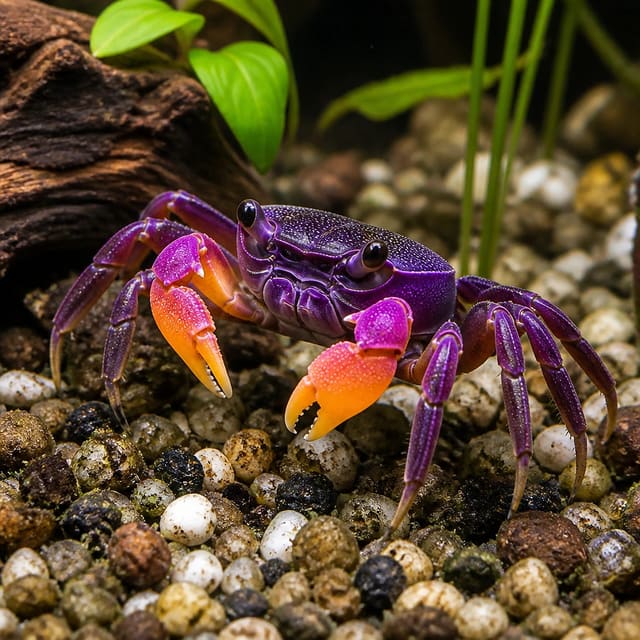
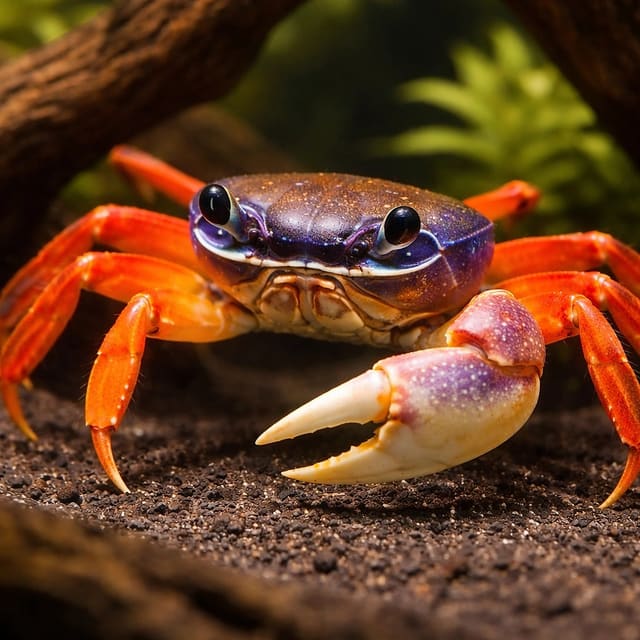
Gallery images have been digitally enhanced to improve image quality. Natural colour, pattern, size and maturity can vary between live animals. The photograph shows a hermit crab with purple-blue legs and claws in a spiral shell on dark gravel beside driftwood. That setting is not a model for the enclosure: this crab needs deep, moist sand and coir to dig into, not gravel.
Both veterinary guides insist on a secure lid. PetMD specifies a glass tank, preferring glass to plastic because it holds heat and humidity better, and the Tree of Life Exotic Pet Medical Center hermit crab care guide asks for an escape-proof top, either mesh or a modified aquarium lid. Hermit crabs are keen climbers, so check that the lid fits closely on every side.
Both guides are American and size tanks in US gallons, so check a UK tank's stated capacity against those figures before buying rather than judging by eye. Remember too that at least 15 cm of substrate sits inside that volume. A long tank usually serves a hermit crab better than a tall, narrow one, because the floor is where it needs room for a warm end and a cooler end, two water dishes, a feeding spot and open space to forage.
PetMD recommends a quiet, low-traffic spot away from draughts, air conditioners and direct sunlight. Direct sun and draughts both make the temperature and humidity harder to hold steady. Choose a sturdy stand, because a tank filled with deep, damp substrate is heavy.
Tree of Life asks for several hides, such as half logs, coconut huts and cork bark, plus climbing surfaces such as branches, coral skeletons and plastic plants, while leaving open floor for foraging. PetMD adds logs, driftwood and lava rock as climbing décor and several hiding places. Give each crab somewhere to retreat, and bed heavy pieces firmly so that a crab digging underneath cannot bring them down on itself.
Tree of Life names inadequate humidity, diet and space as the most common causes of illness in captivity. Humidity needs particular care because these crabs breathe through modified gills that must stay moist. PetMD's hermit crab care sheet warns that if the humidity falls too low, they will suffocate and die.
| Air temperature | 24–29°C (75–85°F) across a gentle gradient (Tree of Life) |
|---|---|
| Cooler end and night | PetMD allows about 70°F, with the warm end at 80°F |
| Relative humidity | 70–80%, the range both guides support; PetMD gives up to 90% |
| Light | About 12 hours of light and 12 of darkness |
Plan for 24–29°C, with one end of the tank warmer than the other so that each crab can choose where to sit. PetMD's figures run a little cooler at the cool end and at night, so treat the Tree of Life range as the everyday target and do not chase a single number. Check it daily with two digital thermometers, one at each end, rather than one reading in the middle.
Aim for 70–80% relative humidity, measured every day with a digital hygrometer. A damp-looking tank is not proof of humid air, so rely on the gauge. Tree of Life mists daily if the humidity drops, PetMD mists with dechlorinated water daily or more often, and PetMD notes that moss in the enclosure can help. Tree of Life also links mites and mould to poor hygiene or ventilation, so the lid should hold humidity without sealing the tank completely.
Whichever combination you choose, put it on a thermostat and let the hygrometer tell you whether the heating is drying the air.
Hermit crabs are nocturnal, so most feeding and exploring happens after dark. Tree of Life recommends a natural cycle of 12 hours of light and 12 of darkness and describes low-output UVB as optional. PetMD gives 10–12 hours of light a day, with the tank unlit at night or lit only by a nocturnal or infrared lamp.
Deep substrate is not decoration for a land hermit crab. Tree of Life describes burrowing as essential for moulting and for reducing stress, and it links poor moults to inadequate humidity, stress and a lack of proper substrate depth.
A burrow that collapses as soon as the crab digs is too dry; a layer that pools water at the bottom is too wet. Mix a handful and squeeze it before filling the tank.
Like other crustaceans, a hermit crab grows by shedding its exoskeleton. PetMD describes one or two moults a year, each taking days or weeks, while Tree of Life says a crab may stay buried for anything from days to months. Signs that a moult is coming include reduced activity, digging and a dull exoskeleton. The crab then buries itself.
Other crabs may attack a newly moulted crab while its new exoskeleton is still soft. Tree of Life advises separating vulnerable moulters if you see aggression. PetMD suggests either moving the other crabs away or pushing a divider into the sand, such as a clean, dry 2-litre drinks bottle with its cap removed, and returning the separated crab only once its new exoskeleton has hardened.
A land hermit crab lives out of water but still needs constant access to it. Both guides call for two dishes at all times:
PetMD asks for bowls made of a non-metal, non-porous material because hermit crabs are extremely sensitive to metals. Glazed ceramic or plastic dishes that can be scrubbed clean suit this well.
The two guides set the depth differently. Tree of Life wants dishes deep enough for a crab to submerge partially, with ramps or shells so it can get out easily. PetMD keeps them no deeper than ¼ to ½ inch, depending on the size of the crab, and puts a natural sea sponge in each bowl to help the crab climb in and out and to prevent accidental drowning. Both agree on the point that matters: every crab, including the smallest, must be able to climb out without help. For a crab of this size, start shallow, and add a ramp, shell or sponge whatever depth you choose. PetMD also recommends disinfecting and changing the sponges regularly.
PetMD suggests placing the crab in its saltwater dish once a day and letting it leave in its own time. Refill both dishes whenever they look dirty or low, and make up the salt water with the same care each time so its strength stays within range.
Hermit crabs cannot make their own shells. As a crab grows through its moults, it needs a larger shell to move into, and if none is available it may fight for one. Spare shells are therefore part of the essential kit, not an optional extra.
Never pull a crab out of its shell or try to force a change. A crab that leaves its shell and stays out of it is showing a warning sign that PetMD lists as a reason to call a vet.
Land hermit crabs are omnivorous scavengers that need a varied diet. Because they are active at night, PetMD feeds once daily at night and removes any uneaten food the following morning; Tree of Life also clears uneaten fresh food every day so that it does not go mouldy in the warm, humid air.
| Base food | Commercial hermit crab pellets without copper sulfate, crushed for a small crab |
|---|---|
| Vegetables | Six to seven days a week: spinach, carrot, kale, romaine lettuce, peppers, cucumber or courgette |
| Fruit | No more than one to three times a week: mango, apple or banana |
| Protein | Cooked egg, fish or shrimp; brine shrimp as a treat |
| Calcium | Cuttlebone, crushed oyster shell or coral pieces |
| Occasional treats | Unsalted nuts, seaweed or fish flakes, no more than two to three days a week |
Tree of Life makes a commercial hermit crab pellet the base of the diet and specifies one without copper sulfate. PetMD crushes pellets for small crabs, which matters for a crab supplied at 2.5–3 cm. Vegetables do most of the daily work in PetMD's plan, with fruit kept to a few times a week and nuts, seaweed, brine shrimp and flakes treated as extras rather than staples. Keep a calcium source in the tank all the time, because a crab builds a new exoskeleton at every moult.
Serve food in shallow, non-metal, non-porous dishes, which suits PetMD's warning about metals, and place the dish where shy crabs can reach it without being pushed aside. Offer small portions and scale up only if the dish is being cleared overnight; a small crab eats little, and leftovers spoil fast.
A short daily check keeps on top of the humidity, diet and hygiene problems the veterinary guides warn about.
PetMD disinfects the habitat at least once a week. Work around any buried crab rather than disturbing the substrate over it. Check the spare shells at the same time and add larger sizes as the crabs grow.
PetMD recommends an annual veterinary check. It is worth finding a vet who treats exotic pets before you need one.
Your crab is hand-packed by our team in an insulated poly box, with a heat pack when the weather calls for it, and carried by a tracked, licensed live-animal courier. We email the tracking number and your confirmed delivery date so that you know when to be in.
The acclimatising advice on our delivery page is written for fish arriving in bags of water. A land hermit crab is never floated or tipped into water: it goes onto the warm, moist substrate of an enclosure that is already running at 24–29°C and 70–80% humidity. Read the full delivery and Live Arrival Guarantee policy before ordering.
Hermit crabs are nocturnal diggers, so a newcomer that hides or burrows during the day is behaving normally. Leave it to explore at night, keep the food and water fresh, and resist digging it up to check on it. If you already keep crabs, PetMD advises introducing a new one gradually under close supervision and separating any that fight.
A land hermit crab is a pet to watch more than to hold. Tree of Life advises limiting handling, working over a soft surface and letting the crab walk onto your hand rather than pulling it from its shell. PetMD picks a crab up by the back of its shell, asks for children to be supervised and warns that hermit crabs can pinch painfully. Avoid handling altogether while a crab is moulting.
PetMD lists the reasons to call a vet: lethargy outside a moult, a crab staying out of its shell, a stuck moult, missing limbs or claws, a strong odour, not eating, or visible parasites. Any of these is a reason to check the enclosure readings straight away and to book that appointment.
PetMD is clear that pet hermit crabs must never be released into the wild. If you can no longer keep your crabs, find them a new home with another keeper who can provide the same enclosure.
Land hermit crabs are social animals. Tree of Life recommends keeping at least two together because they become stressed when housed alone, and PetMD says pet hermit crabs thrive in groups of two or more. Plan to buy at least two, and size the enclosure for the group rather than a single crab.
PetMD advises never keeping different species of invertebrates in the same habitat. The species of this crab has not been identified, so it cannot be matched by species to crabs you already keep, or to another crab from this listing. Crabs bought together here do share the same 2.5–3 cm size grade, which fits the advice on matching sizes; watch any new group closely and separate crabs that fight.
Every Coenobita species is a terrestrial hermit crab. This crab breathes air through gills that must stay moist, and it can drown in water it cannot climb out of. It does not belong in a fish tank, a shrimp tank or any setup where it is kept underwater, and it should not share its enclosure with fish, shrimp or other invertebrate species.
Tropical Fish Co also sells crustaceans that genuinely live underwater. If an aquarium animal is what you had in mind, browse our aquarium shrimp and crustaceans and read the guide to setting up a first freshwater shrimp tank; those animals need a filtered aquarium and share nothing with this crab's enclosure.
If you keep fish as well, keep the two setups entirely separate. Our guide to aquarium water parameters and the water parameter matcher are for aquarium water. For a land hermit crab, the readings that matter are air temperature, relative humidity and the specific gravity of the salt water dish.
Adult size depends on the species, and the species of this crab has not been identified. Across the land hermit crabs kept as pets, Tree of Life gives up to 15 cm (6 in) shell length for the largest, and PetMD gives an average adult size of 2–6 inches. Plan the enclosure and spare shells for a crab that keeps growing and changing shells.
Tree of Life gives a minimum of 10 gallons for two small crabs and recommends 20–40 gallons for adults, while PetMD gives a 10-gallon glass tank for one or two crabs plus at least 5 more gallons for each extra crab. Both quote US gallons. Choose glass with a tight-fitting lid and remember that at least 15 cm of substrate sits inside that space.
Keep at least two. Land hermit crabs are social, and Tree of Life notes that they become stressed when housed alone. Choose companions of a similar size, introduce them gradually under close supervision and separate any that fight.
PetMD rates hermit crab care as beginner level, but Tree of Life names inadequate humidity, diet and space as the most common causes of illness in captivity. We class this crab as intermediate because it needs heating, 70–80% humidity, deep moist substrate, two water dishes and spare shells, all checked every day.
They are omnivorous scavengers. Base the diet on a commercial hermit crab food without copper sulfate, add vegetables most days and fruit no more than one to three times a week, offer protein such as cooked egg, fish or shrimp, and keep a calcium source such as cuttlebone available. Feed once daily at night and remove leftovers the next morning.
Veterinary care guidance gives an air temperature of 24–29°C with a gentle gradient from a warm end to a cooler end, and 70–80% relative humidity. Humidity keeps the gills moist so the crab can breathe, so never let it fall low. These are air values for a land enclosure; the crab has no aquarium pH or hardness target.
Both veterinary guides call for two water dishes at all times: dechlorinated fresh water, and salt water made with marine aquarium salt, never table salt. PetMD gives a specific gravity of 1.021–1.026 for the salt dish. Keep both shallow, or fit a ramp, shell or sea sponge, so the crab can always climb out.
It buries itself in the substrate and can stay under for days to months. Signs beforehand include reduced activity, digging and a dull exoskeleton. Never dig it up or move it. Afterwards it eats its old exoskeleton, and other crabs may attack it until its new exoskeleton has hardened, so separate it if there is any aggression.
Hermit crabs cannot produce their own shells and move into larger ones as they grow. PetMD advises three to five empty, intact shells per crab, slightly larger than the current one, and Tree of Life adds that they should be natural rather than painted. Plenty of choice also helps prevent shell fights.
Yes. PetMD notes that hermit crabs can pinch painfully. Pick a crab up by the back of its shell over a soft surface, or let it walk onto your hand, supervise children, and avoid handling while it is moulting. Never pull a crab out of its shell.
It is hand-packed by our team in an insulated box, with a heat pack when the weather calls for it, and carried by a tracked, licensed live-animal courier. Someone must be at the address to receive it and open it the same day. Start a continuous unboxing video before opening the sealed parcel, and send it with your order number the same day if anything has gone wrong.
The veterinary guides describe pet land hermit crabs as a group rather than one species, which is why this page gives their ranges with the guide that states each one.
No reviews for this item yet. Bought one? Honest reviews only, good or bad.
What customers say about ordering from us
I have a small group of long finned mountain minnows. So was delighted to be able to order ten of this variety to increase the genetics in my tank . The ones I recieved are healthy but it’s to early to give a verdict on wether they are of a long finned type since they are small currently.
Gordon Walker · 23 Sept 2026
100% success travel and "installation". Pleased with quality of purchase. The Siamese fighter a bit "shy" so have not yet seen him at his best yet but looking good. Happy customer. GG
George E Garratt · 21 Sept 2026
Reviews of our shop, collected by Judge.me, an independent third-party review collector. Newest first.