By Tropical Fish Co Editorial Team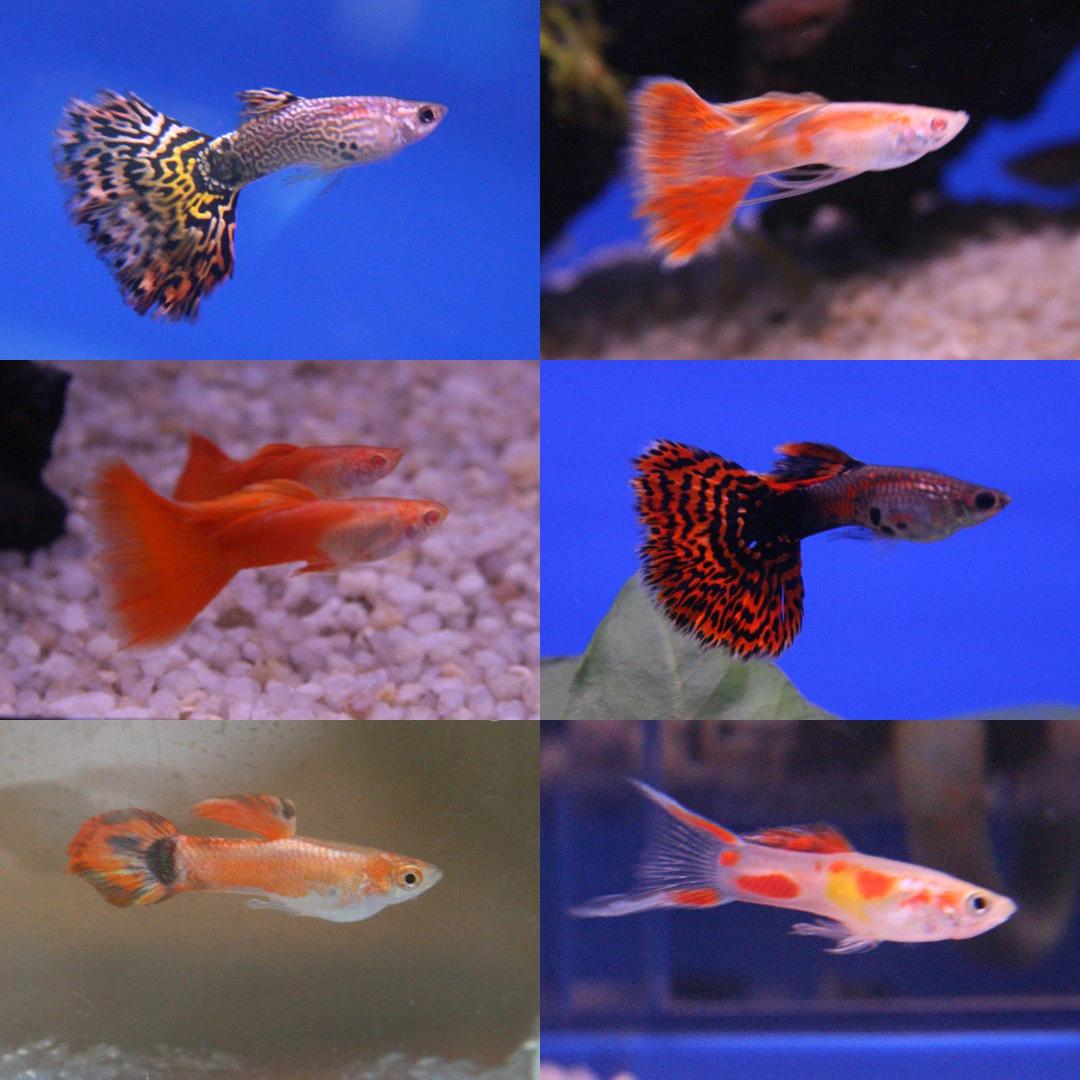
The useful way to compare guppy types
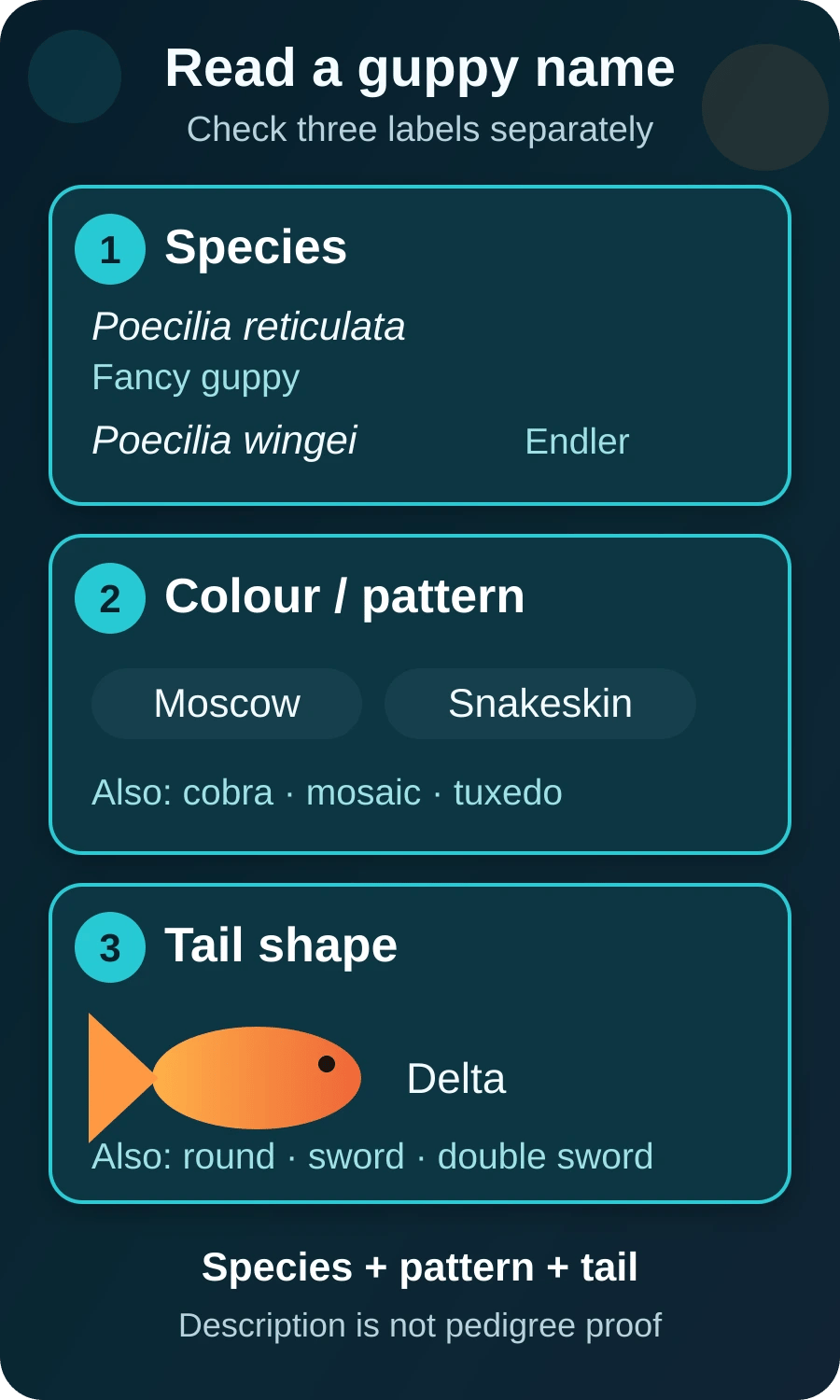
A guppy name can look precise while mixing several different kinds of information. Species, colour or pattern, and tail shape are separate layers. “Cobra delta fancy guppy”, for example, can describe a domestic Poecilia reticulata with a cobra-style pattern and a triangular tail. It does not automatically certify ancestry, sex, adult size, health or current stock.
Search results often turn every label into a different “breed”. Show organisations do define domestic forms, but their standards are competition systems rather than biological taxonomy [9]. There is therefore no honest universal answer to “how many guppy types are there?” without first saying what is being counted.
The six-fish hero above shows the visual range. Its source labels include mosaic, double sword, orange pintail, Moscow red and cobra snakeskin. Those are examples—not a complete catalogue, a size scale or a promise that every seller uses the terms identically.
1. Start with the species
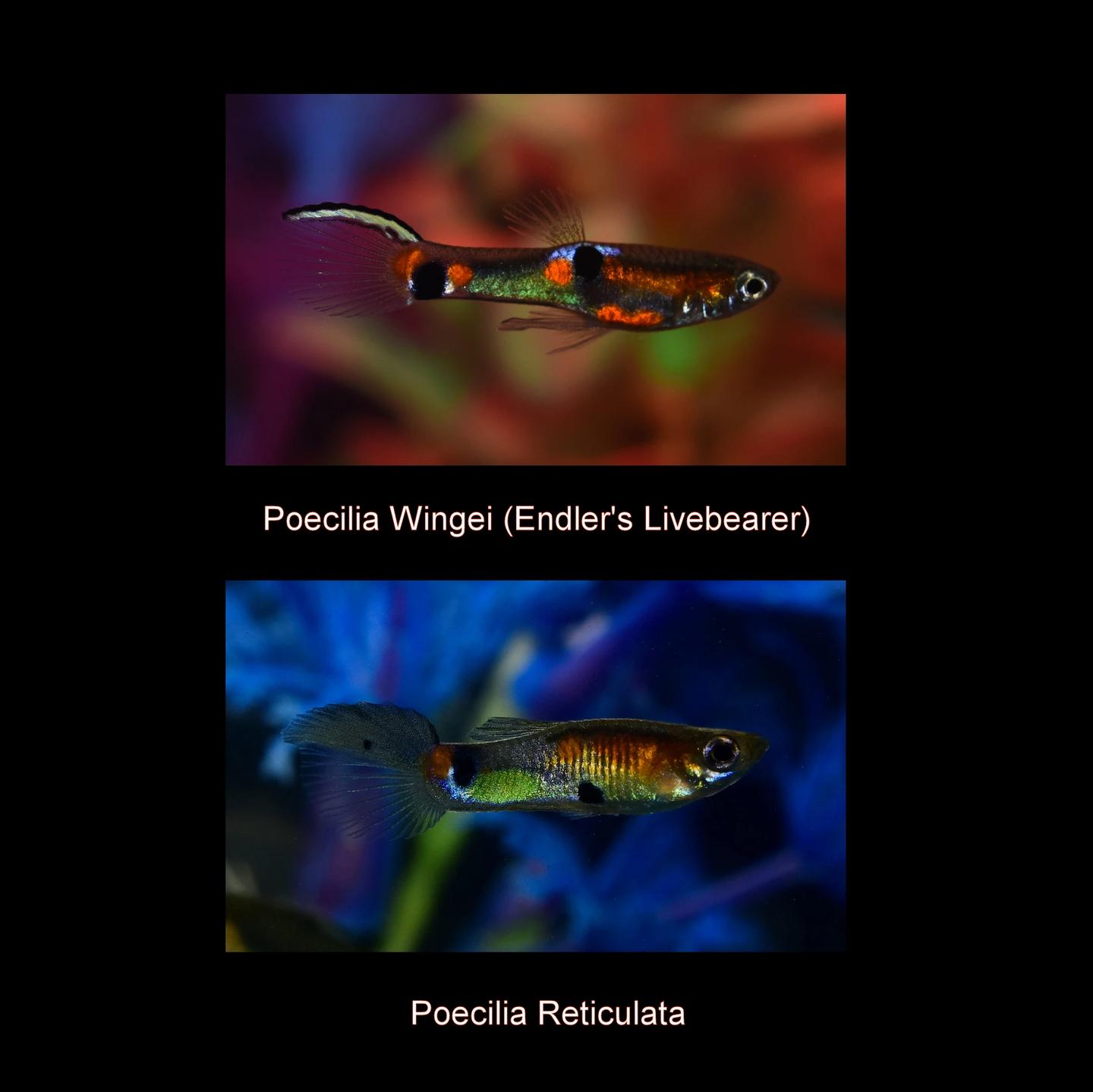
The accepted name for the common or fancy guppy is Poecilia reticulata Peters, 1859 [1]. The accepted name for Endler's livebearer is Poecilia wingei Poeser, Kempkes & Isbrücker, 2005 [2]. The original P. wingei description provides diagnostic and locality context; it is not a certificate for any colourful fish sold as an “Endler” [3].
That gives the safest first question for a seller:
Which species is this listing claiming, and what evidence supports that identification?
Colour is not enough. Domestic guppies and Endlers can resemble one another, and published researchers have produced both F1 and F2 hybrids between P. reticulata and P. wingei [8]. That establishes that hybridisation is possible; it does not tell us how common hybrids are in UK shops or prove that a particular line is pure.
If lineage is important, ask for a documented breeder line and keep it apart from the other species. If lineage is not important, the distinction still helps the product page state honestly what the fish is being sold as.
2. Read the colour and pattern term
Moscow, cobra, snakeskin, mosaic, tuxedo and grass are familiar domestic pattern words. Solid-red, yellow, blue and albino labels add colour or pigment information. Sellers may combine them, and breeders may apply more detailed codes under a show standard [9].
Use these names to narrow what you want to look at—not as a care diagnosis.
| Listing label | What it usually describes | What it does not prove |
|---|---|---|
| Moscow | Broad, comparatively uniform body and fin colour | Exact genotype, pedigree or colour under your lighting |
| Cobra / snakeskin | Reticulated or chain-like markings | One universal pattern boundary across sellers |
| Mosaic / grass | Fin patterning under breeder convention | Species, sex or adult health |
| Tuxedo / half-black | A contrasting darker rear portion | Genetic purity or a fixed care requirement |
| Solid colour / albino | A dominant visual colour or pigment phenotype | Hardiness, lifespan or suitability for your tank |
The genetics are more interesting than the old shortcut. Guppy colour has often been described as “on the Y chromosome”, but modern work measures many colour features and finds a complex architecture. A 2025 study used detailed image phenotyping and genomic data across male colour traits [6]. Another genomic study associated important sex-linked colour variation with a large autosomal haplotype and proposed Y–autosome interaction [7].
The practical conclusion is simple: do not promise that a cross will produce a particular colour from the male alone, and do not describe a female as genetically irrelevant. Appearance labels help; inheritance is not a one-sentence rule.
3. Read the tail shape separately
Delta or triangle, roundtail, pintail, sword and double-sword describe the caudal-fin silhouette. A show standard may distinguish more forms and specify proportions, but those judging categories should not be presented as new species [9].
On a retail page, tail shape helps the customer understand the fish and flags unusually extended fins for an individual check of damage, swimming ability, planned flow and tank mates. It does not justify declaring every short-finned fish hardy or every long-finned fish fragile.
Fancy guppy versus Endler
| Check | Fancy guppy | Endler's livebearer |
|---|---|---|
| Accepted species | Poecilia reticulata | Poecilia wingei |
| Name authority | Peters, 1859 | Poeser, Kempkes & Isbrücker, 2005 |
| Listing language | Fancy, colour strain and tail form | Endler, locality or domestic line name |
| Size context | Compare sex and measurement convention | Compare sex and measurement convention |
| Hybridisation | Can hybridise with P. wingei | Can hybridise with P. reticulata |
| Buying question | “What species, sex, sale size and variety?” | “Is lineage documented, and what does the line name mean?” |
FishBase records common-guppy maxima by standard length—body length without the tail fin—and separates male/unsexed and female records [4]. An ornamental tail can add visible length, so never compare a total-length sales claim with a scientific standard-length maximum as though they were identical.
FishBase records P. wingei separately and notes its restricted native distribution [5]. A source-labelled photograph can illustrate the name but cannot prove the wild locality or ancestry of a retail fish. The gallery comparison deliberately avoids turning two independently photographed fish into a false size chart.
For full husbandry, use the guppy care guide or Endler's livebearer guide. This page owns the name-and-appearance comparison; those pages own the species plans.
UK care screen: test the water, not the postcode
OATA's UK guidance gives guppies a starting range of 20–28 °C, pH 7.0–8.0 and 8–18 dGH, recommends a filtered aquarium of at least 45 litres for a small group, and calls for regular testing of ammonia, nitrite, nitrate, pH and hardness [10]. FishBase separately lists a 60 cm aquarium recommendation for groups of P. reticulata [4].
Our conservative starting screen combines those dimensions: at least 45 litres and a 60 cm front for a small group. This is a Tropical Fish Co screening policy, not a universal scientific minimum. A larger group, mixed sexes, extended fins, tank mates or a different aquarium shape can require a different plan.
“Hard UK tap water” is too broad. The Drinking Water Inspectorate says hardness varies with local geology and recommends asking the water company for an accurate measurement because local variation exists [11]. Use the supplier report as a starting point, then test source and aquarium water. Do not infer GH from a postcode, pH alone or kettle scale.
Whichever type you choose:
- complete a fishless cycle and confirm zero ammonia and nitrite before fish;
- use a filter and thermostatically controlled heater appropriate to the setup;
- match the group and sex plan before buying rather than solving fry or persistent male attention afterwards;
- keep stable conditions inside the evidenced range instead of chasing one “perfect” number; and
- observe feeding, swimming, fins and breathing after arrival.
General UK welfare advice also stresses establishing the aquarium before fish and choosing enough room for normal behaviour [12]. No colour name overrules those basics.
A 60-second buying check
Decide whether you want an identified species, a particular visual style, or a documented breeding line. They are different goals. Then check the live listing for:
- the claimed scientific name;
- male, female, pair, group or unsexed status;
- sale size and its measurement convention where given;
- whether the image shows the exact fish, a representative line or a category example;
- the precise colour/pattern and tail wording;
- current availability and price; and
- breeder or lineage evidence if purity matters.
Choose clear eyes, intact fins, steady swimming and normal breathing over the most dramatic label. A name guides comparison; it cannot guarantee an individual fish's condition.
Compare currently available guppies and Endlers
Cards appear only when the linked listing has current availability, a positive price and a usable image. Confirm the species, sex, sale size and photographed or representative variety on each live product page.
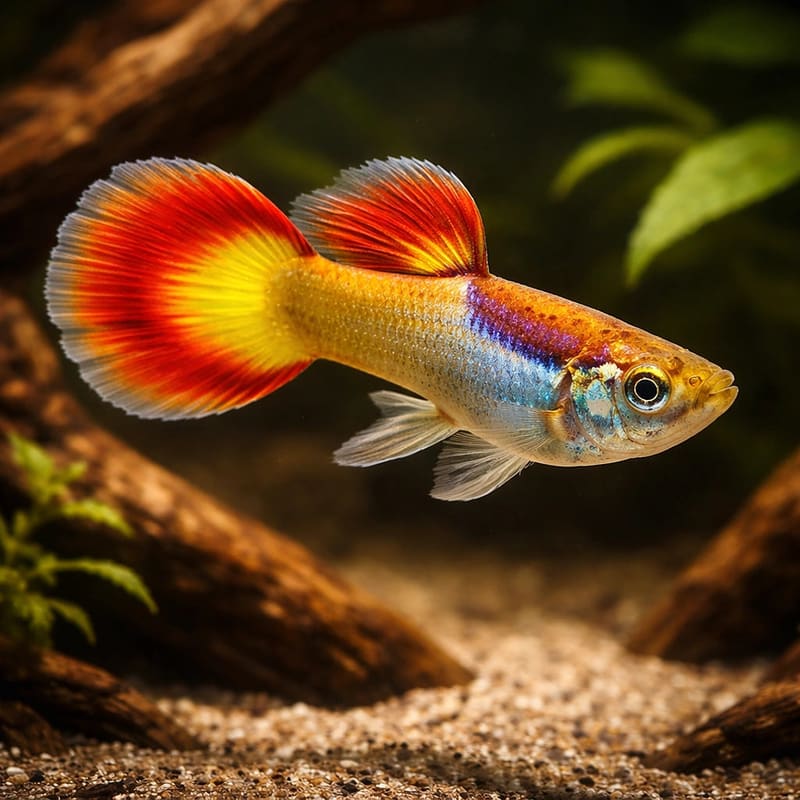
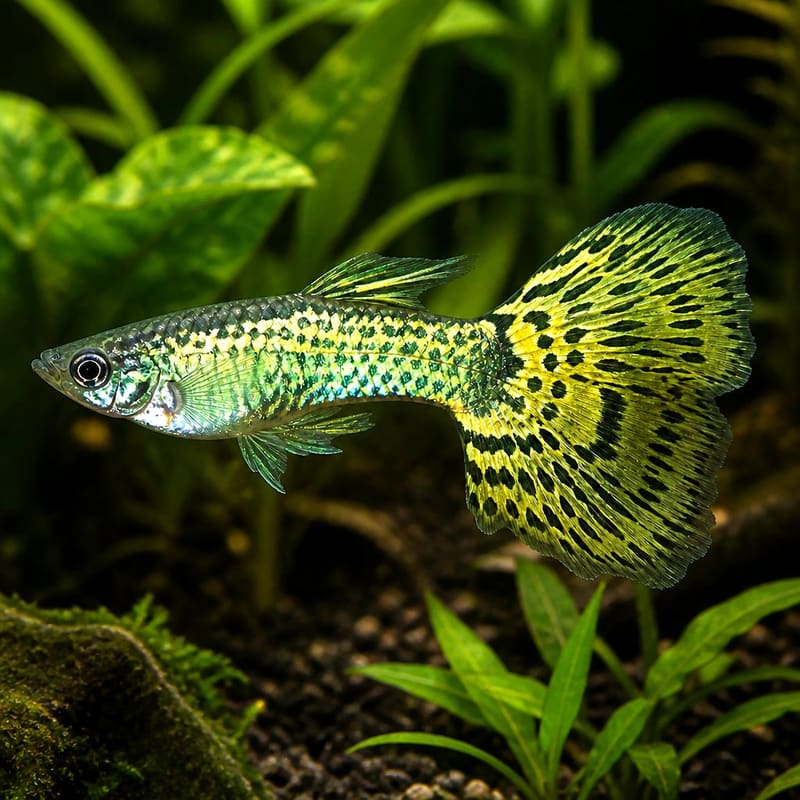
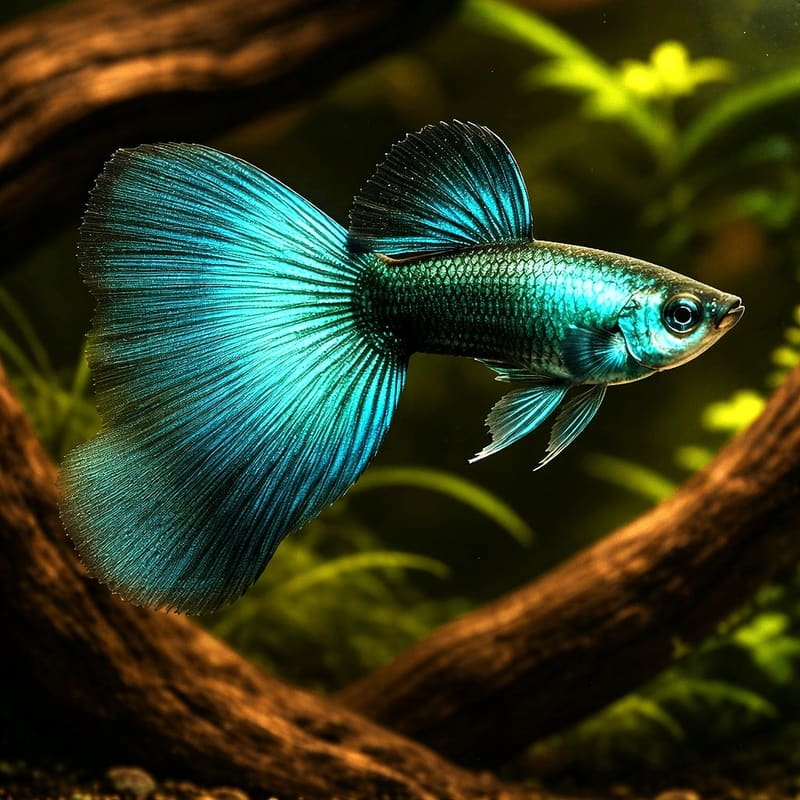
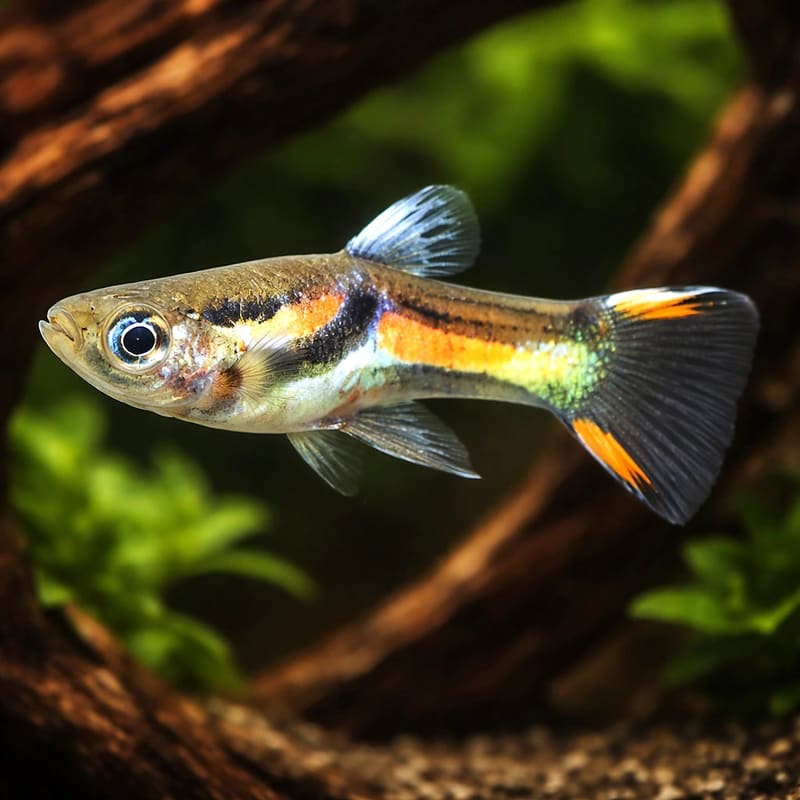
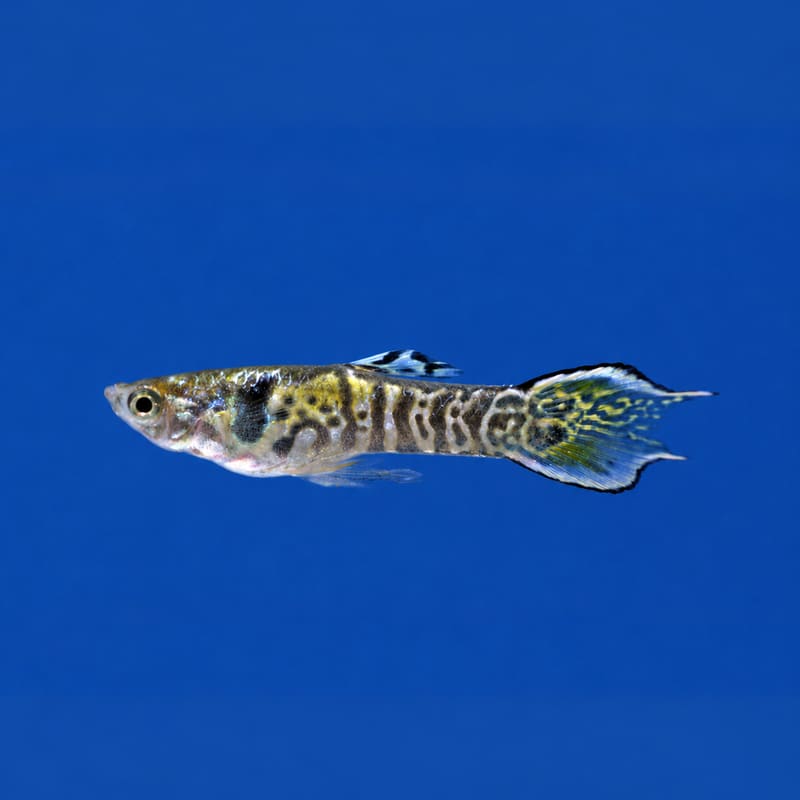
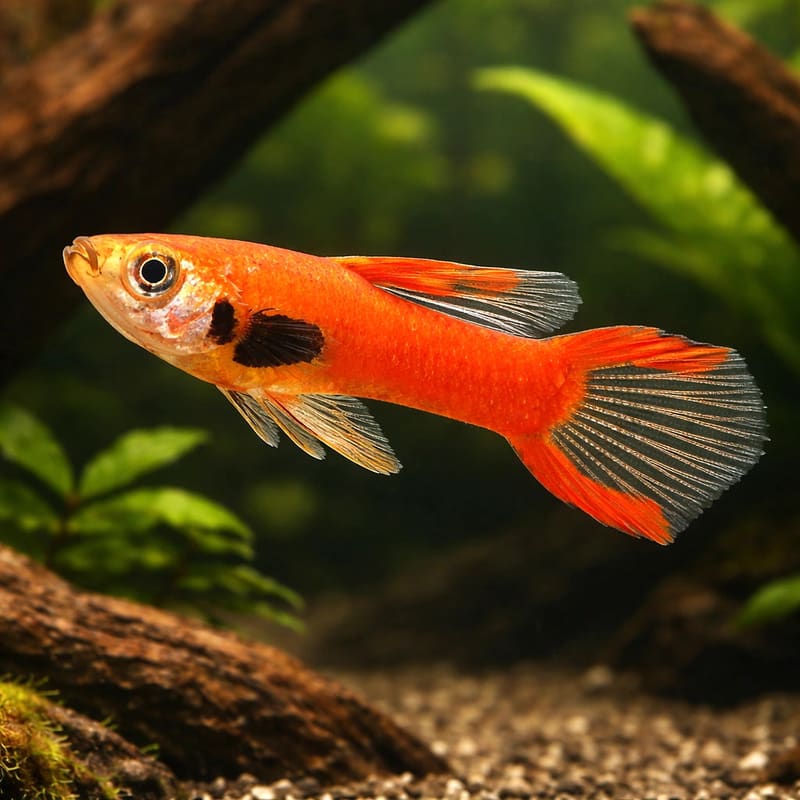
If sex matters more than the strain name, use the female guppy guide. For available guppy products, use the live guppy collection; stock and price belong there rather than in permanent educational copy.
Mistakes this revision corrects
The former page said every strain and both species needed exactly identical care, that most British tap water was automatically suitable, and that colour mostly rode on the Y chromosome. It also presented fixed stock/SKU statements, universal hardiness rankings, a tiny-tank recommendation and a first-person photographer story without a page-bound verified contribution.
Those claims have been removed. The revised page separates published evidence, show terminology and store policy; preserves measurement conventions; keeps stock dynamic; and uses the real Tropical Fish Co Editorial Team organisation byline. It does not promise rankings, clicks, purity, compatibility or a breeding result.
How this guide was checked
We reconciled the two accepted names against the current Catalog of Fishes, used the original P. wingei description for diagnostic context, checked size and biology against exact FishBase records, and bounded UK husbandry with OATA, RSPCA and Drinking Water Inspectorate guidance. Current peer-reviewed genomic work replaces the old all-Y colour shortcut.
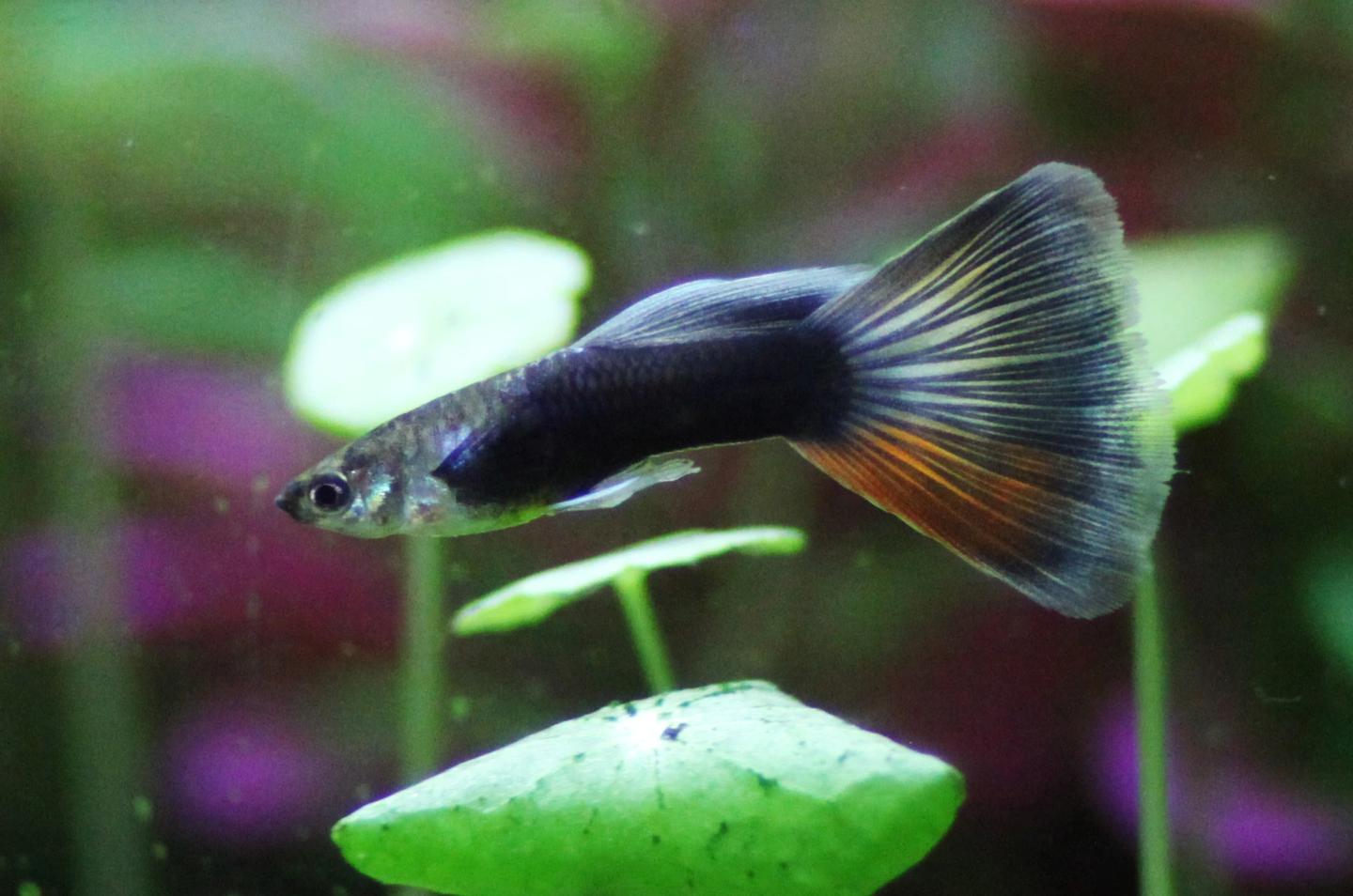
The media set uses four distinct assets with exact file hashes and public rights records: one public-domain six-variety montage, one original explanatory diagram, one CC BY-SA Moscow male photograph and one CC BY-SA source comparison. The photographs illustrate source labels; none is treated as a genetic test, stock record or size scale.
Corrections are welcome through the edit link below. Feedback and email are editorial diagnostics—not leads or ecommerce conversions. We measure commerce only through add-to-cart, begin-checkout, purchase and revenue, with purchase and revenue as the final outcomes.