Easy
Blue Moscow Female Guppy (Poecilia reticulata)
22–28°C · pH 7–8
£3.99

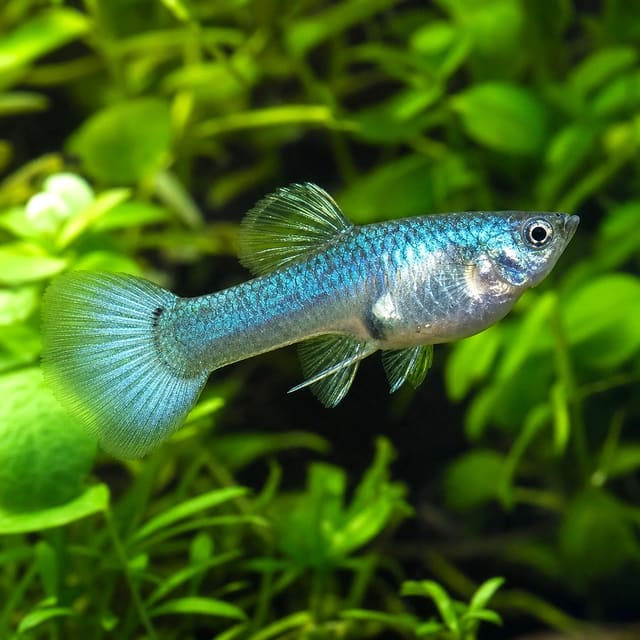
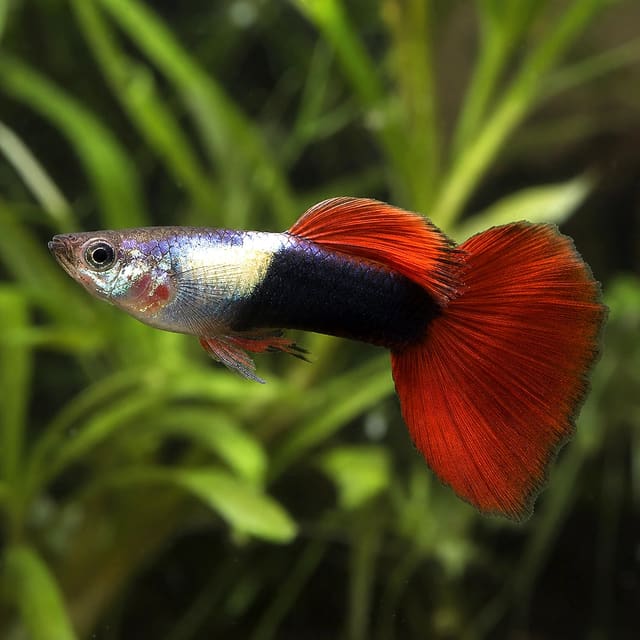
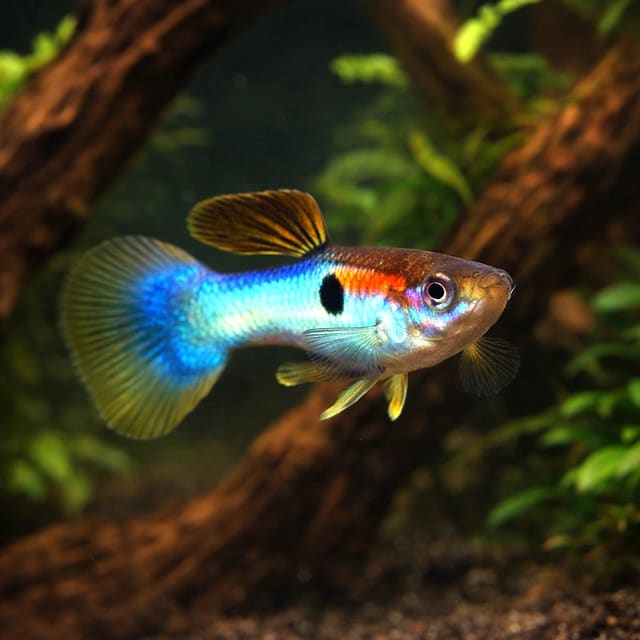
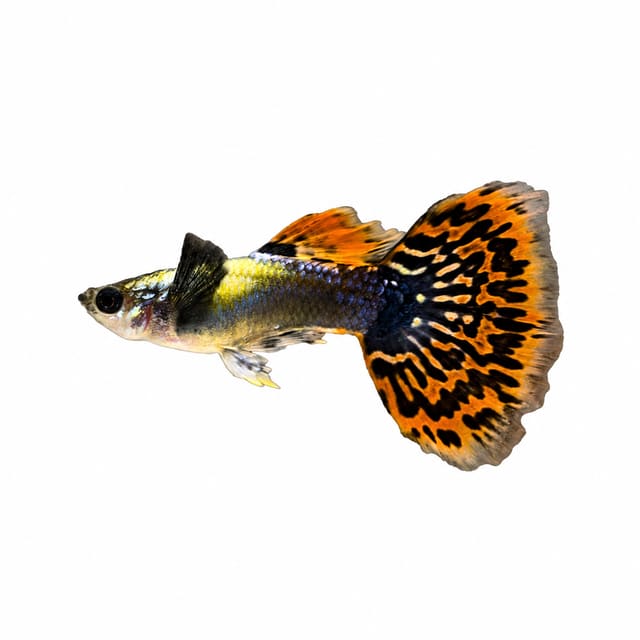
The Blue Moscow Male Guppy (Poecilia reticulata) is a peaceful Poeciliid livebearer native to Venezuela, Barbados, Trinidad, northern Brazil and the Guyanas; FishBase gives up to 5 cm standard length for males or unsexed fish. It suits a prepared beginner using a mature aquarium at least 60 cm long; Tropical Fish Co uses 22–28°C and five or more guppies where capacity and the sex plan allow, while OATA’s group guidance gives pH 7.0–8.0 and 8–18 dGH. Priced per fish: each unit is one male, with multi-buy prices for groups. Its metallic turquoise colour looks bluer or greener depending on the light, so some shops list it as Green Moscow.
Adult size is the maximum length this species reaches at full maturity (scientific sources). The livestock you receive will be younger and smaller. Product-photo provenance and any image-specific limitations are stated on the listing.
Poecilia reticulata
Shoaling fish: kept in a group they feel safer, stay calmer and show their best colour.
The Blue Moscow Male Guppy (Poecilia reticulata) is a peaceful Poeciliid livebearer native to Venezuela, Barbados, Trinidad, northern Brazil and the Guyanas; FishBase gives up to 5 cm standard length for males or unsexed fish. It suits a prepared beginner using a mature aquarium at least 60 cm long; Tropical Fish Co uses 22–28°C and five or more guppies where capacity and the sex plan allow, while OATA’s group guidance gives pH 7.0–8.0 and 8–18 dGH. Priced per fish: each unit is one male, with multi-buy prices for groups. Its metallic turquoise colour looks bluer or greener depending on the light, so some shops list it as Green Moscow.
Adult size is the maximum length this species reaches at full maturity (scientific sources). The livestock you receive will be younger and smaller. Product-photo provenance and any image-specific limitations are stated on the listing.
Guppies are social livebearers suited to a prepared beginner, not a fish-per-litre formula. Use a mature filtered aquarium, tested neutral-to-alkaline mineral-bearing water, deliberate sex and population planning, open swimming room, cover and a separation option.
Maintain these water conditions for optimal health and vibrant colors
The Blue Moscow Male Guppy is a metallic blue-green fancy guppy: a selected aquarium form of Poecilia reticulata, a livebearing member of the family Poeciliidae. FishBase records Poecilia reticulata from Venezuela, Barbados, Trinidad, northern Brazil and the Guyanas, and records a maximum of 5 cm standard length for male or unsexed fish. It is a peaceful fish that can suit a prepared beginner who starts with a mature, filtered aquarium and plans its social group, water chemistry and adult space before purchase.
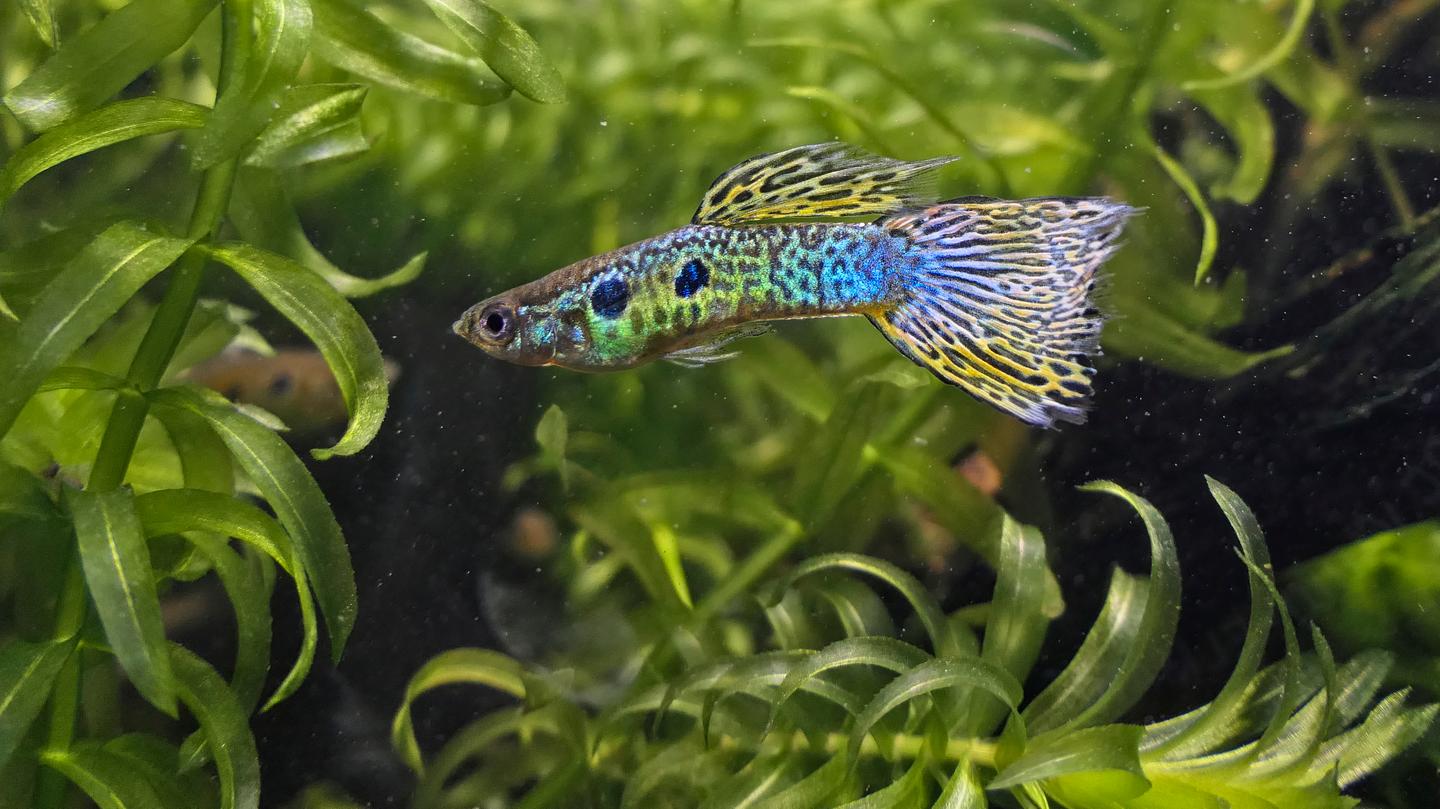
Colour: this line is sold in the trade as Blue Moscow, but its metallic body and fins look turquoise, somewhere between blue and green, and the shade shifts with the lighting, the viewing angle and how settled the fish is. You may also see the same colour listed as Green Moscow. Every fish is an individual, so the exact shade varies.
Moscow is a trade label for selected appearance, not a separate species, and the care decisions remain those of a guppy. Standard length excludes the tail fin, and domestic finnage varies, so plan around the recorded adult body length rather than the fish’s measurement on arrival.
| Name | What it tells you |
|---|---|
| Blue Moscow | The selected aquarium trade form |
| Male Guppy | The common identity and guaranteed sex of this offer |
| Poecilia reticulata | The accepted scientific identity |
| Suits | Not suited to |
|---|---|
| A prepared beginner with a mature, filtered aquarium | An uncycled or unfiltered aquarium |
| A social guppy group with a planned sex mix | A solitary-fish plan |
| Quiet water with open swimming room and cover | Strong current or fin-nipping companions |
| Neutral-to-alkaline, medium-hard water | Long-term soft or acidic conditions |
FishBase also places the guppy in freshwater and brackish environments, but routine aquarium salt is not required simply because the species can occur in brackish water. Eschmeyer’s Catalog of Fishes retains Poecilia reticulata as the accepted name. Our complete Guppy Care Guide explains the store’s conservative planning policy, while the guppy collection lets you compare other guppy forms without treating colour labels as different species.
Each unit is one animal: the quantity you choose is the number of male guppies you receive.
Sex is guaranteed only when the exact product or selected option explicitly states male or female. This Blue Moscow Male Guppy listing is sold as male.
That distinction matters when forming a group. Buying several fish means receiving that number of males, not a pair, a mixed-sex trio or an automatically balanced social group. Plan the aquarium around the total number of fish, the behaviour of the individuals, the filtration capacity and any other livestock already using the space.
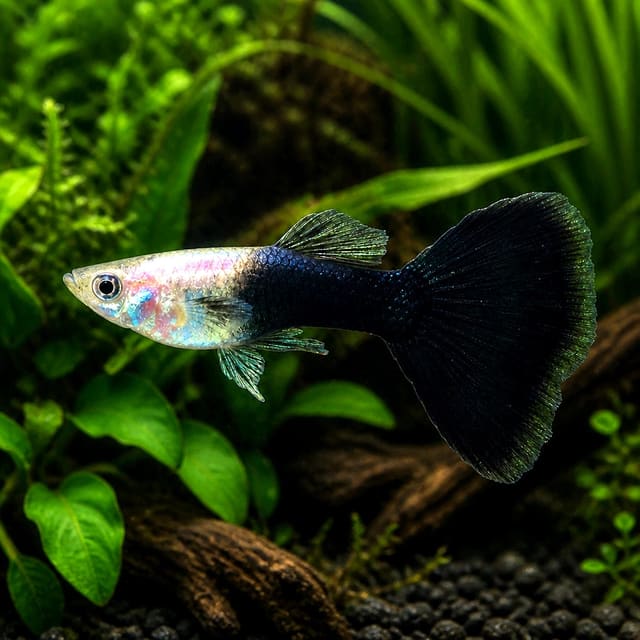
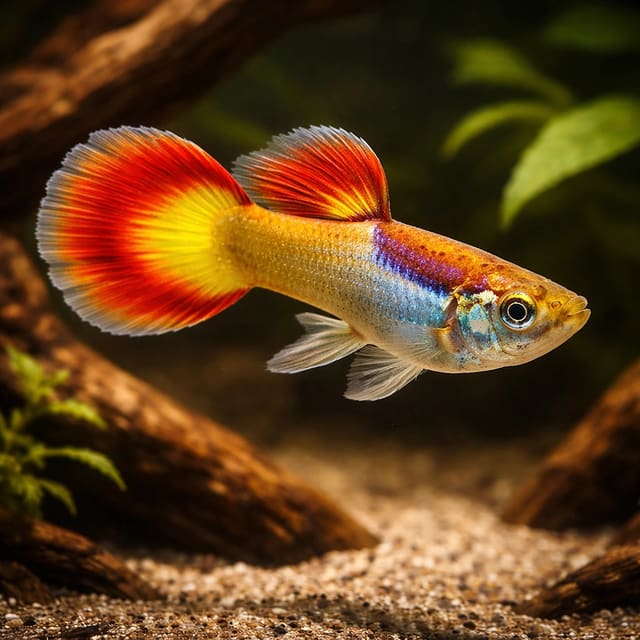
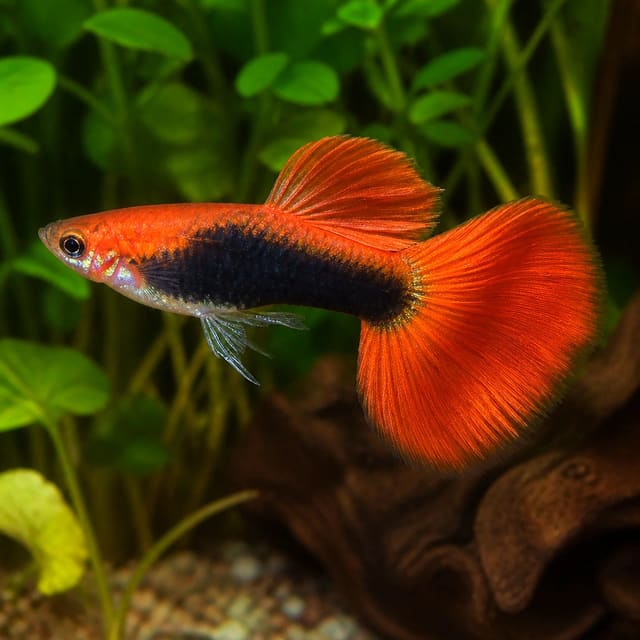
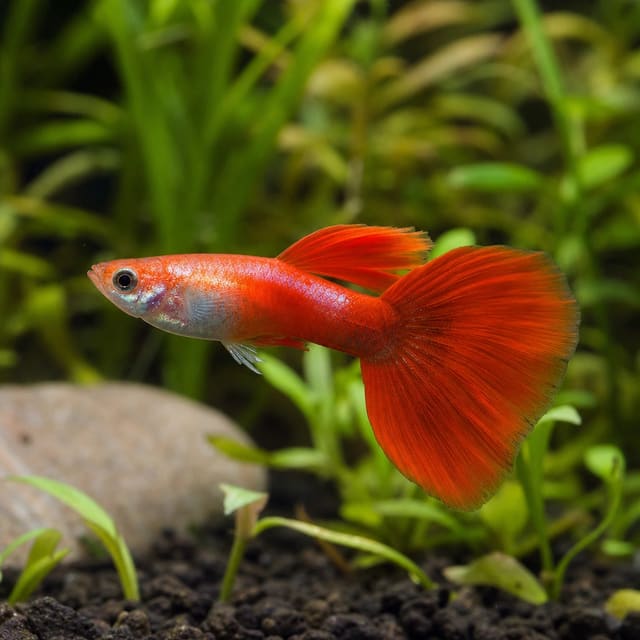
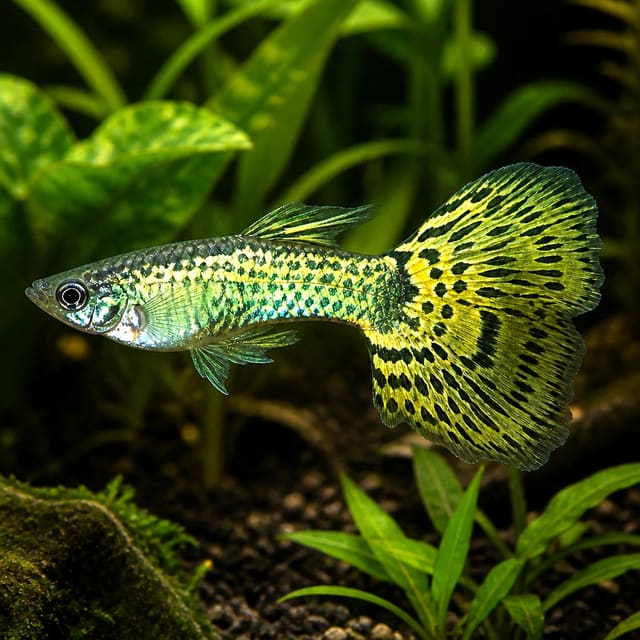
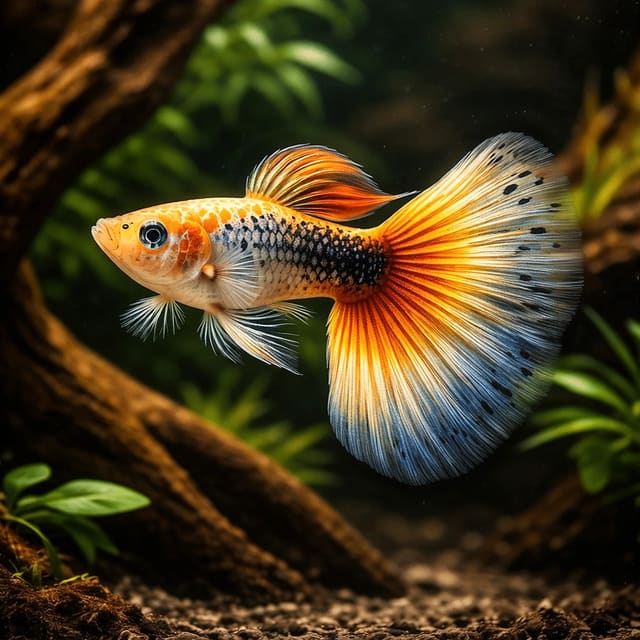
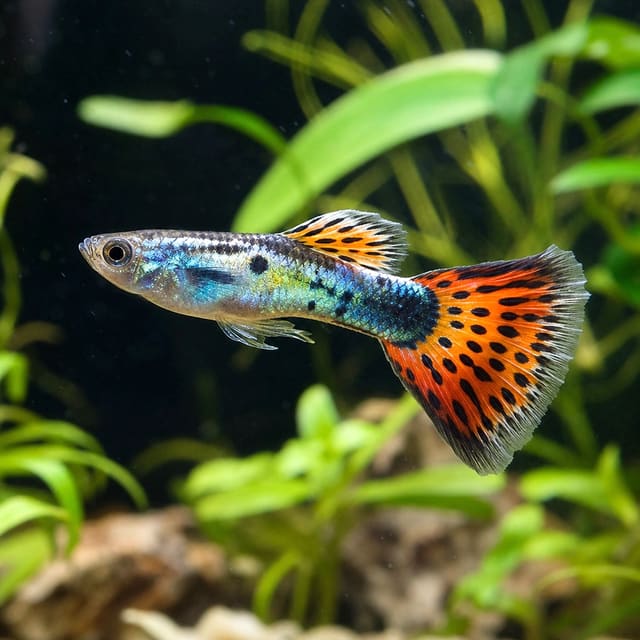
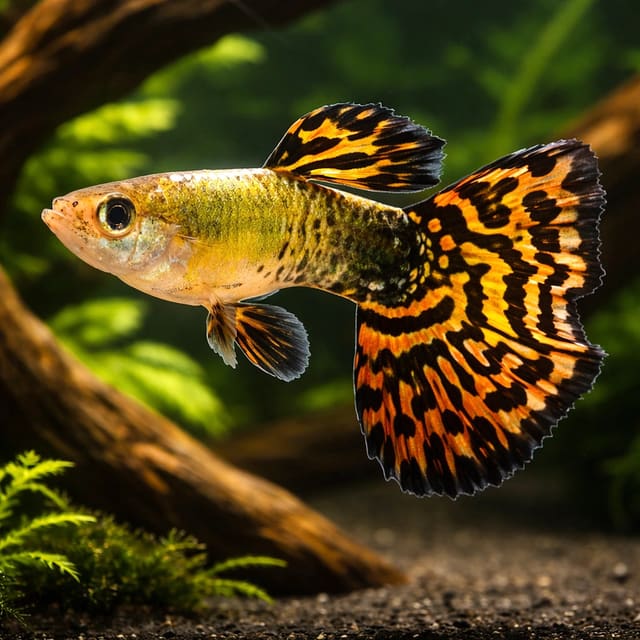
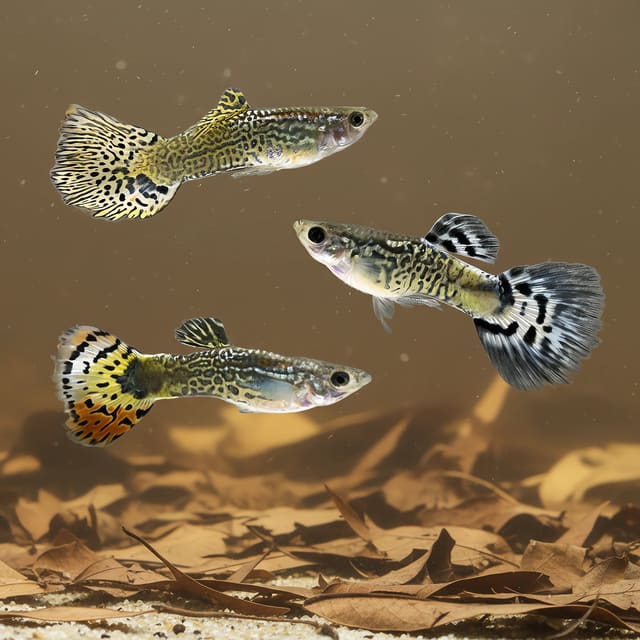
The gallery images are representative, based on reference photographs of this species, so colours can look slightly different from the live animal.
An all-male plan prevents new mixed-sex mating within that group, but it does not remove the possibility of display, pursuit or competition. Space, sight breaks, feeding access and a safe separation option remain part of the purchase decision.
Seriously Fish gives a 45 × 30 cm aquarium base and about 41 litres for Poecilia reticulata. Our more conservative store screen uses a mature aquarium at least 60 cm long for one small guppy group, then adjusts the plan for adult fish, sex mix, tank mates, filtration and water-test results. A conventional 60-litre aquarium can be a candidate when it also meets that length and the rest of the screen; litres alone do not set a safe maximum.
FishBase records a maximum of 5 cm standard length for male or unsexed fish. Standard length excludes the tail fin, and domestic finnage varies, so plan around that adult body length rather than the fish’s measurement on arrival.
For routine aquarium planning, use 22–28°C. OATA’s guppy-and-molly sheet gives pH 7.0–8.0, general hardness of 8–18 dGH, zero ammonia, zero nitrite and at least 45 litres for a small group of the smaller livebearers; these are broad group values rather than a species-specific optimum. Our store policy adds the 60 cm length and a group of five or more where sex planning, aquarium capacity and behaviour allow.
| Planning number | How to use it |
|---|---|
| 5 cm SL | Maximum recorded male or unsexed body length, excluding the tail |
| At least 60 cm | Store aquarium-length screen for one small group |
| 22–28°C | Routine aquarium temperature range |
| pH 7.0–8.0 | Neutral-to-alkaline planning range |
| 8–18 dGH | Medium-hard water guidance |
Start with an aquarium at least 60 cm long, mature and filtered. The usable internal footprint matters because guppies need horizontal swimming room, access to food and places to move out of another fish’s direct line of sight. A tall aquarium with little length does not become a better group home merely because its label shows more litres.
If you are preparing your first aquarium, follow the staged work in our first tropical tank guide before livestock arrives. Add the dimensions of substrate, decoration and equipment to the assessment because these reduce water volume and can divide the swimming area. The result should include open water as well as cover rather than becoming a continuous wall of plants or ornaments.
Seriously Fish describes guppies as unfussy and notes that planted aquariums with floating vegetation are appreciated, while strong currents should be avoided. Judge the flow by the fish rather than by the filter label alone: normal swimming should look controlled, and no individual should be pinned into a quiet corner simply to rest.
A 60-litre example works only as a complete plan. Check that it is at least about 60 cm long, dedicate enough usable space to the guppy group, account for every other animal and begin conservatively. Persistent pursuit, blocked feeding, hiding or fin damage means the arrangement needs intervention rather than another fish.
A working biological filter is essential. The RSPCA explains that fish release toxic ammonia, which established filter bacteria convert first to toxic nitrite and then to safer nitrate. A newly filled aquarium may look clear while lacking enough bacteria to process the waste from a group of feeding fish.
Confirm readiness through water testing rather than counting elapsed days. Ammonia and nitrite should both read zero before introduction and remain at zero after the fish begin feeding. Increase livestock gradually so the bacterial population has time to respond to additional waste, and do not use guppies to cycle an aquarium.
| Decision | Practical check |
|---|---|
| Biological capacity | The filter has matured and keeps ammonia and nitrite at zero |
| Mechanical flow | Water circulates without exhausting or pinning the fish |
| Intake safety | The intake cannot trap a small fish or vulnerable fry |
| Maintenance access | Media can be checked without dismantling the whole aquarium |
| Power interruption | The filter is checked promptly after an outage or flow loss |
Seriously Fish uses a turnover reference of four to five times aquarium volume per hour for an approximately 41-litre setup, corresponding to a nominal filter rating of about 165–205 litres per hour. Treat that as an equipment-planning example, not a promise of biological capacity. Media volume, stocking, feeding, obstruction, maintenance and actual flow all affect performance.
If the filter output creates excessive current, redirect or diffuse it while preserving circulation. If waste collects in dead areas, adjust the layout and maintenance rather than increasing flow until the fish struggle. Observe swimming, breathing and preferred positions after every equipment change.
Keep a separation or quarantine system biologically supported as well. Moving a bullied or unwell fish into a small uncycled container exchanges one problem for exposure to ammonia and unstable temperature.
Use stable water within 22–28°C, pH 7.0–8.0 and 8–18 dGH for routine planning. Guppies are hard-water fish, so test the water that will actually enter the aquarium rather than assuming every UK tap supply has the same mineral content. The linked water chemistry guide explains what the measurements mean, and the water matcher can compare measured values with this range.
Check a current report from the water company and confirm it with aquarium tests because regional supplies may differ or be blended. If the source water is very soft or acidic, do not make abrupt additions simply to chase a number. Any deliberate adjustment should have a measured purpose, move gradually and remain suitable for every animal, plant and biological process in the aquarium.
OATA advises nitrate should not exceed 20 mg per litre above the normal tap-water level. Measure the source and aquarium separately so the result has context. A high source-water reading needs a different response from nitrate that rises sharply inside the aquarium because of feeding, stocking or maintenance.
FishBase records the species across freshwater and brackish environments, but that ecological range is not a direction to add salt. Salt changes the conditions for plants, invertebrates, tank mates and filter biology. Use it only for a defined purpose under appropriate professional direction, not as routine guppy housekeeping.
When a value is outside the planning range, pause the introduction and establish why. Re-test questionable results, check the source water and equipment, then change conditions gradually rather than combining several chemical products at once.
Test ammonia, nitrite and nitrate at least weekly, with additional checks after adding livestock, changing feeding, cleaning equipment or seeing altered behaviour. At least once every week, carry out a partial water change of 25%, as recommended by OATA for guppies and mollies. Use that as the regular baseline, then respond to aquarium test results and waste accumulation without allowing the routine to become irregular.
Condition replacement tap water to remove chlorine or chloramine before it reaches the fish or biological media. Match temperature and other important values closely enough to avoid a rapid shift. Siphon visible waste from accessible areas of the substrate while leaving the aquarium’s cover and swimming structure functional.
Chlorine or chloramine can damage the bacteria that process ammonia and nitrite. Cleaning should restore flow without sterilising the filter. A brown or stained biological medium is not automatically exhausted; judge it by condition, flow and the manufacturer’s replacement requirements.
Use a written log for test results, water changes, livestock additions and unusual observations. A sequence is more useful than one isolated reading. For example, nitrate rising faster each week may point to greater feeding or biomass, while a sudden ammonia reading after maintenance directs attention towards the filter, disturbance of waste or a test error.
Check temperature after a water change and inspect equipment before walking away. A heater left exposed, a filter that has not restarted or an intake blocked by moved plants can turn routine maintenance into an urgent welfare problem.
Never release aquarium water, fish, fry, plants or other organisms outdoors or into a surface-water drain. Rehome livestock responsibly and dispose of water where aquarium organisms cannot reach natural waterways.
Use an appropriately sized, nutritionally complete omnivore flake or granule as the staple. OATA recommends good-quality flake or granules with a high algae content and notes that small live or frozen items such as daphnia, small bloodworm or tubifex can add variety. Seriously Fish describes domestic guppies as willing to accept most foods offered, but willingness to eat does not make every item complete or suitable.
Feed only what the group can consume within a few minutes once a day under OATA’s guppy-and-molly guidance. Start with a modest portion, watch the complete group and stop adding food when pieces begin to fall past the fish or collect on surfaces. Remove leftovers before they break down into waste.
| What you see | What to do |
|---|---|
| Food remains after a few minutes | Remove it and reduce the next portion |
| One male blocks the feeding area | Spread a measured portion across more than one safe point |
| Pieces are repeatedly mouthed and rejected | Use a smaller appropriate particle size |
| Appetite changes suddenly | Test water and check the fish for other warning signs |
| Nitrate rises faster between changes | Review food quantity, waste removal and total stocking |
Safe compatible variety can include algal and invertebrate foods, but variety should complement rather than displace the complete staple. Store food dry and use biosecure aquarium products rather than collecting wild organisms or detritus.
Watch body condition and feeding access, not enthusiasm alone. Guppies may continue investigating the surface after receiving an adequate portion. Repeated extra feeding increases waste and can destabilise water quality without ensuring that a shy individual has eaten.
If fry are deliberately raised in another setup, they need food sized for their mouths and particularly close water-quality monitoring. Plan the nursery, filtration and future homes before encouraging survival of a brood.
Prepare and test the mature aquarium before the fish arrives. Follow the delivery and Live Arrival Guarantee policy when receiving and acclimatising the animal.
Observe the fish after introduction. A settled guppy should swim steadily, breathe regularly, hold open undamaged fins, maintain a normal body profile and feed consistently. Record the date of arrival, water-test results and any behaviour that differs from the rest of the group.
RSPCA fish-health guidance treats hiding, clamped fins, surface gasping, unusual balance, spots, wounds and sudden appetite change as warning signs rather than diagnoses. Similar signs can have different causes, so start with measured water quality and a complete observation instead of selecting treatment from appearance alone.
For an established collection, use a separate biosecure quarantine aquarium with dedicated equipment. The MSD Veterinary Manual recommends at least 30 days of isolation, with longer periods where indicated. The quarantine system still needs biological filtration, stable suitable temperature, testing, cover and enough space for normal movement.
If signs continue, worsen or involve injury, use the OATA fish-vet directory to find qualified help. Do not combine remedies or raise temperature from a symptom alone; diagnosis, lawful product labelling and the needs of every animal in the system should guide treatment.
Guppies are social livebearers. OATA advises keeping at least three, while our conservative house policy is five or more where aquarium capacity, filtration, the sex plan and behaviour allow. The number is a planning floor rather than a guarantee that every group will settle, and it does not override the 60 cm aquarium-length screen.
Every fish ordered from this listing is male. A male-only group avoids new mating within the group, but males may still display, chase, compete for feeding positions or repeatedly target one individual. Provide open swimming room, more than one route around cover and a mature separation option.
| Observation | Required response |
|---|---|
| Brief display with normal feeding | Continue watching the whole group |
| One fish repeatedly cornered | Change sight lines and prepare separation |
| One fish misses meals | Separate feeding points and assess pursuit |
| Clamped or damaged fins | Test water, inspect the fish and intervene |
| Persistent hiding | Check aggression, flow, health and layout |
Do not add another male solely to distract an aggressor. Extra fish increase biological load and reduce each animal’s share of the space. First establish whether the problem is layout, group composition, illness, flow, feeding competition or inadequate capacity.
If males are later mixed with females, plan for courtship pressure and fry before the introduction. OATA suggests two females to each male, but no ratio guarantees calm behaviour or manageable reproduction. Guppies are livebearers, adults may eat young, and dense cover may increase fry survival. Population control should therefore come from a deliberate housing and rehoming plan rather than predation.
A female that encountered a male previously may retain sperm and later produce young. A female-only aquarium consequently avoids new mating inside that group but does not promise that fry can never appear. Keep documented sex and population plans for every guppy group.
Seriously Fish describes Poecilia reticulata as very peaceful and suitable for a quiet community, but compatibility depends on the exact animals and aquarium. Avoid fin-nipping fish; the species profile specifically names tiger barbs and serpae tetras as examples. Long domestic finnage can attract repeated nipping and may be damaged even when the aggressor cannot swallow the guppy.
For every other proposed animal, compare the central part of its temperature, pH and hardness needs with 22–28°C, pH 7.0–8.0 and 8–18 dGH. Merely touching at the edge of two ranges is a weak basis for long-term care. Adult size, mouth size, territorial behaviour, courtship, feeding speed and the complete social groups also belong in the assessment.
Other livebearers, rasboras, corydoras, small loricariids and tetras appear in the Seriously Fish quiet-community examples, but those group names are not blanket approvals. Check the exact species because adult size, temperature, mineral requirements and social needs vary within each group.
Species large enough to swallow or injure a guppy present a predation risk. Bettas are not a dependable default because territorial and long-fin interactions vary between individuals. Small shrimp or young invertebrates may also be eaten, so the phrase “adult invertebrates” is too broad for a promise.
Complete the compatibility decision after introduction by watching what the animals actually do. A peaceful species description cannot guarantee every individual interaction. Normal access to food, steady swimming, open fins and use of the whole aquarium are more useful than the absence of an obvious fight during the first few minutes.
Keep Blue Moscow guppies distinct from Endler’s livebearers when preserving documented line identity matters. The formal description of Poecilia wingei establishes Endler’s livebearer as a separate species, and Eschmeyer’s Catalog of Fishes lists Poecilia wingei as valid. The store guppy guide notes that laboratory research has demonstrated hybridisation between P. reticulata and P. wingei.
If documented identity matters, house those lines separately and do not represent hybrid descendants as pure examples of either parent species. Separation also avoids making reproduction an accidental result of a general community decision.
Stocking remains an aquarium-specific assessment. Use the adult dimensions, tested water, mature filtration, existing livestock, complete group sizes and observed behaviour together. If any proposed companion fails one of those checks, change the plan before introduction rather than relying on the word “community”.
FishBase records a maximum of 5 cm standard length (tail fin excluded) for male or unsexed Poecilia reticulata and 6 cm for females, and Wikipedia gives a typical male length of 1.5–4 cm, so males are the smaller sex. Domestic finnage varies, so plan around the adult body length rather than the fish’s measurement on arrival.
Use a mature, filtered aquarium at least 60 cm long for one small guppy group. A tank around 60 litres can be a candidate only when its dimensions, filtration, water tests, total livestock and usable swimming space also pass the assessment.
Guppies are social; OATA advises at least three, while Tropical Fish Co uses a conservative policy of five or more where aquarium capacity and the sex plan allow. An all-male group prevents new mixed-sex mating, but chasing still needs monitoring and a separation plan.
It can suit a prepared beginner with a mature, filtered aquarium, zero ammonia and nitrite, stable suitable water and a planned social group. It is not maintenance-free and should not be used to cycle a new aquarium.
Use an appropriately sized, nutritionally complete omnivore flake or granule as the staple, with safe compatible algal, live or frozen variety. OATA advises feeding only what the group consumes within a few minutes once daily and removing leftovers.
Keep stable aquarium water at 22–28°C. OATA’s guppy-and-molly guidance gives pH 7.0–8.0 and 8–18 dGH, with zero ammonia and zero nitrite; test the source and aquarium water, condition new tap water and make changes gradually.
Poecilia reticulata is described by Seriously Fish as very peaceful, but males may display, chase or compete. Avoid fin-nipping companions such as tiger barbs and serpae tetras, and intervene if pursuit prevents feeding, causes hiding or damages fins.
Seriously Fish names other livebearers, rasboras, corydoras, small loricariids and tetras as quiet-community examples. Check each exact species for overlapping 22–28°C, pH 7.0–8.0 and 8–18 dGH needs, suitable adult size, feeding access and enough space for every social group.
It travels in an oxygenated bag inside an insulated box, with a heat pack when needed, by a tracked courier licensed to carry live animals. Start filming before opening the sealed parcel and continue in one take while the outer box is visible and the fish remains in the sealed bag. Someone must be present to receive it; open and inspect it that day, float the bag for 20–30 minutes, and never pour the bag water into the aquarium. If it arrives dead, dying or clearly unwell, email us the video and your order number the same day under our Live Arrival Guarantee.
No reviews for this item yet. Bought one? Honest reviews only, good or bad.
What customers say about ordering from us
I have a small group of long finned mountain minnows. So was delighted to be able to order ten of this variety to increase the genetics in my tank . The ones I recieved are healthy but it’s to early to give a verdict on wether they are of a long finned type since they are small currently.
Gordon Walker · 23 Sept 2026
100% success travel and "installation". Pleased with quality of purchase. The Siamese fighter a bit "shy" so have not yet seen him at his best yet but looking good. Happy customer. GG
George E Garratt · 21 Sept 2026
Reviews of our shop, collected by Judge.me, an independent third-party review collector. Newest first.