Easy
Female Elephant Ear Guppy (Poecilia reticulata)
22–28°C · pH 7–8 · 41L
£3.99
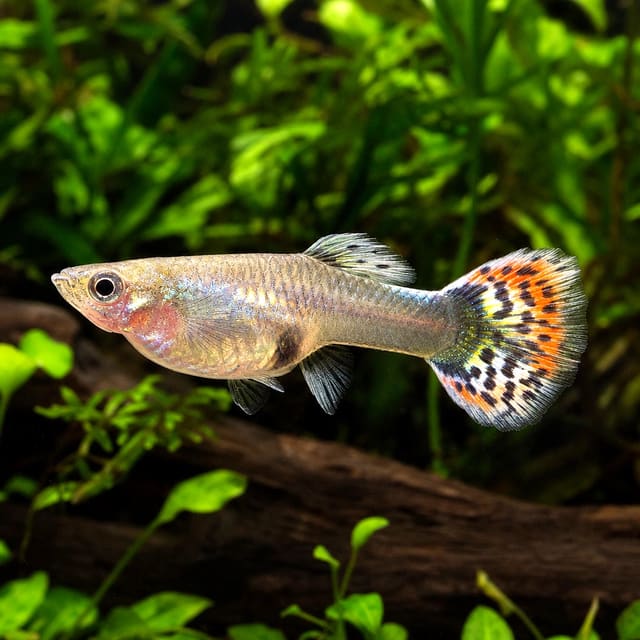
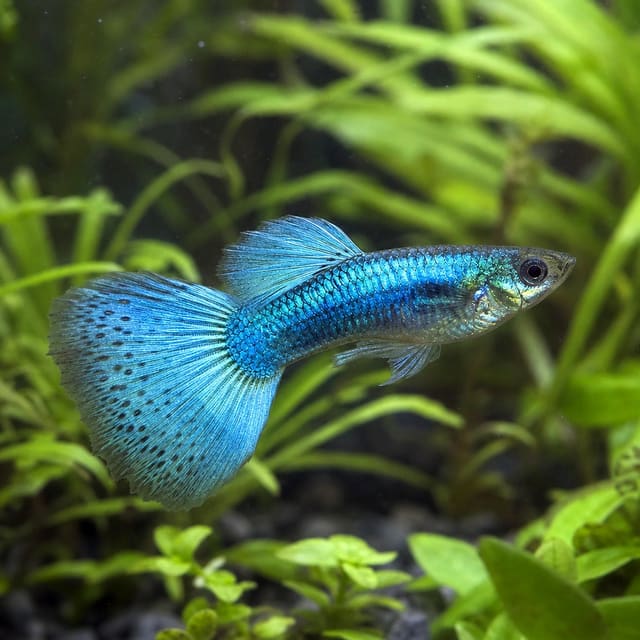
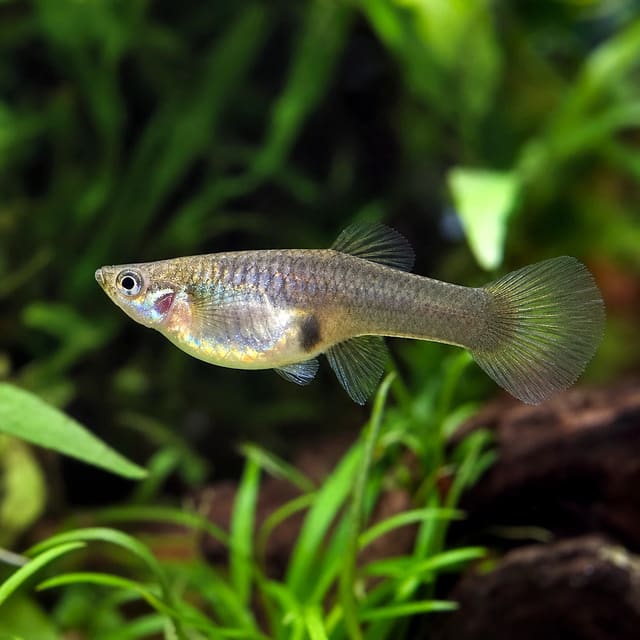
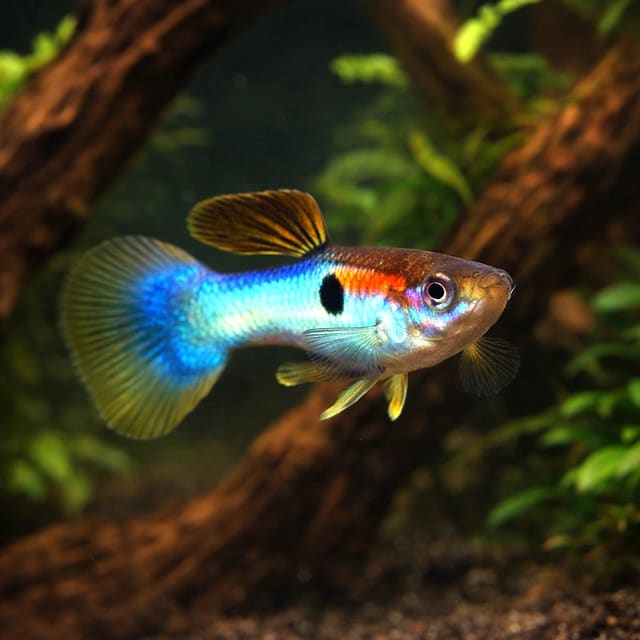
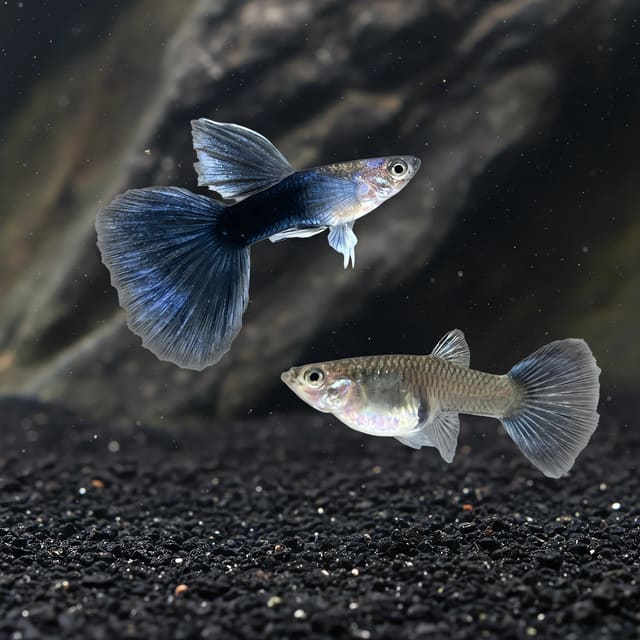
Blue Turquoise Female Guppy (Poecilia reticulata), sold as one female fish at the 3–4 cm supplier grade. Guppies are social livebearers; plan a mature, filtered 60 cm aquarium, a suitable group and a responsible response if fry appear.
Adult size is the maximum length this species reaches at full maturity (scientific sources). The livestock you receive will be younger and smaller. Product-photo provenance and any image-specific limitations are stated on the listing.
Shoaling fish: kept in a group they feel safer, stay calmer and show their best colour.
Minimum of 2 per order.
Blue Turquoise Female Guppy (Poecilia reticulata), sold as one female fish at the 3–4 cm supplier grade. Guppies are social livebearers; plan a mature, filtered 60 cm aquarium, a suitable group and a responsible response if fry appear.
Adult size is the maximum length this species reaches at full maturity (scientific sources). The livestock you receive will be younger and smaller. Product-photo provenance and any image-specific limitations are stated on the listing.

Guppies are social livebearers suited to a prepared beginner, not a fish-per-litre formula. Use a mature filtered aquarium, tested neutral-to-alkaline mineral-bearing water, deliberate sex and population planning, open swimming room, cover and a separation option.
Maintain these water conditions for optimal health and vibrant colors
This Blue Turquoise Female Guppy is one female Poecilia reticulata, a social livebearer for a mature, filtered aquarium. The blue turquoise wording describes the trade colour form. It does not guarantee a fixed pattern, a pedigree, an exact specimen from a photograph or freedom from fry. Sex is guaranteed only when the exact product or selected option explicitly states male or female. This Blue Turquoise Female Guppy listing is sold as female.
One purchase supplies one fish. This fish is offered at a 3–4 cm dispatch grade; that describes the size sent, not a final body length or a promise of millimetre-perfect measurement. There is one product choice, so a basket quantity of several still means individual female guppies rather than a ready-made social balance for every aquarium. FishBase and the store's guppy guide describe guppies as group fish. Before ordering, decide how this female will fit with the existing group, how much room they have and what you will do if social pressure or fry become an issue.
For a comfortable start, Tropical Fish Co uses a conservative house screen: a mature aquarium at least 60 cm long for a small guppy group, with five or more guppies where the sex plan, water tests, filtration and other livestock allow. OATA's combined guppy-and-molly sheet offers a broader floor of at least three and 45 litres for a small group of smaller livebearers. Neither number is permission to add fish by a litre formula. A 60 cm aquarium can still be too crowded if it already holds other species, is short on usable swimming space, has unstable chemistry or cannot support potential young.
| Good preparation | Pause before ordering |
|---|---|
| A mature, filtered tank with open swimming room, cover and repeated zero ammonia and nitrite tests | A newly filled bowl or a tank judged only by its nominal litre label |
| A planned social group and a sex mix that fits the aquarium and any fry plan | An assumption that a female can never give birth without a male present now |
| Measured, stable neutral-to-alkaline mineral-bearing water | Unmeasured water or repeated abrupt chemistry corrections |
Females can store sperm from an earlier mating. A female-only purchase therefore does not prove that fry will never appear. Set aside space and a rehoming plan before adding more fish, especially if the aquarium is small or already stocked. At the same time, do not mistake every rounded body for pregnancy; condition and health need attention on their own terms. The product's female offer is a sex statement, not a claim about reproductive history.
Guppies can suit a prepared beginner because they accept a practical range of foods and can adapt to a stable community. That does not make them suitable for an uncycled aquarium or a tank without a social and population plan. Their small size invites underestimating their needs; long fins, chasing, food competition and a growing group all change the room required. Read the full guppy care guide for the wider species, then use this page for the exact female offer. The guppy collection shows other current forms, but a different colour or sex label needs its own offer check.
The accepted scientific name is Poecilia reticulata. FishBase places the species in Poeciliidae and records a native distribution including Venezuela, Barbados, Trinidad, northern Brazil and the Guianas. Domestic colour labels do not change that species identity or establish a wild locality for the individual on sale. Seriously Fish records up to about 6 cm standard length for the species; standard length excludes the tail fin, and ornamental tails can make the whole fish appear longer. The supplied 3–4 cm grade should never be confused with that adult reference.
The store's routine guppy display guidance is 22–28°C. OATA's combined guppy-and-molly sheet gives pH 7–8 and general hardness around 8–18 dGH, with ammonia and nitrite at zero. Those latter numbers are broad group guidance. Seriously Fish also describes guppies as hard-water fish that should be kept in moderately hard or harder water for long-term maintenance. Together, these references point to stable, tested, neutral-to-alkaline mineral-bearing water for this female, not to a single magic number. FishBase records a wider ecological temperature range; a wild occurrence limit is not a routine target for a domestic display.
Check the aquarium water as it actually is before ordering. A water-company report gives background, but a tank can differ from the tap after decoration, top-ups, feeding and biological activity. Test tap and tank, then write down temperature, pH, hardness, ammonia, nitrite and nitrate. Repeated measurements are more helpful than a single test taken just after a water change. If parameters drift, investigate the cause rather than repeatedly adding products to chase a precise pH. Gradual stability matters to fish already living in the tank as well as to a new arrival.
Biological filtration turns toxic ammonia into toxic nitrite and then less toxic nitrate. The RSPCA notes that fish should not be kept without a well established, maintained filter. Water can look clear while ammonia or nitrite is present. Establish the filter before adding the guppy; the passage of a certain number of days does not demonstrate maturity. After an additional fish joins the aquarium, keep checking because its waste and feed add to the biological load. A sudden spike is a welfare problem, not a normal stage for fish to endure.
OATA advises that nitrate remain no more than 20 mg/l above the usual tap-water level in its guppy-and-molly guidance. That requires knowing the tap baseline. If the source already contains nitrate, an isolated tank reading cannot tell you how much is accumulating. Match test results with observation: excess food in corners, trapped waste, a reduced filter flow or new fish gasping may reveal what needs attention. Change water appropriately, but do not use a dramatic unmeasured change that swaps one problem for temperature or chemistry shock.
OATA recommends a partial water change of about a quarter each week as a general rhythm. Use dechlorinated replacement water with suitable temperature and comparable chemistry, adjust the schedule to measured waste and the group, and remove settled debris. Rinse dirty filter media gently in removed tank water instead of chlorinated tap water. Avoid replacing all filter material at once. It is the established bacteria, not a spotless appearance, that help protect the fish from ammonia and nitrite.
Brackish records for wild guppies do not mean that an ordinary guppy aquarium needs salt. Salt affects plants, invertebrates and other fish differently, and it can obscure a water-quality problem. Use measured, suitable freshwater as the everyday plan unless qualified advice for the actual system establishes a different purpose. Mineral-bearing water is about its measured chemistry, not about adding an arbitrary amount of powder or salt. If your local water is naturally very soft, plan the whole aquarium carefully before mixing species with incompatible needs.
Look at the tank through the day. A heater may hold one corner at a different temperature from another, and summer room heat can push water above the chosen range. Cover the aquarium securely while preserving gas exchange, and provide flow that circulates water without exhausting the fish. Guppies with longer fins may struggle in a strong current. Watch whether this female can swim, feed and rest normally throughout the tank. The water chemistry guide explains the tests, and the water matcher can help compare your readings with the stated guidance.
Plan an aquarium by its usable length and layout as well as its litres. The store's 60 cm screen gives a small group swimming room and supports a more conservative plan than treating OATA's 45-litre combined-sheet floor as a complete answer. A 60-litre tank might be a candidate if it is at least about 60 cm long, mature, filtered and not already crowded. A 60-litre label alone cannot tell you how many fish it can support. Adult fish, fry, other species, decor, filter performance and water results all count. Leave room to respond if the group changes.
Offer open swimming space with planted or other gentle cover. Plants and suitable floating vegetation can help fish move out of one another's direct line of sight and give a newly introduced female a place to settle. Seriously Fish describes planted surroundings and warns against strong current; OATA recommends cover and cautions against sharp decorations that can injure long fins. Choose surfaces you can maintain and areas you can observe. Too much dense decoration can hide a fish that is repeatedly pursued or misses food, so balance refuge with clear sightlines for daily checks.
Cover is especially important when mixing males and females. Male pursuit can be persistent, and one hiding place may simply let a dominant fish trap another. Provide several routes through the aquarium, spread food so shy fish can reach it and watch each individual's body condition. If a female spends most of the day cornered, refuses food or develops damaged fins, more plants alone are not a complete solution. A cycled separation tank or a changed group plan may be needed. The aim is a group whose members can feed and rest without chronic pressure.
| Daily look | Useful response |
|---|---|
| Steady swimming, regular breathing and an open posture | Keep the established routine and watch for changes rather than adjusting water unnecessarily |
| One fish missing food or hiding continuously | Check social pressure, feeding position, water values and a safe separation option |
| Uneaten food collecting under cover | Reduce portions, remove debris and review filtration and testing |
Feed an appropriately sized, nutritionally complete flake or granule made for omnivorous community fish as the staple. OATA recommends a quality food and compatible algal and small invertebrate variety. Wild guppy diets include small animals and detritus, but a wild record is not a recipe to collect pond material for a home aquarium. Use safe aquarium foods and store them correctly. The exact mix can change with age, condition and the rest of the group; no single feeding clock is necessary for every tank.
Watch this female take food rather than assuming that food entering the tank reaches her. A confident male or larger tank mate may take it first. Start with a modest portion, see how quickly it is eaten and remove leftovers before they break down. Overfeeding raises waste and can worsen water quality; underfeeding an excluded individual while the rest eat well can be missed unless you observe. Several small feeding positions can help, but only if the filter and stocking are adequate. Do not add extra food to overcome a social problem without identifying it.
Keep the floor and plant bases accessible to a siphon. Clean enough to remove waste without stripping all biological surfaces at once. Check the filter intake, especially if fry appear, and use an appropriate guard so tiny fish are not drawn in. A nursery or separation tank also needs a mature filter and stable water; a small uncycled container is not a welfare plan. Before setting up to raise young deliberately, consider food size, space as they grow, repeat testing and responsible homes.
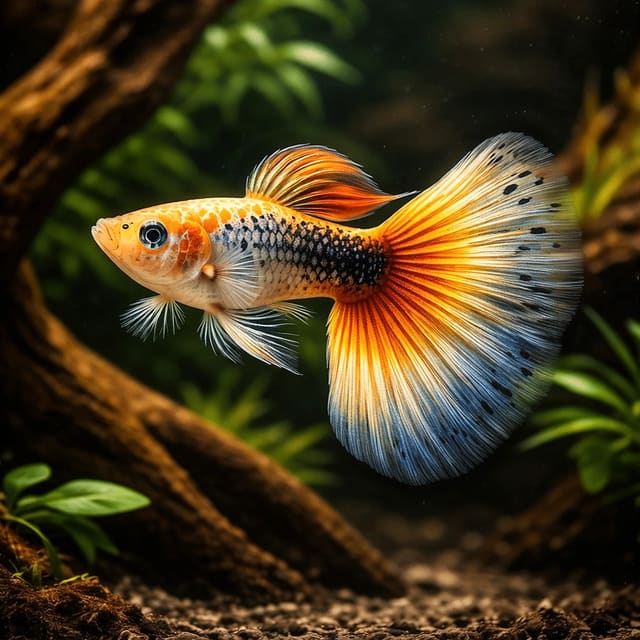
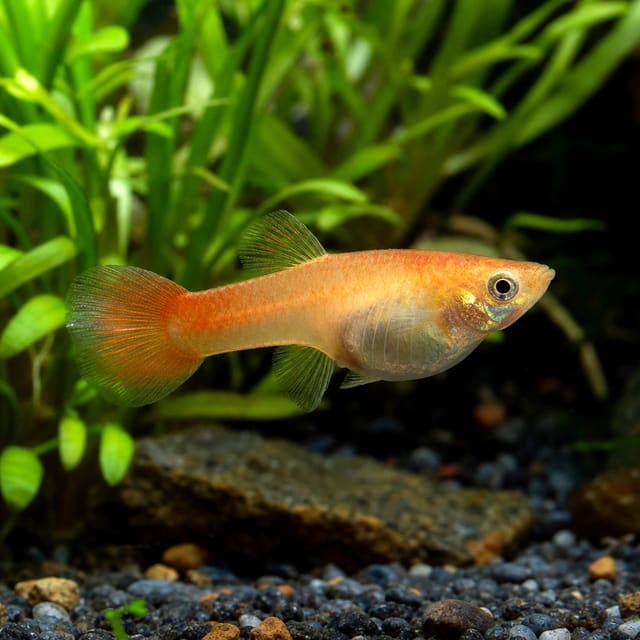
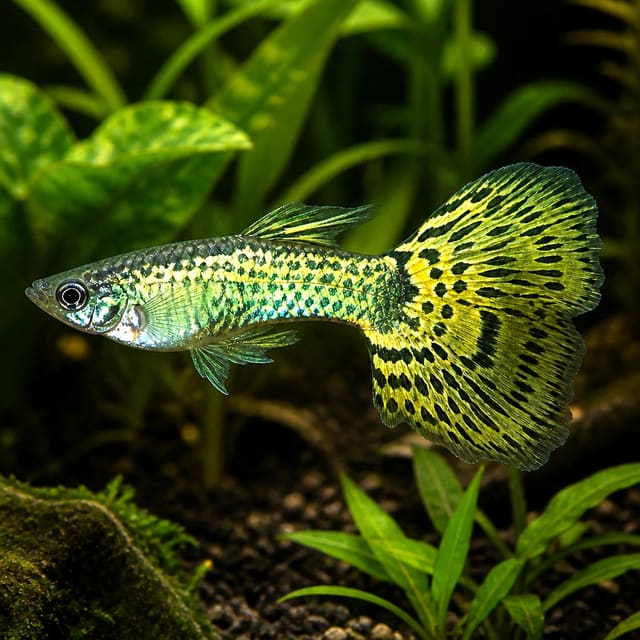
Notice the fish's normal colour, shape and movement over time, but do not use colour alone to diagnose health or reproductive status. Domestic females can carry vivid colour in their tails. A dark area or round abdomen alone is not proof of pregnancy, and stress, disease or feeding can change appearance too. If anything looks wrong, check water and behaviour first, then seek qualified help. A record of recent tests and changes helps someone advise you much more than a guess based on a photograph.
Guppies are generally peaceful, but “peaceful” does not mean every companion is suitable. The first question for this female is whether she has an appropriate guppy group. OATA suggests at least three and a ratio of two females per male in mixed groups to reduce pressure. The store's more conservative policy screens for five or more fish in a mature 60 cm aquarium where capacity and sex planning allow. Neither number guarantees that an individual female will avoid harassment, or that a mixed group will not produce fry. Observe the actual fish, not only the ratio on paper.
Another female-only group can avoid new mating inside the aquarium, but this purchased female may have encountered a male earlier. Guppy sperm storage is documented, so fry can still appear after a female joins a tank without males. This is a practical reason to plan spare capacity and homes before purchase; it is not a claim that this particular fish is pregnant. A mixed group needs a deliberate approach to courtship pressure and to the young. A male-only group avoids new mixed-sex mating but can still involve display and chasing. Choose the whole social plan rather than expecting one additional fish to solve every behaviour problem.
Seriously Fish describes guppies doing well in quiet community aquariums with other livebearers, rasboras, corydoras, small loricariids and tetras, but these are broad kinds, not universal approvals. Each exact species has its own adult size, water, group and feeding needs. A corydoras that needs different water should not be included merely because its genus appears on a list. Small shrimp or young animals may be eaten. Check the needs of the exact animals already living in the tank before adding a guppy.
Fin-nipping fish such as tiger barbs and serpae tetras are poor default companions, especially around ornamental fins. Larger fish that can swallow a guppy or intimidate her are unsuitable. A betta and guppy can draw aggressive attention to one another's display and fins; do not assume a planted tank makes that combination safe. Remember that the guppy also needs its own social group. Combining multiple shoaling species in a small aquarium can crowd each group's usable space even if no obvious fighting occurs.
Inspect the group at more than one time of day. Feeding can briefly gather fish that spend the rest of the day apart or in pursuit. Watch whether this female can rest, swim in open water and reach food. Repeated chasing, cornering, clamped fins, frayed tails or unusual hiding deserves a water test and a social review. Avoid treating every conflict by adding yet another fish; extra animals increase biological load. Sometimes changing sightlines helps, and sometimes separation or a different stocking plan is necessary.
If you want a documented colour line, this trade-colour female alone does not establish pedigree or pure line status. Nor is she an Endler's livebearer. Poecilia wingei is a separately described species that can hybridise with guppies. Keep documented lines apart if preserving them matters, and do not label mixed descendants as pure representatives of either species. A colour form can be enjoyed as an individual fish without making a genetic promise.
For the wider buying decision, compare the current guppy collection only if you need a different sex or form and then read that exact offer. A related product is an alternative purchase, not an automatic tank mate. This listing supplies one explicitly female fish; adding a male listing changes both social and population planning. Even two female listings do not create a balanced group by themselves unless the total aquarium plan makes sense.
Prepare the aquarium before dispatch: the filter should be mature, water values stable and measured, temperature controlled and a quiet area ready for the new fish. The first tank guide can help with basic maturation. The store's delivery page provides the current packing, receipt, acclimation and Live Arrival Guarantee terms. Use the order's confirmed delivery information so someone is present to receive live animals. Inspect the parcel and fish promptly; if there is a concern at arrival, follow the policy's evidence and contact guidance on the same day.
Keep the fish's first hours quiet. Handle the bag gently, avoid sudden bright light and follow the store's current acclimation advice. Transport water should not be poured into the aquarium. The fish may initially stay near cover while learning the new space, but persistent loss of balance, rapid breathing or inability to swim calls for attention rather than a blanket assumption of “travel stress”. Observe existing fish too: a settled resident may chase the newcomer once normal activity returns.
A settled guppy usually swims steadily, breathes regularly, holds open undamaged fins and feeds consistently. Clamped fins, surface gasping, loss of balance, visible lesions or a sudden appetite change are warning signs, not a diagnosis. Test water promptly, inspect the heater and filter, and record recent changes. Seek guidance from an aquatic veterinarian or knowledgeable professional if signs continue. Do not choose medication, salt or a high-temperature treatment based on one symptom; those choices can harm other animals and obscure the actual cause.
A quarantine tank can help keep an arrival separate from established livestock while you observe her, but it must be biologically filtered, appropriately heated and tested. Use dedicated equipment where possible and avoid transferring water or tools between systems without care. The MSD Veterinary Manual discusses quarantine periods of at least 30 days in professional management, with longer periods as indicated. The precise plan depends on the actual fish and system; the point is sustained observation in a suitable environment, not confinement in an uncycled jar. The UK fish-vet directory can help locate qualified advice.
This female may produce fry after purchase even in a tank without a current male. Peer-reviewed work and guppy husbandry accounts describe sperm storage for months. That possibility deserves space, food and rehoming planning, but it is not an assurance that this particular female will give birth. Avoid a fixed timetable or brood count. If young appear, protect the filter intake, use food sized for them and test the nursery or main tank frequently. More mouths and more feeding increase waste long before the fish look crowded.
Do not use adult predation as a population-control plan. If you cannot responsibly house or rehome young, consider the reproductive risk before adding this female. Separating males now does not erase previous mating, and a display that seems spacious for five adults may be strained by a growing brood. Think through where fry will live as they grow and when a second cycled system might be needed. Never release fish, fry, plants, snails or aquarium water outdoors or into natural waterways. Rehome livestock responsibly.
Return to normal observation once she has settled, but keep testing after changes in food, fish numbers or filter performance. A welfare problem often shows first in behaviour: one fish hides, breathes faster or feeds less before water becomes visibly cloudy. Write down the reading and the event rather than guessing. Prompt measured care gives the female and her companions a better chance than repeatedly altering the whole tank because a colour looked different for one afternoon.
Seriously Fish records up to about 6 cm standard length for guppies. Standard length excludes the tail fin. This fish is supplied at the 3–4 cm grade; that is her dispatch size, not an adult promise.
Tropical Fish Co uses a mature, filtered aquarium at least 60 cm long as a conservative screen for a small guppy group. OATA's broader combined guppy-and-molly guidance gives 45 litres for a small group of smaller livebearers. Check usable space, water and other fish too.
Plan a social group. OATA suggests at least three guppies; the store's more conservative policy is five or more where space, water and the sex plan allow. This purchase supplies one female, and no group number eliminates the need to watch behaviour.
She can suit a prepared beginner with a mature filter, stable mineral-bearing water and a planned group. An uncycled bowl or a tank without a response plan for pursuit or fry is unsuitable.
Use a suitably sized complete omnivore flake or granule as the staple, with safe compatible variety. Watch that she receives food, and remove leftovers before they damage water quality.
The store's routine guppy display range is 22–28°C. OATA's broader guppy-and-molly guidance is pH 7–8 and 8–18 dGH. Keep measured water stable, with zero detectable ammonia and nitrite.
Guppies are generally peaceful, but individuals can face pursuit and food competition. Avoid fin-nipping companions and watch for damaged fins, hiding or missed meals; intervene if pressure persists.
Seriously Fish names quiet communities with other livebearers, rasboras, corydoras, small loricariids and tetras as possibilities. Check the exact species' water, adult size, group and feeding needs; none is universally safe.
The Tropical Fish Co delivery page explains protective packing, tracked licensed transport, receipt and Live Arrival Guarantee terms. Be present for the confirmed delivery, inspect her promptly and follow that page's current arrival advice.
This page offers one female guppy at the 3–4 cm dispatch grade. FishBase supports the species identity and distribution. Seriously Fish supplies species-level adult length and practical aquarium guidance. The OATA guppy-and-molly sheet provides broad UK group guidance, and the RSPCA explains biological filtration. The store's guppy guide sets its conservative group and aquarium policy.
Before buying, measure the tank's usable length, test its water and confirm that the fish can join a suitable social group. Plan for possible fry and a safe response if any fish is excluded from food or pursued. Once those pieces are ready, the female's colour is a pleasure to observe rather than a reason to take shortcuts on the aquarium she depends on.
Independently collected by Judge.me from customers who bought this item. All reviews are shown.
Slowly acclimatised them like with shrimp, majority have caught white spot, and now spread to my existing fish, the conditions in my tanks are perfect. Its been a nightmare trying to keep under control, not sure if il be buying from this place again.