Easy
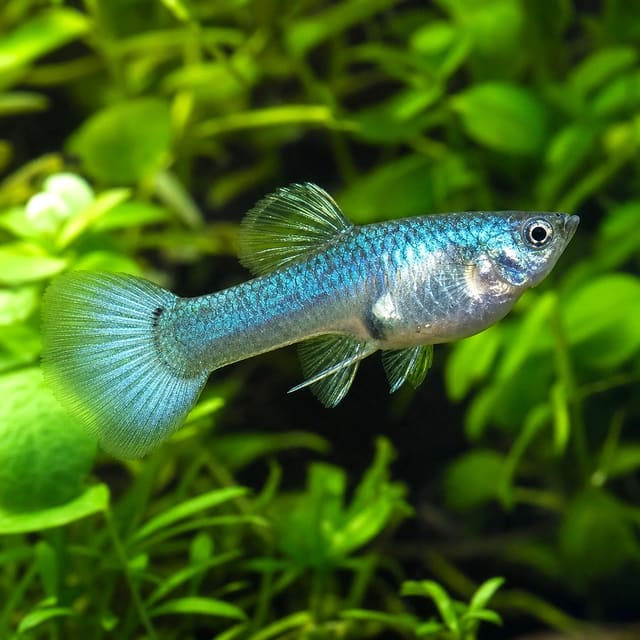
Blue Turquoise Female Guppy (Poecilia reticulata)
22–28°C · pH 7–8
£2.99

Male Guppy (Poecilia reticulata) for a planned, peaceful aquarium with gentle flow, cover and mineral-bearing water. Sold individually in two size grades; keep a suitable social group and protect long fins from nippers.
Poecilia reticulata
Shoaling fish: kept in a group they feel safer, stay calmer and show their best colour.
Minimum of 2 per order.
Male Guppy (Poecilia reticulata) for a planned, peaceful aquarium with gentle flow, cover and mineral-bearing water. Sold individually in two size grades; keep a suitable social group and protect long fins from nippers.
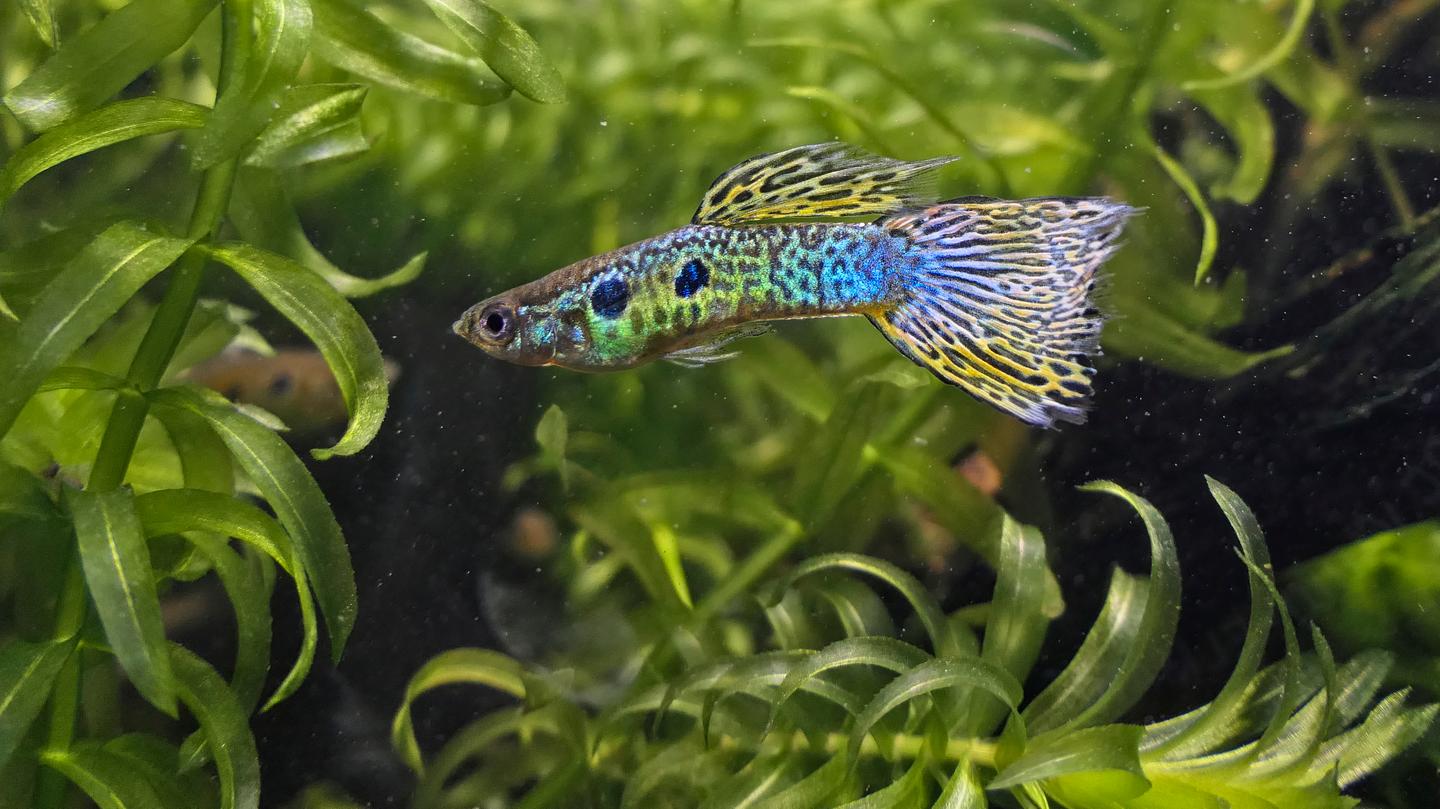
Guppies are social livebearers suited to a prepared beginner, not a fish-per-litre formula. Use a mature filtered aquarium, tested neutral-to-alkaline mineral-bearing water, deliberate sex and population planning, open swimming room, cover and a separation option.
Maintain these water conditions for optimal health and vibrant colors
A male guppy brings colour, flowing fins and lively movement to a well prepared freshwater aquarium. This is Poecilia reticulata, the familiar fancy guppy: a small livebearer whose aquarium varieties show an extraordinary range of patterns. It suits a keeper who enjoys watching a group closely, provides stable mineral-bearing water and chooses companions that leave delicate fins alone. Its manageable size makes daily care approachable, but the aquarium still needs proper swimming space, mature filtration and regular attention.
One purchase supplies one live male guppy of the selected size. The size choices are 2.5–3 cm and 3.5–4 cm. The size you select is the size supplied, not the adult size. Check the live selector for the option you intend to order and plan the aquarium for adult fish before choosing smaller arrivals.
Sex is guaranteed only when the exact product or selected option explicitly states male or female. This Guppy male listing is sold as male. Buying more than one adds individual males; it does not create a breeding pair or a balanced mixed-sex group. A male display can be a practical way to enjoy guppies without introducing females, provided the residents are compatible and pursuit is monitored.
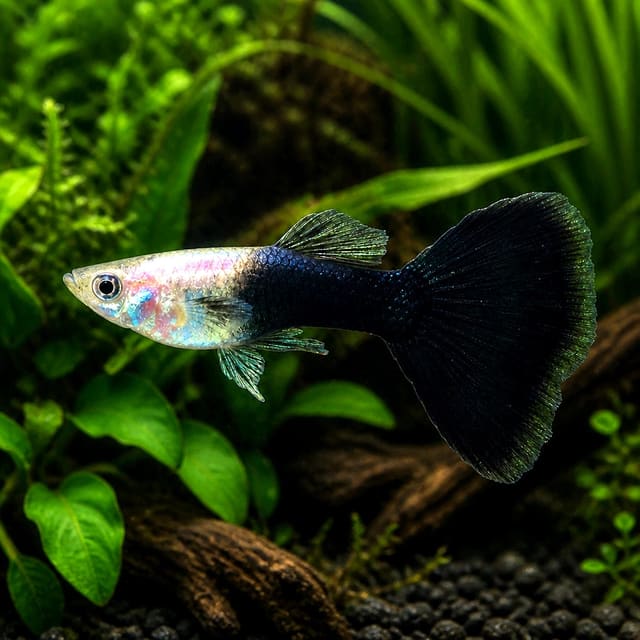
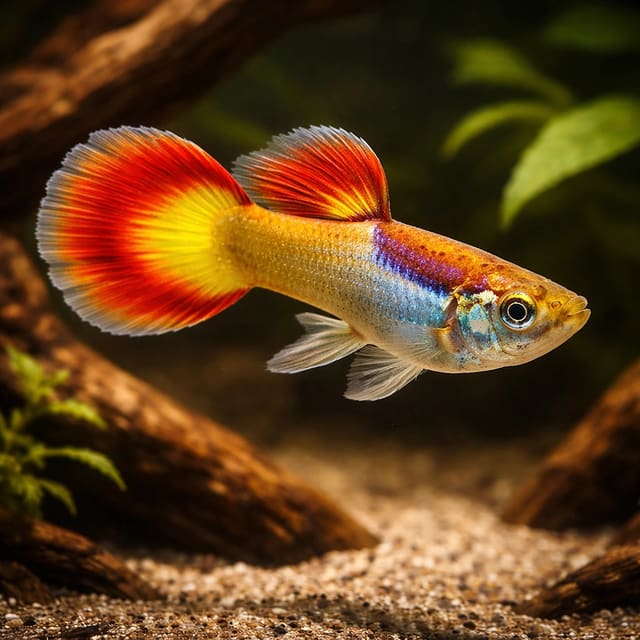
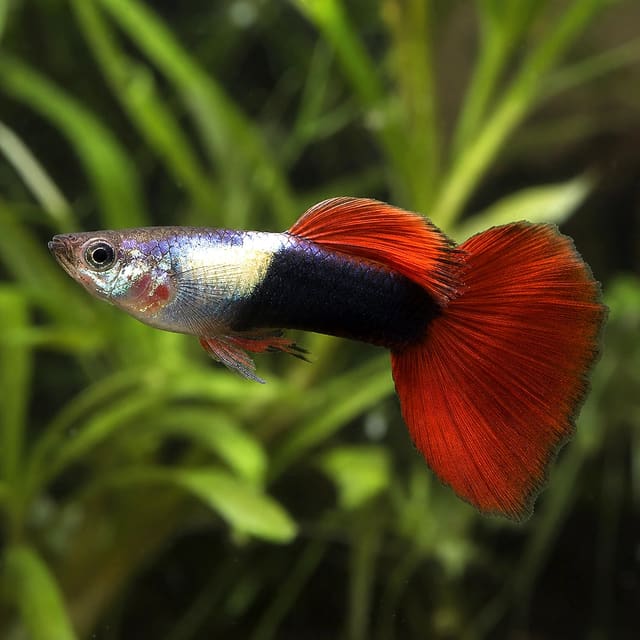
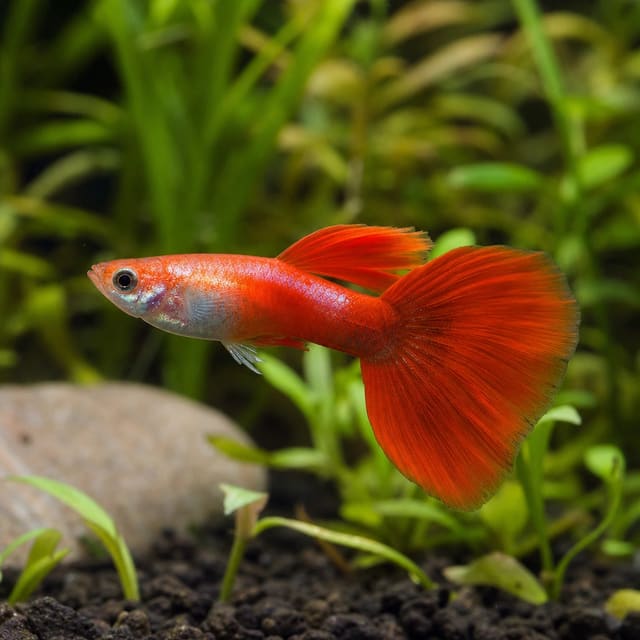
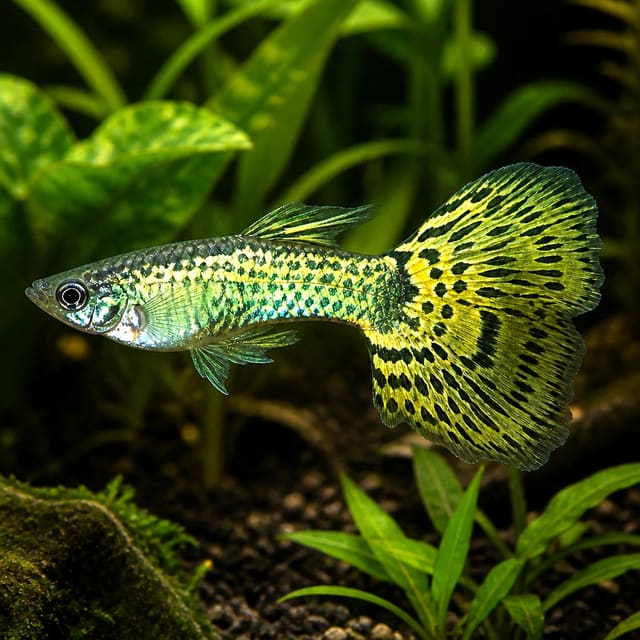
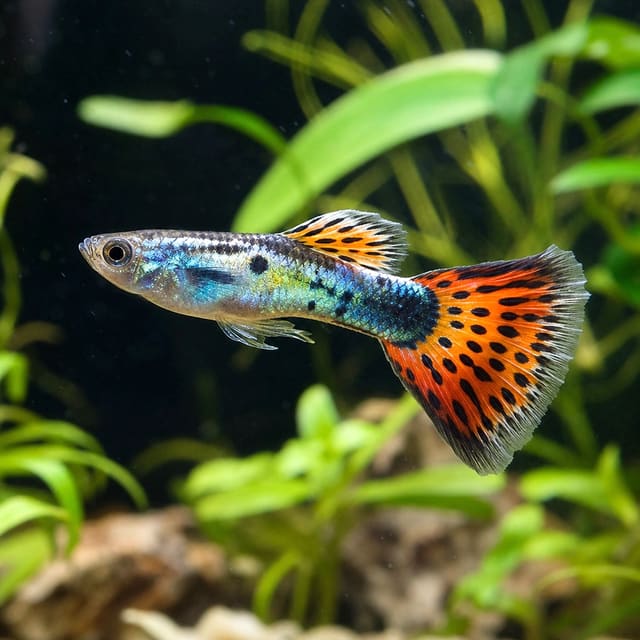
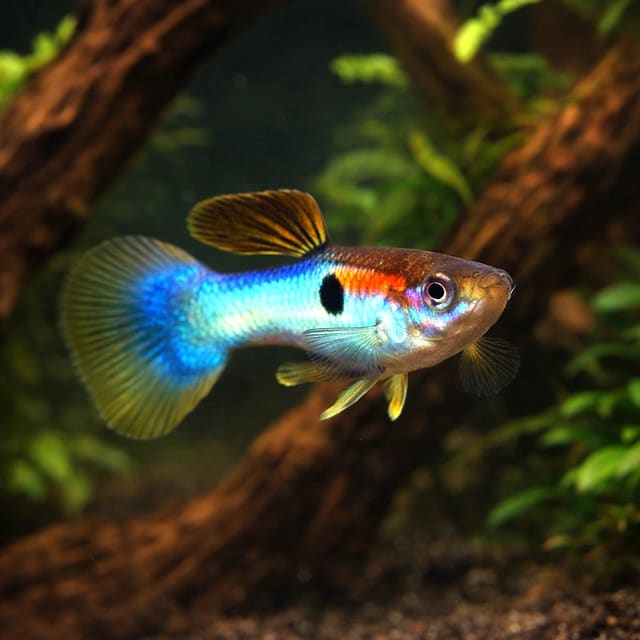
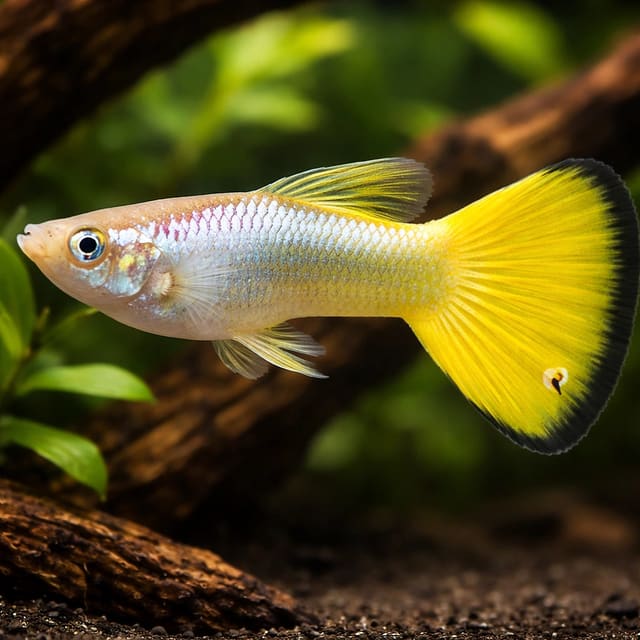
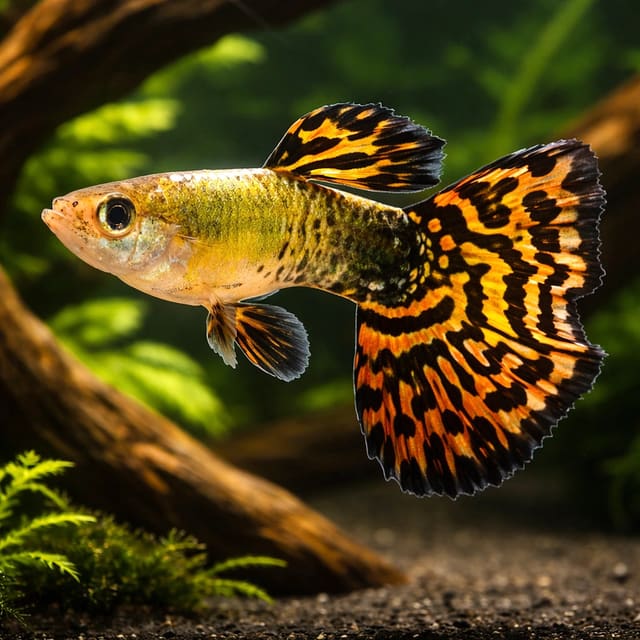
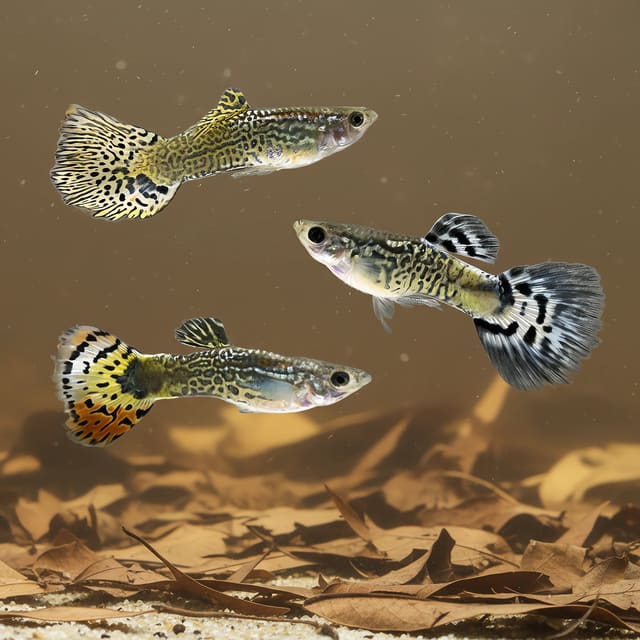
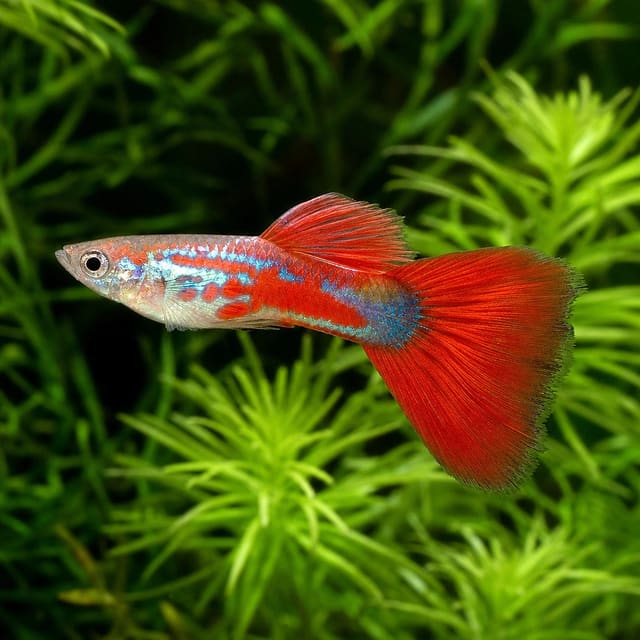
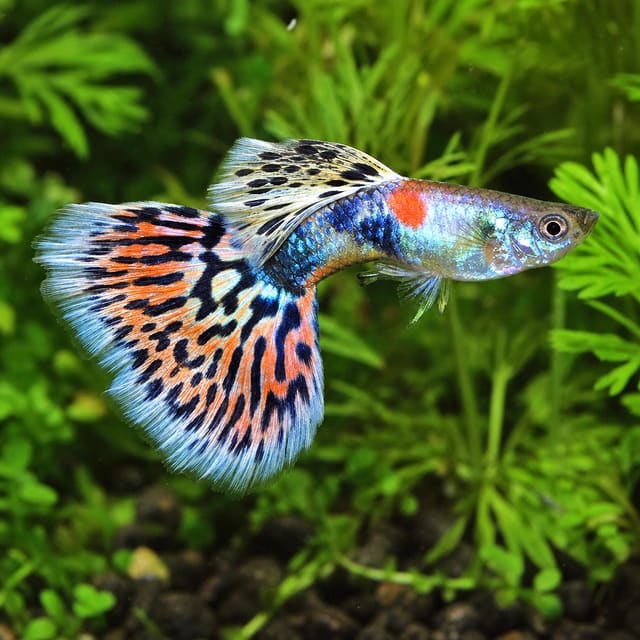
This is a male mix, with individual variation in colour and finnage. If you want a named appearance, compare the Blue Moscow Male Guppy, which is offered under a specific colour-form name. That comparison helps with the look you are choosing; it does not establish pedigree or promise how two particular fish will behave together. The broader guppy collection is useful when deciding between a mixed display and a named form.
Domestic males commonly have more conspicuous colour and longer fins than females. A broad tail can make a fish look much larger than its body measurement, especially in a close photograph. FishBase records 5 cm standard length for male or unsexed fish. Standard length excludes the tail fin; it is not a 5 cm nose-to-tail limit. Plan room for complete fish to turn and swim without rubbing their fins against ornaments, regardless of the dispatch grade.
The gallery images are representative of this type of animal rather than photographs of the exact animal supplied, so colours can look slightly different from the live animal.
Enjoy the changing angles of the fins and the fish's movement rather than expecting a photograph to describe every individual. A comfortable display gives each fish room to feed, move away from another male and rest under cover. Look at the whole group as well as its brightest member: an aquarium is working well when quieter individuals also maintain normal condition and use the space.
Tropical Fish Co's conservative guppy policy starts with an aquarium at least 60 cm long and a group of five or more where capacity, sex planning and other livestock allow. Our routine temperature range is 22–28°C. The water guidance used alongside it is pH 7–8 and 8–18 dGH from OATA's combined guppy-and-molly sheet. These are practical planning recommendations; the number of fish must still fit the actual aquarium and its maintenance.
A prepared beginner can keep guppies successfully when testing, feeding and water changes are part of the routine. An uncycled bowl, a crowded tank with no escape routes or a community of fin nippers is a poor starting point. Read our complete guppy care guide for the wider background, including social planning, population management and the difference between guppies and Endler's livebearers.
A tank's litre label is only part of the decision. Check its internal length, the space left after decoration and the needs of every resident. A tall aquarium may hold plenty of water while offering little horizontal swimming room. Male guppies need to move freely past plants and one another, so a clear swimming area is useful even in a lush display. Leave space for maintenance too: cover that you cannot inspect can hide uneaten food or a fish that is being excluded.
OATA recommends at least 45 litres for a small group of the smaller livebearers in its guppy-and-molly sheet. FishBase's aquarium note gives a 60 cm minimum length and five or more individuals. The store's conservative policy follows that longer footprint and group screen. Neither a volume nor a group number can settle the whole stocking question. Existing fish, adult size, sex mix, feeding, filtration and behaviour all affect whether the plan is sensible.
A conventional aquarium around 60 litres can be a candidate for a small group if it is at least about 60 cm long and meets those checks. That is a starting assessment, not an automatic allowance for five extra fish in an occupied aquarium. Adding females changes the future population; adding other species adds their own social and space requirements. Choose enough room for the intended adult display rather than buying a temporary container on the assumption that an upgrade will happen later.
A biological filter supports bacteria that process fish waste. Ammonia is converted to nitrite and then nitrate; ammonia and nitrite are toxic and should be undetectable in a prepared aquarium. Clear water alone cannot show that this process is established. Use water tests to verify readiness and continue testing after changes to stocking or feeding. A fixed number of weeks is a poor substitute for evidence that the filter is coping.
Our first tropical aquarium guide explains the preparation sequence. Set up the aquarium, choose appropriate equipment, establish biological filtration and check conditions before introducing livestock. Increase the fish population cautiously because a working filter adapted to a smaller load may need time to cope with more waste. Keep a record of results so a change in water quality is easier to recognise.
Filter maintenance should preserve that useful bacterial population. Check the intake and outlet for blockages and confirm that water still moves through the media. When the media needs cleaning, OATA advises a light rinse in water removed during a water change. Do not run the filter media under the tap, because chlorine or chloramine can harm its bacterial population. Cleaning every component aggressively at once can undermine the system you have worked to establish.
For routine guppy care, Tropical Fish Co uses 22–28°C, with OATA's group guidance of pH 7–8 and 8–18 dGH. General hardness describes dissolved minerals; it is not interchangeable with pH. The combined OATA sheet also lists carbonate hardness at 5–15 dKH. These group ranges help assess suitability, but a stable, measured setup is more useful than repeatedly adding products in pursuit of one apparently perfect number.
| Check | How to use the result |
|---|---|
| Temperature | Use the store's routine 22–28°C range and an independent aquarium thermometer. |
| pH and general hardness | Compare with pH 7–8 and 8–18 dGH, the OATA guppy-and-molly guidance adopted here. |
| Ammonia and nitrite | Both should be zero; a detectable result needs attention before further stocking. |
| Nitrate | OATA advises no more than 20 mg/L above the normal tap-water level. |
Test source water as well as aquarium water. Water supplies differ between places and can change over time, so an assumption about your area's hardness should not replace a measurement. Our water chemistry guide explains the separate readings and how they relate. You can use the water matcher to compare measured values, then check the requirements of each proposed companion individually.
Use a thermostatically controlled aquarium heater where the room cannot maintain a suitable water temperature, and verify it with a thermometer rather than trusting the dial. Prepare replacement water to avoid abrupt changes and treat tap water with a suitable conditioner. Although wild guppies occur in some brackish habitats, that does not make salt a routine requirement for this freshwater display. Any deliberate adjustment needs a measured purpose and consideration of all fish and plants.
A planted layout can give male guppies both shelter and open swimming space. Group plants to form areas where fish can leave one another's sight, while leaving clear routes through the tank. Floating vegetation can provide cover above them, but keep access for feeding and normal equipment operation. Artificial plants and ornaments can also provide shelter when chosen carefully. Check for rough edges or narrow gaps that could catch long fins.
Seriously Fish advises avoiding strong currents. Watch what the fish can actually do: they should not have to struggle continuously against the outlet or remain confined to one calm corner. Biological filtration and water movement still matter, so adjust the direction or distribution of flow instead of sacrificing filtration. Small fish also need an intake arrangement that does not draw them into equipment. Match the layout to their observed swimming rather than using a filter rating alone.
Cover is useful when it offers a choice. A fish that hides persistently, misses meals or is cornered whenever it emerges is showing that the social arrangement needs attention. Adding more plants may improve sight breaks, but it cannot guarantee peace. Check whether the fish can reach several parts of the aquarium and retreat without being followed. Maintain a secure cover and keep the display arranged so you can count and observe every resident.
Use an appropriately sized, nutritionally complete omnivore flake or granule as the staple. The fish must be able to take the particles comfortably; a food that looks small to a person can still be awkward for a small guppy. OATA recommends a good quality flake or granule with an algae component and suitable small live or frozen foods for variety. Daphnia is one example in its guidance. Choose safe aquarium foods and store them according to their instructions.
The wild species eats a range of small food items, including invertebrates and detritus, but wild foraging is not a prescription to collect material outdoors for the aquarium. A complete staple gives a more controlled starting point than one favourite treat. Variety should complement that staple, and extra food should not be offered merely to intensify colour. Watch normal body condition, appetite and access to food over time rather than judging nutrition by the brightness of a tail.
OATA's broad adult feeding guidance is an amount eaten within a few minutes once a day. Use it as a portioning starting point for the actual group, food and aquarium. Observe the entire feeding session: dominant or bolder fish may reach food first, and a full-looking group can hide one individual that has eaten little. Adjust presentation so quieter fish get access. Remove uneaten material before it decays and review the portion if food repeatedly accumulates.
Feeding is also a useful daily observation opportunity. Notice whether each fish approaches normally, takes food successfully and remains balanced while swimming. A sudden change deserves a closer look at the environment and social behaviour. Repeatedly offering more food to a fish that is refusing it adds waste without addressing the cause. Compare current behaviour with that individual's usual pattern, and record persistent changes for a retailer or fish vet.
OATA recommends a 25% partial water change at least once every week and testing at least weekly. Treat that as a baseline routine, with the actual water results and stocking determining whether more attention is needed. Siphon accessible debris during changes, prepare conditioned replacement water and check that equipment runs correctly afterwards. Small regular tasks make it easier to spot trends than waiting for the aquarium to look dirty.
Maintain a simple log of temperature, water tests, feeding changes, new livestock and equipment work. If something goes wrong, those notes can distinguish a gradual drift from a sudden event. Recheck water quality after a filter problem or a significant change in fish numbers. A settled tank remains dependent on care: plants, clear glass and active fish are welcome signs, but they cannot replace the measurements that reveal invisible waste problems.
Look for steady swimming, regular breathing, open undamaged fins, a normal body profile and consistent feeding. Clamped fins, gasping, loss of balance, unusual spots or growths, wounds and persistent hiding are warning signs. A symptom alone does not identify its cause. Start by testing the water and checking temperature, filtration, recent maintenance and interactions with other fish. A torn tail, for example, calls for observation of possible chasing as well as water-quality checks.
Use a separate, biologically supported quarantine system and dedicated equipment for new fish where possible. The veterinary guidance summarised in our guppy guide recommends at least 30 days of isolation, with longer periods where indicated. Quarantine still needs suitable water, filtration, feeding and observation; a small uncycled container is not protective housing. It also cannot promise that every illness will be excluded.
If a fish becomes unwell, isolate safely where appropriate and seek qualified guidance. The OATA fish-vet directory can help locate specialist advice. Record the signs and water readings so the conversation begins with useful information. Avoid changing temperature, adding salt or choosing medication on the strength of one symptom. Any treatment decision must consider the exact fish, diagnosis and other animals in the system.
Prepare the mature aquarium and arrange for someone to receive the parcel. The delivery and Live Arrival Guarantee policy gives current coverage, packing, arrival instructions and claim terms. The store hand-bags fish in oxygen, uses insulated packing and adds a heat pack when the weather calls for it. Follow the confirmed delivery information and supplied acclimatisation directions, and do not pour transport water into the aquarium.
Observe arrivals calmly for breathing, balance, swimming and fin condition. Give them suitable cover while keeping them visible enough to check. Continuing distress should be investigated promptly rather than dismissed as the journey. For a Live Arrival Guarantee claim, the policy requires same-day contact and a continuous unboxing video showing the sealed parcel being opened and the fish still in their sealed bag, alongside the order number. This records arrival condition for the claim.
Guppies are social fish, and the store recommends five or more where the tank and sex plan allow. That recommendation is not a guarantee that every male group will settle. Males can display and chase, and a fish that is repeatedly pursued can lose access to food or resting places. Observe who initiates pursuit, whether it stops and whether the same fish is always receiving it. Individual behaviour matters alongside the species' peaceful reputation.
Provide sight breaks, swimming room and a safe separation option. A display works best when every fish can feed and move without constant interference. If persistent chasing, hiding or fin damage appears, review the arrangement promptly. Adding another fish is not an automatic remedy: it changes the social pattern and adds waste. Likewise, adding females simply to distract males brings courtship pressure and the possibility of fry, so it is a separate stocking decision.
Seriously Fish describes guppies as suitable for quiet communities with other livebearers, rasboras, corydoras, small loricariids and tetras. Those are starting categories for research, not promises about every species in them. Compare the exact adult needs for temperature, pH and hardness, then assess swimming behaviour, mouth size and feeding. A fish can be peaceful in one setting yet unsuitable if it needs much softer water or is large enough to swallow a guppy.
Avoid known fin nippers such as tiger barbs and serpae tetras. Long, conspicuous tails are vulnerable, and a tank that appears calm at feeding time may still contain repeated nipping at other times. Observe the fish after additions and as they mature. Calm bottom dwellers still require their own group, floor space and food; occupying a different level does not make their needs disappear or mean the aquarium has spare capacity.
Betta and guppy combinations are not a sensible default. Colourful fins, territorial responses and individual behaviour make outcomes uncertain. The same careful assessment applies to invertebrates: small shrimp and young may be eaten, and dense vegetation cannot guarantee their survival. If breeding shrimp is your main aim, choose an arrangement that protects that aim instead of assuming a general community label means every tiny animal is safe.
| Decision | What to establish first |
|---|---|
| Another peaceful fish | Matching water needs, adult size, social needs and adequate space for both groups. |
| A long-finned companion | No persistent display conflict, chasing or fin damage. |
| Small shrimp or young animals | Accept the predation risk or house them separately. |
| Additional guppies | A deliberate sex plan, remaining capacity and a response to aggression or fry. |
Guppies give birth to live young. A male-only display avoids new mixed-sex mating within that group. If you later introduce females, plan space and responsible rehoming before doing so. OATA suggests two females per male in mixed groups to reduce pressure, while Seriously Fish advises several females per male. No ratio guarantees that pursuit will be mild, and the recommendation does not turn this male listing into a mixed group offer.
A female that has previously encountered a male can retain sperm and later produce young. Removing males therefore does not necessarily end future broods immediately. Dense plants may increase fry survival, which can be welcome in a managed breeding setup but adds to population demands. Adults or tank mates eating fry should not be the planned solution to overcrowding. Young fish need suitable food, safe biologically supported housing and close water-quality attention.
For mature guppies, anal-fin shape is more useful for sexing than colour alone. Males have a narrow modified anal fin called a gonopodium; females have a broader anal fin. Domestic females may also be colourful. Body shape or a dark patch alone is not proof of pregnancy. For a documented breeding strain, establish the history of the fish and keep the lines separate; attractive colours alone do not establish a pedigree.
Poecilia reticulata and Endler's livebearer, Poecilia wingei, are distinct species. The latter is not simply a small size grade of this guppy. They can hybridise, so house documented breeding lines separately and label descendants honestly. This is particularly relevant when a display evolves into a breeding project: a visually mixed aquarium may be enjoyable, but it should not be represented as a collection of pure breeding lines without evidence.
Never release unwanted fish, fry or aquarium organisms outdoors. Arrange responsible rehoming while the system still has capacity, and prevent aquarium water or material carrying organisms from reaching natural waterways. Population planning is easier before a breeding decision than after repeated broods. A well managed male group is a worthwhile display in its own right; there is no need to breed the fish to enjoy their behaviour.
For Poecilia reticulata, FishBase records 5 cm standard length for male or unsexed fish. Standard length excludes the tail fin, so it is not a whole-fish length limit; domestic tail length varies.
Tropical Fish Co uses a conservative minimum length of 60 cm for a small adult group. OATA gives at least 45 litres for a small group of smaller livebearers, but footprint, filtration, existing fish and the sex plan must also be suitable.
Our policy for Poecilia reticulata is five or more where aquarium capacity and the sex plan allow. Monitor persistent pursuit, missed feeding and fin damage, and have a safe separation option.
Yes. Poecilia reticulata suits a prepared beginner with a mature filtered aquarium, tested suitable water and a maintenance routine. Easy care does not mean that guppies can safely live in an uncycled bowl.
Use an appropriately sized complete omnivore flake or granule with safe compatible variety, including suitable algal and small invertebrate foods. Watch every fish feed and remove leftovers before they decay.
The store uses 22–28°C for routine care. The accompanying pH 7–8 and hardness 8–18 dGH are OATA's guppy-and-molly group guidance; test the actual source and aquarium water and avoid abrupt changes.
They are generally peaceful, but males may chase and persistent pursuit can cause harm. Keep them away from fin-nipping fish such as tiger barbs and serpae tetras, and investigate damaged fins promptly.
For Poecilia reticulata, quiet livebearers, rasboras, corydoras, small loricariids or tetras may be candidates when the exact species has matching water needs, suitable adult size and enough space. Avoid fin nippers and fish large enough to eat guppies.
Tropical Fish Co hand-bags fish in oxygen and uses insulated packing, with heat packs when weather requires, through a licensed live-animal courier. Be present to receive them, inspect them the same day and follow the current delivery policy and acclimatisation instructions.
FishBase: Poecilia reticulata provides species identity, distribution and the labelled standard-length record. Its environmental records describe the species in nature. The store's guppy guide sets out the conservative aquarium policy used here.
Seriously Fish: guppy profile discusses planted layouts, gentle flow, food and fin-safe communities. OATA's guppy-and-molly care sheet supplies the broader UK care guidance for water, feeding and routine maintenance. Read those ranges with their stated scope and assess the actual aquarium before stocking.
RSPCA aquarium environment advice explains why filtration and water quality underpin fish welfare. Use qualified advice when a health concern persists; a care page cannot diagnose an individual fish.
No reviews for this item yet. Bought one? Honest reviews only, good or bad.
What customers say about ordering from us
I have a small group of long finned mountain minnows. So was delighted to be able to order ten of this variety to increase the genetics in my tank . The ones I recieved are healthy but it’s to early to give a verdict on wether they are of a long finned type since they are small currently.
Gordon Walker · 23 Sept 2026
100% success travel and "installation". Pleased with quality of purchase. The Siamese fighter a bit "shy" so have not yet seen him at his best yet but looking good. Happy customer. GG
George E Garratt · 21 Sept 2026
Reviews of our shop, collected by Judge.me, an independent third-party review collector. Newest first.