Easy
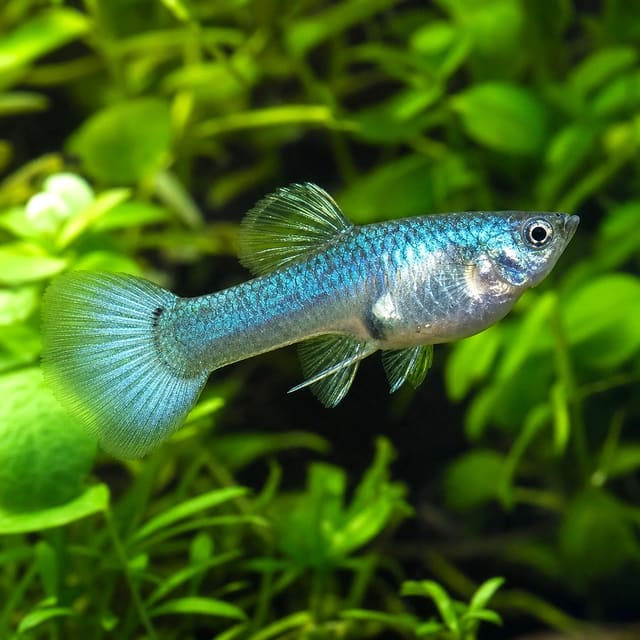
Blue Moscow Male Guppy (Poecilia reticulata)
22–28°C · pH 7–8 · 45L
£4.09
Photo coming soon
The size, price and care details on this page are for this listing.
Male Tuxedo Black Guppy (Poecilia reticulata) is one live male guppy supplied at 3–4 cm. It suits a mature, filtered hard-water aquarium with a carefully planned social group, gentle flow and peaceful companions that will not nip its long fins.
Adult size is the maximum length this species reaches at full maturity (scientific sources). The livestock you receive will be younger and smaller. Product-photo provenance and any image-specific limitations are stated on the listing.
Poecilia reticulata
Shoaling fish: kept in a group they feel safer, stay calmer and show their best colour.
Minimum of 2 per order.
Male Tuxedo Black Guppy (Poecilia reticulata) is one live male guppy supplied at 3–4 cm. It suits a mature, filtered hard-water aquarium with a carefully planned social group, gentle flow and peaceful companions that will not nip its long fins.
Adult size is the maximum length this species reaches at full maturity (scientific sources). The livestock you receive will be younger and smaller. Product-photo provenance and any image-specific limitations are stated on the listing.

Guppies are social livebearers suited to a prepared beginner, not a fish-per-litre formula. Use a mature filtered aquarium, tested neutral-to-alkaline mineral-bearing water, deliberate sex and population planning, open swimming room, cover and a separation option.
Maintain these water conditions for optimal health and vibrant colors
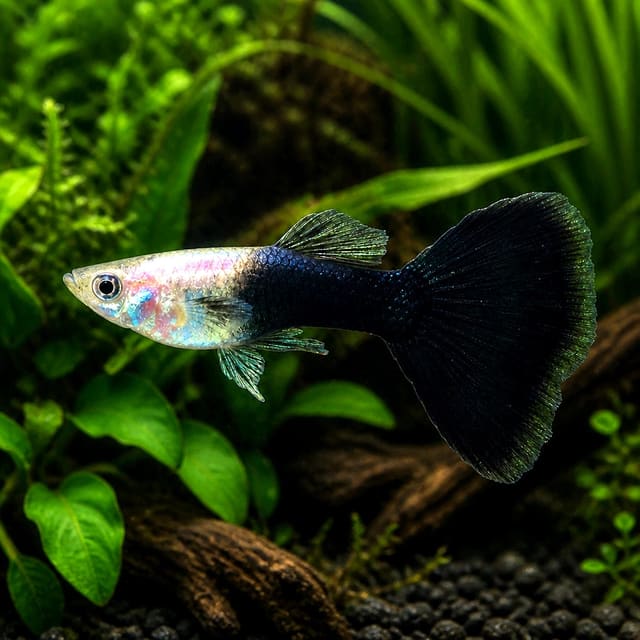
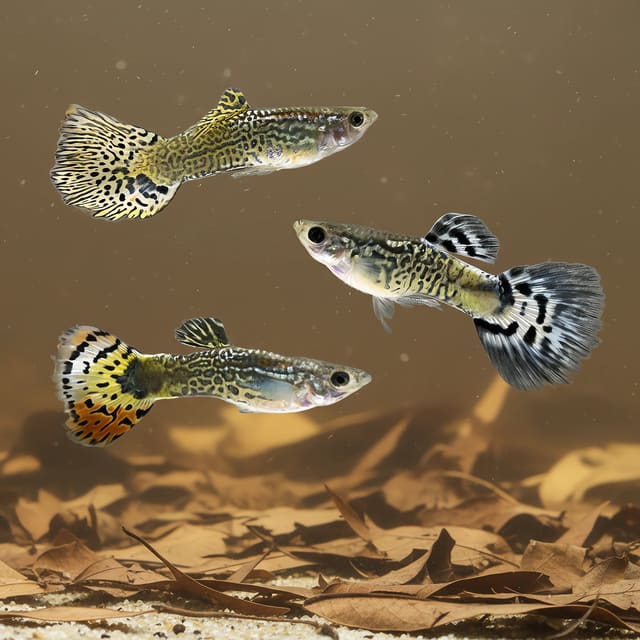
The Male Tuxedo Black Guppy is a domestic colour form of Poecilia reticulata, the familiar guppy. This listing supplies one live male fish per purchase, with a supplier dispatch grade of 3–4 cm. The tuxedo name refers to the dark colour across the rear body and fins; it does not create a separate species or promise that every fish will carry the same boundary, sheen or fin spread.
A male guppy can bring movement and dark contrast to a planted community, but the right decision begins with the aquarium rather than the colour. Prepare a mature, filtered tank with mineral-bearing neutral-to-alkaline water, useful horizontal swimming room, gentle flow and a deliberate plan for the whole guppy group. Long-finned males should not be placed with persistent fin nippers or fish large enough to treat them as prey.
| Suits | A prepared beginner or experienced keeper with a mature filtered aquarium, tested hard water and time to observe group behaviour. |
|---|---|
| Less suitable for | An uncycled bowl, a solitary-fish plan, very soft acidic water, strong current or a community built around known fin nippers. |
| What one purchase supplies | One live male tuxedo-black guppy at the 3–4 cm supplier dispatch grade. |
| Adult planning size | The species record reaches 6 cm standard length; FishBase records 5 cm SL for male or unsexed fish. Standard length excludes the tail. |
| Routine store range | 22–28°C, with pH 7–8 and 8–18 dGH used from broad UK guppy-and-molly guidance. |
| Social plan | Tropical Fish Co screens for a group of five or more in an aquarium at least 60 cm long where filtration, sex mix and other livestock allow. |
Sex is guaranteed only when the exact product or selected option explicitly states male or female. This Guppy male tuxedo black listing is sold as male.
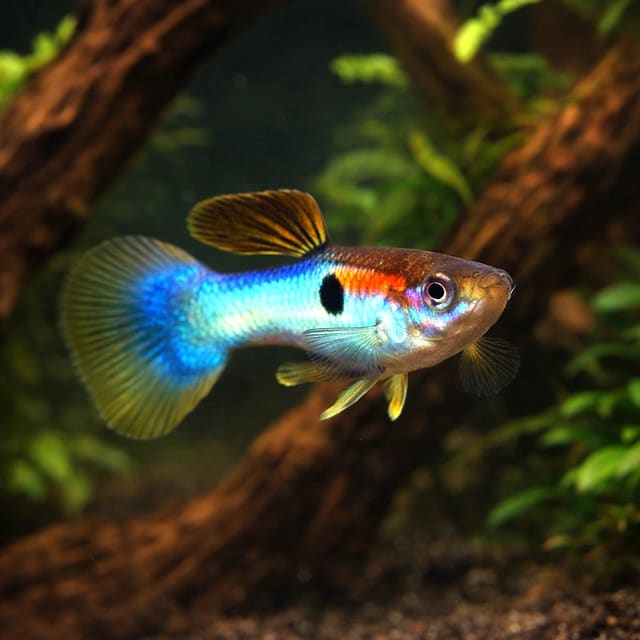
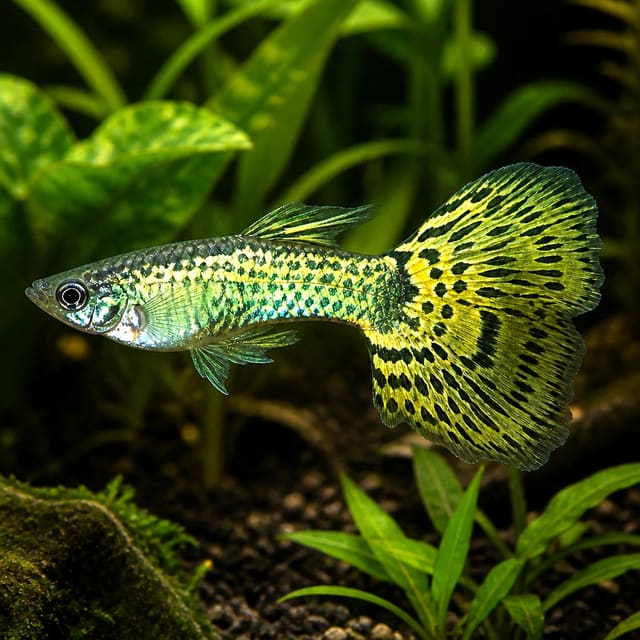
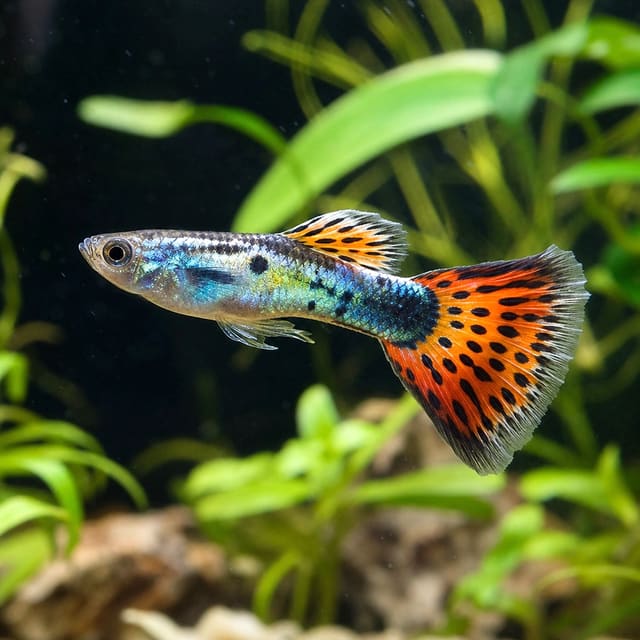
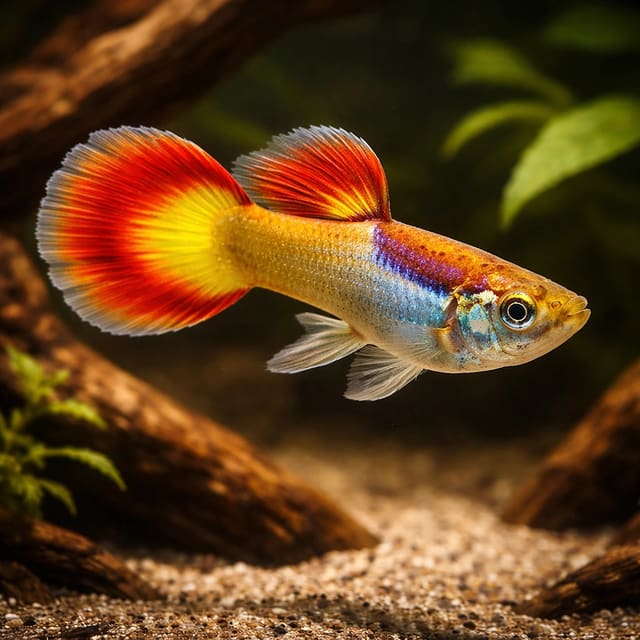
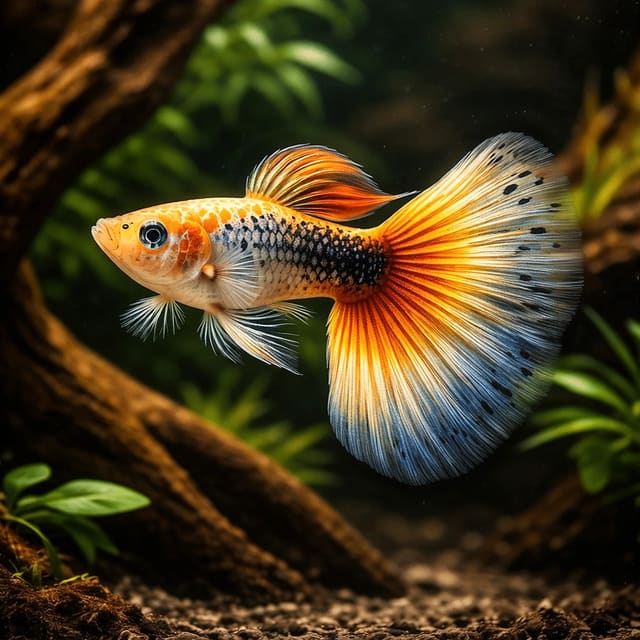
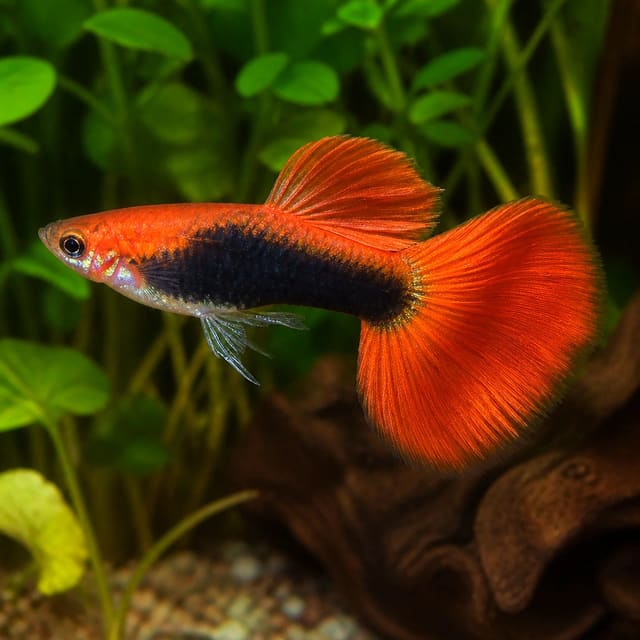
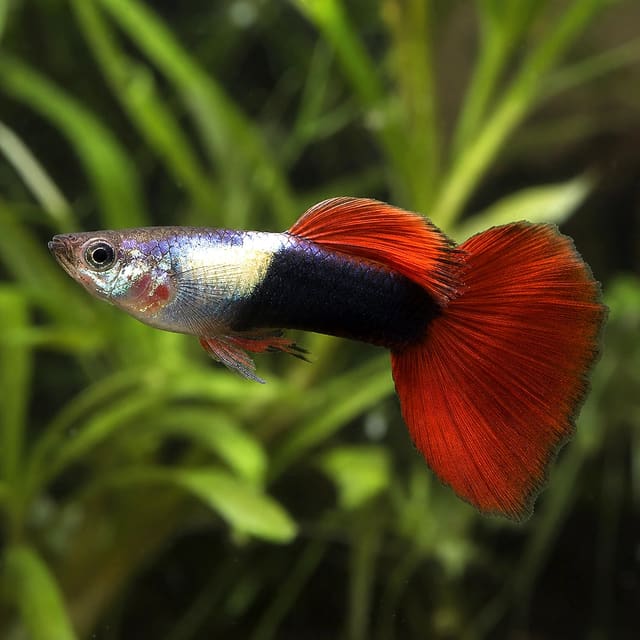
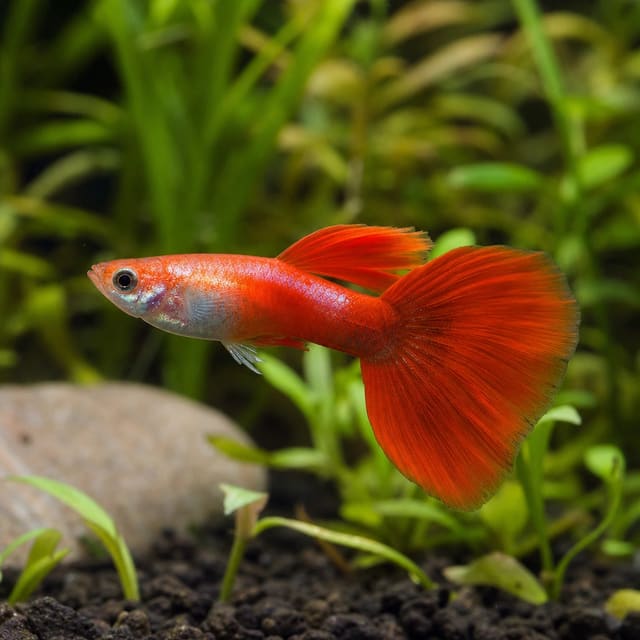
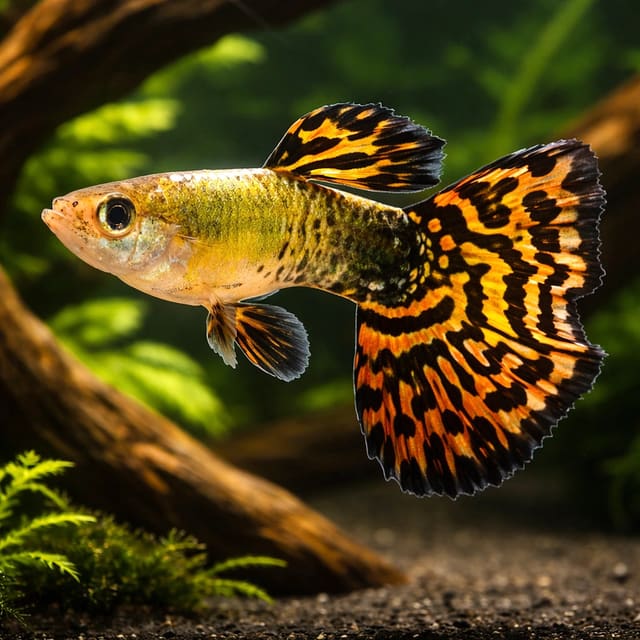
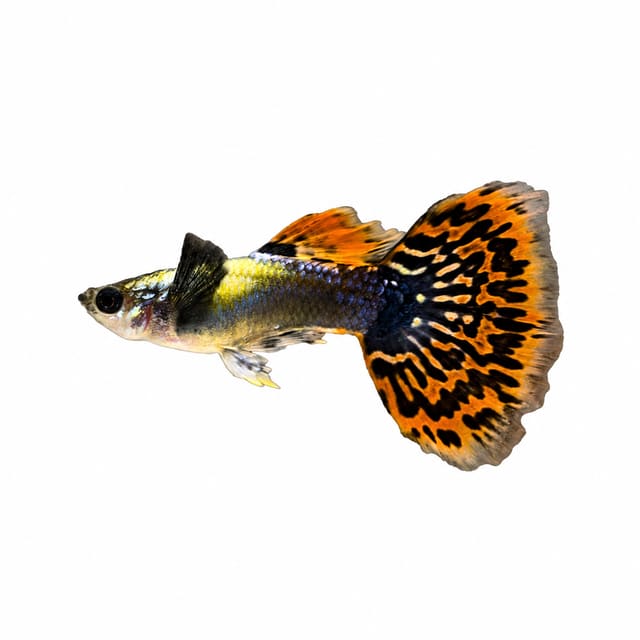
That male guarantee concerns the fish supplied, not the identity of every animal shown in the gallery. Gallery images have been digitally enhanced to improve image quality. Natural colour, pattern, size and maturity can vary between live animals.
One quantity is one male, but guppies are social fish. Buying a single fish for permanent solitary keeping is different from adding one male to a suitable established group. Our conservative house screen is a mature aquarium at least 60 cm long with five or more guppies where the sex plan, footprint, filtration and test results support them. It is a planning policy, not a fish-per-litre formula.
The practical target is stable, tested water rather than chasing an edge value. We use 22–28°C for routine display. The UK OATA sheet covering guppies and mollies gives pH 7–8 and general hardness 8–18 dGH as broad group guidance. Test the source water and aquarium; do not assume that every UK tap supply has the same mineral content.
Guppies are generally peaceful, yet their fins and constant movement can attract unwanted attention. Avoid species known to nip fins, and check that any proposed companion shares the useful middle of the temperature, pH and hardness ranges. A name on a compatibility list never replaces observation or a ready separation option.
This listing is male. A male-only group avoids new mixed-sex mating, although males can still display, pursue and compete. If females are present, plan for courtship pressure and possible fry before adding the fish. Dense plant cover can improve refuge and fry survival, which may increase rather than solve the need for capacity and responsible rehoming.
Ammonia and nitrite should both be zero before arrival, temperature should be confirmed with an independent thermometer, and filtration should be established enough to process the added waste. If this is a first aquarium, use the first tropical tank guide to plan maturation and testing before livestock is dispatched. For deeper species context, read the Guppy Care Guide, then use the live guppy collection only to compare genuine offers rather than to calculate a maximum stocking number.
The accepted scientific name is Poecilia reticulata, in the family Poeciliidae. FishBase records the species from Venezuela, Barbados, Trinidad, northern Brazil and the Guianas, with introductions far beyond that area. The Eschmeyer catalogue record supports the accepted name. Those distribution and taxonomy records describe the species, not a documented breeding history for this domestic tuxedo line. The exact offer establishes a male tuxedo-black trade form; it does not establish a pedigree, a wild collection locality or a genetically closed strain.
The adult-length records need careful reading. FishBase records 5 cm standard length for male or unsexed fish, while the Seriously Fish species profile gives 60 mm SL. Standard length runs from the snout to the base of the tail and excludes the caudal fin, so a flowing domestic tail should not be silently added to that number. For conservative species-level space planning, the structured care data uses the larger 6 cm SL record; for this male offer, keep the 5 cm male/unsexed FishBase value in mind as well.
The 3–4 cm figure is different again: it is the size at which the supplier grades this fish for dispatch. Dispatch grade is neither a guaranteed measurement of the individual nor its adult length. A fish may arrive within the normal variation around a supplier grade and continue developing after arrival. Give the animal space for the adult fish and its finnage, not merely the size written beside the sale line.
In guppy naming, tuxedo commonly describes a darker rear portion of the body. Domestic selection can also produce variation in iridescence, tail outline, dorsal size and the precise transition between pale and dark areas. Those visible differences are part of live-animal variation. They are not a reason to promise a photographic duplicate or to infer health, age or lineage from colour intensity alone.
For mature guppies, anal-fin shape is more dependable for sexing than body colour. Males have a narrow modified anal fin, the gonopodium; females have a broader triangular anal fin. This page does not ask a customer to sex the delivered fish from a photograph because the offer itself already states male. If the animal received appears inconsistent with the order, follow the contact and arrival process instead of making a diagnosis from colour.
The species profile gives an aquarium base of 45 × 30 cm and about 41 litres. OATA gives at least 45 litres for a small group of smaller guppies or mollies. FishBase's secondary aquarium note suggests a 60 cm aquarium and a group of five or more. Tropical Fish Co therefore uses a more conservative screening policy: plan a mature, filtered aquarium at least 60 cm long for one small guppy group, then adjust for the actual footprint, sex mix, companions, filtration and water tests.
A nominal 60-litre aquarium can be a candidate, not an automatic entitlement to a fixed number of fish. Internal dimensions, substrate and décor reduce real water volume, while an established community already uses biological capacity and swimming space. Five guppies may be a cautious starting group under the store policy, but persistent pursuit, hiding, missed feeding, damaged fins or rising nitrogen waste show that the real arrangement needs intervention.
If you know the internal dimensions, calculate the real water volume with the aquarium's filled length, width and water depth. Use that result to plan maintenance and equipment, never as a fish-per-litre rule. A longer tank with open horizontal swimming room can be more useful than a taller tank with the same label volume.
| Temperature | Use 22–28°C as the store's routine guppy range. Seriously Fish records a broader species-care range of 17–28°C; FishBase's 18–28°C describes occurrence and is not, by itself, a routine captive target. |
|---|---|
| pH | Use pH 7–8 from OATA's broad guppy-and-molly guidance. Seriously Fish records pH 7.0–8.5 for the species. |
| General hardness | Use 8–18 dGH from OATA's broad group guidance. Seriously Fish records 8–30 dGH and describes guppies as hard-water fish. |
| Ammonia and nitrite | Both should remain at zero mg/L. |
| Nitrate | OATA says it should not exceed 20 mg/L above the normal tap-water level. |
These figures should remain attached to their scope. A wild occurrence range does not define the ideal target for a domestic male, and the OATA guppy-and-molly care sheet covers both groups. Stable tested water in the useful middle of the chosen range is more defensible than repeated adjustment towards an endpoint. Use the water chemistry guide to understand the measurements and the water matcher to compare actual readings with the care plan.
A working biological filter is essential because fish release ammonia. Beneficial bacteria convert ammonia to nitrite and then nitrate, but that community takes time to establish and can be disrupted by chlorine, medication, prolonged power loss or excessive cleaning. A calendar date alone does not prove that the aquarium is cycled: confirm it with repeated ammonia and nitrite tests under the expected load.
Test at least weekly. At least once every week, make a partial water change of 25%. Treat replacement tap water with conditioner for chlorine or chloramine and match temperature and chemistry gradually. If filter media needs cleaning, rinse it lightly in removed aquarium water and do not run it under the tap.
UK tap water varies between regions and supplies can change. Check a water-company report and test the water that actually enters the aquarium. Guppies can occur in brackish conditions, but that is not a reason to add routine salt. Salt or mineral additions alter conditions for every fish, invertebrate and plant, so use them only for a measured purpose and after checking the entire community.
Provide open horizontal water for swimming, then add plants or smooth décor that create cover and break long sight lines. Floating vegetation can make the upper levels feel secure, while rooted planting gives retreat without filling every path. Check ornaments and artificial plants for sharp or abrasive edges that could catch elongated fins. A secure lid is sensible because startled livebearers can jump.
Flow should circulate waste and oxygenate the aquarium without pinning a small long-finned male in one corner. Seriously Fish advises against strong current, and OATA recommends gentle flow for guppies with long fins. Watch the animal rather than trusting only a filter's box rating: normal movement, feeding access and the ability to rest out of the main current matter. Fit an intake guard if small fish or fry could be drawn towards the filter.
Cover should improve choice, not conceal a failed social plan. If one fish remains trapped behind décor, misses meals or is repeatedly chased into the same refuge, rearranging plants may help but separation may still be necessary. Dense vegetation can also increase fry survival; decide whether that outcome fits the available space and rehoming plan before encouraging it.
Use an appropriately sized, nutritionally complete omnivore flake or granule as the staple. OATA recommends a quality food with algal content and allows small compatible live or frozen foods such as daphnia, small bloodworm or tubifex as variety. Seriously Fish notes that domestically bred guppies accept most foods presented even though wild fish are primarily insectivorous.
Give a portion the group can consume within a few minutes and remove food that is left to decay. Watch whether every fish can reach the food; a confident male can feed readily while a stressed or pursued fish hangs back. Change particle size for smaller fish rather than assuming one flake size suits every mouth. Frozen and live foods are supplements, not substitutes for a balanced staple, and all food should come from a biosecure source.
Body condition, swimming and appetite are more informative than a rigid feeding timetable copied without context. A sudden refusal to feed, surface gasping, clamped fins or isolation should prompt immediate water testing and observation. Adding more food to tempt a distressed fish can worsen water quality if the cause is environmental.
A settled guppy should swim steadily, breathe regularly, hold its fins open, maintain a normal body profile and feed consistently. Colour can change with light, background, stress and maturity, so assess the whole fish rather than treating a darker or paler moment as a diagnosis. Warning signs include clamped or damaged fins, unusual balance, persistent hiding, surface gasping, wounds, spots, fluffy growths or an abrupt appetite change.
When something changes, first test ammonia, nitrite, nitrate, pH and temperature. Check recent maintenance, heater function, filter flow, new livestock, food and social behaviour. Record what you see with dates or photographs. Isolate safely where appropriate, using a mature filtered quarantine system with dedicated equipment, and seek qualified advice rather than treating one visible sign with salt, heat or medication.
The RSPCA aquarium environment guidance explains why filtration matters, while its fish health guidance covers observation and welfare escalation. The MSD Veterinary Manual recommends at least 30 days of quarantine, with longer isolation where indicated. In the UK, the OATA fish-vet directory can help locate qualified support.
The sold unit is one male, not a ready-made social group. Before ordering, write down the number and sex of guppies already present, the aquarium's usable length, other livestock and the reason for adding another male. That short exercise exposes two common mismatches: buying one fish for permanent solitary keeping, or adding a visually appealing male to a group that already has more display and pursuit than its cover can absorb.
For a male-only group, distribute plants and smooth structure so each fish can move out of another's direct view without being boxed into a dead end. Provide open water between those refuges and more than one useful feeding area. Observe whether all males approach food, maintain open fins and use the aquarium rather than one individual controlling the most useful space. Persistent pursuit or damage calls for separation, not simply another decorative object.
For a mixed-sex community, OATA suggests two females for each male to reduce pressure, but that ratio is not a guarantee. Aquarium shape, male activity, individual temperament, cover and overall density still change the outcome. A second mature filtered space should be ready if one fish is repeatedly cornered or loses condition. Do not wait for obvious wounds before acting on a pattern of exclusion.
Guppies are livebearers. A mixed group can produce young, and female guppies can store sperm after earlier mating. Removing the male later or buying females separately therefore cannot guarantee that no fry will appear. Before combining sexes, decide whether the household can provide mature nursery filtration, suitable food, frequent water checks and responsible long-term homes.
Dense plants and floating cover can increase fry survival. That may be desirable in a deliberate breeding aquarium, but it also means the population can grow more quickly than the main tank can support. Adult predation is not a responsible population-control plan. Neither is moving a female or fry into a tiny uncycled container that lacks stable filtration and tested water.
If the aim is purely to enjoy male colour and display, a carefully observed male-only group may be the simpler route. It still needs social space and behaviour monitoring, but it avoids new mixed-sex mating within the aquarium. The exact male status of this listing makes that choice possible; it does not prove the breeding history of any other guppy already in the tank.
These checkpoints turn a paper stocking plan into welfare decisions about the actual group. If behaviour remains calm and water readings stay suitable, the arrangement may be working. If not, reduce pressure through separation or a larger mature setup rather than treating the original number as a promise.
Prepare the aquarium and testing equipment before dispatch. The filter should be running, ammonia and nitrite should read zero, temperature should be stable, and the intended group should already have enough room. Do not plan to cycle the aquarium with the arriving fish.
Read the current delivery and Live Arrival Guarantee policy before dispatch because contact routes, delivery coverage and claim terms can change. If there is a concern, contact Tropical Fish Co the same day with the order number and continuous unboxing video. The policy, rather than this evergreen care page, governs a claim.
Quarantine is valuable even when a fish looks healthy because animals can carry problems before visible signs appear. Use a separate mature system with its own net, siphon and other equipment. Match suitable water and filtration, observe feeding and waste, and avoid moving shared wet equipment between systems. A tiny uncycled container is not a safe quarantine tank.
Never release a guppy, fry, plants, snails, bag water or aquarium contents outdoors or into a surface-water drain. The species has been introduced far beyond its native range. Rehome unwanted fish responsibly and dispose of water and substrate so organisms cannot reach natural watercourses.
Guppies are social. OATA advises at least three guppies or mollies and discusses two females per male for mixed groups; FishBase's secondary aquarium note gives groups of five or more. Tropical Fish Co uses five or more as the conservative house screen where the aquarium and sex plan allow. This listing supplies a male, so decide whether it joins a male-only group or a mixed-sex population before purchase.
A male-only group avoids new mixed-sex mating but does not eliminate display, pursuit or competition. Provide sight breaks, open swimming room and more than one feeding position, then watch whether every fish can rest and feed. A mixed group needs a realistic fry and rehoming plan. No ratio guarantees that every female will avoid pressure or that the aquarium will remain within capacity.
| Usually avoid | Known fin nippers such as tiger barbs and serpae tetras, plus any fish large enough to swallow a guppy. |
|---|---|
| Consider only after checks | Other livebearers, rasboras, corydoras, small loricariids and suitable tetras in a quiet community with matching water and enough room. |
| Not a dependable default | Betta and guppy combinations, because long fins, display and territorial responses vary between individuals. |
| Needs special caution | Small shrimp or young invertebrates that may be eaten, and any timid feeder likely to lose out to active guppies. |
These are categories to investigate, not universal promises. A corydoras species may need a larger group, different substrate or cooler water than the proposed tank. A livebearer can add another courtship and fry burden. A tetra may be peaceful in one context and unsuitable in another. Verify the exact species and adult requirements, then observe the animals after introduction.
Peaceful means the species is not normally kept as an aggressive predator; it does not mean that pursuit or fin damage is impossible. Persistent chasing, hiding, missed meals, clamped fins or a fish trapped at the surface or behind décor requires action. Test the water, examine the group and separate fish when needed. Adding another animal is not the first response to a stressed community.
The two related-product suggestions below the description are alternative guppy offers, not tank-mate recommendations. Choose them only when their stated sex and appearance fit a deliberate guppy-group plan.
A mature 90-litre aquarium with tested pH 7.6, mineral-bearing water, gentle filtration and an established male guppy group may have room for this fish if the real internal length, biological load and behaviour remain suitable. The useful checks are whether the group has several feeding positions, whether one male already dominates the open water and whether another fish can be separated if pursuit increases. The litre label alone gives none of those answers.
Seriously Fish names corydoras among possible companions, but that category contains many species. Check the exact corydoras temperature range, required group size, adult size and substrate before combining it with guppies. A compatible result needs enough floor area for the catfish group as well as upper-water room for guppies, and feeding must reach both levels without excess waste.
Matching temperature does not make the arrangement risk-free. Adult shrimp may coexist in some aquariums, but small shrimp and young can be eaten. Dense planting may improve refuge while also hiding uneaten food or fry. Decide whether losses are acceptable before purchase and avoid describing shrimp as dependable companions for every guppy tank.
This is a poor default because the guppy's broad fins are vulnerable to nipping and OATA specifically warns against barbs as fin nippers. More décor does not remove that basic conflict. Choose a community without known fin-nipping pressure rather than expecting the guppy to adapt.
Worked examples are decision aids, not stocking recipes. Retest the aquarium after any addition, watch feeding and body condition, and make changes from observed behaviour rather than waiting for a compatibility label to fail.
The species record reaches 6 cm standard length, while FishBase records 5 cm SL for male or unsexed guppies. SL excludes the tail, and the 3–4 cm supplier grade is dispatch size rather than adult size.
Tropical Fish Co uses a mature filtered aquarium at least 60 cm long for a small guppy group. Seriously Fish gives about 41 litres and a 45 × 30 cm base, while OATA gives at least 45 litres for a small group of smaller livebearers; length, sex mix, filtration and other fish still matter.
Guppies are social. Our conservative policy is 5 or more where capacity and the sex plan allow, while OATA's broad guppy-and-molly sheet gives at least 3. A male-only group still needs monitoring for display, pursuit and fin damage.
Yes for a prepared beginner with a mature filtered aquarium, tested hard water and a planned social group. It is not suitable for cycling a new tank or for a bowl without stable filtration.
Use an appropriately sized complete omnivore flake or granule as the staple, with safe compatible algal and invertebrate variety. Feed a portion the group can finish within a few minutes and remove uneaten food.
Our routine temperature range is 22–28°C. OATA's broad guppy-and-molly guidance gives pH 7–8 and 8–18 dGH; test the actual source water and aquarium and keep conditions stable.
It is generally peaceful, but males can display and pursue one another. Avoid known fin-nipping companions, provide sight breaks and intervene if any fish is repeatedly chased, excluded from food or damaged.
Seriously Fish names other livebearers, rasboras, corydoras, small loricariids and suitable tetras for a quiet community. Check the exact species for matching water, adult size, group size, feeding and space; those categories are not universal guarantees.
Tropical Fish Co hand-packs live fish in oxygenated bags inside an insulated box, adding a heat pack when needed, and uses a licensed live-animal courier. Someone must receive the parcel; keep one continuous unboxing video from the sealed parcel through the fish in its sealed bag for any Live Arrival Guarantee claim.
Care figures describe planning ranges rather than a guarantee for an individual fish. The live product page remains the place for the exact sold unit, while current delivery terms sit on the store delivery page.
No reviews for this item yet. Bought one? Honest reviews only, good or bad.
What customers say about ordering from us
Easy website plenty of info on fish your buying great to pick a time slot
TRACEY DURRANT · 7 Oct 2026
Got some lovely fish thank you
Kevin Mackie · 7 Oct 2026
Reviews of our shop, collected by Judge.me, an independent third-party review collector. Newest first.