Easy
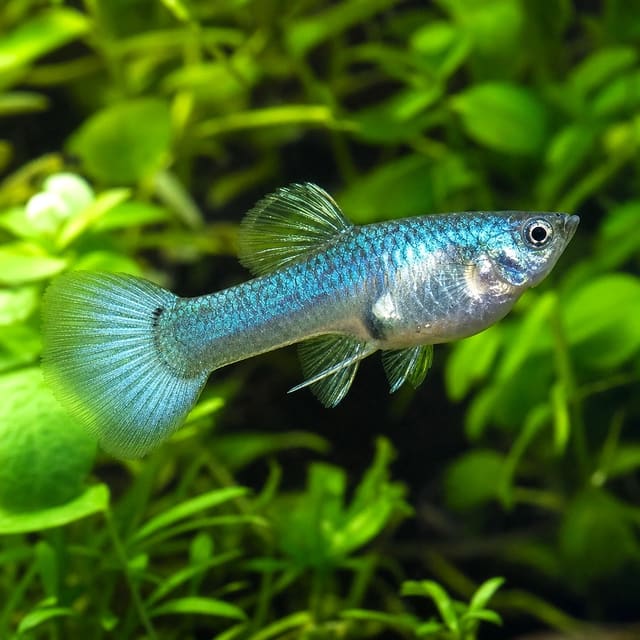
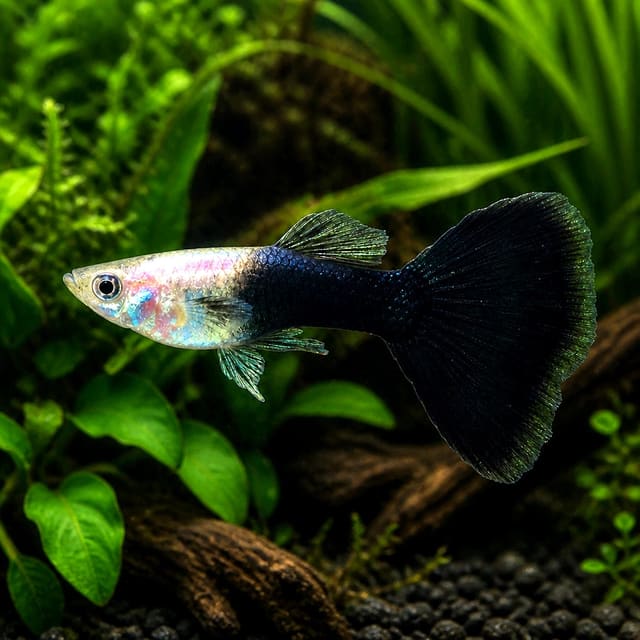
Blue Moscow Male Guppy (Poecilia reticulata)
22–28°C · pH 7–8 · 45L
£4.09
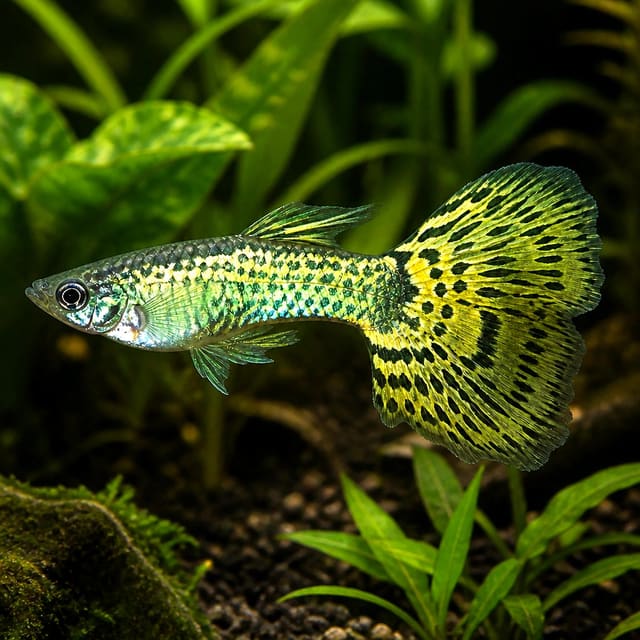
Tiger Male Guppy (Poecilia reticulata) is supplied as one live male fish at approximately 3–4 cm. Plan a mature filtered aquarium at least 60 cm long, a guppy group of five or more where capacity allows, stable mineral-bearing water and companions that will not nip fins or dominate food.
Adult size is the maximum length this species reaches at full maturity (scientific sources). The livestock you receive will be younger and smaller. Product-photo provenance and any image-specific limitations are stated on the listing.
Poecilia reticulata
Shoaling fish: kept in a group they feel safer, stay calmer and show their best colour.
Tiger Male Guppy (Poecilia reticulata) is supplied as one live male fish at approximately 3–4 cm. Plan a mature filtered aquarium at least 60 cm long, a guppy group of five or more where capacity allows, stable mineral-bearing water and companions that will not nip fins or dominate food.
Adult size is the maximum length this species reaches at full maturity (scientific sources). The livestock you receive will be younger and smaller. Product-photo provenance and any image-specific limitations are stated on the listing.
Guppies are social livebearers suited to a prepared beginner, not a fish-per-litre formula. Use a mature filtered aquarium, tested neutral-to-alkaline mineral-bearing water, deliberate sex and population planning, open swimming room, cover and a separation option.
Maintain these water conditions for optimal health and vibrant colors
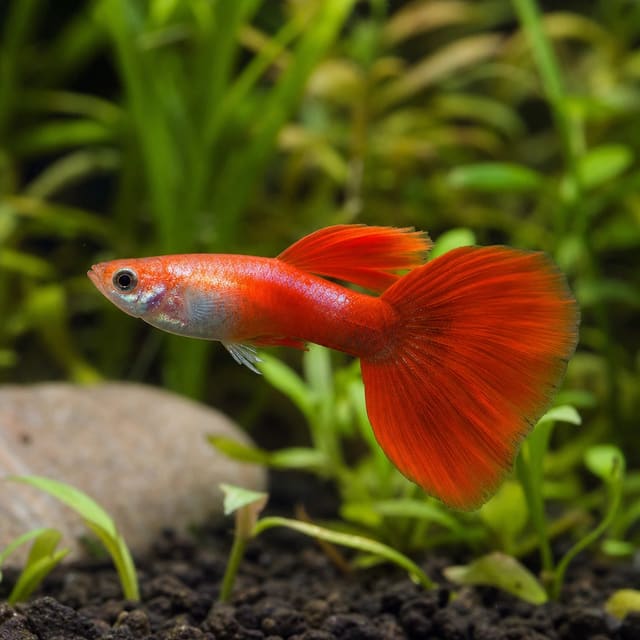
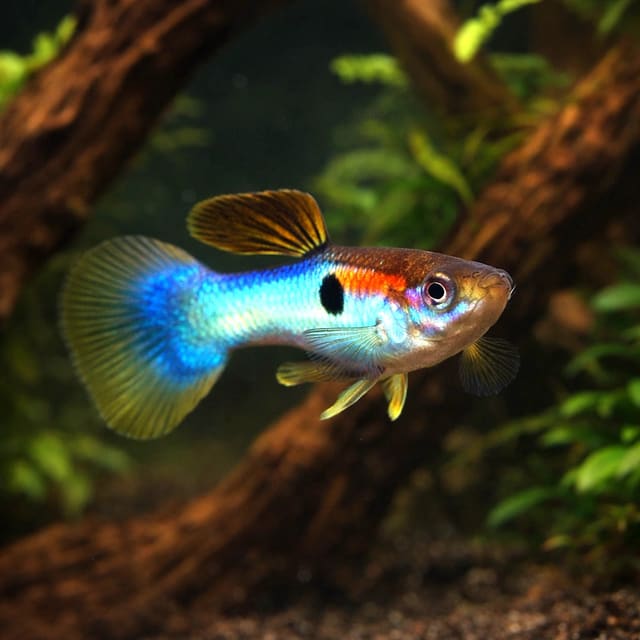
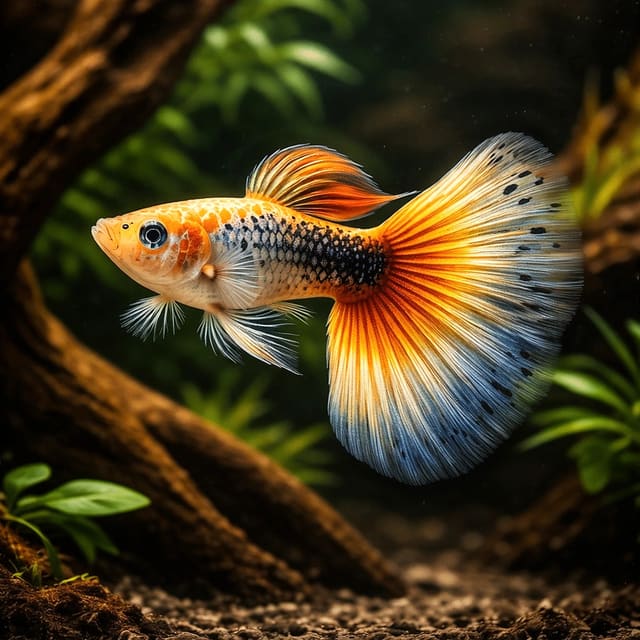
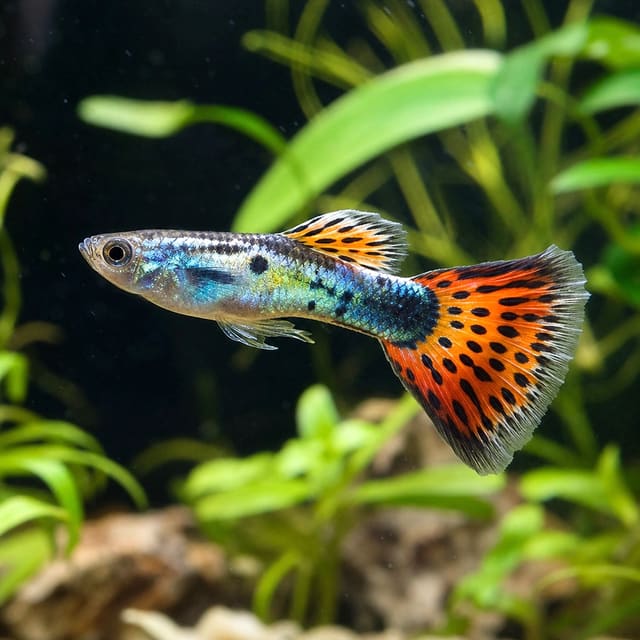
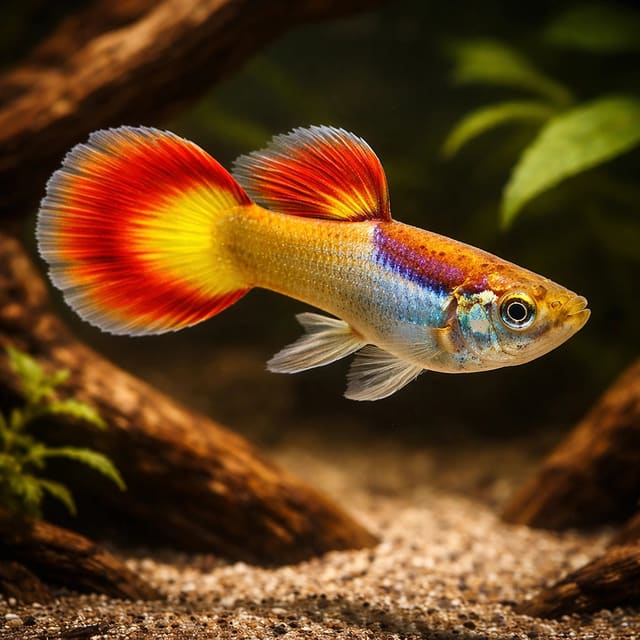
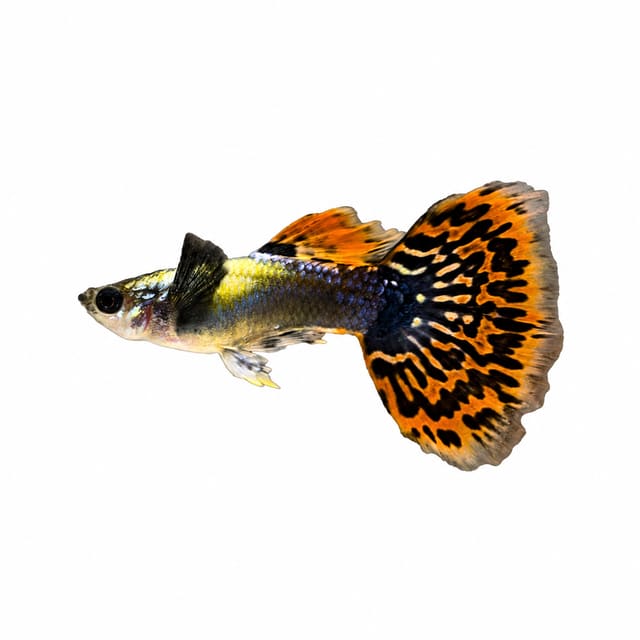
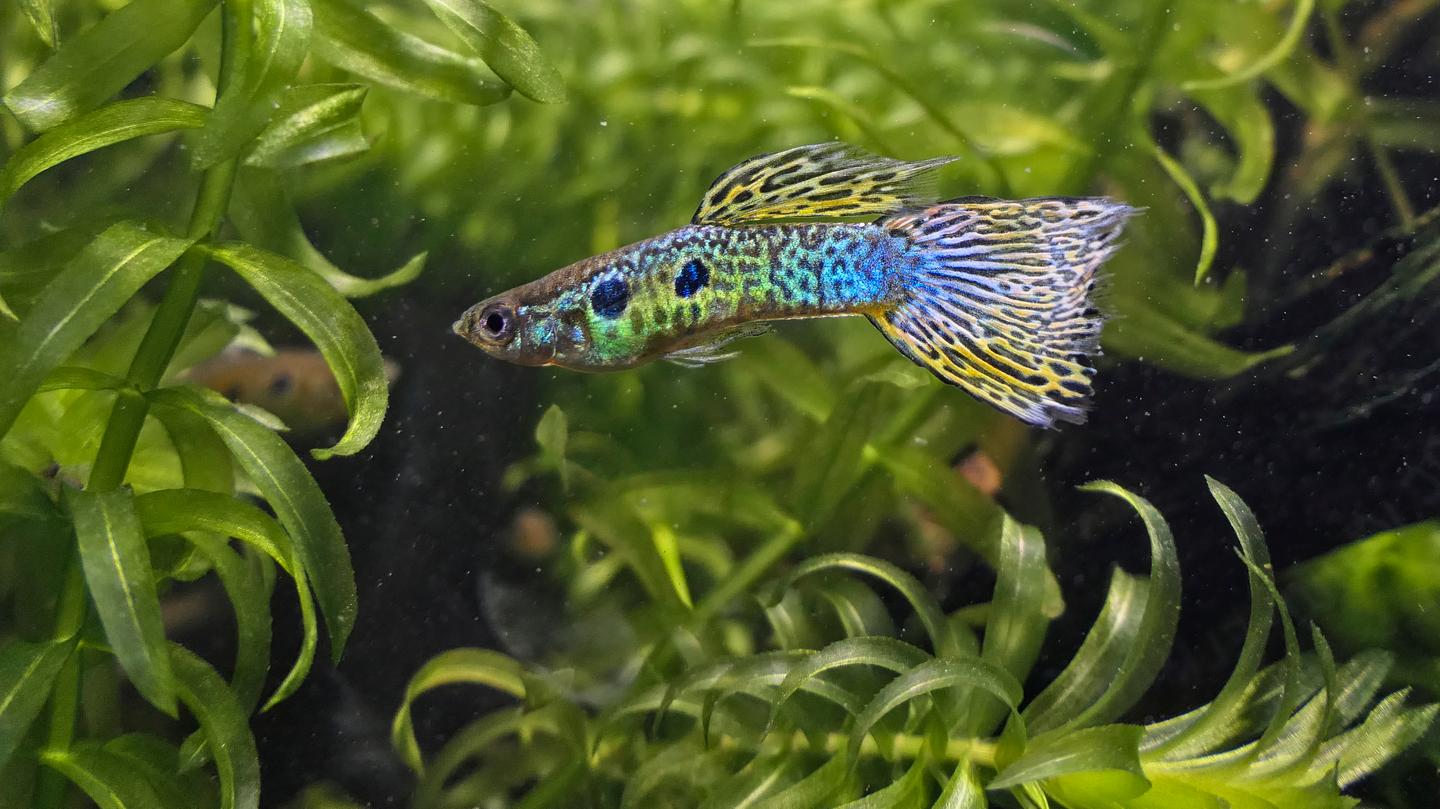
Tiger Male Guppy (Poecilia reticulata) is a male domestic colour form of the familiar guppy. One purchase supplies one live male fish at the reviewed supplier dispatch grade of approximately 3–4 cm. Dispatch size describes the animal supplied, not its final body length, and natural colour, pattern, fin shape, size and maturity vary between live animals.
The Tiger label describes appearance rather than a separate species. The accepted name is Poecilia reticulata, family Poeciliidae. FishBase records the species across Venezuela, Barbados, Trinidad, northern Brazil and the Guianas, with established introductions elsewhere. A male's narrow modified anal fin, the gonopodium, supports mature sex identification; this listing also explicitly sells the fish as male.
FishBase records 5 cm standard length for male or unsexed guppies, while the species record includes females to 6 cm standard length. Standard length stops at the base of the tail, so a domestic strain's flowing finnage should not be added to the body number without explaining the measurement. Plan conservatively for the species maximum while recognising that this male offer is expected to remain smaller-bodied than the largest females.
Guppies are social, active livebearers. FishBase's aquarium note gives a minimum length of 60 cm and a group of five or more; OATA's combined care sheet gives at least 45 litres for a small group of the smaller livebearers. Tropical Fish Co therefore uses a mature, filtered aquarium at least 60 cm long and a group of five or more where filtration, sex planning, other animals and water tests allow. Neither figure is a fish-per-litre formula.
| Suits | Needs another plan |
|---|---|
| A mature filtered aquarium at least 60 cm long | An uncycled bowl, vase or short display container |
| A planned social group with enough feeding access and retreat space | A lone guppy or fish added simply to fill a calculated litre allowance |
| Stable neutral-to-alkaline, mineral-bearing water | Untested soft acidic water or abrupt chemistry changes |
| Peaceful companions that cannot nip fins or dominate food | Predators, persistent fin nippers or territorial fish |
Sex is guaranteed only when the exact product or selected option explicitly states male or female. This Tiger Male Guppy listing is sold as male.
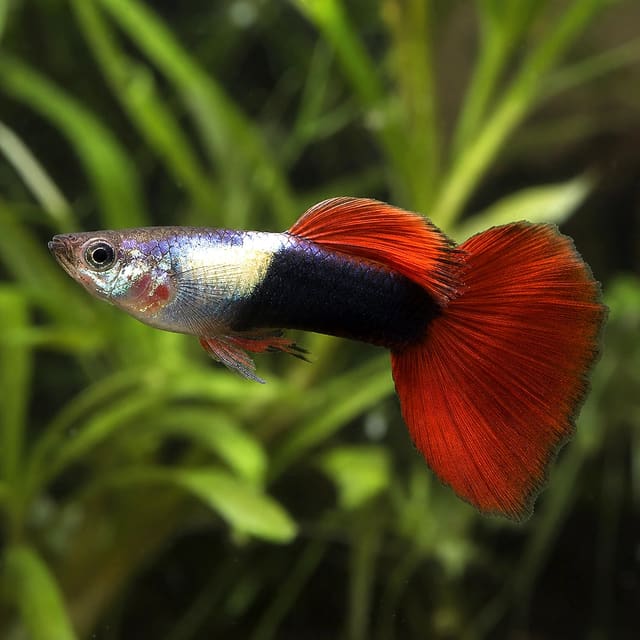
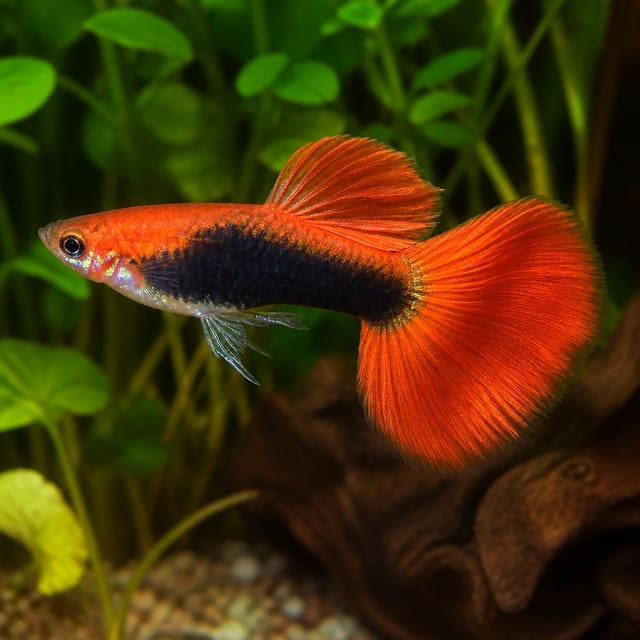
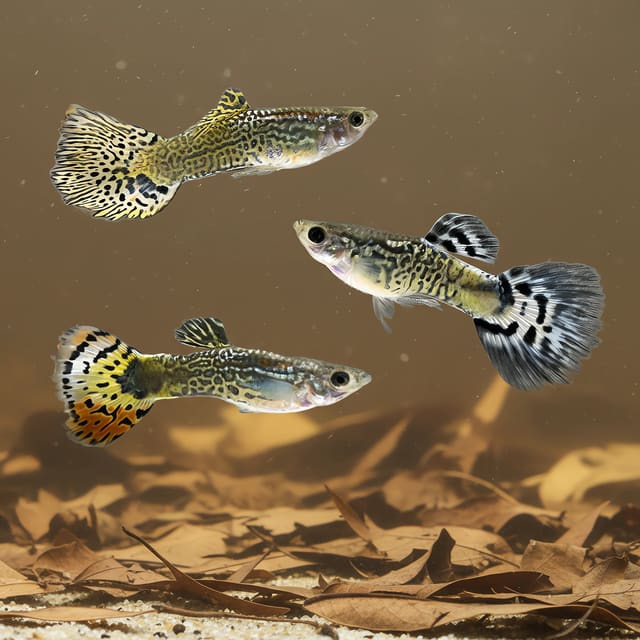
Gallery images have been digitally enhanced to improve image quality. Natural colour, pattern, size and maturity can vary between live animals.
Measure the usable aquarium length, test temperature and water chemistry, count every existing occupant and decide how the social group will be composed. A male-only group avoids new mixed-sex mating inside that aquarium but still needs room and observation because display and chasing can occur. A mixed group introduces persistent courtship and likely fry, so it requires spare mature capacity and a responsible rehoming route.
Use the guppy collection to compare distinct offers without assuming that two colour forms differ in care or will make a balanced group. The complete Guppy care guide covers species evidence and population planning in more depth. Anyone preparing their first cycled aquarium should begin with the first tropical tank guide well before livestock is due.
Think through an ordinary week: observe every fish at feeding, test water, complete maintenance, inspect heater and filter function and notice whether one male is repeatedly excluded. Arrange a competent holiday carer who understands that extra food creates extra waste. Also plan for the group at adult size and for the possibility that a female introduced later has stored sperm from an earlier mating.
This guppy can suit a careful beginner, but “easy” is a store assessment rather than a promise of resilience. Its small size does not reduce the need for biological filtration, stable mineral content, a complete diet and daily observation. Delay purchase if the group, spare capacity or long-fin compatibility has not yet been resolved.
Start with a mature aquarium at least 60 cm long for one small guppy group. OATA's 45-litre figure is a useful volume floor for smaller livebearers, while FishBase's 60 cm note protects swimming length. Use both as screens rather than choosing whichever makes the proposed aquarium pass. A short tall aquarium may hold the stated litres without providing the horizontal room needed for continuous swimming or escape from pursuit.
Cycle the biological filter before fish arrive and demonstrate that it can process the aquarium's waste. Test for zero detectable ammonia and zero detectable nitrite before stocking, then keep testing after fish are added because feeding and respiration increase the load. A calendar does not prove cycling. Repeated results, normal filter function and stable conditions provide a more useful picture.
Provide open water for swimming and plants, wood or other smooth aquarium-safe decor for shelter and broken sight lines. Long-finned domestic males need space to move without scraping sharp ornaments. Floating cover can soften light, but leave open surface for gas exchange. Fit a secure lid around cables and pipework; active fish can find small gaps when startled.
Select filtration for the whole community. Gentle-to-moderate circulation and useful surface movement are preferable to a current that pins long-finned fish behind decor. Protect an intake that could trap a small fish or fry. OATA advises rinsing mature media lightly in removed aquarium water rather than under the tap, preserving the beneficial bacterial population.
Tropical Fish Co uses 22–28 °C as its routine guppy display range. OATA's combined guppy-and-molly sheet gives pH 7.0–8.0, general hardness 8–18 dGH and carbonate hardness 5–15 dKH. These mineral and pH figures are broad group-care guidance, not a controlled optimum for this Tiger male. The specialist species profile gives a wider 17–28 °C, pH 7.0–8.5 and 8–30 dGH range and emphasises long-term maintenance in moderately hard or harder water.
Use the store range for consistent routine planning, then compare it with the water in which the fish has been held and the aquarium it will enter. Make suitable changes gradually. pH, GH, KH and temperature describe different properties, and one value cannot stand in for the others. The water chemistry guide explains the tests; the water matcher helps compare measured values with the stated range.
| Routine planning value | How to use it |
|---|---|
| 22–28 °C | Store display range; maintain stability and verify with a thermometer |
| pH 7.0–8.0 | OATA group-care screening range for neutral-to-alkaline water |
| 8–18 dGH | OATA medium-hard general-hardness range |
| Ammonia and nitrite: zero | Essential filter and stocking check |
A thermostatically controlled aquarium heater is appropriate where room conditions cannot hold the water in range year-round. Verify it with an independent thermometer rather than trusting the heater dial. Avoid direct sun, cold draughts and sudden maintenance-related changes. During warm weather, check the aquarium at the hottest part of the day because the heater being off does not prevent overheating.
Guppies occur in freshwater and brackish environments, but that does not make routine salt addition necessary. Adding salt or minerals without measurements can shift conditions for fish, plants and invertebrates that share the aquarium. Use a tested purpose, appropriate product and compatibility check instead of a generic livebearer recipe.
OATA strongly recommends changing 25% of the water at least once every week. Adjust the practical amount in response to test results, stocking and feeding while avoiding abrupt swings. Treat replacement tap water for chlorine or chloramine before it reaches the fish and match temperature sensibly. Siphon accessible waste without stripping every surface clean in one session.
Keep a simple log of temperature, ammonia, nitrite, nitrate, pH and maintenance. Note a change in filter flow, a heater discrepancy, a new brood, an unusually dirty pre-filter or a fish spending more time near the surface. A sequence of small changes can reveal a developing problem sooner than one dramatic symptom.
Test more often after adding animals, changing food, a filter interruption, a large accidental feed or an unexpected death. If toxic ammonia or nitrite appears, reduce immediate stress, restore reliable filtration and seek knowledgeable help. A cosmetic water-clearer cannot replace the biological process that controls waste.
A newly filled 60 cm aquarium is not ready simply because the heater and filter are running. The first checkpoint is biological: ammonia and nitrite must remain at zero under a realistic waste load. The second is chemical: temperature, pH and hardness must suit guppies without a last-minute swing. The third is physical: the group needs open water, protected filtration and places to move out of another male's path. Only after all three pass should livestock be scheduled.
A conventional 60-litre aquarium can be a candidate for a male guppy group, but the label on the box settles very little. Check its internal length, actual water volume after substrate and decor, current occupants and filter performance. Five males may be a conservative starting social group under the store policy when the aquarium is at least 60 cm long and otherwise lightly stocked. That is not permission to add one fish for every spare few litres. Behaviour and test results decide whether the starting plan remains workable.
A larger aquarium with another community group still needs subtraction rather than optimistic addition. Corydoras need floor area and their own group; tetras use swimming room and compete at feeding; mollies grow larger and add waste. Map where each species lives and how it feeds, then leave capacity for maintenance errors and growth. A nominal 90 litres can be less suitable than a well-planned smaller species aquarium if it is crowded with incompatible social groups.
Adding females changes the project again. Courtship pressure, stored sperm and new broods make spare mature accommodation and rehoming essential. Count likely young as a capacity risk before they appear. If no suitable destination exists, keep a correctly identified male-only group and avoid introducing females rather than hoping fry will be eaten.
Know what stops during a power cut: filter circulation, surface movement, heating and automated feeding may all be affected. Keep the filter media wet in aquarium water, restore oxygen exchange as a priority and test after service resumes. Do not feed heavily while filtration is compromised. If an outage is prolonged or temperature falls, obtain situation-specific advice rather than making a sudden large correction.
A reduced filter flow can indicate a blocked intake, clogged pre-filter or failing impeller. Inspect the obstruction and restore normal circulation carefully. A heater discrepancy should be confirmed with the independent thermometer before the setting is changed. Sudden equipment failure is easier to manage when routine records show the aquarium's normal temperature, flow and water values.
Poecilia reticulata is an adaptable omnivore. FishBase records zooplankton, small insects and detritus in the wild; OATA recommends a good-quality flake or granule with algal content plus suitably sized live or frozen variety. Use a nutritionally complete aquarium staple rather than copying wild feeding or allowing one treat food to dominate.
Choose particles that each fish can swallow without repeated spitting. Spread food so a confident male does not take every piece before quieter fish feed. OATA's household starting point is one daily portion eaten within a few minutes. Treat that as an observation method, not a fixed ration for every temperature, age or food. Adjust to body condition and recurring leftovers.
Safe live or frozen foods can add variety, but avoid collecting them from unknown outdoor water and store products correctly. Do not thaw and refreeze frozen portions repeatedly. Visible algae is not a balanced complete diet, and snails or shrimp are not substitutes for removing waste.
Fry and recovering fish may need a more specialised plan. Their food, filtration and observation should be matched to the actual situation with experienced advice. Health problems need diagnosis and water-quality investigation rather than improvised feeding restrictions or supplements.
A settled guppy should swim steadily, breathe regularly, hold open undamaged fins, maintain a normal body profile and feed consistently. Hiding, clamped fins, surface gasping, loss of balance, white spots, wounds, unusual swelling or a sudden appetite change are warning signs. Test water and inspect heater, filter, recent maintenance, new livestock, food and social behaviour immediately.
Those signs are not diagnoses. Avoid selecting salt, heat or medication from one symptom. Record dates and photographs, isolate safely in a mature suitable system where appropriate, and consult a fish vet or experienced aquatic professional when signs persist or are severe. In the UK, use lawful labelled products and veterinary direction when required.
A quarantine aquarium should be mature, heated, covered and equipped separately from the main system. Dedicated nets and siphons reduce wet transfer between tanks. Quarantine is not a small uncycled container; it needs enough space and biological support for the fish held there.
Prepare and test the aquarium before dispatch, and be available to receive the parcel. The current delivery and Live Arrival Guarantee policy covers postcode availability, packing, courier details and the reporting route. Tropical Fish Co hand-bags live fish in oxygen, uses an insulated poly box and adds a heat pack when conditions call for it; a licensed live-animal courier carries the tracked parcel.
Transport can temporarily affect colour, but persistent pallor or unusual behaviour has several possible causes. Use swimming, breathing, balance and fin condition together, preserve evidence and report promptly rather than assuming distress is normal.
This product is male, so it cannot produce fry without a female. If females are later introduced, reproduction can be rapid, and females may store sperm from earlier mating. Plan mature spare capacity and responsible destinations before creating a mixed group. Dense cover may increase fry survival and therefore increases the demand on filtration and space.
Count fry as future fish from the day they appear. Test water more often, feed suitable complete particles and avoid moving them into an uncycled nursery. Start rehoming conversations early with reputable retailers, clubs or experienced keepers. Never rely on adult predation as population control.
Never release guppies, fry, plants, snails, pathogens or aquarium water outdoors, into a pond, drain or natural waterway. Introduced guppy populations can affect native ecosystems. Prevention, permanent suitable care and responsible rehoming are the appropriate routes.
Compatibility starts with the social group. Guppies are generally peaceful but males display and chase, and long fins may be damaged during persistent interactions. FishBase gives a group of five or more. Provide enough length, cover and feeding spread for every fish to move away and eat; adding more males to an already cramped aquarium increases competition rather than solving it.
A male-only group avoids new mating within that aquarium and can make population planning simpler. It does not guarantee perfect calm. Watch the whole group at feeding time and look for cornering, constant pursuit, clamped fins or one fish remaining behind decor. A mixed group adds vigorous male courtship and possible fry. OATA suggests two females per male to reduce pressure, but no ratio makes inadequate space safe or removes the need to observe individuals.
Check adult size, mouth size, temperature, pH, hardness, fin-nipping tendency, territory, feeding speed and the combined needs of every social group. Long-finned domestic males are especially poor companions for fish known to nip fins. A juvenile that looks harmless may mature into a predator or forceful feeder, so plan around adult behaviour.
The specialist profile names quiet community companions including suitable livebearers, rasboras, Corydoras, small loricariids and tetras. These are categories to investigate, not blanket approvals. A Corydoras group needs suitable floor area and substrate; a tetra group needs its own swimming room; a molly may grow larger and require more space. Compare the full requirements of the exact species before combining them.
| More promising conditions | High-risk conditions |
|---|---|
| Small peaceful fish sharing neutral-to-alkaline mineral-bearing water | Fish large enough to swallow a guppy |
| Companions that leave food available to the guppy group | Known fin nippers such as tiger barbs or serpae tetras |
| Enough footprint for every species' adult social needs | Territorial fish or a betta chosen on appearance alone |
| A mature separation option ready before mixing | Continuing a combination after hiding, injury or missed feeding appears |
The guppy is Poecilia reticulata; Endler's livebearer is the distinct species Poecilia wingei. Laboratory research confirms that they can hybridise and that later hybrid generations can remain fertile. Keep documented lines separate to preserve reliable identity. If hybrids already exist, label descendants honestly and never present them as pure examples of either parent species.
The Tiger label is a domestic appearance name. It does not establish locality, ancestry, temperament or breeding outcome. Dependable pedigree claims require breeder and chain-of-custody records; avoid using a photograph alone to certify a strain.
Display between males can look dramatic without causing injury, so judge the effect on each fish. A healthy interaction allows both animals to return to normal swimming and feeding. Constant chasing, one male remaining behind equipment, a fish repeatedly missing food or progressive fin damage indicates a welfare problem. Increase separation and usable structure, and move fish to mature accommodation when the pattern continues.
Sight breaks work only when they create genuine routes rather than dead ends. Arrange cover so a pursued fish can leave view and re-enter open water elsewhere. Keep enough clear frontage to inspect fins and body condition. Dense planting that hides the victim from the keeper but not from the pursuing fish has not solved the problem.
Feed across more than one point and watch the slowest individual. Long-finned males may accelerate less effectively than short-finned companions, while confident surface feeders can take the whole ration. Food that reaches every fish without large leftovers is a better compatibility test than seeing several species occupy the same photograph.
Adult shrimp may coexist in a suitable mineral-bearing aquarium, but young shrimp and shrimplets may be eaten. Plants and moss reduce exposure without guaranteeing survival. Feeding competition can also leave shy invertebrates short of food. Check the exact shrimp's temperature and hardness requirements rather than describing the guppy as universally shrimp-safe.
Snails must match the water and receive appropriate nutrition; they are not a cleaning service. A rising snail population can indicate excess food rather than a need for a snail-eating fish. Maintain the aquarium directly.
A betta and guppy are not a reliable default combination. Both can have conspicuous fins and variable individual behaviour, creating display, territorial and fin-damage risks. A larger planted aquarium may provide options, but it cannot guarantee safety. Choose a calmer, evidence-backed combination rather than relying on close supervision to rescue an inherently uncertain match.
Persistent cornering, repeated chasing, one fish missing meals, torn fins, clamped posture or surface hiding are reasons to act. Use a mature spare aquarium or suitable divider plan. An unheated uncycled container exchanges social pressure for water-quality danger.
Review compatibility after a fish matures, decor changes, a brood appears, feeding changes or filter flow declines. A combination that worked for juveniles may fail as bodies, fins and territories develop. Compatibility is an observed relationship requiring ongoing management rather than a permanent species label.
The species record reaches 6 cm standard length in females, while FishBase records 5 cm standard length for male or unsexed guppies. Standard length excludes the tail, whose size varies among domestic strains. Use 6 cm as the conservative species planning maximum rather than treating the 3–4 cm dispatch grade as adult size.
Use a mature filtered aquarium at least 60 cm long for a small adult guppy group. OATA also gives 45 litres for a small group of the smaller livebearers. Length, sex mix, other livestock, filtration, test results and possible fry all matter, so litres alone do not set a safe maximum.
Guppies are social. FishBase's aquarium note gives a group of five or more, and Tropical Fish Co uses 5+ as its conservative house policy where capacity and the sex plan allow. Watch whether every fish can feed and move away from pursuit, and keep a mature separation option ready.
It can suit a prepared beginner with a cycled aquarium, reliable water tests and a deliberate social plan. Easy care still requires stable mineral-bearing water, appropriate food, compatible companions and a response to chasing, fin damage, illness or unexpected fry.
Use an appropriately sized complete omnivore flake or granule as the staple, with safe algal and invertebrate variety. Offer portions the group can consume cleanly, make sure quieter fish receive food and remove repeated leftovers before they affect water quality.
Tropical Fish Co uses 22–28 °C for routine display care. OATA's broad guppy-and-molly guidance gives pH 7.0–8.0 and 8–18 dGH, with zero ammonia and nitrite. Test the actual aquarium and source water, verify temperature with a thermometer and change suitable conditions gradually.
Guppies are generally peaceful, but males can display and chase, and long fins can be damaged by unsuitable companions. Provide swimming length, cover and feeding access. Avoid known fin nippers and separate fish when pursuit causes cornering, hiding, missed food or injury.
Quiet community fish such as suitable rasboras, Corydoras, small loricariids, tetras and compatible livebearers are examples named by the specialist profile. Each exact species still needs overlapping water, safe adult size, enough group space and suitable feeding behaviour. Small shrimp or young may be eaten, and bettas are not a dependable default companion.
Tropical Fish Co hand-bags live fish in oxygen and uses an insulated box, with a heat pack when conditions call for it, for a tracked licensed live-animal courier service. Be present to receive the parcel. Before disturbing the bag, record optional unboxing video evidence; inspect promptly, float the closed bag for 20–30 minutes, transfer the fish carefully without adding transport water, and report any concern the same day with the order number and clear photos or an optional video. We strongly recommend an unboxing video when practical: it helps us investigate arrival concerns faster, resolve them with less back-and-forth and understand packing or transit issues so we can reduce recurrence. Video is optional and clear photos are accepted. Never delay necessary animal care to record evidence.
FishBase: Poecilia reticulata supports the accepted name, family, distribution, ecological record and aquarium note. The Eschmeyer Catalog of Fishes record supports the current accepted taxon, authorship and type-locality history.
The Seriously Fish guppy profile provides species-level guidance on footprint, harder water, diet, behaviour and possible community companions. The OATA guppy and molly care sheet supplies UK group guidance on water, filtration, social care, feeding and maintenance. Its combined values are labelled with that scope rather than presented as experimental Tiger-strain limits.
RSPCA aquarium environment guidance explains the role of a mature biological filter. RSPCA fish-health guidance supports water-quality-first assessment and prompt professional help for concerning signs. Current price, stock and the exact sale unit remain properties of the live product page.
No reviews for this item yet. Bought one? Honest reviews only, good or bad.
What customers say about ordering from us
Easy website plenty of info on fish your buying great to pick a time slot
TRACEY DURRANT · 7 Oct 2026
Got some lovely fish thank you
Kevin Mackie · 7 Oct 2026
Reviews of our shop, collected by Judge.me, an independent third-party review collector. Newest first.