Easy
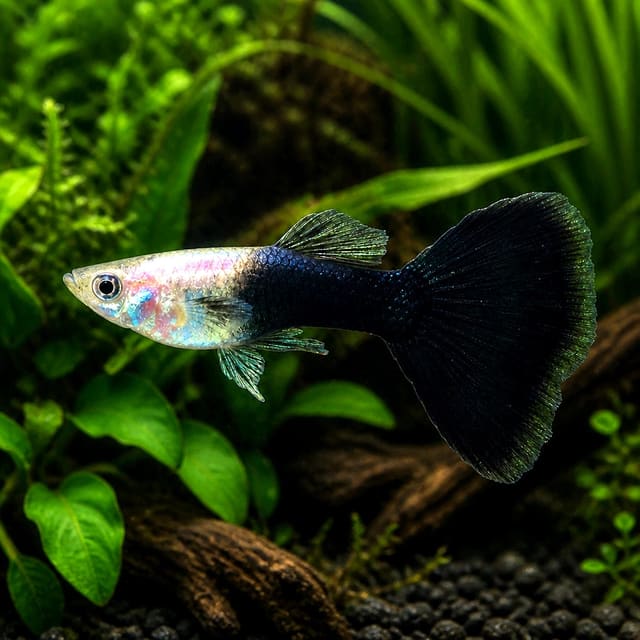
Blue Moscow Male Guppy (Poecilia reticulata)
22–28°C · pH 7–8 · 45L
£5.99

The Elephant Ear Male Guppy (Poecilia reticulata) is a Poeciliidae livebearer from Venezuela, Barbados, Trinidad, northern Brazil and the Guianas that reaches 6 cm standard length. It suits a prepared beginner keeping 5+ fish; Tropical Fish Co uses 22–28°C, while pH 7.0–8.0 and 9–18 dGH are the FishBase, Seriously Fish and OATA overlap. Sold individually at an approximate dispatch size of 3–4 cm.
Adult size is the maximum length this species reaches at full maturity (scientific sources). The livestock you receive will be younger and smaller. Product-photo provenance and any image-specific limitations are stated on the listing.
Save when buying multiple fish. Each quantity is one fish; sex and pair formation are not guaranteed unless the selected variant explicitly states them.
Minimum of 2 per order.
The Elephant Ear Male Guppy (Poecilia reticulata) is a Poeciliidae livebearer from Venezuela, Barbados, Trinidad, northern Brazil and the Guianas that reaches 6 cm standard length. It suits a prepared beginner keeping 5+ fish; Tropical Fish Co uses 22–28°C, while pH 7.0–8.0 and 9–18 dGH are the FishBase, Seriously Fish and OATA overlap. Sold individually at an approximate dispatch size of 3–4 cm.
Adult size is the maximum length this species reaches at full maturity (scientific sources). The livestock you receive will be younger and smaller. Product-photo provenance and any image-specific limitations are stated on the listing.
Guppies are social livebearers suited to a prepared beginner, not a fish-per-litre formula. Use a mature filtered aquarium, tested neutral-to-alkaline mineral-bearing water, deliberate sex and population planning, open swimming room, cover and a separation option.
Maintain these water conditions for optimal health and vibrant colors
The Elephant Ear Male Guppy (Poecilia reticulata) is a small Poeciliidae livebearer from Venezuela, Barbados, Trinidad, northern Brazil and the Guianas. This male form reaches 5 cm standard length and suits a prepared beginner who can provide a mature filtered aquarium, mineral-bearing water and a planned social group. Its Elephant Ear name identifies the aquarium trade form; it remains the familiar guppy species rather than a separate species.
FishBase records the native range, Poeciliidae family and 5 cm maximum standard length for male or unsexed fish. Standard length measures the body without the tail fin. The accepted scientific name is also listed as Poecilia reticulata by Eschmeyer’s Catalog of Fishes.
| Suits | Not suited to |
|---|---|
| A prepared beginner following a regular testing and maintenance routine | An uncycled aquarium or unfiltered bowl |
| A mature aquarium at least 60 cm long under our conservative group policy | A plan based only on the fish’s dispatch size |
| A social group of five or more where capacity and the sex plan allow | Permanent solitary keeping |
| Neutral-to-alkaline, moderately hard or harder water | Long-term soft, acidic conditions |
| A quiet community screened for fin safety | Fin-nipping species |
Our complete Guppy Care Guide explains the conservative 60 cm aquarium and five-fish group policy. Apply both figures as starting screens, then assess the aquarium’s usable footprint, filtration, test results, sex mix and other livestock.
Each purchase supplies one male Elephant Ear Guppy at an approximate dispatch size of 3–4 cm. This is a dispatch grade, not the adult planning size, and individual measurements can vary within an approximate grade. The aquarium must therefore be planned around the 5 cm standard-length adult figure and the needs of the complete group.
Sex is guaranteed only when the exact product or selected option explicitly states male or female. This Elephant Ear Male Guppy listing is sold as male.
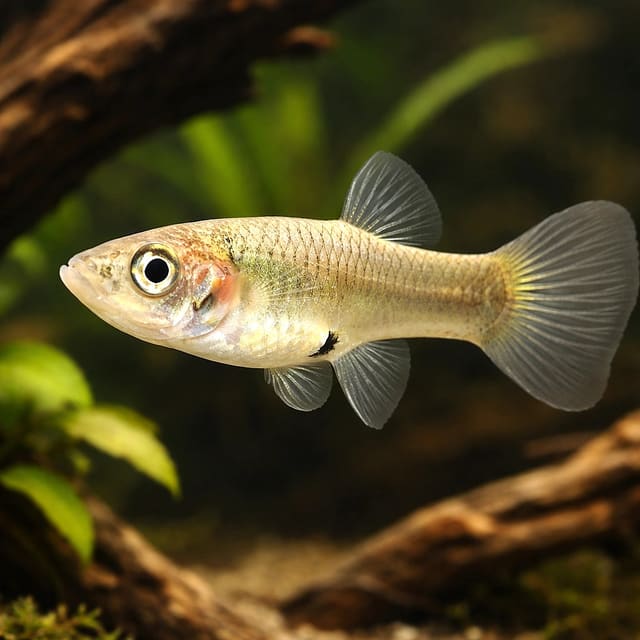
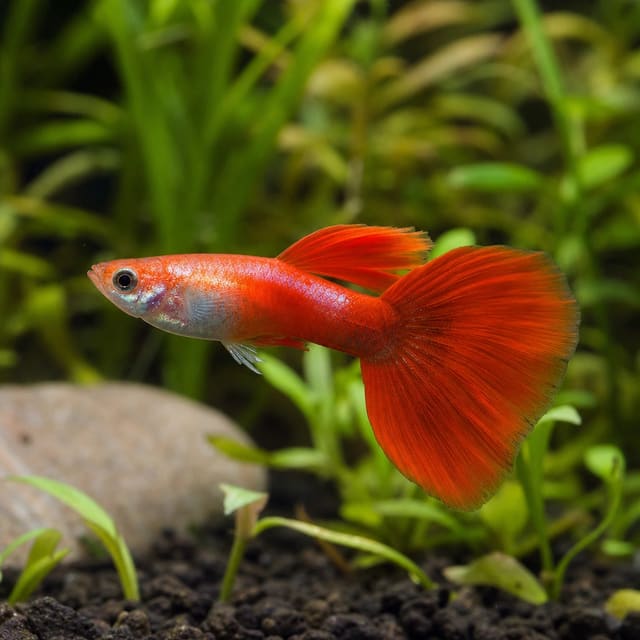
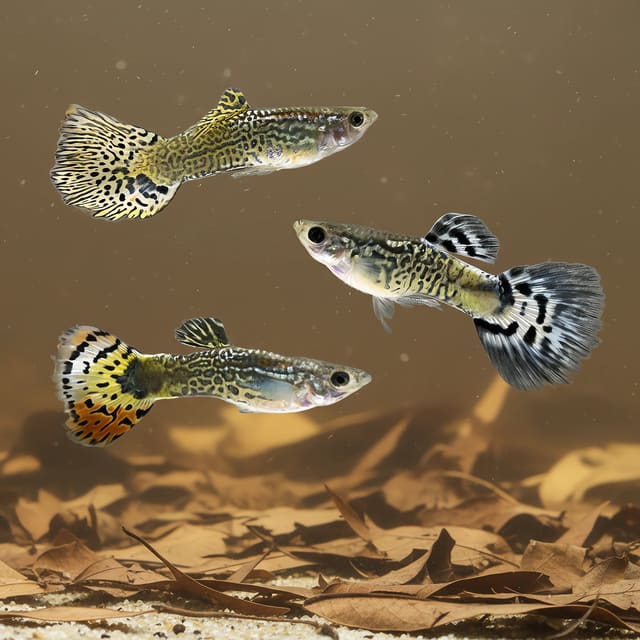
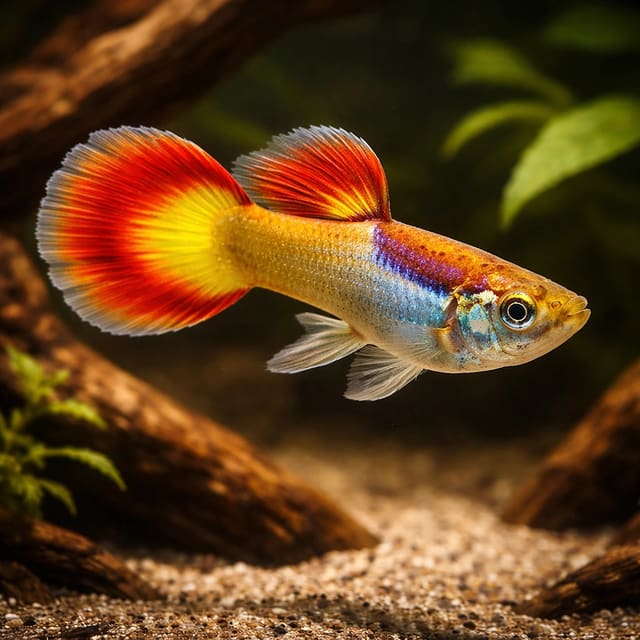
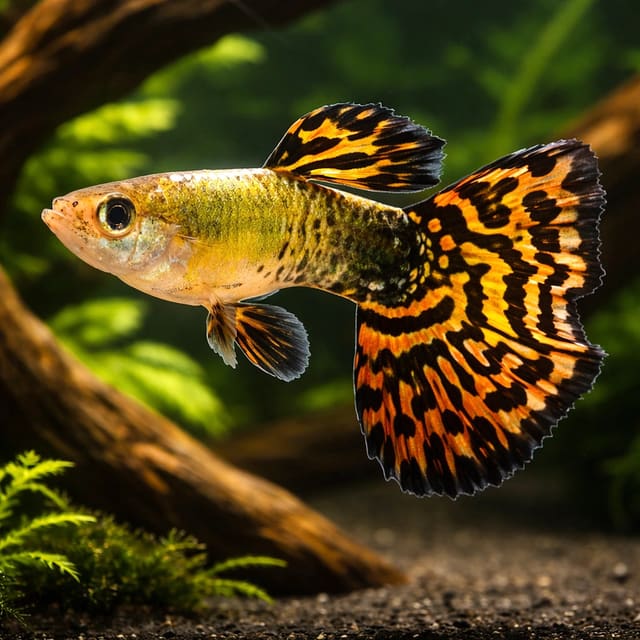
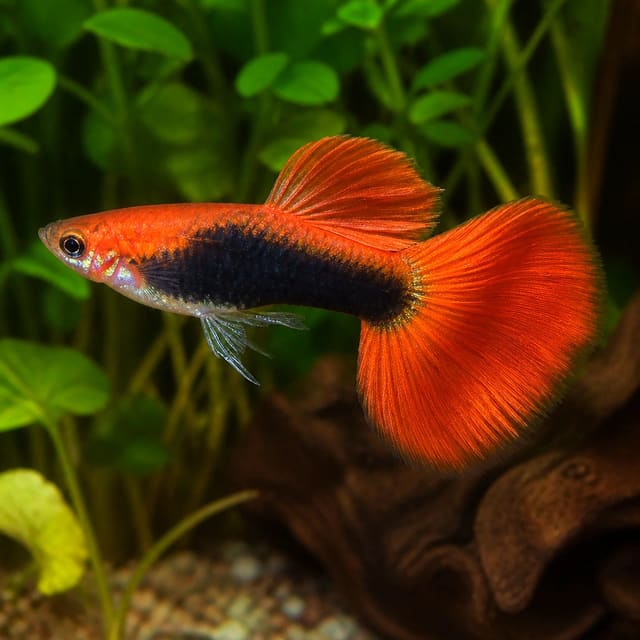
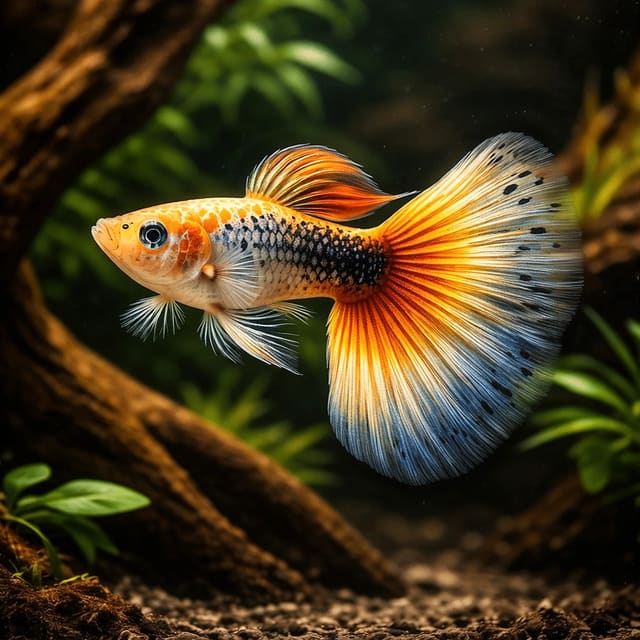
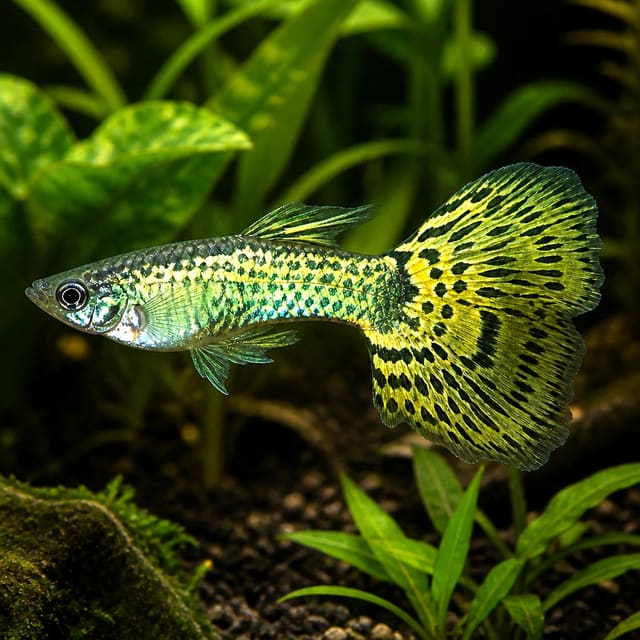
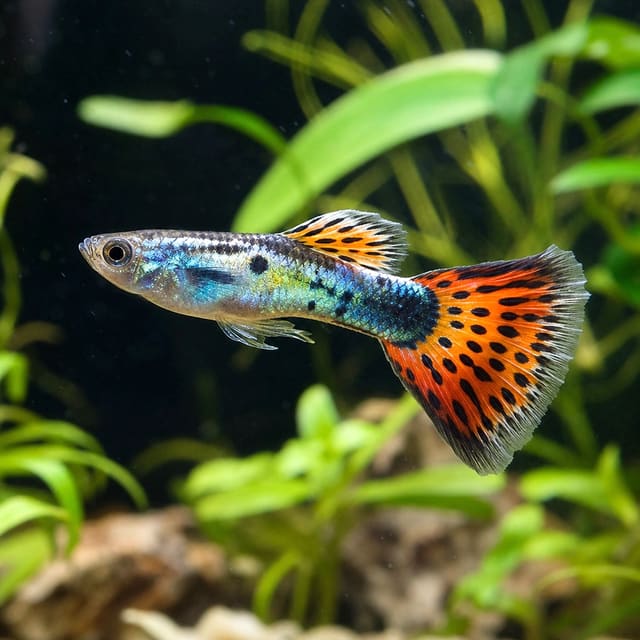
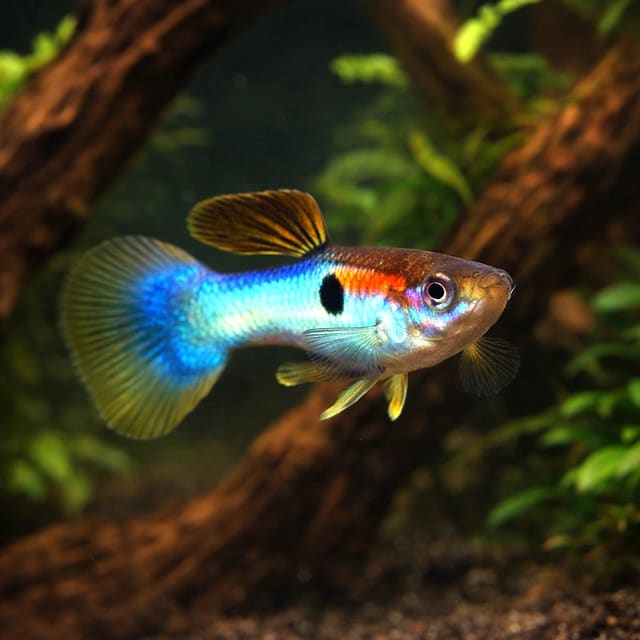
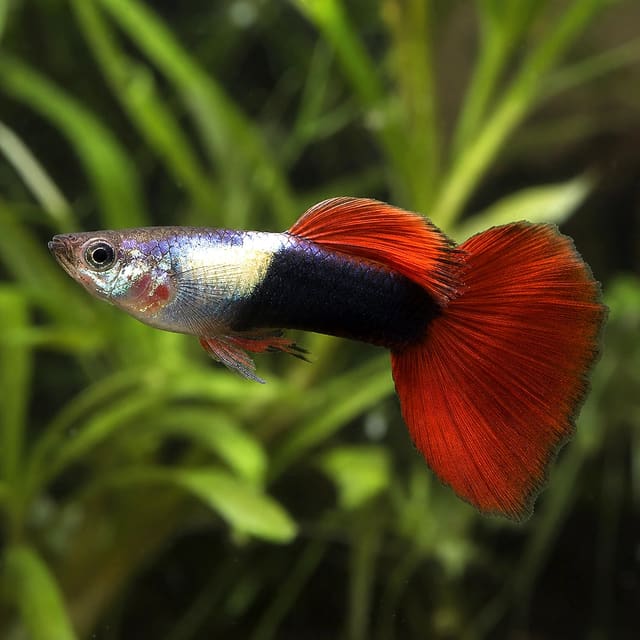
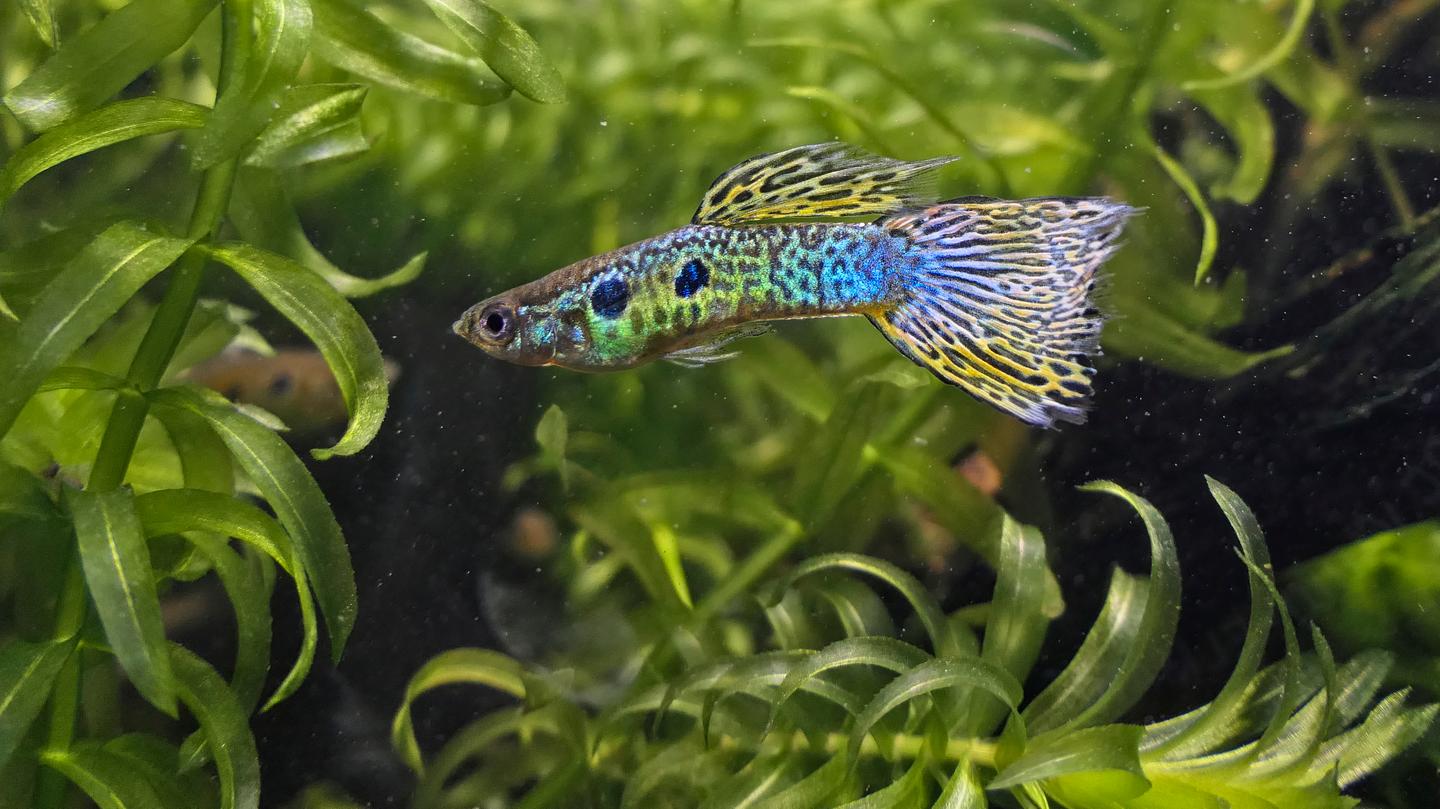
Elephant Ear is the stated trade-form name for this offer. Colour, tail markings and fin appearance can vary between individual fancy guppies, so choose the fish for its stated identity and care requirements rather than for an exact arrangement of colour shown in one image. The gallery image shows a blue-green guppy with a spotted orange fan tail against blurred green leaves.
The gallery images are representative of this type of animal rather than photographs of the exact animal supplied, so colours can look slightly different from the live animal.
A male-only plan prevents new mixed-sex mating within that group, but it does not remove the need to watch chasing, feeding access and fin condition. A mixed-sex plan needs space, population planning and the OATA ratio guidance explained below.
Plan for an adult size of 5 cm standard length. This is the FishBase maximum recorded for male or unsexed Poecilia reticulata and is the figure used throughout this profile because the offer is male. The approximate 3–4 cm dispatch grade describes the fish at dispatch rather than its finished size.
Seriously Fish lists 6 cm standard length, a 45 × 30 cm base and approximately 41 litres as its species reference. That 6 cm figure differs from the male or unsexed FishBase figure, so retain a margin rather than fitting the aquarium closely around the smaller measurement.
Our conservative policy uses a mature, filtered aquarium at least 60 cm long for one small guppy group. FishBase also gives a 60 cm aquarium length and a group of five or more. OATA gives at least 45 litres for a small group of smaller livebearers, while Seriously Fish gives approximately 41 litres with a 45 × 30 cm base. These are planning references, not fish-per-litre permissions.
| Check | Decision |
|---|---|
| Internal length | Use at least 60 cm under our conservative group policy |
| Mature filtration | Confirm zero ammonia and zero nitrite before adding fish |
| Social capacity | Allow for five or more guppies and the intended sex plan |
| Existing livestock | Count every animal at adult size and preserve its group space |
| Behaviour | Intervene if one fish cannot feed, rest or leave pursuit |
A nominal volume cannot show swimming length, established biological capacity or how much space other animals already use. A 60-litre aquarium can be a candidate only when it is also about 60 cm long, mature, filtered, suitably furnished and not already crowded. More water can improve stability, but it does not create an automatic entitlement to add more fish.
Keep this guppy at 22–28°C, pH 7.0–8.0 and 9–18 dGH. Tropical Fish Co uses 22–28°C as its routine display range inside the species ranges from FishBase and Seriously Fish. The pH and hardness figures are the overlap of FishBase, Seriously Fish and OATA’s guppy-and-molly guidance. OATA’s 20–28°C, pH 7.0–8.0 and 8–18 dGH figures are group guidance, not a species-specific optimum.
| Value | Routine instruction |
|---|---|
| Temperature | 22–28°C, kept stable and checked with an aquarium thermometer |
| pH | 7.0–8.0; make changes gradually |
| General hardness | 9–18 dGH for mineral-bearing water |
| Ammonia | 0 mg/l |
| Nitrite | 0 mg/l |
| Nitrate | No more than 20 mg/l above the normal tap-water level under OATA guidance |
Test the aquarium water itself rather than relying on the heater dial, room temperature or a regional description of tap water. Use our water chemistry guide to understand each test, then compare measured values with the range through the water matcher.
Dechlorinate replacement tap water and match it gradually to the aquarium. Do not chase a target pH with abrupt corrections. Seriously Fish describes the guppy as a hard-water fish that may manage in soft or acidic conditions but should be maintained long term in moderately hard or harder water.
Guppies also occur in brackish environments, but that does not make routine salt necessary. Add salt or minerals only for a measured purpose after checking the needs of every fish, invertebrate and plant sharing the aquarium.
Use a well-established biological filter and confirm zero ammonia and zero nitrite before adding the guppy. The RSPCA explains that biological filtration supports bacteria that convert toxic ammonia to nitrite and then to safer nitrate. Clear water alone does not show that this process is working.
Prepare the aquarium before the fish arrives. Our first tropical aquarium guide covers the practical sequence for setting up, maturing and testing a new system without using livestock to establish the filter.
Choose filtration for the aquarium’s actual volume and livestock while keeping the flow comfortable. Seriously Fish gives four to five aquarium turnovers per hour for its approximately 41-litre reference setup, equivalent to a filter rating of about 165–205 litres per hour. Media condition, head height and obstruction can affect real flow, so observe the outlet and test water rather than relying only on the box rating.
Never use extra fish as a test of whether a filter is mature. Rising ammonia or nitrite can make fish ill or kill them, and adding more livestock increases the waste load precisely when biological capacity is inadequate. If either reading is detectable, stop additions and correct the water-quality problem.
Arrange the aquarium with open swimming room, planted or furnished edges and quiet places where a fish can leave another’s line of sight. Seriously Fish describes a planted aquarium with floating vegetation as appreciated and says strong currents should be avoided. Keep enough open water for the group to move and feed without forcing every fish through the same narrow route.
Place live plants where they provide cover without filling the entire swimming footprint. OATA also permits suitable plastic plants and ornaments when live plants are not used. Choose smooth furnishings that do not create obvious snagging points, and check narrow gaps where a small fish could become trapped.
Cover should offer several routes rather than one defended cave or corner. Watch how each fish uses the layout after a new arrival or rearrangement. Persistent hiding, cornering, repeated pursuit or exclusion from food means the social plan needs intervention; adding more decoration without checking the result is not enough.
Use a secure aquarium cover and check openings around cables and filter pipes. Maintain clear access to the surface, and keep the filter intake safe for the fish in the aquarium. If fry are deliberately being raised in another planned setup, assess intake protection and filtration for their smaller size as a separate decision.
Use an appropriately sized, nutritionally complete omnivore flake or granule as the staple. FishBase records wild guppies feeding on zooplankton, small insects and detritus, while Seriously Fish describes wild fish as primarily insectivorous and aquarium strains as accepting most foods. Choose a staple that covers routine nutrition, then add compatible invertebrate and algal variety.
OATA recommends small live or frozen items such as daphnia, small bloodworm or tubifex as variety. These additions should complement the complete staple rather than replace it. Use biosecure foods intended for aquarium animals and select pieces small enough for the fish to swallow comfortably.
OATA advises feeding once a day and offering only what the fish can eat within a few minutes. Begin with a small measured portion, watch every fish and stop before uneaten food accumulates. Guppies can approach food eagerly, but active feeding behaviour is not permission to keep adding food.
| Food role | Practical choice |
|---|---|
| Daily staple | Appropriately sized complete omnivore flake or granule |
| Invertebrate variety | Small portions of daphnia, small bloodworm or tubifex |
| Algal variety | A safe compatible component within the omnivore rotation |
| Group access | Distribute a small portion so quieter fish can feed |
| Waste control | Remove leftovers before they break down |
Observe swallowing rather than merely seeing food enter the aquarium. A fish that repeatedly misses food, hangs away from the group or loses body condition needs closer assessment of competition, mouth-sized food, water quality and health.
Overfeeding increases uneaten waste and fish waste, placing extra demand on the biological filter. If ammonia, nitrite or nitrate rises, review portion size, stocking and maintenance together instead of using reduced feeding as the only response.
At least once every week, change 25% of the aquarium water. OATA recommends this frequency and amount, alongside water testing at least once per week. A siphon can remove solid waste from the substrate while water is removed.
Check the filter for blockages. If reusable filter media needs cleaning, do not run it under the tap. Rinse it lightly in aquarium water removed during the partial water change so fewer beneficial bacteria are lost. Avoid replacing all established biological media together.
A weekly schedule is a baseline rather than permission to ignore conditions between maintenance days. Test immediately after a filter interruption or when fish show surface gasping, unusual swimming, reduced feeding or a sudden behavioural change. Increased stocking, fry or heavy feeding can also require closer monitoring.
| Observation | Response |
|---|---|
| Reduced filter output | Inspect the intake and media for obstruction |
| Detectable ammonia or nitrite | Act immediately and pause livestock additions |
| Rising nitrate | Review stocking, feeding and maintenance frequency |
| Abrupt pH movement | Check source water and recent additions before correcting gradually |
| Normal tests but persistent pursuit | Review the social group and separation plan |
Prepare and test the mature aquarium before the parcel is received. The arrival steps below come from the Tropical Fish Co delivery and Live Arrival Guarantee policy.
Film every delivery from the sealed parcel onward. Keep the order number and continuous video, and report any concern on the same day so the condition in the unopened parcel and sealed bag can be assessed.
Confirm 22–28°C, pH 7.0–8.0, 9–18 dGH, zero ammonia and zero nitrite before release. The Tropical Fish Co guppy care guidance sets these aquarium checks. Do not begin rearranging an unsuitable aquarium after the fish has arrived.
After release, observe orientation, swimming control, breathing and whether the newcomer can move away from other fish. Test the water promptly if it gasps at the surface, loses balance or remains unable to settle. Persistent pursuit or immediate fin damage requires the prepared separation route rather than waiting for the fish to become exhausted.
During the first week, inspect the fish at each feed. Confirm that it swallows food, crosses the aquarium normally and can rest without being repeatedly displaced. Record any change in appetite, colour, breathing, balance or fin condition so that a developing problem is easier to describe accurately.
Check the fish daily for steady swimming, regular breathing, open undamaged fins, a normal body profile and consistent feeding. The RSPCA’s fish health guidance identifies changes in behaviour, appearance and feeding as reasons to investigate water quality and seek appropriate help.
| Sign | First response |
|---|---|
| Surface gasping or changed breathing | Test temperature, ammonia and nitrite and inspect filtration |
| Clamped, damaged or deteriorating fins | Check water, sharp objects and fin-nipping behaviour |
| Hiding or loss of swimming control | Test water and prepare safe isolation where appropriate |
| Reduced appetite or weight change | Confirm feeding access and review other physical signs |
| White spots, fluffy growths or wounds | Isolate safely where appropriate and seek diagnosis |
Do not select salt, heat or medication from one symptom. Similar signs can arise from water-quality failure, injury, social pressure or disease, and a poorly chosen treatment can delay the correct response. Record the water values, recent maintenance, new livestock, food and the timing of visible signs.
The MSD Veterinary Manual recommends at least 30 days of quarantine, with longer isolation where indicated. Use dedicated equipment, biologically supported filtration and repeated water testing. A small uncycled container is not a safe quarantine system.
Keep the quarantine temperature and water chemistry suitable for the guppy, and avoid sharing nets, siphons or wet equipment with the display aquarium. Observation should include appetite, breathing, swimming, fins, skin and waste, not merely whether the fish remains alive.
For diagnosis and treatment in the UK, use the OATA fish-vet directory. Veterinary support is particularly important when signs progress, several fish are affected or water correction does not resolve the problem.
Keep guppies in a social group rather than as permanently solitary fish. FishBase gives aquarium keeping in groups of five or more, and Tropical Fish Co adopts five or more as its conservative policy where aquarium capacity and the sex plan allow. OATA suggests at least three guppies or mollies, with two females to each male in a mixed-sex group.
| Group plan | Decision |
|---|---|
| Male-only group | Prevents new mixed-sex mating within the group; continue monitoring pursuit, feeding and fins |
| Mixed-sex group | Use OATA’s two-females-to-each-male ratio and plan for live young |
| One male joining a group | Check mature capacity, existing sex mix and individual feeding access |
| New group | Use five or more under our policy, with a 60 cm aquarium and a separation option |
A ratio does not guarantee that every fish will be left undisturbed. Seriously Fish describes males as vigorous in their pursuit of females, while the Tropical Fish Co guide also warns that repeated pursuit, hiding, missed feeding or fin damage requires intervention. Provide sight breaks and enough usable space, then judge the actual behaviour.
This offer supplies a male, so it must be counted as a male in any mixed-sex plan. Guppies give birth to live young, and Seriously Fish describes aquarium breeding as easy. Decide how fry would be housed and responsibly rehomed before combining sexes rather than treating unexpected young as a filtration or stocking problem later.
Do not add unrelated community fish to substitute for a guppy group. Each social species needs its own appropriate number, and all those adults must fit within the same aquarium footprint and biological capacity.
A quiet community can work when every species overlaps at 22–28°C, pH 7.0–8.0 and 9–18 dGH and the aquarium accommodates all adult sizes and social groups. Seriously Fish names other livebearers, rasboras, corydoras, small loricariids and tetras as community candidates. Treat each as a candidate rather than a universal promise.
Avoid fin-nipping species. Seriously Fish specifically says not to keep guppies with tiger barbs or serpae tetras, while OATA says guppies should not be kept with species that might nip their fins. This exclusion remains in place even when temperature and pH overlap.
| Decision | Rule |
|---|---|
| Suitable after screening | Other livebearers, rasboras, corydoras, small loricariids and non-nipping tetras with matching adult needs |
| Use caution | Any animal that may swallow, injure, outcompete or persistently pursue the guppy |
| Avoid | Fin-nipping species, including tiger barbs and serpae tetras |
| Preserve line identity | Avoid mixing documented guppy and Endler lines intended to remain pure |
Before combining species, compare adult size, temperature, pH, hardness, activity, feeding method, required group size and usable footprint. Watch whether every animal can reach food and refuge. Keep a separation plan ready because compatibility can change as fish mature or the group composition changes.
Endler’s livebearer is the separately described species Poecilia wingei. Its formal description is available through the 2005 species paper, and Eschmeyer’s Catalog of Fishes lists it as valid. Hybridisation with Poecilia reticulata is possible, so avoid mixing documented lines intended to remain pure and never represent hybrid descendants as pure examples of either species.
Invertebrates require the same screening. “Adult invertebrates” is too broad for a compatibility promise, and the Tropical Fish Co guide warns that small shrimp or young may be eaten. Assess the exact invertebrate’s adult and juvenile sizes, water needs and escape cover before combining it with guppies.
An Elephant Ear Male Guppy reaches 5 cm standard length according to FishBase’s male or unsexed figure. Standard length excludes the tail fin, so plan the aquarium around the adult body size and allow additional room for the flowing tail.
Use a mature filtered aquarium at least 60 cm long under Tropical Fish Co’s conservative group policy. Seriously Fish gives approximately 41 litres with a 45 × 30 cm base, while OATA gives at least 45 litres for a small group of smaller livebearers; length, filtration, tests and total stocking must also pass.
Keep five or more guppies where aquarium capacity and the sex plan allow, following the FishBase group figure and Tropical Fish Co policy. OATA’s guppy-and-molly guidance suggests at least three, but the shop uses the more conservative five-fish screen.
An Elephant Ear Male Guppy can suit a prepared beginner and has an easy store care rating. It still needs a mature filtered aquarium, zero ammonia and nitrite, tested mineral-bearing water, a social plan and weekly maintenance.
Feed an appropriately sized complete omnivore flake or granule as the staple, with compatible invertebrate and algal variety. OATA advises one daily feed limited to what the fish can eat within a few minutes.
Keep it at 22–28°C, pH 7.0–8.0 and 9–18 dGH. Tropical Fish Co uses the temperature range, while pH and hardness are the overlap of FishBase, Seriously Fish and OATA; ammonia and nitrite must remain at 0 mg/l.
Seriously Fish describes the guppy as very peaceful, although courtship or pursuit can still require intervention. Avoid fin-nipping species such as tiger barbs and serpae tetras, and separate fish if persistent chasing, exclusion or damage develops.
Other livebearers, rasboras, corydoras, small loricariids and non-nipping tetras are candidates after matching water, adult size, group needs and space. Small shrimp or young may be eaten, so no broad invertebrate group can be promised as compatible.
Start filming the sealed parcel before opening it, keeping the outer box visible and continuing until the fish is shown inside the sealed bag. Tropical Fish Co’s delivery policy says fish are hand-bagged in pure oxygen inside an insulated poly box; receive the parcel in person, open it the same day and float the bag for 20–30 minutes before releasing the fish.
Independently collected by Judge.me from customers who bought this item. All reviews are shown.
Really enjoying watching this guppy. Very pleased with my purchase.
Reply from Tropical Fish Co
<p>Thank you Marianne. Elephant Ear guppies are a proper watch-and-enjoy fish - those pectorals carry on growing for a while yet, so he should look even better in a couple of months than he does now. - Tropical Fish Co</p>