Easy
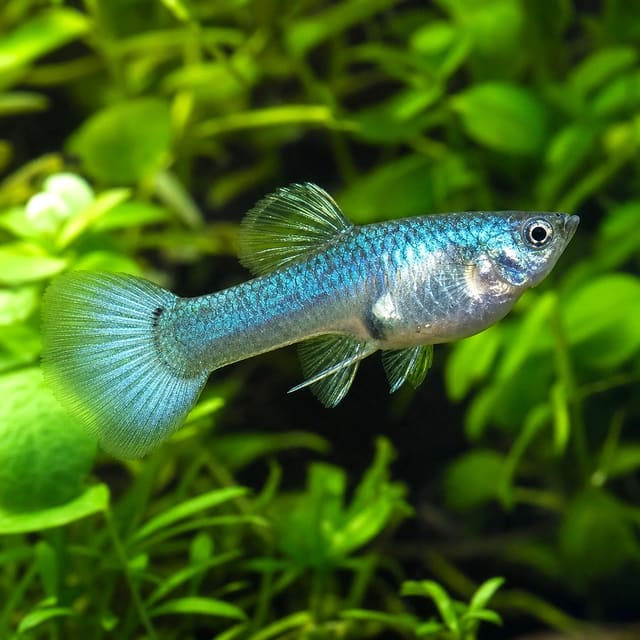
Blue Moscow Male Guppy (Poecilia reticulata)
22–28°C · pH 7–8 · 45L
£6.49
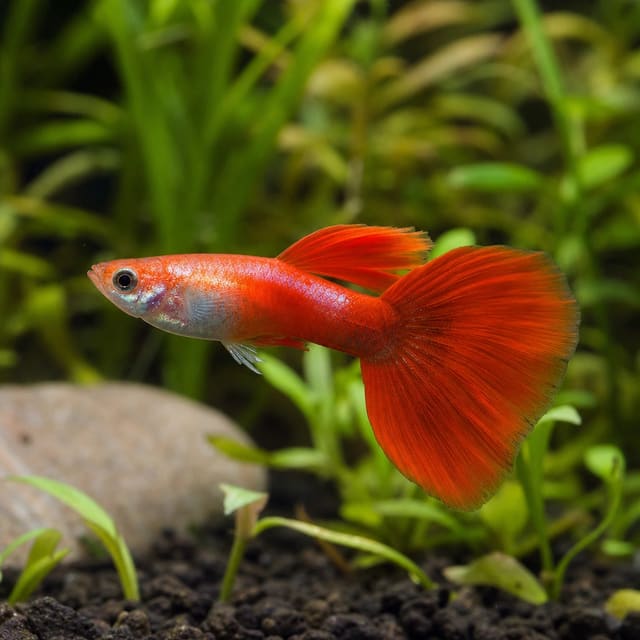
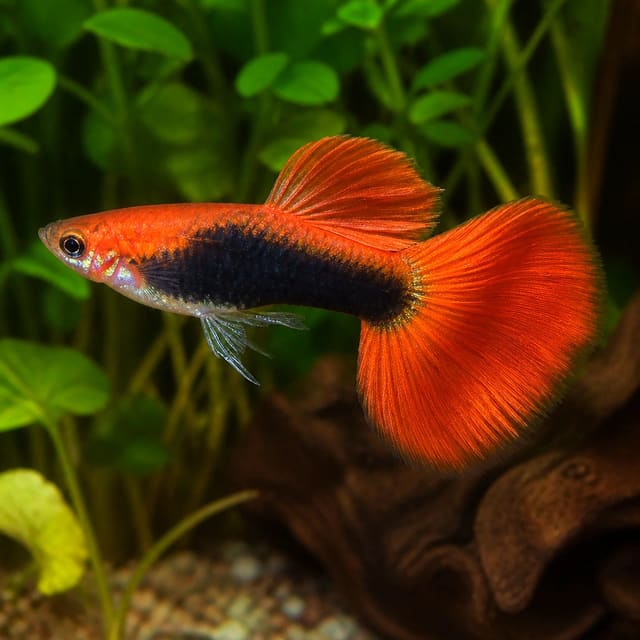
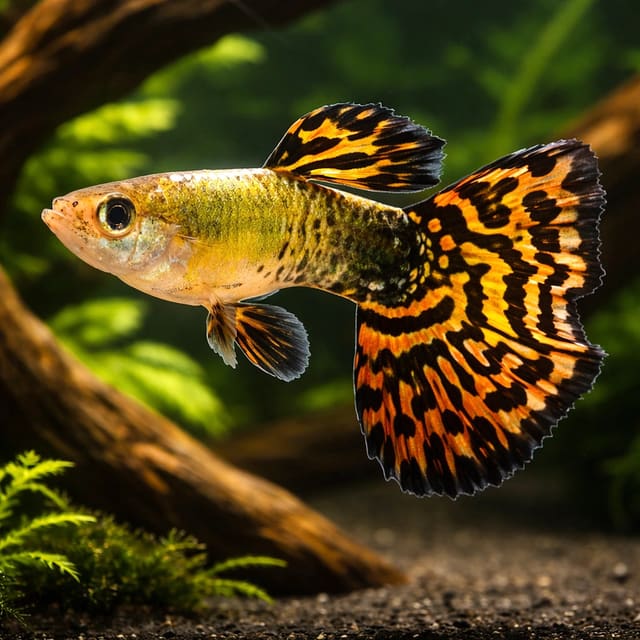
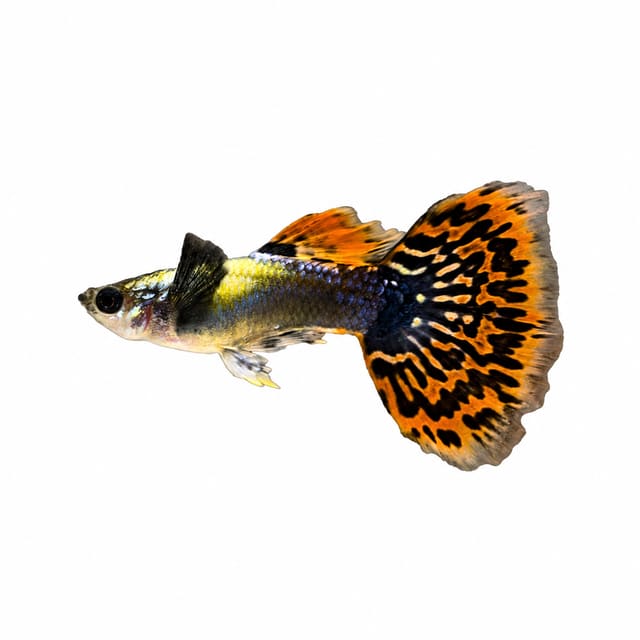
Red Tuxedo Male Guppy (Poecilia reticulata) is one live male guppy supplied at a 3–4 cm dispatch grade. It needs a mature filtered aquarium at least 60 cm long, a deliberately planned social group, stable neutral-to-alkaline mineral-bearing water and tank mates that will not nip its fins.
Adult size is the maximum length this species reaches at full maturity (scientific sources). The livestock you receive will be younger and smaller. Product-photo provenance and any image-specific limitations are stated on the listing.
Poecilia reticulata
Shoaling fish: kept in a group they feel safer, stay calmer and show their best colour.
Minimum of 2 per order.
Red Tuxedo Male Guppy (Poecilia reticulata) is one live male guppy supplied at a 3–4 cm dispatch grade. It needs a mature filtered aquarium at least 60 cm long, a deliberately planned social group, stable neutral-to-alkaline mineral-bearing water and tank mates that will not nip its fins.
Adult size is the maximum length this species reaches at full maturity (scientific sources). The livestock you receive will be younger and smaller. Product-photo provenance and any image-specific limitations are stated on the listing.

Guppies are social livebearers suited to a prepared beginner, not a fish-per-litre formula. Use a mature filtered aquarium, tested neutral-to-alkaline mineral-bearing water, deliberate sex and population planning, open swimming room, cover and a separation option.
Maintain these water conditions for optimal health and vibrant colors
Red Tuxedo Male Guppy (Poecilia reticulata) is the exact offer on this page: one live male guppy per purchase, supplied at a 3–4 cm trade grade. Red Tuxedo is the variety label; the accepted species remains Poecilia reticulata. The supplied grade describes the fish at dispatch and should not be read as its final length. A specialist species profile records 6 cm standard length, while FishBase records 5 cm standard length for male or unsexed guppies. Standard length ends where the tail begins, so ornamental finnage can make the fish look longer.
Three decisions matter before adding this fish to a basket. First, is the aquarium mature, filtered and at least 60 cm long? Second, does its tested water sit in a stable neutral-to-alkaline, mineral-bearing range? Third, what is the complete guppy social and sex plan? One male is a sold unit, not a complete group. Tropical Fish Co’s conservative policy is five or more guppies where capacity, filtration, water results and the chosen sex arrangement allow.
| Buyer decision | Useful answer for this offer |
|---|---|
| What arrives? | One live Red Tuxedo Male Guppy, explicitly sold as male |
| How large is it supplied? | 3–4 cm trade grade; adult planning uses species records rather than the dispatch grade |
| How much aquarium space? | A mature filtered aquarium at least 60 cm long for one small group, adjusted for the real footprint and all residents |
| How many guppies? | Five or more under the store’s conservative policy, provided the aquarium and sex plan support them |
| Which routine water? | Store range 22–28°C; broad OATA guppy-and-molly guidance pH 7–8 and 8–18 dGH |
| Who should avoid it? | Keepers with an uncycled aquarium, unsuitable soft acidic water, no group plan or fin-nipping tank mates |
| What does it eat? | A complete small omnivore food, supported by safe appropriate variety |
| Suits | A prepared keeper with a mature 60 cm aquarium, measured water and a complete guppy social plan |
Sex is guaranteed only when the exact product or selected option explicitly states male or female. This Red Tuxedo Male Guppy listing is sold as male.
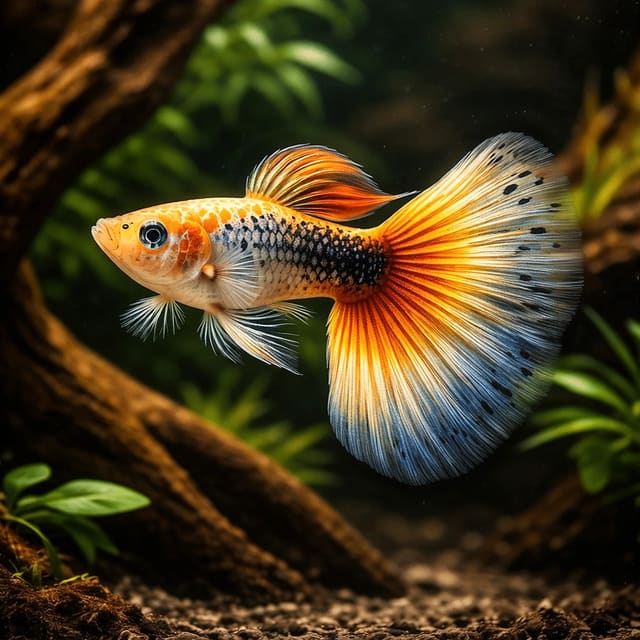
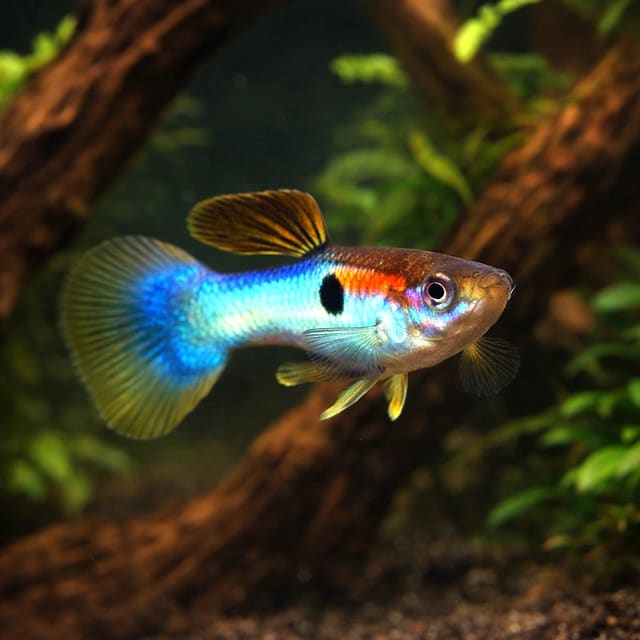
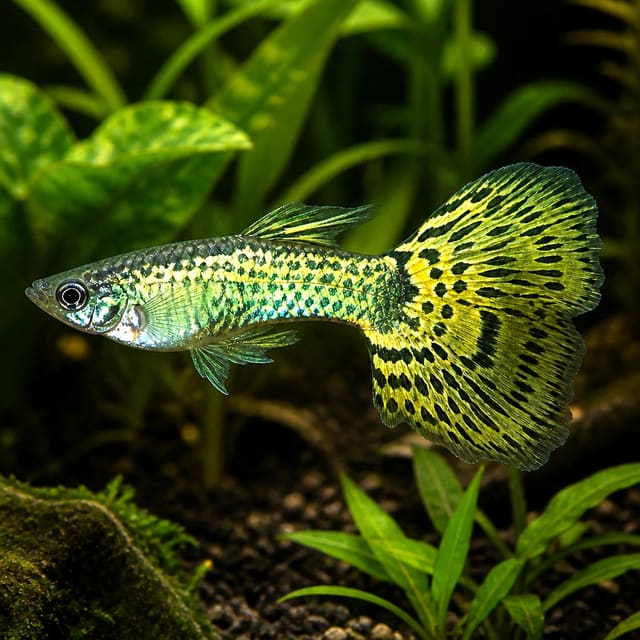
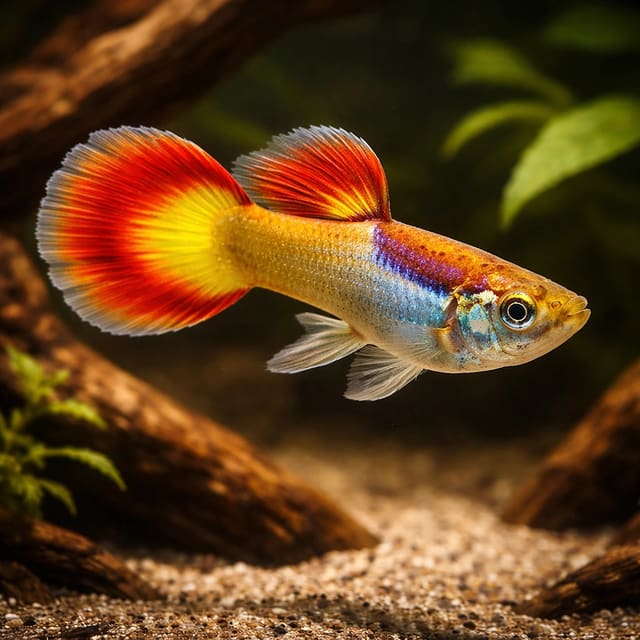
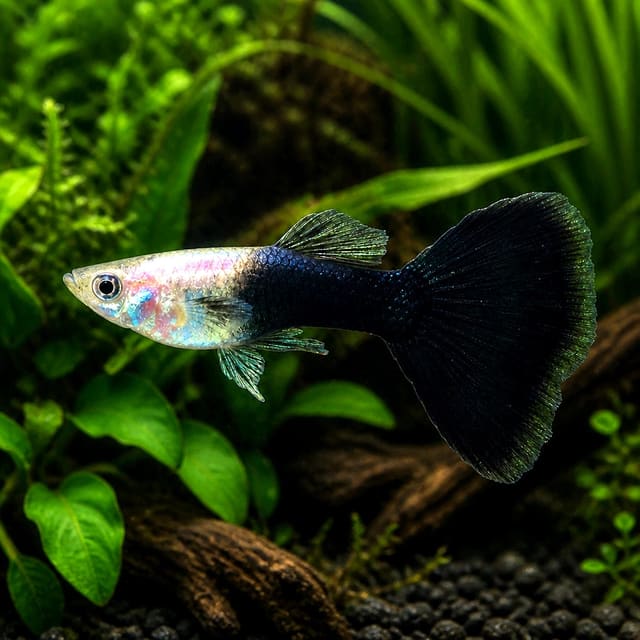
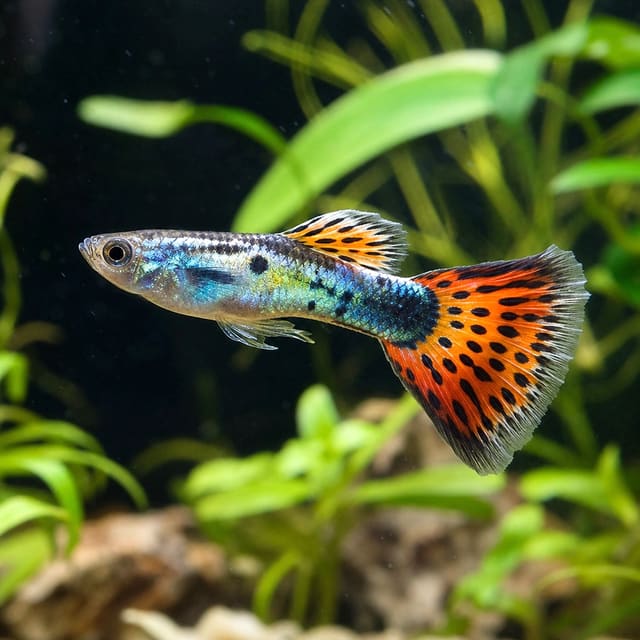
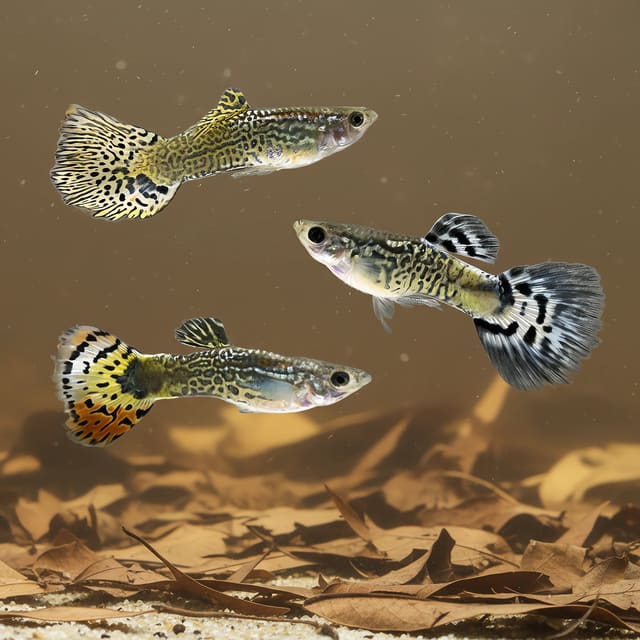
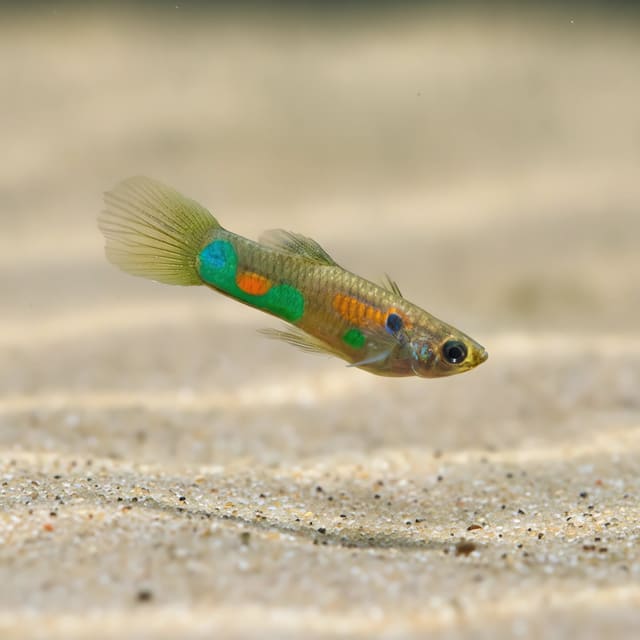
The Red Tuxedo name does not establish a separate species, a genetic pedigree or a promise that every fish has identical red and dark coverage. Domestic guppies vary in colour distribution, fin proportions, body profile and maturity. The held gallery image is not being used here to infer anatomy, sex or the exact appearance of the animal supplied. Plan care from the verified offer and species, while allowing normal individual variation.
A prepared beginner can keep this guppy successfully, but “easy” is a store suitability assessment, not an exemption from cycling or testing. A suitable keeper can read ammonia and nitrite results, maintain a stable heater and filter, feed without leaving waste, observe social pressure and move a fish into a mature separation aquarium when necessary. Those practical habits matter more than the popularity of the species.
This offer is a poor fit when the only available container is shorter than the 60 cm house screen, when ammonia or nitrite is detectable, or when the source water is far outside the useful mineral-bearing range. It is also the wrong purchase when no one has decided whether the display will be male-only or mixed sex. Correcting those fundamentals before ordering is easier and kinder than trying to solve them with the fish already in transit.
Red Tuxedo tells the buyer which selected variety is being offered, but it does not create a different care sheet. Temperature, group needs, diet, adult-size planning and compatibility come from Poecilia reticulata. The colour label should guide product identity, while water tests and species evidence guide husbandry. That distinction prevents a striking trade name from being mistaken for a biological difference that has not been established.
Keep the live product controls and this description in separate roles. The guide explains enduring care and the sold unit; the current product page controls price and availability. The offer here has one male fish per purchase. Ordering several individuals still requires the keeper to judge whether the resulting group, sex mix and aquarium capacity are suitable.
A male-only display prevents new mating between the fish in that display, although males can still chase and display. A mixed-sex setup creates a real likelihood of fry and continuing pressure on females. OATA’s broad guidance suggests two females per male, but no ratio guarantees welfare. Before choosing either arrangement, account for every adult, possible young, food access, filtration and a responsible rehoming route.
Read the full Guppy Care Guide before deciding. The current guppy collection can help compare other sale offers, but it does not turn those alternatives into tank-mate recommendations. Each listing should be checked for sex, sold quantity and exact offer in its own right.
Gallery images have been digitally enhanced to improve image quality. Natural colour, pattern, size and maturity can vary between live animals.
Begin with the aquarium’s internal length and usable footprint, not only the litres printed on its box. FishBase’s secondary aquarium note gives a 60 cm minimum length and a group of five or more. OATA gives 45 litres for a small group of smaller livebearers, while Seriously Fish lists a 45 × 30 cm base at about 41 litres. Tropical Fish Co applies the more conservative 60 cm screen because horizontal room, a social group and separation from pursuit all need usable distance.
A nominal 60-litre aquarium can be a candidate, yet it is not an automatic permission for five fish. Its internal length, mature biological capacity, other species, decor, water chemistry and actual test history remain decisive. A tall narrow aquarium can have the same nominal volume as a longer one while offering less swimming distance. Measure after substrate and furnishings are installed, and count every existing animal when judging the load.
The first tropical tank guide is useful if the aquarium is new. Cycling means establishing a biological filter capable of processing livestock waste; waiting a set number of days does not demonstrate that. Test results should show zero detectable ammonia and nitrite before stocking. Add animals in stages so the bacterial population can respond to increased feeding and waste rather than being overwhelmed by a sudden full group.
Tropical Fish Co uses 22–28°C as its routine display range for guppies. OATA’s combined guppy-and-molly sheet gives pH 7–8 and general hardness 8–18 dGH. The Seriously Fish species profile publishes broader values of 17–28°C, pH 7–8.5 and 8–30 dGH. The broader range is useful context, but ordinary care should stay in a stable middle range rather than testing what the fish can tolerate at an edge.
Water leaving a UK tap is not uniform across the country. Obtain a current supplier report and test the source used for the aquarium. The water chemistry guide explains pH, hardness and nitrogen waste, and the water matcher helps compare real readings with the stated care range. Neither tool can compensate for a missing test or an abrupt adjustment.
Use a thermostat-controlled aquarium heater where the room cannot keep the water in range, then confirm the water temperature with an independent thermometer. Condition replacement tap water before it reaches the livestock. Match temperature and chemistry gradually during maintenance. Although guppies occur in freshwater and brackish records, that fact alone does not justify routine salt. Any mineral, salt or pH product needs a measured reason and a safety check for the other fish, invertebrates and plants.
The RSPCA’s aquarium environment advice describes the filter’s essential biological role: beneficial bacteria convert toxic ammonia to nitrite and then to nitrate. Choose equipment for the complete community and maintain enough flow for oxygen and waste movement without forcing a long-finned guppy to fight the current. Watch the fish at different points in the tank; packaging ratings cannot show whether an individual is pinned, fatigued or unable to feed.
Check the intake as well as the outlet. Small fish or future fry should not be drawn against it. A sponge guard may be appropriate where the design and flow remain effective. Position plants and hardscape so debris does not accumulate unseen, but retain calmer areas where fish can leave the strongest flow. Surface movement, normal respiration and even distribution of waste provide practical clues alongside test results.
OATA strongly recommends a partial water change of 25% at least once every week. Siphon accumulated waste, dechlorinate the new water and record the result of routine tests. Under the same broad guidance, nitrate should remain no more than 20 mg/L above the normal tap-water level. If filter media needs cleaning, rinse it lightly in water removed from the aquarium; do not run it beneath the tap. Protect the established filter rather than treating every maintenance session as a complete reset.
The weekly 25% change is the broad OATA routine, not a reason to ignore what happens between scheduled tasks. Test after adding livestock, after a filter interruption, when feeding has increased or whenever behaviour changes. A detectable ammonia or nitrite result needs prompt action and investigation even when the ordinary water-change day is still several days away.
When a result is unexpected, repeat the test carefully and inspect the aquarium for a plausible cause: reduced filter flow, dead organic matter, excess food or a sudden increase in waste. Correct the source while protecting the biological filter. Record the reading before and after the response so the next decision is based on movement in the values rather than memory.
Large, abrupt changes can create their own instability. Prepare replacement water correctly, match it sensibly and retest. If the pattern persists or the fish shows distress, seek informed help instead of repeatedly changing chemistry with unmeasured additives.
Give guppies open swimming space and areas of cover. Plants, floating vegetation and carefully placed wood or ornaments can interrupt a direct pursuit route, while a clear central area makes ordinary movement and feeding easier to assess. Select smooth furnishings because extended domestic fins can snag on sharp edges. Check artificial plants by touch before use and remove anything that damages tissue.
A secure lid reduces escape risk and limits evaporation. Close gaps around pipework and cables without blocking ventilation or routine access. Keep household sprays, soap and cleaning equipment away from the aquarium. Nets, siphons and buckets dedicated to one system reduce the chance of transferring contaminants between tanks.
Structure is only useful when the fish can use it. A heavily planted corner does not solve persistent pursuit if the same fish is trapped there. Observe whether each individual can move into open water, take food and rest without being followed continuously. If the layout conceals an ongoing welfare problem, change the stocking arrangement rather than adding more cover indefinitely.
Choose an appropriately sized, nutritionally complete omnivore flake or micro-granule as the staple. Safe variety can include suitable foods with algal material and small frozen or live aquarium foods from a biosecure supply. Wild diet records include small invertebrates, algae and detrital material, but they describe ecology; they are not instructions to collect pond organisms or dirty substrate for the home aquarium.
Offer an amount the group can consume without leaving food to decay. Spread a small portion if one assertive fish takes everything from a single spot. Watch the slowest member, not just the first fish at the surface. Persistent refusal, difficulty swimming to food or loss of body condition should trigger water tests and closer observation rather than automatic overfeeding.
Keep food sealed, dry and away from heat, and discard it when freshness has deteriorated. Match particle size to the mouths being fed. Fry require finer food and especially careful waste control, which is another reason to settle the sex and population plan before introducing males and females together.
A minute of quiet observation can reveal more than a weekly maintenance session alone. Check whether the Red Tuxedo male is swimming through the usual areas, breathing at a regular rate and approaching food. Look at fin position, body profile and balance. Then watch the other guppies: one healthy-looking dominant fish can conceal the fact that another member is missing meals or staying behind equipment.
Compare behaviour with the fish’s own recent pattern rather than expecting every guppy to act identically. Note sudden changes after a water change, new tank mate, heater adjustment or filter cleaning. When a change appears, test the water before adding food or treatment. Written dates, values and photographs make it easier to see whether a problem is improving or progressing.
Equipment deserves the same quick check. Confirm the filter is moving water, the heater indicator agrees with the independent thermometer, the lid is secure and no intake has become blocked. Remove uneaten food and dead plant material before decomposition adds unnecessary load. Small corrections made early can prevent a manageable issue becoming an emergency.
A quarantine aquarium should be an established care environment, not an empty container found after a fish becomes unwell. It needs a biologically supported filter, reliable heat, cover, appropriate water and its own net and siphon. Locate it where the fish can be observed without large temperature swings or constant disturbance.
Quarantine offers time to confirm feeding, respiration and waste processing before an arrival joins the main display. It also provides a safe place when chasing develops. Moving a fish still causes stress, so match the receiving water and handle it gently. Continue testing both systems because transferring livestock changes the biological load in each.
Keep clear records of which tools belong to which aquarium. Wash and dry hands between systems without introducing soap residue, and avoid moving wet decor or filter material casually from one tank to another. Biosecurity is a collection of ordinary habits rather than one dramatic action.
This is a sexed male offer. In mature guppies, a male has a narrow modified anal fin called a gonopodium, whereas a female’s anal fin is broader and triangular. Colour is not a safe sex test because domestic females can also be colourful. The sale guarantee comes from the exact product identity; the keeper is not being asked to decide sex from a gallery view.
Seriously Fish lists 60 mm standard length for the species. FishBase records 5 cm standard length for male or unsexed fish, and the store’s reviewed guide notes the larger species maximum while separating it from the male record. For planning, allow for a mature guppy and its finnage rather than treating either number as a guaranteed individual outcome. The 3–4 cm dispatch grade describes what is supplied, not how far that individual will grow.
Observe fin carriage because it links size, flow and health. A male that constantly folds its fins, struggles to turn or is pushed away from food needs investigation. Test the water and inspect social interactions before choosing a treatment. Damage from hard decor or repeated nipping requires removal of the cause, not a cosmetic response.
Prepare the mature aquarium and any quarantine system before the journey. The current delivery and Live Arrival Guarantee page governs packing, receipt, postcode coverage, arrival directions and claim evidence. Someone must be present to receive live fish, so arrange the delivery around an adult who can inspect the parcel immediately.
This order protects both the fish and the customer’s ability to provide the required arrival evidence. Quarantine is a separate longer-term precaution. A useful quarantine tank has mature biological filtration, stable suitable heat, shelter, testing and dedicated equipment; an unheated uncycled container creates another hazard instead of reducing one.
Healthy-looking behaviour includes steady swimming, regular respiration, open fins, a normal body profile and consistent feeding. Concern signs include surface gasping, clamped fins, erratic movement, loss of balance, wounds, spots, swelling, unusual hiding or a sudden change in appetite. None of these identifies one disease by itself.
Immediately check ammonia, nitrite, nitrate, pH and temperature. Confirm heater and filter operation, consider recent water changes, new arrivals, food and chasing, and keep notes or photographs. The RSPCA fish health guidance supports water-quality-led assessment. Avoid applying salt, heat or medication solely from a single visible sign, because a wrong intervention can harm the fish or other residents.
A separate established system allows safe observation and reduces transfer of pathogens. The MSD Veterinary Manual recommends at least 30 days of isolation for new aquarium fish, with longer periods where indicated. It is a professional US reference; use UK product directions and veterinary advice for treatment decisions. The OATA fish-vet directory can help locate qualified UK support.
Compatibility begins inside the guppy group. FishBase’s aquarium note says five or more; OATA’s broad guppy-and-molly sheet gives at least three and suggests two females per male for mixed groups. Tropical Fish Co adopts five or more as the conservative house policy where space and sex planning allow. This listing contributes one male to that plan.
For a male-only group, compare body and fin size, offer several feeding positions and watch for one fish being followed relentlessly. Male-only does not mean behaviour-free; it means there will be no new male-to-female mating among those residents. A mixed-sex group adds courtship pressure and likely fry. No ratio removes the need for a mature separation option if one individual cannot rest or feed.
Female guppies can store sperm from earlier mating, so adding females later can still result in young. The welfare plan must cover nursery capacity, food, biological filtration and responsible rehoming. Predation by adult fish is not a population-control strategy, and a small uncycled breeding box is not a substitute for a prepared nursery.
Seriously Fish identifies other livebearers, rasboras, Corydoras, small loricariids and tetras as possible companions in a quiet community. Treat those as kinds to investigate, not a universal safe list. The exact species still needs a compatible adult size, water range, group requirement and feeding style. The floor area consumed by two complete social groups can make a nominally suitable volume too crowded.
| Usually reject | Reason |
|---|---|
| Tiger barbs, serpae tetras and other established fin-nippers | Repeated attention to domestic fins can cause injury |
| Fish large enough to swallow a guppy | Peaceful behaviour does not remove predation risk |
| A betta chosen as a default guppy companion | Long-fin and display interactions vary and cannot be guaranteed safe |
| Any species needing substantially softer or more acidic water | One group should not be held at the edge of its needs for the other |
A community can fail without dramatic attacks. One fish may remain behind equipment, reach no food, breathe rapidly after every chase or develop progressively ragged fins. Observe during feeding and again when the aquarium is quiet. Record which animal initiates pursuit and whether the target can leave. Repeated exclusion is a husbandry problem even when no obvious wound is present.
Changing decor can alter routes through the tank, but it does not increase biological capacity or turn a fin-nipper into a safe companion. When pressure remains persistent, use the prepared separation aquarium. Adding more fish to spread aggression also increases waste and can intensify competition, so it should not be the automatic response.
After any stocking change, repeat water tests more often while the biological filter adjusts. Check all animals for food access and normal respiration. Compatibility combines chemistry, space, behaviour and care capacity; success in one category cannot cancel failure in another.
Before the guppy leaves quarantine, compare the two aquariums rather than assuming both are simply tropical. Check temperature, pH and hardness, identify where the resident groups feed, and confirm there is open swimming room after the newcomer is included. A chemically suitable display can still fail if every refuge or feeding route is already occupied.
Observe the residents as well as the new male. A guppy approaching other fish is not automatically aggression, and a resident briefly investigating the newcomer is not automatically a failed match. The concern is a pattern: repeated pursuit, blocked feeding, torn fins, hiding without recovery or abnormal breathing. If that pattern develops, separate promptly instead of waiting for a serious wound.
Do not rearrange the whole aquarium and add several new species on the same day. Multiple changes make it harder to identify whether stress came from water, social pressure or the increased biological load. A staged approach gives the keeper useful information and gives the filter time to respond. Continue recording water values while the community settles.
Food type and feeding position can expose problems that are invisible at other times. Surface-oriented guppies may collect flakes quickly, while bottom-dwelling companions need food that reaches them. Feed for each species without allowing surplus to decay. If one group repeatedly consumes the other’s ration, change the delivery method or stocking plan rather than simply adding more food.
Small shrimp and juvenile invertebrates may be eaten. “Adult shrimp” is too broad to serve as a guarantee because species and individual size differ. Snails also need compatible hardness and a check that any medication is safe for them. Assess the exact animal rather than relying on an invertebrate label.
Endler’s livebearer is the separately described, currently valid species Poecilia wingei. Research confirms that P. reticulata and P. wingei can hybridise. If keeping a documented line matters, house them separately and do not represent descendants as pure members of either parent species without reliable records. A Tuxedo trade label does not change this species distinction.
Never release guppies, fry, plants, snails, transport water or aquarium water outdoors. Guppies are established beyond their native range, and aquarium life can introduce pathogens or disrupt wildlife. Rehome unwanted livestock responsibly and dispose of water so it cannot enter a pond, stream or surface-water drain.
A specialist Poecilia reticulata profile lists 6 cm standard length, while FishBase records 5 cm standard length for male or unsexed guppies. Standard length excludes the tail. The 3–4 cm figure on this offer is the dispatch grade, not a guaranteed final length.
Use a mature filtered aquarium at least 60 cm long for one small guppy group under Tropical Fish Co’s conservative policy. OATA gives 45 litres for a small group of smaller livebearers, but internal footprint, test results, existing animals and filtration still determine whether a particular setup works.
Yes. Guppies are social, and the store’s conservative starting policy is five or more where the aquarium and sex arrangement allow. This product supplies one male, so choose the remaining group deliberately and keep a separation option for persistent chasing.
A Red Tuxedo Male Guppy can suit a beginner who has already matured the filter, can test water and has planned the whole group. Easy care does not mean bowl care, fish-in cycling or tolerance of detectable ammonia and nitrite.
Make a suitably small complete omnivore flake or micro-granule the staple, then add safe appropriate variety. Offer only what the group can consume without waste building up, and check that chased or quieter fish are not excluded from feeding.
Use the shop’s routine 22–28°C range. OATA’s broad guppy-and-molly guidance gives pH 7–8 and 8–18 dGH. Test the actual aquarium and tap source, keep values steady in a suitable middle range and avoid abrupt attempts to reach an edge.
The species is generally peaceful, although males can display and chase. Guppies are vulnerable to known fin-nippers, so avoid tiger barbs, serpae tetras and similar fish. Separate any individual that is repeatedly cornered, prevented from feeding or injured.
Suitable livebearers, rasboras, Corydoras, small loricariids and tetras can be investigated for a quiet community. Confirm the exact species has overlapping water, adult size, social and feeding needs, and avoid animals able to swallow a guppy or damage its fins.
Tropical Fish Co packs live fish in oxygenated bags inside an insulated box and uses a licensed live-animal courier, with a heat pack when conditions require it. Be present for delivery. Begin a continuous video before opening the sealed parcel, show the fish inside the sealed bag, inspect it promptly and follow the current delivery policy for introduction or a claim.
The page separates scientific identity, practical species care, broad UK group guidance, animal-welfare advice and store delivery policy so that each statement retains its proper scope.
No reviews for this item yet. Bought one? Honest reviews only, good or bad.
What customers say about ordering from us
Easy website plenty of info on fish your buying great to pick a time slot
TRACEY DURRANT · 7 Oct 2026
Got some lovely fish thank you
Kevin Mackie · 7 Oct 2026
Reviews of our shop, collected by Judge.me, an independent third-party review collector. Newest first.