Easy
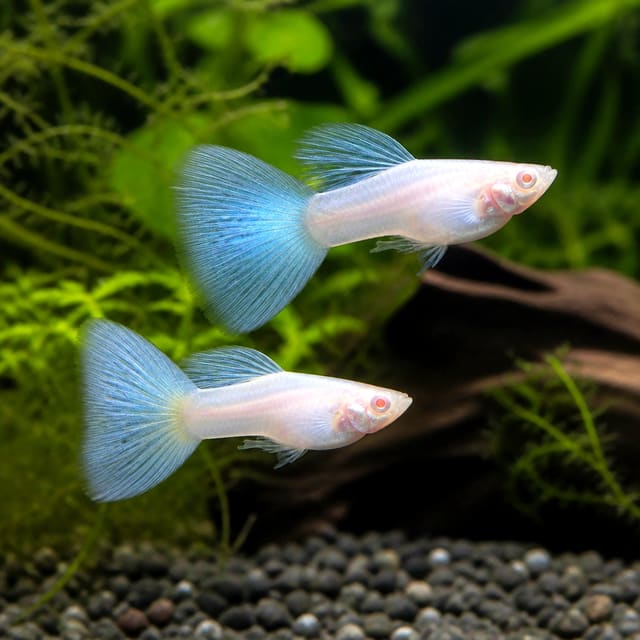
Blue Moscow Male Guppy (Poecilia reticulata)
22–28°C · pH 7–8 · 45L
£5.99

The Yellow Mix Male Guppy (Poecilia reticulata) is a Poeciliidae livebearer from Venezuela, Barbados, Trinidad, northern Brazil and the Guianas that reaches 6 cm standard length. It suits a prepared beginner; the overlap of FishBase, Seriously Fish, OATA and Tropical Fish Co guidance is 22–28°C, pH 7.0–8.0 and 9–18 dGH, with a group of 5+ under our care policy. Sold individually in 3–4 cm and XL sizes.
Adult size is the maximum length this species reaches at full maturity (scientific sources). The livestock you receive will be younger and smaller — pick a size above for the actual shipping size. Product-photo provenance and any image-specific limitations are stated on the listing.
Poecilia reticulata
Minimum of 2 per order.
The Yellow Mix Male Guppy (Poecilia reticulata) is a Poeciliidae livebearer from Venezuela, Barbados, Trinidad, northern Brazil and the Guianas that reaches 6 cm standard length. It suits a prepared beginner; the overlap of FishBase, Seriously Fish, OATA and Tropical Fish Co guidance is 22–28°C, pH 7.0–8.0 and 9–18 dGH, with a group of 5+ under our care policy. Sold individually in 3–4 cm and XL sizes.
Adult size is the maximum length this species reaches at full maturity (scientific sources). The livestock you receive will be younger and smaller — pick a size above for the actual shipping size. Product-photo provenance and any image-specific limitations are stated on the listing.
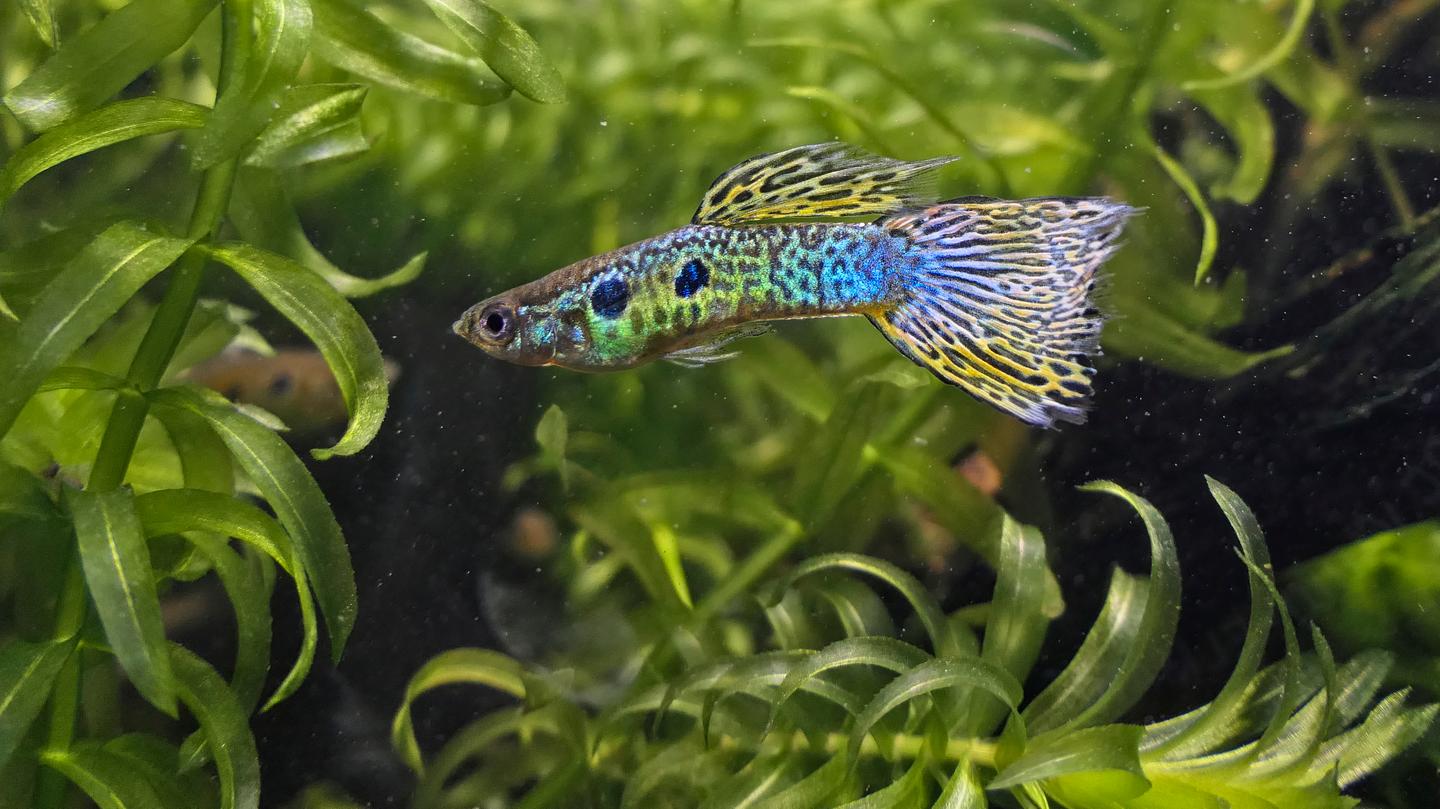
Guppies are social livebearers suited to a prepared beginner, not a fish-per-litre formula. Use a mature filtered aquarium, tested neutral-to-alkaline mineral-bearing water, deliberate sex and population planning, open swimming room, cover and a separation option.
Maintain these water conditions for optimal health and vibrant colors
The Yellow Mix Male Guppy (Poecilia reticulata) is a small Poeciliidae livebearer from Venezuela, Barbados, Trinidad, northern Brazil and the Guianas. FishBase records a maximum of 5 cm standard length for male or unsexed fish. This male offer suits a prepared beginner who can provide a mature filtered aquarium, mineral-bearing water, compatible company and a plan for chasing or fin damage.
Wild guppies occupy varied freshwater and brackish habitats, including vegetated springs, streams, ditches and canals. They feed on zooplankton, small insects and detritus. In the aquarium, plan around the domestic fish in front of you rather than trying to recreate one wild locality: give it open swimming room, cover, gentle flow and regular access to appropriate food.
We rate guppy care as easy for a prepared keeper, but easy does not mean suitable for an uncycled bowl. Read our complete Guppy Care Guide when planning the whole group, especially if males and females may be mixed.
| Suits | Not suited to |
|---|---|
| A mature, filtered aquarium at least 60 cm long | An uncycled aquarium or unfiltered container |
| A planned social group of 5+ | A plan based on one isolated guppy |
| Neutral-to-alkaline, mineral-bearing water | Long-term very soft or acidic conditions |
| A quiet community screened for compatibility | Fin-nipping fish such as tiger barbs or serpae tetras |
One purchase supplies one male fish. Use the live size selector to choose either 3-4 cm or XL; XL is a commercial size label rather than a centimetre measurement. The size you select is the size supplied, not the adult size. Plan the permanent aquarium around the 5 cm recorded male or unsexed standard length, the complete social group and all other livestock.
Sex is guaranteed only when the exact product or selected option explicitly states male or female. This Yellow Mix Male Guppy listing is sold as male.
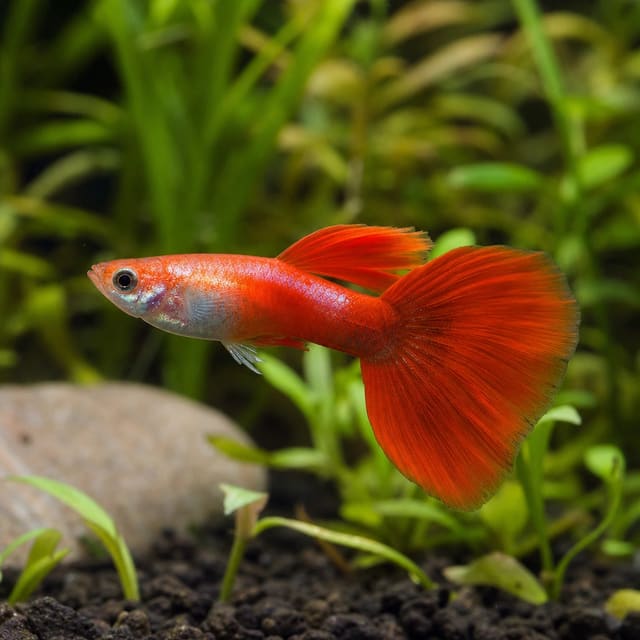
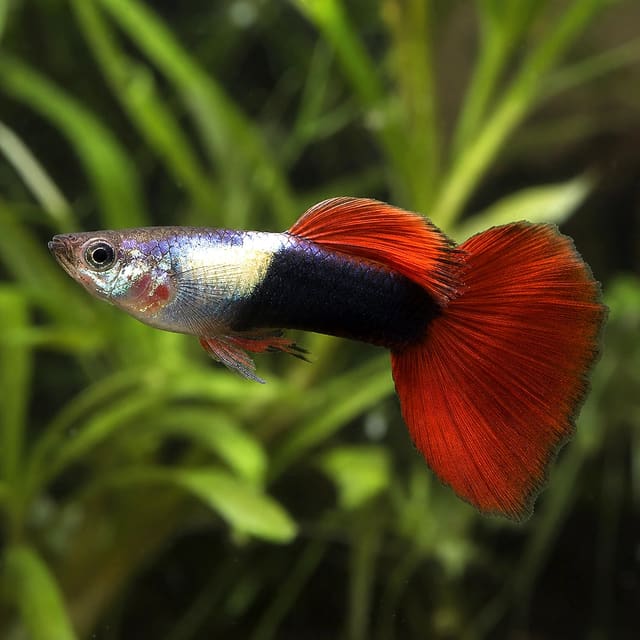
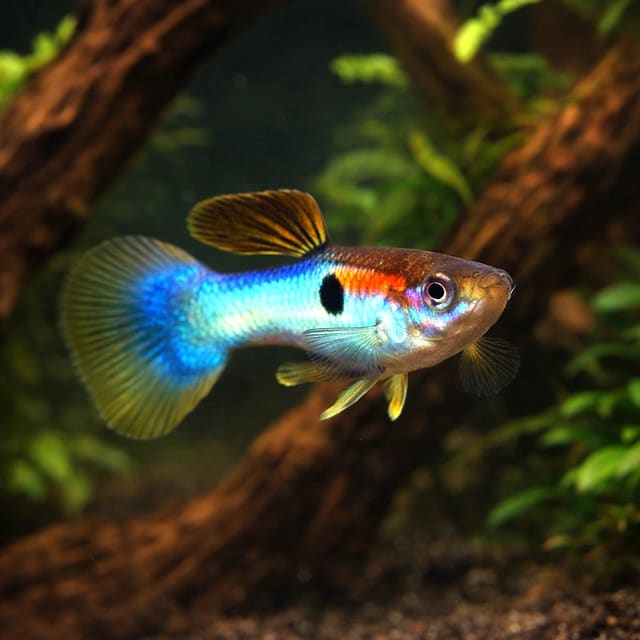
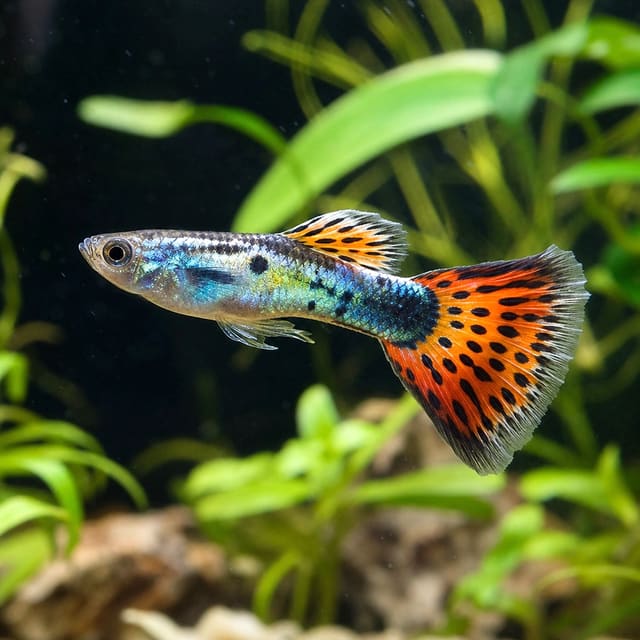
Yellow Mix is the offer’s colour label rather than a documented named strain. It does not promise German Sunset pedigree, one fixed pattern, a particular tail standard or matching fish when several are ordered. You can browse the guppy collection when comparing other stated sexes and colour labels.
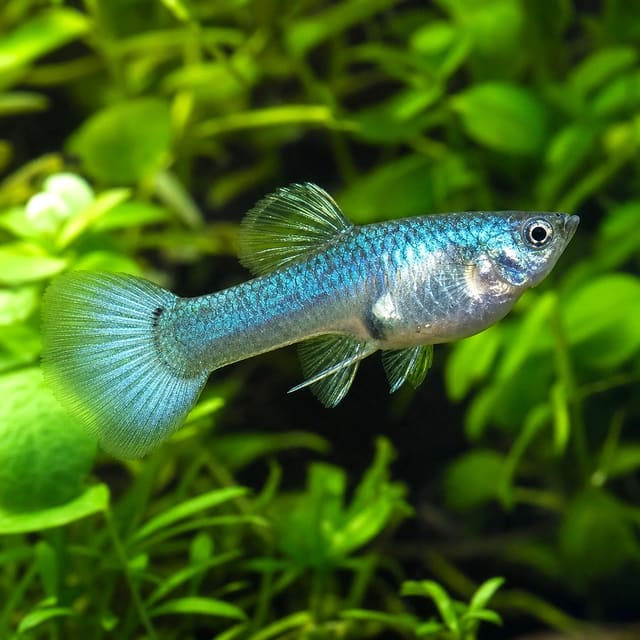
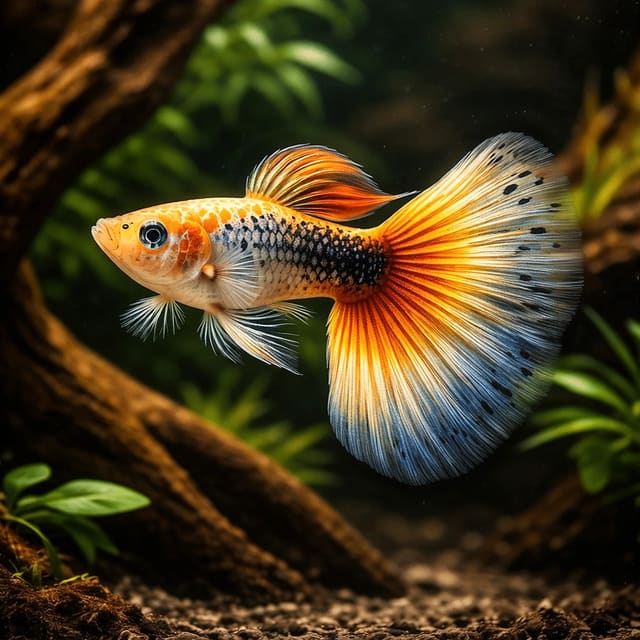
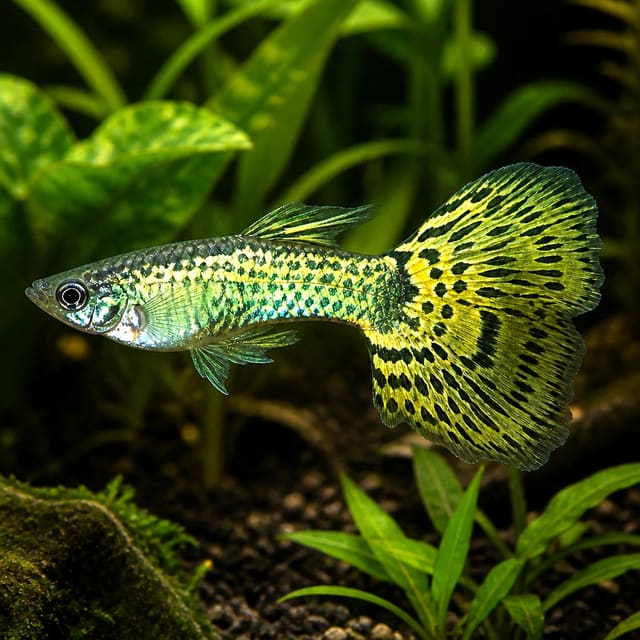
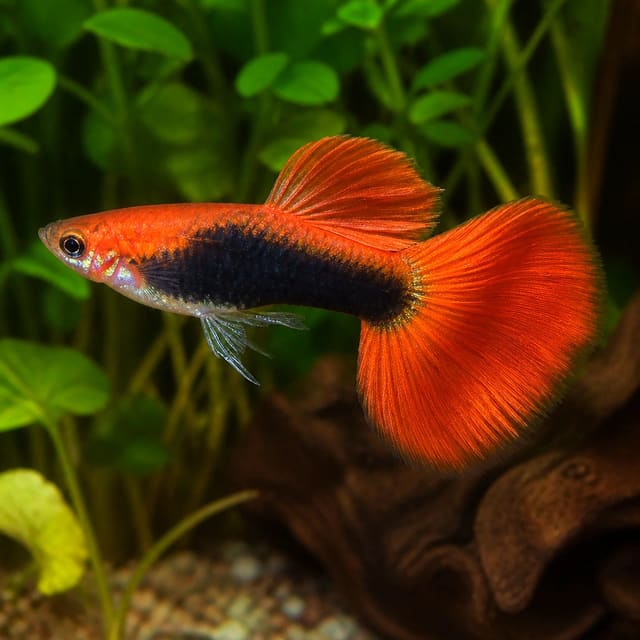
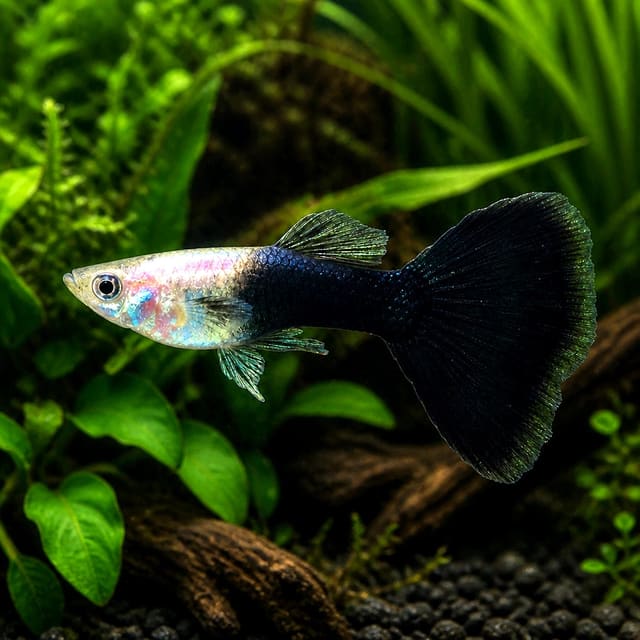
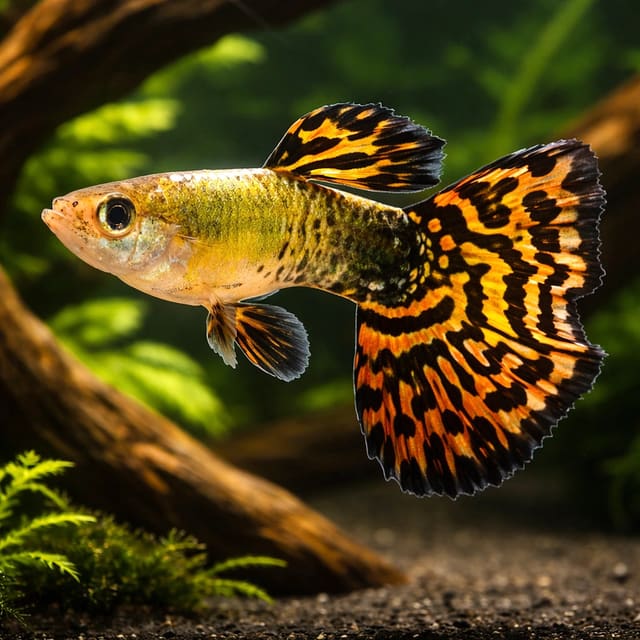
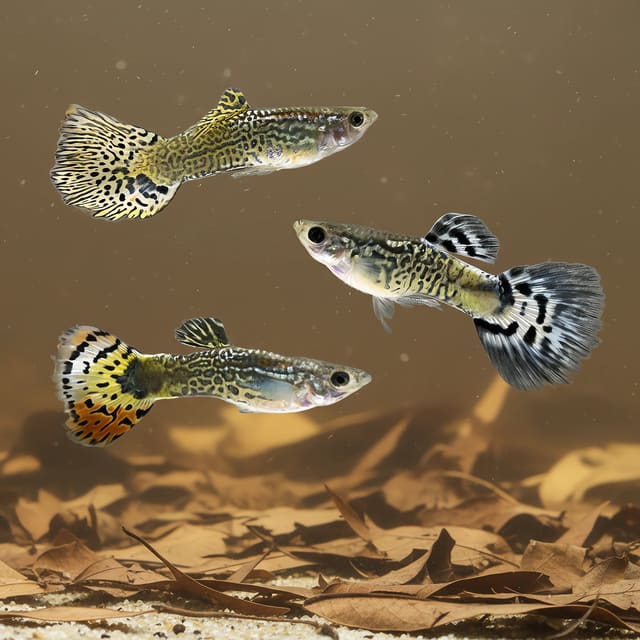
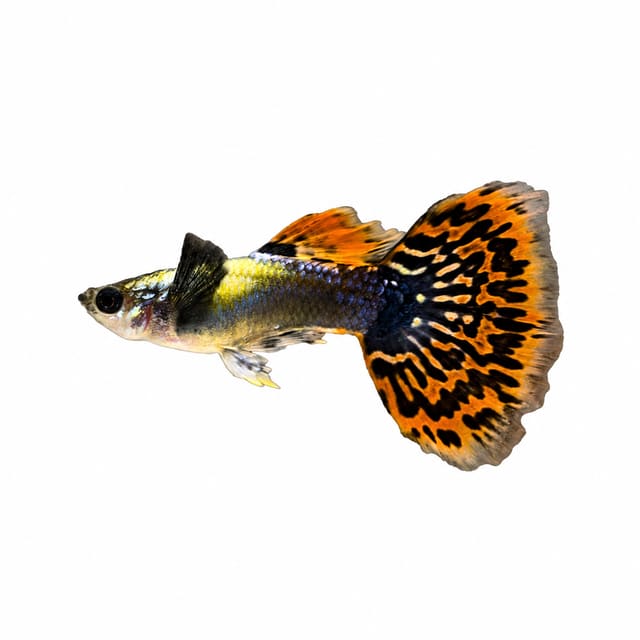
Some gallery images have been digitally enhanced to improve image quality. They show the listed type of animal rather than guaranteeing the exact markings of the individual supplied, so natural colour and pattern can vary. One gallery scene shows two fish, but the purchase unit remains one male fish. The illustrations depict gold, blue, red and yellow features in planted aquarium scenes; those visible features describe the artwork rather than a guaranteed individual pattern.
Keep this guppy at 22–28°C, pH 7.0–8.0 and 9–18 dGH. These routine values are the overlap of FishBase, the Seriously Fish species profile, OATA’s guppy-and-molly guidance and the Tropical Fish Co care range. OATA’s figures are group guidance rather than a species-specific optimum.
Use a mature filtered aquarium at least 60 cm long for one small guppy group. Seriously Fish describes a 45 × 30 cm base and about 41 litres, while OATA advises at least 45 litres for a small group of smaller livebearers. Our more conservative 60 cm screen adds horizontal swimming room, but litres, filtration, sex mix, existing livestock and water tests must still be assessed together.
Plan a group of 5 or more where aquarium capacity and the sex plan allow. FishBase lists aquarium keeping in groups of 5+, and our care policy adopts that number; OATA suggests at least three. Five is a starting social policy, not a stocking maximum.
Maintain 22–28°C, pH 7.0–8.0 and 9–18 dGH, and change conditions gradually. Use an independent aquarium thermometer and test the water itself rather than relying on room temperature or the heater dial. A thermostatically controlled heater is appropriate where the room cannot hold the aquarium inside the required range.
Keep ammonia and nitrite at 0 mg/l. OATA also advises that nitrate should not exceed 20 mg/l above the normal tap-water level. Test the source water as well as the aquarium because UK supplies differ in pH and mineral content. Our water chemistry guide explains what each measurement means, while the water matcher helps compare measured values with this routine range.
The RSPCA explains that a working biological filter supports bacteria that convert toxic ammonia to nitrite and then to safer nitrate. Clear water can still contain toxic dissolved waste, so appearance never replaces testing.
Record temperature, pH, hardness, ammonia, nitrite and nitrate before the routine water change. Compare each result with the previous week rather than judging a single number in isolation. If ammonia and nitrite remain at 0 mg/l but nitrate climbs faster each week, review the amount fed, the number of fish and the volume changed. If pH or hardness shifts after each water change, test the replacement water before it enters the aquarium and match changes gradually. A short written log makes slow changes visible before appetite, breathing or swimming deteriorates.
Do not add aquarium salt merely because wild guppies occur in brackish habitats. Any mineral or salt adjustment needs a measured purpose and a compatibility check for every fish, invertebrate and plant in the aquarium.
Plan this male guppy around a maximum of 5 cm standard length. Seriously Fish uses 6 cm standard length in its profile, but FishBase records 5 cm for male or unsexed fish; 5 cm is therefore the planning figure for this male offer. Standard length excludes the tail fin, and domestic finnage varies.
Use a mature aquarium at least 60 cm long under our care policy. The 45 × 30 cm base and approximately 41-litre aquarium described by Seriously Fish are a species-level reference, while OATA’s 45-litre figure applies to a small group of smaller livebearers. The longer house screen is the practical starting point for adult swimming room and group management.
| Check | Decision |
|---|---|
| Length and footprint | Provide at least 60 cm of aquarium length and retain open horizontal swimming room. |
| Biological capacity | Confirm zero ammonia and nitrite with the planned group being added slowly. |
| Existing livestock | Count every species at adult size and include each species’ social group. |
| Sex plan | Allow for chasing, mixed-sex courtship and potential fry. |
| Separation capacity | Keep a mature alternative space ready if one fish is persistently pursued or excluded. |
For a 60 cm aquarium, begin with the adult group rather than the dispatch measurements. List every resident already present, its adult size and its own group requirement, then add the planned guppies. Check whether the combined groups still leave open swimming room, cover and feeding access. Confirm that the filter is mature and that ammonia and nitrite are 0 mg/l before increasing livestock. A nominal volume or spare-looking corner does not create capacity if another species already uses the same water column or the biological filter is near its limit.
A 3-4 cm dispatch fish does not make a smaller temporary aquarium suitable. XL also describes dispatch size rather than a different adult species. Furnish the permanent aquarium before arrival so the filter, water and social plan do not depend on the fish remaining at its purchase size.
Combine open swimming space with planted or structured areas where a fish can move out of another guppy’s line of sight. Seriously Fish notes that planted aquariums with floating vegetation are appreciated and that strong currents should be avoided. OATA also recommends gravel or sand, plants or suitable shelter, and ornaments without sharp edges that could injure long fins.
Set the filter outlet so water circulates through the aquarium without pinning the guppy in place or forcing it to fight a jet continuously. Check that every fish can swim, rest and feed normally. A layout is not successful merely because it looks densely planted; persistent pursuit, hiding or food exclusion means the arrangement or social plan needs changing.
Prepare and mature the aquarium before livestock arrives. Our first tropical aquarium guide covers the sequence from equipment and filtration to testing. Add livestock gradually because beneficial bacteria must respond to the extra waste and food; adding too many fish quickly can allow ammonia or nitrite to rise.
Plants can improve cover, but they do not replace filtration, swimming room or a fry plan. In a mixed-sex aquarium, dense cover may help more young survive, increasing the demand for space, biological capacity and responsible rehoming.
Use an appropriately sized, nutritionally complete omnivore flake or granule as the staple. FishBase records wild guppies eating zooplankton, small insects and detritus, while Seriously Fish describes wild fish as primarily insectivorous and notes that aquarium-bred guppies accept most foods. Choose a staple that supports the whole diet rather than relying on one treat.
OATA’s guppy-and-molly sheet recommends feeding only what the fish can consume within a few minutes, once a day. Portion for the actual group, make sure quieter fish obtain food and remove leftovers before they break down. Guppies often approach eagerly, but repeated begging is not a safe measure of portion size.
| Food | How to use it |
|---|---|
| Complete omnivore flake or granule | Use as the main food in a particle size every guppy can swallow. |
| Daphnia | Offer as small live or frozen invertebrate variety. |
| Small bloodworm or tubifex | Use compatible, appropriately sized portions within the varied diet. |
| Algal variety | Include through a safe compatible omnivore diet rather than making it the only food. |
If food remains after a few minutes, reduce the next portion and remove the excess. If one fish repeatedly misses food, change the distribution method or address social pressure rather than increasing the total until waste accumulates.
Check appetite alongside swimming and breathing. A sudden loss of interest in food is a warning sign that should prompt water tests and observation. Do not compensate by offering repeated rich meals, because decomposing food increases the load on the biological filter.
Keep a planned guppy group of 5 or more where aquarium capacity and sex planning allow. FishBase lists groups of 5+, while OATA suggests at least three. Tropical Fish Co uses the more conservative 5+ policy because one number must be considered alongside aquarium length, filtration, test results, existing livestock and observed behaviour.
This product contributes one male per purchase. A male-only group avoids new mixed-sex mating, but males may still display or chase. Watch whether every fish can feed, rest and move away from pursuit. Persistent cornering, missed feeding, hiding or fin damage calls for intervention and a prepared separation space.
| Group plan | Keeper’s decision |
|---|---|
| Male-only | Provide 5+ where capacity allows, visual breaks and a separation response for persistent chasing. |
| Mixed sex | OATA suggests two females to each male; also plan for courtship pressure and fry. |
| Adding to an existing group | Reassess adult stock, sex mix, filtration and behaviour before increasing numbers. |
| Breeding-line project | Do not treat the Yellow Mix label as proof of named-strain lineage. |
Seriously Fish describes the male’s gonopodium as a narrow modified anal fin and notes that males are generally more colourful in wild-type fish, while domestic females may also show strong colour. Use a stated-sex product when sex matters rather than relying on colour alone.
Guppies are livebearers. A male can fertilise a female, and the store care guide notes that females may retain sperm from earlier mating. Before mixing sexes, decide how fry would be housed and rehomed. Plants, predation or crowding are not substitutes for a population plan.
Carry out a partial water change of 25% at least once every week, as OATA recommends. Treat replacement tap water with conditioner before adding it, and test ammonia and nitrite at least weekly. Check the filter for blockages and adjust the routine when nitrate trends, feeding or stock show that more maintenance is needed.
Do not run filter media under the tap. Rinse it lightly in aquarium water removed during the partial change so fewer beneficial bacteria are lost. Avoid cleaning every part of the filter at the same time, and restore normal flow promptly after maintenance.
A settled guppy should swim steadily, breathe regularly, hold open undamaged fins and feed consistently. The RSPCA’s fish health guidance treats surface gasping, unusual balance, spots, wounds, fin damage, hiding or sudden appetite change as reasons to investigate.
The MSD Veterinary Manual recommends biosecure quarantine for at least 30 days, with longer isolation where indicated. Use dedicated equipment, biologically supported filtration and repeated testing. For diagnosis or treatment in the UK, use OATA’s fish-vet directory. Do not choose salt, heat or medication from one symptom alone.
Prepare and test the mature aquarium before the delivery date, and arrange for someone to receive the parcel. Follow the current delivery and Live Arrival Guarantee policy for the reporting terms and arrival procedure.
After release, observe swimming, breathing, fin position and interactions. OATA advises checking that a newly introduced fish is feeding normally, shows appropriate swimming and is not being chased. Test the aquarium if behaviour changes rather than assuming distress is simply part of arrival.
During the first week, confirm that the guppy reaches food, can leave another fish’s line of sight and maintains steady breathing. Use the prepared separation space if pursuit becomes persistent. Add no further livestock until the filter results and social behaviour remain stable.
This guppy is peaceful, but compatibility depends on the exact animals, adult stock and aquarium. Screen each proposed companion for overlapping temperature, pH and hardness; adult size; fin-nipping or territorial behaviour; social-group requirements; feeding competition; and the usable footprint after both groups are included.
Seriously Fish lists other livebearers, rasboras, corydoras, small loricariids and tetras for a quiet community. Treat those as candidates, not universal matches. The exact species must fit 22–28°C, pH 7.0–8.0 and 9–18 dGH, and its complete adult group must fit the aquarium without displacing the guppies’ swimming and refuge areas.
Avoid tiger barbs, serpae tetras and all fin-nipping species. Both Seriously Fish and OATA support that exclusion. Do not move one of these fish into the caution category after a larger aquarium or closer observation; choose a different companion.
| Candidate | Decision |
|---|---|
| Other livebearers | Consider only after checking exact water, adult size, group and reproduction needs. |
| Rasboras | Screen the exact species for water overlap, group size and feeding competition. |
| Corydoras | Check the exact species’ temperature, hardness, footprint and social group. |
| Small loricariids | Assess adult size, diet, waste load, refuge and water requirements. |
| Non-fin-nipping tetras | Screen exact temperament and water needs; avoid serpae tetras. |
Compatibility remains uncertain until the exact combination is assessed and observed. Keep a separation plan ready because behaviour can change as fish mature or group composition changes.
Endler’s livebearer is a separate species, Poecilia wingei. Its formal species description and current Eschmeyer catalogue entry distinguish it from Poecilia reticulata. The Tropical Fish Co guppy guide notes that the two species can hybridise, so keep documented lines apart.
A mixed-sex guppy aquarium also needs population capacity. OATA suggests two females per male to reduce pressure on females or other inhabitants, but that ratio does not guarantee low pursuit or manageable fry numbers. Watch actual feeding, body condition, hiding and fin condition.
Do not use extra fish as a remedy for poor water, weak filtration or persistent pursuit. Change the condition causing the problem first. A companion should pass every compatibility check and leave enough biological and physical capacity for all animals at adult size.
The Yellow Mix Male Guppy reaches 5 cm standard length according to FishBase’s male or unsexed maximum. Plan the permanent aquarium around that adult figure, not the 3-4 cm or XL dispatch label.
Use a mature filtered aquarium at least 60 cm long under Tropical Fish Co’s care policy. Seriously Fish describes a 45 × 30 cm base and about 41 litres, but length, filtration, sex mix, test results and other livestock still decide suitability.
Keep a group of 5+ where aquarium capacity and the sex plan allow. FishBase lists 5 or more, Tropical Fish Co adopts that policy, and OATA’s guppy-and-molly guidance suggests at least three.
It suits a prepared beginner and Tropical Fish Co rates its care easy. The aquarium must already be mature, filtered and tested, with compatible mineral-bearing water and a planned social group.
Feed an appropriately sized complete omnivore flake or granule as the staple, once a day in an amount consumed within a few minutes. OATA also supports small live or frozen variety such as daphnia, small bloodworm or tubifex.
Keep it at 22–28°C, pH 7.0–8.0 and 9–18 dGH. Those routine values are the overlap of FishBase, Seriously Fish, OATA and Tropical Fish Co guidance.
This fish is peaceful, although males may display or chase. Its long fins are vulnerable to nipping, so avoid tiger barbs, serpae tetras and all fin-nipping species.
Other livebearers, rasboras, corydoras, small loricariids and non-fin-nipping tetras may be candidates. Screen the exact species for water overlap, adult size, temperament, group needs, feeding and total aquarium capacity.
Start filming the sealed parcel before opening it, keep one continuous take through showing the fish in the sealed bag, then float the bag for 20–30 minutes before release. The fish is hand-bagged in pure oxygen and packed in an insulated box, with a heat pack when required; contact us the same day with the order number and video if there is a Live Arrival Guarantee concern.
No reviews for this item yet. Bought one? Honest reviews only, good or bad.
What customers say about ordering from us
I have a small group of long finned mountain minnows. So was delighted to be able to order ten of this variety to increase the genetics in my tank . The ones I recieved are healthy but it’s to early to give a verdict on wether they are of a long finned type since they are small currently.
Gordon Walker · 23 Sept 2026
100% success travel and "installation". Pleased with quality of purchase. The Siamese fighter a bit "shy" so have not yet seen him at his best yet but looking good. Happy customer. GG
George E Garratt · 21 Sept 2026
Reviews of our shop, collected by Judge.me, an independent third-party review collector. Newest first.