Easy
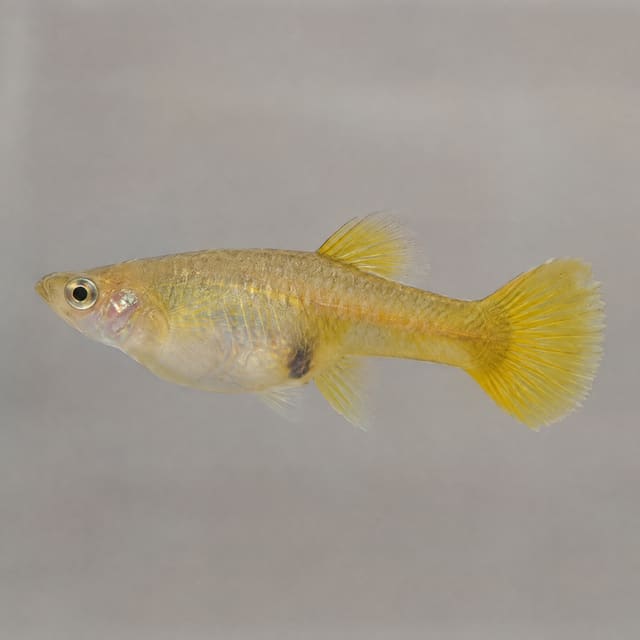
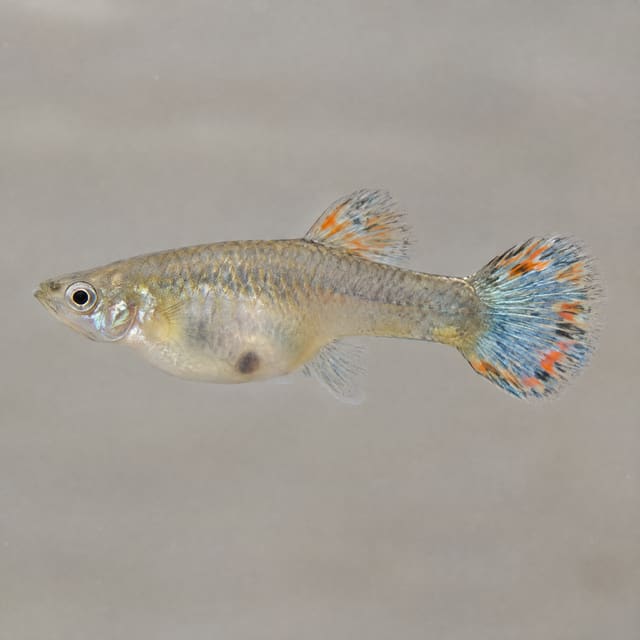
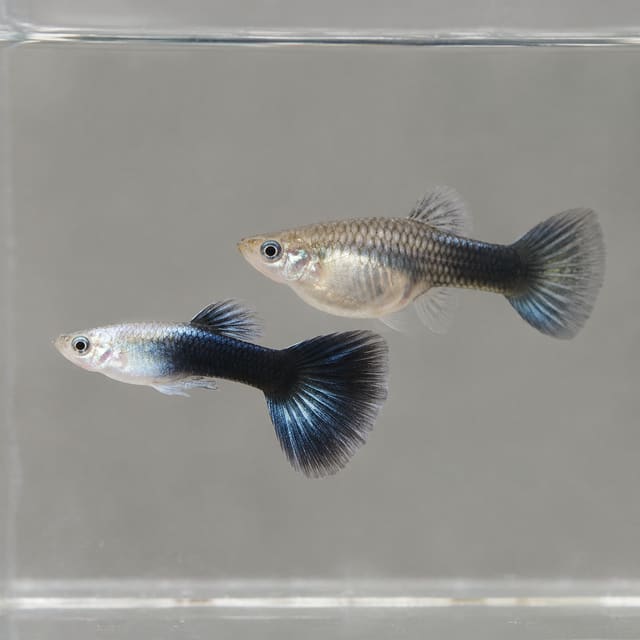
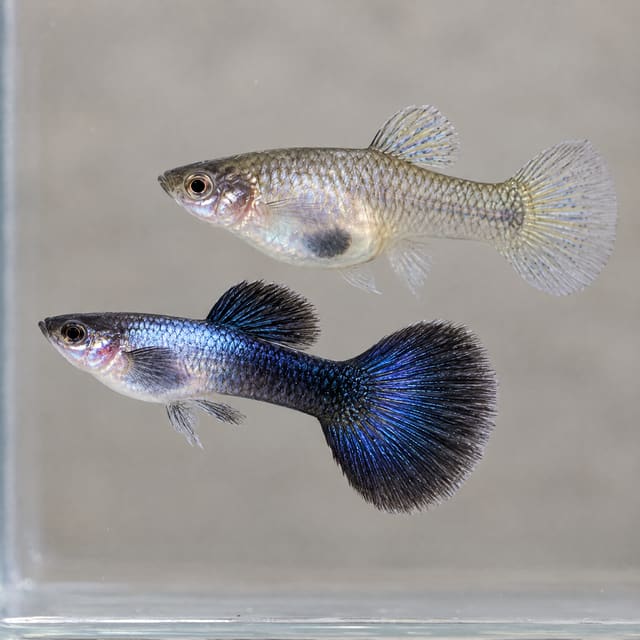
A fancy Poecilia reticulata pair: a male with a navy-black rear, pale yellow fan tail and see-through glass belly, and a larger pinkish-silver female. One pair per quantity, about 3–4 cm. Peaceful and easy in a planted tank of 60 litres or more at 22–28°C, pH 7.0–8.0.
Adult size is the maximum length this species reaches at full maturity (scientific sources). The livestock you receive will be younger and smaller. Product-photo provenance and any image-specific limitations are stated on the listing.
Poecilia reticulata
Each quantity is one pair containing 2 fish. Discounts count pairs. Selected: 1 pair (2 fish).
A fancy Poecilia reticulata pair: a male with a navy-black rear, pale yellow fan tail and see-through glass belly, and a larger pinkish-silver female. One pair per quantity, about 3–4 cm. Peaceful and easy in a planted tank of 60 litres or more at 22–28°C, pH 7.0–8.0.
Adult size is the maximum length this species reaches at full maturity (scientific sources). The livestock you receive will be younger and smaller. Product-photo provenance and any image-specific limitations are stated on the listing.
Guppies are social livebearers suited to a prepared beginner, not a fish-per-litre formula. Use a mature filtered aquarium, tested neutral-to-alkaline mineral-bearing water, deliberate sex and population planning, open swimming room, cover and a separation option.
Read the full care guidance when planning conditions for your aquarium.
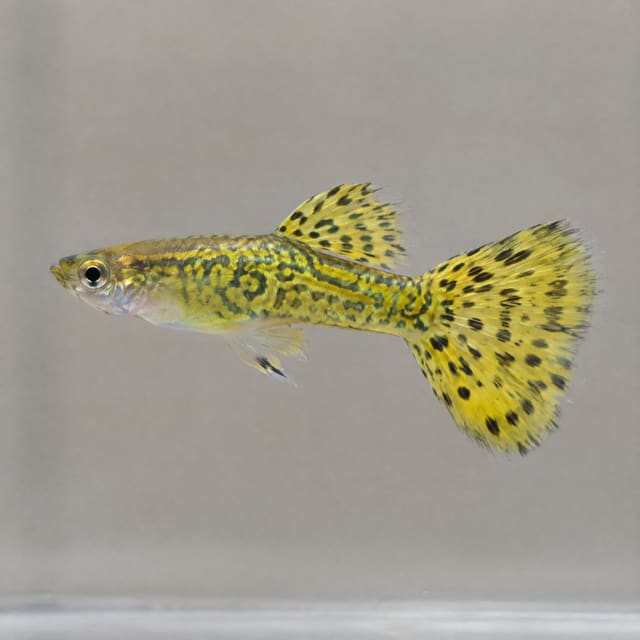
The Yellow Tuxedo Glass Belly is a fancy, aquarium-bred colour form of the guppy, Poecilia reticulata, the small livebearing fish of northern South America and the southern Caribbean. We sell it as a pair: one quantity is one pair, one male and one female, both about 3–4 cm when they leave us. The strain name is a mouthful, but each word describes something you can check against the two photos on this page, so it is worth reading it piece by piece.
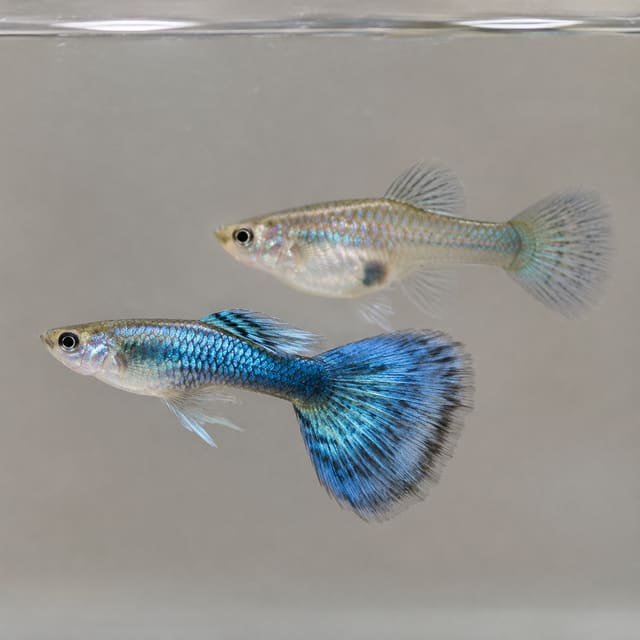
On the male, the yellow lives in the fins. His tail opens into a broad fan of soft, buttery yellow with the fine fin rays showing through it, and the dorsal fin on his back carries the same pale lemon wash. It is a gentle shade rather than a deep gold, and it looks its best against dark plants or a dark background, which is why the studio photo on black shows it so clearly. The female's tail is a different thing altogether: smaller, rounded at the edge, see-through and silvery grey with a faint fine speckle.
Follow the male's body from the middle backwards. From roughly below the dorsal fin to the root of the tail his flank turns a deep navy that reads as black in most light, while the front half of the fish stays pale. That clean split between a light front and a dark rear is what the word tuxedo refers to in the name. In our photos the female does not carry the dark block; her body stays pinkish silver from head to tail.
Both fish share the trait behind the rest of the name. The lower front of the body is translucent, and behind the gill cover and along the belly a rosy pink to red area shows through from inside. On the male it sits just behind the head and throat; on the larger female it runs much further back along her deeper belly. Higher up, the scales on the back are edged in a darker line that gives a neat net pattern over a faint golden sheen.
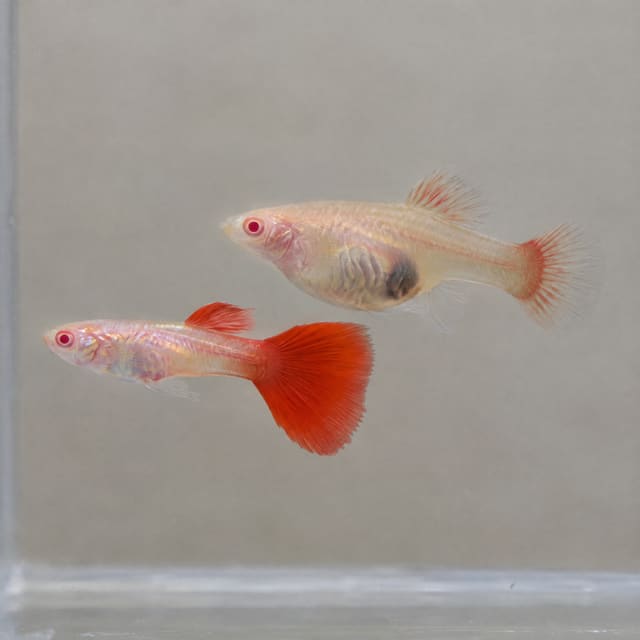
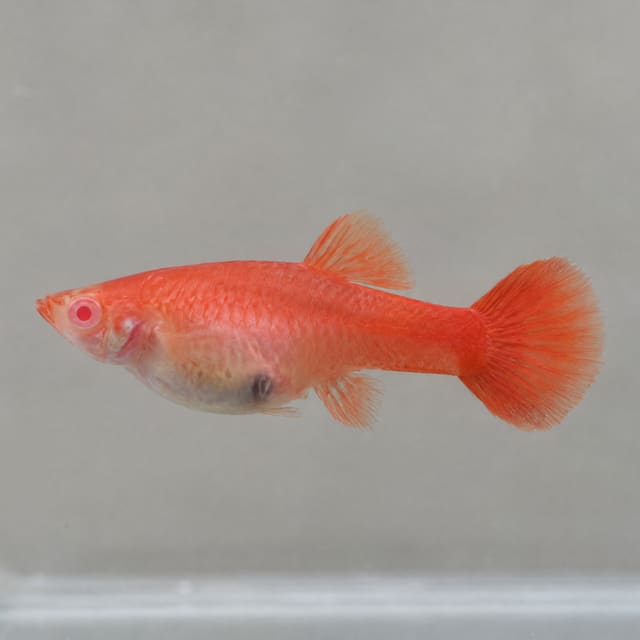
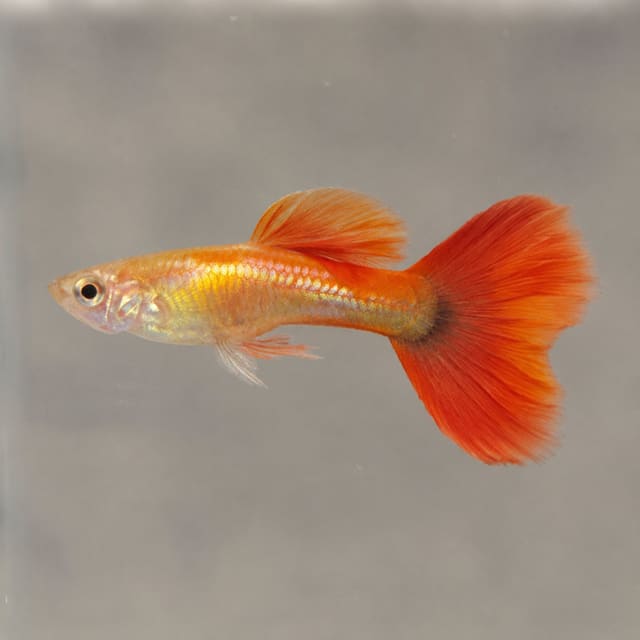
If the see-through belly is the part you like but you would rather have a red fish, the Albino Red Glass Belly guppy pair is another glass-belly strain on our site.
| Quick reference | Yellow Tuxedo Glass Belly guppy |
|---|---|
| Scientific name | Poecilia reticulata Peters, 1859 (fancy aquarium strain) |
| Family | Poeciliidae, the livebearers |
| What one quantity is | One pair: one male and one female |
| Size when dispatched | About 3–4 cm |
| Recorded maximum (FishBase) | 5.0 cm SL male, 6.0 cm SL female (standard length, tail not included) |
| Temperature we recommend | 22–28°C |
| pH and hardness | pH 7.0–8.0, 9–18 dGH |
| Aquarium | 60 litres or more, planted, gentle flow |
| Temperament | Peaceful |
| Care level | Easy |
Adult guppies are among the easiest aquarium fish to sex, and the two fish in our photos show the textbook differences plainly. Seriously Fish describes males as the more colourful sex, with longer fins, and females as larger, plumper and generally duller. Both photos on this page show exactly that: a slim fish with a dark rear and yellow fins above, and a bigger, deeper-bodied, paler fish below.
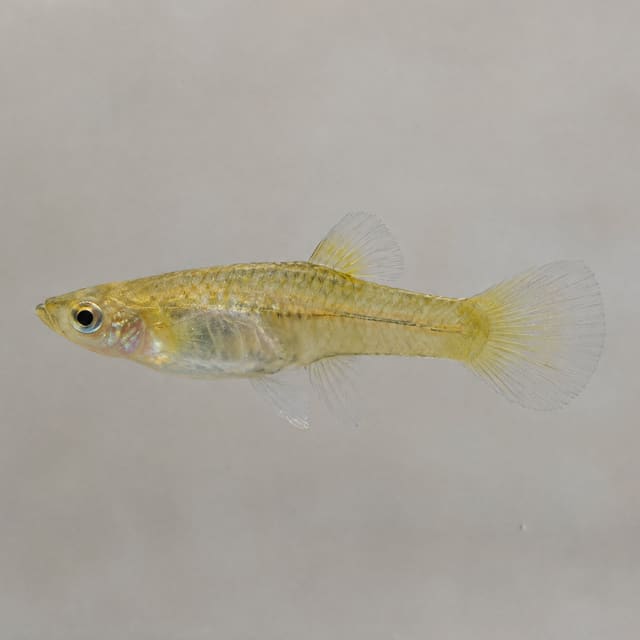
Customers looking for a yellow female guppy sometimes expect the female of a yellow strain to be yellow all over. In this strain she is not. Her appeal is the see-through belly and the soft pink and silver of her body, while the bright yellow belongs to the male. If a yellow female is what you are after, our Yellow Female Guppy is a separate listing.
Both fish travel at about 3–4 cm. FishBase records a maximum of 5.0 cm standard length for males and 6.0 cm standard length for females, and Seriously Fish gives 60 mm standard length for the species. Standard length is measured to the base of the tail, so it leaves out the fan. Wikipedia puts males at about 1.5–4 cm and females at 3–7 cm, and the OATA care sheet says traditional guppies reach about 5 cm. Treat the FishBase numbers as recorded maximums rather than a size every fish will reach. Whatever the final figures, the female will end up the bigger of the two.
However far a fancy strain has been bred from its ancestors, it belongs to the same species that lives in fresh and slightly brackish water across north-eastern South America and the southern Caribbean. FishBase lists Venezuela, Barbados, Trinidad, northern Brazil and the Guianas. Seriously Fish adds Tobago, Antigua and Barbuda and the Netherlands Antilles, and gives the type locality as the Guayre River at Caracas, Venezuela. The species was described by Peters in 1859.
Wild guppies are not fussy about where they live. FishBase describes adults in warm springs and the water flowing out of them, in weedy ditches and canals, and in everything from very turbid lowland ponds to clear mountain streams. It notes that they occur where predation pressure is low, usually in very small streams and densely vegetated lakes and springs, and that while their salinity range is wide they need fairly warm water (23–24°C) and quiet, vegetated conditions to survive. Seriously Fish makes a similar point: the species turns up in almost every kind of biotope but does best where algae, marginal plants or aquatic plants grow thickly.
The wild fish look very different from the strain in this pair. Wikipedia notes that wild females are grey, while males carry variable patches of colour. Seriously Fish says the wild form is seldom offered to fishkeepers; what the hobby sees instead are aquarium-bred varieties with long fins and bold colours. The Yellow Tuxedo Glass Belly is one of those bred forms: a selected combination of fin colour, body pattern and translucency kept going by breeders, not something you would net from a Trinidad stream.
Wild guppies are also a well-known research animal. Wikipedia describes the species as a model organism in ecology, evolution and behaviour, including studies in Trinidad of how wild populations respond to predators. It also records that female guppies are drawn to brightly coloured males, especially those with orange spots on the flank.
Seriously Fish reports feral populations in around fifty countries, including the UK, and FishBase lists the species as a potential pest, noting that wild populations in Australia were established before the 1970s from aquarium fish that were thrown away. Wikipedia adds that guppies have been introduced to many countries, often in the hope of controlling mosquitoes. A pair of guppies will produce far more young than one aquarium can hold, so plan from the start: surplus fish should go to another fishkeeper, a local aquarium club or a shop that will take them, never into a pond, stream or drain.
Two small fish do not need much room on day one, but a male and a female guppy rarely stay two for long, so we set the bar a little higher than the bare minimum. Seriously Fish suggests a footprint of 45 × 30 cm, about 41 litres, for the species. FishBase quotes a recommendation to keep guppies in groups of five or more in an aquarium at least 60 cm long. Our own guidance is 60 litres or more, which gives room for the pair, a couple of extra females and any young that grow on.
Seriously Fish recommends a planted tank with floating vegetation, which matches the thick-weed habitats FishBase describes in the wild. In practice that means:
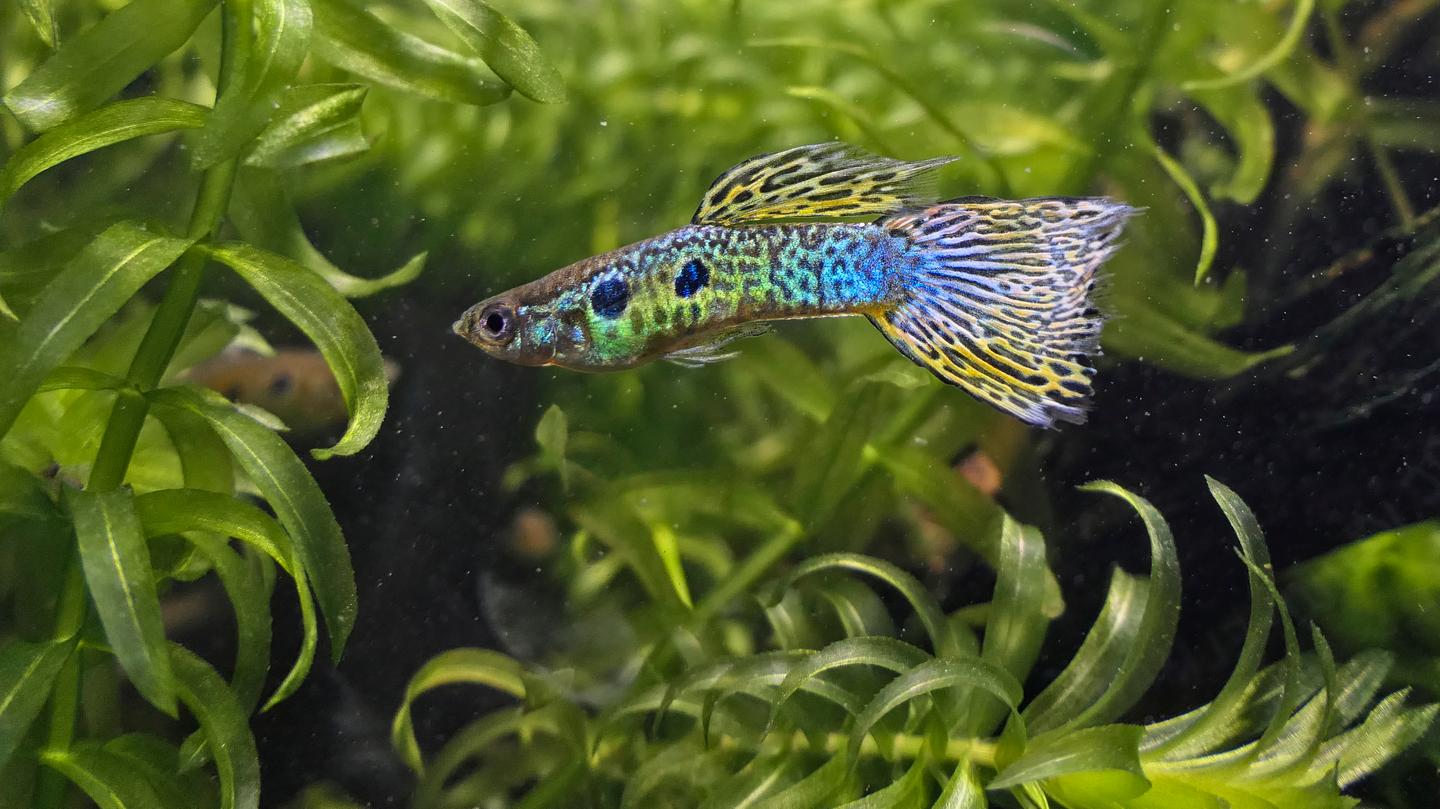
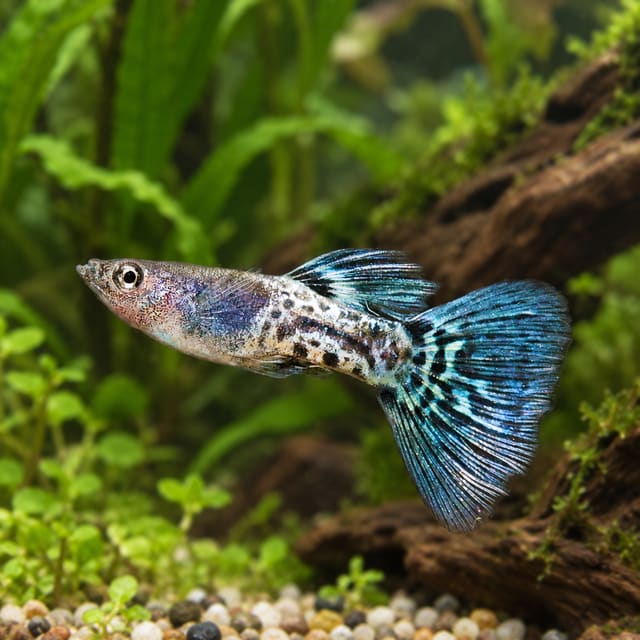
Wood, smooth stones and broad-leaved plants such as those in our planted-tank photo make a natural-looking scene and break up the view, which helps the female when the male is persistent.
Seriously Fish advises against strong currents, and a male trailing a tail this broad is happiest where the water moves gently. A sponge filter or an internal filter turned down, or an outlet aimed at the glass, will keep the surface moving without pushing him around. The RSPCA is clear that tropical fish need a heater set for the species and controlled by a thermostat, and suggests checking the temperature every day with a digital thermometer. Set the heater to hold the water inside our 22–28°C band and let the thermometer, not the dial, tell you where it really is.
The most useful thing you can do for a new pair happens weeks before they arrive. The RSPCA explains why: fish give off ammonia, which is toxic, and in a working biological filter beneficial bacteria turn it into nitrite, also toxic, and then into nitrate, which is safer. A brand-new filter has none of those bacteria, so fish put into a new tank are left sitting in their own waste with nothing to break it down.
The RSPCA recommends fishless cycling and says there is no exact rule for how long it takes, but it will be at least two weeks. You seed the tank with a bacterial starter product, or with filter media taken from an established aquarium, and then test regularly. Its rule for when fish may go in is the one to follow: only after ammonia and nitrite have risen in a spike and then dropped back to zero. Ammonia and nitrite test kits, in the RSPCA's words, are essential rather than optional extras, and the safe reading for both is 0 mg/L.
Keep the aquarium away from direct sunlight and radiators, both of which the RSPCA warns can push the temperature up dangerously, and stand it on a sturdy surface built for the weight. A light cycle of eight to ten hours a day, switched off at night, suits most species according to the RSPCA, and a cheap plug-in timer makes it easy to keep to. When you top up or change water, dechlorinate it first and bring it to the tank's temperature, because chlorine harms both the fish and the filter bacteria you spent weeks growing.
Both features of this strain are subtle. The pale yellow tail and the see-through belly show up far better against a dark background, dark gravel or dense green planting than against bright white sand, as the photo on black makes clear. Moderate lighting over a planted tank is ideal. If the plants grow well, the guppies will usually look their best too.
Guppies are hard-water livebearers. Seriously Fish calls the guppy a hard water fish: it may cope in soft, acidic water but should be kept long term in moderately hard conditions. The published ranges differ a little from source to source, so here they are side by side, with the routine we recommend.
| Source | Temperature | pH | Hardness |
|---|---|---|---|
| FishBase | 18–28°C | 7.0–8.0 | 9–19 dH |
| Seriously Fish | 17–28°C | 7.0–8.5 | 8–30 dGH |
| OATA care sheet | 20–28°C | 7.0–8.0 | 8–18 °dH general, 5–15 °dKH carbonate |
| Wikipedia | 25.5–27.8°C described as optimal in aquaria | not given | not given |
| Our routine | 22–28°C | 7.0–8.0 | 9–18 dGH |
FishBase gives 18–28°C. That lower figure is a tolerance, not a target: FishBase's own biology notes say the species needs fairly warm water, around 23–24°C, to survive in the wild. A fancy pair in a living room aquarium is best held somewhere in the middle to upper part of our 22–28°C band and kept steady there. Sudden swings matter more than the exact number, which is another reason to keep the tank out of the sun and away from radiators, as described above.
Our 7.0–8.0 pH and 9–18 dGH sit inside all three published ranges. Test your tap water before you buy: if it is soft and acidic, guppies are not the easiest choice, and you will need a plan for raising hardness steadily rather than chasing the numbers with repeated quick fixes. If your water is already hard and slightly alkaline, it may well suit guppies straight from the tap once it is dechlorinated.
FishBase notes a wide salinity range, and Wikipedia reports that guppies can survive salinity up to 150% of normal seawater. That is a survival record from research, not a care instruction. A freshwater guppy aquarium needs no salt.
The OATA sheet gives clear targets: zero ammonia, zero nitrite, and nitrate no more than 20 mg per litre above your tap water. It recommends a 25% partial water change every week and testing at least once a week. The RSPCA's general guidance for all aquarium fish is a smaller 10% each week and a test every fortnight. A breeding pair adds fish to the tank without asking, and every brood adds to the waste the filter has to handle, so the guppy-specific OATA routine is the one we would follow, even when the tank looks fine.
In the wild, guppies eat whatever small food the water offers. FishBase lists zooplankton, small insects and detritus. Wikipedia gives a longer list that includes algal remains, diatoms, invertebrates, plant fragments and aquatic insect larvae. Seriously Fish describes wild fish as mainly insect-eaters, but says aquarium-bred guppies accept most foods offered.
Guppies are surface and midwater feeders, so food that floats or sinks slowly suits them better than heavy pellets that drop straight to the gravel. Watch the female as well as the male at feeding time. In a community tank the quicker species can take more than their share, so make sure both fish of your pair are getting food.
If the pair breeds, any young that survive need food small enough for their mouths. Rub flake between finger and thumb to a fine powder and offer small amounts several times through the day, keeping a close eye on water quality, because uneaten fine food spoils quickly. Fry hidden in floating plants will also pick at whatever grows on the leaves.
Overfeeding is one of the quickest ways to turn an easy fish into a hard one. Leftover food rots, ammonia rises, and a well-fed pair in a small tank can end up in worse condition than a slightly hungry one in clean water. If food is still drifting about after a few minutes, feed less next time.
Seriously Fish calls the guppy a very peaceful fish, and Wikipedia notes that guppies shoal. They spend their day cruising the upper and middle water, and the male spends a great deal of it courting. Wikipedia describes the display: the male bends his body into an S shape and vibrates rapidly in front of the female. It also describes the other approach, where the male skips the display and simply darts in to thrust his gonopodium at the female's genital opening.
This is the main thing to understand before you buy a single pair. Seriously Fish says males can be quite vigorous in their constant pursuit of females and recommends keeping several females to each male. The OATA care sheet asks for at least three guppies kept together, with two females to each male, to reduce stress. A pair on its own means one female receives all of one male's attention, all day.
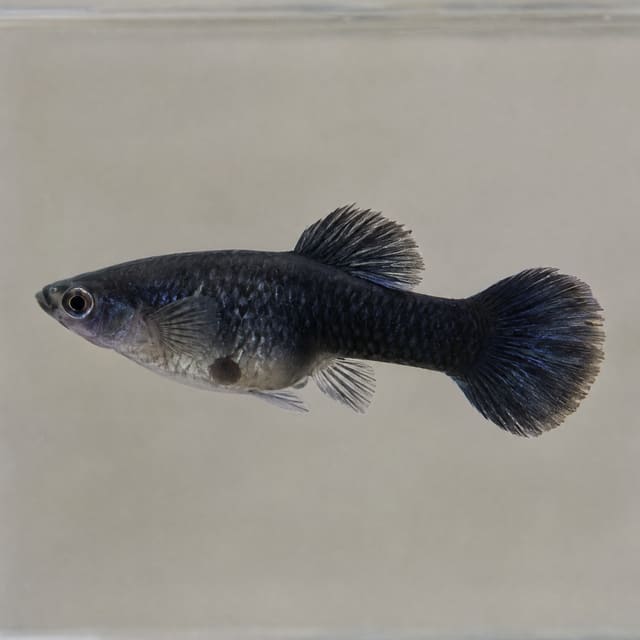
The easy answer is to add one or two more female guppies, so the male's interest is shared. Any female guppy will even up the ratio. Bear in mind that if you mix strains, any young will be a mix as well rather than a copy of this pair. If you want a choice of females, our Female Guppy Mix sells females on their own. Plenty of plants, as described in the aquarium section, also give her somewhere to take a break.
Seriously Fish says guppies do well in a quiet community tank with other livebearers, rasboras, Corydoras, small loricariids and tetras. Choose species that enjoy the same harder, warmer water, and keep the overall mood calm.
Expect the adult guppies themselves, and very likely other fish in the tank, to eat any fry they find. That is not aggression in the usual sense, and it is why people who want to raise young guppies give them their own space or very dense cover.
With a mature male and female in the same tank, breeding is close to certain. The guppy is a livebearer: the male fertilises the female internally with his gonopodium, and she gives birth to fully formed young instead of laying eggs.
The published figures vary, which is normal for a fish this widely studied:
Female guppies keep sperm. Seriously Fish says a female can go on producing young for six months or more with no male present, and Wikipedia gives up to eight months. So a female may keep having broods long after the male has gone, which is worth knowing if you later move her to a different tank.
Wikipedia describes a gravid spot near the vent that enlarges and darkens during pregnancy, and notes that just before birth the eyes of the fry may be seen through the translucent skin in that area. With a glass-bellied female, keep an eye on that region and on how full her belly looks as the weeks go by.
Seriously Fish warns that adult guppies eat their young and suggests removing fry after birth for full survival. Floating plants and fine-leaved cover help many fry survive in a planted tank. A separate rearing tank, or a breeding box moved in shortly before she is due, gives the best results if you want to raise a brood.
FishBase gives maturity at two months for males and three months for females. Wikipedia says females mature at 10–20 weeks and males in seven weeks or less. That is why a single pair can turn into a crowded tank within a few months, and why the 60-litre figure and a plan for surplus fish matter.
Wikipedia notes that many of the colour and fin traits selected in fancy guppies are linked to the Y chromosome and are heritable. Keeping this pair apart from other strains gives you the best chance of youngsters with similar features, although colour intensity and tail shape will always vary from fish to fish, as they do in every fancy guppy line.
Decide early what you will do with the young. Some keepers let nature take its course in a densely planted community tank, where a few fry survive and most are eaten. Others raise every brood and pass the surplus on to friends, an aquarium club or a local shop that takes home-bred fish. Either is fine; what is not fine is letting numbers climb until the filter cannot cope. If you would rather not breed at all, the honest answer is a single-sex tank, and remember that a female who has already been with a male can keep producing young for months.
Guppies have a reputation as tough beginner fish, and wild guppies certainly are adaptable. Seriously Fish adds a fair warning about fancy strains, though: many commercially bred guppies are not very hardy because of inbreeding and over-production, and are prone to disease and early death. The best protection is the basics done well: a matured filter, stable warm and moderately hard water, weekly water changes and a sensible male-to-female balance.
The OATA care sheet lists the signs: clear, bright eyes, undamaged fins, intact scales and no ulcers or bumps. On this strain, also look for a male who holds his yellow tail open and well spread, and a female who swims freely and feeds keenly.
The first three are the disease indicators OATA highlights. When you see any of them, test the water before anything else. OATA and the RSPCA both put regular testing at the centre of fish care, and if ammonia, nitrite or temperature is off, put that right first.
Wikipedia says wild guppies typically live around two years, though this varies a lot. The OATA care sheet says guppies can live several years in a well-matured set-up. A long, steady life comes from stable conditions rather than from any special product.
The translucent body of this strain is part of its look, so do not mistake the pink and red interior showing through for a wound or an infection. What matters is a change from normal: new redness on the fins or skin surface, swelling, or ulcers. Get to know how your pair looks in the first week, so any change later is easy to spot.
Please read our delivery and live-arrival information before you order. It explains how the parcel travels and what we need from you if something goes wrong.
Your pair travels in an oxygen-filled bag inside insulated packaging, with a heat pack when the weather calls for one, carried by a tracked courier licensed to move live animals.
Start a continuous video while the parcel is still sealed. Keep filming as you open it, in the same take, until the fish can be seen in the still-sealed bag. If a fish arrives dead, dying or clearly unwell, email hello@tropicalfishco.co.uk on the day of delivery with your order number and that video. Photos on their own do not meet the policy. Under the guarantee terms, the resolution is a replacement with your next order or a refund for the affected fish.
Keep the lights low and watch breathing, appetite and behaviour over the following week. Expect the male to start displaying to the female quickly; if he never leaves her alone, that is the moment to think about the extra females discussed above.
The facts on this page come from these sources. They are worth reading in full if you want to go further.
No reviews for this item yet. Bought one? Honest reviews only, good or bad.
What customers say about ordering from us
Easy website plenty of info on fish your buying great to pick a time slot
TRACEY DURRANT · 7 Oct 2026
Got some lovely fish thank you
Kevin Mackie · 7 Oct 2026
Reviews of our shop, collected by Judge.me, an independent third-party review collector. Newest first.
Moved by UK carriers licensed to handle live animals
Hand-packed with oxygen bags, poly box, heat pack
Email photos the same day; an optional unboxing video helps us review problems faster — claim terms apply
Klarna & PayPal Pay in 3 at checkout



22–26°C · pH 6–7.8 · 75L