Easy
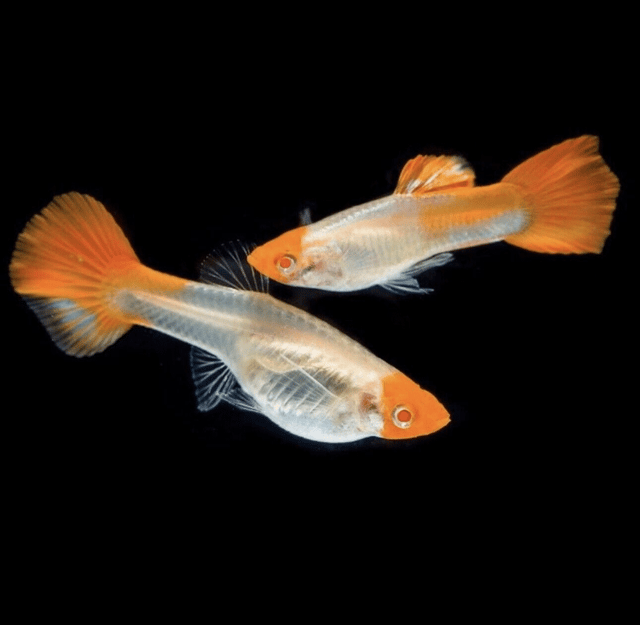
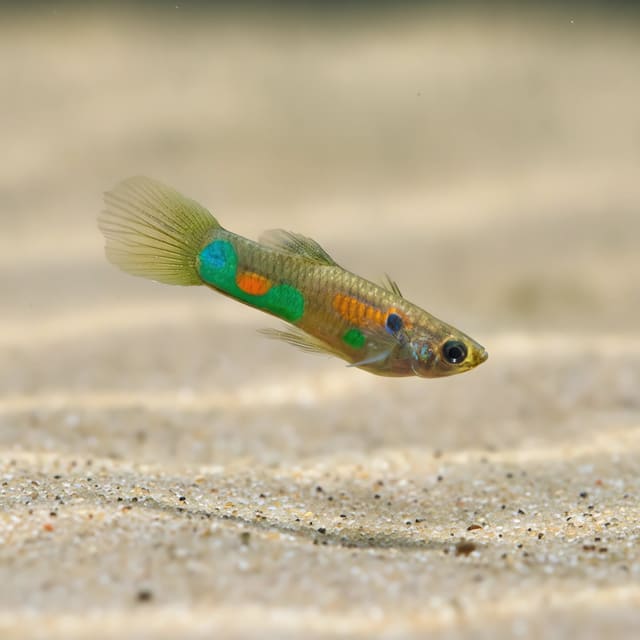
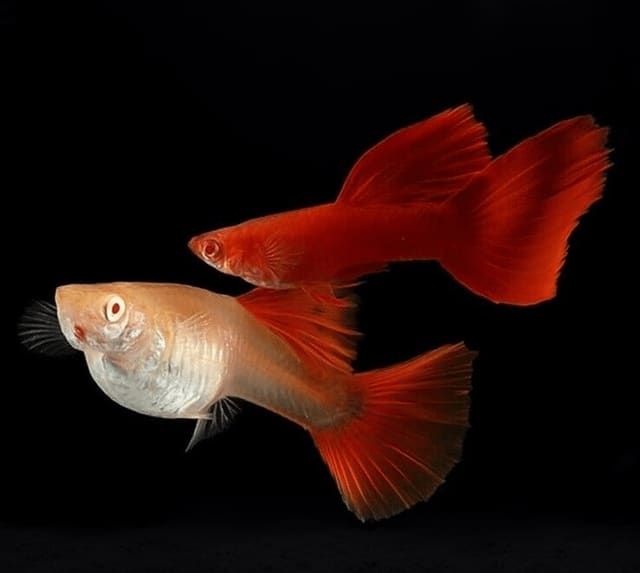
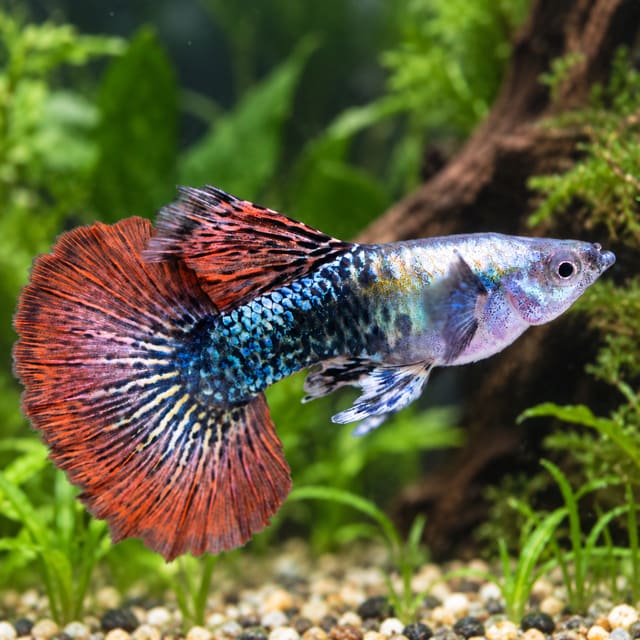
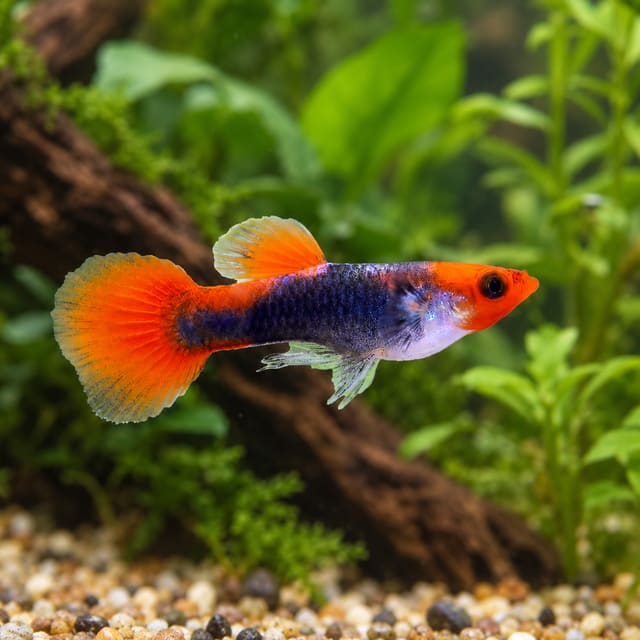
Blue Moscow Male Guppy (Poecilia reticulata)
22–28°C · pH 7–8 · 45L
£4.09
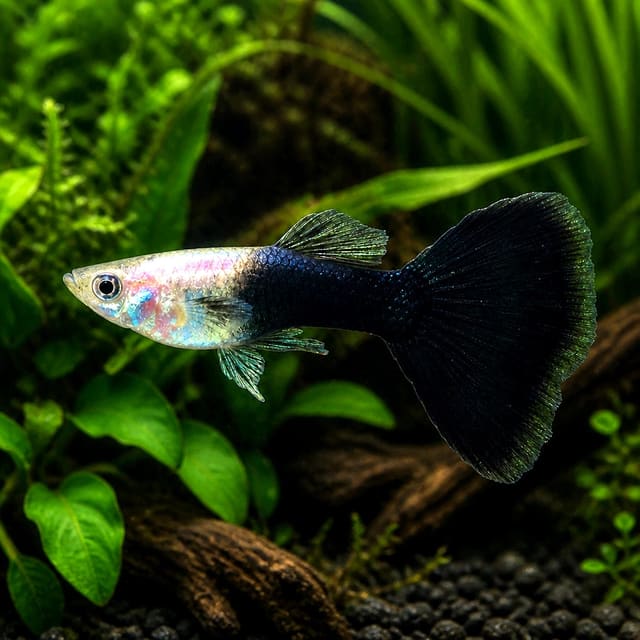
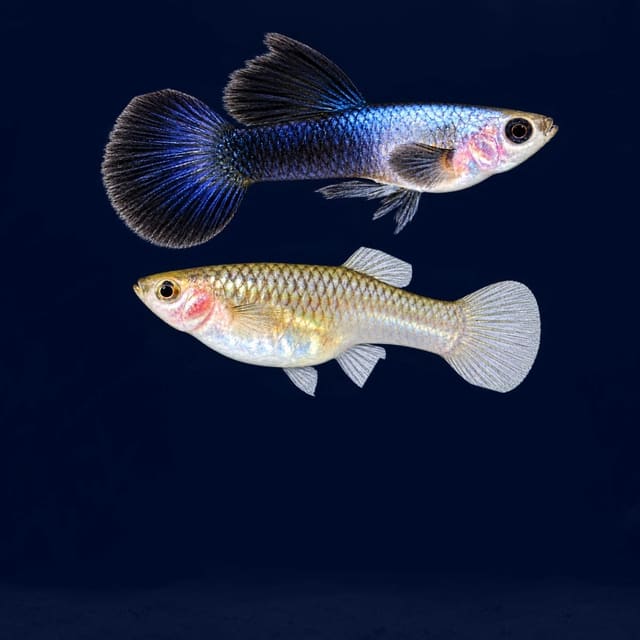
One female guppy (Poecilia reticulata) from the Full Black Moscow line. A peaceful livebearer that reaches up to 6 cm SL as an adult female and needs warm, clean, moderately hard water at 20 to 28 °C and pH 7 to 8. Suits a females-only group or a planned Moscow breeding trio.
Adult size is the maximum length this species reaches at full maturity (scientific sources). The livestock you receive will be younger and smaller. Product-photo provenance and any image-specific limitations are stated on the listing.
Poecilia reticulata
Shoaling fish: kept in a group they feel safer, stay calmer and show their best colour.
Minimum of 2 per order.
One female guppy (Poecilia reticulata) from the Full Black Moscow line. A peaceful livebearer that reaches up to 6 cm SL as an adult female and needs warm, clean, moderately hard water at 20 to 28 °C and pH 7 to 8. Suits a females-only group or a planned Moscow breeding trio.
Adult size is the maximum length this species reaches at full maturity (scientific sources). The livestock you receive will be younger and smaller. Product-photo provenance and any image-specific limitations are stated on the listing.
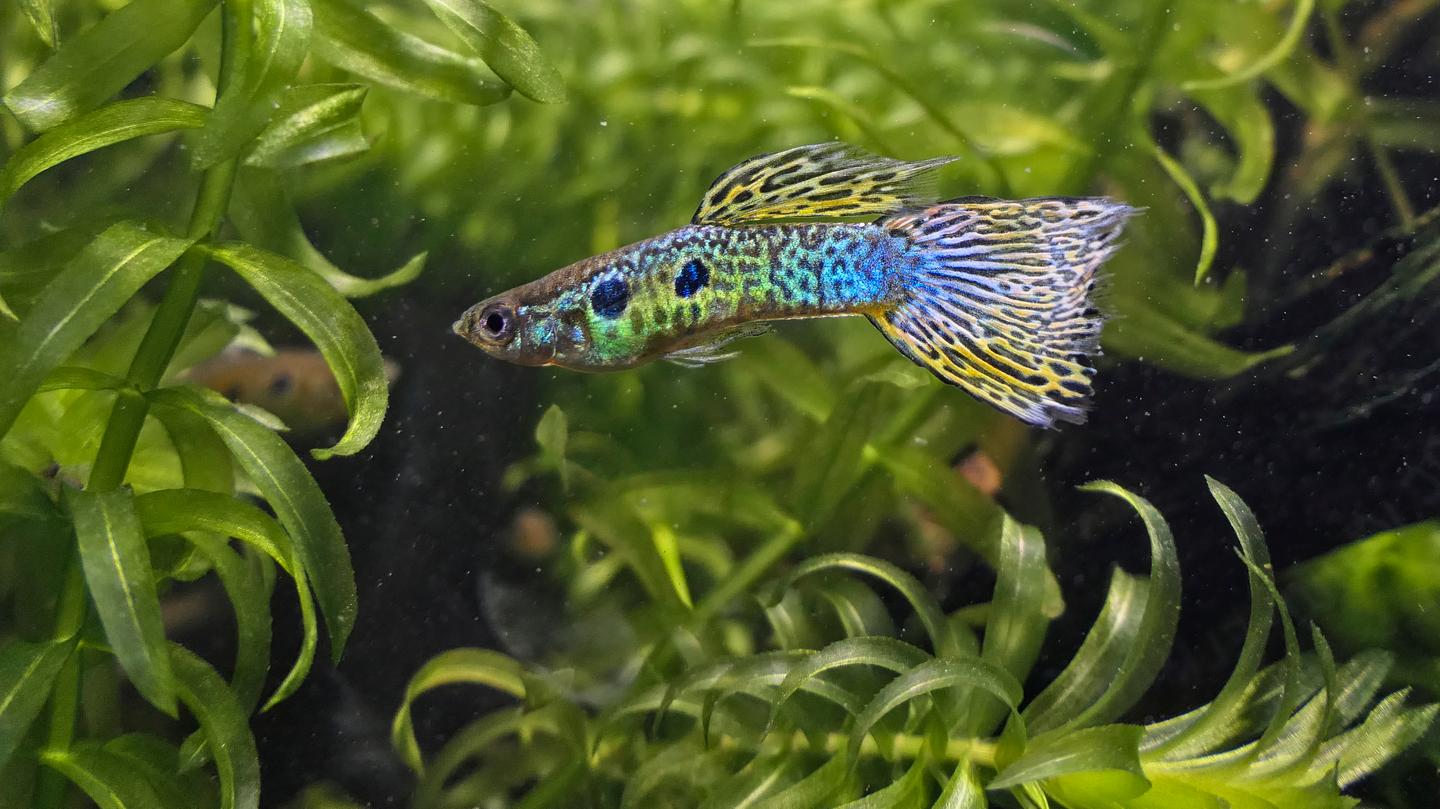
Guppies are social livebearers suited to a prepared beginner, not a fish-per-litre formula. Use a mature filtered aquarium, tested neutral-to-alkaline mineral-bearing water, deliberate sex and population planning, open swimming room, cover and a separation option.
Maintain these water conditions for optimal health and vibrant colors
This listing is for a female guppy, Poecilia reticulata, from the Full Black Moscow line. The title sells a female, so a female is what goes in the bag, and each one you add to your basket is a single fish. There is only one option on the page: no size grades and no colour picks. You are ordering a female of this line, and the rest of this guide explains what that means and how to keep her well.
Guppies are livebearers in the family Poeciliidae. FishBase calls the species one of the most popular aquarium fishes, kept in many standardised varieties. Moscow is one of those varieties, and Full Black is the name breeders give this particular line, which has been selected for black colour. Both names come from the hobby rather than from science, and that distinction matters once we get to colour and breeding further down.
Most people who buy a female from a named line want one of two things. Some are building a calm, females-only group where nobody gets chased and nothing breeds by surprise. Others want the mother of a small breeding project and plan to add a male of the same line. Both are sensible choices, and the advice differs a little between them, so we cover each as we go.
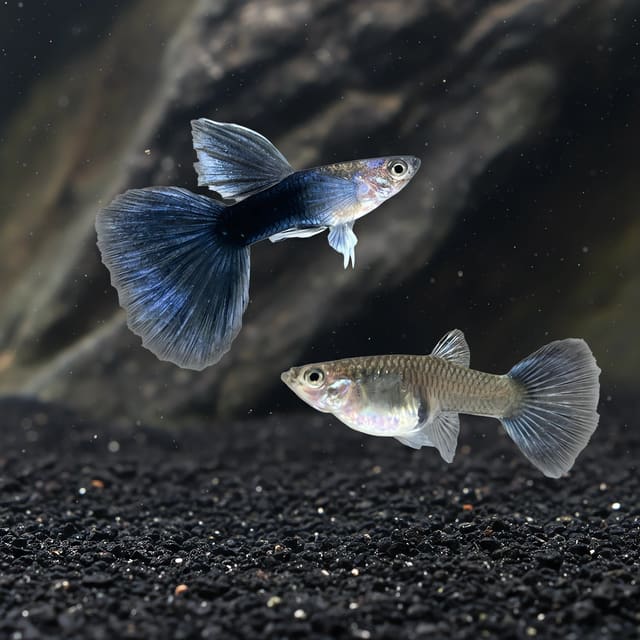
Colour is the least reliable way to sex a guppy. Look instead at the fin on her underside, just behind the vent. In a male that anal fin is folded into a narrow rod called the gonopodium, which he uses to fertilise females internally. In a female it stays an ordinary fan, roughly triangular in outline. The OATA guppy care sheet uses exactly this check, and it works on a fish of any colour.
Shape tells you a lot as well. Seriously Fish describes females as larger, plumper and duller than males, and males as the ones with bright colour and elongated fins. FishBase gives the maximum standard length as 6.0 cm for females against 5.0 cm for males. Wikipedia paints a broader picture, with females typically 3 to 7 cm and males 1.5 to 4 cm. Standard length runs from the tip of the snout to the base of the tail, so the tail fin adds a little more on top. Those are adult figures. The size she arrives at is just her size on the day we pack her, and it tells you nothing about her final length.
One more feature is worth learning before she arrives: the gravid spot. Wikipedia describes pregnant females developing an enlarged, darkened patch near the anal vent. Spotting it early tells you to get some fine-leaved cover into the tank before any fry appear.
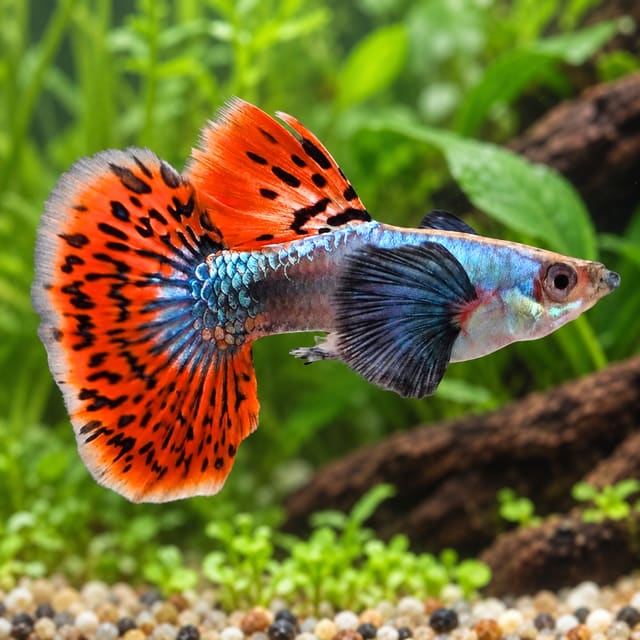
Most of the showpiece colour in a fancy guppy line is carried by the males. Wikipedia sums up the research in a single line: the genes responsible for male ornament are linked to the Y chromosome and are heritable. Guppies determine sex with an X and Y system, so males are XY and females are XX. Anything that sits only on the Y chromosome passes from father to son and never reaches a daughter.
The Moscow gene is a good example. In their 2017 paper on the Purple Body gene in domestic guppy strains, Alan Bias and Richard Squire list Moscow, gene symbol Mw, as Y-linked. They describe it as producing a blue iridophore shoulder pattern in males and say it probably acts as a full-body modifier. Iridophores are the reflective pigment cells that give guppies their metallic sheen. If a line behaves the way that paper describes, the classic Moscow male pattern is something a female simply does not carry, whichever line she comes from.
That does not make her an ordinary female. Guppy colour genes are not all on the Y. A 1999 linkage study by Khoo and colleagues in Zoological Science mapped three colour pattern genes that sit on both the X and the Y chromosome and showed that they are expressed in both sexes. The authors also noted that the colours are more distinct and definitive in males because of androgens, the male hormones. Put simply, a female can carry colour genes and pass them on while showing them faintly, or hardly at all.
What does that mean for you in practice?
If you would rather keep a few females together with no breeding at all, her line becomes a point of interest rather than a plan, and her health and condition matter far more than her pedigree. Some keepers like to mix females from related lines; our Blue Moscow female guppy comes from the same family of Moscow varieties and makes an easy companion in a females-only tank, since both share the same needs.
Every fancy guppy in the hobby, Moscow lines included, traces back to a small fish from the north-east corner of South America and the southern Caribbean. Wikipedia lists the native range as Antigua and Barbuda, Barbados, Brazil, Guyana, Trinidad and Tobago and Venezuela, and FishBase gives a similar list that names the Guianas and northern Brazil.
Wilhelm Peters described the species in 1859 from Venezuelan material. A few years later Albert Günther named fish in honour of Robert John Lechmere Guppy, who had sent specimens from Trinidad to the Natural History Museum in London, and his surname became the common name. The species was moved to the genus Lebistes in 1913 and returned to Poecilia reticulata in 1963, so older books may still call it Lebistes reticulatus. Two other common names you might come across are millionfish and rainbow fish.
FishBase describes an unusually wide spread of habitats, from warm springs, weedy ditches, canals and turbid ponds to clear mountain streams. Seriously Fish puts it more bluntly: guppies turn up in almost every imaginable biotope, from high-altitude streams to swamps. Wikipedia adds that they favour smaller streams and pools over large rivers, while FishBase notes a preference for densely vegetated, quiet water. Some wild populations live in brackish water, and Wikipedia records guppies tolerating salinity up to one and a half times that of normal seawater. That is a wild extreme, recorded in research, and nothing to copy at home.
The Trinidad populations have become some of the best-studied fish in evolutionary biology, through work by Endler, Reznick, Magurran and many others. Researchers compared guppies living alongside dangerous predators, such as the pike cichlid Crenicichla alta, with guppies from streams where predators are scarce. Wikipedia summarises some of what they found. Guppies inspect predators while keeping out of the angle from which an attack is likely, shoaling is stronger where predation is heavy, and males can darken their irises when they detect a threat. Females prefer brightly coloured males with orange spots, which goes some way to explaining how breeders have pushed male colour so far.
Two practical lessons come out of all this. First, guppies come from places with cover, and a female that can slip into plants when a male becomes too keen is a calmer fish. Second, the wild guppy is tough and adaptable, but fancy lines are not wild fish. Seriously Fish warns that many commercially bred guppies are not very hardy because of inbreeding and over-production. Treat her as a domestic animal that needs steady, clean conditions, not as a weed that will survive anything.
One last point concerns the wild rather than your tank. Guppies have been released around the world, often in the hope of controlling mosquitoes. FishBase notes that the effect on mosquitoes was limited and that several countries report harm to their native wildlife after introductions. The OATA care sheet reminds keepers that releasing aquarium animals or plants into the wild is illegal. If you ever need to rehome her, ask a local aquatic shop or fish-keeping club.
Seriously Fish recommends an aquarium with a base of at least 45 by 30 cm, about 41 litres, and the OATA care sheet sets a minimum of 45 litres for guppies and the smaller livebearers. OATA also asks for at least three guppies to be kept together. Treat those numbers as the floor rather than the goal. A larger volume of water holds its temperature and quality more steadily, and in a mixed group it gives a female more room to get away from a persistent male.
The equipment list is short, and none of it is optional:
For the furnishings, Seriously Fish calls guppies unfussy but says they appreciate a planted tank with floating vegetation, and advises against strong currents. OATA suggests gravel or sand, live or artificial plants and ornaments for shelter, and asks you to keep the aquarium away from direct sunlight and draughts. Put that advice together and a good tank for her looks something like this:
If she is joining a females-only group, the layout matters less for escaping harassment but still matters for a natural-looking, settled tank. If she is going into a mixed group, plant cover stops being decoration and becomes a genuine welfare measure.
Think about fry even if you do not plan to breed. Seriously Fish notes that fry need dense vegetation to survive, and FishBase records that adults eat their young. A female who has lived with males may already be carrying a brood, so a corner of fine-leaved plants is cheap insurance.
Finally, set the tank up and run the filter well before you order. Every live delivery depends on the same thing: the aquarium ready, with the filter running, the water tested and the heater holding the right temperature, before the parcel leaves us.
Guppies want warm, clean water that is moderately hard to hard, with a neutral to alkaline pH. The published ranges differ slightly, which is normal, so here they are side by side:
| Source | Temperature | pH | Hardness |
|---|---|---|---|
| FishBase | 18 to 28 °C | 7.0 to 8.0 | 9 to 19 dH |
| Seriously Fish | 17 to 28 °C | 7.0 to 8.5 | 8 to 30 dGH |
| OATA care sheet | 20 to 28 °C | 7.0 to 8.0 | test weekly |
For a home aquarium we work to OATA's 20 to 28 °C, which sits inside both of the other ranges, with a pH of 7.0 to 8.0 and general hardness of roughly 9 to 19 degrees. The cooler figures quoted by FishBase and Seriously Fish mark the edge of what the species tolerates, not a target. Wikipedia's aquarium notes give about 25.5 to 27.8 °C as a comfortable range and about 22.2 to 26.1 °C for breeding, so the middle of the overall range suits most tanks. Whatever figure you choose, keep it steady: a heater on a thermostat and a tank away from windows and radiators does most of that work.
Hardness deserves more attention than it usually gets. Seriously Fish states that guppies need moderately hard or harder water for long-term health. If your tap water is soft, talk to us or a local aquatic shop well before she arrives, rather than trying to adjust it on delivery day. A value that is slightly off but stable does far less harm than a big swing.
The nitrogen numbers are where most guppy problems begin. OATA sets clear limits:
To hold them there, OATA recommends a partial water change of 25% at least once a week and testing ammonia, nitrite, nitrate, pH and hardness weekly. Use a tap water conditioner on the new water and bring it close to tank temperature before it goes in. Write your results down. A notebook of weekly readings makes a slow drift obvious long before the fish show it.
You will read that guppies need salt. Wikipedia mentions one tablespoon per 19 litres in its aquarium notes, and it is true that some wild guppies live in brackish water. None of the other sources we used asks for salt in a freshwater guppy tank, so we treat it as optional rather than required. Hard, clean, stable fresh water is the baseline. If you do use salt, have a reason for it and think about every other fish in the tank first.
The main references describe the wild diet in different ways, and the differences are useful rather than confusing. FishBase lists zooplankton, small insects and detritus. Wikipedia reports that algal remains make up the largest share of the diet in most studies, alongside diatoms, invertebrates, insect larvae, plant fragments and detritus, and that the mix shifts with whatever each habitat offers. Seriously Fish calls wild guppies primarily insectivorous. Read together, they describe an opportunist that takes whatever small plant and animal food is about.
In the aquarium that means a varied diet with both halves covered. OATA recommends a good-quality flake or granule with algae content, plus live or frozen foods, and Seriously Fish notes that captive-bred guppies accept most foods offered. A sensible week for her might run like this:
Portion size matters more than the brand on the tub. OATA's rule is to feed only what the fish can eat within a few minutes, once a day, because uneaten food breaks down and releases toxic waste into the water. Guppies always look hungry, and a heavily fed tank is the quickest route to the ammonia and nitrite readings described above.
In a mixed group, check that she actually gets her share. Males spend a great deal of time following females, and a female who is being pursued can miss most of a feed. Scattering food across a wider area, or feeding at both ends of the tank at once, helps every fish reach some.
Colour in guppies is partly made from food. Wikipedia notes that guppy colours contain carotenoids, which the fish obtain through their diet. That matters most for males, whose colour is the point of the line, but a well-fed female in good condition is exactly what you want if she is going to be the mother of your next generation.
Seriously Fish describes guppies as very peaceful, and the friction in a guppy tank almost always comes from other guppies, specifically the males. Seriously Fish warns that males harass females persistently and advises keeping several females to each male. OATA sets a minimum of three guppies together, at two females per male. Wikipedia adds that guppies should be kept in groups rather than alone, and describes a polyandrous mating system in which males often try sneak matings instead of displaying first.
That leaves three workable ways to keep a Full Black Moscow female:
For the third option, Seriously Fish lists other livebearers, rasboras, corydoras, small loricariid catfish and tetras as suitable company. It specifically warns against fin-nippers and names tiger barbs and serpae tetras. Fancy guppies with flowing fins are an easy target for those fish, and a female with ragged fins is a stressed female. Avoid anything large enough to swallow her, too. Wild guppies are hunted by fish such as pike cichlids, and a big predatory fish in a living-room tank is no different.
Check water needs before you add companions, not afterwards. A fish that wants soft, acidic water and a guppy that wants hard, alkaline water cannot both be comfortable in the same tank, and one of them will pay for the compromise.
Endler's livebearer, Poecilia wingei, often sits next to guppies in shops, and people regularly ask how the two differ. Wikipedia explains that it was formally described in 2005 from the Paria Peninsula of Venezuela, and that a 2009 study supported treating it as a separate species from P. reticulata. The two interbreed and their hybrids are fertile, which Wikipedia notes dilutes the gene pool. If you care about her line, keep Endler males out of her tank.
Any adult female guppy that has shared a tank with males may be carrying young, and nobody can tell you for certain whether an individual fish is pregnant on the day she is packed. Here is what the sources say, so you know what to expect either way.
| Topic | Published figures |
|---|---|
| Gestation | Four to six weeks (FishBase, Seriously Fish); 24 to 30 days (OATA); 20 to 60 days at 25 to 27.8 °C (Wikipedia) |
| Brood size | 20 to 40 (FishBase); 20 to 80 (OATA); 5 to 100 (Seriously Fish); usually 30 to 60, with 2 to 200 recorded (Wikipedia) |
| Stored sperm | Young for six months or more without a male (Seriously Fish); sperm stored for up to eight months (Wikipedia) |
| How often | Broods roughly every four weeks (FishBase) |
| Maturity | Males at about two months, females at three (FishBase); males at seven weeks, with females first giving birth at 10 to 20 weeks (Wikipedia) |
The stored sperm figure is the one that catches people out. A female moved into a tank with no males at all can keep producing broods for months afterwards. If you see fry in a females-only tank, nothing has gone wrong; it is simply how guppies work.
Guppies give no parental care, and FishBase notes that cannibalism occurs. Seriously Fish advises dense vegetation for fry and removing the adults if you want to raise a brood. In practice that leaves two approaches:
Keep an eye on the gravid spot near her vent. Wikipedia describes it enlarging and darkening as pregnancy advances, which makes it the simplest progress marker you have.
Decide what you are breeding for before you add a male. With a Moscow male, the sons inherit his Y-linked pattern while the daughters inherit her X chromosome and a mix of both parents' other genes. If you want to control which fish pair up later, separate young males from young females once you can see the gonopodium forming. Wikipedia notes that aquarium fry take three or four months to mature, while FishBase gives an earlier age for males, so start checking sooner rather than later. Pairing her with a male from a different line, such as a black male guppy, will still give you fry, but expect a mixture of traits rather than a copy of either parent's line.
The most useful health check is the one you do every day at feeding time. OATA's description of a healthy guppy is short: clear, bright eyes, undamaged fins, intact scales and no ulcers or bumps. Add normal breathing, interest in food and swimming in open water rather than hanging in a corner, and you have a routine that takes about a minute.
Wikipedia lists the problems guppy keepers meet most often:
When something looks wrong, test the water before anything else. If ammonia or nitrite reads above zero, correct it with water changes before you reach for any treatment, because a remedy added to poor water rarely fixes the cause. If the water tests clean, look at behaviour. Is a male hounding her? Is she missing feeds? Is she hiding all day when she used to swim openly? Each of those points to a different fix: more females or more cover, a change in how you feed, or a closer look at her body and fins.
Get to know her normal shape and habits in the first week so that any change stands out. A darkening, enlarging gravid spot near the vent, which Wikipedia describes in pregnant females, points to a brood on the way rather than illness; changes in breathing, fins, skin or appetite point the other way and deserve a water test and a closer look.
Be stricter with fancy lines than you would with wild-type fish. Seriously Fish's warning that many commercially bred guppies are not very hardy is the honest reason. Stable temperature, clean water and a calm tank do more for her than anything sold in a bottle.
As for lifespan, Wikipedia says wild guppies typically live about two years, with wide variation between populations, and OATA notes that guppies can live several years in a well-matured set-up with good water quality. That is a fair reward for keeping her tank steady.
Before you order, please read our delivery and live-arrival information, because it sets out what we need from you on the day. The aquarium must be ready before the parcel is on its way: filter running, water tested and the heater holding the right temperature. Someone also has to be at the delivery address to take the parcel in, because live animals need to be received in person.
She travels in an oxygen-filled bag inside insulated packaging, with heat packs when the weather calls for them, carried by a tracked courier licensed to carry live animals. We email you the confirmed delivery date and the tracking details, so you know exactly when to be in.
Start recording a continuous video while the parcel is still sealed, and keep filming as you open it, so the video shows her in the bag before the bag is opened. That single unbroken clip is what our live-arrival guarantee relies on. If a fish arrives dead, dying or clearly in poor condition, email hello@tropicalfishco.co.uk on the day of delivery with your order number and the video. Photos on their own do not meet the policy. Where a claim is accepted under the guarantee terms, we replace the affected fish with your next order or refund it.
Leave the lights low for the rest of the first day and give her peace. Over the following week, keep an eye on three things: her breathing, her appetite and her behaviour. Feed lightly to begin with, and test the water a couple of times that week, since a new fish adds to the load on the filter. If she is in a mixed tank, make sure the males are not pinning her into a corner; this is when plant cover earns its place. If anything worries you, contact us and describe what you see, along with your latest test results.
These are the sources behind the facts in this guide, so you can check them or read further:
No reviews for this item yet. Bought one? Honest reviews only, good or bad.
What customers say about ordering from us
Easy website plenty of info on fish your buying great to pick a time slot
TRACEY DURRANT · 7 Oct 2026
Got some lovely fish thank you
Kevin Mackie · 7 Oct 2026
Reviews of our shop, collected by Judge.me, an independent third-party review collector. Newest first.