Easy
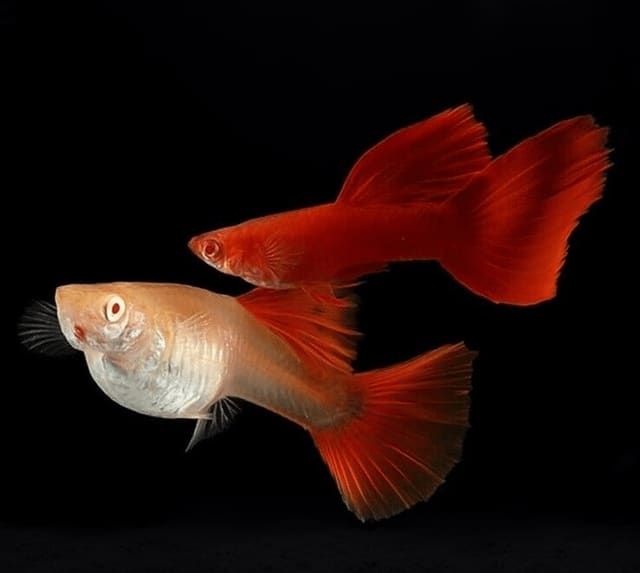
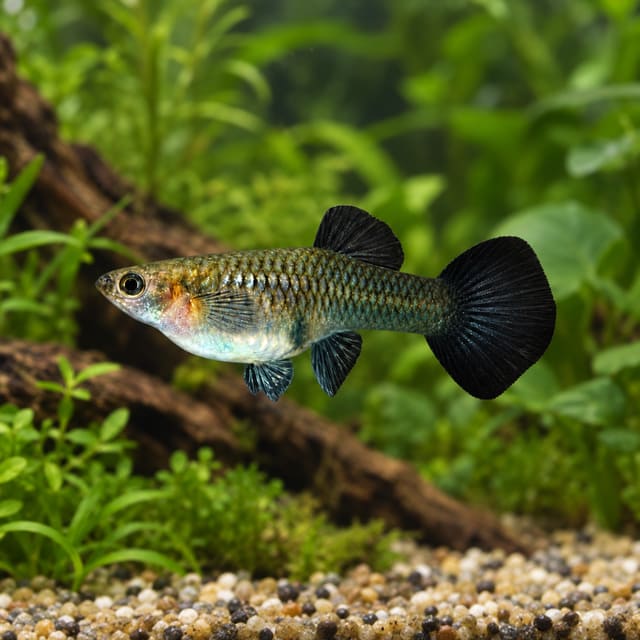
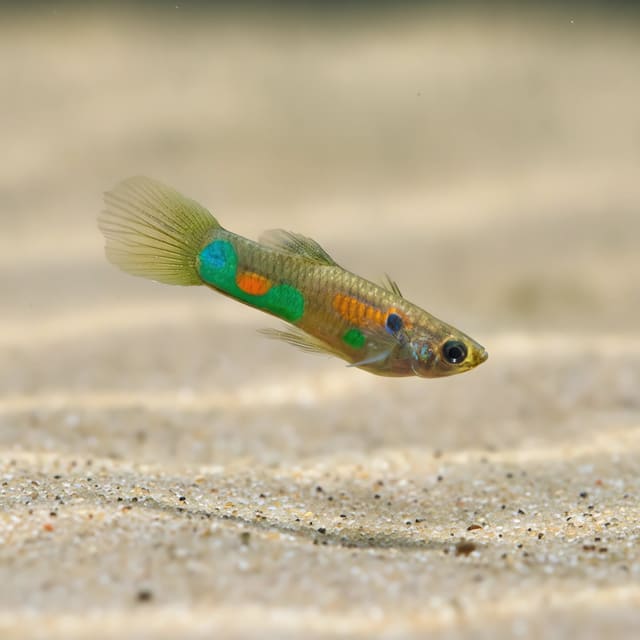
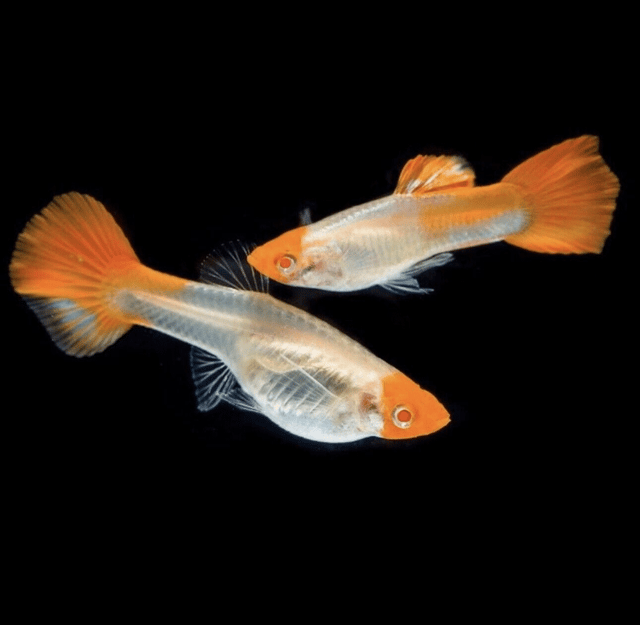
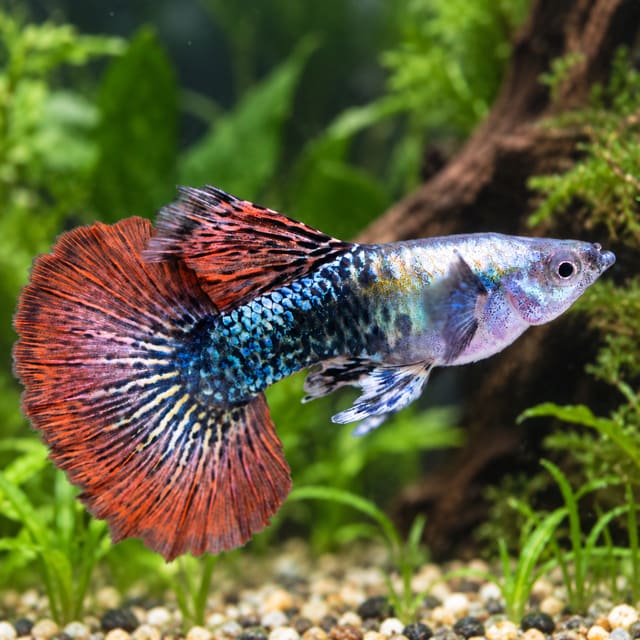
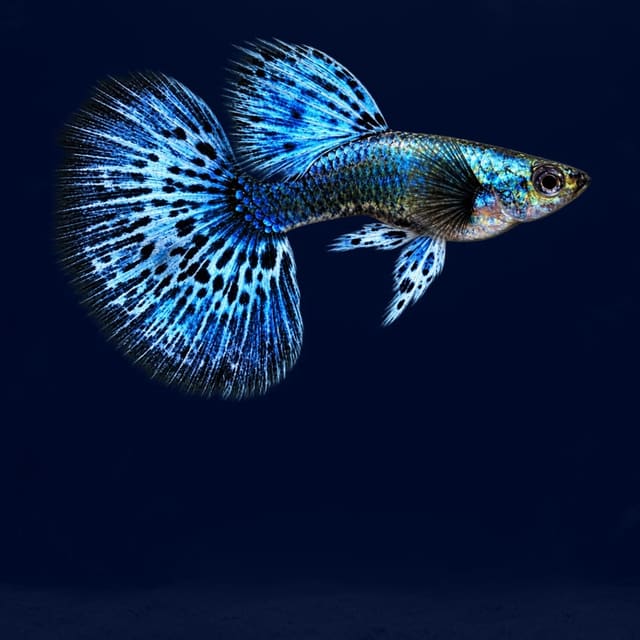
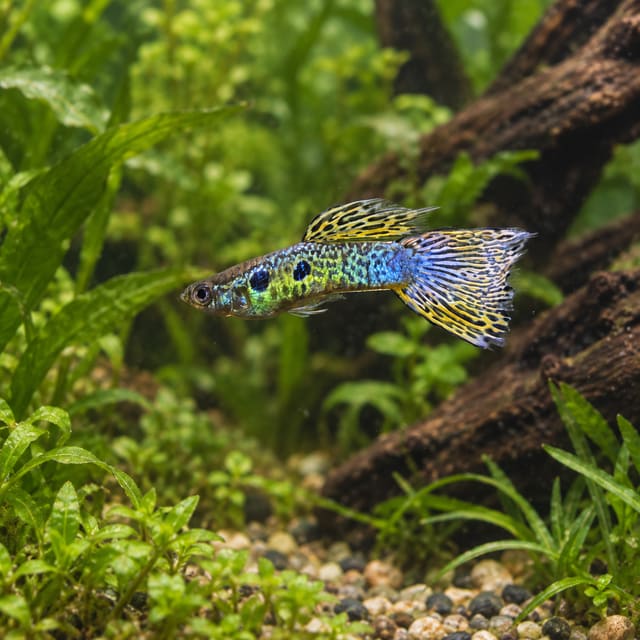
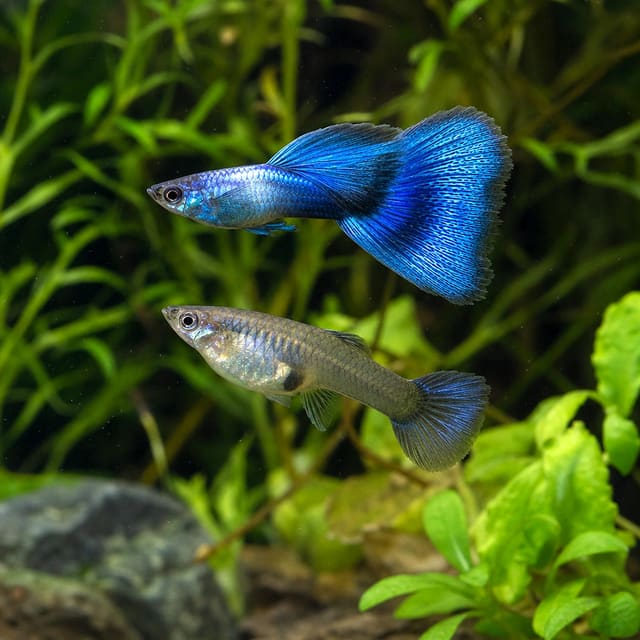
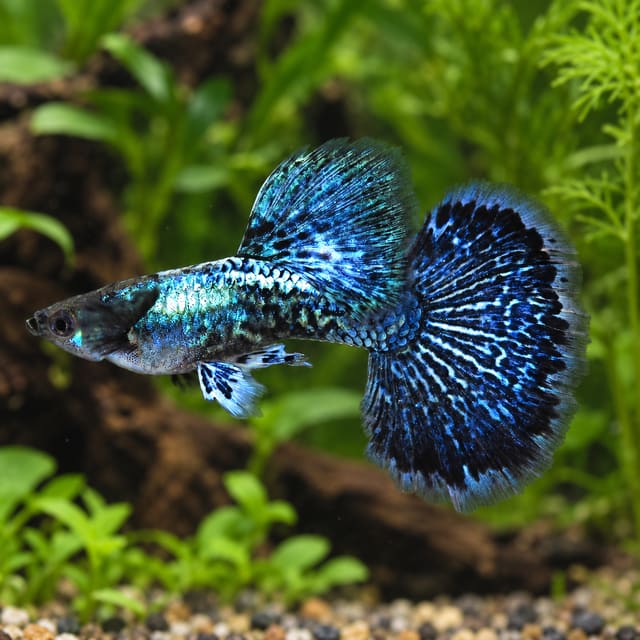
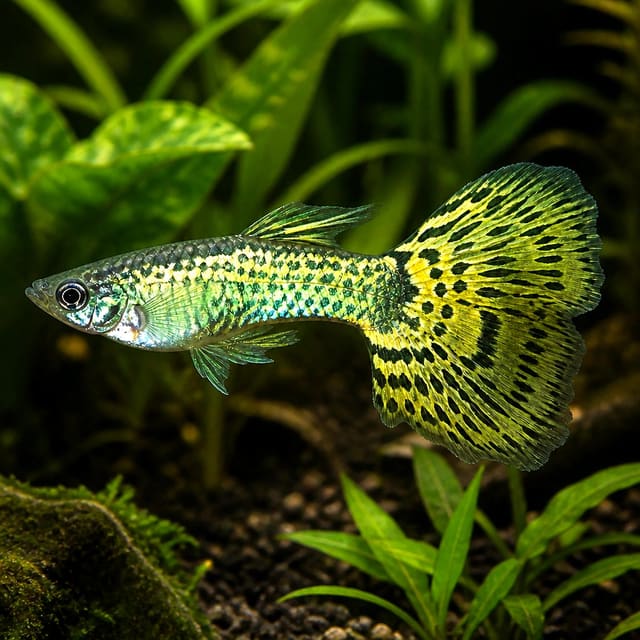
Green Cobra Male Guppy (Poecilia reticulata)
24–28°C · pH 6.8–8
£4.99
One male guppy (Poecilia reticulata) of the Yellow Cobra line. A peaceful, colourful livebearer that grows to about 5 cm SL and lives at 20 to 28 °C in moderately hard, alkaline water. Suits a males-only display, a breeding group with two or more females per male, or a calm community.
Adult size is the maximum length this species reaches at full maturity (scientific sources). The livestock you receive will be younger and smaller. Product-photo provenance and any image-specific limitations are stated on the listing.
Poecilia reticulata
Shoaling fish: kept in a group they feel safer, stay calmer and show their best colour.
Minimum of 2 per order.
One male guppy (Poecilia reticulata) of the Yellow Cobra line. A peaceful, colourful livebearer that grows to about 5 cm SL and lives at 20 to 28 °C in moderately hard, alkaline water. Suits a males-only display, a breeding group with two or more females per male, or a calm community.
Adult size is the maximum length this species reaches at full maturity (scientific sources). The livestock you receive will be younger and smaller. Product-photo provenance and any image-specific limitations are stated on the listing.
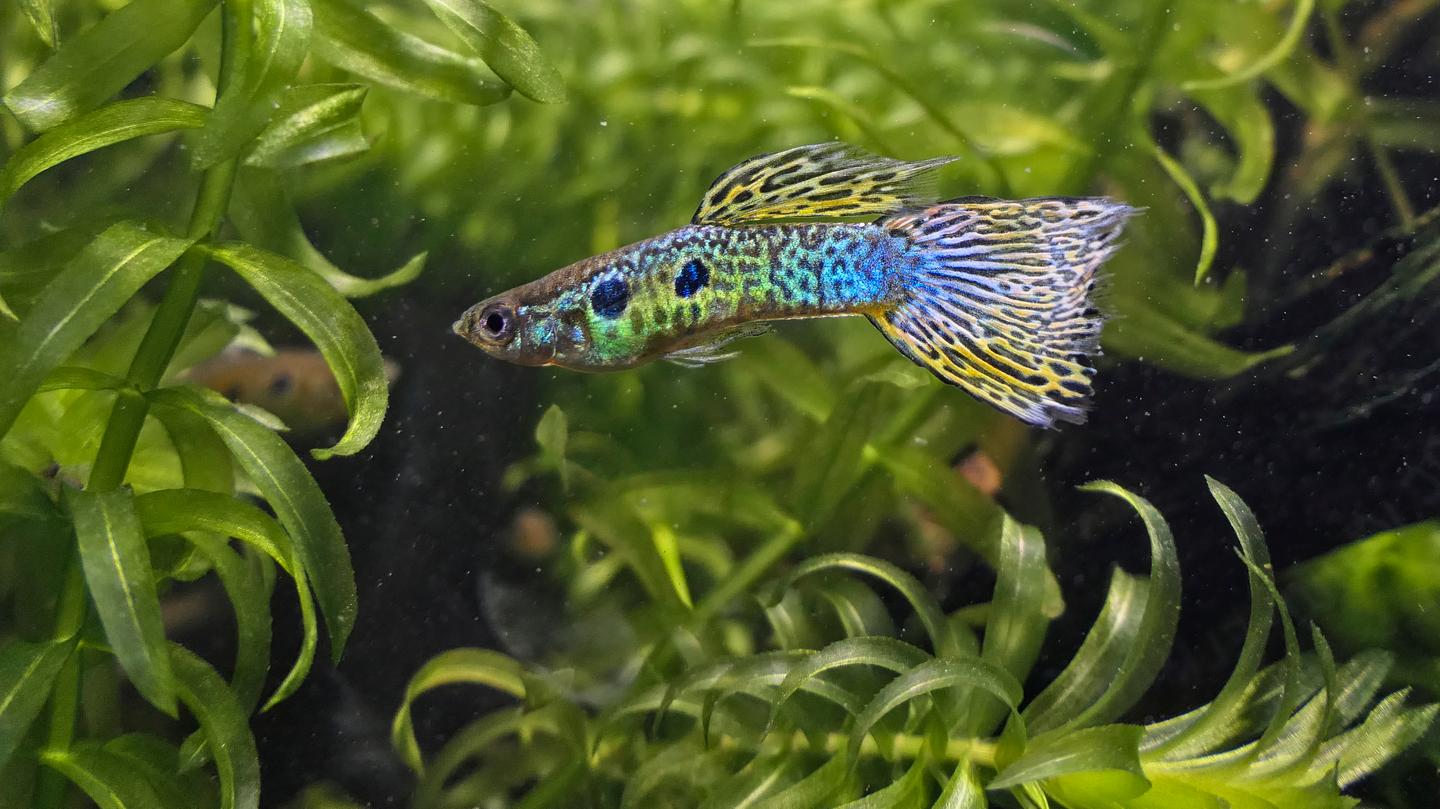
Guppies are social livebearers suited to a prepared beginner, not a fish-per-litre formula. Use a mature filtered aquarium, tested neutral-to-alkaline mineral-bearing water, deliberate sex and population planning, open swimming room, cover and a separation option.
Maintain these water conditions for optimal health and vibrant colors
You are ordering a male guppy, Poecilia reticulata, sold under the trade name Yellow Cobra. The live title names a male, so a male is what we send: one fish for each unit in your basket. There is a single option on the listing, which means no size grades to pick from and no choice of individual fish.
| Fact | Detail |
|---|---|
| Species and family | Poecilia reticulata Peters, 1859; Poeciliidae, the livebearers |
| What is sold | One male per unit |
| Adult size | Males up to 5.0 cm standard length (FishBase); Wikipedia gives 1.5 to 4 cm for typical males |
| Temperature | 20 to 28 °C for the aquarium (OATA) |
| pH | 7.0 to 8.0 |
| Hardness | Moderately hard to hard; FishBase gives 9 to 19 dH |
| Smallest sensible aquarium | 45 litres (OATA); a 45 by 30 cm base (Seriously Fish) |
| Temperament | Very peaceful with other species; males pursue females |
| Diet | Omnivore: flake or granules with algae, plus small live or frozen foods |
| Wild home | Fresh and brackish waters of north-east South America and the southern Caribbean |
The name needs a word of explanation. "Yellow" is the base colour this line has been bred for, and "Cobra" is a pattern name used in the guppy hobby. Neither word is a scientific term, and the next section is honest about what the published research does and does not say about patterned guppies like this one.
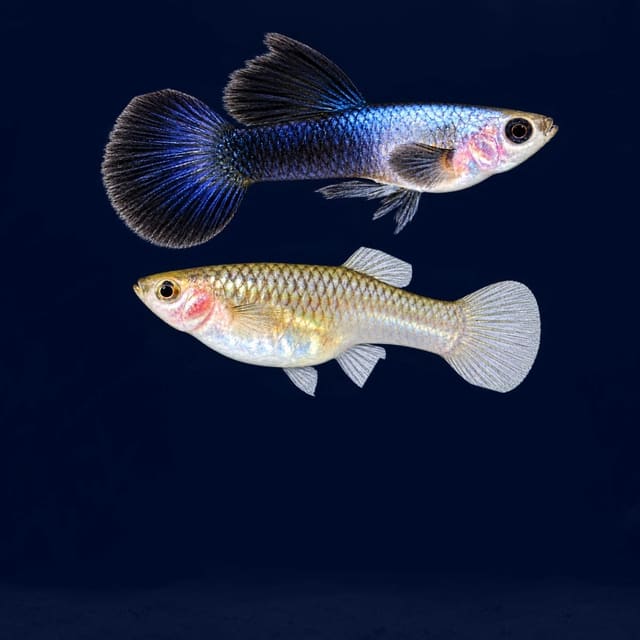
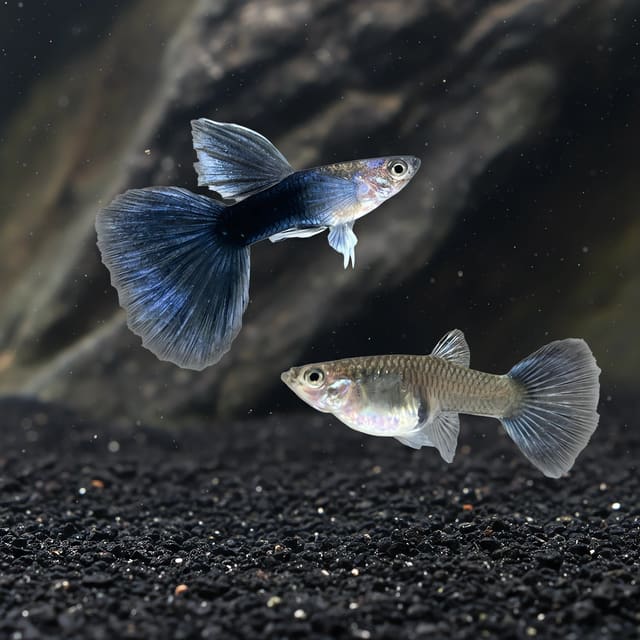
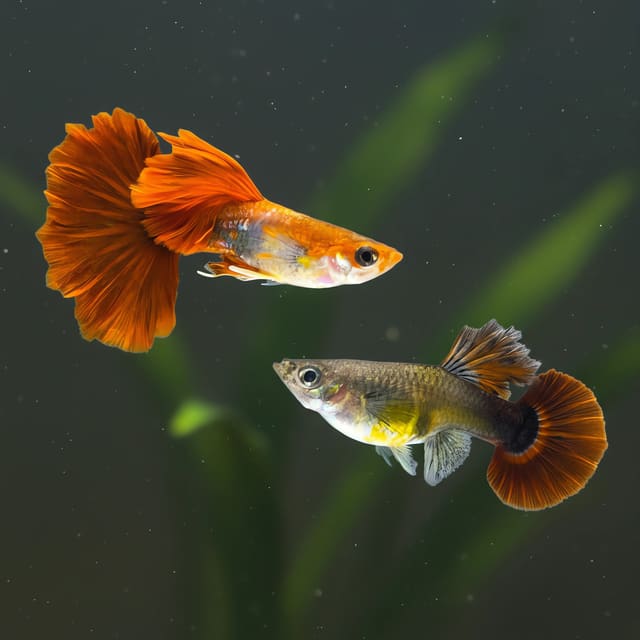
Male guppies are easy to confirm once you know the trick. Look at the fin on the underside behind the vent. In a male it is a narrow, pointed organ called the gonopodium, a modified anal fin used to fertilise females internally. A female has an ordinary, roughly triangular anal fin instead; the OATA care sheet uses the same check. Seriously Fish adds the other differences: males are the more colourful sex with elongated fins, while females grow larger and plumper and are duller. FishBase records males maturing at around two months old, and Wikipedia puts it at about seven weeks, so an adult male's gonopodium is well developed.
"Cobra" is a breeders' word, and it is worth being clear about how far the science goes. None of the genetics papers we read for this guide uses it. What they do describe are patterned-body guppies sold under the name snakeskin, which Wikipedia lists among the fancy varieties produced by selective breeding.
The study closest to a yellow patterned male is a 1999 paper in Zoological Science by Violet Phang, Gideon Khoo and Sock Peng Ang, who worked with commercially cultured ornamental strains. They describe Yellow Snakeskin males as having a pale yellowish background body colour and a yellow tail overlaid with delicate, snakeskin-like reticulations. Their crosses showed that the body pattern comes from a gene named Snakeskin-body, symbol Ssb, carried on the Y chromosome. Because females have two X chromosomes and no Y, the authors point out that female guppies do not carry Ssb at all.
The same paper explains a variation you may notice in patterned lines. Around one in ten of their Yellow Snakeskin males showed four or five vertical bars across the caudal peduncle, the narrow stretch of body in front of the tail, instead of the usual reticulated pattern over the body. That happened when a male also inherited two copies of a separate recessive gene, which they called bar, one from each parent.
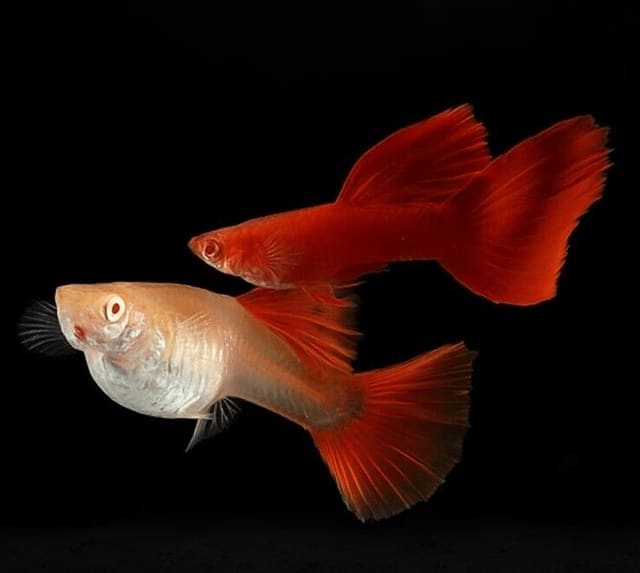
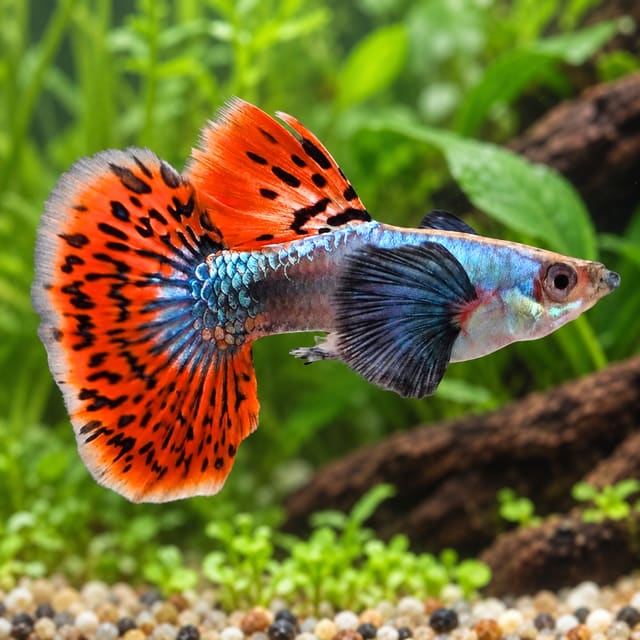
We include all this as background, not as a promise about your fish. Whether any particular cobra line carries exactly the same gene has not been published as far as our reading goes, and there are no photographs of this line on the listing to show you his markings. The trade name tells you what the line was selected for; the research tells you how patterns of this kind are usually passed on.
Two general points are firm, and both matter if you ever breed him:
Condition plays a part as well. Wikipedia records that guppy colours contain carotenoids obtained through the diet, which is why the feeding section below is about colour as much as health. The same article notes that thyroid hormones help control colour patterns, so a male's markings depend on his body chemistry as well as his genes.
The species behind every fancy line comes from a fairly small corner of the world. Wikipedia gives the native range as Antigua and Barbuda, Barbados, Brazil, Guyana, Trinidad and Tobago and Venezuela, and FishBase names the Guianas and northern Brazil among the same places. Wilhelm Peters described it in 1859 from Venezuela. The common name honours Robert John Lechmere Guppy, who sent specimens from Trinidad to the Natural History Museum in London, and for half a century, from 1913 until 1963, the fish was classified as Lebistes reticulatus before returning to its original name.
Wild guppies are not fussy about where they live. FishBase lists warm springs, weedy ditches and canals, murky ponds and clean mountain streams, with a preference for quiet water thick with vegetation. Seriously Fish says they occur in almost every biotope imaginable. Wikipedia notes they favour small streams and pools rather than large rivers, and that they can tolerate salt up to one and a half times seawater strength. That last figure is a wild tolerance recorded by researchers, not a setting for a home aquarium.
Trinidad's guppies have taught biologists a great deal about why males look the way they do. Long-running studies by Endler, Reznick, Magurran and others compared streams with heavy predation, from fish such as the pike cichlid Crenicichla alta, against streams with few predators. A few findings summarised by Wikipedia are worth knowing as a keeper:
Put those together and you have the reason a fancy male exists at all. Female choice favoured colour in the wild, and breeders have taken that much further. Wikipedia notes that domestic strains are larger and much more lavishly ornamented than wild-type fish, and Seriously Fish points to the elongated fins of aquarium varieties. That is lovely to look at, but it is not a design built for fast water or rough company, and the aquarium advice below reflects that.
One responsibility comes with owning any guppy. They have been introduced across the world, often to control mosquitoes, and FishBase notes the results against mosquitoes were limited while several countries report harm to native wildlife. The OATA care sheet states plainly that releasing aquarium animals or plants into the wild is illegal. A fish you can no longer keep should go to a shop, a club or another keeper.
For the tank itself, Seriously Fish gives a minimum base of 45 by 30 cm, roughly 41 litres, and the OATA care sheet asks for at least 45 litres for guppies. OATA also says to keep at least three guppies together. Those are starting points. More water means steadier conditions, and if he lives with females, a longer tank spreads his attention around.
Here is the kit, with the figures the sources give:
Flow is the setting that matters most for a male like this. Seriously Fish advises avoiding strong currents, and a fancy male carries a lot of fin for his size. Aim the filter outlet at the glass, use a spray bar, or add a sponge over the outlet if he struggles to hold position. You want water that moves gently through the tank, not a river he has to fight.
Seriously Fish describes guppies as unfussy about décor but notes they appreciate a planted tank with floating vegetation. Floating plants take the edge off bright lighting, give fry cover if he is housed with females, and add the kind of quiet, weedy surface water FishBase describes in the wild. Keep the centre and front open so he can swim and display, and plant more thickly along the back.
Position the tank sensibly too. OATA warns against direct sunlight and draughts, both of which make temperature harder to hold. A spot away from windows, doors and radiators saves a lot of trouble.
Avoid sharp-edged ornaments, which can tear long fins. If you can feel a rough edge with your fingertip, sand it down or leave that piece out.
Above all, run the filter for long enough to mature before you order. On delivery day the tank has to be ready and waiting: filter running, water tested, temperature matched.
The three sources give slightly different ranges for Poecilia reticulata, and seeing them together makes the choice easier:
We use the OATA band of 20 to 28 °C for the aquarium, since it sits inside the other two, with a pH of 7.0 to 8.0 and hardness somewhere in FishBase's 9 to 19 degree span. The coolest published figures are the limit of what the species tolerates, not a recommendation. Wikipedia's aquarium notes put comfortable keeping temperatures at about 25.5 to 27.8 °C and breeding at about 22.2 to 26.1 °C, so most keepers settle around the middle.
If your water report gives hardness in milligrams per litre rather than degrees, the conversion is simple: one German degree (dH or dGH) is about 17.8 mg/l expressed as calcium carbonate. FishBase's 9 to 19 dH therefore works out at roughly 160 to 340 mg/l. Most water companies publish hardness figures for the area they serve, so you can check before you buy a single test strip.
Soft, acidic water is the main thing to avoid. If your tap water is soft, ask for advice before he arrives, because hardness is something to adjust gradually over weeks rather than on the afternoon a fish turns up.
OATA's targets for guppies are simple to remember. Ammonia and nitrite should both read zero mg per litre. Nitrate should stay no more than 20 mg per litre above whatever your tap water already contains. Anything above zero for ammonia or nitrite means the filter cannot keep up, and that needs dealing with straight away.
Salt comes up a lot with livebearers. Wikipedia's aquarium notes mention a tablespoon per 19 litres, and wild guppies certainly handle brackish water, but neither FishBase, Seriously Fish nor OATA asks for salt in a freshwater guppy aquarium. We regard it as optional, and not worth adding to a mixed community without a clear reason.
Wild guppies eat a mixture, and the sources weight it differently. FishBase lists zooplankton, small insects and detritus. Seriously Fish describes wild fish as primarily insectivorous. Wikipedia reports that, in most studies, algal remains make up the largest part of the diet, with diatoms, invertebrates, aquatic insect larvae, plant fragments and detritus also eaten, and that the balance changes with what is available locally. The fair conclusion is a small omnivore that takes both plant and animal food.
In the tank, OATA recommends a good-quality flake or granule containing algae, alongside live or frozen foods, and Seriously Fish notes that captive-bred guppies will take most foods offered. For a male that means:
Colour is where diet shows. Wikipedia records that guppy colours contain carotenoids, which the fish obtain through their diet. A varied menu of good food is the sensible way to support a yellow male's colour, and it does far more than any single product claiming to boost it.
Quantity is the part most people get wrong. OATA's rule is to feed only what the fish can finish within a few minutes, once a day, because uneaten food rots and releases toxic waste into the water. Guppies beg constantly, and a male in a tank with females spends so much time following them that it is easy to assume he has not eaten. Watch him at feeding time instead of guessing.
In a males-only tank, scatter food across the surface so every fish reaches some. In a mixed tank, check he is getting a fair amount while he is busy following the females. If he looks thin while everyone else looks well, that is worth watching closely; the health section covers what else to look for.
Guppies should not live alone. Wikipedia says they need to be kept in groups, and OATA advises at least three together. How you make up that group depends on what you want from your tank.
A tank of males gives you all the colour with no fry and no females to chase. Seriously Fish describes guppies as very peaceful, so several males together is a straightforward display. OATA's minimum of three guppies applies here as well; a lone male, or a pair of males, is not a group. Mixing a few patterned lines works well visually; a Green Cobra male guppy or a Blue Cobra male sits nicely alongside a yellow one, and all of them share the same water needs because they are the same species.
Seriously Fish warns that males harass females persistently and advises several females for each male. OATA sets the minimum at two females per male. With fewer females, one or two of them take all of his attention, so plan for more rather than fewer, and give them plenty of planting to get out of his sight.
Seriously Fish lists other livebearers, rasboras, corydoras, small loricariid catfish and tetras as suitable companions. The big warning is fin-nippers: it names tiger barbs and serpae tetras specifically, and a long-finned male guppy is exactly what those fish target. The same thinking rules out anything large enough to treat him as food. Pike cichlids hunt guppies in the wild, and a large predatory fish in a home tank behaves no differently.
Whatever you choose, match the water before you match the looks. Every companion needs to be happy in warm, moderately hard, alkaline water. A soft-water specialist and a guppy cannot both be at their best in one tank.
Endler's livebearer, Poecilia wingei, is frequently sold near guppies, and buyers often ask how the two differ. Wikipedia explains that it was formally described in 2005 from Venezuela's Paria Peninsula and that a 2009 study supported it as a species separate from P. reticulata. The two cross readily and their offspring are fertile, which Wikipedia notes dilutes the gene pool. This listing is a guppy. If you keep both and want either line to stay true, keep them apart.
If you plan to breed from him, the genetics in section two become practical. Because the genes for male ornament sit on the Y chromosome, every son he fathers carries his Y. His daughters receive his X chromosome instead, and in the snakeskin strain studied by Phang and colleagues the body pattern gene is simply absent from females. So his sons are where you look for his pattern, and his daughters carry the rest of what he passes on.
Stored sperm is the complication that catches out most first-time breeders. Female guppies keep sperm for a long time: Wikipedia records storage for up to eight months, and Seriously Fish says a female can produce young for six months or more without a male present. Combine that with a mating system in which females mate with several males, and a female who has lived in a mixed tank can give birth to another male's fry long after she meets him. If you want to be sure of the father, use young females raised apart from males.
Female choice matters in a mixed tank too. Wikipedia notes that females prefer brightly coloured males with orange spots, and that males also attempt sneak matings. With several males present, any of them may father a brood, so a single male with his own females is the cleanest set-up if you want to follow his line.
The published figures for pregnancy and broods vary between sources, so it helps to see them together:
Guppies do not look after their young, and FishBase records cannibalism. Seriously Fish advises dense vegetation for fry and taking the adults out if you want to raise a brood. Wikipedia describes a pregnant female's gravid spot near the vent becoming larger and darker, which gives you warning to move her to a planted tank of her own or to thicken the cover in the main one.
Choosing his partners is part of the fun. One option is to pair a yellow male with yellow-line females, such as our Yellow Female Guppy, or with females from a cobra line, such as a Cobra Red female. Crossing lines gives a mixture of traits, so keep notes on which female produced which brood. Once young males show their gonopodium, move them away from the young females if you want to control the next generation.
A quick look every day tells you most of what you need. OATA lists the signs of a healthy guppy: clear, bright eyes, undamaged fins, intact scales and no ulcers or bumps. On a male, pay particular attention to the edges of the tail and dorsal fin, since long fins are where problems tend to show first.
Wikipedia names the conditions guppy keepers come across most often. This table puts them in order of what you are likely to see:
| Problem | What you see | Cause named by Wikipedia |
|---|---|---|
| White spot (ich) | Small white cysts on skin and gills | The parasite Ichthyophthirius multifiliis |
| Fin rot | Fins decaying progressively from the edges | Bacteria including Pseudomonas fluorescens and Aeromonas hydrophila |
| Columnaris | Cotton-like growth, especially around the mouth | Flavobacterium columnare |
| Velvet | A fine gold-dust coating on the body | Oodinium |
| Swim bladder disease | Trouble controlling buoyancy | No single organism named |
Before treating anything, test the water. Ammonia or nitrite above zero, or a temperature that has drifted, explains a great deal of guppy illness, and medicating a tank with poor water rarely solves the real problem. Correct the water first with partial changes, then reassess.
Behaviour gives early warnings too. A male who usually patrols the front glass but starts hanging near the surface, sitting on the bottom with his fins folded, or ignoring food is telling you something. Note when it started and what has changed in the tank, as that is the information anyone helping you will ask for.
Ragged fins in a community tank with clean water results can point to a tank mate. Watch the tank for ten minutes at a quiet time and see who is following him. If you find a nipper, rehoming it is the lasting fix.
Seriously Fish is frank that many commercially bred guppies are not very hardy, because of inbreeding and over-production. That is not a reason to avoid fancy males, but it is a reason to keep conditions steady and avoid sudden changes.
Lifespan varies. Wikipedia gives around two years for wild guppies, with a lot of variation between populations, and OATA notes that guppies can live several years in a well-matured aquarium with good water quality.
Please read our delivery and live-arrival page before you place an order; it explains what has to be in place on your side. In short, his aquarium must be fully ready before the parcel arrives, with the filter running, the water tested and the temperature correct. Someone must be at the delivery address to receive him, since live animals have to be handed over in person.
He will travel in an oxygen-filled bag packed inside insulated packaging, with heat packs added when conditions call for them, carried by a tracked courier licensed to transport live animals. You will receive the confirmed delivery date and tracking details by email.
Our live-arrival guarantee depends on one continuous video. Start filming while the parcel is still sealed, then open it in the same take and show him in the sealed bag. Should a fish arrive dead, dying or clearly compromised, send that video with your order number to hello@tropicalfishco.co.uk on the day of delivery. Still photos are not enough to meet the policy. Accepted claims are settled by a replacement sent with your next order or a refund for the affected fish, subject to the guarantee terms.
Keep the lighting dim for the rest of the day. Through the first week, watch his breathing, whether he comes up to feed and how he behaves around the other fish. Offer small portions at first and test the water a little more often than usual, because an extra fish adds to what the filter has to handle. In a tank with females, expect him to take an interest in them quickly, which is exactly why the female-to-male ratio and plant cover matter. If you are unsure about anything you see, get in touch and tell us what is happening and what your test kit says.
Everything in this guide comes from the sources below, if you want to read more:
No reviews for this item yet. Bought one? Honest reviews only, good or bad.
What customers say about ordering from us
Easy website plenty of info on fish your buying great to pick a time slot
TRACEY DURRANT · 7 Oct 2026
Got some lovely fish thank you
Kevin Mackie · 7 Oct 2026
Reviews of our shop, collected by Judge.me, an independent third-party review collector. Newest first.