Easy
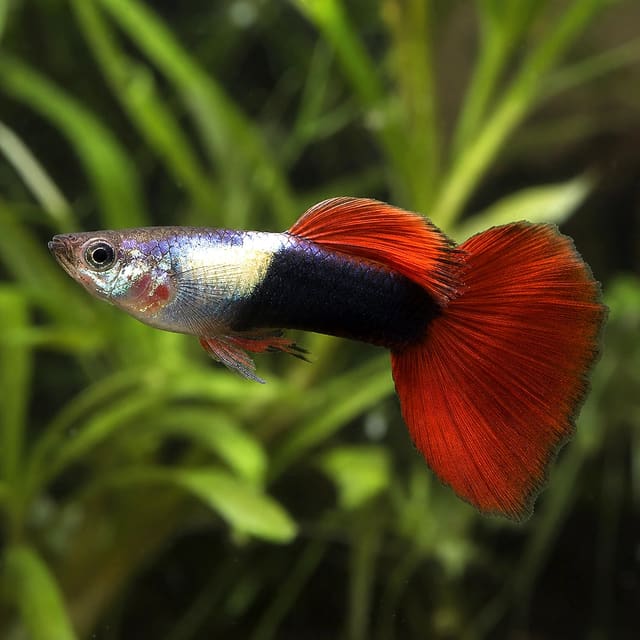
Blue Moscow Male Guppy (Poecilia reticulata)
22–28°C · pH 7–8 · 45L
£4.09
Photo coming soon
The size, price and care details on this page are for this listing.
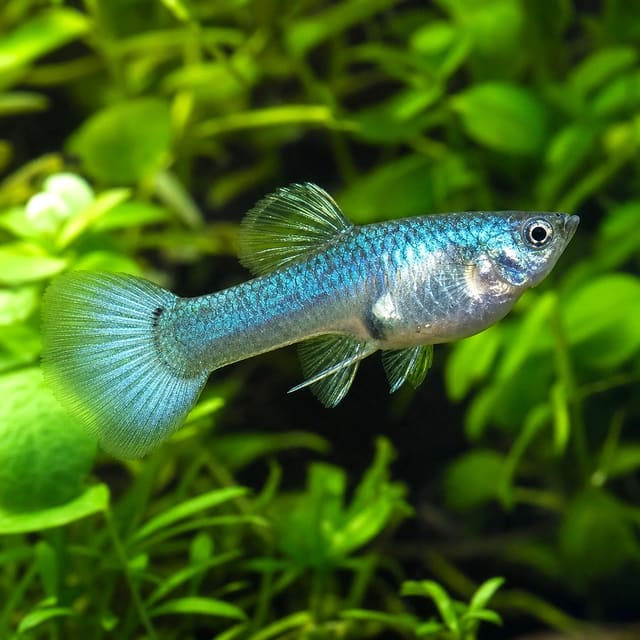
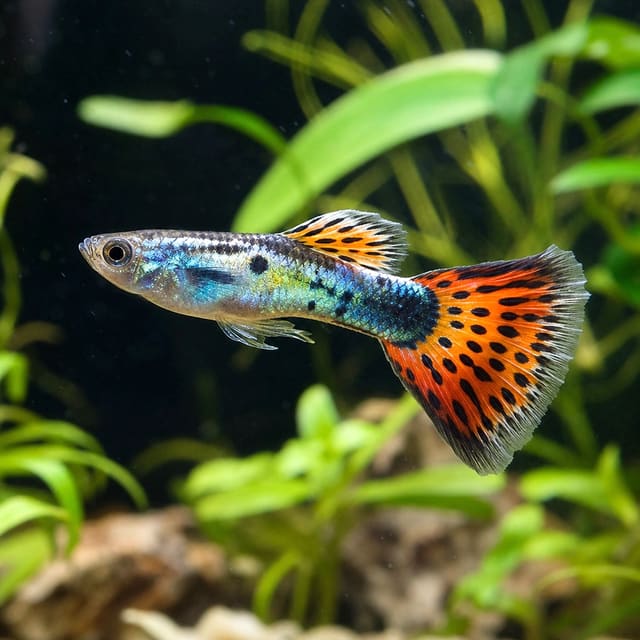
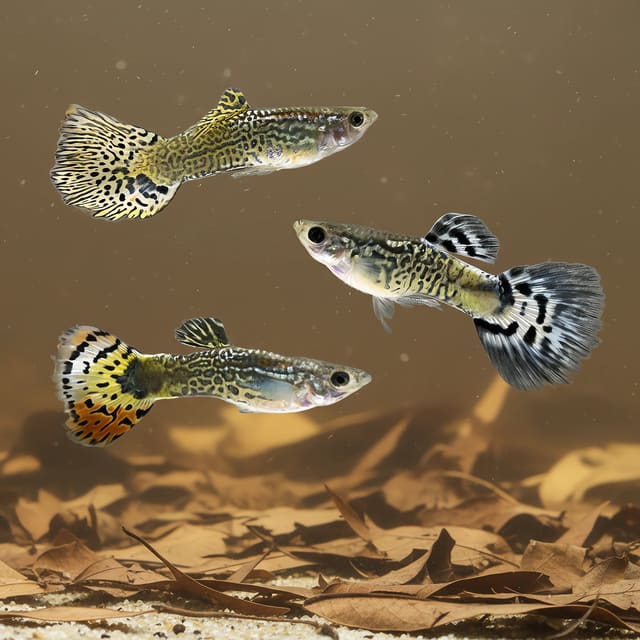
A male Blue Cobra Guppy (Poecilia reticulata) with blue cobra-patterned finnage, supplied as one live fish per purchase at a recorded dispatch size of 3–4 cm. Best for a mature, filtered aquarium at least 60 cm long, with stable mineral-bearing water, a properly planned guppy group and no persistent fin-nippers.
Adult size is the maximum length this species reaches at full maturity (scientific sources). The livestock you receive will be younger and smaller. Product-photo provenance and any image-specific limitations are stated on the listing.
Poecilia reticulata
Shoaling fish: kept in a group they feel safer, stay calmer and show their best colour.
Minimum of 2 per order.
A male Blue Cobra Guppy (Poecilia reticulata) with blue cobra-patterned finnage, supplied as one live fish per purchase at a recorded dispatch size of 3–4 cm. Best for a mature, filtered aquarium at least 60 cm long, with stable mineral-bearing water, a properly planned guppy group and no persistent fin-nippers.
Adult size is the maximum length this species reaches at full maturity (scientific sources). The livestock you receive will be younger and smaller. Product-photo provenance and any image-specific limitations are stated on the listing.

Guppies are social livebearers suited to a prepared beginner, not a fish-per-litre formula. Use a mature filtered aquarium, tested neutral-to-alkaline mineral-bearing water, deliberate sex and population planning, open swimming room, cover and a separation option.
Maintain these water conditions for optimal health and vibrant colors
The Blue Cobra Guppy Male is a domestic colour form of Poecilia reticulata, the guppy. Its trade name describes the blue tones and reticulated, cobra-style pattern selected in aquarium strains; it does not describe a separate species. This listing is explicitly for a male Blue Cobra guppy. One purchase supplies one live fish, and the verified dispatch grade is 3–4 cm. Dispatch size is the size at which the fish is supplied, not a promise that it has finished growing.
Sex is guaranteed only when the exact product or selected option explicitly states male or female. This Blue Cobra Guppy Male listing is sold as male.
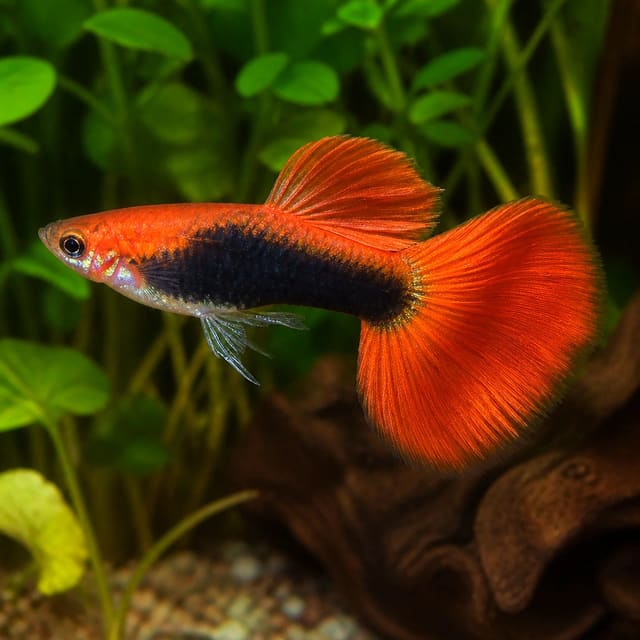
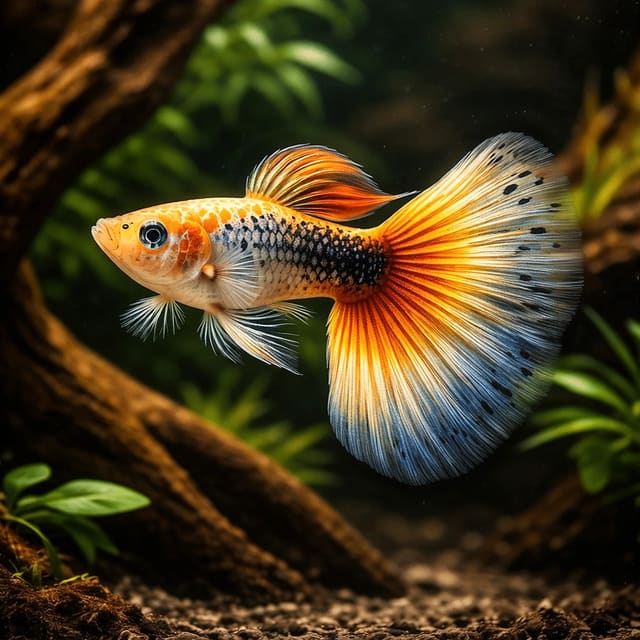
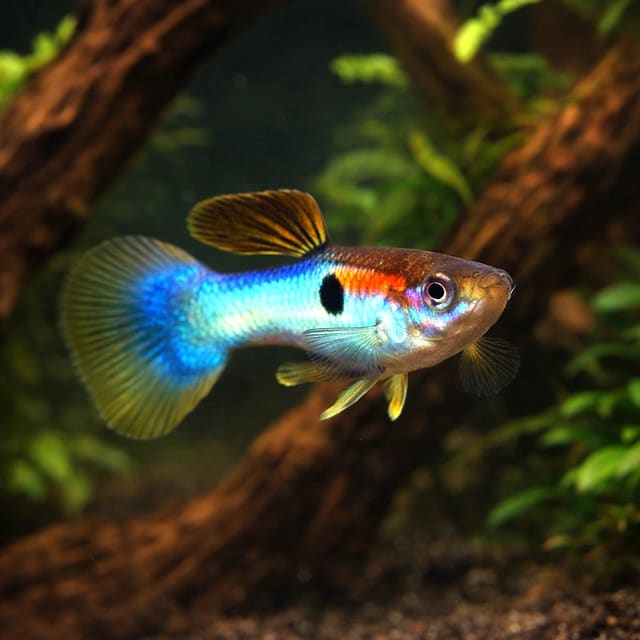
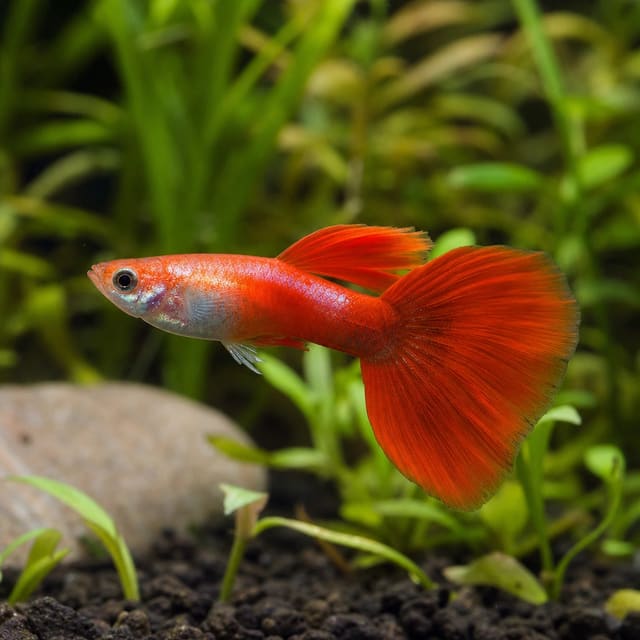
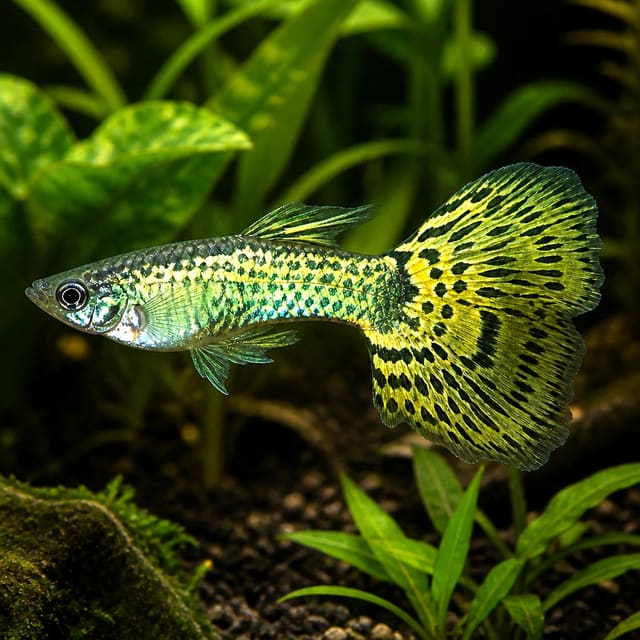
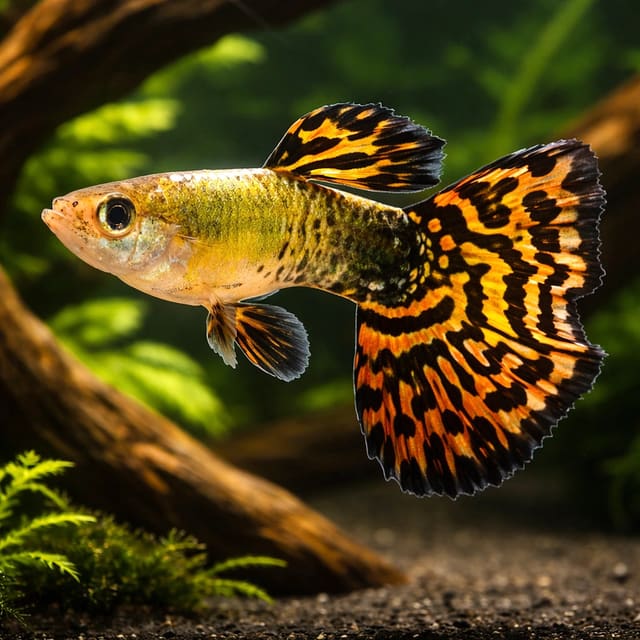
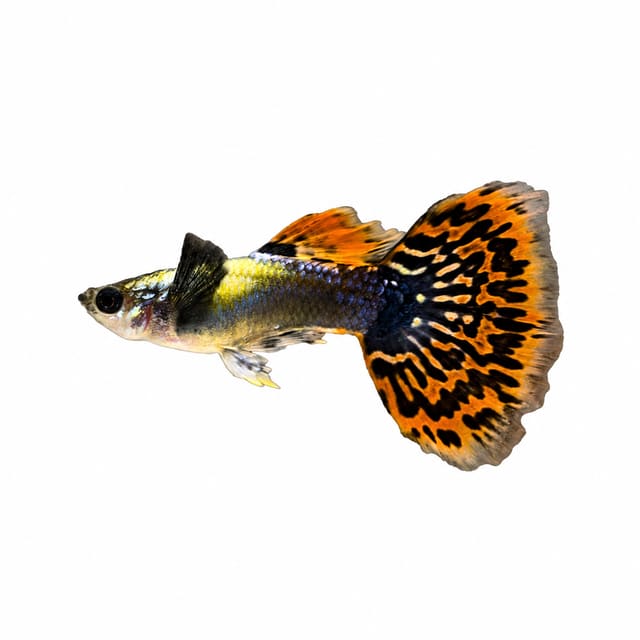
FishBase records 5 cm standard length for male or unsexed P. reticulata, while the species profile in Seriously Fish lists 6 cm standard length. Standard length excludes the tail fin, which matters for a fancy male because domestic tail shape and length can make the whole fish look larger. Plan space around the more conservative 6 cm species figure while recognising that the exact male record is smaller. The colour and pattern of living animals also vary. The photograph shows the expected blue cobra character, but no two live fish are carbon copies.
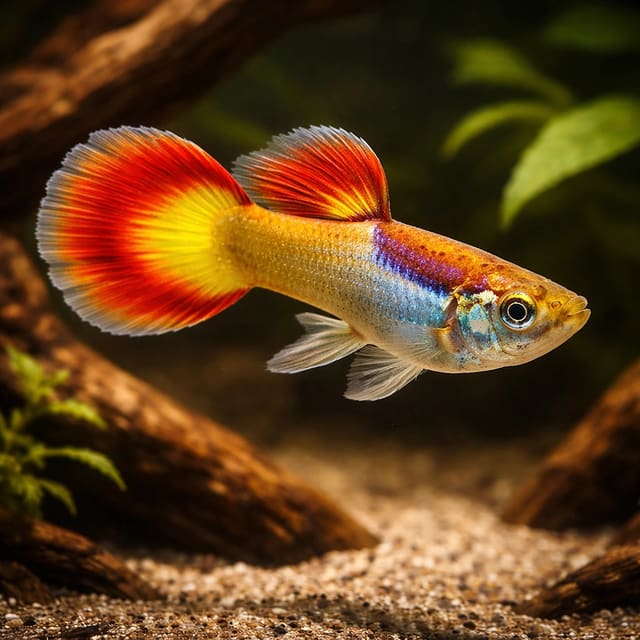
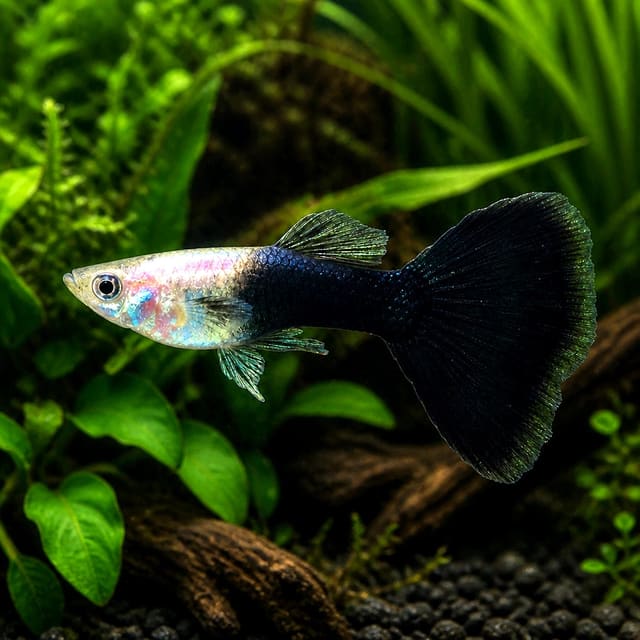
Gallery images have been digitally enhanced to improve image quality. Natural colour, pattern, size and maturity can vary between live animals.
This is a lively, conspicuous community fish for a keeper who has already prepared a mature, filtered aquarium and tested the water. Guppies can suit a prepared beginner, but “easy” does not mean suitable for a newly filled bowl, a cycling aquarium or water chosen by guesswork. A good home provides horizontal swimming room, plants or other cover, gentle enough flow, a social plan and a practical response if chasing or fin damage develops.
The most suitable keeper enjoys watching and adjusting a living group rather than expecting a decorative fish to look after itself. Daily observation should include breathing, fin position, appetite and whether every individual can cross the aquarium and feed without being driven away. The keeper should also have test kits, conditioned replacement water and a safe temporary separation option ready before a problem occurs.
Guppies are social. Tropical Fish Co uses a conservative house plan of five or more where aquarium capacity, filtration, other livestock and the sex plan allow. A male-only display can avoid new mixed-sex mating, but it still needs observation because persistent display and chasing can occur. A mixed-sex group needs a population plan before purchase; livebearers can produce fry, and no sex ratio guarantees that every individual will be left in peace.
The Blue Cobra colour form is best chosen because its pattern appeals to you, not because the name implies different water or easier care. Dark substrate and green planting may make the blue pattern more visible, but appearance should come after a stable biological filter, suitable minerals and enough swimming room. Colour-enhancing lighting or food cannot compensate for unsuitable water or chronic social pressure.
| Suits | A prepared beginner or experienced keeper with a mature, mineral-bearing community aquarium and a planned guppy group |
|---|---|
| Identity | Blue Cobra male guppy, Poecilia reticulata, family Poeciliidae |
| What one purchase supplies | One male live fish |
| Dispatch size | 3–4 cm verified grade |
| Recorded adult size | Plan for 6 cm standard length from the larger species profile; FishBase records 5 cm for male or unsexed fish |
| Routine aquarium range | 22–28°C; pH 7.0–8.0; 8–18 dGH, with the water values scoped below |
| Social plan | Five or more under the store's conservative policy where capacity and sex planning allow |
| Temperament | Generally peaceful; protect long fins from persistent nippers |
| Diet | Complete, appropriately sized omnivore staple with safe variety |
For the species-level detail behind these figures, read the complete guppy care guide. If colour form is the main decision, the current guppy collection lets you compare other listings without suggesting that every guppy should share one aquarium.
Set up and mature the aquarium before the guppy is dispatched. A working biological filter gives beneficial bacteria somewhere to convert toxic ammonia first to nitrite and then to less toxic nitrate. “The filter has been running for a few days” is not evidence that this process is ready for livestock. Test the aquarium repeatedly and add the fish only when ammonia and nitrite remain at zero under the intended routine.
If this is your first setup, use the first tropical aquarium guide to work through cycling, equipment and early stocking in the right order. Add livestock gradually. Each additional fish and each extra meal increases the work demanded of the biological filter, so a tank that coped yesterday can still become unstable after a sudden stocking increase.
Choose an aquarium by usable dimensions as well as the number printed on the box. Seriously Fish gives a 45 × 30 cm base and about 41 litres for the species, while FishBase's aquarium note gives a 60 cm minimum length. Tropical Fish Co uses the more conservative screen: a mature, filtered aquarium at least 60 cm long for one small guppy group, with the final population adjusted for adult fish, sex mix, existing livestock, filtration and test results. A nominal volume is not permission to fill a calculated maximum.
Measure the clear internal space after substrate, decor and equipment are installed. A tall narrow aquarium may hold a respectable volume while offering less of the horizontal route this active livebearer uses. Leave room for the whole adult group rather than sizing the aquarium around one 3–4 cm arrival, and remember that a second social species brings its own group and footprint requirements.
The routine store display range is 22–28°C. OATA's combined guppy-and-molly sheet gives pH 7.0–8.0 and medium-hard water at 8–18 dGH. These pH and hardness values are broad group-level guidance, not a laboratory-proven optimum for every domestic strain. Seriously Fish gives a wider species profile of 17–28°C, pH 7.0–8.5 and 8–30 dGH. For an ordinary home aquarium, a stable value within the conservative house range is more useful than repeatedly chasing an exact midpoint.
FishBase records guppies across freshwater and brackish environments, but that ecological breadth is not an instruction to add aquarium salt. Salt changes conditions for every fish, invertebrate and plant in the system. Add minerals or salt only for a measured purpose after checking all inhabitants, never because the word “brackish” appears in a species record.
Test the water you actually use. UK supplies differ by region and can change when a water company blends sources. Measure temperature, pH, general hardness, ammonia, nitrite and nitrate rather than relying on a postcode assumption or the heater dial. The water chemistry guide explains what the readings mean, and the water matcher helps compare measured values with this listing's stated guidance. Make changes gradually, dechlorinate replacement tap water correctly and verify temperature with an independent aquarium thermometer.
OATA advises zero ammonia and nitrite and nitrate no more than 20 mg/l above the normal tap-water level for its guppy-and-molly guidance. Treat a detectable ammonia or nitrite result as a problem to investigate, not a target to dilute into acceptability. Check the filter, recent additions, missed maintenance and excess food. Water quality comes before cosmetic adjustments.
Leave a useful open route through the middle and upper water where guppies spend much of their time. Plants around the back and sides, floating cover and thoughtfully placed wood or smooth ornaments can create refuge and break lines of sight without turning the entire footprint into an obstacle course. Long fins should not brush repeatedly against sharp decor or rough artificial plants.
Use filtration that keeps the water healthy without forcing the fish to swim continuously against a strong current. Seriously Fish advises avoiding strong currents. Watch the actual animal: if it is pinned into one quiet corner, struggling to feed or constantly bracing itself, the flow is not appropriate simply because a turnover calculation looked impressive. Guard intakes where small fish or possible fry could be drawn in.
A secure cover is sensible for a small, active fish. Keep the aquarium away from rapid temperature swings and uncontrolled direct sun. Plants are useful cover, but they do not replace filtration, swimming room or a population plan. Dense cover may allow more fry to survive, which is an advantage only when the keeper has capacity to raise and rehome them responsibly.
Use an appropriately sized, nutritionally complete omnivore flake or small granule as the staple. OATA's group guidance also supports safe variety including small live or frozen foods, while Seriously Fish notes that tank-bred guppies accept most aquarium foods. Variety should complement a complete staple, not turn the diet into a succession of rich treats.
Offer a portion the group can consume without food settling and decaying. Observe whether each fish actually eats; enthusiastic surface activity can make one dominant fish look like the whole group has fed. Adjust particle size so the Blue Cobra male can take food easily and spread food across more than one spot if shy animals are excluded. Remove uneaten material and use body profile, activity and water tests to refine the portion.
Wild guppies consume small insects, zooplankton and detrital material, but this is ecological context rather than a recipe to collect wild food or feed aquarium detritus. Use biosecure foods intended for aquarium animals. Store dry food away from moisture and replace stale supplies rather than compensating with larger portions.
Make maintenance regular and predictable. OATA strongly recommends a weekly partial water change of about 25% in its broad care sheet, alongside regular testing. The exact routine still depends on stocking, feeding, source-water chemistry and test results. Condition new water, avoid sudden temperature or chemistry shifts and siphon accumulated waste from accessible areas.
Record readings and maintenance dates when the aquarium is new or behaviour changes. A simple log makes a gradual trend easier to recognise than memory does. It also helps separate a recurring water-quality problem from a one-off reading and gives a vet or experienced adviser more useful information if the fish becomes unwell.
Clean filter media only when needed to restore function, and rinse reusable biological media gently in removed aquarium water rather than chlorinated tap water. Do not replace all mature media at once unless the manufacturer's safe process specifically provides preserved biological capacity. Check impellers and inlets for blockage while keeping the bacterial colony and livestock safe.
Learn this fish's normal swimming, breathing, fin position, body profile and feeding response. Clear eyes, open undamaged fins, regular breathing and steady swimming are useful observations. Surface gasping, clamped or damaged fins, spots, wounds, loss of balance, unusual hiding or a sudden loss of appetite are warning signs, not diagnoses. Test water immediately, examine the heater and filter, review recent changes and seek qualified help where needed. Do not choose salt, heat or medication from one symptom.
Quarantine is a separate, mature and testable system, not a small unfiltered container. Dedicated equipment reduces cross-contamination. The MSD Veterinary Manual recommends at least 30 days of isolation for aquarium fish, with longer periods where indicated; that is professional US veterinary guidance rather than a promise that every issue appears on the same timetable. For diagnosis and treatment in the UK, use a fish vet or a suitable aquatic professional.
Have the aquarium tested, heated and ready before the parcel arrives, and make sure somebody is present to receive live fish. Tropical Fish Co uses protective packing and a licensed live-animal courier. When the box arrives, first inspect the parcel and the fish quietly. If anything appears wrong, the current guarantee process requires a continuous short video that begins with the parcel still sealed, shows the outer box being opened and shows the fish in the sealed bag before anything is disturbed. Contact the store the same day with the order number.
Follow the supplied arrival directions. The current policy supports floating the sealed bag for 20–30 minutes to equalise temperature. After that supported temperature equalisation, transfer the fish carefully without pouring transport water into the aquarium. Avoid bright lights and unnecessary chasing during the first observation period. The delivery and Live Arrival Guarantee page is the current source for packing, arrival and claim terms; check it before dispatch rather than relying on an old screenshot.
Continue to observe swimming, breathing and balance after introduction, while keeping disturbance low. A journey can affect behaviour, but continuing distress should not be dismissed automatically as transit stress. Recheck temperature, ammonia and nitrite and ask for help promptly if the fish does not settle.
A peaceful label is a starting point, not a guarantee that every social arrangement works. Guppies seek company, interact frequently and can pursue one another. Tropical Fish Co's conservative policy is a group of five or more where aquarium capacity, water, filtration and the sex plan allow. The number is a planning screen rather than a magic threshold; every fish still needs access to food, open water and refuge.
This product is explicitly sold as male. A male-only group avoids new mixed-sex mating inside that group, but males may still display, chase or damage fins. Give them room and sight breaks, observe at several times of day and keep a separation option. Do not add another male as a reflex if one fish is being cornered; first assess space, layout and the behaviour of the whole group.
In mixed-sex groups, Seriously Fish recommends several females to each male and OATA suggests two females per male to reduce pressure. A ratio can reduce risk but cannot guarantee calm behaviour. Mixed groups also need a fry plan. Female guppies can retain sperm from previous mating, so a later female purchase may produce young even when no male is then present.
Seriously Fish describes guppies as very peaceful and names other livebearers, rasboras, Corydoras, small loricariids and tetras as possible companions in a quiet community aquarium. Those are categories to investigate, not automatic approvals. Exact species, adult size, temperature, pH, hardness, group size, feeding style and the available footprint must overlap well away from the edge of tolerance.
Rasboras, Corydoras and small loricariids can be considered only when the exact species shares suitable water and the aquarium accommodates its own social and spatial needs. The word “tetra” covers very different animals; use the source's warning about serpae tetras as a reminder that a broad family label is not enough. Other livebearers may share hard, alkaline water preferences, but adding another prolific species can increase competition and population pressure.
Avoid large predatory fish and any species likely to swallow a guppy. Avoid persistent fin-nippers because fancy male finnage presents an easy target. Do not use a highly territorial species as the default centrepiece for a male guppy display. Even a larger planted aquarium cannot guarantee that an individual territorial fish will ignore a bright, long-finned male.
Small shrimp and fry may be eaten, while larger invertebrates vary too much to promise under one label. Check the exact invertebrate species, size and water needs. A photograph of fish and shrimp together does not establish safe compatibility. Snails likewise have species-specific mineral and temperature requirements.
Be cautious when combining guppies with Poecilia wingei, Endler's livebearer. The two are distinct valid species but can hybridise. If maintaining a documented strain or species line matters, house them separately and do not sell descendants as pure representatives of either parent. This is an identity-management issue as well as a stocking decision.
Watch for repeated pursuit, cornering, missed meals, clamped fins, torn fins, loss of condition or a fish that stays hidden whenever another approaches. These signs call for intervention, not another decorative cave and hope. Test water because poor conditions can worsen behaviour, then assess group composition, footprint and sight lines. Separate fish safely when necessary.
Compatibility is successful only when all animals can use the aquarium normally over time. A calm first hour or a generic “community fish” label is not proof. Recheck the group as fish mature, plants grow, territories change or fry increase the population.
Seriously Fish lists 6 cm standard length for Poecilia reticulata, while FishBase records 5 cm for male or unsexed fish. Standard length excludes the tail fin, so use the larger 6 cm species figure for space planning and expect fancy finnage to add visual length. The 3–4 cm dispatch grade is not an adult-size limit.
Use a mature, filtered aquarium at least 60 cm long for a small guppy group under Tropical Fish Co's conservative policy. Seriously Fish gives a 45 × 30 cm base and about 41 litres, while FishBase gives a 60 cm minimum length. Check usable footprint, water tests, group size and tank mates rather than relying on litres alone.
Guppies are social. Tropical Fish Co recommends five or more where aquarium capacity, filtration and the sex plan allow; this is a conservative house policy, not a magic number. This listing supplies one male, so plan the rest of the group and a separation option before ordering.
Yes, it can suit a prepared beginner with a fully cycled aquarium, stable tested water, a planned social group and a maintenance routine. It is not suitable for an uncycled bowl or a newly filled tank, and easy does not remove the need to test ammonia, nitrite, temperature, pH and hardness.
Use an appropriately sized, nutritionally complete omnivore flake or small granule as the staple, with safe compatible variety such as suitable algal and invertebrate foods. Feed portions the group consumes without leaving food to decay, and check that every fish can reach the meal.
Use the routine store range of 22–28°C. OATA's broad guppy-and-molly guidance gives pH 7.0–8.0 and 8–18 dGH. Test the actual aquarium and keep conditions stable; those pH and hardness figures are group guidance rather than a proven optimum for every domestic colour strain.
It is generally peaceful and is not presented as a routine fin-nipper, but guppies can display and chase one another. Provide space, cover and sight breaks, monitor male groups and mixed-sex pursuit, and avoid tank mates known for persistent fin-nipping.
Seriously Fish names other livebearers, rasboras, Corydoras, small loricariids and some tetras for a quiet community, but each exact species must match the guppy's water, adult size and space needs. Avoid predators and fin-nippers such as tiger barbs and serpae tetras, and never treat a category as a guarantee.
Tropical Fish Co hand-packs live fish in oxygenated bags, an insulated box and a heat pack when conditions call for it, then uses a licensed live-animal courier. Be present to receive the parcel; for a Live Arrival Guarantee claim, record one continuous video from the sealed parcel to the fish still in its sealed bag and contact the store the same day.
One purchase provides one male fish, and the verified dispatch grade is 3–4 cm. Water ranges in this page retain their source scope: the house temperature range is practical store guidance, while pH and hardness figures from OATA are broad guppy-and-molly guidance.
No reviews for this item yet. Bought one? Honest reviews only, good or bad.
What customers say about ordering from us
Easy website plenty of info on fish your buying great to pick a time slot
TRACEY DURRANT · 7 Oct 2026
Got some lovely fish thank you
Kevin Mackie · 7 Oct 2026
Reviews of our shop, collected by Judge.me, an independent third-party review collector. Newest first.