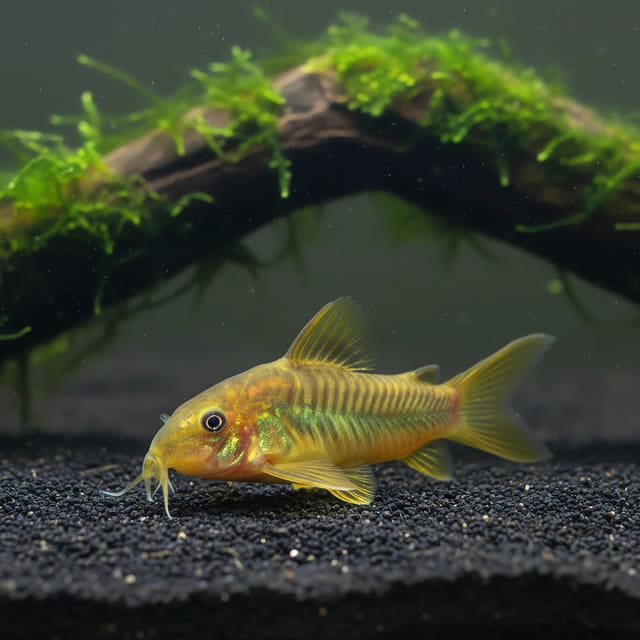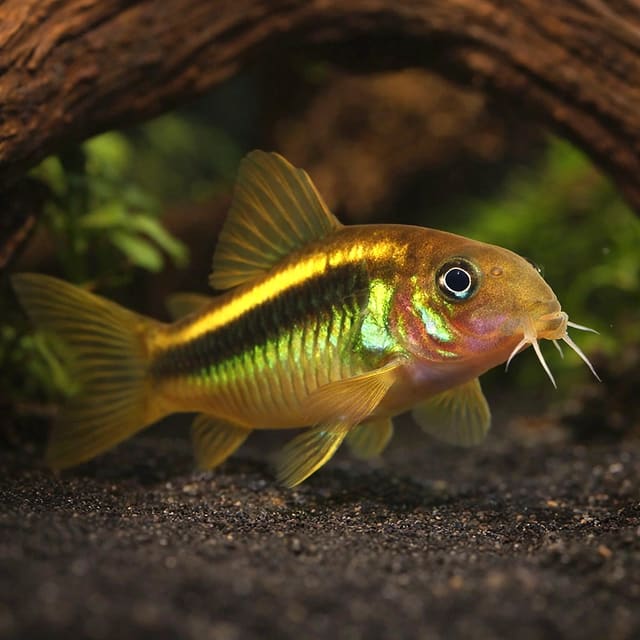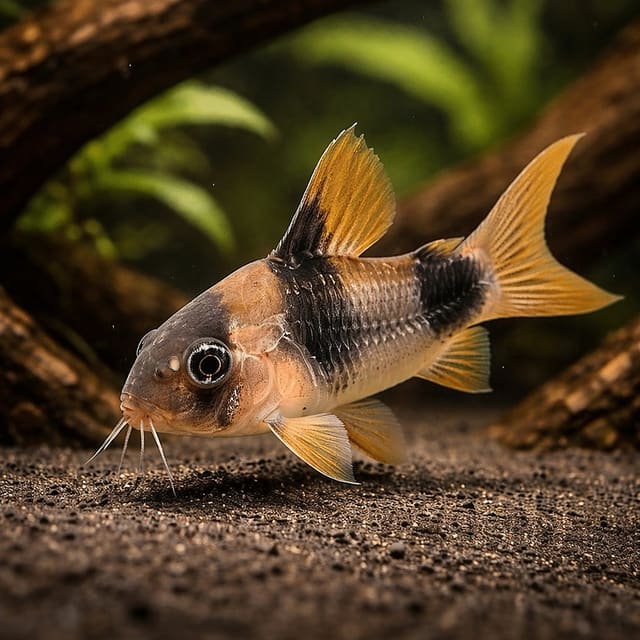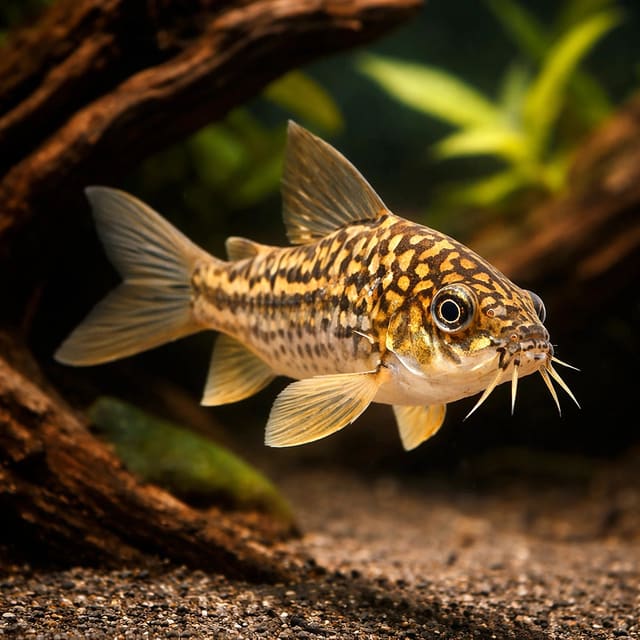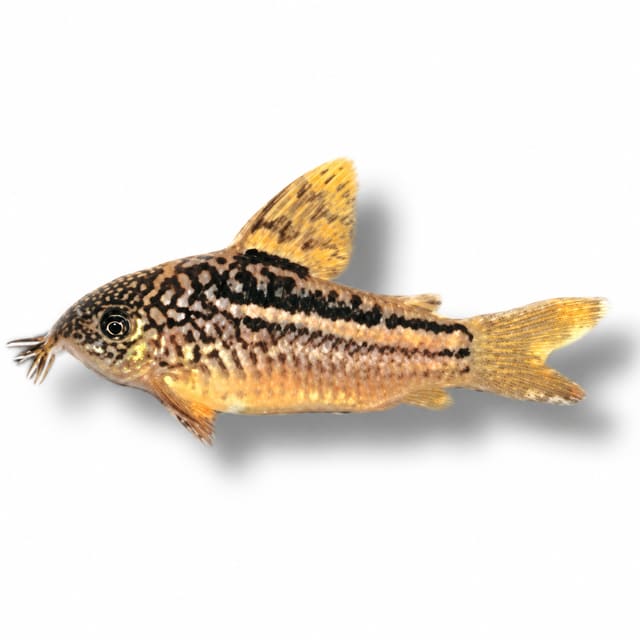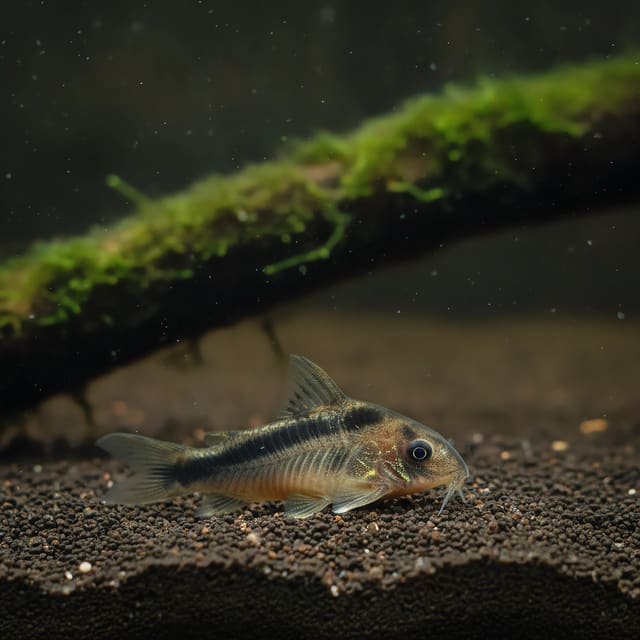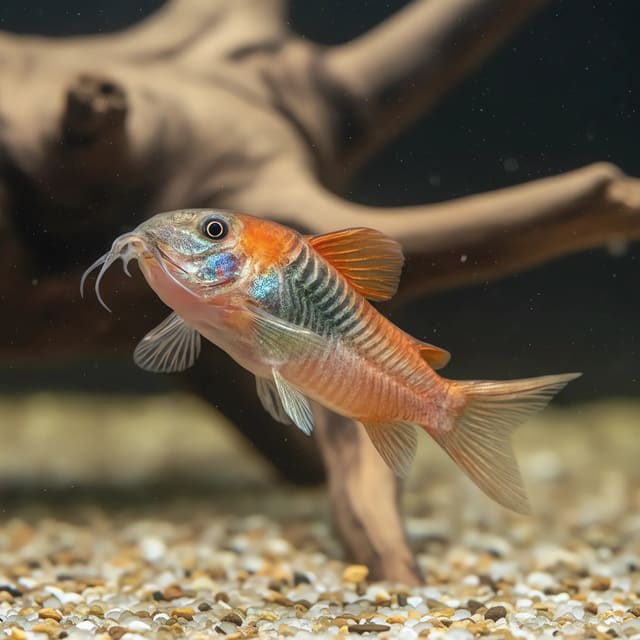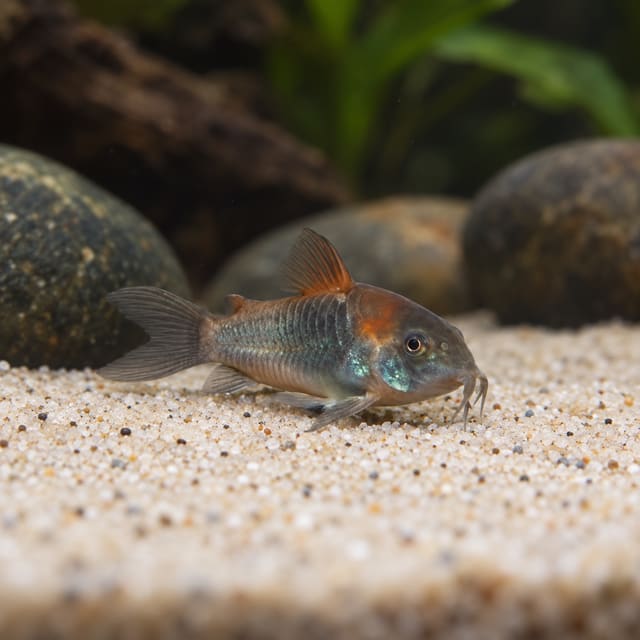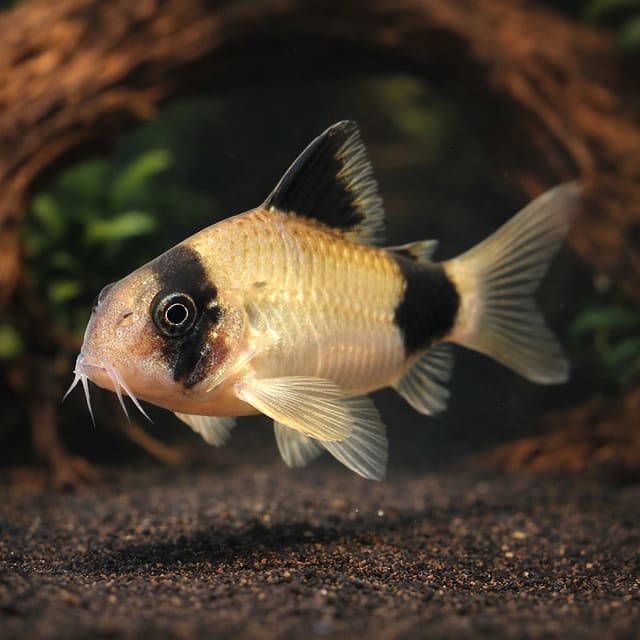
Panda Cory Catfish (Corydoras panda)
22–25°C · pH 6–7.4
From £8.69Some sizes on sale

The Albino Bronze Cory (Osteogaster aenea) is a callichthyid armoured catfish from South America that reaches 7.5 cm. It suits peaceful community aquariums; keep at least five at 22–27°C, pH 6.0–8.0 and 4–15 dGH, the overlap of Seriously Fish aquarium guidance and OATA's freshwater-catfish group guidance. Sold individually in dispatch sizes from 2–2.5 cm to >4 cm.
Adult size is the maximum length this species reaches at full maturity (scientific sources). The livestock you receive will be younger and smaller — pick a size above for the actual shipping size. Product-photo provenance and any image-specific limitations are stated on the listing.
Shoaling fish: kept in a group they feel safer, stay calmer and show their best colour.
Minimum of 2 per order.
The Albino Bronze Cory (Osteogaster aenea) is a callichthyid armoured catfish from South America that reaches 7.5 cm. It suits peaceful community aquariums; keep at least five at 22–27°C, pH 6.0–8.0 and 4–15 dGH, the overlap of Seriously Fish aquarium guidance and OATA's freshwater-catfish group guidance. Sold individually in dispatch sizes from 2–2.5 cm to >4 cm.
Adult size is the maximum length this species reaches at full maturity (scientific sources). The livestock you receive will be younger and smaller — pick a size above for the actual shipping size. Product-photo provenance and any image-specific limitations are stated on the listing.
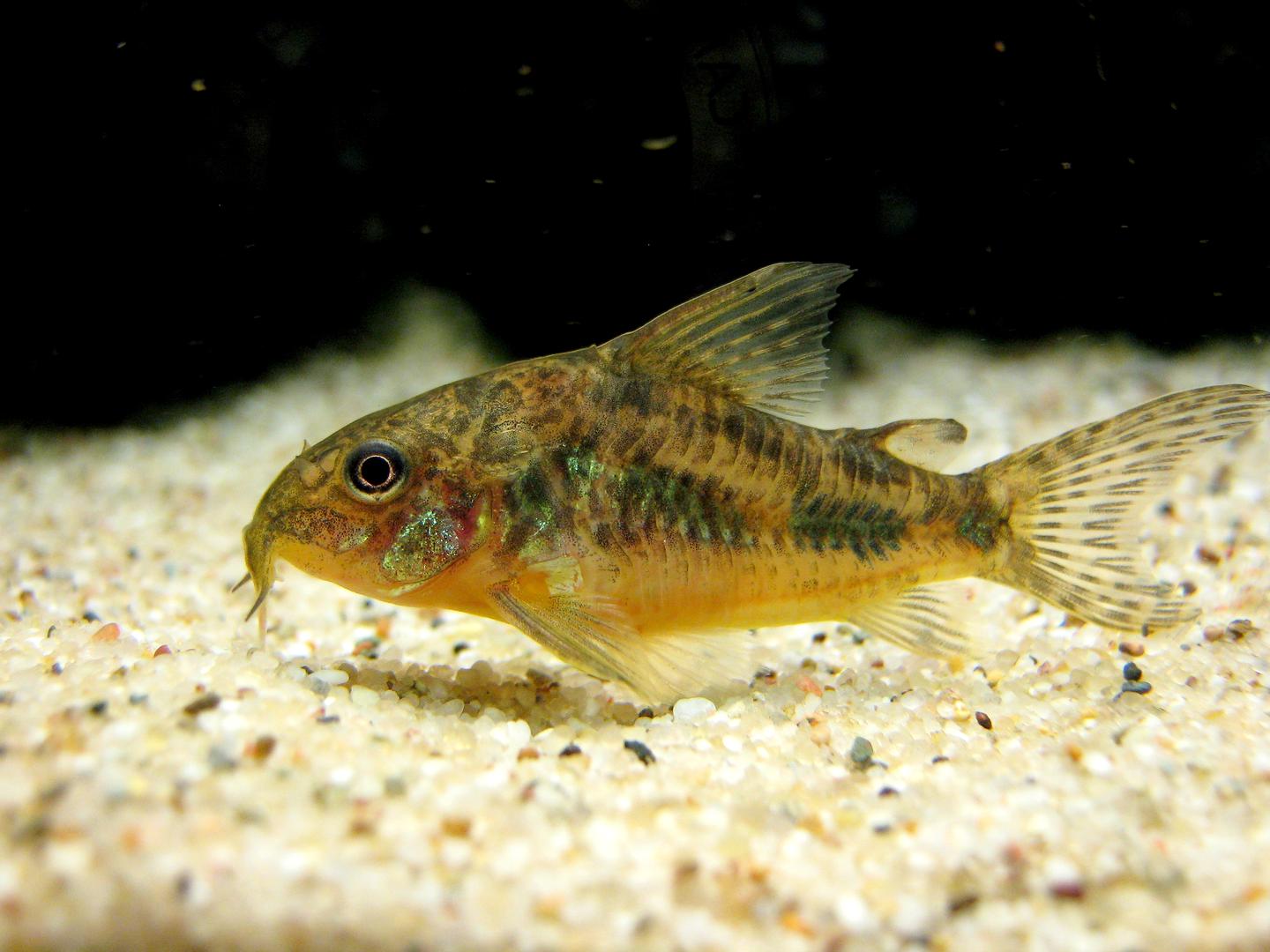
Identify the exact cory catfish before choosing care. Our starting policy for many common medium species is six compatible conspecifics, a mature 60 x 30 cm aquarium of about 60 litres, smooth fine sand and measured species-appropriate water.
Maintain these water conditions for optimal health and vibrant colors
The Albino Bronze Cory (Osteogaster aenea) is a pale form of a callichthyid armoured catfish from South America. FishBase places the species from Colombia and Trinidad to the La Plata River basin east of the Andes and records a maximum length of 7.5 cm standard length. It suits a keeper prepared to maintain a proper social group, dedicate enough aquarium floor space and feed the fish directly rather than expecting it to clean up after other inhabitants.
Keep at least five together in an established aquarium with a base of at least 80 × 30 cm. The Seriously Fish profile recommends that footprint or an equivalent, equating it to about 72 litres, while OATA's freshwater-catfish guidance recommends at least 80 litres for a shoal of smaller catfish. Planning around at least 80 litres and the stated base dimensions satisfies both practical benchmarks while leaving the footprint visible as the key long-term measurement.
Keep the water at 22–27°C, pH 6.0–8.0 and 4–15 dGH. These routine values are the overlap of the Seriously Fish aquarium range and OATA's freshwater-catfish group guidance, not a species-specific optimum. Maintain ammonia and nitrite at 0 mg/l and use an established biological filter from the outset.
| Suits | Not suited to |
|---|---|
| A peaceful community plan screened for matching water and space | A plan for one Cory kept alone |
| An established, filtered aquarium with an 80 × 30 cm base or larger | An uncycled or unfiltered aquarium |
| A group of at least five | A setup that cannot accommodate the full social group |
| Direct feeding with suitable sinking food | A scraps-only or aquarium-cleaner role |
This is a bottom-oriented, foraging fish rather than a piece of maintenance equipment. Its peaceful temperament makes it a candidate for a community aquarium, but the Cory group, adult size, water range, filter capacity and feeding access all need to be settled before other inhabitants are considered.
Each purchase supplies one Albino Bronze Cory from the size grade chosen on the live selector. The selector includes 2–2.5 cm, 2.5–3 cm, 3–3.5 cm, >3.5 cm and >4 cm grades. Use the grade to choose the dispatch size that fits your stocking plan, but build the aquarium around the recorded adult length of 7.5 cm and the needs of the complete group.
The size you select is the size supplied, not the adult size. A larger dispatch grade does not change the long-term water, group or footprint requirements. Likewise, a smaller grade is not a reason to begin with an aquarium below the long-term recommendation.
Sex is guaranteed only when the selected option explicitly states male or female. This Albino Bronze Cory listing has no sex-guaranteed option. Do not use body shape, colour intensity or a gallery image to choose or predict sex.
The current scientific name is Osteogaster aenea. The older combination Corydoras aeneus remains familiar in aquarium literature, while Albino Corydoras is another established trade name for this selectively bred albino strain. Treat these names as references to the same care subject here, rather than as different species or separate care types.
Some gallery images have been digitally enhanced to improve image quality. They show the listed type of animal rather than guaranteeing the exact markings of the individual supplied, so natural colour and pattern can vary. The gallery is useful for recognising the characteristic pale form, but the offer is defined by the title and live size selector rather than by the appearance of one pictured fish.
If you are comparing this fish with other members of the group, browse the current Corydoras collection. Compare adult length, social requirement, aquarium footprint and water values before deciding; a shared group name does not make every species interchangeable in one aquarium.
Use an aquarium with a base of at least 80 × 30 cm and plan on at least 80 litres for the Cory group. Seriously Fish associates that base with about 72 litres, while OATA's broader recommendation begins at 80 litres for a shoal of smaller catfish. Meeting both the footprint and practical volume target gives the group room to forage while providing more stable temperature and water quality than a smaller body of water.
Prepare and mature the aquarium before adding livestock. Our first tropical aquarium guide explains the setup sequence, while the essential decision here is to have an established biological filter capable of processing the waste created by the complete stocking plan. OATA advises increasing fish numbers slowly because the beneficial bacterial population must grow when fish numbers and feeding increase.
Seriously Fish recommends filtration turnover of four to five times the aquarium volume per hour. For its example of about 72 litres, that corresponds to a filter rated at roughly 290–360 litres per hour. Applied to an 80-litre aquarium, the same calculation gives 320–400 litres per hour. Use the actual aquarium volume when making the calculation rather than copying the example rating onto a differently sized tank.
The same profile gives a heater reference of roughly 50–75 W for a 72-litre aquarium maintained at 21–27°C in a room around 20°C. The room-temperature assumption matters: select equipment capable of holding the chosen temperature steadily in the room where the aquarium stands.
Reserve capacity for at least five Albino Bronze Corys before adding other fish. Extra inhabitants increase waste and may also use the aquarium floor or compete at feeding time. OATA recommends buying an aquarium as large as reasonably possible because larger systems tend to offer more stable environmental conditions. A larger group or a fuller community plan therefore calls for more space and filtration capacity rather than simply fitting more fish into the minimum footprint.
Keep the aquarium at 22–27°C, pH 6.0–8.0 and 4–15 dGH. Choose a point within those ranges that also suits every proposed community inhabitant, then use regular testing to catch changes before they become a livestock problem. Our water chemistry guide explains what the main readings mean, and the water matcher helps compare measured aquarium water with these care values.
Maintain ammonia at 0 mg/l and nitrite at 0 mg/l. OATA also advises keeping nitrate no more than 20 mg/l above the normal tap-water level. That wording uses the tap-water result as the baseline: if the tap reads 10 mg/l nitrate, the stated ceiling is 30 mg/l in the aquarium. A result above that difference calls for maintenance and a review of feeding, stocking and filter performance.
The RSPCA explains why biological filtration is vital: fish waste releases toxic ammonia, beneficial bacteria convert it to nitrite, and another stage converts nitrite to the safer nitrate. A working filter and established bacterial population are therefore part of the life-support system, not optional accessories.
Test at least once per week as part of routine care and test promptly when behaviour, breathing, appearance or feeding changes. Record the results so a trend is visible. A single number shows the aquarium at one moment; repeated results reveal whether filtration and maintenance are keeping pace with the fish population.
Choose fine sand as the ideal substrate. Seriously Fish accepts rounded gravel as an alternative when it is kept scrupulously clean, so substrate shape and maintenance must be considered together. Leave open areas where the group can search for food, and place cover around those spaces rather than filling the entire floor with décor.
FishBase describes the species as benthic and records it mostly in quiet, shallow water with soft bottoms, although it also occurs in running water. That natural history explains why the aquarium floor is central to the setup. It does not require copying a wild locality; it supports giving the fish a clean lower zone where normal searching and resting are easy to observe.
Seriously Fish recommends some cover to give the fish security. Plants, suitable wood, pots or caves can create sheltered areas, and OATA notes that many catfish appreciate these forms of refuge. Arrange them so the group can move between open feeding ground and cover without narrow traps or a heavily obstructed base.
Live plants may help create cover. OATA notes that some catfish may eat or dig up live plants and suggests suitable ornaments or artificial plants as alternatives where necessary. Make that choice according to how the aquarium is functioning rather than treating live planting as a fixed requirement.
This species is a facultative air-breather. FishBase records intestinal air breathing and surface air-taking as part of its biology, so a direct trip from the aquarium floor to the surface can be normal behaviour. Preserve an open route to the surface and watch for changes in the usual pattern rather than treating every surface visit as a crisis.
Context remains important. A sudden change in breathing, repeated unusual positioning or a wider change in activity belongs with an immediate water test and equipment check. The routine setup decision is simple: maintain clean, filtered water, keep the surface reachable and arrange the floor so the whole group remains visible enough for daily observation.
Use a quality sinking dried food as the staple. Seriously Fish describes Corydoras as foraging omnivores that accept most sinking dried foods, with small live and frozen foods such as bloodworm and Tubifex providing useful variety. Freeze-dried bloodworm is another named option. Choose food that reaches the aquarium floor in a form the group can eat.
FishBase records worms, crustaceans, insects and plant matter in the wild adult diet. That mixed diet supports varied omnivore feeding rather than a single-purpose cleaner diet. Rotate suitable foods while keeping the complete sinking product as the dependable staple.
OATA advises feeding catfish once a day and giving only what they can eat within a few minutes. Put the food where the Cory group can reach it and remain present long enough to see whether each fish joins the feed. If one area becomes crowded, divide the same measured portion between more than one reachable point rather than increasing the total automatically.
Do not expect the group to survive on leftovers from other inhabitants or rely on it to clean the aquarium. Seriously Fish is explicit on both points. Food missed by other fish is unpredictable in quantity and nutrition, while uneaten material releases waste as it decomposes.
Variety should improve the diet without producing excess food. Alternate the named small live, frozen or freeze-dried choices in modest portions and keep the once-daily, few-minutes limit attached to the total feed. The useful measure is what the fish consume, not how much food reaches the bottom.
At least once every week, complete a 25% partial water change. OATA pairs that frequency with regular testing, so make the water change, test results and filter check one repeatable routine rather than unrelated jobs completed at different times.
the recommendation is a 25% change at least once every week. More frequent action may be prompted by test results, but do not turn the weekly instruction into a larger routine change without using the measured aquarium condition to guide the decision.
If filter media needs cleaning, do not run it under the tap. Rinse it lightly in aquarium water removed during the partial water change. OATA gives this method because chlorine or chloramine can kill the beneficial bacterial population established in the media, while a light rinse in removed aquarium water reduces bacterial loss.
Increase the livestock population slowly. OATA explains that adding fish and increasing food creates a larger waste load, while the bacterial population needs time to grow. Adding too many fish too quickly can lead to new tank syndrome, with ammonia and nitrite rising because nitrifying bacteria cannot yet process the waste.
Use the test record to judge whether the routine is working. Stable zero readings for ammonia and nitrite, nitrate held within the stated limit and consistent fish behaviour indicate that maintenance is keeping pace. A change in those results is a reason to examine the aquarium promptly rather than waiting for the next scheduled task.
Prepare the mature, heated and filtered aquarium before the parcel arrives. OATA advises checking that ammonia and nitrite are 0 mg/l before adding fish and increasing livestock numbers slowly so the biological filter can adjust to the extra waste and feeding.
Arrange for someone to be at the delivery address to receive the parcel. The Tropical Fish Co delivery and Live Arrival Guarantee policy explains the packing, receipt and claim requirements. Fish are hand-bagged in pure oxygen, placed in an insulated poly box and given a heat pack when the weather calls for it, then carried by a licensed live-animal courier.
Begin filming at the sealed parcel for every delivery so the full sequence is captured if a problem becomes apparent. Do not begin filming after the box has been opened or after the bag has started floating.
After release, observe swimming, breathing, appearance and interest in food. OATA advises watching for changes from the animal's normal pattern and testing water promptly when a concern appears. Keep ammonia and nitrite at 0 mg/l and confirm that temperature remains within 22–27°C.
During the first week, make short daily observations and retain the normal weekly testing schedule. The useful questions are concrete: does every fish move normally, can every fish reach sinking food, are breathing and colour consistent, and do ammonia and nitrite remain at zero? These checks connect the arrival to the established care routine without introducing a separate temporary standard.
Learn the group's usual swimming, resting, surface visits and feeding pattern so a change is easy to recognise. FishBase records air-taking as part of this species' biology, which means an individual trip to the surface has to be read in context. A change in frequency combined with altered breathing, posture or appetite deserves prompt attention.
| What changes | What to do |
|---|---|
| Swimming or position | Test the water and check whether fish are hanging at the surface, remaining unusually still or swimming erratically. |
| Breathing | Compare gill movement with the normal pattern and check temperature, ammonia, nitrite and filter operation. |
| Colour or appearance | Look for an unusual darker or paler colour, white spots, fluffy growths, damaged fins, lost scales, ulcerations or bumps. |
| Body condition | Note an increase or decrease in weight and whether every member reaches food. |
| Temperament or feeding | Investigate increased hiding, a behavioural change, reduced intake or loss of interest in food. |
OATA recommends testing water quality when any of these changes appears. Check ammonia and nitrite against the 0 mg/l target, confirm the routine temperature and compare nitrate with the tap-water baseline. Also inspect the filter for blockages and review recent feeding, maintenance and livestock additions.
Record which fish is affected, what changed and the measured water results. That information distinguishes a group-wide environmental change from a problem first noticed in one animal and makes the next decision more precise.
Contact us for further guidance when a health concern continues after the immediate water and equipment checks. Give the observed signs and measured results rather than selecting a treatment from appearance alone. Keep routine care focused on prevention: established filtration, weekly testing, a 25% water change at least once a week, direct feeding and enough space for the complete group.
Keep at least five Albino Bronze Corys together. FishBase gives aquarium keeping in groups of five or more, while OATA says Corydoras are shoaling fish and warns that individuals kept singly or in groups that are too small often become stressed. Seriously Fish describes the species as peaceful and gregarious and recommends a group of at least four to six; five therefore meets the explicit FishBase and OATA floor.
The wild social observation is larger: FishBase records adults in schools of 20 to 30 individuals. Treat that as natural-history context, not as a requirement to place 20 fish in the recommended aquarium. Aquarium stocking must still account for the 80 × 30 cm base, filter capacity, feeding access and every other inhabitant.
Observe the group at feeding time. Social housing is not complete if some members consistently fail to reach food. Place sinking food where the whole group can forage and confirm that every fish participates within the few-minute feeding window.
Use behaviour as a continuing check rather than expecting a fixed display. FishBase describes the species as nocturnal and benthic, and aquarium individuals may alternate between foraging, resting under cover and travelling to the surface for air. The essential decision is to give them companions of their own kind, accessible floor space and a predictable feeding routine.
Consider peaceful community fish only after checking water, space, waste production and feeding. OATA describes Corydoras as excellent additions to community aquariums, while Seriously Fish describes this species as peaceful and gregarious. Those descriptions support a community role, but each proposed combination still has to pass the practical checks below.
| Check | Pass condition |
|---|---|
| Water | Every inhabitant can remain at 22–27°C, pH 6.0–8.0 and 4–15 dGH without being held outside its own care range. |
| Space | The aquarium retains an 80 × 30 cm base or larger for the Cory group and has capacity for the complete population. |
| Social plan | At least five Albino Bronze Corys can be housed together. |
| Feeding | Sinking food reaches the group and every Cory can eat within the observed feeding period. |
| Waste | The established filter keeps ammonia and nitrite at 0 mg/l after livestock is added gradually. |
| Behaviour | The proposed community remains peaceful and allows normal foraging, resting and feeding. |
A shared temperature figure is only one part of compatibility. Two fish may overlap in temperature while the aquarium lacks enough floor space, the biological filter cannot process the total waste, or food fails to reach the Cory group. Make the decision using all six checks rather than a single matching number.
No named companion is universal across every aquarium. Stocking density, aquarium dimensions, filter maturity and the needs of the proposed fish can change the result. If any pass condition fails, choose a different community plan or increase the aquarium's capacity before introducing more livestock.
Continue screening after introduction by observing feeding and behaviour and by testing ammonia and nitrite. OATA advises increasing numbers slowly because beneficial bacteria need to respond to the larger waste load. A peaceful community remains suitable only while water quality, space and food access continue to meet the requirements of every inhabitant.
It reaches 7.5 cm standard length, the maximum recorded by FishBase and the figure used for long-term space planning.
Use a base of at least 80 × 30 cm. Seriously Fish equates that to about 72 litres, while OATA recommends at least 80 litres for a shoal of smaller catfish.
Keep at least five together. FishBase gives aquarium keeping in groups of five or more, and OATA warns that Corydoras kept singly or in groups that are too small often become stressed.
Use the care requirements as the test: prepare a mature filtered aquarium, maintain 22–27°C, keep ammonia and nitrite at 0 mg/l, provide at least five fish and complete the weekly maintenance.
Feed quality sinking dried food as the staple, with small live or frozen foods such as bloodworm and Tubifex, plus freeze-dried bloodworm. Feed once daily, only what the group eats within a few minutes.
Keep it at 22–27°C, pH 6.0–8.0 and 4–15 dGH; these routine values are the overlap of Seriously Fish aquarium guidance and OATA’s freshwater-catfish group guidance.
Seriously Fish describes it as peaceful and gregarious. Build a group of at least five, then observe every community member’s behaviour and feeding rather than relying on a temperament label alone.
Consider peaceful community fish only after confirming the same temperature and water range, enough aquarium space, manageable waste production and reliable feeding access for the Cory group.
Start filming the still-sealed parcel before opening it or floating the bag. The delivery policy says fish are hand-bagged in pure oxygen, packed in an insulated poly box with a heat pack when weather calls for it, and carried by a licensed live-animal courier; float the bag for 20–30 minutes before release.
Independently collected by Judge.me from customers who bought this item. All reviews are shown.
healthy fish quick delivery will use this site again
Reply from Tropical Fish Co
<p>Thanks Arthur, that's good to hear. Albino Bronze Corys travel well when they go out early in the week, and it sounds like this one arrived exactly as it should. They're happiest in a group of six or more over sand rather than gravel, so if you ever want to build the shoal up just message us before you order and we'll combine the shipping for you. - Tropical Fish Co</p>
Love this little Cory. It's quite difficult to see in my tank but it's doing a great job of keeping the bottom of the tank nice and clean.
Reply from Tropical Fish Co
<p>Thanks Marianne - and yes, albinos have a habit of vanishing against a pale substrate. Worth knowing they're a shoaling fish: add two or three more and you'll actually see a lot more of him, because they get much bolder in a group and forage out in the open rather than hugging the edges. - Tropical Fish Co</p>
Healthy and doing well
Reply from Tropical Fish Co
<p>Thanks Tracey. Albino Bronze are about the easiest Cory there is, and they're far more active in a group of six or more - they'll forage out in the open instead of tucking themselves away at the back. Glad it's doing well. - Tropical Fish Co</p>
Received my 6 Albino Corydoras Catfish about 2 weeks ago. They arrived well packaged, in a polystyrene box with foil and newspaper protection. The bag containing the fish was full of air and remained in verry good condition. Delivered by Royal mail. One thing you could add to the package alongside the Fragile sticker is a statement of LIVE FISH as I hope that anyone handling the package would take even more care. They have settled in really well, they are a great fish to watch with their constant search for food! They do a great job of eating any food that gets past my Harlequins and male betta (not a lot LOL) and sinks to the bottom. I also feed them Fluval Bug Bites Bottom Feeder Formula which they love. Bloodworm is another welcome addition as a treat once or twice a week. Overall I would recommend this species as they seem hardy, and are very active, even with the light on in the tank. They are even more active with lights out, and any food fed when the lights go out (my normal routine for bottom feeders) is gone by the morning. Great price on the fish. Good condition on arrival. They are growing daily! ***** 5 Stars!