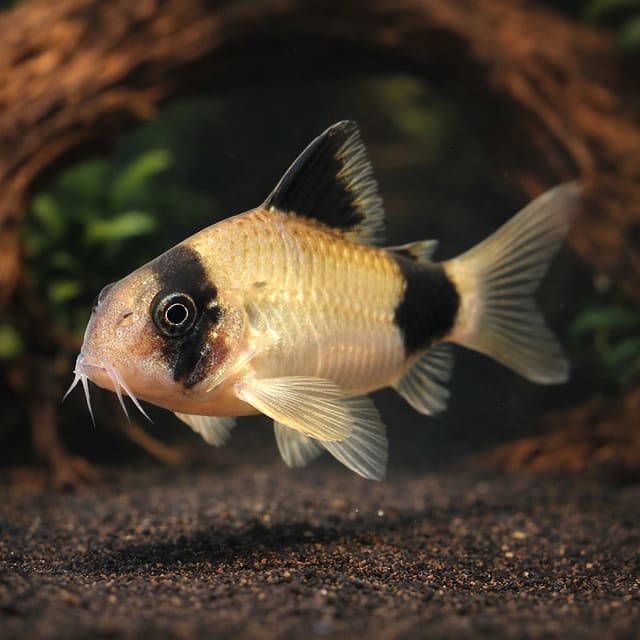
Panda Cory Catfish (Corydoras panda)
22–25°C · pH 6–7.4
£7.29

The Twosaddle Corydoras (Corydoras weitzmani) is a freshwater armoured catfish from the western Amazon River basin. It suits keepers who can follow OATA’s group guidance of at least five fish in at least 80 litres, with the FishBase and OATA overlap of 22–26°C, pH 6.0–8.0 and 4–18°dH. Sold individually in 2-2.5 cm and 3-3.5 cm dispatch sizes.
Corydoras weitzmani
Shoaling fish: kept in a group they feel safer, stay calmer and show their best colour.
The Twosaddle Corydoras (Corydoras weitzmani) is a freshwater armoured catfish from the western Amazon River basin. It suits keepers who can follow OATA’s group guidance of at least five fish in at least 80 litres, with the FishBase and OATA overlap of 22–26°C, pH 6.0–8.0 and 4–18°dH. Sold individually in 2-2.5 cm and 3-3.5 cm dispatch sizes.
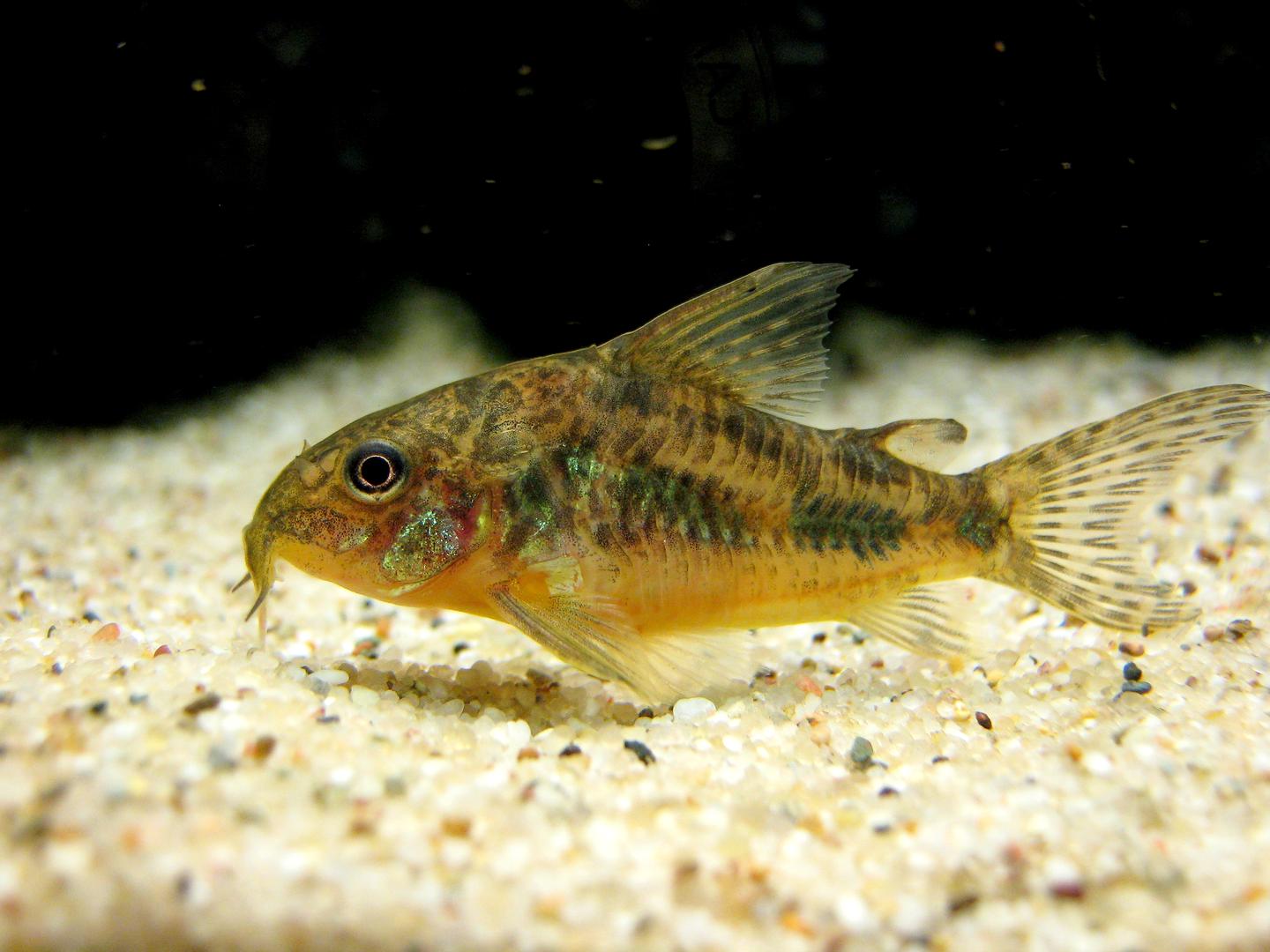
Identify the exact cory catfish before choosing care. Our starting policy for many common medium species is six compatible conspecifics, a mature 60 x 30 cm aquarium of about 60 litres, smooth fine sand and measured species-appropriate water.
Maintain these water conditions for optimal health and vibrant colors
The Twosaddle Corydoras (Corydoras weitzmani) is a freshwater, bottom-associated armoured catfish in the family Callichthyidae from the western Amazon River basin. It suits keepers who can prepare a filtered community aquarium for a social group, maintain stable water and feed the fish directly. FishBase now lists it as Hoplisoma weitzmani and describes it as demersal, meaning that its life is associated with the lower part of the water column.
This is a shoaling aquarium fish rather than a piece of cleaning equipment. Plan for its social needs, direct feeding and water quality before considering what activity it may add near the bottom. Food left for other fish is not a feeding plan, and adding a catfish does not replace gravel cleaning, water changes or algae management.
| Suits | Not suited to |
|---|---|
| Keepers planning a Corydoras shoal of at least five | Permanent solitary keeping or a group that is too small |
| A filtered aquarium of at least 80 litres for the smaller Corydoras shoal | An unfiltered or biologically immature aquarium |
| Stable 22–26°C, pH 6.0–8.0 and routine hardness of 4–18°dH | Water outside the shared working ranges |
| A carefully screened community aquarium | A community that fails the water, space, temperament or bottom-area checks |
Keepers who can meet those points can plan for a social catfish that occupies a different aquarium zone from many midwater fish. If the aquarium is still being prepared, compare the required group, water and space before selecting livestock. You can also browse the current Corydoras collection when deciding which identity and care profile suits the aquarium.
One purchase quantity supplies one animal of the selected option. Use the live size selector to choose between the labels 2-2.5 cm and 3-3.5 cm. The size you select is the size supplied, not the adult size. Treat either label as a dispatch measurement and plan the permanent aquarium around the fish’s social and long-term space needs.
A larger dispatch label does not establish sex, age, life stage or origin. It also does not turn the fish into a solitary specimen. Whichever size you choose, include it in a Corydoras group plan and assess the aquarium’s biological capacity before adding livestock.
Sex is guaranteed only when the selected option explicitly states male or female. This Twosaddle Corydoras listing has no sex-guaranteed option.
Do not try to infer the supplied sex from a dispatch measurement or gallery scene. Where a mixed-sex group is important to a future plan, the practical decision is to allow for uncertainty rather than treating body shape, markings or option size as a guarantee.
Check the full stocking load rather than solving only the headcount. A social minimum cannot compensate for an aquarium that is too small, an immature filter or unsuitable water.
Keep the aquarium at 22–26°C, pH 6.0–8.0 and general hardness of 4–18°dH. FishBase records 22–26°C, pH 6.0–8.0 and 2–25°dH for the species, while OATA’s freshwater-catfish sheet gives 22–27°C, pH 6.0–8.0 and 4–18°dH as group guidance rather than a species-specific optimum. The working values therefore keep temperature within the FishBase range and use the overlap of both sources for pH and hardness.
OATA recommends an aquarium of at least 80 litres for a shoal of smaller Corydoras and says Corydoras should be kept in groups of at least five. These are the working space and social minimums for this plan. Larger aquariums make environmental conditions such as temperature and water quality more stable, but volume alone does not make an unsuitable community safe.
| Planning value | Working instruction |
|---|---|
| Temperature | Keep within 22–26°C |
| pH | Keep within 6.0–8.0 |
| General hardness | Use 4–18°dH for routine planning |
| Aquarium volume | At least 80 litres for the shoal |
| Group | At least five Corydoras |
| Ammonia and nitrite | Keep both at zero mg per litre |
Measure the aquarium’s real values instead of choosing fish from a generic “tropical” label. A tank at 24°C and pH 7.0 passes the temperature and pH screen, but hardness, waste control, group space and existing occupants still require separate checks.
The Corydoras genus summary places corys among the freshwater armoured catfishes of South America. Across the genus, distributions extend from east of the Andes to the Atlantic coast and from Trinidad to the Río de la Plata drainage. For this animal, use FishBase’s narrower western Amazon basin placement rather than treating the range of the whole genus as the species’ own distribution.
FishBase describes the species as a facultative air-breather. It can use atmospheric air, so arrange the aquarium with unobstructed access to the water surface. A brief rise to the surface can be considered alongside this biology, but repeated changes in swimming, breathing or feeding still deserve a water-quality check.
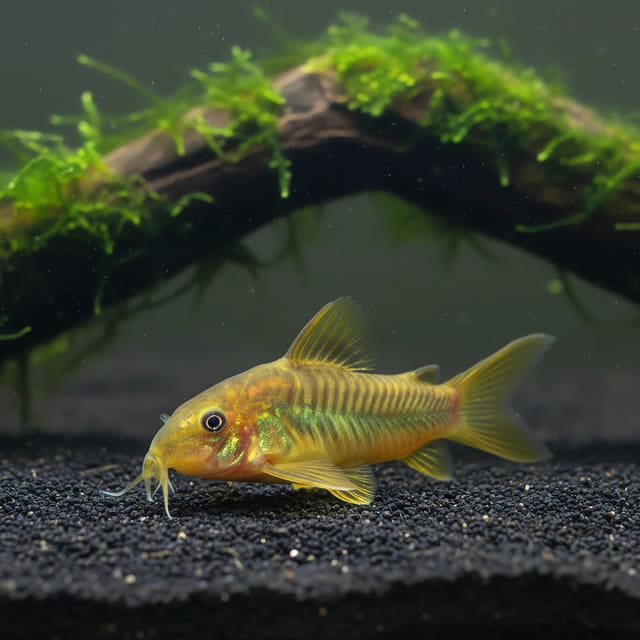
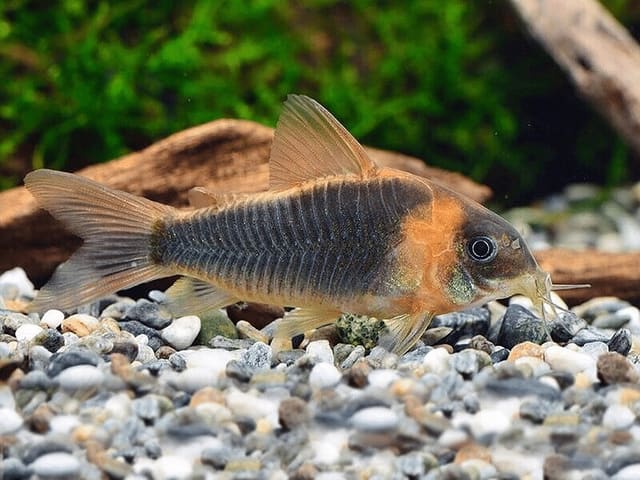
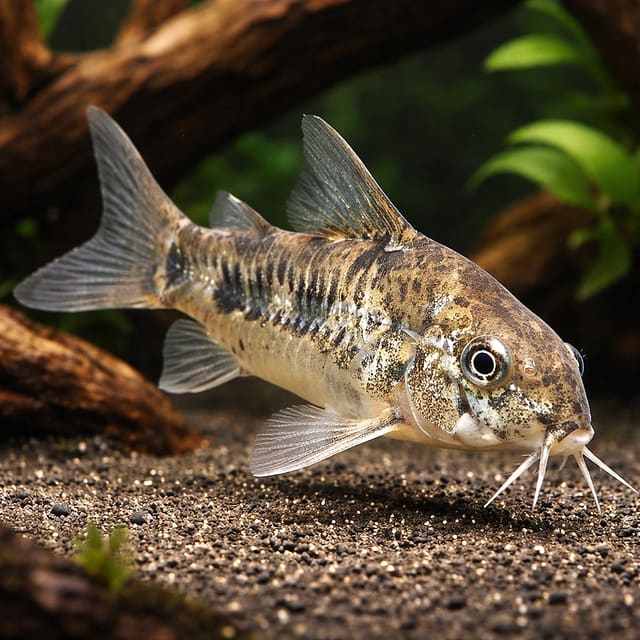
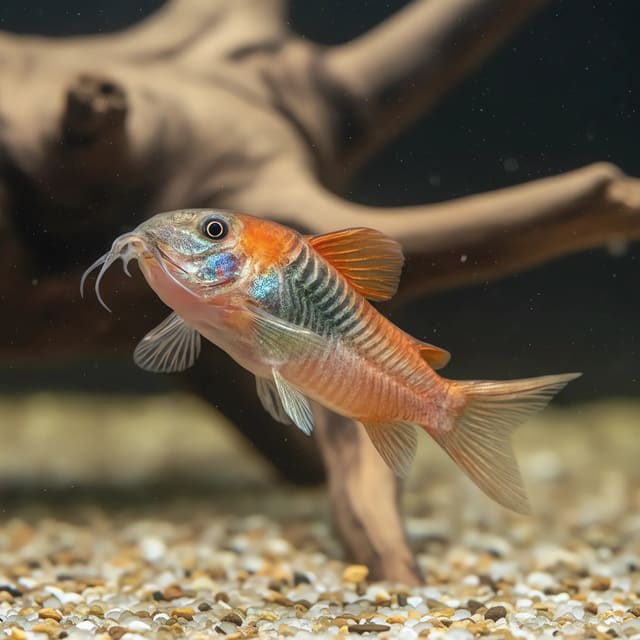
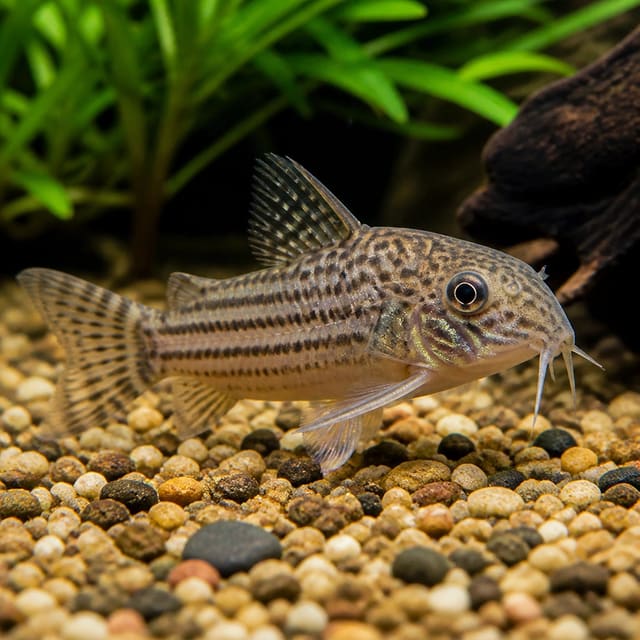
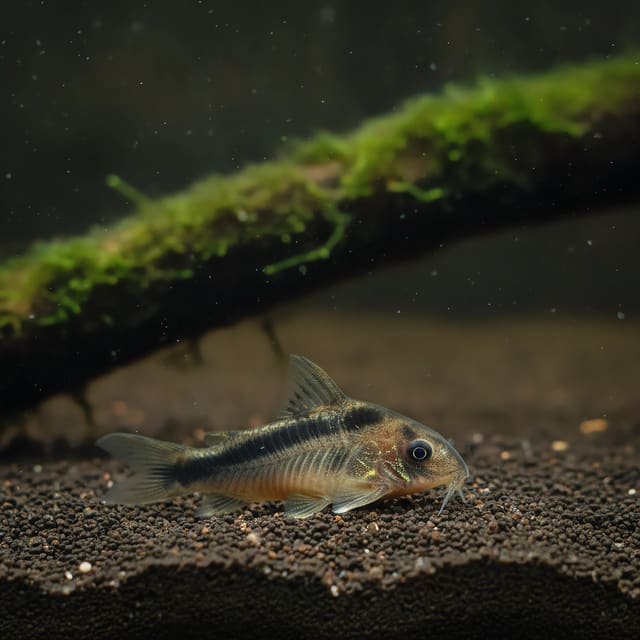
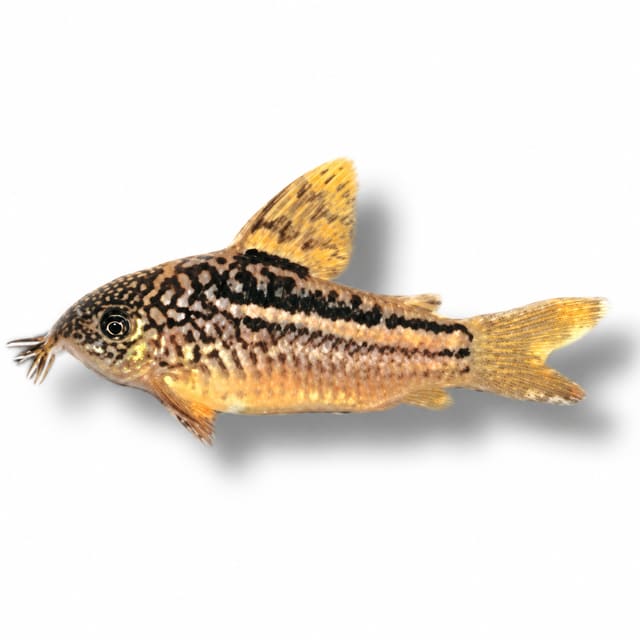
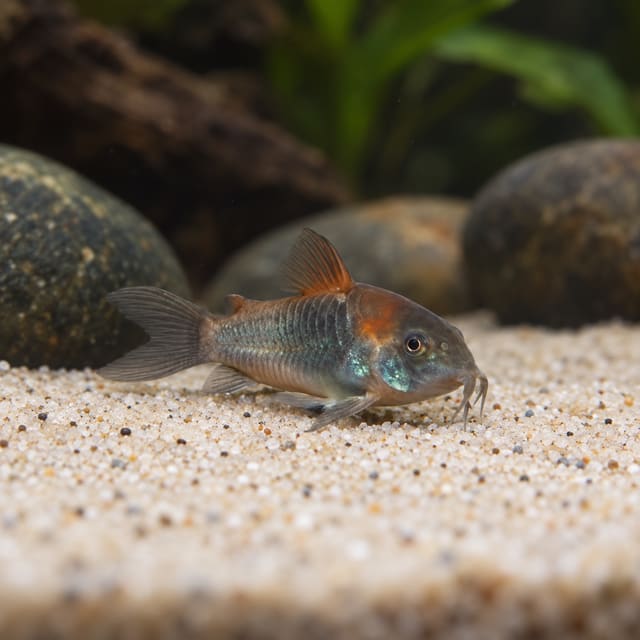
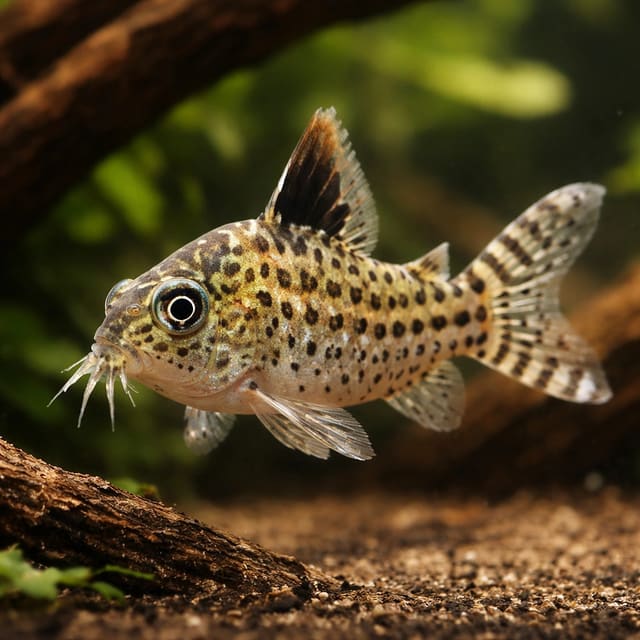
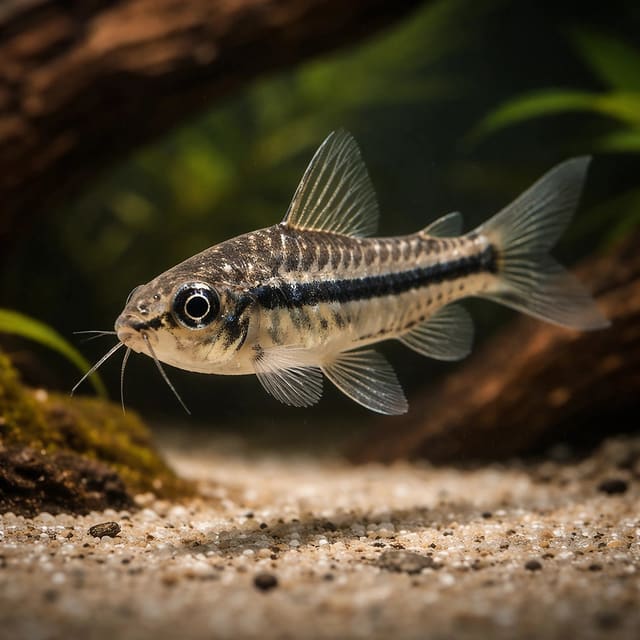
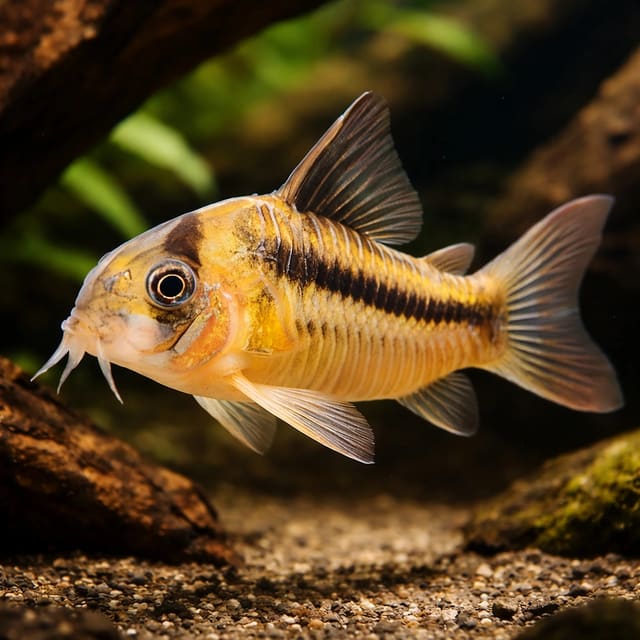
The gallery scenes show pale bronze fish with dark eye masks, two dark saddle-like markings, barbels and amber-toned fins. One scene contains two fish, while the remaining scenes contain one. Image count never changes the retail unit: purchase quantity is explained by the selector and offer text.
The gallery images are representative, based on reference photographs of this species, so colours can look slightly different from the live animal.
Use the gallery to understand the illustrated body shape and marking pattern, not to select sex or predict the exact shade of an individual fish. Lighting, background and the illustrative process can affect how pale bronze, black and amber details appear on screen.
A filter is essential. The RSPCA explains that biological filtration supports beneficial bacteria that process toxic ammonia into nitrite and then into the safer nitrate. Ammonia and nitrite are both dangerous stages in that process, so a running filter is not enough on its own; it must have an established bacterial population capable of handling the aquarium’s waste.
Prepare and mature the aquarium before livestock arrives. Our first tropical aquarium guide sets out that preparation without relying on a fixed number of days. Maturity is demonstrated by stable conditions and waste processing, not simply by how long the tank has contained water.
Beneficial bacteria must increase as fish numbers and feeding increase. Adding too much livestock too quickly can produce new tank syndrome because the filter cannot yet process the additional waste. This is especially important when a social fish needs companions: prepare enough biological capacity for the intended shoal rather than buying one fish as a test inhabitant.
If ammonia or nitrite is detectable before arrival, postpone the livestock plan and correct the filter cycle. Do not use a water change or chemical adjustment to disguise a filter that is not processing waste consistently.
Keep the aquarium between 22 and 26°C, with pH 6.0–8.0 and general hardness of 4–18°dH. These ranges overlap the species’ recorded environment and OATA’s narrower routine guidance. Choose a stable point within them that also suits the aquarium’s other inhabitants instead of repeatedly adjusting towards a supposed perfect number.
Use our water chemistry guide to understand the values being measured, then compare the results with the working range through the water matcher. Test the aquarium itself; tap-water values are only a starting point because substrate, decor, maintenance and biological activity may affect the tank.
| Result | Decision |
|---|---|
| 24°C, pH 7.2, 10°dH | Inside all three working ranges |
| 27°C | Outside the species range; correct before introduction |
| pH 6.0 | At the lower stated boundary; stability still matters |
| 20°dH | Inside FishBase’s recorded range but outside the narrower routine target |
| Any ammonia or nitrite | Investigate waste processing immediately |
Test ammonia, nitrite and nitrate at least weekly, and test again whenever behaviour, feeding, breathing or colour changes. OATA’s nitrate limit is no more than 20 mg per litre above the normal tap-water level, so measure both sources when interpreting nitrate rather than relying on the aquarium number alone.
A sudden reading matters even when it remains inside a broad range. Compare results with the aquarium’s usual baseline, look for equipment problems or recent stocking changes, and make corrections gradually unless toxic ammonia or nitrite requires immediate action.
Use live plants where practical to create cover for smaller or shy catfish. OATA also recommends suitable ornaments and shelter such as wood, pots or caves for many catfish. Arrange these features securely and leave enough accessible space for the whole shoal to move, rest and reach food.
Because the fish is a facultative air-breather, keep the route to the surface open. Avoid a continuous barrier of decor or plant growth across the entire surface, and check that lids, floating growth and equipment do not create inaccessible areas.
Choose a floor covering that can be cleaned effectively. OATA recommends siphoning solid waste from gravel during partial water changes, so account for how food and waste will be removed around plants and shelters. Inspect the floor during feeding: if food repeatedly disappears into inaccessible gaps, change the feeding location or rearrange the obstruction.
Watch how the whole group uses the layout after introduction. If one shelter becomes a congested feeding point, spread the food across more than one reachable area while keeping the total portion within what the fish finish in a few minutes. If an individual remains hidden while others feed, first check access, competition and water quality rather than assuming it has eaten elsewhere.
OATA describes Corydoras as omnivorous catfish and says catfish with a scavenging reputation still need appropriate sinking food. Feed once a day, offering only what the group can eat within a few minutes. The food must reach the lower part of the aquarium without being consumed entirely by fish feeding above.
Choose a sinking food intended to meet the needs of omnivorous catfish. Do not treat incidental leftovers, detritus or visible algae as a complete diet. The useful question is not whether food reached the bottom, but whether every Corydoras had a fair opportunity to eat an appropriate portion.
Overfeeding adds waste that can raise ammonia, nitrite and nitrate and increase the maintenance burden. Underfeeding may be hidden in a community aquarium when faster fish intercept the ration. If upper-level fish consistently take the food, adjust placement so the sinking portion reaches the Corydoras; do not solve competition by adding food without measuring what remains.
Body condition, feeding interest and group access are more useful than a rigid item count because sinking foods differ in size and density. Keep the daily schedule consistent enough to notice change. Reduced intake or a lack of interest in food is one of OATA’s warning signs, especially when it appears with altered breathing, hiding, colour or swimming.
When a new fish joins an established group, observe whether it reaches food during the same few-minute window. A fish that repeatedly misses out needs a competition and health check, not an assumption that it will survive on scraps later.
Arrange for someone to receive the parcel so live fish are not left unattended. Read the current delivery and Live Arrival Guarantee policy before the delivery window, including the current claim requirements and the instructions for the moment the box is opened.
Prepare the destination aquarium, clear surface space and complete the water tests before the parcel arrives; acclimatisation cannot correct unsuitable pH, hardness, temperature or an immature biological filter.
Keep the first decision simple: transfer the animal according to the policy, then allow it to settle in stable conditions. Avoid making several unrelated changes to temperature, decor, stocking and feeding at the same time, because simultaneous changes make it harder to identify the cause of a problem.
A transport response can change as the fish settles, but worsening breathing, loss of balance or persistent abnormal behaviour requires immediate attention to water quality and the policy’s reporting steps.
Change 25% of the aquarium water at least once every week. Treat replacement tap water with conditioner to remove harmful chlorine or chloramine before it enters the aquarium. Use a siphon to remove solid waste from gravel and accessible areas rather than allowing it to accumulate around shelters.
Test ammonia, nitrite and nitrate at least weekly. Ammonia and nitrite should remain at zero mg per litre, while nitrate should not rise more than 20 mg per litre above the normal tap-water level. Record the results so gradual change is visible before it becomes an emergency.
Tap-water chlorine or chloramine may kill beneficial bacteria in filter media. Losing too much of that population reduces the aquarium’s ability to process fish waste, even if the equipment still appears to run normally.
| Observation | Action |
|---|---|
| Waste remains after siphoning | Improve access or cleaning technique |
| Filter flow falls | Check for blockage and clean media gently if needed |
| Nitrate trend rises | Review feeding, stocking and water-change consistency |
| Ammonia or nitrite appears | Treat it as a biological filtration problem immediately |
A larger aquarium may be more stable, but it still needs this routine. Likewise, clear-looking water does not demonstrate zero ammonia or nitrite. Testing, partial water changes and careful filter handling each answer a different part of the water-quality decision.
Learn the group’s normal appearance and activity so changes stand out. OATA highlights swimming, colour, temperament, breathing, outward appearance, body condition and feeding as practical warning categories. Observe the shoal during routine feeding and again when the aquarium is quiet.
| What changes | What to do first |
|---|---|
| Hanging at the surface, prolonged bottom sitting or erratic swimming | Test water and check equipment operation |
| Faster or slower gill-cover movement | Check temperature, ammonia and nitrite promptly |
| Darker or paler colour | Compare water, social pressure and recent changes |
| More hiding or altered temperament | Check shelter access, competition and water quality |
| White spots, fluffy growths or fin damage | Record the signs and seek case-specific guidance |
| Reduced food intake | Confirm food access and test the water |
Start with measurements rather than a treatment guess. Temperature, pH, ammonia, nitrite and recent maintenance can reveal an environmental cause without exposing the fish to an inappropriate medicine. Do not add a treatment merely because two conditions share a similar outward sign.
If you are concerned about a health change, test the water and contact us with the readings, a description of the behaviour and when it began. Include any recent stocking, feeding, filter or maintenance changes because those details help distinguish an individual problem from an aquarium-wide one.
Facultative air-breathing belongs in the interpretation, but it should not be used to dismiss a new pattern of repeated surface activity. Compare the behaviour with the fish’s baseline and with other group members, then act on the measured conditions.
OATA describes Corydoras as suitable additions to community aquariums, but catfish compatibility varies widely. Treat community suitability as a starting point, then assess every occupant against the Twosaddle Corydoras plan.
A fish can pass the temperature screen and still fail because it dominates food or shelter. Conversely, two fish described as community species may need different hardness or aquarium space. Compatibility is therefore conditional on the exact aquarium, not created by a shared retail category.
| If the assessment shows | Decision |
|---|---|
| Full water-range overlap and calm use of different zones | Continue to space and filtration checks |
| Only partial temperature or pH overlap | Choose a stable target that genuinely suits both |
| Persistent bottom competition | Revise the community plan |
| Unknown adult behaviour or size | Pause until that animal’s long-term needs are clear |
For a stocking and compatibility assessment, provide aquarium volume, measured temperature, pH and hardness, current livestock with numbers, and the intended Corydoras group size. That produces a more useful decision than a generic tank-mate list.
Keep at least five Corydoras together. OATA warns that Corydoras kept singly or in groups that are too small will often become stressed. Count the actual fish in the social group and do not treat unrelated bottom dwellers as substitutes for Corydoras companions.
Use at least 80 litres as the starting point for the smaller Corydoras shoal, then reassess space for every additional inhabitant. The minimum volume is not a promise that every group of five fits every 80-litre aquarium; shape, decor, filter capacity, existing fish and shared use of the lower area all affect the decision.
Increase fish numbers slowly enough for beneficial filter bacteria to respond to the additional waste and feeding. At the same time, do not use slow stocking as a reason to leave a shoaling fish alone indefinitely. The sound sequence is to mature sufficient filtration first, choose an aquarium that can support the intended shoal, and then introduce livestock without exceeding biological capacity.
After any addition, watch the first feeds closely. Every animal should reach appropriate sinking food within a few minutes. If one individual is repeatedly displaced, revise placement, decor or stocking rather than simply increasing the portion and leaving excess food to decay.
Plan its permanent aquarium around OATA’s recommendation of at least 80 litres for a shoal of smaller Corydoras, rather than treating the 2-2.5 cm or 3-3.5 cm dispatch sizes as adult lengths.
Use a filtered, established aquarium of at least 80 litres for the smaller Corydoras shoal. OATA gives this as group guidance, and additional occupants still need separate space and filtration checks.
Keep at least five Corydoras together. OATA warns that Corydoras kept singly or in groups that are too small will often become stressed.
It suits a keeper who can establish biological filtration, keep ammonia and nitrite at zero mg per litre, maintain the stated water range and provide a group of at least five; no beginner rating is applied.
Feed an appropriate sinking food for omnivorous catfish once a day, giving only what the group can finish within a few minutes. Do not rely on scraps or visible algae as a complete diet.
Keep it at 22–26°C and pH 6.0–8.0, with 4–18°dH as the routine hardness target from the FishBase and OATA overlap. Ammonia and nitrite must remain at zero mg per litre.
OATA includes Corydoras among community-aquarium catfish, but screen every companion for temperament, chasing, disturbance, food exclusion and competition near the bottom before mixing them.
Consider calm community fish only after checking overlap in 22–26°C water, adult size, temperament, feeding competition, bottom-area use and total biological load.
Have someone present to receive it, then film every delivery continuously from the sealed parcel as it is opened, with the fish still inside the sealed bag. Float the bag for 20–30 minutes before releasing the fish, and never pour the transport-bag water into the aquarium.
No reviews for this item yet. Bought one? Honest reviews only, good or bad.
What customers say about ordering from us
I have a small group of long finned mountain minnows. So was delighted to be able to order ten of this variety to increase the genetics in my tank . The ones I recieved are healthy but it’s to early to give a verdict on wether they are of a long finned type since they are small currently.
Gordon Walker · 23 Sept 2026
100% success travel and "installation". Pleased with quality of purchase. The Siamese fighter a bit "shy" so have not yet seen him at his best yet but looking good. Happy customer. GG
George E Garratt · 21 Sept 2026
Reviews of our shop, collected by Judge.me, an independent third-party review collector. Newest first.