Albino Bronze Cory (Osteogaster aenea)
22–27°C · pH 6–8 · 72L
£2.99

Rusty Cory (Corydoras rabauti), also called Rabaut's Cory, is a peaceful shoaling catfish for mature planted community aquariums with soft sand and gentle tank mates.
Adult size is the maximum length this species reaches at full maturity (scientific sources). The livestock you receive will be younger and smaller — pick a size above for the actual shipping size. Product-photo provenance and any image-specific limitations are stated on the listing.
Corydoras rabauti
Shoaling fish: kept in a group they feel safer, stay calmer and show their best colour.
Rusty Cory (Corydoras rabauti), also called Rabaut's Cory, is a peaceful shoaling catfish for mature planted community aquariums with soft sand and gentle tank mates.
Adult size is the maximum length this species reaches at full maturity (scientific sources). The livestock you receive will be younger and smaller — pick a size above for the actual shipping size. Product-photo provenance and any image-specific limitations are stated on the listing.
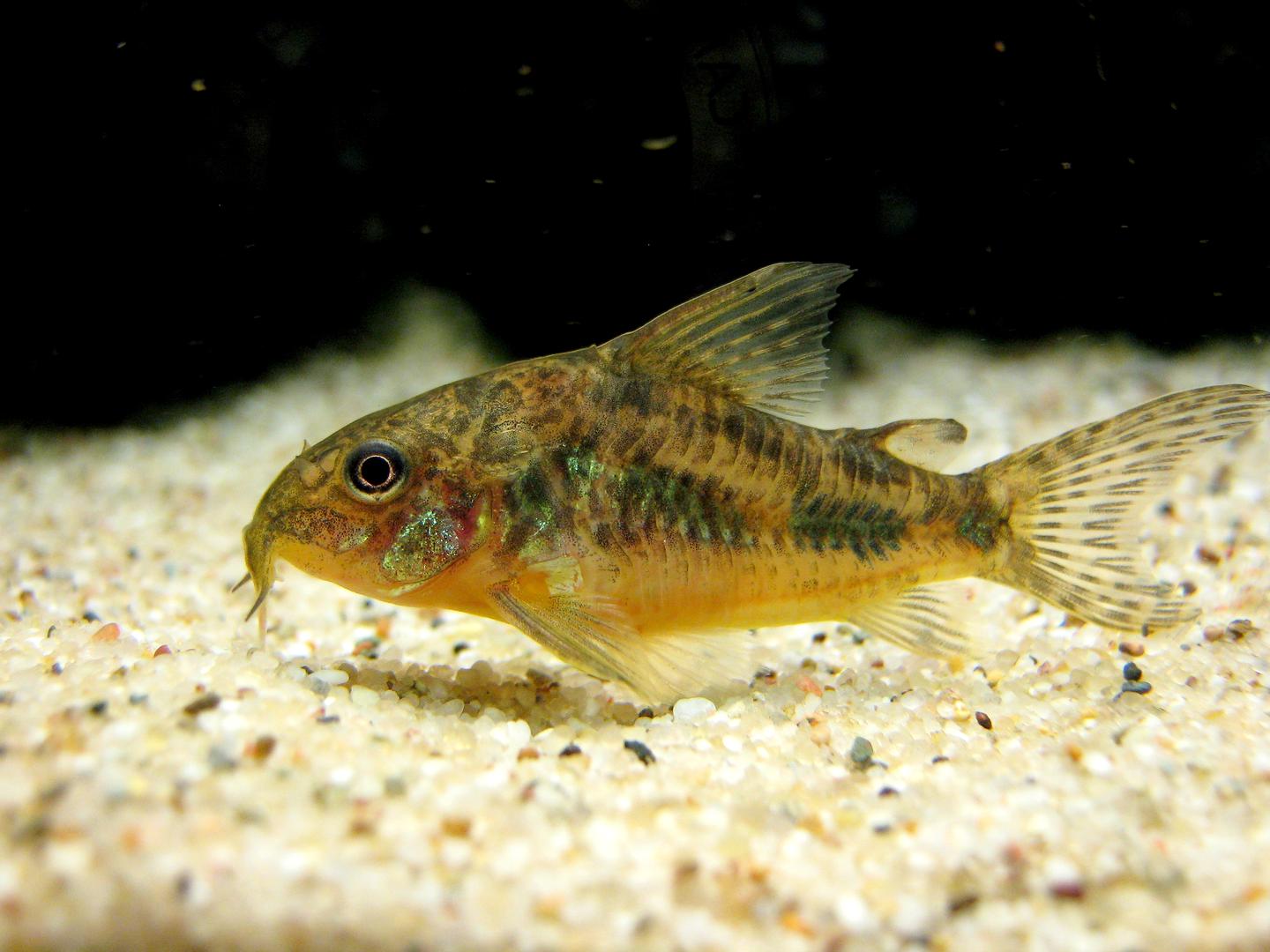
Identify the exact cory catfish before choosing care. Our starting policy for many common medium species is six compatible conspecifics, a mature 60 x 30 cm aquarium of about 60 litres, smooth fine sand and measured species-appropriate water.
Maintain these water conditions for optimal health and vibrant colors
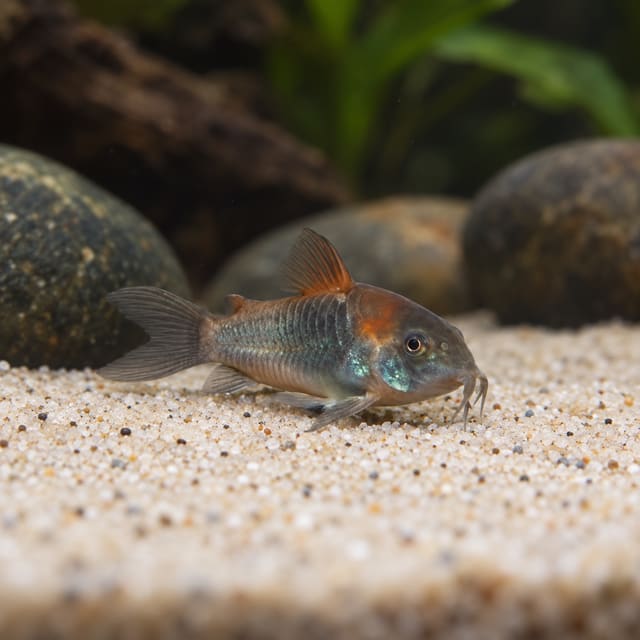
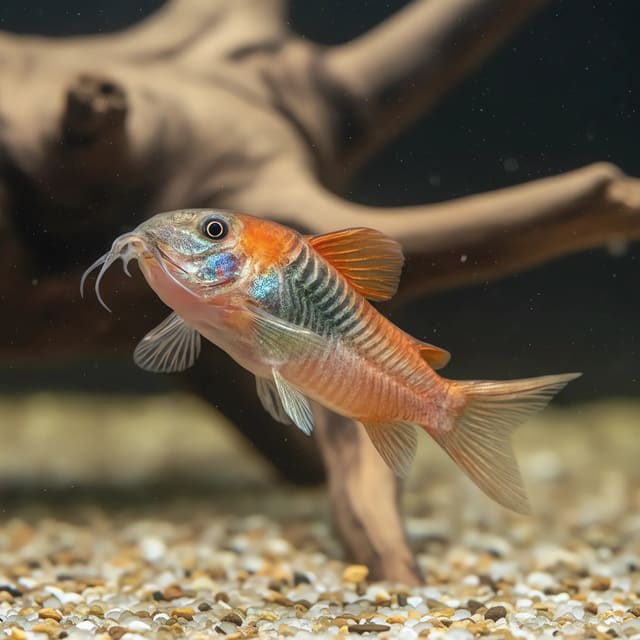
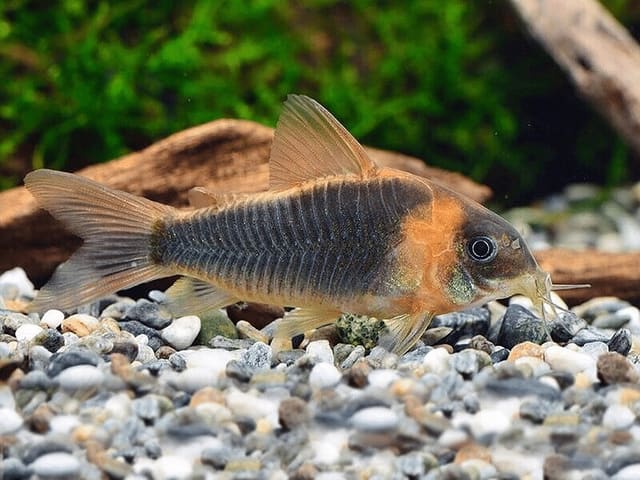
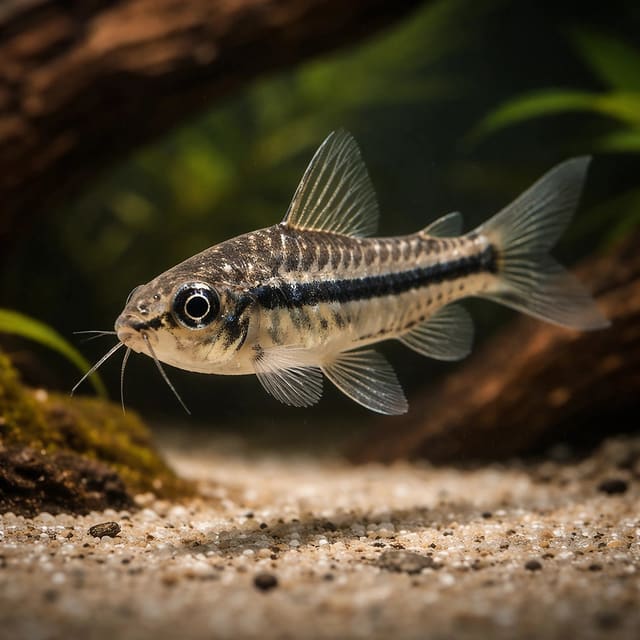
Rusty Cory (Corydoras rabauti) is a warm bronze-orange Corydoras with the calm, busy, bottom-level behaviour that makes cory catfish so useful in a peaceful planted aquarium. It is also sold as Rabaut's Cory, Rust Cory or Iridescent Cory, and it is a better name fit than the old generic Cory Catfish wording because this species has its own recognisable look: a compact armoured body, pale belly, gold to rusty flanks, barbels for searching the substrate and a darker upper stripe that runs towards the tail.
Choose this fish if you want a sociable bottom-dweller for a mature tropical tank with soft sand, clean oxygen-rich water and gentle tank mates. It is not an aggressive algae-eater or a substitute for maintenance. It is a living shoaling catfish that spends the day sifting for leftover prepared foods, small frozen foods and natural morsels around the substrate. Keep it in a proper group and it becomes much more confident, visible and enjoyable.
Current live variants for this product include smaller in-stock sizes plus the larger JP04 size. Prices and stock are shown by the live variant selector on the page. Eligible first orders can use WELCOME10, and live fish orders are covered by the Tropical Fish Co Live Arrival Guarantee when the delivery and acclimation terms are followed.
| Scientific name | Corydoras rabauti, also seen in newer taxonomy as Osteogaster rabauti |
|---|---|
| Common names | Rusty Cory, Rabaut's Cory, Rust Cory, Iridescent Cory |
| Family | Callichthyidae, the armoured catfish family |
| Adult size | Usually around 5-6 cm in aquarium care |
| Temperament | Peaceful, social and best kept in a group |
| Minimum aquarium | 60 litres for a small group; more floor area is better |
| Temperature | 22-26°C is a practical aquarium range; keep it stable |
| pH and hardness | Soft to moderately hard water; avoid sudden swings |
| Diet | Omnivore: sinking pellets, wafers, frozen foods and small live foods |
| Best substrate | Fine sand or very smooth rounded gravel kept clean |
Rusty Cory is a good fit when you want movement and interest at the bottom of the aquarium without adding a pushy or territorial fish. A healthy group spends much of the day nosing through the substrate, pausing under plants, exploring around wood and joining the group again when food appears. They bring the kind of quiet activity that makes a planted community tank feel complete.
The species is especially appealing because it is different from the most common Corydoras without needing extreme care. Bronze Cory, Panda Cory and Sterbai Cory are better known, but Corydoras rabauti has a richer rusty sheen and a more subtle, grown-up look. In good condition the body can show gold, copper, olive and brown tones, with the darker upper stripe giving the fish a clear profile against sand and plants.
They are also useful from a husbandry point of view. Corydoras search for food that reaches the bottom, so they help stop edible leftovers sitting in one place. They do not replace gravel cleaning, water changes or sensible feeding, and they should not be sold as a miracle cleaning fish. Their real value is that they are active, peaceful, social and easy to watch when the aquarium is set up around their needs.
Because they are armoured catfish, they have bony plates rather than ordinary scales and small barbels around the mouth. Those barbels are one of the most important features to protect. A soft, clean substrate is not a decorative extra; it is part of keeping the fish comfortable and healthy. Sharp gravel, compacted dirt and trapped waste can lead to worn barbels, infections and shy behaviour.
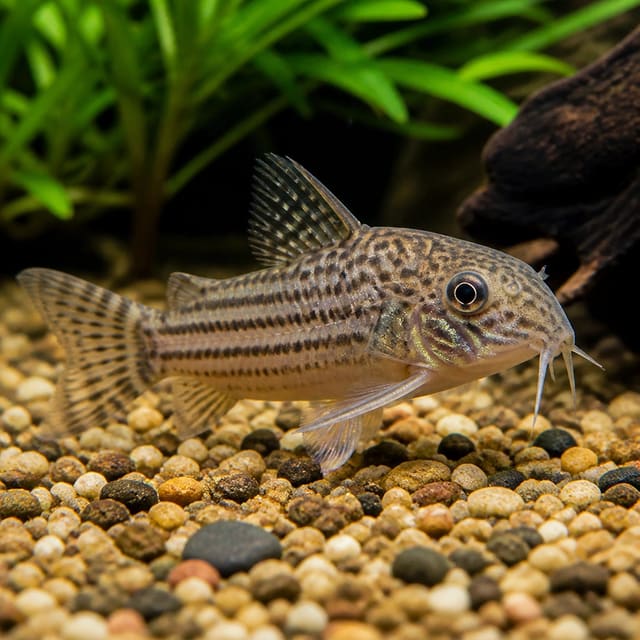
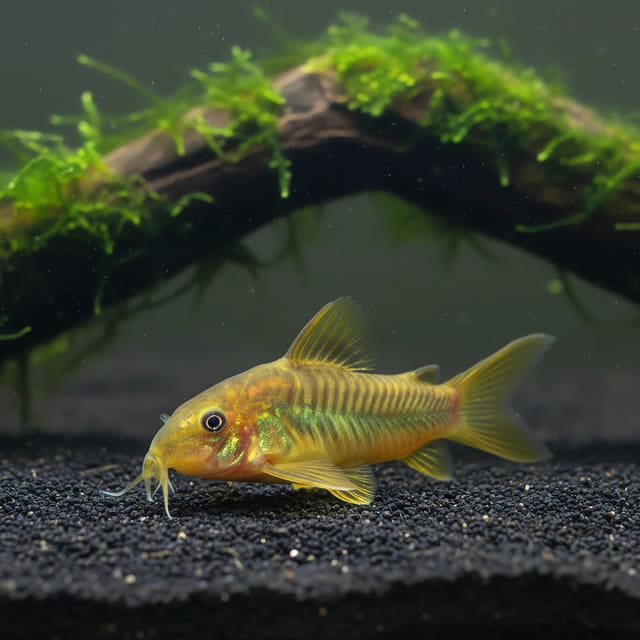
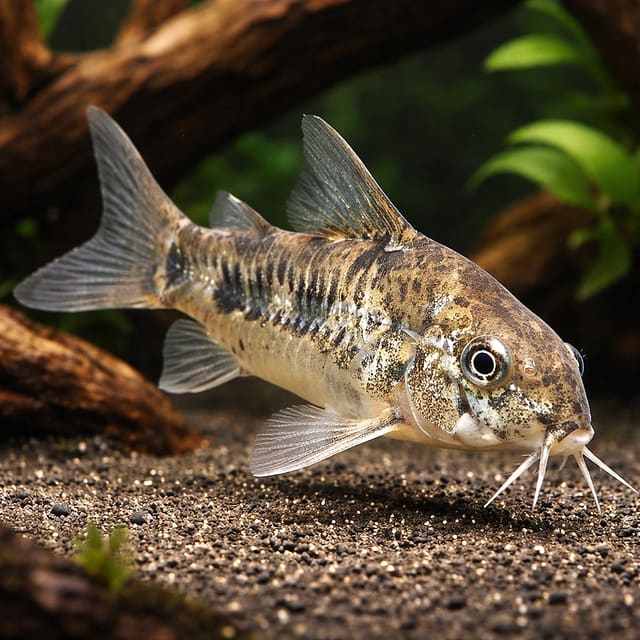
Rusty Cory is a compact Corydoras with a rounded body, high back, broad head and short whisker-like barbels. The colour is the main reason aquarists seek it out. Depending on mood, lighting and age, it can show a pale cream underside, yellow to orange gill area, bronze flanks, olive highlights and a darker band along the upper body. In planted tanks with warm light, adults can look almost golden.
ScotCat notes that Osteogaster rabauti is often confused with the similar Osteogaster zygatus. The useful practical distinction for aquarists is that Rabaut's Cory has a rusty body and fins with a matt greenish stripe that bends downward near the caudal peduncle, while the similar species is more elongate and patterned differently.
Females normally become broader and deeper-bodied than males once mature, particularly when well fed. Males tend to look a little slimmer from above. Young fish can look paler than adults, and newly arrived fish may take time to show full colour. Good diet, calm tank mates, a dark natural background and a group of their own kind usually bring out stronger colour and bolder behaviour.
| Feature | What to look for | Why it matters |
|---|---|---|
| Body colour | Rust, bronze, orange-gold or olive tones | Separates it from paler or greyer Corydoras types |
| Upper stripe | Darker line running towards the tail | Part of the Rabaut's Cory look and useful for identification |
| Barbels | Fine sensory whiskers around the mouth | Need clean sand and careful substrate maintenance |
| Body shape | Chunky, armoured and compact | Healthy adults should not look thin, pinched or hollow |
Corydoras rabauti is a South American armoured catfish associated with Amazon basin waters, including the Rio Negro and Solimões regions. FishBase lists it as a tropical freshwater aquarium species and records its reproductive behaviour among typical Corydoras-style egg scatterers. Other aquarium references place it in soft-water river and floodplain habitats where the fish forages in groups over bottom material and among cover.
For aquarium care, the habitat lesson is more important than trying to copy one exact river. Give the fish warm stable water, a clean bottom, shaded retreats, gentle open feeding areas and enough oxygen. They appreciate a layout with soft sand in front, wood or roots at the back, plants around the edges and a few open paths where the group can move together. Leaf litter can be used in mature soft-water aquariums, but it should not be allowed to rot into dirty pockets.
Rusty Cory can rise to the surface for a quick gulp of air. Corydoras have a specialised way of using atmospheric oxygen, so the occasional dash to the surface is normal. Constant frantic gulping, however, can signal low oxygen, poor water quality, overheating or stress. If the fish are gasping repeatedly, test the water and increase aeration rather than assuming the behaviour is harmless.
The best aquarium for Rusty Cory is stable, mature and built around floor space. A 60 litre aquarium can work for a small group if the footprint is generous and the tank is not crowded, but a longer aquarium is better than a tall narrow one. Corydoras use the bottom more than the open top, so length and open substrate matter more than water height.
Use fine aquarium sand if possible. Smooth rounded gravel can work if it is small, clean and not sharp, but sand lets the fish search naturally without damaging the barbels. Keep the substrate shallow enough to clean properly, and do not bury uneaten food where the fish cannot reach it. A good feeding routine should leave the bottom active, not dirty.
Filtration should be steady but not violent. Rusty Cory appreciates oxygen-rich water and a gentle current, especially around feeding time, but it should not have to fight a blasting flow all day. Sponge filters, spray bars, well-aimed internal filters and mature external filters can all work. The important points are stable biological filtration, no ammonia, no nitrite and regular maintenance.
Decor should give cover without stealing all the floor area. Driftwood, rounded stones, low plants, floating shade and leaf litter can all help the fish feel secure. Leave open sand in front for feeding and group movement. If the tank is too bare, the fish may hide. If it is too cluttered, waste can collect and the group has nowhere to forage properly.
| Parameter | Recommended approach | Notes |
|---|---|---|
| Temperature | 22-26°C | Avoid sharp daily swings; warmer water needs more oxygen |
| pH | Soft-acidic to neutral is ideal; stable slightly alkaline can be workable | Do not chase numbers with repeated chemical changes |
| Hardness | Soft to moderately hard | Stability matters more than a perfect textbook figure |
| Ammonia / nitrite | 0 | Corydoras are sensitive to poor bottom-level water quality |
| Nitrate | Keep low with water changes | Lower is better for long-term health and barbels |
Rusty Cory should be kept socially. A single Corydoras may survive, but it will not show the same confidence, feeding response or natural movement. Aim for at least six when space allows. Larger groups are even better in a suitable aquarium because the fish spread stress across the shoal and spend more time in the open.
In a settled group you will see short bursts of activity, nose-down searching, resting under leaves, occasional surface dashes and loose shoaling. They are not strict schooling fish that hold a tight formation every minute. Instead, they keep contact, split up, regroup and respond strongly when one fish discovers food.
Shy behaviour after arrival is normal. Keep lights gentle, avoid boisterous tank mates, offer food after the lights dim and let the aquarium settle. If the group remains hidden for weeks, look at the environment: too few Corydoras, sharp substrate, aggressive fish, high nitrate, bright open layout or not enough food reaching the bottom are common causes.
| Behaviour | Usually normal? | What it means |
|---|---|---|
| Quick surface gulp | Yes, if occasional | Normal Corydoras air-breathing behaviour |
| Constant surface rushing | No | Check oxygen, temperature, ammonia, nitrite and stress |
| Resting on sand | Yes | Corydoras often pause between feeding bursts |
| Missing barbels | No | Review substrate cleanliness and infection risk |
| Very thin belly | No | Food may not be reaching the group or fish may need treatment |
Rusty Cory is an omnivore, not a fish that lives on algae alone. FishBase records the natural diet of related habitat as worms, crustaceans, insects and plant matter. In the aquarium, the safest routine is a varied bottom-feeding diet built around quality sinking foods with frozen or live foods used as enrichment.
Feed after the upper-water fish have calmed down so the Corydoras get a fair share. Small sinking granules, wafers and tablets are useful, but they should not be the only food forever. Rotate in frozen bloodworm, brine shrimp, daphnia, cyclops or mosquito larvae where appropriate. Live foods can encourage breeding condition, but they should come from safe sources.
Watch body shape rather than guessing from the amount added. A healthy Cory should have a rounded belly after feeding but should not become bloated. If fast tetras, barbs or cichlids steal everything before it reaches the bottom, target feed with tongs or feed at two points in the aquarium. Remove obvious uneaten food before it decays.
| Food type | Use | Notes |
|---|---|---|
| Sinking catfish tablets | Staple | Break into pieces for even group feeding |
| Micro granules | Staple or rotation | Good for smaller juveniles and mixed communities |
| Frozen bloodworm or brine shrimp | Conditioning treat | Useful but should not be the only food |
| Algae wafers | Occasional variety | They may graze them, but the fish still needs protein |
| Vegetable-based foods | Small part of varied diet | Helpful as balance, not as a complete diet |
Rusty Cory is peaceful and works best with other peaceful fish that do not harass the bottom. Good tank mates include small tetras, rasboras, pencilfish, peaceful livebearers, smaller gouramis, calm dwarf cichlids and other non-aggressive catfish that leave enough floor space. The key is not just temperament; it is whether the Corydoras can feed without being bullied.
Avoid large predatory fish, fin-nippers that constantly disturb the bottom, aggressive cichlids, large loaches that compete too strongly and rough goldfish-style setups. Even if a larger fish cannot swallow an adult Cory easily, attempted predation can injure both fish because Corydoras have stiff pectoral fin spines. Choose tank mates that are genuinely peaceful and appropriately sized.
Shrimp compatibility depends on the shrimp size and the aquarium. Adult Amano shrimp or larger Neocaridina often live alongside Corydoras, but tiny shrimplets may be eaten opportunistically. Corydoras are not shrimp hunters in the way some cichlids are, but any small fish may take very small invertebrates if they fit in the mouth.
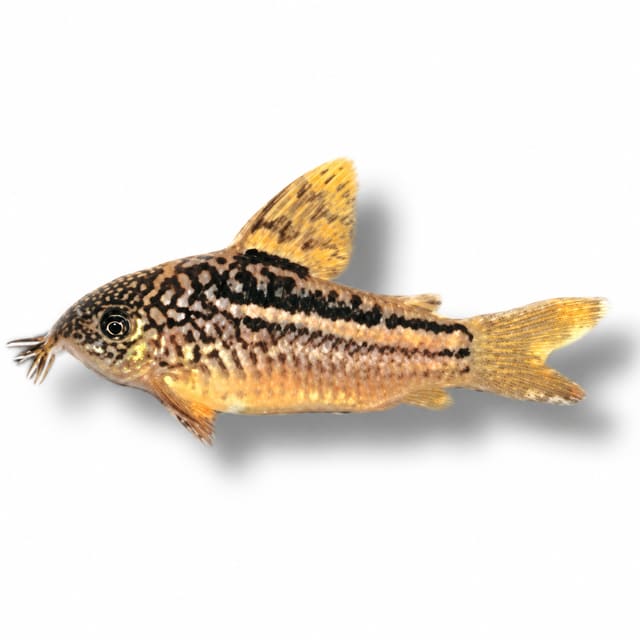
If you want other Corydoras in the same aquarium, choose carefully. Mixed Cory groups can work, but each species is happiest with enough of its own kind. If you only have room for six Corydoras total, six Rusty Cory are better than one each of six different species. For comparison, see our Green Gold Cory, Leopard Cory, Horseman Cory, Two Point Cory and Seuss' Cory listings.
| Tank mate type | Suitability | Reason |
|---|---|---|
| Small peaceful tetras | Good | Use upper and middle water, usually calm |
| Dwarf cichlids | Conditional | Choose calm species and give territory space |
| Other Corydoras | Good with planning | Keep proper groups and avoid overcrowding the bottom |
| Large cichlids | Poor | Bullying and predation risk |
| Large rough loaches | Poor to conditional | Can outcompete Corydoras for food and space |
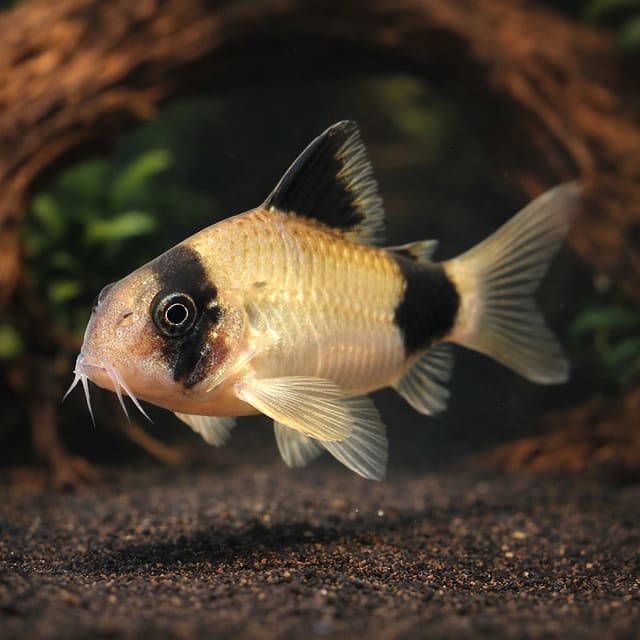
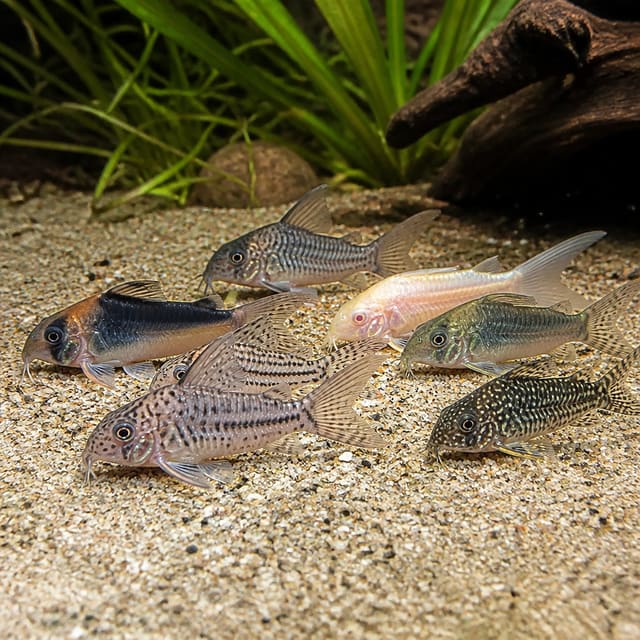
Rusty Cory has a warm bronze-orange look and a darker upper stripe. Panda Cory is a contrasting black-and-cream fish, Sterbai Cory is spotted with orange pectoral fins, and Albino Cory is usually an albino form of a different Corydoras species. Compare their care and appearance as separate fish.
If you are choosing between them, think about the aquarium temperature, visual style and group size. Rusty Cory suits a planted tropical community with a softer natural look. Panda Cory gives a brighter high-contrast pattern. Sterbai Cory can be a strong option for warmer community tanks. Albino Cory is usually hardy and visible, but it has a very different look from Rabaut's Cory.
| Fish | Main look | Best reason to choose it |
|---|---|---|
| Rusty Cory (Corydoras rabauti) | Rust, bronze and olive with darker upper stripe | Natural-looking, peaceful shoaling catfish for planted tanks |
| Panda Cory | Cream body with black patches | High-contrast, popular Corydoras with a cute pattern |
| Sterbai Cory | Spotted body with orange pectoral fins | Attractive option for warmer peaceful aquariums |
| Albino Cory | Pale body and red eyes | Very visible, often bold and easy to spot |
| Green Gold Cory | Green-gold sheen and natural catfish profile | Another subtle South American bottom-dweller |
Rusty Cory can spawn in aquarium conditions, although the product page should treat breeding as a care note rather than a promise. FishBase describes the typical Corydoras method where the female holds a small number of eggs between the pelvic fins while the male fertilises them, then attaches sticky eggs to a chosen surface. This process can be repeated until many eggs have been laid.
Conditioning is usually done with varied foods, clean water and a settled group. Many aquarists trigger Corydoras spawning with a cool water change, increased oxygenation and a weather-change effect, but the fish need to be mature and in good condition first. A group with more males than females often gives better spawning activity.
Adults may eat eggs, so serious breeding attempts normally use a separate hatching container or remove eggs carefully to a safe tank with matching clean water and gentle aeration. Fry are small and need tiny foods after the yolk sac is absorbed. Baby brine shrimp, microworms and other appropriately sized live foods are often used by breeders.
For most customers, the practical point is simpler: a Corydoras that is kept in a group, fed well and given clean stable water will behave more naturally. Even if you never raise fry, the same care that supports breeding condition also supports colour, confidence and long-term health.
Rusty Cory is not difficult when kept correctly, but it is sensitive to the common bottom-dweller problems: dirty substrate, poor oxygen, rough gravel, aggressive tank mates and not enough food reaching the bottom. The first health check is always the environment. Test ammonia, nitrite, nitrate, temperature and pH; look at the substrate; and watch whether the group is being outcompeted at feeding time.
Barbel erosion is one of the clearest warnings. Short, red or missing barbels can come from abrasive substrate, bacterial issues or dirty pockets in the bottom. Move the fish to cleaner conditions, review the substrate and treat infection only when diagnosis supports it. Do not keep dosing medication into a dirty aquarium and expect the problem to stay fixed.
Thin fish need attention. Because Corydoras are bottom feeders, it is easy to assume they are eating when food is actually being stolen above them. Feed sinking foods after lights dim, use several feeding spots and watch each fish. A pinched belly, clamped fins or isolation from the group is a sign to investigate quickly.
Always acclimate new Corydoras gently. They are armoured, but they are still live fish dealing with transport stress. Float or temperature-match the bag as instructed, transfer carefully, keep lights subdued and do not add them to an immature tank. Avoid exposing Corydoras to air longer than necessary and never catch them roughly in a net where pectoral spines can snag.
| Problem | Likely causes | First response |
|---|---|---|
| Worn barbels | Sharp or dirty substrate, infection | Improve substrate hygiene and check water quality |
| Hiding constantly | Too few Corydoras, bright tank, bullying | Increase group size and add safe cover |
| Thin belly | Not enough food reaching bottom, internal issue | Target feed and monitor individual fish |
| Rapid breathing | Low oxygen, ammonia/nitrite, heat stress | Test water and increase aeration immediately |
| Clamped fins | Stress, poor water, disease | Check environment before medicating |
When Rusty Cory is in stock, choose the size variant that suits your aquarium and existing fish. Smaller Corydoras can settle very well in peaceful planted tanks, while larger fish may be easier to mix with established adult communities. Check the live stock selector for the current JP04 and sibling variant availability because stock and pricing can change with weekly supplier updates.
Live fish are sent with specialist packing and a live-fish delivery process rather than ordinary dry-goods handling. The Live Arrival Guarantee is there to support responsible delivery, but it depends on following the delivery and acclimation instructions. Be ready for the parcel, open it promptly, keep the lights low and give the new group time to settle before heavy feeding.
Do not add Rusty Cory to a brand new aquarium. The tank should be cycled, stable and ready with no ammonia or nitrite. If the fish arrive pale or shy, that is normal after transport. Colour and confidence usually improve over the first days as they find cover, join the group and learn the feeding routine.
If this is your first Corydoras group, plan the whole shoal rather than buying one fish as a test. A lone Corydoras is less confident and less representative of the species. A group of six or more in a clean mature aquarium is the better welfare choice and the better display.
Yes. Rusty Cory, Rust Cory and Rabaut's Cory are common names used for Corydoras rabauti. Some newer taxonomic sources place the species in Osteogaster, but many aquarium shops and keepers still search for it as Corydoras rabauti.
Keep at least six when the aquarium size allows. A proper group makes the fish more confident, improves feeding response and gives the natural loose-shoaling behaviour people expect from Corydoras.
It will search the bottom for edible foods, but it is not a replacement for maintenance. You still need water changes, substrate cleaning and sensible feeding. Think of it as an active bottom-dweller, not a waste disposal fish.
Fine sand is strongly recommended because Corydoras use their barbels to explore the substrate. Very smooth rounded gravel can work, but sharp gravel and dirty compacted substrate increase the risk of barbel damage.
It is usually peaceful with adult shrimp in a planted tank, but tiny shrimplets may be eaten opportunistically. Provide moss, plants and hiding spaces if shrimp breeding is important to you.
Occasional surface gulps are normal for Corydoras. Constant gulping is not something to ignore; check oxygen, temperature, ammonia, nitrite and general stress if the behaviour becomes frequent.
Use a varied sinking diet: catfish tablets, small granules, wafers, frozen bloodworm, brine shrimp, daphnia and other small foods. Make sure food actually reaches the group.
It can be suitable for careful beginners with a cycled aquarium, soft clean substrate and peaceful tank mates. It is less suitable for brand new tanks, rough gravel setups or aquariums with aggressive fish.
Rusty Cory looks best in an aquarium that gives contrast without making the fish feel exposed. A pale open sand foreground shows the natural body shape and makes feeding easy to watch. Behind that, use darker wood, roots, Cryptocoryne, Java fern, Anubias, floating plants or tall stems to create shade. The fish will often rest at the edge of cover and then move forward as a group when food is added.
Do not make the whole floor a dense carpet if Corydoras are the main bottom fish. Carpet plants can look attractive, but the fish still need open areas where they can sift and turn comfortably. A layout with open sand lanes, planted borders and a few smooth resting spots gives a better balance between display and welfare.
If you use botanicals such as leaves or alder cones, add them gradually and monitor water colour and pH. Light tannins can suit the natural feel of a South American aquarium, but stability is more important than making the water extremely dark. Remove decaying material before it creates dirty pockets in the substrate.
| Aquascape choice | Good use | Watch point |
|---|---|---|
| Fine pale sand | Shows colour and protects barbels | Vacuum lightly so food does not sour underneath |
| Driftwood and roots | Creates shade and natural shelter | Leave open routes for the group to move |
| Leaf litter | Natural cover in mature soft-water tanks | Do not let old leaves trap waste |
| Floating plants | Softens light and calms shy fish | Keep enough surface movement for oxygen |
A simple weekly routine keeps Rusty Cory in better condition than occasional heavy intervention. Test the water if the tank is new, recently changed or behaving oddly. Change water regularly, clean the substrate surface gently and rinse mechanical filter media in old tank water when flow drops. Avoid deep disruptive cleaning of every surface at once because Corydoras prefer mature biological stability.
Watch the group during feeding at least a few times each week. This tells you more than a quick glance at the tank. You should see most fish come out, locate food and keep a rounded but not swollen belly. If one fish hangs back repeatedly, it may be bullied, unwell or simply losing the feeding race. Early observation prevents small issues becoming emergency treatment.
After maintenance, give the aquarium time to settle before judging colour. Corydoras can look pale immediately after disturbance. They should regain normal colour and behaviour once the tank is calm. If they stay clamped, breathe quickly or sit away from the group, test water immediately and check that no cleaning product, aerosol or contaminated bucket has been used near the aquarium.
| Task | Frequency | Reason |
|---|---|---|
| Water change | Weekly or as nitrate requires | Keeps bottom-level water fresh and stable |
| Light substrate clean | Weekly | Protects barbels and removes trapped food |
| Feeding observation | Several times weekly | Confirms all Corydoras are eating |
| Filter flow check | Weekly | Maintains oxygen and biological filtration |
| Body-condition check | Weekly | Finds thin, isolated or stressed fish early |
Rusty Cory suits the aquarist who enjoys natural behaviour more than showy aggression. It is not a centrepiece fish that dominates the aquarium. Its appeal is in the group: several fish moving together over sand, pausing under leaves, responding at feeding time and adding gentle movement to the lower level of the tank.
It is a strong choice for planted South American-style communities, soft-water aquariums, calm mixed tropical tanks and aquarists who already like Corydoras but want a less common look. It is less suitable for rough gravel, very new aquariums, predator tanks, large aggressive cichlid layouts or tanks where the bottom is already crowded with competing fish.
If you are building a first Corydoras group, buy the group and design the floor around them. If you are adding to an existing Corydoras collection, make sure the Rusty Cory group still has enough of its own species. That one decision does more for confidence than almost any decoration choice.
No reviews for this item yet. Bought one? Honest reviews only, good or bad.
What customers say about ordering from us
I have a small group of long finned mountain minnows. So was delighted to be able to order ten of this variety to increase the genetics in my tank . The ones I recieved are healthy but it’s to early to give a verdict on wether they are of a long finned type since they are small currently.
Gordon Walker · 23 Sept 2026
100% success travel and "installation". Pleased with quality of purchase. The Siamese fighter a bit "shy" so have not yet seen him at his best yet but looking good. Happy customer. GG
George E Garratt · 21 Sept 2026
Reviews of our shop, collected by Judge.me, an independent third-party review collector. Newest first.