−15%
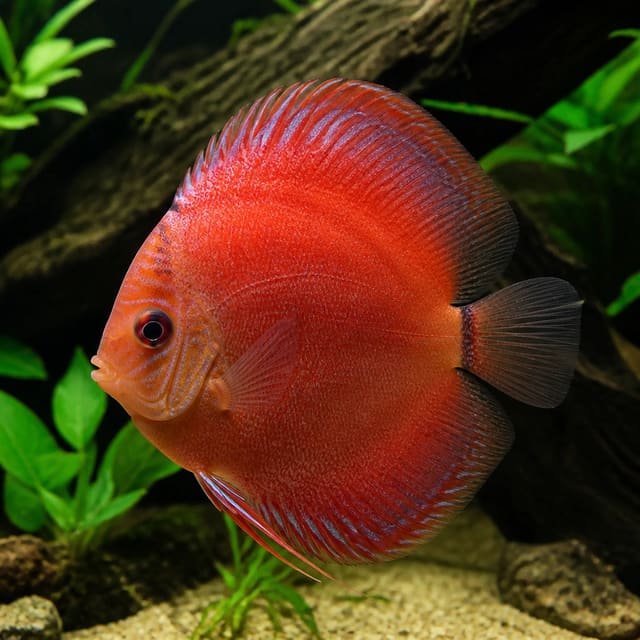
Red Turquoise Discus (Symphysodon spp.)
26–30°C · pH 6–7.5
£37.99£53.99

Red Alenquer Discus (Symphysodon spp.) is a genus-level colour-form listing, with one fish supplied in the size chosen. Plan for a group of at least five, up to 20 cm across per adult, in a mature aquarium at 26–30°C with clean, stable water and carefully screened peaceful tank mates.
Symphysodon spp.
Shoaling fish: kept in a group they feel safer, stay calmer and show their best colour.
Red Alenquer Discus (Symphysodon spp.) is a genus-level colour-form listing, with one fish supplied in the size chosen. Plan for a group of at least five, up to 20 cm across per adult, in a mature aquarium at 26–30°C with clean, stable water and carefully screened peaceful tank mates.
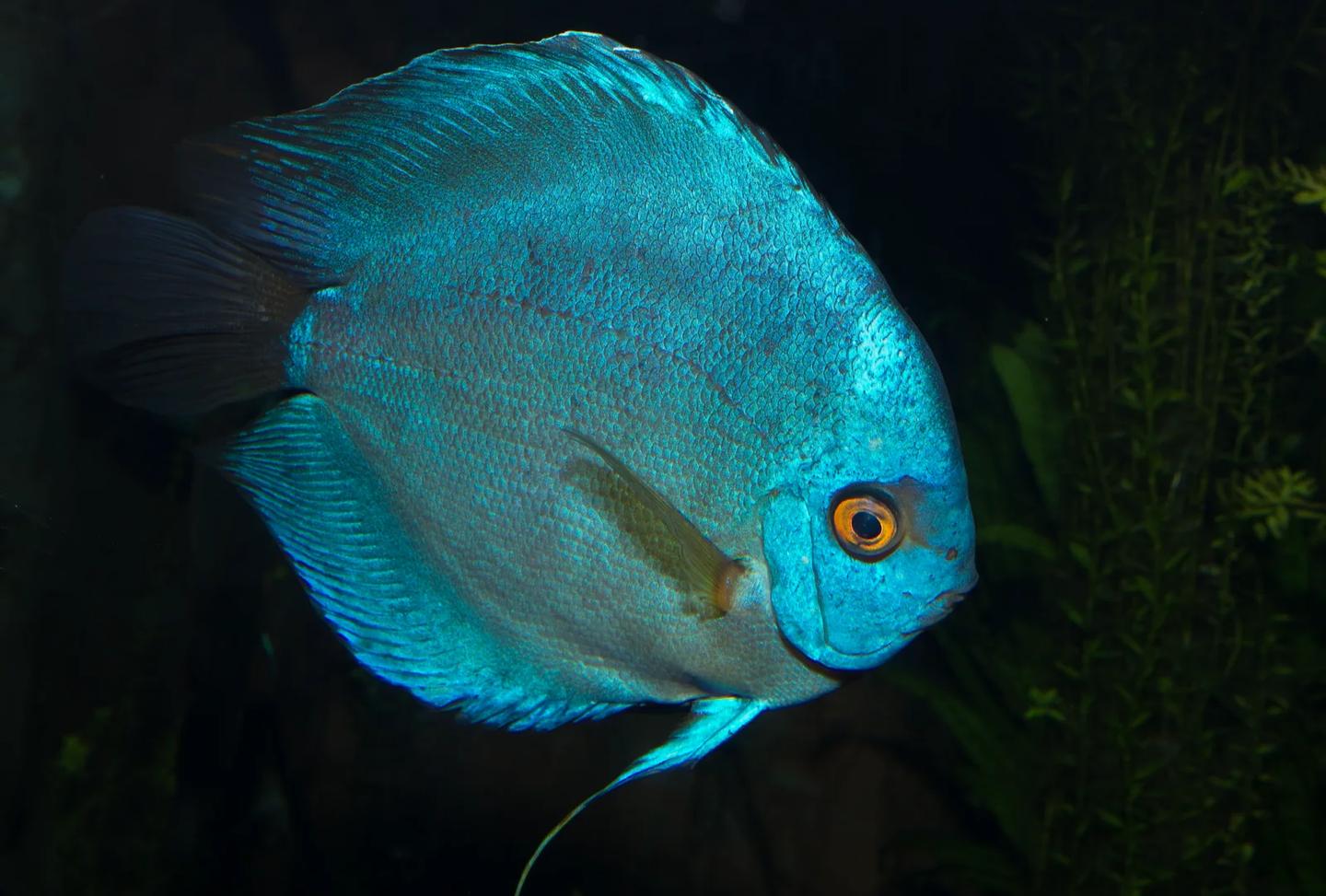
Discus are social Amazonian cichlids with specialised aquarium needs. OATA advises at least five fish, except an established breeding pair, and about 50 litres per adult—roughly 300 litres for six adults. Use that as a planning floor, then check usable dimensions, filtration, source water and the actual fish.
Maintain these water conditions for optimal health and vibrant colors
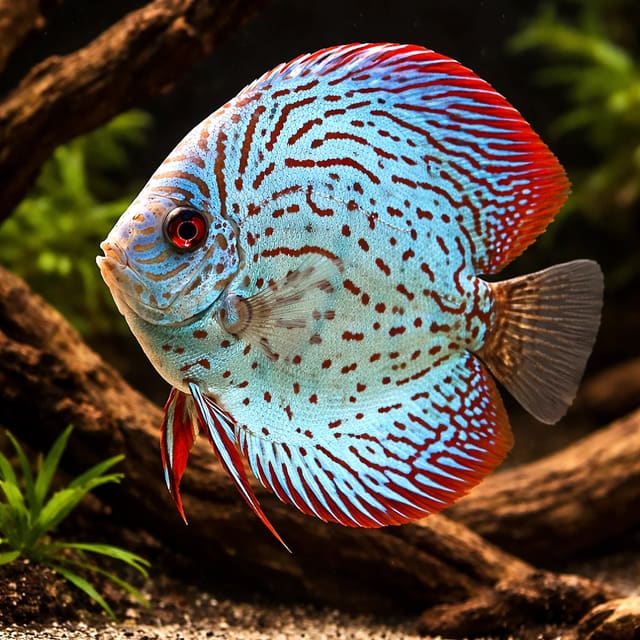
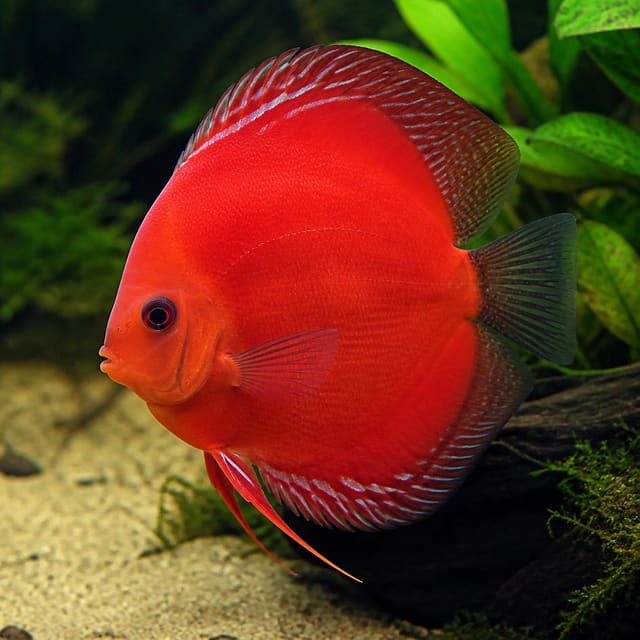
Red Alenquer Discus is a named aquarium form within Symphysodon, the discus genus. The deep, laterally compressed body and red colour identity distinguish the form in the trade, while the scientific label remains Symphysodon spp. The exact species has not been identified, so the care advice here follows the genus Symphysodon and its care group.
The World Register of Marine Species places Symphysodon in the cichlid family Cichlidae. Red Alenquer is the trade identity for this animal rather than the name of one identified species, so plan from the verified needs of discus as a group instead of assigning it the biology of a particular wild species.
At genus level, the discus natural-history overview describes Symphysodon as native to the Amazon river basin in Brazil. Discus are recognised for their distinctive shape, calm behaviour and many bright colours and patterns. Aquaculture has also made cultivated discus an important part of the international freshwater aquarium trade. These genus facts explain the fish’s familiar discus profile without assigning a precise collection locality or wild origin to an individual Red Alenquer.
This fish suits a keeper who can prepare a mature, filtered aquarium, maintain warm water within a narrow routine, complete substantial weekly maintenance and house a proper social group. Discus have more specialised requirements than many tropical fish, so the decisive question is not whether a small fish fits today. It is whether the aquarium can support the eventual adult group with stable water and enough open floor space.
| Suits | Not suited to |
|---|---|
| A mature, filtered aquarium at 26–30°C | An immature or unfiltered aquarium |
| A planned group of at least five discus | Routine solitary keeping or a group that is too small |
| A keeper prepared for a 50% water change at least weekly | An aquarium maintained with infrequent partial water changes |
| A layout with cover and open group-swimming space | A layout without enough useful floor space for the adult group |
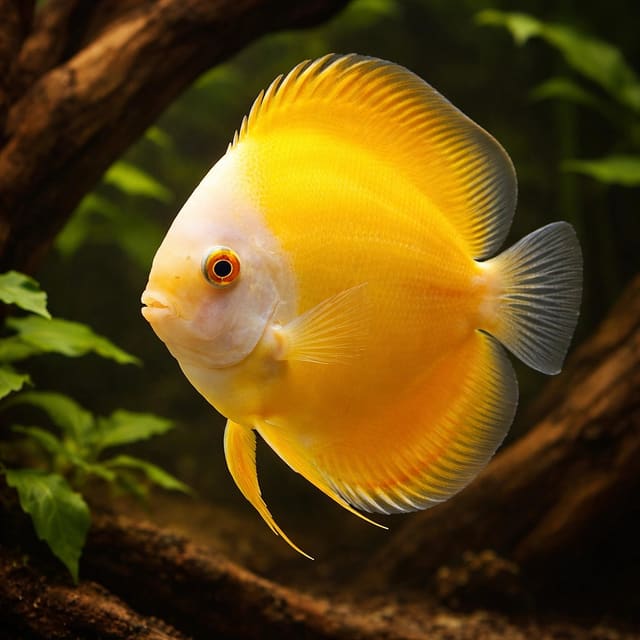
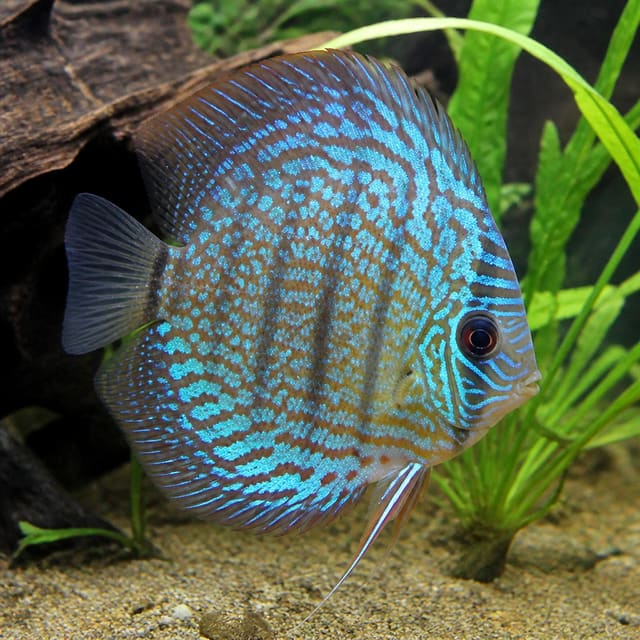
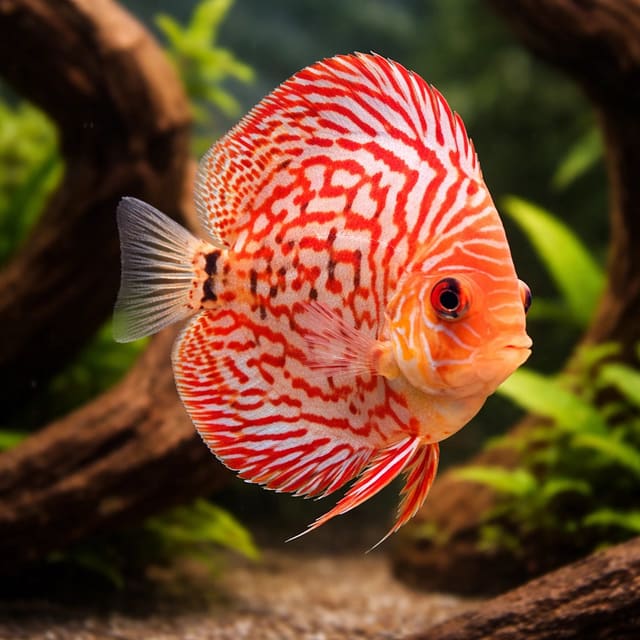
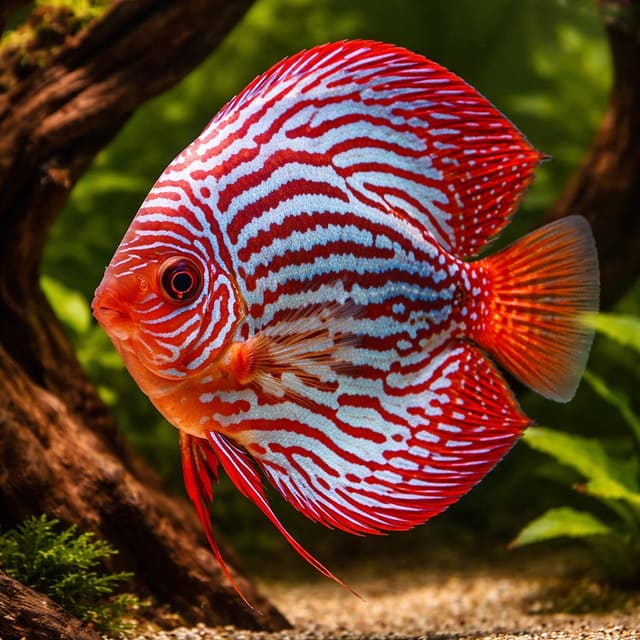
Use the colour and scene details in the gallery to recognise the named form, then make the husbandry decision from the adult measurements and water requirements below. The gallery images are representative, based on reference photographs of this kind of animal, so colours can look slightly different from the live animal.
If you are comparing colour forms before deciding, browse the current discus collection. Treat each form as a discus care commitment: colour choice does not reduce the need for group housing, mature filtration or disciplined water changes.
One purchase quantity supplies one animal in the size you choose. Use the live size selector to choose the fish’s supplied size. The size you select is the size supplied, not the adult size. A smaller size on arrival therefore changes the fish’s immediate dimensions, but it does not reduce the space that its permanent social group will require.
Sex is guaranteed only when the selected option explicitly states male or female. This Red Alenquer Discus listing has no sex-guaranteed option.
OATA’s discus care sheet gives broad guidance of 26–30°C, pH 6.0–7.5 and an adult size of up to 20 cm across; use these as genus-care values rather than a species-specific optimum. It also advises keeping at least five discus, with more being better, and planning about 50 litres of water for each adult. Approximately 300 litres is recommended for six adults.
| Decision | Planning value |
|---|---|
| Adult size | Up to 20 cm across |
| Social group | At least five; more is better |
| Adult water allowance | About 50 litres per fish |
| Six-adult example | Approximately 300 litres |
| Routine temperature | 26–30°C |
For five adults, the 50-litre planning allowance gives 250 litres before accounting for the advantages of extra stability and swimming room. For six adults, the stated example is approximately 300 litres. If other fish will share the aquarium, their adult space and waste load must be added rather than fitted into the discus allocation. A larger aquarium gives more environmental stability, which is valuable when maintaining warm water and low waste concentrations.
The fish may arrive well below 20 cm, and discus are described as slow growers. Do not use that slower growth as a reason to postpone the permanent aquarium. Preparing the adult accommodation first prevents repeated moves and ensures the biological filter, cover and swimming area are established before the group needs them.
Review the delivery and Live Arrival Guarantee policy separately from the care plan. The live selector remains the place to check the supplied-size choices.
Keep the aquarium between 26 and 30°C, at pH 6.0–7.5, with soft-to-medium general hardness of 4–12°dH and carbonate hardness of 3–10°dKH. Clean, warm, soft and slightly acidic water is the preferred direction for discus, although tank-bred fish may tolerate harder conditions than wild counterparts. Stability within the stated range matters when planning every water change or transfer.
| Water value | Routine target |
|---|---|
| Temperature | 26–30°C |
| pH | 6.0–7.5 |
| General hardness | 4–12°dH |
| Carbonate hardness | 3–10°dKH |
| Ammonia | Zero mg per litre |
| Nitrite | Zero mg per litre |
| Nitrate | Not to exceed 20 mg per litre |
Before introducing the fish, compare the aquarium’s measured temperature, pH and hardness with its current holding conditions. For current holding conditions and a stocking and compatibility assessment, ask us before the planned introduction. Aim to reproduce those conditions closely, then maintain the aquarium inside the stated discus range without abrupt changes.
Use the water chemistry guide to understand what each test measures and why ammonia and nitrite require immediate attention. The water matcher can help compare your measured aquarium values with the discus range before livestock is added.
A single acceptable test is only a snapshot. The aquarium must hold these values while the group is fed and producing waste, which is why mature filtration, weekly testing and substantial partial water changes form one connected routine.
Plan the aquarium for at least five discus because these are social, shoaling fish. Discus kept singly or in too small a group will often become stressed or bullied by a larger or more dominant fish. More than five is better when the aquarium can provide the corresponding volume, floor space, filtration and maintenance capacity.
Use approximately 50 litres for every adult as the starting calculation. This gives 250 litres for five adults and 300 litres for six adults; the six-fish result matches OATA’s example of an approximately 300-litre aquarium. These figures describe the adult discus allocation. Tank mates, ornaments and restricted swimming areas do not cancel their own demands on the system.
| Planned adult group | Discus water allocation |
|---|---|
| Five | About 250 litres |
| Six | Approximately 300 litres |
| More than six | Add about 50 litres per adult |
Volume must be paired with plenty of floor space because a shoal needs room to explore together. A tall-looking aquarium with limited floor area can meet a litre figure while still giving the fish too little useful group space. Choose a layout that combines open swimming room with cover rather than filling every part of the aquarium with ornaments.
Larger aquariums provide more stable temperature and water quality. That extra stability does not replace testing or maintenance, but it gives the keeper more capacity to manage the waste produced by a substantial, frequently fed cichlid group. If the proposed aquarium only just reaches the arithmetic allowance, consider whether plants, wood, other fish and equipment will leave enough unobstructed space.
A group of smaller fish may initially look small in its permanent aquarium. That is preferable to planning around a temporary size and later discovering that the adult shoal has insufficient volume or open swimming room.
Build the aquascape around two needs: sheltered areas for shy fish and clear space where the group can swim together. Live plants, branches, wood and other ornaments can provide cover, while an open central or forward area lets the discus explore without threading through a dense obstacle course.
Use fine gravel or sand. Discus can feed by blowing at the substrate, so a fine surface supports that natural feeding action. Whichever material you choose must also work with the weekly cleaning routine. Solid waste should remain accessible to a siphon instead of collecting beneath tightly packed décor.
| Layout element | Purpose |
|---|---|
| Fine gravel or sand | Allows substrate-blowing feeding behaviour |
| Live plants | Provides cover for shy fish |
| Branches and wood | Creates sheltered areas and visual structure |
| Open floor space | Leaves room for group swimming |
| Overhead lighting | Provides the recommended lighting position |
Place cover so that a fish can move into shelter without becoming trapped away from the group or food. Several separated areas are more useful than one solid wall of decoration because a larger or more dominant fish cannot occupy every sheltered place at once. At the same time, retain clear routes through the aquarium for the full-bodied adult shape.
When using sand, stir the open areas regularly to prevent dead spots where waste can build up. Keep wood, ornaments and plant bases positioned so that the siphon can reach the surrounding substrate during the weekly partial water change. A visually dense layout that cannot be cleaned effectively works against the clean-water requirement.
Review the arrangement as the fish approach adult size. Up to 20 cm across is a substantial body profile, and a route that suits a smaller fish may become too narrow later. Move removable décor when necessary while preserving both cover and open floor space; do not reduce the social group’s swimming area simply to add more ornament.
No discus aquarium should operate without a well-set-up and maintained filter. The RSPCA explains the biological filter’s role: fish release toxic ammonia, beneficial bacteria convert it to nitrite, and another stage converts nitrite to the safer nitrate. Ammonia and nitrite must both remain at zero mg per litre.
Prepare and mature the biological filter before the fish arrive. If this is a new system, follow the first tropical aquarium guide before planning livestock. Adding fish before the bacterial population is ready, or increasing the population too quickly, can create new tank syndrome because the filter cannot process the increased waste.
When the filter media needs cleaning, rinse it lightly in aquarium water removed during the partial water change. Do not rinse it under the tap because chlorine or chloramine may kill the established bacterial population. Avoid turning routine cleaning into a complete sterilisation of the media; the bacteria are the working part of biological filtration.
Use the test result after maintenance to guide stocking and feeding decisions. Nitrate must not exceed 20 mg per litre, while ammonia and nitrite remain at zero. If those values begin moving in the wrong direction, inspect the filter for blockage, remove accumulated waste, review uneaten food and pause further livestock additions.
The 50% weekly change is the baseline discus recommendation, not a substitute for testing. A heavily fed or newly increased group still needs observation between maintenance days. Clear water can contain dissolved waste, so judge the biological system by measured values and fish behaviour rather than appearance alone.
Discus are generally carnivores and eat aquatic invertebrates in the wild. Build the aquarium diet around specialised dried discus food in granule or pellet form, offered at least once each day so the fish receive the vitamins included in a complete prepared feed.
Frozen or live feeds can add variety. OATA particularly lists beef heart, bloodworm and specialist discus mixes. Use these alongside the prepared discus food rather than allowing one occasional item to displace the daily complete feed.
Discus have relatively small stomachs and appreciate two to three smaller feeds through the day. At each meal, provide only what the group can eat within a few minutes. This approach gives the fish repeated access to food without leaving a large amount to decay on the substrate.
| Feeding decision | Action |
|---|---|
| Daily complete food | Use specialised discus granules or pellets at least once |
| Meal frequency | Offer two to three smaller feeds |
| Meal limit | Only what is eaten within a few minutes |
| Variety | Add suitable frozen or live feeds |
| Food remains | Remove it before it breaks down |
If granules, pellets or frozen food remain after the group has finished, reduce the next portion and remove the residue. Uneaten food breaks down and releases waste into the water, adding pressure to the biological filter and making the zero-ammonia, zero-nitrite targets harder to maintain.
Watch every fish during feeding rather than judging only the group’s total appetite. Reduced intake or a loss of interest in food can be an early sign of a health or social problem. Check whether one fish is repeatedly missing meals, hiding or showing a change in body condition, then test the aquarium water before deciding what to do next.
Keep feeding and maintenance connected. More food means more waste for the filter and the weekly 50% water change to manage. A clean plate after a few minutes, stable body condition and water values within range are better guides than adding food until the fish stop responding.
Maintain at least five discus in the home aquarium, and choose a larger group when the aquarium can support it. Social housing distributes interactions across the shoal. Discus kept singly or in too small a group will often become stressed or bullied by a larger or more dominant fish.
Two discus may sometimes be kept together when they are already an established breeding pair. Do not treat any two fish chosen by size as an established pair, and do not reduce the normal group plan on the assumption that they will pair later. The offer makes no breeding-pair promise.
| Social plan | Decision |
|---|---|
| One fish | Do not use as the routine home-aquarium plan |
| Two fish | Only the stated exception for an established breeding pair |
| Five fish | The advised minimum shoal |
| More than five | Better when space and filtration increase with the group |
Plants, wood and branches provide places for a shy fish to move out of direct view. Retain multiple sheltered areas alongside the open group-swimming zone. Cover should reduce pressure without preventing the fish from reaching food or forcing the shoal into a cramped section of the aquarium.
Observe whether each individual continues to swim appropriately, feed and use the aquarium. A fish that becomes darker or paler, hides more than normal, loses interest in food or changes body condition needs prompt attention. Those changes may accompany a water-quality, health or social problem, so begin with measured water tests rather than assuming every change is ordinary group behaviour.
If the group will be enlarged, calculate the final adult volume first and add fish slowly. Every additional fish increases feeding and waste, and the established filter bacteria need time to increase. Social planning and biological capacity must advance together.
Complete the aquarium preparation before the planned introduction. The filter should be mature, ammonia and nitrite should test at zero mg per litre, nitrate should remain below 20 mg per litre, and temperature, pH and hardness should sit within the discus range. Confirm that the final group plan also fits the adult volume and floor space.
Keep the normal routine steady. Feed two or three small meals, including specialised dried discus food at least once a day, and remove uneaten food. Test ammonia, nitrite and nitrate during the week instead of waiting for visible cloudiness or distress. The first sign that waste processing is falling behind should come from the test kit, not from a sick fish.
Watch swimming behaviour, breathing, colour, temperament, body condition and food intake. Healthy fish should have clear, bright eyes, undamaged fins, intact scales, no ulcerations or bumps and appropriate swimming behaviour. Note each fish individually so that a quiet or pressured animal is not hidden by the activity of the group.
| Checkpoint | Action |
|---|---|
| At least weekly | Test ammonia, nitrite and nitrate |
| At least weekly | Complete the 50% partial water change |
| At each feed | Check that every fish eats within a few minutes |
| Before another addition | Confirm zero ammonia and nitrite and enough adult space |
Increase the population slowly. Beneficial bacteria established in the filter must increase whenever more fish and more food raise the waste load. If ammonia or nitrite rises above zero, make water quality and filter capacity the priority and postpone further additions.
Build the aquarium around the discus group first. Only a handful of other fish categories are identified as potentially suitable for a discus aquarium: medium-sized tetras, Corydoras, plecos and dwarf cichlids. These are conditional categories, not automatic approvals for every species placed under those names.
A category match is not a guarantee of compatibility. Check the exact proposed animal for an overlapping 26–30°C temperature range, compatible pH and hardness, suitable adult space and a calm temperament. The companion must fit a warm discus aquarium throughout adulthood rather than merely tolerating it for a short period.
| Compatibility screen | Question to answer |
|---|---|
| Temperature | Can it live routinely at 26–30°C? |
| Water chemistry | Does its pH and hardness range overlap? |
| Adult space | Can its full allocation be added beyond the discus volume? |
| Temperament | Will it share a calm aquarium without harassing the group? |
| Group needs | Can its own social requirements also be met? |
Smaller dither fish may help discus feel more confident because their normal activity can indicate that no predator is nearby. That potential benefit only applies after the species passes the complete water, temperament and space screen. It does not justify placing an unsuitable fish into warm water or crowding the discus allocation.
Corydoras and plecos also require exact-species screening because a family or common category contains animals with different adult needs. Dwarf cichlids need the same care: the word “dwarf” alone does not answer whether the fish fits the temperature, water chemistry, temperament and available floor space.
Complete the calculation with adult sizes. Six discus already account for approximately 300 litres under the stated planning allowance. Any tetra group, Corydoras group, pleco or dwarf cichlid must have its own space added to that plan, along with the increased biological load created by feeding and waste.
Introduce only one planned change at a time and increase the aquarium population slowly. This gives the filter bacteria time to respond and makes it easier to connect a change in behaviour or water quality with the latest addition. Test ammonia and nitrite before adding another group; both must remain at zero mg per litre.
Watch for hanging at the surface, sitting on the bottom, erratic swimming, darker or paler colour, increased aggression, increased hiding, faster or slower gill-cover movement, white spots, fluffy growths, damaged fins or scales, body-condition changes and reduced feeding. These are warning signs that require action rather than a reason to add another fish.
Begin by testing temperature, ammonia, nitrite, nitrate, pH and hardness. Check the filter for blockage, confirm that maintenance has been completed and inspect whether every discus can reach cover and food. If a problem follows a stocking change, pause further additions while the aquarium and the affected fish are assessed.
If you are concerned about a health change, test the water quality and contact us for further guidance. Do not select a treatment from appearance alone; the supported first steps are observation, measured water tests and correction of any husbandry problem revealed by those checks.
Compatibility remains an ongoing condition, not a decision completed on introduction day. Adult growth, social behaviour and increased waste can alter how the aquarium works, so keep applying the same water, space and behaviour checks throughout the life of the group.
It is identified at genus level as Symphysodon spp.; the Red Alenquer name does not identify one species.
One purchase supplies one fish in the size chosen through the live selector.
Each label shows the fish’s supplied size, while OATA’s discus guidance says an adult can reach up to 20 cm across.
OATA’s discus guidance advises about 50 litres per adult and approximately 300 litres for six adults, plus open floor space, cover and mature filtration.
OATA’s discus guidance advises keeping at least five, with more being better; two are a separate exception only when they are already an established breeding pair.
OATA’s discus guidance gives 26–30°C, pH 6.0–7.5 and 4–12°dH, with zero mg per litre ammonia and nitrite and nitrate not exceeding 20 mg per litre.
OATA’s discus guidance advises two to three small feeds daily, using specialised discus granules or pellets at least once and adding suitable frozen or live food for variety.
OATA’s discus guidance advises matching a mature aquarium closely to its current holding conditions, confirming zero ammonia and nitrite, preventing abrupt water changes and increasing the population slowly.
OATA’s discus guidance conditionally identifies medium-sized tetras, Corydoras, plecos and dwarf cichlids, but each exact species must match 26–30°C water, space and temperament needs.
No reviews for this item yet. Bought one? Honest reviews only, good or bad.
What customers say about ordering from us
I have a small group of long finned mountain minnows. So was delighted to be able to order ten of this variety to increase the genetics in my tank . The ones I recieved are healthy but it’s to early to give a verdict on wether they are of a long finned type since they are small currently.
Gordon Walker · 23 Sept 2026
100% success travel and "installation". Pleased with quality of purchase. The Siamese fighter a bit "shy" so have not yet seen him at his best yet but looking good. Happy customer. GG
George E Garratt · 21 Sept 2026
Reviews of our shop, collected by Judge.me, an independent third-party review collector. Newest first.