Easy
Bolivian Ram Cichlid (Mikrogeophagus altispinosus)
22–27°C · pH 6–7.5 · 80L
£11.99
Cockatoo Dwarf Cichlid Double Red is a colourful, cave-oriented Apistogramma for a mature, carefully structured aquarium. One purchase supplies one fish in the chosen size, with several size choices available; sex is not guaranteed on this listing.
Apistogramma cacatuoides
Save when buying multiple fish. Each quantity is one fish; sex and pair formation are not guaranteed unless the selected variant explicitly states them.
Cockatoo Dwarf Cichlid Double Red is a colourful, cave-oriented Apistogramma for a mature, carefully structured aquarium. One purchase supplies one fish in the chosen size, with several size choices available; sex is not guaranteed on this listing.

Cichlids are a family of roughly 1,800 accepted species, not one care type. Before buying, identify the exact species and source, then compare adult measurement, usable tank dimensions, social system, territory, tested water, diet and an exit plan. No family-wide minimum tank, water range or tank-mate list is safe.
Maintain these water conditions for optimal health and vibrant colors
| Good fit | A mature, cave-rich aquarium with stable water and room for lower-level territories. |
|---|---|
| Reconsider if | The aquarium is new, cramped, short of retreats or already holds forceful bottom-dwelling fish. |
| Sold unit | One fish in the chosen size; sex is not guaranteed on this listing. |
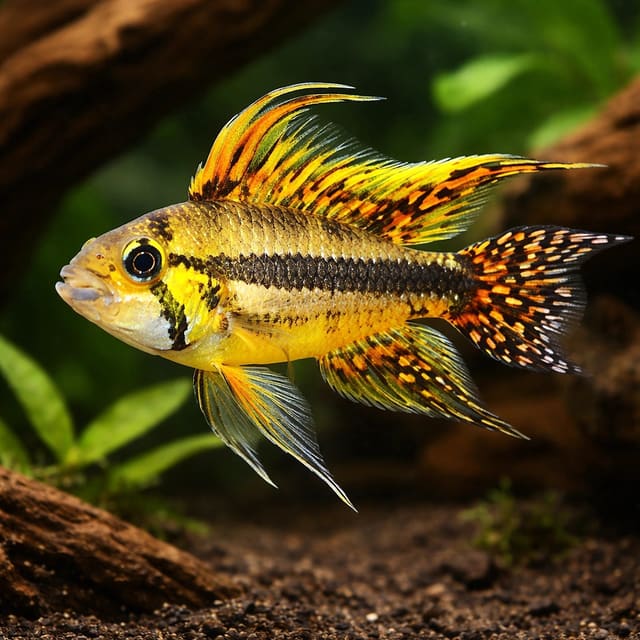
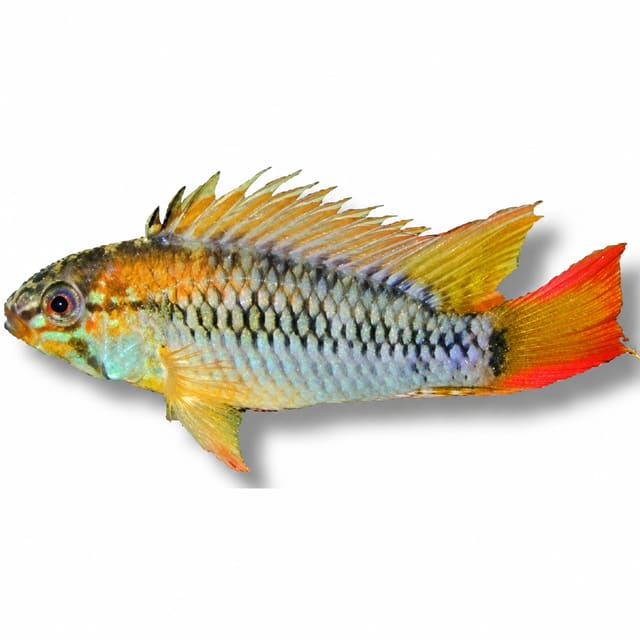
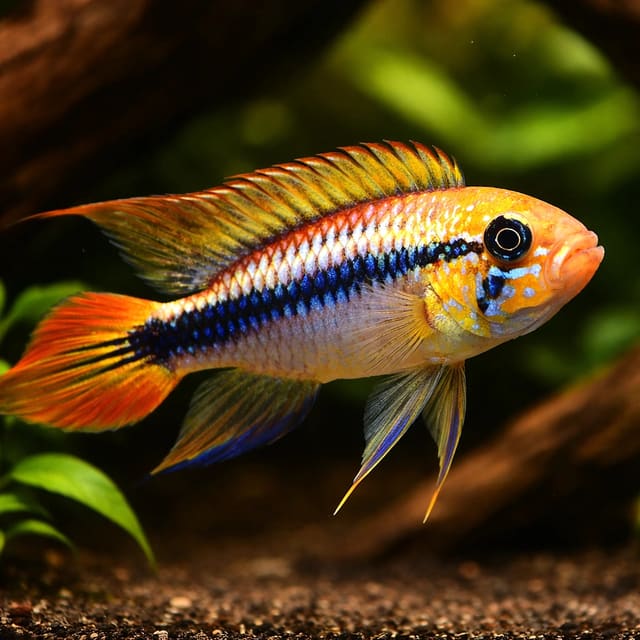
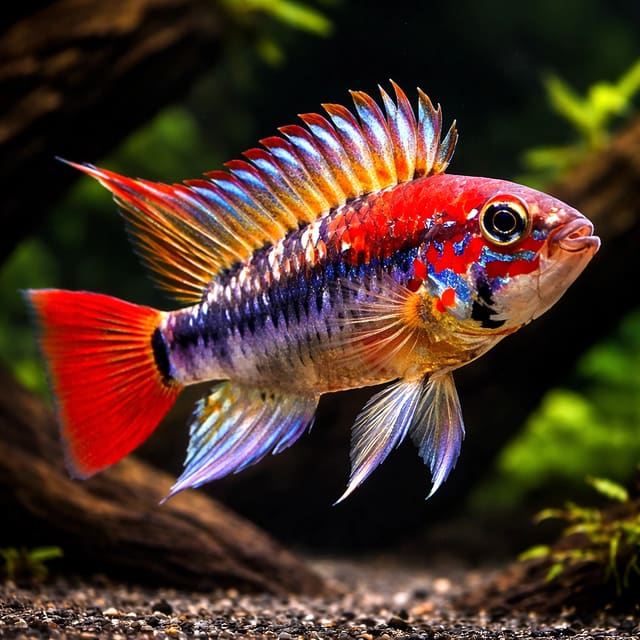
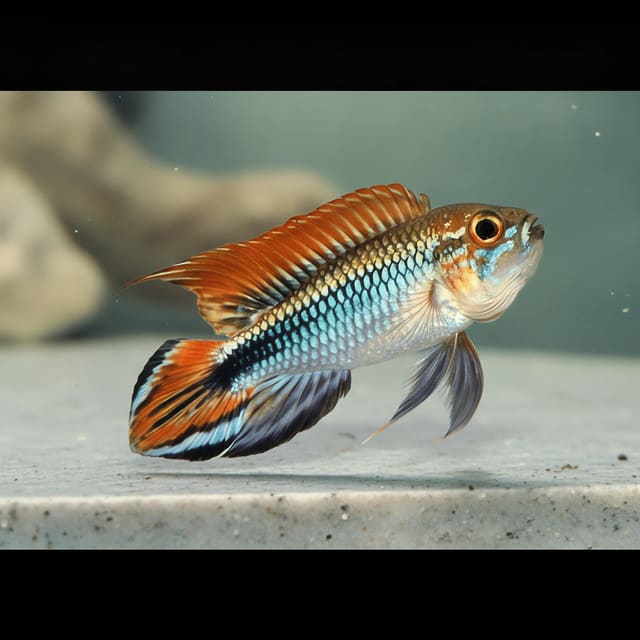
This listing is for the Double Red aquarium form of Apistogramma cacatuoides, a small South American cichlid known for its high, cockatoo-like dorsal fin and strongly patterned red-and-black fins. Double Red is an ornamental form name, not part of the scientific binomial. It tells you which colour line is offered, while Apistogramma cacatuoides remains the species identity.
One purchase supplies one live fish in the size you choose. The listing has 3–4 cm, 5.5–6 cm and XL size choices. The size you select is the size supplied, not the adult size. XL is the named grade and has no stated centimetre definition. Sex is guaranteed only when the selected option explicitly states male or female. This Cockatoo Dwarf Cichlid Double Red listing has no sex-guaranteed option.
The available measurements also need careful reading. FishBase records 5 cm standard length for a male or unsexed fish, while the species husbandry profile at Seriously Fish gives males to 7.5 cm standard length and females to 5 cm standard length. Standard length stops at the base of the tail. Because the published records differ in scope, plan around the larger published male record and the fish's territorial behaviour rather than assuming every fish ends at its dispatch measurement.
This is a fish for a mature aquarium with stable water, a working biological filter, a soft substrate, shaded cover and several cave-like retreats. It spends much of its time near the lower part of the aquarium and uses structure as territory. A pair can be planned around a base of at least 60 × 30 cm, about 54 litres in the cited species profile, but a community or group needs more room. OATA gives 60 litres for a dwarf-cichlid pair and 80 litres when mixing dwarf cichlids with other fish as broad group guidance. Footprint, sight breaks and stocking matter as much as the litre figure.
Tropical Fish Co rates this listing as intermediate. The fish is not impossibly delicate, but the keeper must manage territory, feeding, stable water and possible breeding aggression rather than relying on an “easy community fish” label. A prepared newer keeper can succeed after maturing the aquarium and understanding its water; the first tropical tank guide is a useful place to check that foundation.
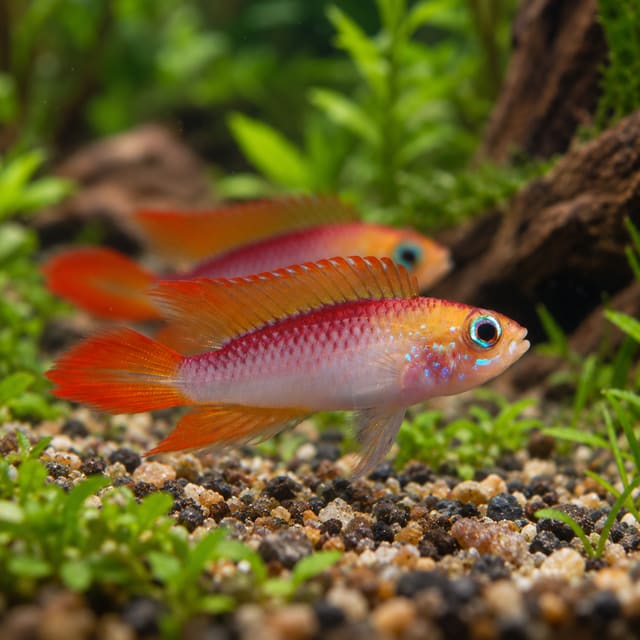
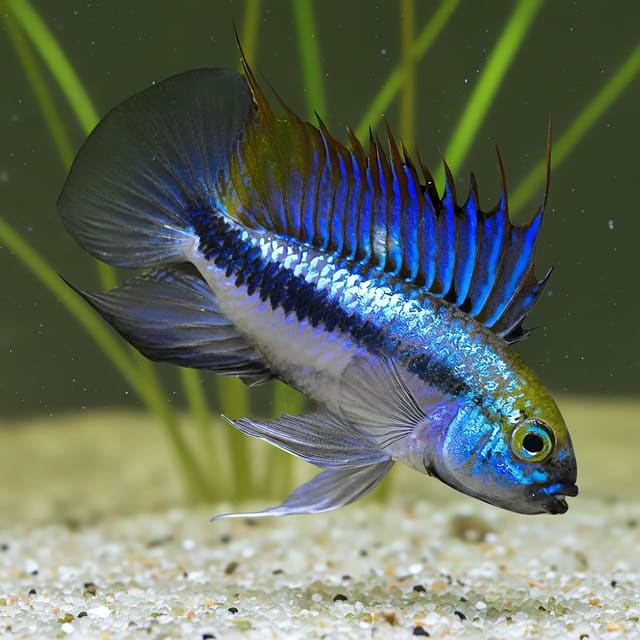
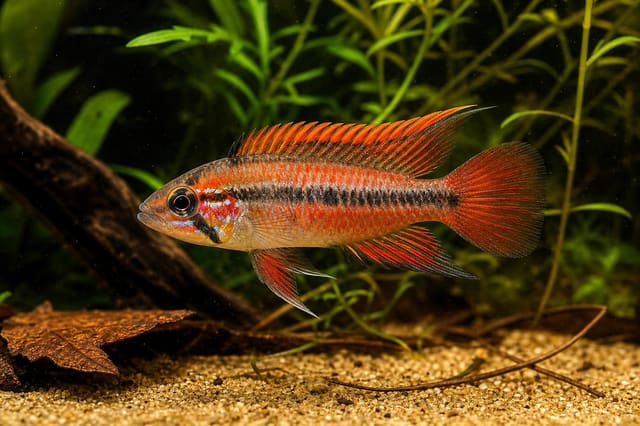
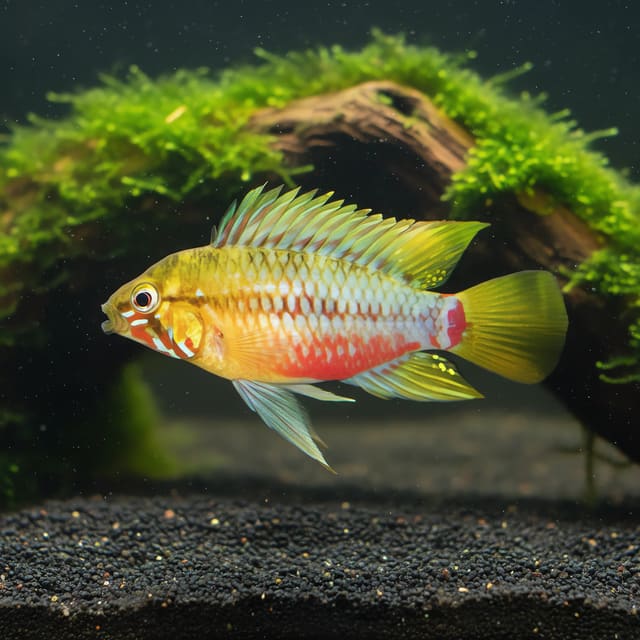
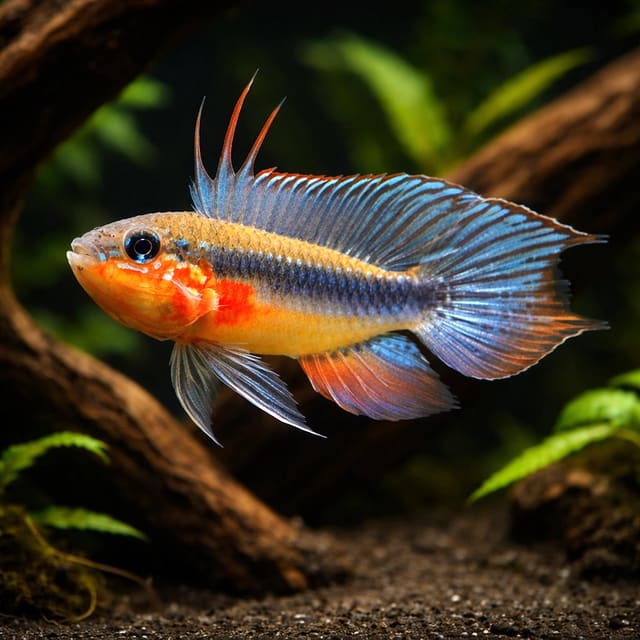
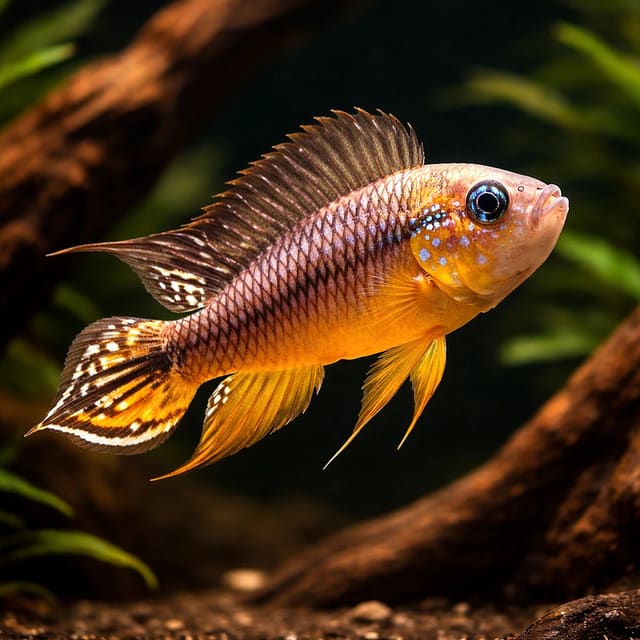
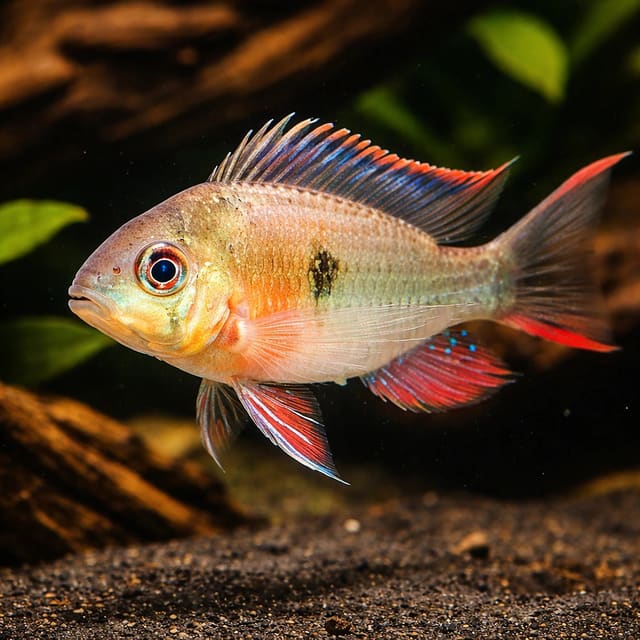
The gallery images show the offered type in several aquarium-style views. Gallery images have been digitally enhanced to improve image quality. Natural colour, pattern, size and maturity can vary between live animals. Individual colour, fin development and markings vary with age, sex, condition and display. Use the live option selector for the current choices rather than treating a photograph as a promise of one exact individual.
If you are comparing forms of the same species, the Orange Cockatoo Dwarf Cichlid is the most useful checked comparison. It is a separate product and colour-form offer, not a guaranteed compatible tank mate or an interchangeable option on this listing. The broader South American cichlids collection is useful for browsing, but every species still needs its own space, water and behaviour assessment.
Apistogramma cacatuoides is a freshwater cichlid from the Amazon basin, including tributaries of the Ucayali, Amazon and Solimões systems in Peru and Brazil. That wild distribution describes the species; it does not prove that an individual offered here was collected there. This product is offered as the Double Red trade form, but captive or wild provenance is not stated; the species' native range should not be read as the origin of each supplied fish.
Numerous ornamental lines of this species are kept in aquariums, including Double Red and Orange forms. These names can be useful within the trade, but colour-line language must not be folded into the italicised binomial. Keep line identity when selecting fish for a breeding project, and do not assume that two similarly coloured Apistogramma from different products share documented locality or lineage.
Size records are not as simple as one number. FishBase gives a maximum of 5 cm standard length for a male or unsexed record. Seriously Fish gives males to 75 mm standard length and females to 50 mm standard length. Those sources are not describing total length including the tail, and the sex scope is not identical. For aquarium planning, allow for a male at the larger published figure and use the visible labelled measurements rather than silently merging them into a false universal maximum.
Dispatch grades answer a different question: how large the fish is when supplied. A 3–4 cm fish still needs an aquarium planned for adult behaviour and adult space. The 5.5–6 cm choice may overlap an adult record, but it remains a practical supplier grade rather than a biological claim. XL has no stated centimetre definition.
Seriously Fish states that a base of 60 × 30 cm or more is acceptable for a single pair, with larger quarters required for a group. Its stated volume for that footprint is about 54 litres. OATA's broader dwarf-cichlid sheet recommends at least 60 litres for a pair and at least 80 litres when dwarf cichlids are mixed with other fish. These figures are starting points, not permission to crowd several territories into a narrow tank.
Use the floor area deliberately. Break the lower level into separate visual zones with wood, roots, dense planting and caves. Each fish should be able to leave another's sight without being trapped. Put more than one retreat in the aquarium and avoid arranging every entrance to face the same open patch. A female guarding eggs or fry can become forceful, and in a smaller aquarium even the male may need to be separated if he cannot escape her territory.
A soft sandy substrate suits the species profile and makes it easier to build a natural-looking lower zone. Ceramic flowerpots, short aquarium-safe pipes and purpose-made caves are practical alternatives when natural hardscape cannot provide secure cavities. Wood and leaf litter can add shade and surfaces for microorganisms, but botanicals are optional. Add only aquarium-safe material and monitor any effect on water chemistry.
Published values vary because they describe different contexts. FishBase reports a species environment of 24–25°C, pH 6.0–8.0 and 5–19 dH. Seriously Fish gives aquarium guidance of 22–29°C, pH 5.0–6.0 and 0–15 dGH, while noting that commercially produced fish are relatively unfussy and that some wild populations may need pH 5.0–6.0 for breeding. OATA's group-level dwarf-cichlid guidance is 22–27°C, pH 6.0–8.0 and 4–12 dH.
For routine care, 22–29°C, pH 5.0–6.0 and 0–15 dGH are retained as the species-profile aquarium range, with the important context that origin affects tolerance and breeding requirements. Do not aim at the outer edges merely because they appear in print. Match the fish's source water where known, check compatibility with all tank mates and favour a stable point within an appropriate range. The water chemistry guide explains what pH, hardness, ammonia and nitrite mean, while the water matcher can help compare measured values with stated guidance.
Test the source water and the aquarium rather than guessing from postcode or clarity. Ammonia and nitrite should be zero in a mature aquarium. A working biological filter converts toxic waste; clear water can still be unsafe. Record results so a slow drift is visible, and make changes gradually. Chasing pH with repeated unmeasured additives can create swings that are more stressful than a stable, suitable value.
Provide a mature filter sized for the whole aquarium's biological load. Seriously Fish describes gentle movement for this species, so the goal is clean, oxygenated water without a jet that pins a small fish against the décor. Aim the outlet to create surface movement and circulation while leaving calmer areas around caves and planting.
During maintenance, preserve the established biological media and avoid replacing all of it at once. Check intakes for safety around the smallest dispatch size and use a suitable guard or pre-filter where needed. Plants can support the system, but they do not replace a working filter or regular testing.
Seriously Fish describes this species as primarily carnivorous, feeding mainly on benthic invertebrates in nature. In the aquarium it recommends regular live or frozen foods such as Artemia, Daphnia and chironomid larvae, while noting that many fish learn to accept dried foods and often prefer pellets to flakes. OATA's group sheet is broader and calls dwarf cichlids omnivorous, accepting quality flake or granule plus small live or frozen foods. For this species, small invertebrate foods should remain central to a varied diet.
Use an appropriately sized quality pellet as a practical staple where the fish accepts it, then rotate small frozen or live invertebrate foods from safe aquarium sources. Distribute food so a shy or subordinate fish can eat without crossing a dominant territory. Offer modest portions that are eaten within a few minutes; persistent leftovers raise the waste load. Watch body condition and feeding response rather than following a rigid universal spoonful or schedule.
A fish refusing food can be responding to stress, bullying, unsuitable particle size or poor water. Check temperature, ammonia, nitrite, breathing and social position before simply adding richer foods. Do not use colour-enhancing feed as a substitute for appropriate water, cover and a calm social setting.
Look at each fish every day. Clear eyes, intact fins and scales, controlled movement, steady breathing and an appropriate feeding response are useful signs. A fish that hides constantly, darkens or pales suddenly, breathes rapidly, loses weight or is repeatedly chased deserves investigation. These signs are not a diagnosis; begin with water tests, equipment checks and a review of recent changes.
OATA recommends a partial water change of about 25% each week as broad dwarf-cichlid guidance, adjusted to the actual aquarium. Match replacement-water temperature, use conditioner where required and remove accumulated waste without stripping every surface clean. Check the filter for blockage and preserve the mature biological media. Consistency is more valuable than an occasional drastic clean.
When adding this fish, increase biological load gradually where possible and keep testing during the first weeks. A mature aquarium can still be overloaded by adding too many fish or too much food at once. If illness is suspected, seek experienced aquatic or veterinary advice rather than dosing the display aquarium “just in case”.
Apistogramma cacatuoides is a cavity-spawning cichlid. FishBase records eggs being placed on cave ceilings and tended by the female. Seriously Fish likewise describes eggs laid in crevices or cavities, with the female caring for eggs and fry. This is useful behaviour information, not a promise that the fish supplied is sexed, paired or ready to breed.
Males are generally larger, more colourful and more extended in the fins than females in the species profile, but this listing has no sex-guaranteed option. Juveniles and trade forms can make visual judgement unreliable. Do not order two fish and assume they form a pair, and gallery animals should not be taken as the exact fish that will arrive. During the first month, keep a simple log of feeding, water tests and territorial behaviour. Patterns are easier to act on than a single observation, and the record helps separate an equipment change from a social problem. Review cave access as plants grow, because a route that was open on arrival can gradually close.
This species can work in a carefully planned community, but “peaceful” is too simple on its own. Apistogramma use the lower aquarium as territory, and a female guarding eggs or fry may drive other fish away from a cave. Space, cover and sight breaks decide whether those interactions remain brief or become relentless.
The species profile gives a 60 × 30 cm base for a single pair and says a group needs larger quarters. A fixed one-male-to-two-or-three-females ratio is not a universal rule. If keeping more than a pair, provide a meaningfully larger footprint, several independent retreats and a plan to separate a bullied fish.
Sex is not guaranteed here, so a customer cannot build a precise ratio from the current options. Observe actual behaviour after introduction. Short displays and territorial posturing may be normal; repeated cornering, torn fins, exclusion from food or a fish unable to leave cover means the arrangement needs intervention.
Seriously Fish recommends captive-raised fish for a general community and says wild examples are better kept alone or with small dither fish such as Nannostomus, ideally without other Apistogramma. OATA says dwarf cichlids can be kept in communities when every fish has enough space, and notes that shoals of quick dither fish can provide security. These are conditional suggestions, not a universal tank-mate list.
Suitable candidates are calm, small midwater fish with overlapping water needs and enough room to avoid the cave zone. Pencilfish are specifically named in the species guidance. Caution is needed with any bottom-dweller that repeatedly enters a guarded cave area, and with boisterous feeders that leave the cichlid unable to eat. Avoid large aggressive cichlids and crowding with other Apistogramma, especially in a small footprint.
Compatibility must be checked for both directions. A tiny fish can be vulnerable to a larger companion, while eggs, fry or very small shrimp may be eaten by a cichlid that is otherwise described as community-suitable. A fish from the same category is not automatically a suitable tank mate.
Before arrival, rearrange or add cover if the lower level has one obvious cave controlled by an established fish. Introduce only into mature, tested water, dim the lights and follow the retailer's current acclimation directions. Feed carefully so newcomers can access food, then watch the entire lower area rather than checking only the most colourful individual.
Measure the aquarium footprint and look at how much of the lower level is genuinely usable. A nominal volume can hide a narrow base, a large internal filter or hardscape that leaves only one obvious cave. The 60 × 30 cm species-profile base is for a single pair, and any community or group needs more room. Choose the fish only when each individual can have refuge and leave another's line of sight.
Compare the selected dispatch grade with the existing community. A 3–4 cm fish may be vulnerable beside a large companion even when both species are usually described as community fish. A larger grade still needs careful acclimation and cannot be assumed to dominate safely. Adult behaviour and mouth size matter more than a category label.
Build several cave-like choices before the fish arrives. An entrance should not face directly into every other retreat, and a fish leaving one cave should have plant, wood or rock cover nearby. Leave a clear feeding area where food can reach the lower half without collecting behind décor. Check that caves cannot collapse and that openings do not trap a fish.
Keep the substrate and hardscape clean without making the aquarium sterile. Leaf litter can support a natural feel and secondary microorganisms, but it should be added gradually and watched as it breaks down. If leaf material causes pH to fall quickly or traps waste in a low-flow pocket, reduce it and correct the layout rather than treating botanicals as compulsory.
Test temperature, pH, ammonia, nitrite and hardness before arranging delivery. Ammonia and nitrite should be zero. Confirm the heater with a separate thermometer and watch the filter outlet long enough to see both moving water and calmer refuge. A strong current that looks mild from above can still push a small fish continuously near the substrate.
Preserve established biological media, clear blockages and avoid changing every part of the filter at the same time. The aim is stable function, not a spotless-looking unit.
After introduction, observe where each fish rests, feeds and retreats. A shy fish may need time, but it should not be pinned into one corner or prevented from eating. Spread small foods across more than one point so a territorial fish cannot control the entire meal. Remove leftovers and test water more often while the filter adjusts to the added load.
Record behaviour as well as chemistry. Note repeated chasing, rapid breathing, colour loss, clamped fins and refusal of food. One brief display is different from a pattern that continues through the day. If one fish cannot escape attention, add effective sight breaks or separate fish rather than waiting for injury.
The best routine is steady and fairly uneventful: modest varied feeding, regular partial water changes, clear access to caves and daily observation. Review the layout as plants grow or décor moves, because a once-open escape route can disappear. Recheck the community whenever a new species is added, since a tank that suited a pair can become crowded without its litre figure changing.
FishBase records 5 cm standard length for a male or unsexed fish, while Seriously Fish gives males to 7.5 cm SL and females to 5 cm SL. SL excludes the tail. Because those records differ in sex and scope, plan around the larger supported male figure rather than treating one number as universal.
Seriously Fish gives a 60 × 30 cm base, about 54 litres, for a single pair and says a group needs larger quarters. OATA's broad dwarf-cichlid guidance starts at 60 litres for a pair and 80 litres for a community. Footprint, caves and sight breaks are essential.
There is no universal number. A single pair can use a 60 × 30 cm base; any group needs more room and several territories. This listing does not guarantee sex, so do not order a fixed “harem” ratio and assume it will be supplied.
Tropical Fish Co rates it intermediate. A prepared newer keeper can succeed with a mature filter, tested stable water, cave-rich structure and a plan for territorial behaviour, but it is not a set-and-forget community fish.
Offer small live or frozen foods such as Artemia, Daphnia and chironomid larvae regularly, supported by a quality small pellet when accepted. Feed modest portions, vary the diet and make sure shy fish can reach food.
The species-profile aquarium range is 22–29°C, pH 5.0–6.0 and 0–15 dGH, with origin affecting requirements. FishBase reports a broader environmental pH of 6.0–8.0. Choose a stable suitable point, match source water where known and avoid chasing extremes.
It is territorial rather than simply peaceful or aggressive. A female guarding eggs or fry can become forceful, and cramped quarters intensify conflict. Provide several caves, visual barriers and enough floor area, then intervene if one fish is repeatedly cornered or damaged.
Calm small midwater fish with matching water needs can work; the species profile specifically mentions small dither fish such as pencilfish. Avoid large aggressive cichlids, boisterous feeders and other Apistogramma in cramped tanks. No companion is universally safe without checking adult size and behaviour.
Fish are hand-packed in oxygen-filled bags, an insulated box and a heat pack when weather calls for it, then carried by a licensed live-animal courier. Read the current delivery and Live Arrival Guarantee policy. A claim requires same-day contact and a continuous unboxing video showing the sealed parcel being opened and the fish still in the bag.
The scientific and husbandry references cover identity and care; the exact sale information establishes the available unit and dispatch grades. Group-level sources are labelled as such and are not presented as a species-specific optimum.
No reviews for this item yet. Bought one? Honest reviews only, good or bad.
What customers say about ordering from us
Easy website plenty of info on fish your buying great to pick a time slot
TRACEY DURRANT · 7 Oct 2026
Got some lovely fish thank you
Kevin Mackie · 7 Oct 2026
Reviews of our shop, collected by Judge.me, an independent third-party review collector. Newest first.