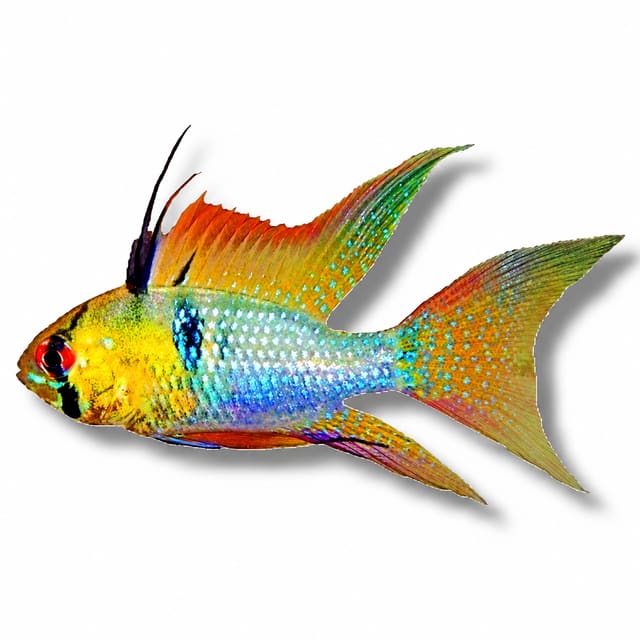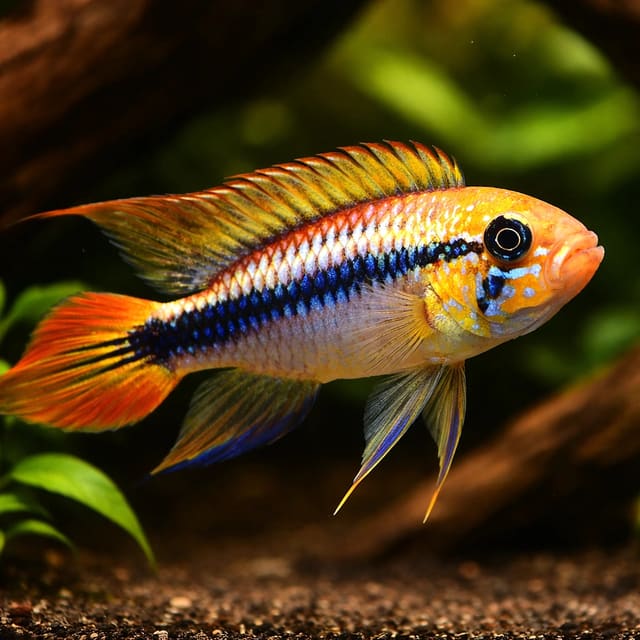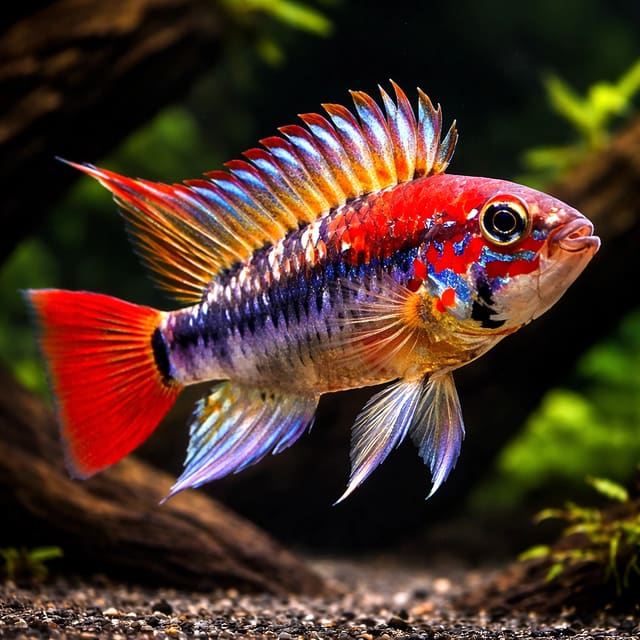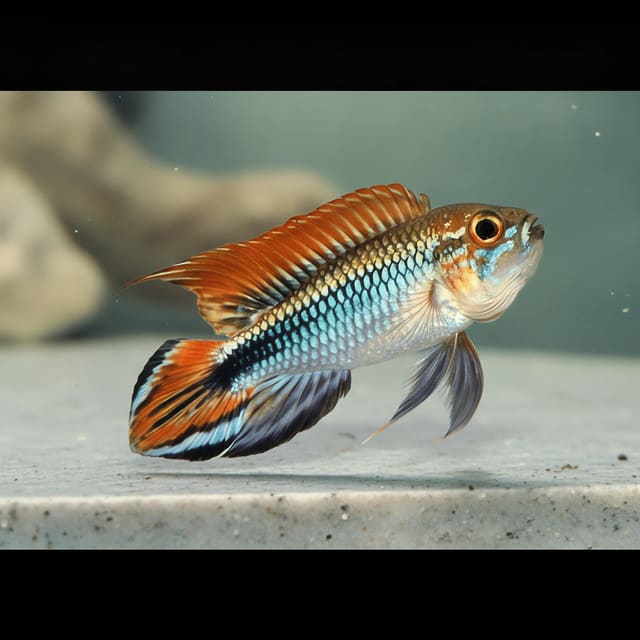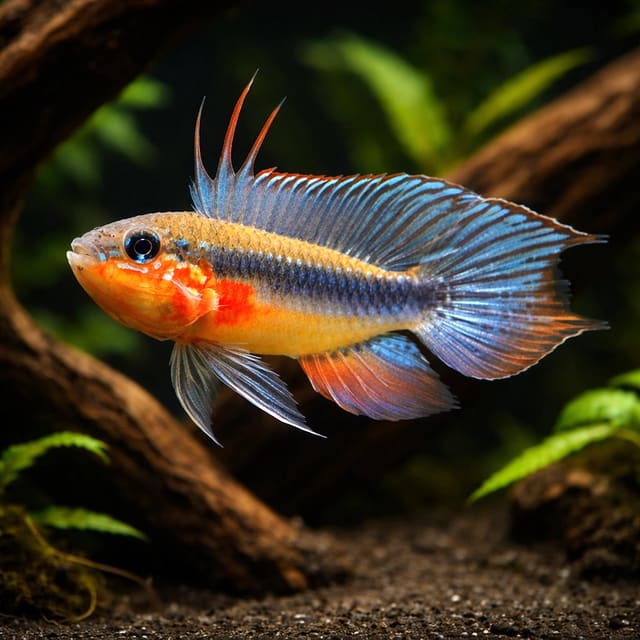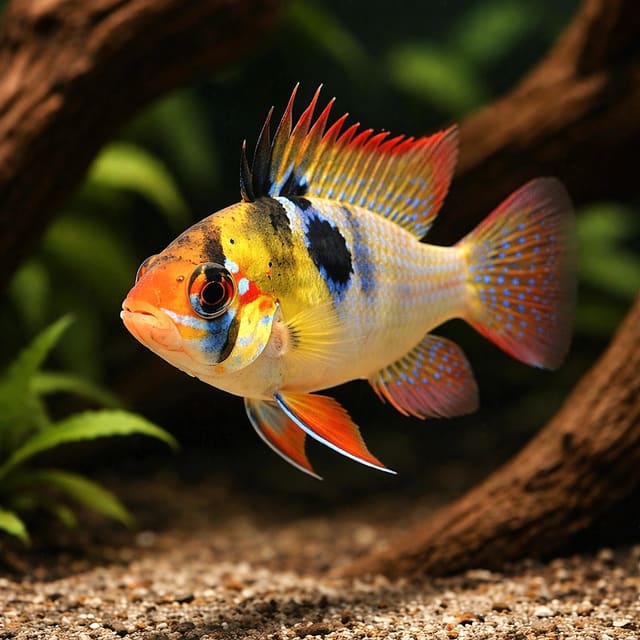
Asia Form Ram Cichlid (Mikrogeophagus ramirezi)
27–30°C · pH 4–7 · 54L
£5.99

The Pandurini Dwarf Cichlid (Apistogramma panduro) is a freshwater cichlid from Peru’s Amazon River basin that reaches 4.9 cm standard length. Seriously Fish and OATA guidance overlap at 22–27°C, pH 6.0–6.5 and 4–5 dGH; plan a softly acidic aquarium for a single pair. Sold individually in 3–4 cm and XL dispatch sizes.
Adult size is the maximum length this species reaches at full maturity (scientific sources). The livestock you receive will be younger and smaller — pick a size above for the actual shipping size. Product-photo provenance and any image-specific limitations are stated on the listing.
Apistogramma panduro
Save when buying multiple fish. Each quantity is one fish; sex and pair formation are not guaranteed unless the selected variant explicitly states them.
The Pandurini Dwarf Cichlid (Apistogramma panduro) is a freshwater cichlid from Peru’s Amazon River basin that reaches 4.9 cm standard length. Seriously Fish and OATA guidance overlap at 22–27°C, pH 6.0–6.5 and 4–5 dGH; plan a softly acidic aquarium for a single pair. Sold individually in 3–4 cm and XL dispatch sizes.
Adult size is the maximum length this species reaches at full maturity (scientific sources). The livestock you receive will be younger and smaller — pick a size above for the actual shipping size. Product-photo provenance and any image-specific limitations are stated on the listing.
Cichlids are a family of roughly 1,800 accepted species, not one care type. Before buying, identify the exact species and source, then compare adult measurement, usable tank dimensions, social system, territory, tested water, diet and an exit plan. No family-wide minimum tank, water range or tank-mate list is safe.
Maintain these water conditions for optimal health and vibrant colors
The Pandurini Dwarf Cichlid (Apistogramma panduro) is a small freshwater cichlid in the family Cichlidae from the Amazon River basin in Peru. FishBase records a maximum of 4.9 cm standard length and describes the species as benthopelagic, meaning its activity is associated with the lower part of the water column. It suits a keeper prepared to create a softly acidic, low-mineral aquarium with caves, shaded retreats and enough floor space for territorial behaviour.
This is an observation fish rather than an automatic addition to every mixed aquarium. Breeding behaviour and interactions with its own kind can make cave placement and sight lines decisive. The alternative names blue panda cichlid, blue sky dwarf cichlid and azure cichlid are also used for the species.
Seriously Fish accepts a base of at least 60 × 30 cm for a single pair and describes a soft sandy substrate, roots, branches, shady areas and caves as a natural-looking arrangement. Those features are functional: cover gives each fish somewhere to withdraw, while separate visual zones reduce constant exposure to another cichlid.
| Suits | Not suited to |
|---|---|
| A softly acidic aquarium maintained at 22–27°C, pH 6.0–6.5 and 4–5 dGH | Water above the species’ pH and hardness ranges |
| A base of at least 60 × 30 cm for a single pair | A group confined to pair-sized quarters |
| Sand, wood, caves, plants or other substantial cover | An exposed layout without adequate retreats |
| Carefully screened dither fish in a larger community | Other Apistogramma, or fish that disturb spawning sites or eat fry when breeding |
| A mature, filtered aquarium with zero ammonia and nitrite | A newly stocked aquarium without an established biological filter |
If you are comparing behaviour, footprint and community demands across the group, browse our South American cichlid collection before deciding which fish fits your aquarium.
One purchase supplies one Pandurini Dwarf Cichlid in the size selected on the live selector. The labels are 3–4 cm and XL. The size you select is the size supplied, not the adult size. Use the 4.9 cm recorded adult measurement and the required aquarium footprint when planning long-term space rather than treating a dispatch label as the fish’s final dimensions.
| Selector label | How to use it |
|---|---|
| 3–4 cm | A bounded dispatch size for the single fish supplied |
| XL | A named dispatch grade; plan from the adult measurement rather than assigning it a centimetre value |
Sex is guaranteed only when the selected option explicitly states male or female. This Pandurini Dwarf Cichlid listing has no sex-guaranteed option.
The size label does not tell you age, life stage, rearing origin or a future pairing outcome. Select it only as a dispatch-size decision, then prepare the aquarium for the territorial needs of the individual fish you receive. A pair or group should be assembled through deliberate compatibility planning rather than by assuming that two selected fish will form a compatible pair.
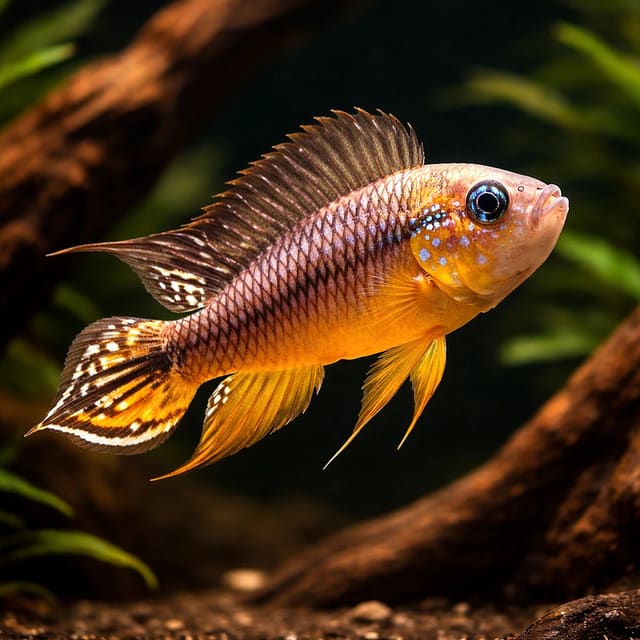
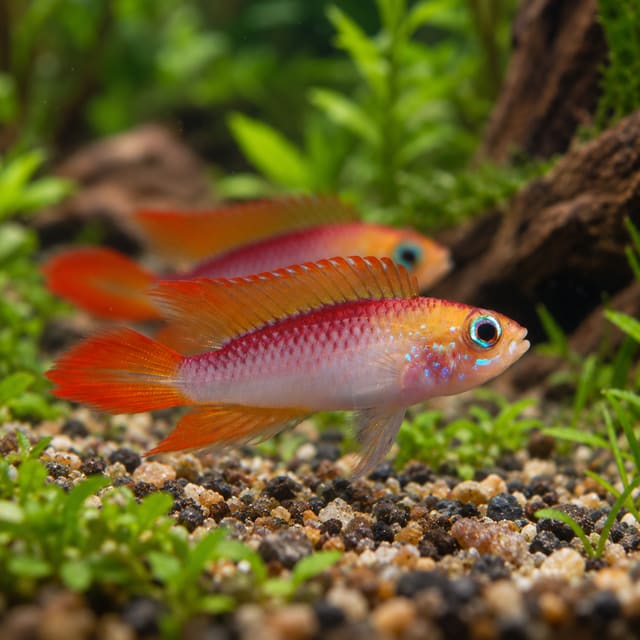
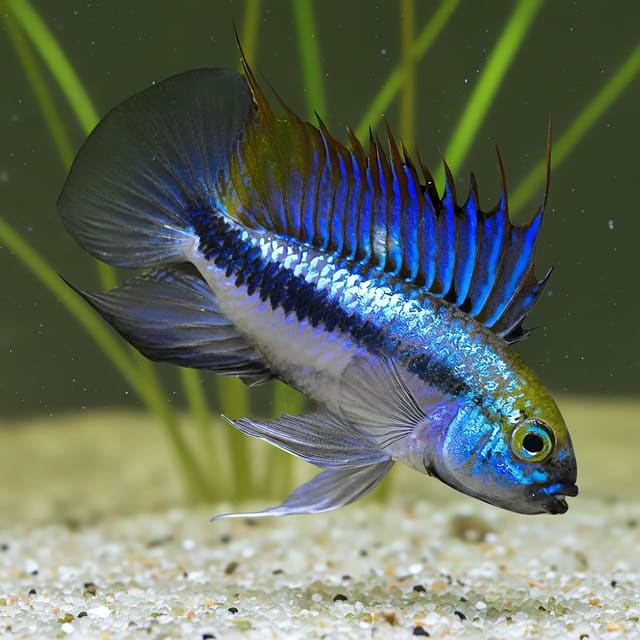
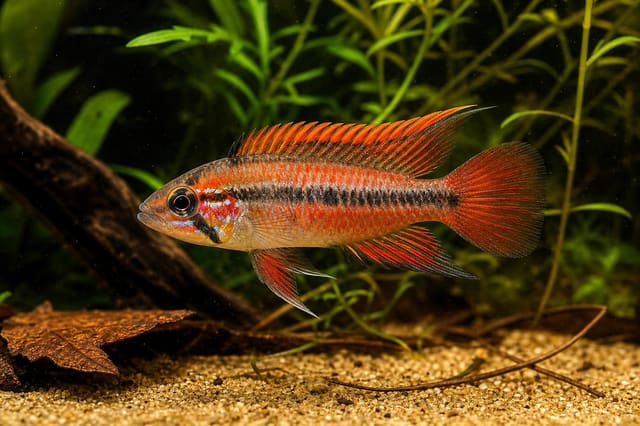
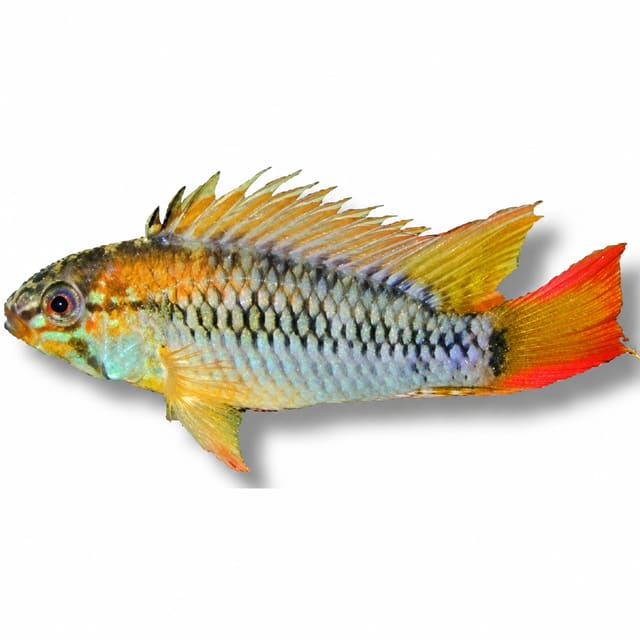
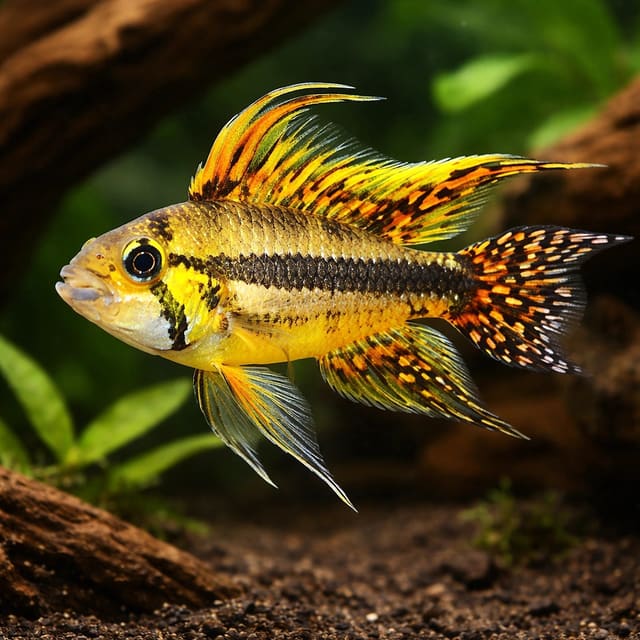
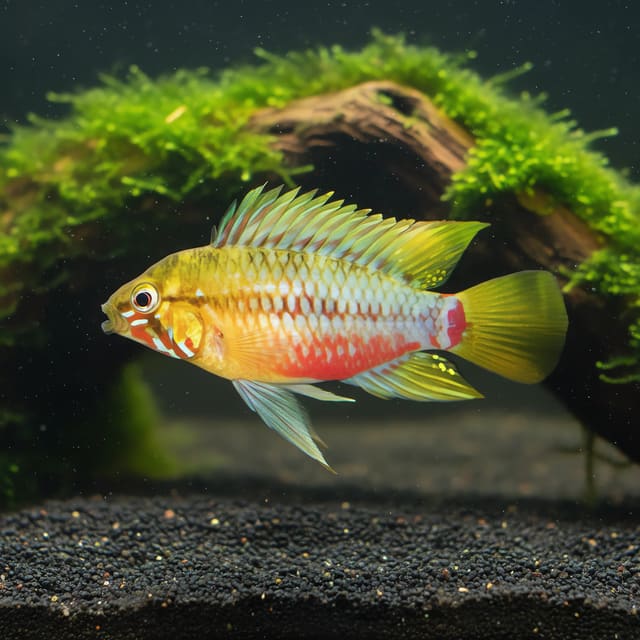
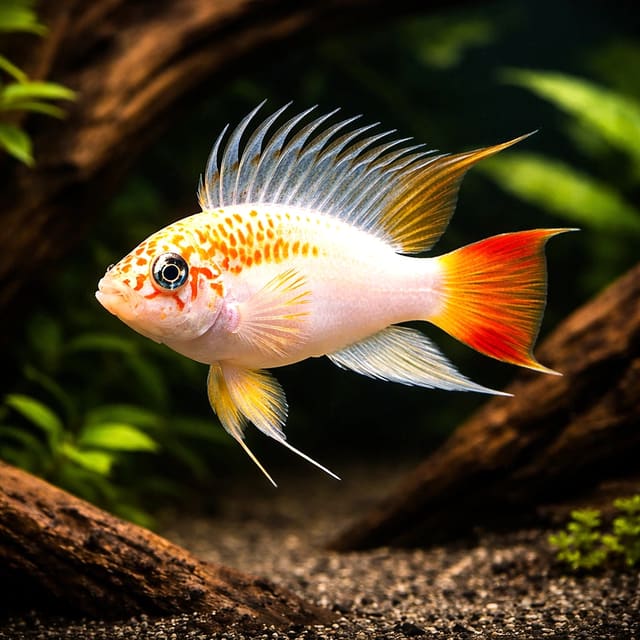
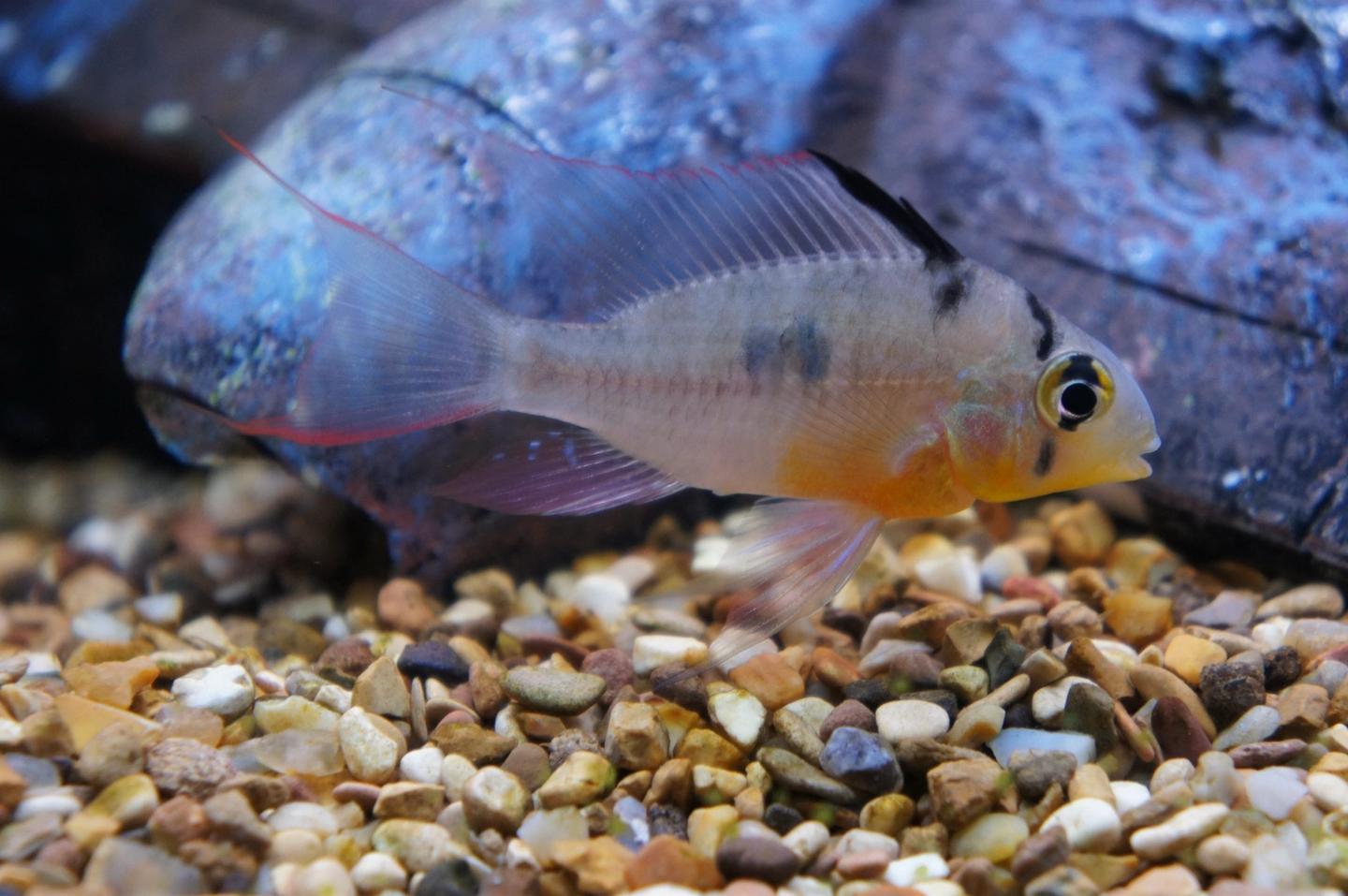
The gallery images are representative of this type of animal rather than photographs of the exact animal supplied, so colours can look slightly different from the live animal.
Assess the delivered fish by its condition and behaviour rather than expecting an exact match to a representative scene. Healthy fish have clear, bright eyes, undamaged fins, intact scales, no ulcerations or bumps and appropriate swimming. Colour and behaviour can vary between individual fish, while the offer remains one animal in the selected dispatch size.
Start with a base of at least 60 × 30 cm for a single pair. Seriously Fish equates that footprint to approximately 54 litres, while OATA recommends at least 60 litres for a pair of dwarf cichlids and says an aquarium of at least 80 litres will be needed to mix them with other fish. A practical pair aquarium should therefore hold at least 60 litres without sacrificing the 60 × 30 cm base, and a community needs at least 80 litres with its actual stocking assessed separately.
Volume alone does not create usable territory. A tall aquarium with a restricted floor can hold the same litres as a longer tank while offering fewer places to separate caves and feeding areas. Mark out the 60 × 30 cm base before choosing décor, then retain open routes between shelters so the fish can enter and leave without passing every other inhabitant.
Dried beech, oak or Ketapang almond leaves can be added as leaf litter. As they decompose, they encourage microbial colonies that may become a secondary food source for fry, while tannins and other released compounds help create naturalistic conditions. Leaves may be allowed to break down fully or removed and replaced every few weeks.
Even well-settled pairs will often chase each other, so providing plenty of cover is essential. A group requires larger quarters than the pair footprint, and this species can be quite aggressive towards its own kind. Do not use extra caves as a substitute for extra floor space: increase the aquarium dimensions first, then distribute shelter across the expanded base.
For a community, reserve room for tank mates to move away from a defended cave. OATA says at least 80 litres will be needed to mix dwarf cichlids with other fish, and that minimum is not blanket approval for a particular stocking list. The final number of fish must fit the aquarium’s dimensions, filtration capacity and territorial layout.
Keep the aquarium at 22–27°C, pH 6.0–6.5 and 4–5 dGH. These routine values are the overlap between the Seriously Fish species profile, which gives 22–29°C, pH 4.0–6.5 and 0–5 dGH, and OATA’s dwarf-cichlid group guidance, which gives 22–27°C, pH 6.0–8.0 and 4–12 dGH. The overlap provides one coherent operating range without exceeding the species’ upper pH or hardness limits.
| Value | Routine instruction |
|---|---|
| Temperature | Hold between 22 and 27°C |
| pH | Hold between 6.0 and 6.5 |
| General hardness | Hold between 4 and 5 dGH |
| Ammonia | Maintain at zero mg per litre |
| Nitrite | Maintain at zero mg per litre |
| Nitrate | Do not exceed 20 mg per litre above the normal tap-water level |
Test the aquarium and the replacement water rather than adjusting from an assumed tap-water profile. Our water chemistry guide explains what each reading means, and the water matcher helps compare measured values with this range.
If the aquarium reads 27°C, pH 6.5 and 5 dGH, every value remains at the upper edge of the routine range. If pH or hardness reads above the range, the setup does not suit this fish even when the temperature fits. Treat the range as three simultaneous requirements rather than choosing whichever number is easiest to match.
Prepare replacement water with tap-water conditioner before adding it to the aquarium. Make planned changes through the normal maintenance routine and re-test afterwards. A steady reading within the range gives the fish a consistent environment, while zero ammonia and nitrite protect it from toxic nitrogen waste.
Use a well-established biological filter and confirm that ammonia and nitrite are both zero before adding the fish. The RSPCA explains that fish release toxic ammonia, which beneficial filter bacteria convert first to nitrite and then to the safer nitrate. This bacterial population must be established and maintained rather than treated as an optional accessory.
If this is your first aquarium, follow our first tropical tank guide to prepare and mature the filter before livestock arrives. Adding several fish at once or rapidly increasing feeding can exceed the filter bacteria’s capacity. OATA identifies that imbalance as new tank syndrome, in which ammonia or nitrite rises because there are too few nitrifying bacteria for the increased waste.
For the approximately 54-litre species setup described by Seriously Fish, use a filter rated around 110–160 litres per hour while retaining the gentle movement this fish needs. Check the actual flow after décor is installed because roots, caves and plants alter circulation. The aim is effective biological filtration without removing the calmer lower-level territory around shelters.
The same profile estimates roughly 75–100 W of heating to maintain 22–29°C in an aquarium of that size when the room is around 20°C. Equipment choice still needs to reflect the actual aquarium volume and room conditions, while the routine operating temperature for this setup remains 22–27°C.
A working filter does not replace water changes or testing. Filtration processes waste continuously, while testing shows whether the system is coping and partial changes control accumulated nitrate and dissolved waste.
Build the main ration around appropriately sized invertebrate foods. Seriously Fish describes Apistogramma as chiefly carnivorous fish that feed mostly on benthic invertebrates in nature. In the aquarium, offer live or frozen Artemia, Daphnia and chironomid larvae such as bloodworm regularly, with a quality small pelleted product as the preferred dried alternative to flake.
Present food where this lower-level fish can reach it and watch the individual eat. Fast tank mates can intercept food before it reaches the cichlid, so successful community feeding depends on distribution as well as the food chosen. The portion is correct when the fish consumes it within a few minutes and little remains to decay.
OATA’s dwarf-cichlid group guidance recommends feeding once a day and offering only what the fish can eat within a few minutes. Choose the foods from the species’ carnivorous diet and use this schedule for how much and how often.
| Feeding decision | Practical choice |
|---|---|
| Main live or frozen foods | Artemia, Daphnia and bloodworm |
| Dried alternative | An appropriately sized quality pellet |
| Frequency | Once a day |
| Portion limit | Only what is eaten within a few minutes |
| Variety | Rotate suitable live, frozen and dried foods |
If food remains after several minutes, remove the excess and reduce the next portion. Uneaten food breaks down and releases waste, which can raise the load on the biological filter. Test ammonia and nitrite if feeding has been excessive or appetite falls, because both readings must remain at zero.
If the fish waits near cover while other inhabitants take every item, distribute a small amount closer to its retreat rather than increasing the whole aquarium’s ration. If it repeatedly ignores a food, try another suitable invertebrate-based form and continue watching body condition and feeding response.
Change 25% of the aquarium water at least once every week. Siphon solid waste from the substrate where it collects, condition the replacement water to remove chlorine or chloramine, and match it to the aquarium’s planned parameters before adding it.
Test ammonia and nitrite at least once per week and keep both at zero. Check nitrate against the limit of no more than 20 mg per litre above the normal tap-water level. Record the readings so a gradual shift is visible before it becomes a sudden problem.
Inspect caves, pipework and wood during maintenance without dismantling every retreat. Remove blockages that prevent normal circulation, but preserve the shelter structure that allows the cichlid to withdraw. Replace selected leaf litter every few weeks if you do not intend to let it break down fully.
Watch swimming, colour, temperament, breathing, appearance, body condition and feeding. Warning changes include hanging at the surface, sitting on the bottom unusually, erratic swimming, darker or paler colour, increased aggression or hiding, faster or slower gill movement, white spots, fluffy growths, damaged fins or scales, weight change and reduced appetite.
If any of those changes appears, test water quality first and correct aquarium-management problems within the stated care ranges. Check that temperature is steady, ammonia and nitrite are zero, the filter is running and tank mates are not preventing access to food or cover. Contact us for further guidance when a health change persists or the fish’s condition causes concern.
Arrange for someone to receive the parcel in person. Tropical Fish Co’s delivery and Live Arrival Guarantee policy says live fish are hand-bagged in pure oxygen, placed in an insulated poly box and given a heat pack when the weather calls for it. A licensed live-animal courier carries the parcel.
Keep the order number with the continuous unboxing video. For a Live Arrival Guarantee claim, contact us on the same day with the order number and video showing the sealed parcel, the continuous opening and the fish still inside the bag.
Complete the aquarium checks separately before the delivery. Temperature should already be within 22–27°C, pH within 6.0–6.5, hardness within 4–5 dGH, and ammonia and nitrite at zero. The filter must be established and operating, with caves and shaded retreats already arranged. These checks prevent the arrival period from becoming the moment when equipment, décor or water chemistry is first tested.
Introduce livestock gradually rather than combining a major stocking increase with heavier feeding. Beneficial filter bacteria need time to respond whenever the fish population and waste load increase. After release, use the normal health observations: breathing, swimming, condition and feeding response. Test the water promptly if behaviour changes, because ammonia and nitrite must remain at zero during the increased biological load.
Plan around FishBase’s recorded maximum of 4.9 cm standard length. Standard length measures the body without the tail fin and is the consistent adult figure used for this animal. Retain the full 60 × 30 cm footprint even for a fish sold at a smaller dispatch size.
Seriously Fish describes males as larger and more colourful than females, with more extended fins. Those are general adult traits rather than a guarantee for a particular selected fish. Dispatch size, temporary colour and a representative gallery scene should not be used to promise sex or a compatible pair.
FishBase records eggs being deposited on the ceiling of caves and tended by the female parent. Seriously Fish similarly describes a substrate-spawning cichlid that normally lays eggs in crevices or cavities among the décor, with the female responsible for post-spawning care of eggs and fry.
These behaviours explain why caves, broken sight lines and spare retreat areas matter even when breeding is not the keeper’s goal. A cave can become a defended spawning site, and territorial intensity may rise around eggs or fry. In a smaller aquarium, a female may become sufficiently aggressive after spawning that the male needs to be removed.
Do not crowd the aquarium in anticipation of a particular breeding outcome. Build the layout for safe withdrawal, keep water quality within range and be prepared to separate fish if post-spawning aggression makes the shared space unsafe.
Use small dither fish as the narrow starting point for a community plan, then screen the exact aquarium for space, activity and breeding risk. OATA recommends shoals of dither fish because they can give dwarf cichlids a sense of security and move away when territorial behaviour begins. Seriously Fish specifically names Nannostomus and Micropoecilia species for wild examples.
Screen any named companion against your own aquarium before adding it. The aquarium must still provide at least 80 litres for a mixed dwarf-cichlid community under OATA’s guidance, enough open swimming room for the dither shoal and a separately structured lower area around the cichlid’s caves.
| Test | Decision |
|---|---|
| Activity | Avoid very active or boisterous fish, because shy Apistogramma will not do well with them |
| Territory | Give every fish room to move away from a defended cave, especially during breeding |
| Breeding risk | Avoid fish that disturb spawning sites or prey on fry when breeding is intended |
Avoid other Apistogramma. Seriously Fish advises that wild examples ideally should not be mixed with other members of the genus, while this species can also be quite aggressive towards its own kind. Adding more caves does not remove the risk created by overlapping cichlid territories.
Avoid very active or boisterous tank mates, because OATA says shy dwarf cichlids such as Apistogramma will not do well in aquariums with them. Observe whether the cichlid can leave cover, reach food and hold a retreat without constant chasing. If any of those functions fails, revise the stocking plan rather than feeding more or removing all shelter.
Ask us for advice before adding fish, with the aquarium dimensions, volume, water readings and the full proposed fish list. Compatibility remains conditional on individual behaviour, available floor space and whether spawning territory develops.
Treat a single pair as the standard small-group plan and give any larger group substantially more space. Seriously Fish accepts a 60 × 30 cm base for one pair but says a group requires larger quarters; it also describes the species as potentially quite aggressive towards conspecifics and says a very large aquarium would be needed for a group.
Do not add multiple females on the assumption that a male requires a harem. Once pairs form, they often remain monogamous, so extra fish may create additional territorial pressure without serving a social requirement. Selecting a dispatch size does not mean two individuals will pair.
The pursued fish should be able to move out of view and remain there without losing all access to food. If one fish continually occupies the only viable cave or feeding route, the layout is not providing two functional territories.
When chasing increases, first identify whether it centres on a cave, feeding point or newly introduced fish. Check water quality because ammonia and nitrite must remain at zero, then confirm that each fish can reach shelter and food. During spawning, protect the defended site from tank mates that may disturb it or prey on fry.
Community success is therefore a continuing observation decision, not a fixed label attached to a companion species. Suitable water, adequate dimensions and dither-fish behaviour create a reasonable starting point; the response of the individual cichlid determines whether that arrangement remains workable.
FishBase records a maximum adult size of 4.9 cm standard length; plan the aquarium around that adult measurement, not its dispatch size.
Seriously Fish accepts a base of at least 60 × 30 cm, approximately 54 litres, for a single pair; OATA recommends at least 60 litres for a pair and says at least 80 litres will be needed to mix dwarf cichlids with other fish.
Plan a pair for a base of at least 60 × 30 cm; a group requires much larger quarters because this species can be quite aggressive towards its own kind, and a harem is unnecessary once a pair forms.
A beginner should be ready to mature a filtered aquarium first, maintain zero ammonia and nitrite, hold 22–27°C, pH 6.0–6.5 and 4–5 dGH, and manage cave-related territorial behaviour.
Feed appropriately sized invertebrate foods such as live or frozen Artemia, Daphnia and bloodworm regularly, with a quality small pellet as a dried alternative; offer once daily and only what it eats within a few minutes.
Keep it at 22–27°C, pH 6.0–6.5 and 4–5 dGH; those values are the overlap between Seriously Fish species guidance and OATA dwarf-cichlid guidance.
Territorial aggression is the main behaviour to plan for: it can be quite aggressive towards its own kind, and breeding fish may defend caves. Use cover and do not treat a group as a small-aquarium choice.
After individual screening, shoals of small dither fish are the supported community approach; Seriously Fish specifically names Nannostomus and Micropoecilia species for wild examples. Avoid other Apistogramma, and when breeding avoid fish that disturb spawning sites or eat fry.
Tropical Fish Co packs live fish in pure oxygen inside an insulated box, with a heat pack when weather calls for it, and uses a licensed live-animal courier. Receive the parcel in person, film continuously from the sealed parcel through opening, show the fish inside the sealed bag, inspect it the same day and float the bag for 20–30 minutes before release.
No reviews for this item yet. Bought one? Honest reviews only, good or bad.
What customers say about ordering from us
I have a small group of long finned mountain minnows. So was delighted to be able to order ten of this variety to increase the genetics in my tank . The ones I recieved are healthy but it’s to early to give a verdict on wether they are of a long finned type since they are small currently.
Gordon Walker · 23 Sept 2026
100% success travel and "installation". Pleased with quality of purchase. The Siamese fighter a bit "shy" so have not yet seen him at his best yet but looking good. Happy customer. GG
George E Garratt · 21 Sept 2026
Reviews of our shop, collected by Judge.me, an independent third-party review collector. Newest first.