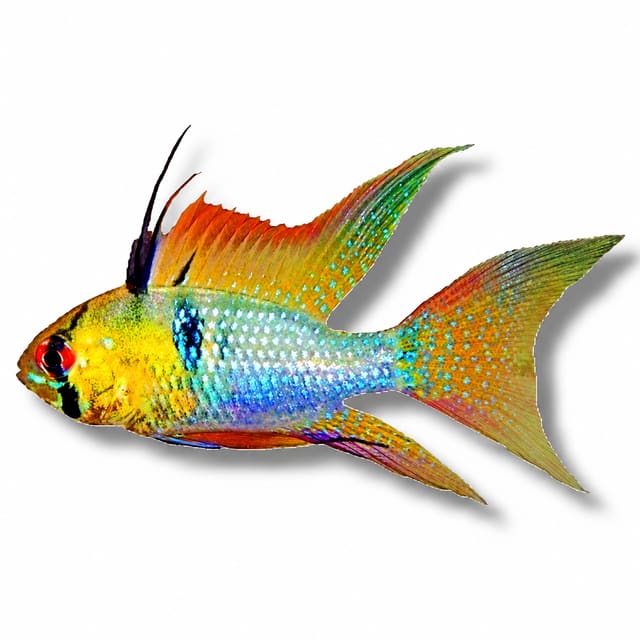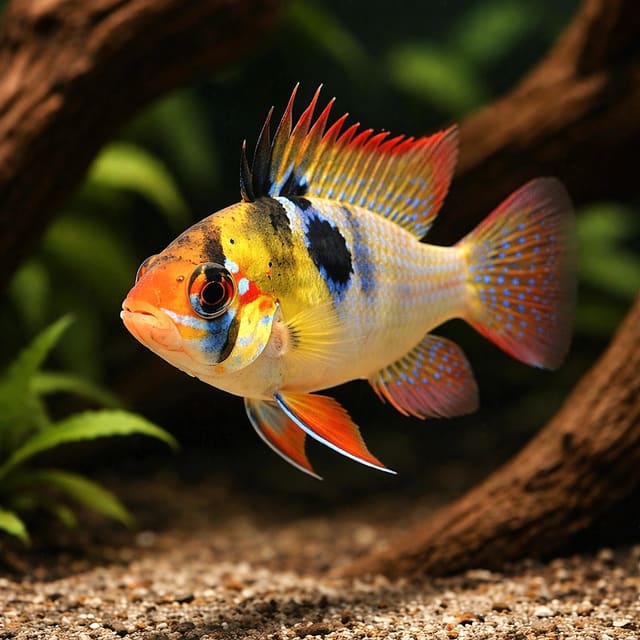
Asia Form Ram Cichlid (Mikrogeophagus ramirezi)
27–30°C · pH 4–7 · 54L
£5.99

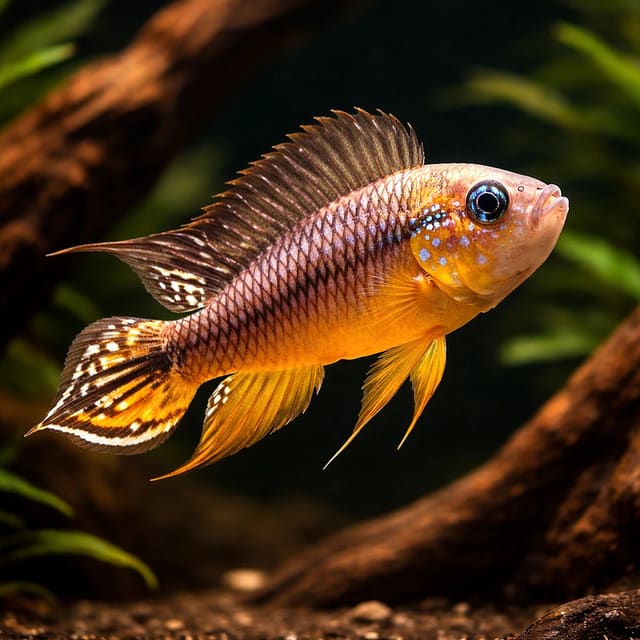
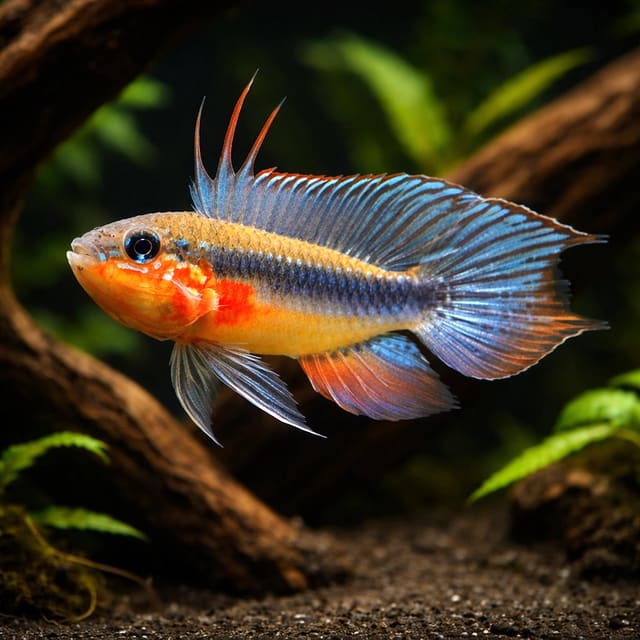
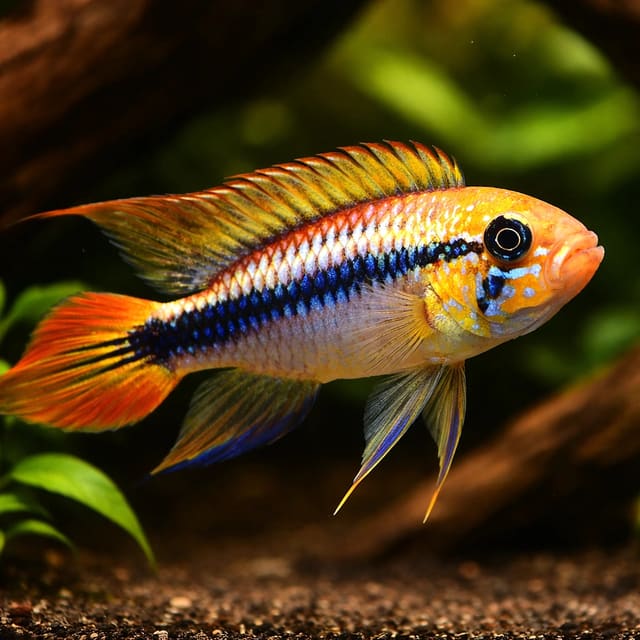
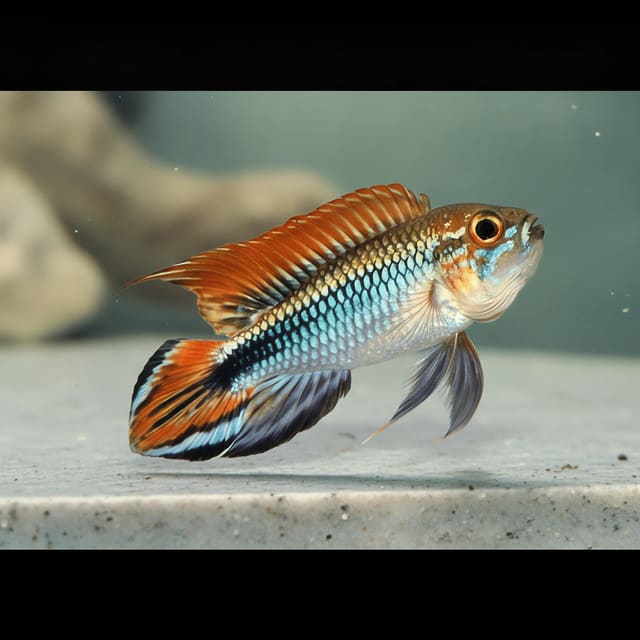
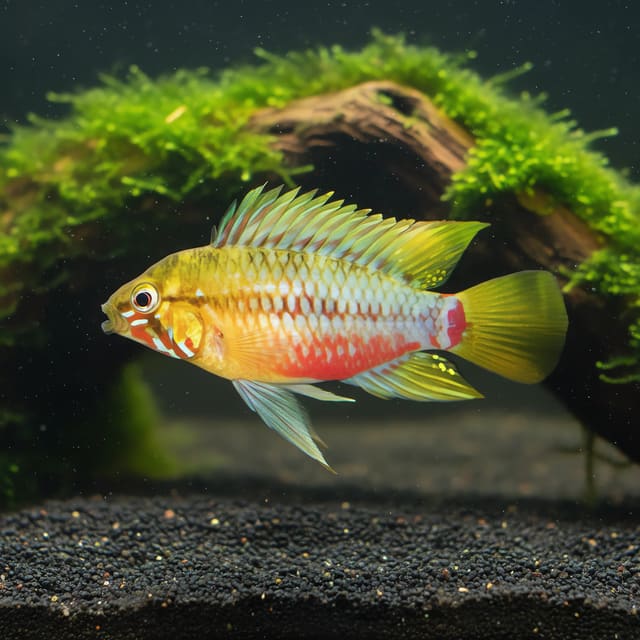
Double Red Agassiz’s Dwarf Cichlid (Apistogramma agassizii) is an ornamental colour form of a small cave-spawning cichlid from the Amazon basin. It needs soft, clean water, caves and calm dither fish; each purchase is one fish, supplied at 3–4 cm or as a larger XL grade.
Apistogramma agassizii
Save when buying multiple fish. Each quantity is one fish; sex and pair formation are not guaranteed unless the selected variant explicitly states them.
Double Red Agassiz’s Dwarf Cichlid (Apistogramma agassizii) is an ornamental colour form of a small cave-spawning cichlid from the Amazon basin. It needs soft, clean water, caves and calm dither fish; each purchase is one fish, supplied at 3–4 cm or as a larger XL grade.

Cichlids are a family of roughly 1,800 accepted species, not one care type. Before buying, identify the exact species and source, then compare adult measurement, usable tank dimensions, social system, territory, tested water, diet and an exit plan. No family-wide minimum tank, water range or tank-mate list is safe.
Maintain these water conditions for optimal health and vibrant colors
The Double Red Agassiz’s Dwarf Cichlid is an ornamental colour form of Apistogramma agassizii, a small cave-spawning cichlid from the Amazon basin. Each purchase supplies one live fish of the size you choose. It belongs in a matured, well-filtered aquarium with soft water, several caves and plenty of cover, shared only with calm fish that leave the lower levels to it.
Agassiz’s dwarf cichlid is one of the best-known members of Apistogramma, a genus that Seriously Fish puts at around 70 valid species with many more awaiting description. Numerous ornamental forms of this species have been selectively bred for the aquarium trade, and Double Red is one of those trade names. Everything in this guide applies to the species as a whole: the colour name changes how the fish looks, not what it needs.
| Suits | A matured aquarium with a base of at least 60 × 30 cm for a pair, or 80 litres or more if it will share with other fish |
|---|---|
| Water | Soft and slightly acidic to neutral: pH 5.0–7.0, 0–10 dGH, a steady 22–29 °C |
| Tank mates | Small, calm shoaling fish such as pencilfish; nothing fast or pushy |
| Diet | Mainly small meaty foods, live or frozen, with a quality pellet |
| Less suited to | Busy tanks full of boisterous fish, or bare aquariums without caves and cover |
| Scientific name | Apistogramma agassizii |
|---|---|
| Family | Cichlidae |
| Native range | Amazon River basin, from Peru through Brazil |
| Recorded adult length | 4.4 cm standard length (FishBase) to about 75 mm standard length for males (Seriously Fish) |
| Social pattern | A pair, or one male with several females |
| Breeding | Cave spawner; the female guards the eggs and fry |
| Conservation status | Least Concern (IUCN) |
This fish makes a fine centrepiece for a quiet, planted soft-water aquarium where the floor is left to it and small shoaling fish fill the middle water. It is a poor match for a tank of large or fast fish, for hard and alkaline water, or for a bare set-up with nowhere to hide. Choose it when you can give it a territory of its own and are happy to keep the water clean week after week.
One purchase is one fish. There are two sizes to choose from: a 3–4 cm fish and a larger grade sold as XL. The size you select is the size supplied, not the adult size. Adult length is covered in the care tab, where the published records for the species are compared.
Sex is guaranteed only when the selected option explicitly states male or female. This Double Red Agassiz’s Dwarf Cichlid listing has no sex-guaranteed option. Seriously Fish notes that males grow larger, more colourful and longer-finned than females, so a young fish’s sex and final appearance become clear only as it matures.
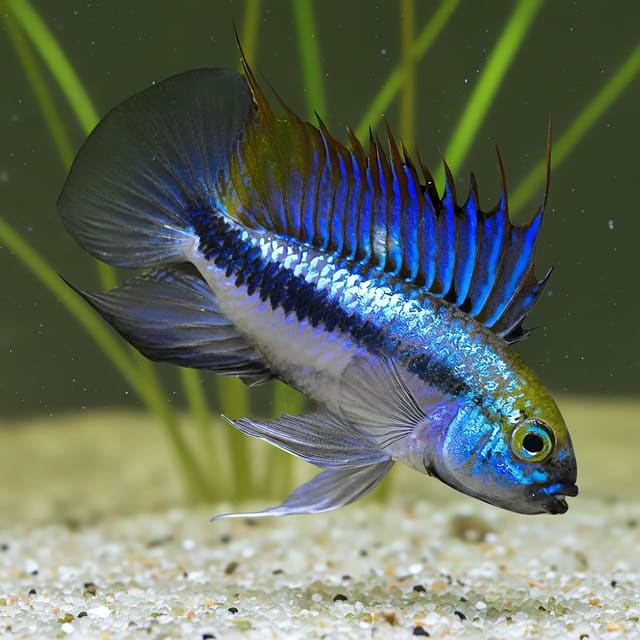
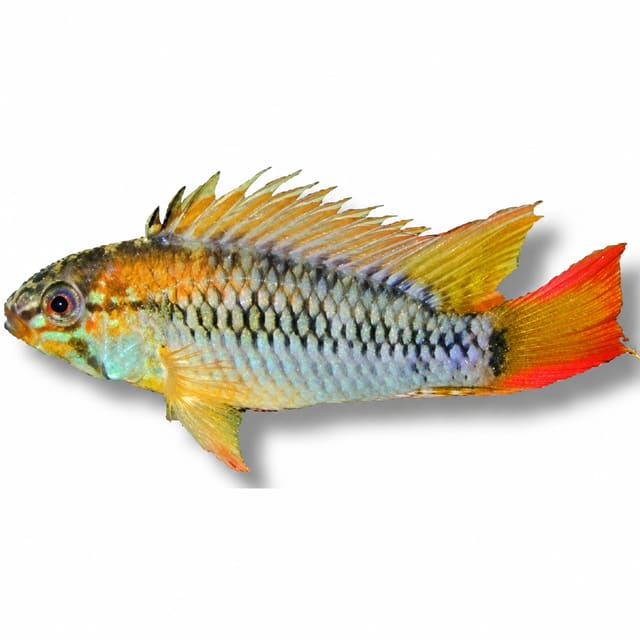
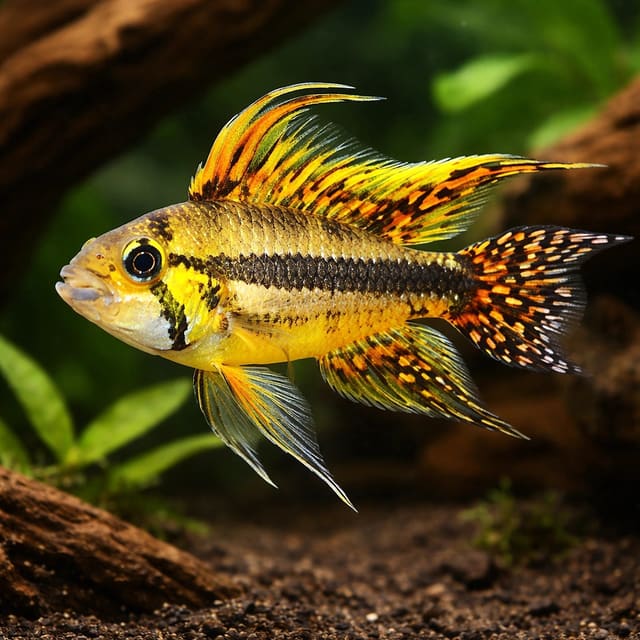
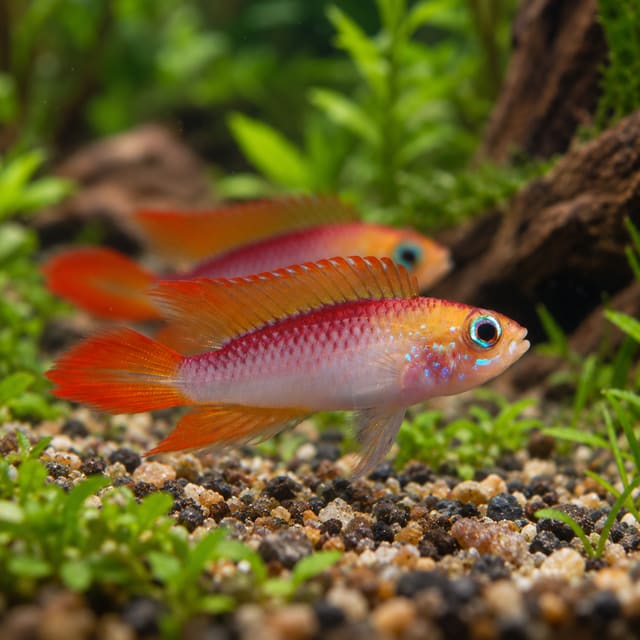
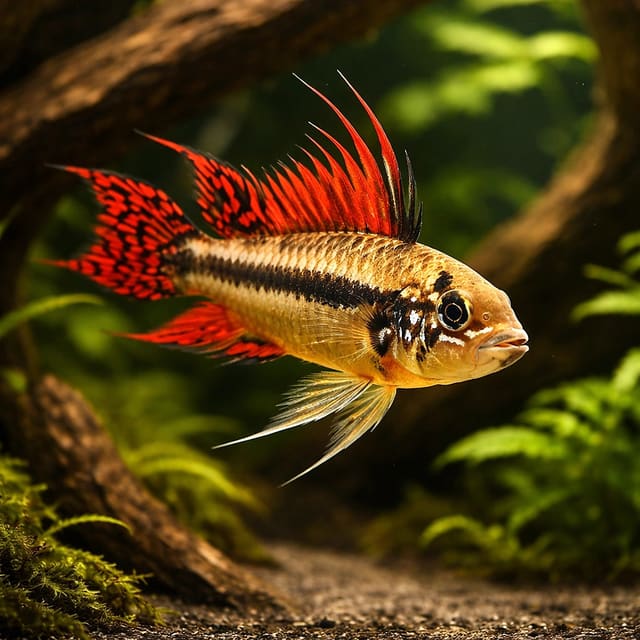
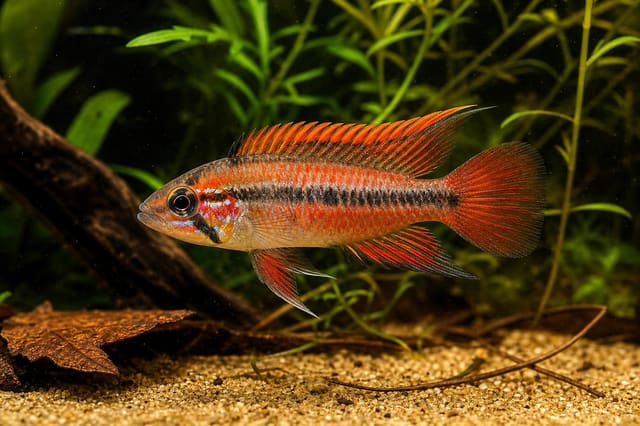
Gallery images have been digitally enhanced to improve image quality. Natural colour, pattern, size and maturity can vary between live animals. The photographs show long-finned fish with red-orange dorsal and tail fins, a dark stripe along the body and blue markings on the face. A 3–4 cm fish is smaller than the adult lengths recorded for the species, so allow for growth after it arrives.
If you are still comparing species, our South American cichlid collection brings the rams, Apistogramma and larger South American cichlids together in one place.
FishBase lists Apistogramma agassizii as a benthopelagic freshwater cichlid, recorded along the Amazon–Solimões River from Peru through Brazil to the Capim River basin. Adults inhabit clear, black and white water, three very different kinds of river water. It is assessed as Least Concern by the IUCN.
In practice it stays low in the aquarium, close to the floor and the cover that the wood, caves and leaves provide. That is where it feeds, where it holds its ground and where a female raises her brood, so the lower part of the tank matters far more to this fish than open water near the surface.
| Record | Length |
|---|---|
| FishBase maximum length, male or unsexed | 4.4 cm standard length |
| Seriously Fish, males | About 75 mm standard length |
| Seriously Fish, females | About 50 mm standard length |
| Sizes supplied | 3–4 cm, or the larger XL grade |
The references do not agree, and the gap is large for such a small fish. Plan around the larger Seriously Fish figure for males. A fish that finishes nearer the FishBase record will simply have room to spare, while a male that reaches 75 mm needs the floor space, the cave entrances and the tank mates you have already allowed for.
Both figures are standard lengths, so the long tail visible in the photographs adds to the length you will see in the tank. Females are the smaller sex, and Seriously Fish describes males as larger, more colourful and more extended in the fins.
Seriously Fish records the DATZ ‘A’ number A234 for the species, with possibly conspecific locality forms numbered A103, A104, A105 and A238 to A242. Many species in the genus exist in two or more geographical colour forms, and hobbyists label their fish with collection data where it is known to avoid mixing them and the risk of hybridisation. Double Red is a trade colour name; if you already keep another form of Agassiz’s dwarf cichlid, keep the two apart and labelled.
| Plan | Aquarium |
|---|---|
| A single pair | A base of at least 60 × 30 cm, about 54 litres (Seriously Fish) |
| One male with several females | Larger than the pair tank; Seriously Fish says a group needs larger quarters |
| Shared with other fish | At least 80 litres, from OATA’s dwarf cichlid guidance |
| Tank length | At least 60 cm, the minimum aquarium size in FishBase’s aquarium note |
OATA’s care sheet for dwarf cichlids recommends at least 60 litres if just a pair is being kept, and says an aquarium of at least 80 litres will be needed to mix these species with other fish. It also advises buying an aquarium as large as possible within reason, because a larger volume holds its temperature and water quality more steadily. Floor area is the measurement that counts for a cave-dwelling cichlid, so a long, shallow tank serves it better than a tall one of the same volume.
Seriously Fish describes the species as unfussy about décor provided there is adequate cover and structure. Ceramic flowerpots and short lengths of plastic piping make perfectly good caves. A more natural layout uses a soft, sandy substrate with wood roots and branches arranged to form shady spots and caves.
Spread the caves out rather than clustering them. Dwarf cichlids can be territorial, especially when breeding, and a fish that can defend its own cave without facing a neighbour at the entrance settles far more readily.
Picture an 80-litre soft-water community built for this fish. Sand covers the floor, two or three pieces of wood run from the back towards the front, and three or four caves sit at different points so that no entrance faces another. A handful of dried leaves gathers in the corners. A shoal of pencilfish uses the middle and upper water, and the filter outlet runs along the back glass rather than across the floor. That layout gives a pair or a small group room to settle, keeps the dither fish out of the cichlid’s way and leaves space should the fish begin to breed.
The RSPCA says no fish should be kept without a well set up and maintained filter: fish release ammonia, a working biological filter lets beneficial bacteria convert it to nitrite and then to the safer nitrate. This species prefers gentle water movement. For a tank of about 54 litres, Seriously Fish suggests a filter rated at 110–160 litres per hour, and roughly 75–100 W of heating to hold 22–29 °C in a room of around 20 °C. Scale both up for a larger community aquarium, and position the outlet so it does not blast across the caves.
| Measure | Aim |
|---|---|
| Temperature | 22–29 °C, held steady (Seriously Fish aquarium range) |
| pH | 5.0–7.0 (FishBase) |
| General hardness | 0–10 dGH (Seriously Fish); FishBase gives 0–12 dH |
| Ammonia and nitrite | Zero |
| Nitrate | No more than 20 mg per litre above your tap water level (OATA) |
FishBase records the species’ natural waters at 26–29 °C, which sits in the upper half of the aquarium range. Choose one temperature within 22–29 °C and keep it there; a steady figure matters more than hitting a particular number, and a fish kept towards the warmer end is closest to its home conditions.
Seriously Fish is clear that commercially produced fish are relatively unfussy, but that some wild populations may require a pH as low as 3.0–4.0 in order to breed, and that wild fish are more likely to need negligible to low hardness. Those extremes describe spawning conditions for particular wild fish; they are not a routine target for an ornamental form in a home aquarium. Soft water within the ranges in the table is the practical aim.
OATA’s dwarf cichlid sheet gives broader figures for the whole group: 22–27 °C, pH 6.0–8.0, general hardness of 4–12 °dH and carbonate hardness of 3–10 °dKH. That sheet covers rams, kribensis and other dwarf cichlids as well as Apistogramma, so for this species keep to the ranges in the table, and treat a pH above 7.0 as outside its comfortable range.
Test the water at least once a week so that ammonia and nitrite never have the chance to build up. Our guide to aquarium water parameters explains what each reading means, and the water parameter matcher lets you compare your own tap and tank results with the ranges above before you commit to the fish. Treat every batch of replacement water with a tap water conditioner to remove chlorine and chloramine.
If your tap water is hard, decide how you will produce soft water before the fish arrives, and make the change gradually across several water changes rather than in one go. Stability is kinder than a large swing towards an ideal number.
Seriously Fish describes Agassiz’s dwarf cichlid as primarily carnivorous, apparently feeding mostly on benthic invertebrates, the small animals that live on the river bed. That shapes the whole feeding plan. It is a small hunter that picks food from the bottom, not a grazer.
OATA’s dwarf cichlid care sheet, written for the whole group, describes them as omnivorous and suggests a good quality flake or granule with small live or frozen foods such as daphnia, brine shrimp or tubifex. For this species the meatier Seriously Fish menu comes first, with dried food alongside it.
OATA advises feeding dwarf cichlids only what they can eat within a few minutes, once a day, and taking care not to overfeed, because uneaten food breaks down and releases toxic waste into the water. In a small soft-water aquarium that waste builds quickly, so remove anything left on the floor after the meal.
In a community tank, fast mid-water fish can take much of the food before it sinks. Let some frozen food or pellets sink to the floor near the caves so the cichlid gets its share, and watch that it is actually eating rather than hiding through every meal.
OATA notes that some dwarf cichlids can be territorial, especially when breeding, and that Apistogramma in particular can be quite shy and will not do well alongside very active or boisterous tank mates. Expect a fish that claims a cave and the floor around it and retreats into cover when disturbed. A shoal of calm dither fish in open water gives it the security to come out into view.
Seriously Fish describes males as larger, more colourful and longer in the fins than females, and FishBase gives several females for one male as the aquarium arrangement. Because sex cannot be chosen on this listing, you will not know which fish you have until they mature. Plan the space and caves for whichever mix of sexes you end up with, and be ready to rehome an extra male if two compete for the same territory.
This is a substrate spawner that normally lays its eggs in crevices or cavities among the décor; FishBase notes that eggs are placed on the ceiling of caves and tended by the female parent. Seriously Fish adds that the female is responsible for post-spawning care of eggs and fry, and that in smaller aquaria the male may need to be removed because she may become hyper-aggressive while guarding.
Decaying leaf litter supports microbe colonies that can give fry a valuable secondary food. OATA advises avoiding tank mates that might disturb spawning sites or eat the fry if you intend to breed these fish. Remember that some wild populations may need extremely acidic water to spawn; an ornamental form in ordinary soft water is a very different starting point.
Every order is hand-bagged in pure oxygen and packed in an insulated poly box, with a heat pack when the weather calls for it, then carried by a tracked, licensed live-animal courier. You receive an email with the tracking number and your confirmed delivery date. Someone needs to be at the delivery address to receive the parcel, because live fish cannot be left unattended.
Before the date, check that ammonia and nitrite read zero and that the heater has held the tank at your chosen temperature for several days. OATA advises increasing fish numbers slowly, because the filter bacteria need time to catch up with each new addition; adding too many fish too quickly can cause new tank syndrome, with ammonia and nitrite rising to levels that make fish ill.
The full terms are on our delivery and Live Arrival Guarantee page.
A shy new Agassiz’s dwarf cichlid may spend its first days close to cover while it learns the tank. Offer a small meal once it is out and exploring, and make sure the caves you planned are already in place, so it can claim one straight away rather than competing for space later. Keep testing, because a new fish adds to the load on the filter, and hold off on further stocking until readings stay at zero.
OATA stresses that good husbandry is essential because dwarf cichlids can be stressed by even the smallest amounts of ammonia. For a small soft-water fish, the weekly routine is the single most important part of its care.
Keep a simple log of test results, water changes and anything unusual you notice. A short record makes a slow rise in nitrate, or a fish that has gradually started to eat less, far easier to see than memory alone, and it gives useful detail if you ever need advice.
OATA describes healthy fish as having clear, bright eyes, undamaged fins, intact scales and no ulcerations or bumps, together with normal swimming. Get to know how your fish looks and behaves when it is settled, because small changes are easiest to spot against that baseline.
If you notice any of these, test the water first, as OATA advises, because water quality is the quickest thing to check and put right. Then get in touch with our team for guidance with your readings to hand.
OATA advises that dwarf cichlids are best kept with shoals of dither fish, which give the cichlids a sense of security and are quick enough to swim away if the cichlids become territorial. Seriously Fish names small dither fishes such as Nannostomus pencilfish as the companions for wild examples, and recommends captive-raised fish as the choice for a general community aquarium.
| Tank mate type | Guidance |
|---|---|
| Small shoaling dither fish, such as pencilfish | Good choice: they occupy open water and help a shy cichlid settle |
| Very active or boisterous fish | Avoid: OATA notes that Apistogramma will not do well with them |
| Fish that would disturb caves or eat fry | Avoid if you intend to breed, following OATA’s advice |
| Other Apistogramma | Take care: Seriously Fish advises that wild examples ideally should not be mixed with other Apistogramma, and forms can hybridise |
OATA says dwarf cichlids can be kept in community aquariums provided every tank mate has enough space should the cichlids start breeding, and that an aquarium of at least 80 litres will be needed to mix these species with other fish. In practice that means keeping the floor and the caves for the cichlid, and choosing companions that live mainly in the middle and upper water.
Stock slowly. Add the dither fish first so the aquarium already feels occupied and calm, then introduce the cichlid once the tank is stable. A cichlid added to a tank full of established fast-moving fish is more likely to hide and miss meals.
FishBase gives several females for one male as the aquarium arrangement, so keeping more than one Agassiz’s dwarf cichlid is the usual plan. Mixing Apistogramma species is a different decision. Because hobbyists label colour forms and localities to avoid hybridisation, and Seriously Fish advises against mixing wild examples with other Apistogramma, a single-species cichlid set-up with dither fish is the straightforward plan. If you do combine cichlids, allow a separate territory for each and watch the first weeks closely.
Any of these calls for a change: more cover, fewer or different companions, or a move for the fish under pressure.
Tank mates must also share the water. Anything that needs hard or alkaline water, or temperatures outside 22–29 °C, is a poor match however calm it is. Pencilfish and other soft-water shoaling fish fit this plan far better than species that prefer pH above 7.0.
FishBase records a maximum length of 4.4 cm standard length for a male or unsexed fish, while Seriously Fish gives about 75 mm standard length for males and 50 mm for females. Plan the aquarium, the caves and the tank mates around the larger male figure so there is room to spare whichever way your fish grows.
Seriously Fish sizes a base of at least 60 × 30 cm, about 54 litres, for a single pair and says a group needs larger quarters. OATA’s dwarf cichlid care sheet says an aquarium of at least 80 litres will be needed to mix these fish with other species, so a community tank should start at 80 litres.
FishBase gives several females for one male as the aquarium arrangement, and Seriously Fish sizes its smallest tank for one pair. Sex cannot be chosen when ordering, so a group bought together will be a mix you discover as the fish mature. Give a group more floor space and more caves than a pair, and be ready to rehome a surplus male if two start fighting over the same territory.
It suits a keeper who already has a matured, well-filtered aquarium and will test the water every week. OATA describes dwarf cichlids as usually undemanding, but it also notes that Apistogramma can be shy and territorial, especially when breeding, and that good husbandry matters because even small amounts of ammonia cause stress.
Seriously Fish describes it as primarily carnivorous, feeding mostly on small bottom-living invertebrates in nature. Offer live or frozen brine shrimp, Daphnia and bloodworm regularly alongside a quality small pellet, and give only what the fish clear within a few minutes.
Hold one steady temperature within 22–29 °C, keep the pH between 5.0 and 7.0 and aim for general hardness of 0–10 dGH. FishBase records its natural waters at 26–29 °C. Some wild populations need far more acidic water to breed, but aquarium-raised fish are much less fussy.
It is a small and often shy cichlid, but it defends a territory, most of all when breeding. Seriously Fish notes that a brooding female may become hyper-aggressive in a smaller aquarium, where the male may need to be moved elsewhere. Plenty of caves, wood and planting spread that pressure out.
Small, calm shoaling dither fish are the kind to choose; Seriously Fish names pencilfish (Nannostomus species), and OATA explains that dither fish give dwarf cichlids a sense of security and can swim clear of a defended cave. Leave out very active or boisterous species, and fish that would disturb spawning caves or eat fry.
Each order is hand-bagged in pure oxygen inside an insulated poly box, with a heat pack when the weather calls for it, and travels with a licensed live-animal courier. Someone must be in to receive it. Film a continuous unboxing video from the sealed parcel, float the sealed bag for 20–30 minutes before releasing the fish, never pour the bag water into the tank, and contact us the same day with your order number and the video if anything is wrong.
No reviews for this item yet. Bought one? Honest reviews only, good or bad.
What customers say about ordering from us
I have a small group of long finned mountain minnows. So was delighted to be able to order ten of this variety to increase the genetics in my tank . The ones I recieved are healthy but it’s to early to give a verdict on wether they are of a long finned type since they are small currently.
Gordon Walker · 23 Sept 2026
100% success travel and "installation". Pleased with quality of purchase. The Siamese fighter a bit "shy" so have not yet seen him at his best yet but looking good. Happy customer. GG
George E Garratt · 21 Sept 2026
Reviews of our shop, collected by Judge.me, an independent third-party review collector. Newest first.