−13%
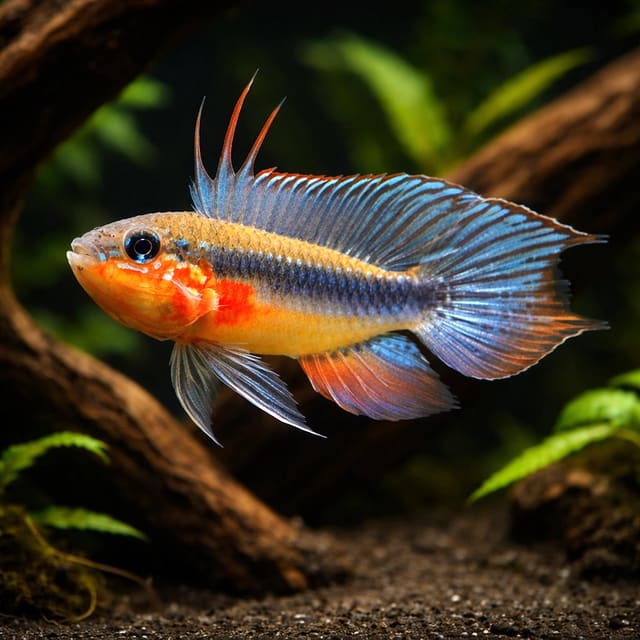
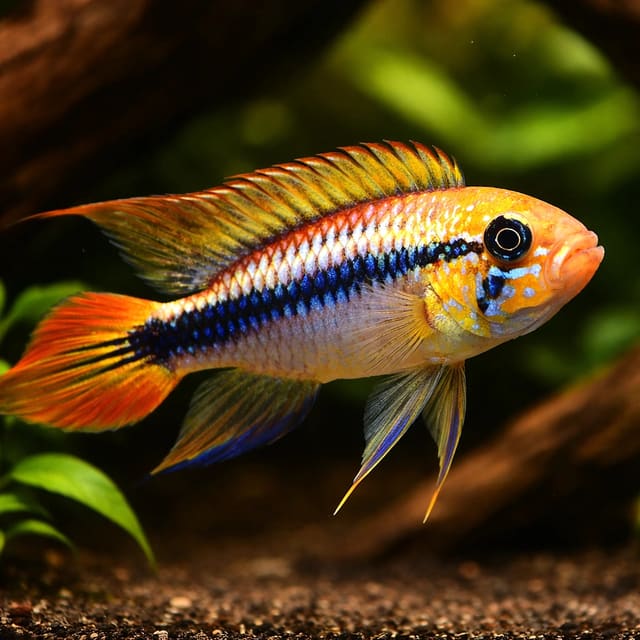
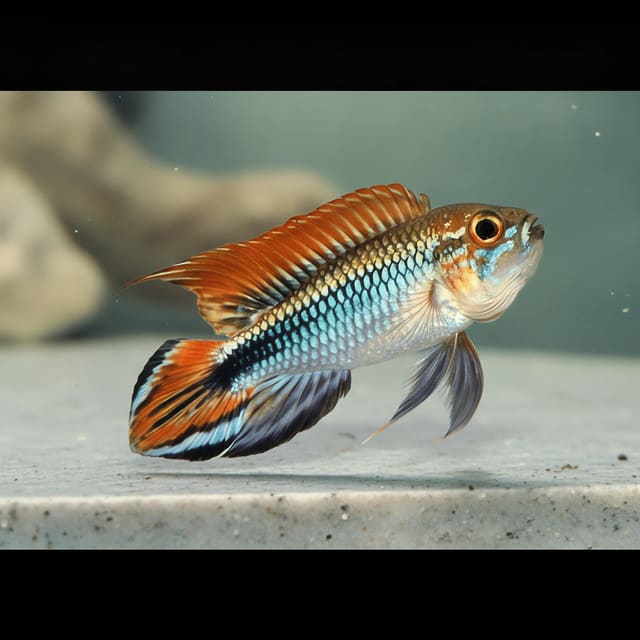
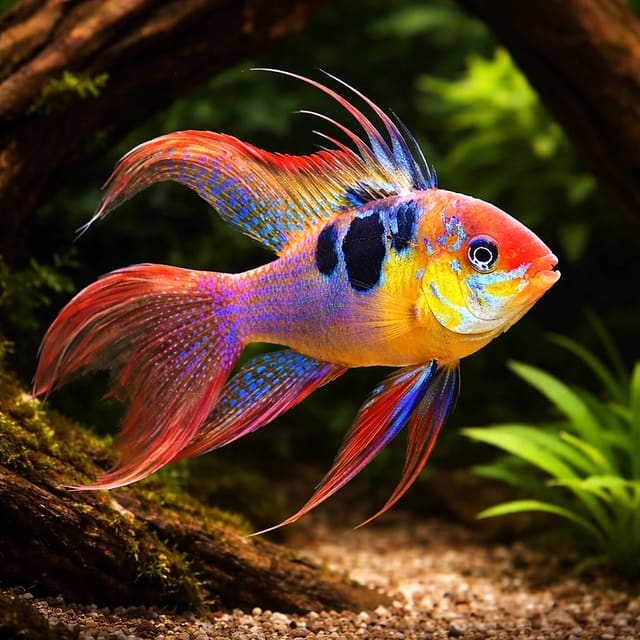
Longfin Ram Cichlid (Mikrogeophagus ramirezi)
27–30°C · pH 4–7 · 54L
£11.30£12.99

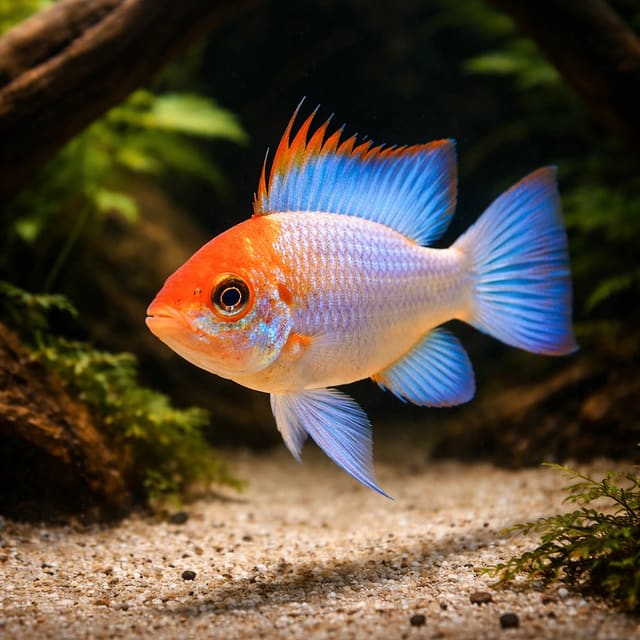
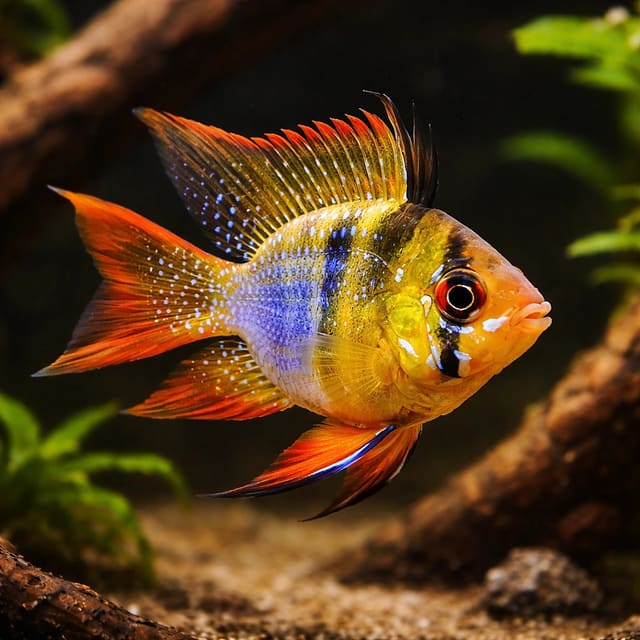
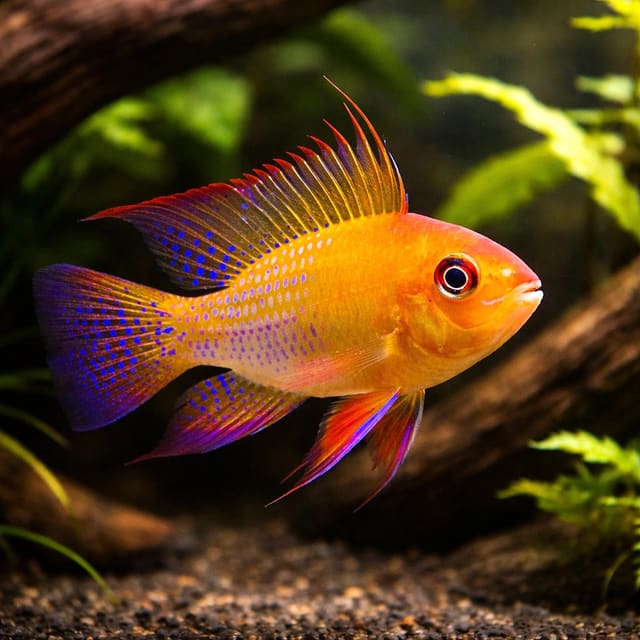
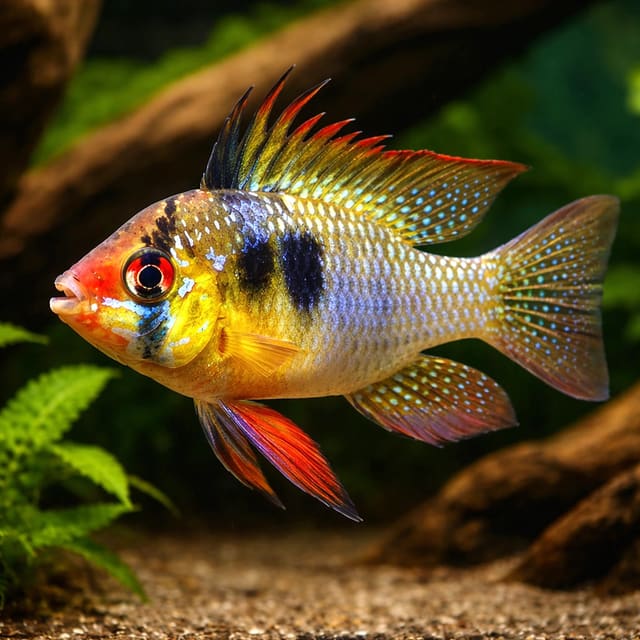
The Asia Form Ram Cichlid (Mikrogeophagus ramirezi) is a freshwater cichlid from the Orinoco basin of Venezuela and Colombia that reaches 4.2 cm standard length. It suits mature aquariums; Seriously Fish gives a 60 × 30 cm base for a compatible pair, 27–30°C, pH 4.0–7.0 and 1–10 dGH. Sold individually in sizes from 3–3.5 cm to XL (4–4.5 cm).
Adult size is the maximum length this species reaches at full maturity (scientific sources). The livestock you receive will be younger and smaller — pick a size above for the actual shipping size. Product-photo provenance and any image-specific limitations are stated on the listing.
Mikrogeophagus ramirezi
Save when buying multiple fish. Each quantity is one fish; sex and pair formation are not guaranteed unless the selected variant explicitly states them.
The Asia Form Ram Cichlid (Mikrogeophagus ramirezi) is a freshwater cichlid from the Orinoco basin of Venezuela and Colombia that reaches 4.2 cm standard length. It suits mature aquariums; Seriously Fish gives a 60 × 30 cm base for a compatible pair, 27–30°C, pH 4.0–7.0 and 1–10 dGH. Sold individually in sizes from 3–3.5 cm to XL (4–4.5 cm).
Adult size is the maximum length this species reaches at full maturity (scientific sources). The livestock you receive will be younger and smaller — pick a size above for the actual shipping size. Product-photo provenance and any image-specific limitations are stated on the listing.
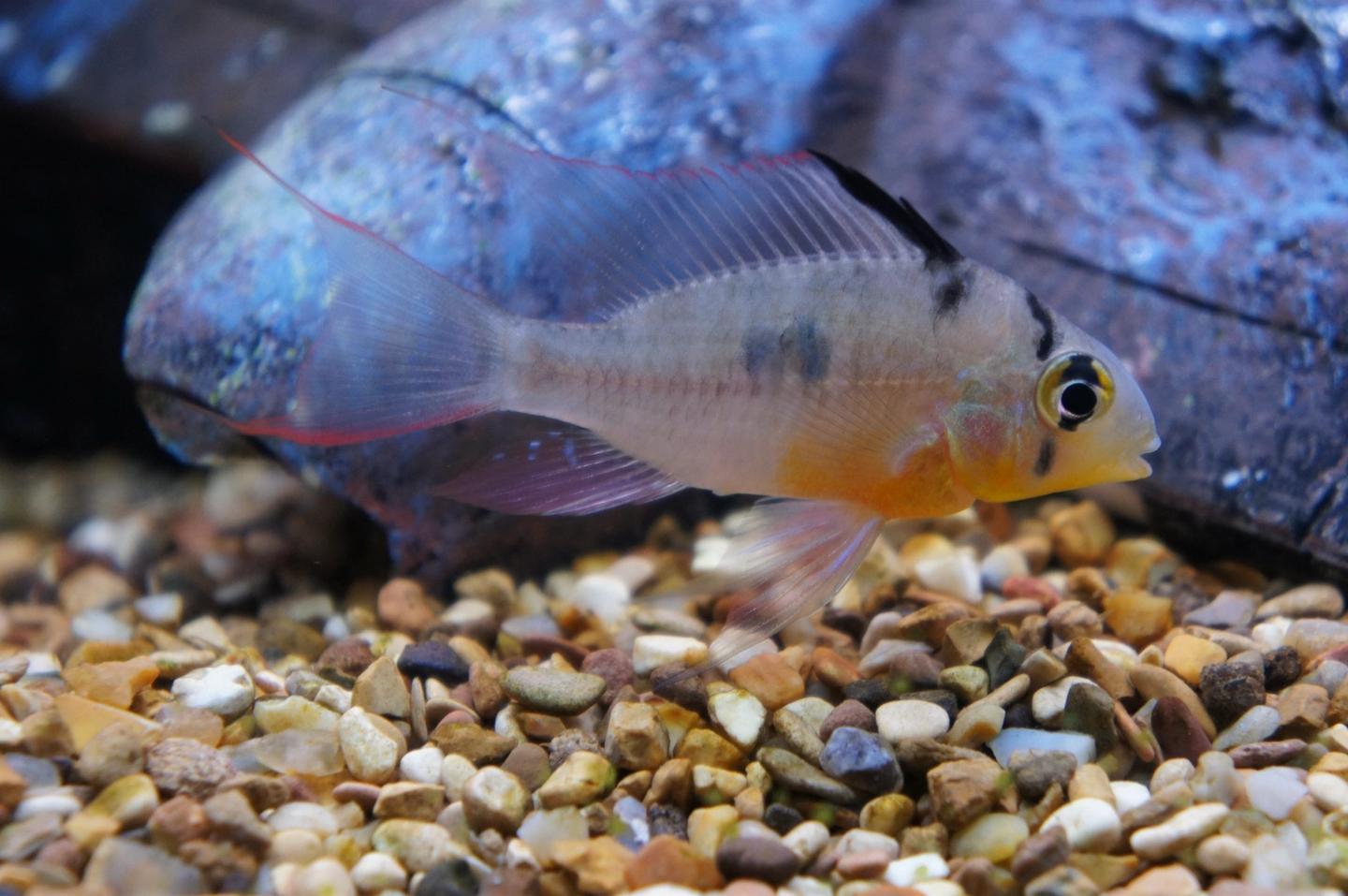
Cichlids are a family of roughly 1,800 accepted species, not one care type. Before buying, identify the exact species and source, then compare adult measurement, usable tank dimensions, social system, territory, tested water, diet and an exit plan. No family-wide minimum tank, water range or tank-mate list is safe.
Maintain these water conditions for optimal health and vibrant colors
The Asia Form Ram Cichlid is Mikrogeophagus ramirezi, a freshwater member of the cichlid family. “Asia Form” is the trade label attached to this product rather than a change to the fish’s scientific identity or natural distribution. FishBase records the species in the Orinoco River basin of Venezuela and Colombia and gives a maximum recorded length of 4.2 cm standard length. Treat that maximum as an adult planning reference rather than a promised final measurement for every individual.
This small cichlid suits a keeper who can hold warm conditions consistently, protect water quality and choose companions carefully. It is not a routine choice for a busy mixed community: it requires pristine water and can lose food to stronger competitors. Territorial behaviour can also increase around a spawning area, so the layout must provide cover as well as open feeding space.
Seriously Fish gives species-level aquarium guidance of a 60 × 30 cm base, equivalent to about 54 litres, for a single compatible pair. Its aquarium range is 27–30°C, pH 4.0–7.0 and 1–10 dGH. Those values make warmth, floor area and water chemistry the decisive checks before selecting this fish.
| Suits | Not suited to |
|---|---|
| A mature, filtered aquarium maintained at 27–30°C | An immature or unfiltered aquarium |
| A compatible pair in a 60 × 30 cm base or equivalent | An arbitrary group placed in the pair footprint |
| Peaceful open-water companions sharing its warm, soft-water range | Territorial, aggressive or harder-water fish |
| A keeper who can protect feeding access and pristine water quality | A busy community where stronger competitors take its food |
Explore the South American cichlid collection when comparing this warm, soft-water fish with other cichlids.
Each purchase supplies one animal from the option selected through the live size selector. The recurring dispatch bands are 3–3.5 cm, 3.5–3.8 cm, L at 3.8–4 cm and XL at 4–4.5 cm. Read the selected label before adding the fish to your basket, particularly where two neighbouring bands differ by only a few millimetres.
The size you select is the size supplied, not the adult size. Dispatch size answers what size the fish should be when supplied; the 4.2 cm standard-length record answers a different planning question. Aquarium dimensions, filtration and companion choices must therefore be decided from the species’ long-term needs rather than from the smallest selectable band.
| Selector label | What one quantity means |
|---|---|
| 3–3.5 cm | One animal in that dispatch band |
| 3.5–3.8 cm | One animal in that dispatch band |
| L, 3.8–4 cm | One animal in that dispatch band |
| XL, 4–4.5 cm | One animal in that dispatch band |
Sex is guaranteed only when the selected option explicitly states male or female. This Asia Form Ram Cichlid listing has no sex-guaranteed option.
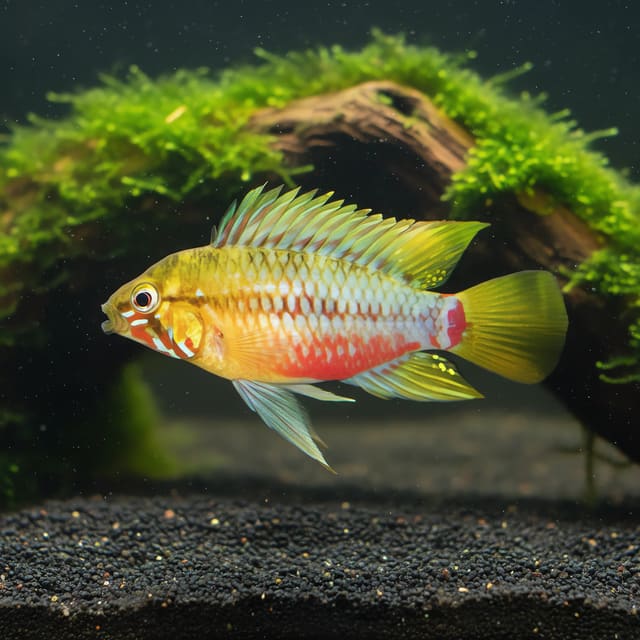
The gallery images are representative, based on reference photographs of this species, so colours can look slightly different from the live animal.
Selecting two means receiving two animals, but it does not create a bonded or compatible pair. The 60 × 30 cm aquarium-base figure applies to a single compatible pair, so it should not be read as permission to place any two individuals together without cover and observation. Structure the lower aquarium with separate sheltered areas and make sure each fish can reach food.
If two fish repeatedly occupy separate covered areas but both feed and rest normally, continue monitoring their use of space. If one fish is consistently displaced from food or shelter, adding further fish is unlikely to solve the pressure. Reassess the layout and social plan before increasing the number kept.
Prepare the aquarium and biological filter before choosing a delivery date. The RSPCA explains that a working biological filter houses bacteria that process toxic ammonia into nitrite and then safer nitrate. A filter that is merely running is not necessarily ready; it must be established and able to process the aquarium’s waste.
OATA’s dwarf-cichlid guidance gives group-level thresholds of zero mg/l ammonia, zero mg/l nitrite and nitrate no more than 20 mg/l above the normal tap-water level. Confirm the first two readings at zero before introduction. These warm-water cichlids can be stressed by even small amounts of ammonia or nitrite, making preparation more reliable than trying to correct an immature system after the fish enters it.
For a roughly 54-litre setup, the species profile suggests a filter rated around 110–160 litres per hour where gentle movement is maintained. Use that as a filter-selection range rather than a reason to drive a concentrated jet through the fish’s lower territory. Diffuse the return or direct it so that the aquarium retains calm areas while the full water volume continues to pass through filtration.
Our first tropical aquarium guide explains how to prepare and mature a setup before livestock arrives. Use it to organise the process, but apply this fish’s warmer temperature and softer-water requirements when choosing equipment and occupants.
Add livestock slowly because every increase in fish numbers and feeding requires the filter’s bacterial population to process more waste. A gradual stocking plan gives the filter time to respond and makes any change in test results easier to trace.
Set the aquarium to 27–30°C and keep it within that range. For the approximately 54-litre aquarium used in the species profile, a heater around 125–175 W is suggested when the room is about 20°C. Room temperature, aquarium position and equipment design all affect heater choice, so use a thermostat-controlled aquarium heater and check the actual water with a thermometer.
Plan for pH 4.0–7.0 and general hardness of 1–10 dGH. FishBase separately records wild environmental values of 27–30°C, pH 5.0–6.0 and 5–12 dH. For aquarium care, use the species aquarium range while favouring steady conditions over repeated attempts to force one exact number.
Measure the water that will fill the aquarium before buying livestock. The water chemistry guide explains how temperature, pH, hardness and nitrogen-waste readings answer different questions. Record the values together because a temperature match alone cannot make a harder-water companion suitable, and a matching pH does not show whether ammonia or nitrite is present.
| Result | Decision |
|---|---|
| 27–30°C, pH 4.0–7.0, 1–10 dGH | Continue to filtration and compatibility checks |
| Outside the pH or hardness range | Resolve the water plan before selecting the fish |
| Ammonia or nitrite above zero | Do not introduce the fish |
| Temperature fluctuating | Stabilise the heater and confirm repeated readings |
The water matcher can compare measured aquarium values with the stated planning range. Enter readings from the intended aquarium rather than relying on a regional average, then screen every proposed companion against the same values.
Once the aquarium is established, use regular measurements to identify trends. A reading taken only after behaviour changes gives no comparison point, whereas a simple record of weekly temperature and water tests shows whether a change is new, gradual or linked to recent maintenance.
Use a soft sandy substrate when building a naturalistic layout. This ram takes mouthfuls of substrate, sifts them for edible material and expels the remainder through the mouth and gill openings. Sand supports that benthic feeding pattern while open patches let you see whether food is being reached and eaten.
Add wood roots and branches so they create shady spots, caves and broken views across the lower aquarium. Ceramic flowerpots, suitable lengths of plastic piping and other aquarium-safe structures can provide the same practical shelter in a less naturalistic display. The purpose is not decoration alone: cover gives each fish somewhere to withdraw from direct attention and helps interrupt territorial pursuit.
| Layout element | Job it performs |
|---|---|
| Soft sand | Supports substrate sifting and lower-level feeding |
| Roots and branches | Create shade, cover and interrupted sight lines |
| Caves or flowerpots | Provide enclosed retreats |
| Flat rock | Offers a potential spawning surface |
| Open sand patch | Keeps a feeding area visible and accessible |
Aquatic plants can be used around the hardscape, but avoid filling every lower-level route. Leave clear passages between sheltered areas so a fish is not trapped in a dead end. If keeping two, distribute useful cover across the whole base instead of making one dense refuge that both animals must contest.
Dried leaf litter can strengthen the natural feel of the aquarium. As it decomposes, it can support beneficial microbe colonies that may become a secondary food source for fry, while released tannins and other compounds help simulate natural conditions. Use leaves as part of a maintained aquarium rather than allowing waste and uneaten food to accumulate among them.
Keep movement gentle throughout the occupied area. The filter still needs to process the aquarium effectively, but the fish should be able to forage, hover near cover and inspect surfaces without continually working against a strong current. Watch where sinking food travels: if every portion is swept into one corner or behind décor, adjust the return direction while preserving filtration.
Choose food by size, variety and where it travels in the aquarium. This species naturally feeds from substrate mouthfuls, solid surfaces and items taken from the water column. A suitably small sinking dried food is therefore a practical staple because it remains accessible below faster open-water fish.
Offer a varied rotation of live or frozen foods such as bloodworm, Artemia, Daphnia and grindal worm alongside good-quality sinking dried food. Each piece must be small enough to swallow comfortably. Variety lets the fish use several feeding behaviours without making rich frozen food the only part of the diet.
Feed once a day, using only the amount eaten within a few minutes. That schedule comes from OATA’s dwarf-cichlid group guidance and gives a clear starting routine where the species profile lists foods rather than a timetable. Uneaten food breaks down and adds toxic waste to the water, so a larger portion is not a substitute for ensuring the fish can reach its share.
| Food choice | How to use it |
|---|---|
| Small sinking dried food | Use as the regular prepared portion |
| Bloodworm or grindal worm | Rotate in appropriately sized portions |
| Artemia or Daphnia | Add variety through live or frozen feeding |
| Gel-bound food | Cut into bite-sized discs before offering |
A home-made gelatine-bound mixture can also work when it combines dried fish food with puréed shellfish, fruit and vegetables and is cut into bite-sized discs. Keep preparation hygienic and portion it carefully so fragments do not remain trapped under wood or among leaves.
Observe every fish during the meal. If one animal reaches all the sinking food first, place small portions at separated feeding points rather than increasing the total indiscriminately. When food is ignored, check temperature, ammonia, nitrite and social pressure before trying repeated extra meals. Reduced interest in food can accompany water-quality or health changes and should be treated as a reason to investigate, not as proof that the food itself is unsuitable.
Remove visible leftovers after the feeding window. During the next weekly maintenance session, siphon trapped waste from accessible substrate areas so the feeding plan and filtration capacity remain in balance.
Carry out a 25% partial water change at least once every week. In an aquarium containing about 54 litres, 25% is approximately 13.5 litres. That calculation provides a useful starting quantity, while the test results and actual setup show whether feeding and stocking are remaining within the filter’s capacity.
Test the aquarium at least weekly for ammonia and nitrite and record both results. Each should remain at zero mg/l. Track nitrate against the tap-water baseline and keep it no more than 20 mg/l above that normal level. Testing on the same day each week makes trends easier to compare and links the result with a consistent maintenance point.
Do not rinse biological filter media under the tap. Chlorine or chloramine can kill the beneficial bacteria established in it. When cleaning is needed, rinse the media lightly in aquarium water removed during the partial change. Avoid replacing all mature media at once, because the bacterial population is the part of the filter that processes ammonia and nitrite.
| Weekly finding | Next decision |
|---|---|
| Ammonia and nitrite at zero | Continue the established routine |
| Either reading above zero | Pause further stocking and examine filtration, waste and recent changes |
| Nitrate trend rising | Review portions, waste removal and stocking load |
| Filter flow reduced | Check for a blockage and clean media gently if needed |
A single acceptable reading should not encourage a sudden increase in stocking. Additions and increased feeding create extra waste, and the biological filter’s bacterial population needs time to increase. Keep changes gradual and continue the same weekly testing schedule after every addition.
Have the mature, heated aquarium ready before arranging the fish’s journey. Confirm 27–30°C, zero mg/l ammonia, zero mg/l nitrite and water within pH 4.0–7.0 and 1–10 dGH. Place the intended cover and feeding areas before introduction so the fish does not enter a bare aquarium that is rearranged repeatedly around it.
Read the current delivery and Live Arrival Guarantee policy before dispatch and follow the instructions associated with the order. The policy page is the place to check operational delivery and guarantee details rather than relying on permanent product-description wording.
| Checkpoint | What to confirm |
|---|---|
| Before dispatch | Heater, filter, cover and test kit are ready |
| Before introduction | Temperature is stable; ammonia and nitrite are zero |
| First feeding | Food is small and reaches the fish’s feeding level |
| First week | Breathing, swimming, appetite and access to shelter remain consistent |
Keep the first stocking change modest. OATA warns that adding too many fish too quickly can produce new tank syndrome when the bacterial population cannot process the extra waste. Do not combine the ram’s introduction with several other additions, because a smaller change reduces the biological load and makes behaviour easier to assess.
During the first week, compare the fish’s behaviour from day to day rather than judging one brief moment. Note whether it approaches suitable food, moves between open substrate and cover, breathes at its usual rate and holds its fins without obvious damage. Check the same water values again if appetite falls, breathing changes or the fish remains in an unusual position.
A new fish may face competition even when every companion is described as peaceful. Watch the food reach the lower aquarium and use separated feeding points if an established open-water fish intercepts every portion. Do not compensate by scattering excess food, because leftovers increase the burden on the filter at the point when careful observation matters most.
Learn the fish’s normal pattern so changes stand out. Healthy livestock should have clear, bright eyes, intact scales, undamaged fins and no ulcerations or bumps. For this bottom-oriented cichlid, inspecting substrate and surfaces is expected; remaining in an unusual position, losing interest in food or changing its breathing pattern calls for a closer check.
| If you see this | Do this first |
|---|---|
| Hanging at the surface or erratic swimming | Test water and check temperature and filtration |
| Faster or slower gill-cover movement | Check water quality and recent aquarium changes |
| More hiding or aggression | Assess cover, sight lines and social pressure |
| Reduced food intake | Check water results and whether another fish blocks feeding |
| White spots, fluffy growths or damaged fins | Record the signs and seek qualified health guidance |
| Loss or gain of body condition | Review feeding access, portions and water quality |
These signs can have more than one cause, so begin with measurements rather than choosing a treatment from appearance alone. Check ammonia, nitrite, nitrate and temperature, then review recent maintenance, filter disturbance, new livestock and changes in feeding. Contact us for further guidance when a health change continues or the fish’s condition gives immediate cause for concern.
Territorial behaviour needs the same measured approach. A short display near a cave or flat rock differs from persistent pressure that stops another fish feeding or using shelter. First check whether the layout contains more than one usable retreat and whether a direct view runs across the full base. Do not add another fish in an attempt to distract an established territorial animal.
Keep a brief record of observations alongside weekly water results. Date any change in appetite, breathing, position, colour, body condition or aggression. The combination of timing and measured water values is more useful than a vague recollection after several days, particularly when deciding whether the problem followed maintenance, feeding or a social change.
Do not choose companions from a general “community fish” label. This ram requires pristine warm water and is a poor competitor, so a fish can be non-aggressive yet still unsuitable if it takes every meal, needs cooler conditions or prefers harder water.
Peaceful open-water characids or similar schooling fish are the clearest conditional companions in the species profile. Their activity can signal that no immediate threat is present and may reduce shyness. They remain suitable only when they tolerate 27–30°C, pH 4.0–7.0 and 1–10 dGH and leave the ram reliable access to small sinking food.
| Screen | Pass condition |
|---|---|
| Temperature | The companion is suited to 27–30°C |
| Water chemistry | Its pH and hardness needs overlap 4.0–7.0 and 1–10 dGH |
| Behaviour | It is peaceful and does not maintain an aggressive lower territory |
| Feeding | The ram can obtain small food without being outcompeted |
Avoid territorial or otherwise aggressive fish, including most other cichlids, and avoid fish that require harder water. These exclusions come directly from the species profile. Also reject any proposed companion that cannot remain comfortable at the ram’s warmer temperature, even if both fish are commonly placed in community displays.
Treat very active or boisterous fish cautiously. OATA notes that shy dwarf cichlids can struggle with such companions, while the species profile identifies this ram as a poor competitor. Observe the actual feeding pattern after introduction: a theoretical overlap is not enough if one fish consistently prevents another from eating.
Bottom-oriented companions need an individual assessment because they may cross the same feeding and sheltered areas. The decision depends on floor space, number of retreats, feeding access and the other animal’s territorial behaviour. Honest uncertainty remains for combinations that are not covered directly: screen the full conditions, introduce stocking slowly and be prepared to revise the plan if normal feeding or shelter use breaks down.
A 60 × 30 cm base, equivalent to about 54 litres, is sufficient for a single compatible pair. The word “compatible” matters: ordering two animals supplies two animals, not an established partnership. Build the aquarium so each fish has cover and feeding access from the beginning rather than waiting for conflict before adding structure.
Even settled dwarf-cichlid pairs will often chase one another, and territorial behaviour can become stronger during breeding. Use plants, wood, caves and other ornaments to create several sheltered areas. A line of sight that runs uninterrupted from one end of the aquarium to the other allows one fish to monitor and pursue another across the entire base.
OATA says an aquarium of at least 80 litres is needed to mix dwarf cichlids with other fish. This species’ 27–30°C requirement, soft-water range and poor competitive ability still rule out many combinations. A longer base with broken sight lines can offer more useful territory than extra height alone.
Additional rams create more than a simple volume calculation. Each animal needs somewhere to forage and withdraw, and a developing pair may defend part of the base. Do not divide 54 litres by two and use the result as a per-fish allowance; the published aquarium figure is for one compatible pair occupying a structured footprint.
When planning a peaceful open-water group above the ram, preserve open swimming room without removing lower cover. Feed in a way that lets food reach both levels. If the open-water fish consume every item before it sinks, change the food placement or companion plan rather than increasing waste-producing portions.
FishBase records a maximum of 4.2 cm standard length for Mikrogeophagus ramirezi. Plan the aquarium around that adult reference rather than the fish’s dispatch measurement.
Seriously Fish gives a 60 × 30 cm base, equivalent to about 54 litres, for one compatible pair. Use a mature, filtered aquarium with soft sand, cover and gentle water movement.
Plan around one Asia Form Ram Cichlid or one compatible pair rather than an arbitrary group. Two fish are not automatically compatible, and additional animals need more floor space, cover and territorial planning.
It suits a keeper who can maintain a mature aquarium at 27–30°C with pristine water and carefully screened companions. Seriously Fish describes it as a poor competitor and does not recommend it for a general community aquarium.
Feed suitably small sinking dried food with varied live or frozen bloodworm, Artemia, Daphnia or grindal worm. OATA’s dwarf-cichlid guidance says to feed once a day and offer only what is eaten within a few minutes.
Keep it at 27–30°C, pH 4.0–7.0 and 1–10 dGH, the aquarium range given by Seriously Fish. Maintain ammonia and nitrite at zero mg/l and change 25% of the water at least once a week.
Treat it as a territorial cichlid, particularly around breeding areas. Avoid territorial or otherwise aggressive fish, including most other cichlids, and act if pursuit prevents another fish from feeding or using shelter.
Consider peaceful open-water characids or similar schooling fish that tolerate 27–30°C and the same soft-water range. Avoid harder-water fish and screen active or bottom-oriented companions for competition, territory and feeding access.
It is packed in an oxygenated bag inside an insulated box, with a heat pack when the weather calls for it. Someone must be present to receive the parcel. Start filming every delivery while the parcel is still sealed, continue as it is opened and show the fish still inside the sealed bag. Float the bag for 20–30 minutes before releasing the fish, and never pour the bag water into the aquarium.
No reviews for this item yet. Bought one? Honest reviews only, good or bad.
What customers say about ordering from us
I have a small group of long finned mountain minnows. So was delighted to be able to order ten of this variety to increase the genetics in my tank . The ones I recieved are healthy but it’s to early to give a verdict on wether they are of a long finned type since they are small currently.
Gordon Walker · 23 Sept 2026
100% success travel and "installation". Pleased with quality of purchase. The Siamese fighter a bit "shy" so have not yet seen him at his best yet but looking good. Happy customer. GG
George E Garratt · 21 Sept 2026
Reviews of our shop, collected by Judge.me, an independent third-party review collector. Newest first.