

Easy
Blue Moscow Male Guppy (Poecilia reticulata)
22–28°C · pH 7–8 · 45L
£5.99

Cichlids are a family of roughly 1,800 accepted species, not one care type. Before buying, identify the exact species and source, then compare adult measurement, usable tank dimensions, social system, territory, tested water, diet and an exit plan. No family-wide minimum tank, water range or tank-mate list is safe.
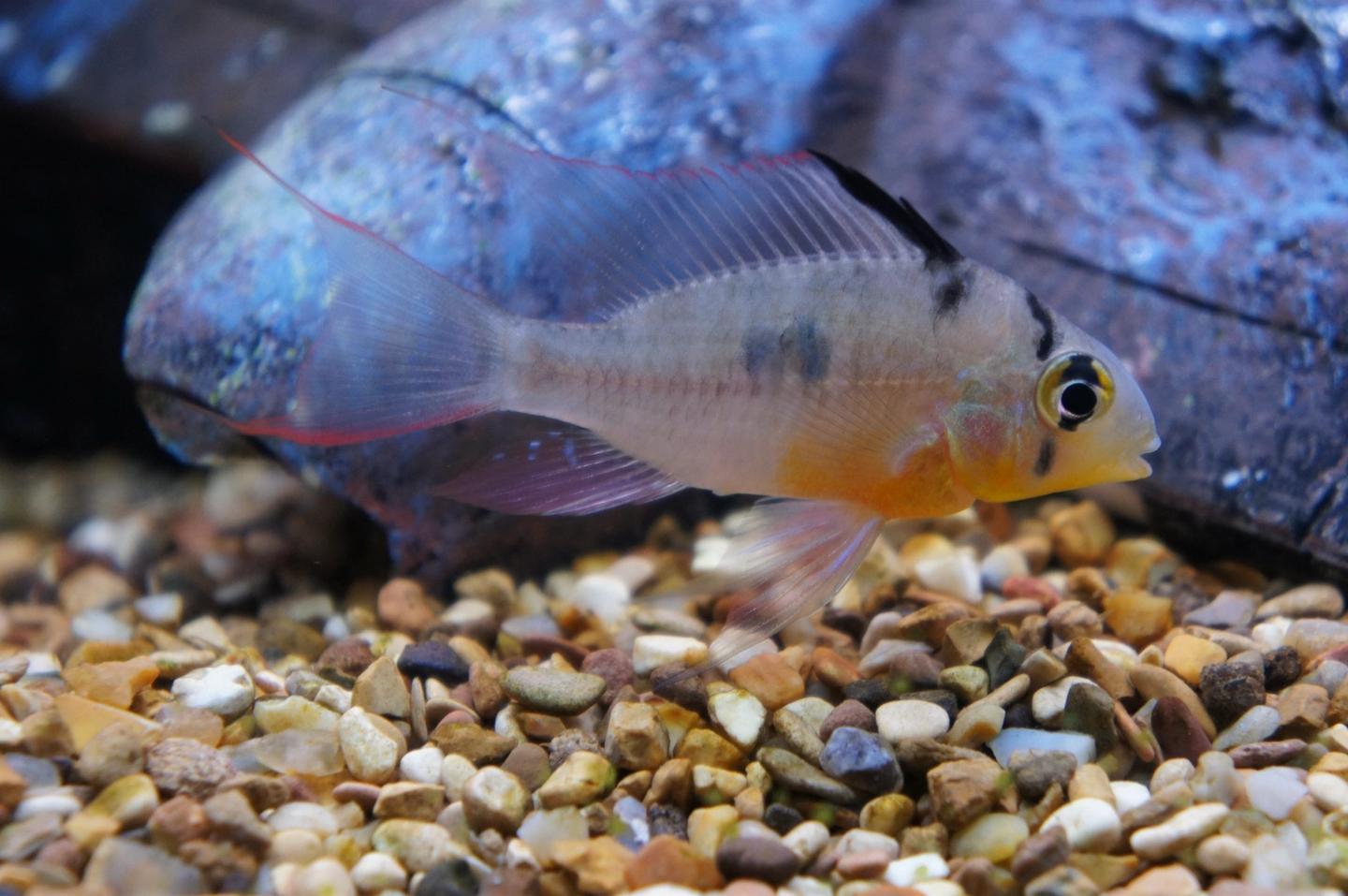
This listing is for two Assorted Ram Cichlids (Mikrogeophagus ramirezi) — the same fish as our single Assorted Ram Cichlid listing, supplied together. Please note they are supplied as two fish, not as a guaranteed male-female pair.
Rams are peaceful dwarf cichlids for mature, planted tanks with soft, warm water.
Assorted ram cichlids offer the compact shape, colour and behaviour of Mikrogeophagus ramirezi in a warm, well-kept tropical aquarium. Colour and pattern vary between fish. Native to the Orinoco basin of South America, this fish stays compact at around 6-7 cm, has a generally peaceful temperament, and usually lives around 3 years when kept in stable, warm water. It is best described as a moderate-care species because water conditions need to be consistent, especially temperature, hardness, and cleanliness.
Rams offer the personality of a cichlid without the size of larger species. They suit mature planted tanks and carefully planned communities of peaceful fish that share their warm, soft-water needs. Colour, behaviour and breeding interest make them rewarding fish to observe, but the assortment does not promise a particular colour form.
Mikrogeophagus ramirezi sits among the smallest South American cichlids kept in aquariums. It is closely associated with the ram cichlid group rather than the cave-spawning Apistogramma species, and that difference matters in breeding and tank design. The species is available in several ornamental forms, but this offer is for assorted rams rather than a named colour strain. Aquarists often compare it with Apistogramma when exploring dwarf cichlid options because both groups stay small, show strong parental behaviour, and suit warm planted tanks.
The species Mikrogeophagus ramirezi comes from the Orinoco basin in Venezuela and Colombia, especially slow-moving waters, seasonally flooded plains, and warm shallow margins rich in leaf litter and submerged vegetation. Understanding the species’ natural habitat helps you keep it properly. In the wild, these fish live over soft substrates with scattered roots, low to moderate flow, and warm water that often stays well above the temperatures many community fish prefer.
This is why dwarf cichlid temperature requirements are so important here. Rams are not a cool-room fish. The ideal water temperature is 26-30°C, with many experienced keepers finding 27-29°C the sweet spot for appetite, colour, and immunity. Their natural environment is also soft and slightly acidic, so dwarf cichlid water hardness should stay low, ideally around 2-10 dGH, and the pH should remain between 5.5 and 7.0.
In nature they feed on tiny invertebrates, organic debris, and microfauna picked from the bottom. They are not plant eaters in the way some larger cichlids can be, which answers a common question: do dwarf cichlids eat plants? Rams generally do not damage healthy aquarium plants. They may sift around roots or move a little substrate during spawning, but they are excellent for a planted display. Their foraging behaviour makes a planted display especially rewarding.
Choose the aquarium around the fish’s needs. Rams thrive in warm, mature aquariums that mimic calm South American margins rather than bright, sparse, newly set-up tanks.
Mimicking the natural habitat with warm soft water, a dark sand base, broad leaves, and broken lines of sight usually improves colour, confidence, and breeding behaviour. Rams often look their best when they feel secure rather than exposed.
A good setup is the difference between a ram that merely survives and one that shows full colour, stable appetite, and confident behaviour. The most important part of any ram cichlid care guide is stability. These fish dislike sudden changes, and they are less forgiving of poor maintenance than many beginner livebearers or danios.
The minimum tank size in this guide is 60 litres for a bonded pair. A 60-litre aquarium can work if it is mature, well filtered, and not overstocked. For easier maintenance and better territory structure, 75-90 litres is even better. A smaller aquarium must still be a properly heated, cycled, stable tank of at least 60 litres.
A thoughtful dwarf cichlid nano tank setup can work for a single pair, but tiny tanks under this size are risky because temperature swings and waste spikes happen quickly. Avoid undersized aquariums for long-term care.
Suitable water conditions for rams are: temperature 26-30°C, pH 5.5-7.0, and hardness 2-10 dGH. These are the core ram cichlid aquarium requirements. Keep ammonia and nitrite at zero, and nitrate as low as possible, ideally below 20 mg/L. The species is sensitive to dirty water, so regular partial changes are essential. For rams, clean, warm, stable water matters more than a long list of gadgets.
Choose filtration that keeps water polished but does not blast the fish with current. A mature sponge filter, compact external filter, or gentle internal filter works well. Rams come from calmer waters, so avoid turning the aquarium into a river tank. Biological filtration is especially important because this species reacts badly to unstable cycles. Pair your setup with a reliable aquarium heater and thermometer so the water temperature stays constant day and night.
The best substrate for this species is fine sand or very smooth fine gravel. Sand allows natural foraging and is safer for delicate mouths. A darker substrate also improves contrast and helps the blue body tones stand out. This matters in a display-focused aquarium layout where colour is part of the appeal.
A classic dwarf cichlid planted tank setup suits rams very well. Use broad-leaved plants such as Amazon swords, crypts, and Anubias-style foliage, along with wood, leaf litter, and smooth stones for spawning sites. Open sand patches at the front help them feed naturally, while denser planting at the sides creates security. If you enjoy alternative South American dwarfs, compare their needs with Apistogramma Agassizii - Agassiz'S Dwarf Cichlid or Apistogramma Cf. Viejita Gold - Dwarf, both of which also appreciate cover-rich layouts.
For hobbyists planning a ram aquarium, a warm blackwater-inspired scape with roots and floating shade works beautifully. If you prefer a brighter show tank, use planting to break sightlines so the fish still feel secure.
Moderate lighting is ideal. Strong light is fine if balanced with floating plants or shaded areas. Aim for 6-8 hours daily in a new setup, increasing to 8-10 hours in a mature planted tank if algae stays under control. Good lighting helps show the fish’s blue iridescence, but too much exposure in a bare tank can make them skittish.
Always cycle the tank for 4-6 weeks before adding rams. This species often struggles in immature aquariums even when test kits look acceptable for tougher fish.
The ram’s diet is omnivorous, but in practice these fish do best on protein-rich foods with some high-quality prepared staples. In the wild they pick at tiny crustaceans, insect larvae, and micro-organisms from the substrate. In the aquarium, a varied feeding routine should include small pellets, fine granules, frozen bloodworm, brine shrimp, daphnia, and occasional live foods for conditioning.
Use a high-quality micro pellet or soft granule as the daily base. Choose foods that sink slowly because rams often feed in the lower half of the aquarium. This is especially useful if they are housed with faster midwater fish. For a community setup, have suitable small foods ready before arrival so they settle quickly.
Frozen bloodworm, brine shrimp, and daphnia are excellent 3-4 times per week. These improve body condition and help bring out stronger colour. They are also useful when conditioning pairs for ram breeding. For ram keepers, diet quality is one of the biggest factors behind whether the fish keep their colour after purchase.
Live baby brine shrimp, whiteworm in moderation, and finely chopped blackworm can be used as occasional treats. These are especially useful before spawning. To help fish settle and condition them for breeding, a varied feeding routine helps more than overfeeding one rich item.
Feed adults twice daily in small portions they can finish within 1-2 minutes. Juveniles can be fed 2-3 smaller meals. Their stomachs are small, and overfeeding quickly harms water quality. For all small cichlids, community success depends on controlled feeding and clean water, not just temperament.
| Time | Food | Amount |
|---|---|---|
| Morning | Small sinking pellet or granule | Very small pinch |
| Evening | Frozen brine shrimp or bloodworm | What is eaten in 1-2 minutes |
Before the fish arrive, prepare a food mix rather than relying on one product. This helps maintain condition during acclimation and reduces stress. It also supports good ram health and can improve their lifespan.
A useful related ram option if you want to compare feeding response, colour tone, and behaviour within the same general group.
Overfeeding causes ammonia spikes, bloating, and poor water quality. Rams are sensitive fish, so a little food given consistently is much safer than one large daily meal.
Rams are compact, laterally compressed cichlids with a rounded forehead, elegant dorsal fin, and a body built for short bursts of movement near the bottom. Adult size in this species is usually around 5-7 cm, with well-grown males often appearing slightly larger and more extended in the finnage.
Colour and pattern vary between assorted rams and can change with maturity, mood and lighting. The assortment does not guarantee heavy blue coverage or an exact match to a gallery photograph.
Sexing is easier in mature fish. Males usually have longer first dorsal rays and more pointed fins, while females are often slightly rounder-bodied and may show warmer pinkish tones on the belly when in breeding condition. Remember that sexual dimorphism in rams is subtler than in some Apistogramma species.
Choose these fish for their behaviour and the conditions you can provide, as well as their colour. Individual appearance varies within the assortment.
Rams are widely considered among the suitable dwarf cichlids for carefully planned communities, but compatibility depends on temperature, temperament, and tank layout. They are generally peaceful, especially outside breeding periods, yet they remain cichlids with a territory. So, can dwarf cichlids be aggressive? Sometimes, but usually in a localised and manageable way when given enough space and cover.
The best tank mates for rams are peaceful fish that enjoy warm water and do not nip fins. Small tetras, Corydoras suited to higher temperatures, pencilfish, and Otocinclus are classic choices. For example, cardinals and other warm-water tetras often make excellent companions in a planted South American layout.
If you want to expand your South American dwarf collection, you can also compare temperament and setup needs with Apistogramma Hongsloi «Red Stroke» - Red, Apistogramma Elizabethae - Elizabeth'S Dwarf Cichlid, and Andinoacara Pulcher «Neon Blue» - Nannacara. Mixing dwarf cichlids can sometimes work, but only in larger aquariums with clear territories and careful species selection.
Avoid large barbs, boisterous livebearers, aggressive cichlids, and cool-water fish. Fast, pushy feeders can outcompete rams at mealtimes. Fin nippers stress them, and larger territorial species may bully them relentlessly. This is why not all freshwater cichlid stock mixes well, even when all are labelled “peaceful”.
In a 60-litre tank, keep a single pair with perhaps a small group of suitable upper-level dither fish if filtration and maintenance are strong. In 90 litres or more, a pair can live with 8-12 small tetras and a small group of bottom companions such as warm-tolerant Corydoras. The species is manageable if the keeper can maintain stable warm water; it is not as forgiving as some hardier species, but it is more community-suited than many larger cichlids.
Snails are usually fine. Shrimp are more complicated. Adult Amano shrimp may coexist in a planted tank, but small ornamental shrimp and shrimplets can be viewed as food. Rams are curious bottom-oriented fish, so do not assume shrimp safety.
| Species | Compatible? | Notes |
|---|---|---|
| Apistogramma Agassizii - Agassiz'S Dwarf Cichlid | ⚠️ Caution | Possible in larger tanks with separate territories; not ideal in small tanks. |
| Apistogramma Cf. Viejita Gold - Dwarf | ⚠️ Caution | Can work only with space, cover, and close observation. |
| Small warm-water tetras | ✅ Yes | Excellent dither fish and among the best dwarf cichlids tank mates. |
| Large aggressive cichlids | ❌ Avoid | Too stressful and likely to outcompete or injure rams. |
For anyone asking whether these suit a peaceful community, the answer is yes with planning. They are one of the better options among South American cichlids hobbyists choose for planted aquariums, but they still need warm, calm companions. If you want a visually different alternative, browse Guianacara Dacrya - Bandit Cichlid - or Stunning Mikrogeophagus Ramirezi «Balloon» Balloon Ram for comparison.
Always quarantine new arrivals for 2-4 weeks before adding them to a ram tank. This species is sensitive to stress and parasites, so prevention is much easier than treatment.
Ram cichlid breeding is moderate in difficulty. The fish will often pair naturally, but raising fry consistently requires excellent water quality, warm temperatures, and low stress. For breeding, a compatible pair is only the start. Environment determines success.
Use a separate breeding tank of 45-60 litres or more with fine sand, broad leaves, and flat stones. Keep the pH slightly acidic to neutral, the water soft, and the temperature around 28-30°C. Feed a varied conditioning diet of frozen and live foods for 1-2 weeks before expected spawning.
The typical ram cichlid spawning behaviour includes cleaning a flat stone or leaf, intensifying colour, and driving other fish away from the chosen site. Unlike many Apistogramma, rams are open spawners. Their spawning styles therefore need different layouts. The female lays a line of eggs, and the male follows to fertilise them.
Eggs usually hatch in around 48-72 hours depending on temperature. Parents may move wrigglers to shallow pits in the substrate. First-time pairs sometimes eat eggs or fry, especially in busy community tanks. That is normal and often improves with age and experience.
Once fry become free-swimming, feed infusoria, vinegar eels, or freshly hatched baby brine shrimp several times daily. Keep the tank spotless with small, frequent water changes. Fry grow steadily in warm water but are sensitive to swings in water chemistry.
The biggest problems are infertile spawns, egg-eating, fungus on eggs, and poor fry survival due to dirty water. If you are comparing with an apistogramma cacatuoides care guide, note that rams often demand warmer water and are more sensitive to instability. They are rewarding, but not the easiest route for every breeder. Rams offer a different breeding style and a very attractive parental display.
If a proven pair repeatedly eats eggs in a community tank, move them to a dedicated warm breeding setup with subdued lighting and no dither fish. Many pairs become far more reliable once disturbance is reduced.
Comparisons matter because many aquarists looking for dwarf cichlids are choosing between rams, Apistogramma, and other compact cichlids. The right choice depends on your water, tank size, and whether you want a planted community fish or a more specialist breeding project.
| Feature | Ram Cichlid | Apistogramma cacatuoides |
|---|---|---|
| Spawning Style | Open spawner | Cave spawner |
| Water Warmth | Higher | Moderate to warm |
| Community Suitability | Very good with warm peaceful fish | Good, but can be more territorial |
| Visual Style | Variable colour and markings | Stronger fin extension and pattern contrast |
| Best For | Warm planted show tanks | Cave-rich dwarf cichlid setups |
When comparing rams with Apistogramma cacatuoides, the decision usually comes down to breeding style and water temperature. Rams suit a carefully planned warm planted community, while cacatuoides may suit keepers who enjoy cave spawning and territorial displays.
If you are comparing rams with kribensis, remember kribs are generally tougher but often more assertive and less suited to the same soft, warm South American theme. For many aquarists comparing dwarf cichlids, rams rank highly among suitable dwarf cichlids for careful beginners only if the beginner is prepared to prioritise water quality and stable heat.
To compare alternatives directly, see Ramirez Dwarf Cichlid Papiliochromis Ramirezi Asia, Apistogramma Hongsloi «Red Stroke» - Red, and Stunning Mikrogeophagus Ramirezi «Balloon» Balloon Ram.
One of the most common questions from buyers is are dwarf cichlids hardy? Rams are hardy only when their environment is correct. In poor conditions, they are one of the first fish to show stress. Good ram health starts with warm, clean, stable water and careful acclimation.
A healthy ram is alert, feeds eagerly, holds fins open, shows strong colour, and patrols the lower part of the tank with confidence. Breathing should be calm, and the belly should look full but not swollen.
Watch for white spot, bacterial infections, wasting, fin damage, and internal parasites. Stress darkening, clamped fins, hiding, and refusal to eat are early warning signs. Impulse purchases can lead to adding rams to tanks that are too cool or too new. That is when problems begin.
First correct water quality and temperature. Move sick fish to a hospital tank if needed. Use medication only after identifying the likely issue, and avoid random treatment combinations. Many ram losses come from stress plus inappropriate treatment rather than disease alone.
Keep nitrate low, avoid sudden water changes with mismatched temperature, and feed a varied diet. Quarantine all new fish. When choosing a source, ask how the fish were conditioned, packed, and quarantined before sale.
Use a separate heated tank for 2-4 weeks. Observe appetite, respiration, faeces, and skin condition. This is especially important if mixing fish from different sources. Each added species can carry stress or parasite risks into a warm ram setup.
Never use copper-based medications in tanks with shrimp or other sensitive invertebrates. Copper can be lethal, and stressed rams may also react badly to unnecessary medication.
The typical ram cichlid behaviour is calm, curious, and bottom-oriented. These fish spend much of the day inspecting the substrate, browsing around decor, and interacting with a chosen mate or territory. They are not schooling fish, but they do respond well to the presence of peaceful dither fish above them.
Outside spawning they are usually gentle, which is why they are popular among keepers seeking peaceful community fish displays. During courtship or brood care, they become more territorial and may chase intruders away from eggs or fry. This is normal cichlid behaviour and usually stays localised in a properly structured tank.
To encourage natural behaviour, provide visual barriers, warm stable water, and open feeding areas. In sparse tanks they can become shy or washed out. In a mature planted aquarium, they show far more confidence and richer colour. This is one reason they remain a favourite among aquarists exploring types of dwarf cichlid and looking for a species with both beauty and personality.
With rams, preparation matters. The species is sensitive to rough handling, cold exposure and unstable water, so plan a mature, heated aquarium and suitable food before ordering.
This listing supplies two assorted ram cichlids. Colour and pattern vary, and the two fish are not guaranteed to form a breeding pair. Check their compatibility as they settle and provide cover and separate territories.
Fish are packed in insulated boxes, with heat packs in colder weather, and sent using tracked delivery methods appropriate for live tropical fish. Acclimation guidance is included because warm-water species like rams need a careful transition. A specialist online source with proper packing and aftercare often gives better results than an impulse local purchase from mixed systems.
For a pair-based display, compatibility matters as much as sex. Two supplied fish do not guarantee a bonded pair; monitor them closely and be ready to separate them if aggression develops.
If you are building a South American dwarf setup, compare this fish with Apistogramma Elizabethae - Elizabeth'S Dwarf Cichlid for a more specialist soft-water option, or Apistogramma Agassizii - Agassiz'S Dwarf Cichlid if you enjoy stronger territorial behaviour and cave-spawning interest. For a different ram form, Stunning Mikrogeophagus Ramirezi «Balloon» Balloon Ram offers a distinct body shape. If you want another colourful alternative among dwarf cichlids, see Apistogramma Hongsloi «Red Stroke» - Red. You can also browse the wider dwarf cichlids collection to compare species for your tank size, water type, and stocking plan.
Species reference: Mikrogeophagus ramirezi — Seriously Fish. This species profile supports general ram care; it does not identify a particular colour form in this assortment.
No reviews for this item yet. Bought one? Honest reviews only, good or bad.
What customers say about ordering from us
I have a small group of long finned mountain minnows. So was delighted to be able to order ten of this variety to increase the genetics in my tank . The ones I recieved are healthy but it’s to early to give a verdict on wether they are of a long finned type since they are small currently.
Gordon Walker · 23 Sept 2026
100% success travel and "installation". Pleased with quality of purchase. The Siamese fighter a bit "shy" so have not yet seen him at his best yet but looking good. Happy customer. GG
George E Garratt · 21 Sept 2026
Reviews of our shop, collected by Judge.me, an independent third-party review collector. Newest first.






