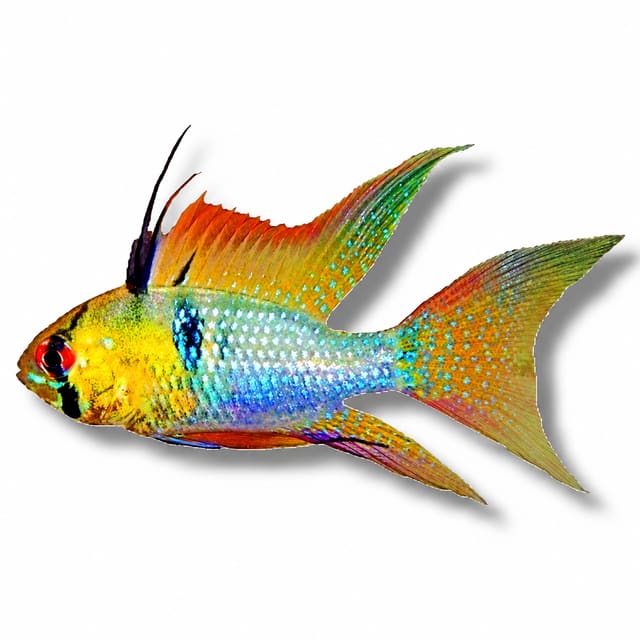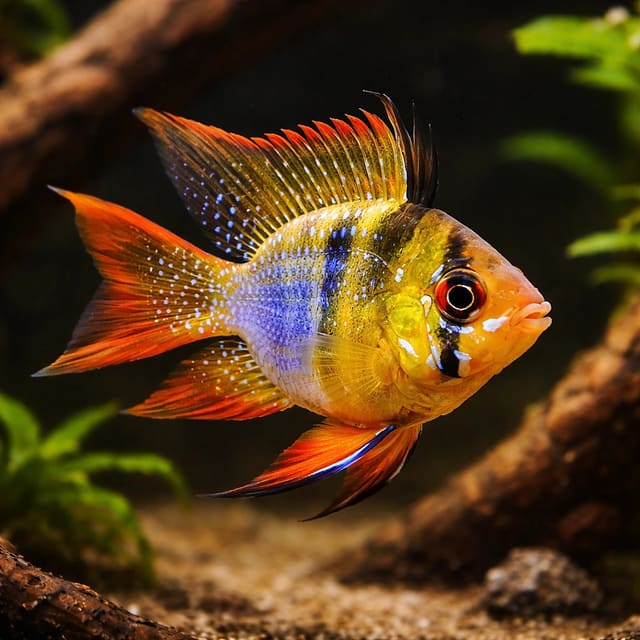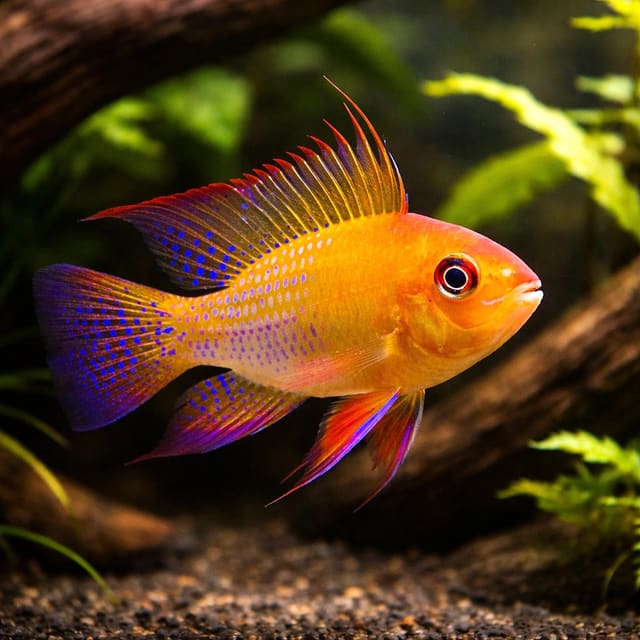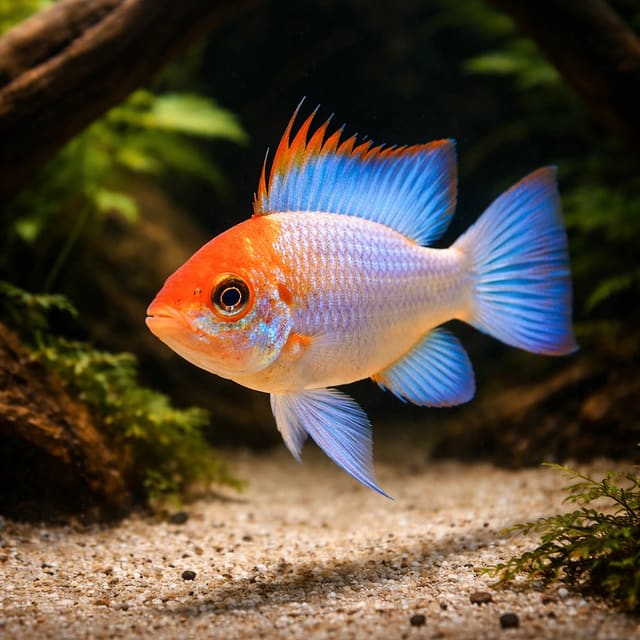
Asia Form Ram Cichlid (Mikrogeophagus ramirezi)
27–30°C · pH 4–7 · 54L
£5.99

The Electric Blue Balloon Ram (Mikrogeophagus ramirezi) is an ornamental dwarf cichlid form of a species native to the Orinoco basin in Venezuela and Colombia, reaching 4.2 cm standard length. It suits a keeper who can maintain a pair-focused aquarium; the FishBase and Seriously Fish overlap is 27–30°C, pH 5.0–6.0 and 5–10 dGH. Sold individually in dispatch sizes from 2.5–3 cm to 3.5–4 cm.
Adult size is the maximum length this species reaches at full maturity (scientific sources). The livestock you receive will be younger and smaller — pick a size above for the actual shipping size. Product-photo provenance and any image-specific limitations are stated on the listing.
Mikrogeophagus ramirezi
Save when buying multiple fish. Each quantity is one fish; sex and pair formation are not guaranteed unless the selected variant explicitly states them.
The Electric Blue Balloon Ram (Mikrogeophagus ramirezi) is an ornamental dwarf cichlid form of a species native to the Orinoco basin in Venezuela and Colombia, reaching 4.2 cm standard length. It suits a keeper who can maintain a pair-focused aquarium; the FishBase and Seriously Fish overlap is 27–30°C, pH 5.0–6.0 and 5–10 dGH. Sold individually in dispatch sizes from 2.5–3 cm to 3.5–4 cm.
Adult size is the maximum length this species reaches at full maturity (scientific sources). The livestock you receive will be younger and smaller — pick a size above for the actual shipping size. Product-photo provenance and any image-specific limitations are stated on the listing.
Cichlids are a family of roughly 1,800 accepted species, not one care type. Before buying, identify the exact species and source, then compare adult measurement, usable tank dimensions, social system, territory, tested water, diet and an exit plan. No family-wide minimum tank, water range or tank-mate list is safe.
Maintain these water conditions for optimal health and vibrant colors
The Electric Blue Balloon Ram (Mikrogeophagus ramirezi) is an ornamental dwarf cichlid in the family Cichlidae. The underlying species is native to the Orinoco River basin in the llanos of Venezuela and Colombia. FishBase records a maximum of 4.2 cm standard length, so plan its aquarium around a small adult fish that still needs carefully controlled water and a useful floor area.
This form suits a keeper prepared to maintain warm, clean, stable conditions and to screen every companion carefully. It is a poor competitor in a busy general community, while its need for pristine water makes a newly established or inconsistently maintained aquarium a poor fit. A calm, structured tank with suitable feeding access is more important than simply choosing other small fish.
Seriously Fish identifies electric or neon blue and balloon strains among the ornamental forms of M. ramirezi. It also notes that balloon forms in particular tend to be genetically weak, susceptible to disease and poor in reproductive vigour. Treat the rounded ornamental form as a reason for precise daily observation, modest feeding and stringent maintenance rather than as a hardier version of a standard ram.
Those figures work together. Warm water increases the importance of a well-maintained biological filter, while the low pH and soft-to-moderate hardness requirement rule out companions kept in harder water. The 60 × 30 cm footprint gives room for structure, feeding patches and separation when territorial behaviour appears.
| Suits | Not suited to |
|---|---|
| A mature, well-maintained filtered aquarium | A new aquarium with an immature biological filter |
| A 60 × 30 cm base or equivalent for a single pair | A footprint below the species planning recommendation |
| The FishBase and Seriously Fish overlap of 27–30°C, pH 5.0–6.0 and 5–10 dGH | Harder-water communities outside those values |
| Peaceful open-water characids or similar after screening | Territorial or otherwise aggressive fish, including most other cichlids |
| A keeper able to test water and complete weekly maintenance | An aquarium managed through occasional large corrections |
One purchase supplies one live fish. If you would like a pair, add two to your basket. We cannot guarantee a male and a female, or that two fish will form a bond. If you intend to follow the pair-keeping guidance, plan the total aquarium population and select each fish deliberately.
The live size selector contains 2.5–3 cm and 3.5–4 cm dispatch grades. The size you select is the size supplied, not the adult size. Use the label to judge the fish’s supplied length, then plan the permanent aquarium around the 4.2 cm maximum recorded by FishBase.
Dispatch length does not establish sex, life stage, origin or future pair compatibility. Sex is guaranteed only when the selected option explicitly states male or female. This Electric Blue Balloon Ram listing has no sex-guaranteed option.
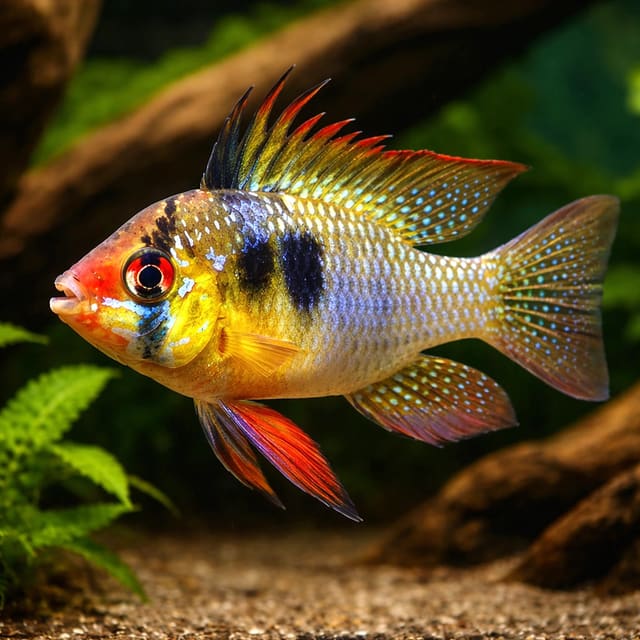
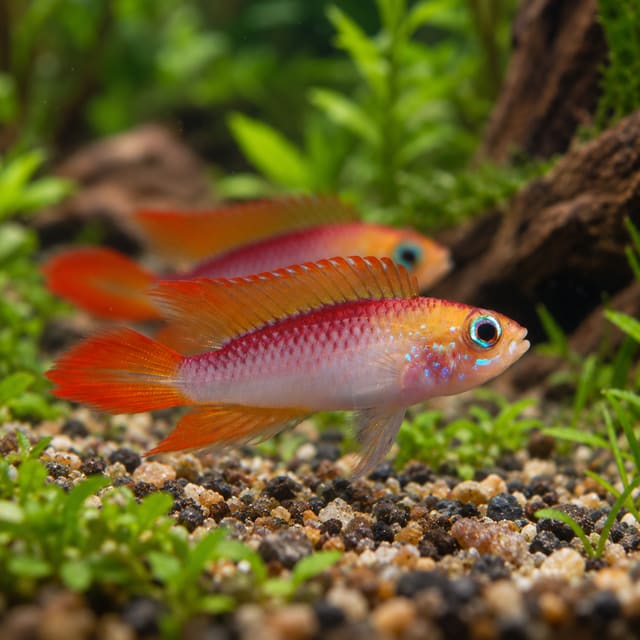
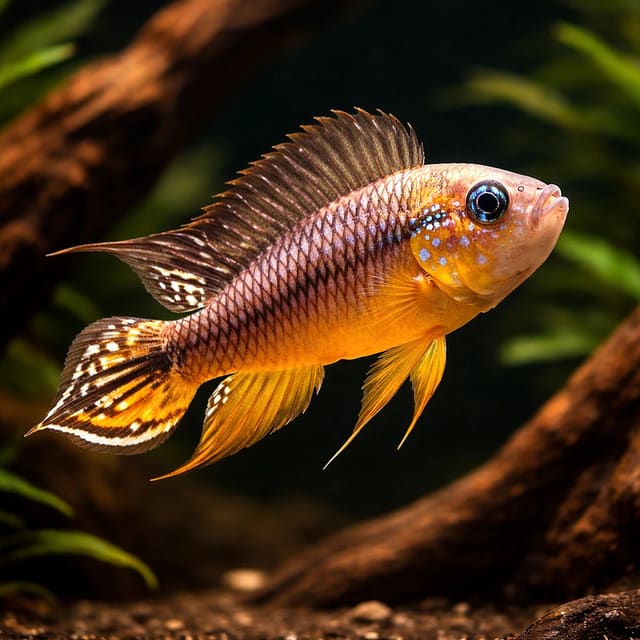
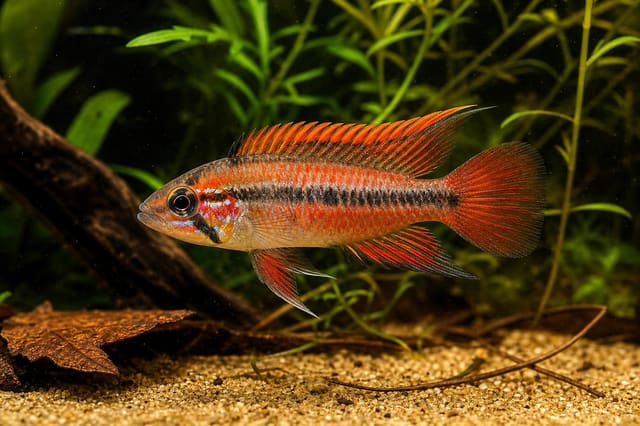
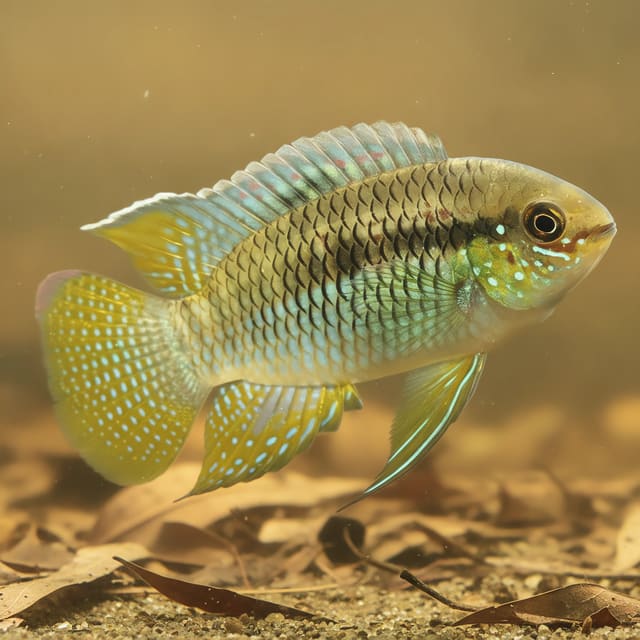
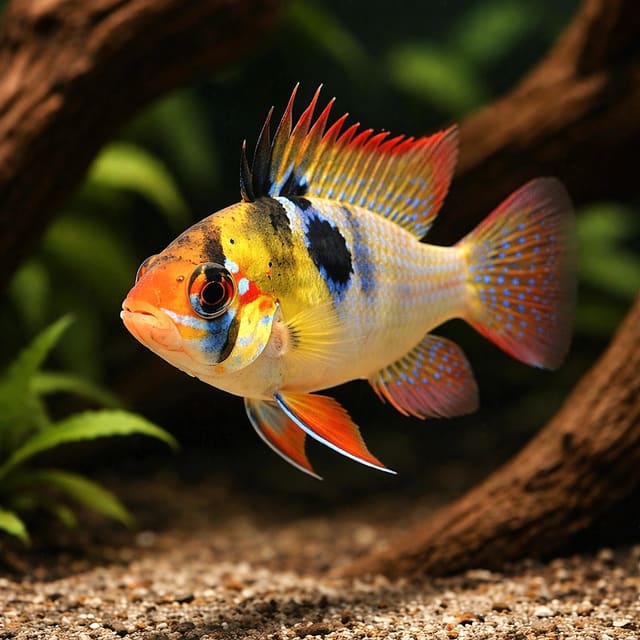
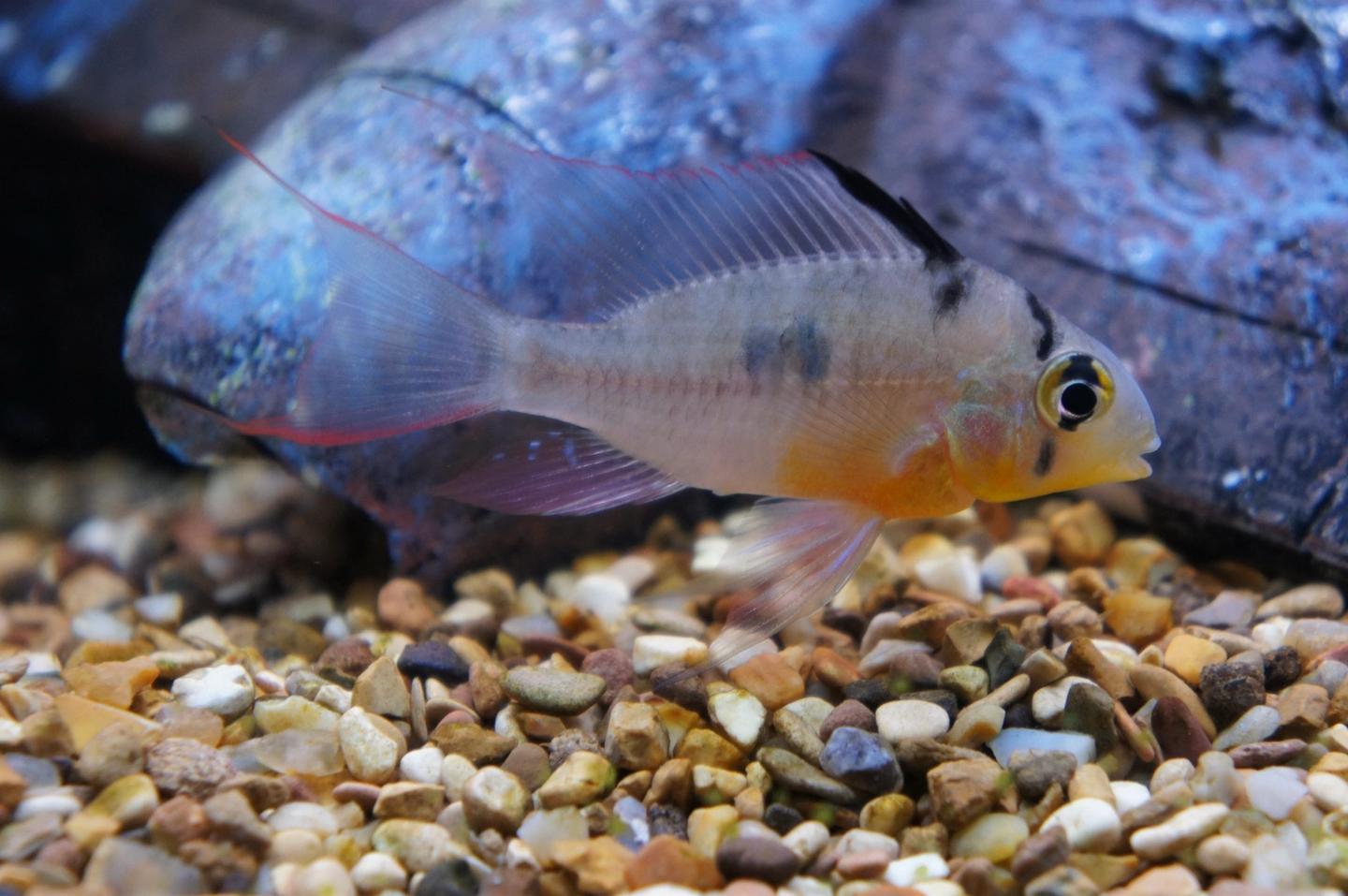
Some gallery images are representative illustrations of this type of animal, and none shows the exact animal supplied, so pattern and colours can differ from the live animal.
Several gallery scenes show pale lavender-blue fish with orange foreheads and unusually long fins. Use those images to understand the rounded ram-like profile and aquarium presentation, not as a promise of the precise colour, fin shape or markings of the fish supplied.
This ram is a focused choice for a warm, mature aquarium rather than a general-purpose community fish. Its small adult length does not remove the need for floor space, cover, stable water and careful companion selection. Start with the permanent requirements and work backwards to the fish you hope to keep together.
The aquarium is ready when its filter is established, ammonia and nitrite test at zero, temperature remains within 27–30°C, and pH and hardness remain within the stated overlap. The planned companions must also tolerate those values and must not prevent this relatively poor competitor from feeding.
Choose structure that creates shady areas, caves and broken sight lines without taking away all open feeding space. A soft sandy substrate matches the species’ substrate-sifting feeding behaviour, while wood, suitable caves and flat rocks give it places to withdraw or establish a territory.
Browse the South American cichlid collection to compare other fish by their own requirements, but do not treat a shared collection as proof of compatibility. Water overlap, temperament, feeding access and available space must all pass separately.
Provide a tank base measuring 60 × 30 cm or an equivalent footprint for a single pair. Seriously Fish associates that footprint with about 54 litres. OATA’s dwarf-cichlid group guidance recommends at least 60 litres for a pair and says an aquarium of at least 80 litres will be needed to mix dwarf cichlids with other fish. Seriously Fish’s species-level figure for a single pair is about 54 litres on a 60 × 30 cm base; OATA’s broader group sheet gives a more cautious 60 litres for a pair.
Do not use a smaller temporary aquarium because the selected fish is below adult length. Territory, cover and feeding access depend on usable space now, and a dispatch grade is not an adult-space category. If other fish are included, start from at least 80 litres, which OATA’s group guidance says will be needed for mixing, and then assess whether the footprint and layout give every animal enough room.
Use a soft sandy substrate where the ram can take and sift mouthfuls while searching for edible items. Seriously Fish also supports ceramic flowerpots, lengths of suitable plastic piping, wood roots, branches and flat rocks. Arrange them to create shady spots, caves and visual breaks without blocking the entire base.
Live plants can contribute cover. Seriously Fish names Microsorum, Taxiphyllum, Cryptocoryne and Anubias as usable examples. Where live plants are not used, OATA recommends plastic plants and suitable ornaments such as plant pots, model caves, wood and leaf litter to provide shelter. The functional test is whether the layout supplies shelter and separation while retaining room to feed and observe the fish.
Keep this ram at 27–30°C, pH 5.0–6.0 and 5–10 dGH. These are the overlapping species values from FishBase and Seriously Fish: FishBase records 27–30°C, pH 5.0–6.0 and 5–12 dGH, while Seriously Fish gives 27–30°C, pH 4.0–7.0 and 1–10 dGH.
OATA’s broad dwarf-cichlid guidance gives 22–27°C, pH 6.0–8.0 and 4–12 dGH. For this warm-water ram, retain the narrower FishBase and Seriously Fish instruction rather than extending the aquarium into the cooler, more alkaline part of that group range. The values meet OATA’s temperature guidance at 27°C and its pH guidance at 6.0, while hardness of 5–10 dGH lies inside all three ranges.
A temperature match alone is not enough. Record temperature, pH and general hardness together, because a fish that shares this temperature may still require water that is too hard or alkaline for this ram. Our water chemistry guide explains the purpose of the main tests, and the water matcher helps compare measured aquarium values with the required range.
| Reading | Decision |
|---|---|
| 27–30°C | Continue only if pH and hardness also match. |
| pH 5.0–6.0 | Keep changes controlled and retest after maintenance. |
| 5–10 dGH | Screen out fish that require harder water. |
| Any value outside range | Correct the aquarium before introducing the ram. |
Seriously Fish gives a heater planning figure of roughly 125–175 W for an aquarium of about 54 litres when the room is around 20°C. Treat that as a sizing reference for those stated conditions; actual equipment still needs to hold the aquarium steadily within 27–30°C.
Run a mature biological filter continuously and keep ammonia and nitrite at zero mg per litre. The RSPCA explains that fish release toxic ammonia, which filter bacteria convert first to toxic nitrite and then to safer nitrate. This biological process is why an established, maintained filter is essential.
For an aquarium of about 54 litres, Seriously Fish suggests a filter rated around 110–160 litres per hour to provide the gentle movement this species wants. Rating alone is not enough: check that the outlet does not create forceful movement across the ram’s feeding and shelter areas, and make sure the filter continues moving water without blockage.
If filter media needs cleaning, do not rinse it under the tap. Rinse it lightly in aquarium water removed during the partial water change. This reduces the loss of beneficial bacteria and avoids exposing the established population to chlorine or chloramine.
Respond to an abnormal test by protecting water quality first. Pause further livestock additions, check the filter and feeding level, and carry out appropriate maintenance with conditioned replacement water. Do not use a routine water change as permission to overfeed or overcrowd the aquarium between tests.
Offer a varied diet built around small live and frozen invertebrate foods, supported by good-quality sinking dried food of a suitable size. Seriously Fish describes Mikrogeophagus as benthophagous: it takes mouthfuls of substrate, sifts out edible items and expels the remaining material through the mouth and gill openings. It also browses solid surfaces and takes food from the water column.
Suitable named foods include bloodworm, Artemia, Daphnia and grindal worm. Small sinking dried foods can supplement that variety. Seriously Fish says home-made, gelatine-bound foods containing dried fish food, puréed shellfish, fresh fruit and vegetables also work well when cut into bite-sized discs.
Feed once a day and offer only what the fish can eat within a few minutes. That frequency and portion come from OATA’s dwarf-cichlid guidance. Watch where the food lands and confirm that this relatively poor competitor reaches enough of it before faster open-water fish consume the meal.
| What you see | What to do |
|---|---|
| Food is eaten within a few minutes | Keep the portion modest and continue varying suitable foods. |
| Food remains after the feeding period | Reduce the next portion and remove accessible leftovers. |
| Other fish take every item | Change food placement or reassess those companions. |
| Reduced interest in food | Test water and check breathing, swimming and appearance. |
Uneaten food breaks down and releases toxic waste into the water, so feeding and filtration cannot be managed separately. A small daily portion protects water quality only when it is actually consumed. Check each individual rather than assuming that food disappearing from view means every fish has eaten.
Prepare the permanent aquarium before the fish arrives. The filter should be mature, ammonia and nitrite should be zero, and the FishBase and Seriously Fish overlap of 27–30°C, pH 5.0–6.0 and 5–10 dGH should already be stable. If this is your first setup, follow our first tropical aquarium guide before choosing livestock.
OATA advises increasing the aquarium population slowly because the beneficial bacteria established during maturation must respond whenever fish numbers and feeding rise. Adding too many fish too quickly can leave the filter unable to process the extra waste, producing unhealthy ammonia and nitrite.
The current delivery and Live Arrival Guarantee policy explains the packing, receipt and claim requirements. Keep the unboxing video and order number, and if anything has gone wrong, contact us the same day your fish arrive with both so we can arrange a replacement or refund.
Observe swimming, breathing and access to shelter without changing several conditions at the same time. Confirm that the filter remains operational and that existing residents do not immediately prevent the new fish from withdrawing or reaching the feeding area.
Continue testing after the population changes. A previously stable reading does not remove the need for the weekly test schedule, because feeding and waste have increased. Add further fish only gradually and only after water quality remains controlled.
Watch the fish’s swimming, colour, temperament, breathing, appearance, body condition and feeding every day. OATA identifies changes in these areas as early warning signs. Compare behaviour across several calm observations rather than reacting to a single brief movement.
| Change | First action |
|---|---|
| Hanging at the surface, sitting on the bottom or erratic swimming | Test ammonia, nitrite and temperature, then check filter operation. |
| Breathing faster or slower than normal | Test water immediately and inspect the fish for other changes. |
| Darker or paler colour | Check water values, companion behaviour and access to shelter. |
| More aggression or hiding | Review cover, territory and tank-mate pressure. |
| White spots, fluffy growths, damaged fins or missing scales | Record the change clearly, test water and contact us for health guidance. |
| Reduced feeding or changing body condition | Check the daily portion, food access and water readings. |
Keep the response ordered. First establish the water readings and equipment status, then assess feeding and social pressure. This prevents a territorial or feeding problem from being mistaken for a filtration problem, while still addressing toxic ammonia or nitrite promptly.
Confirm that the fish uses cover, reaches food and maintains normal breathing and swimming. Continue the 25% partial water change at least once every week, water testing at least once per week and the filter checks.
Reassess the layout and population whenever behaviour or feeding access changes. A fish that feeds successfully but is repeatedly chased still needs a compatibility or space change. Equally, peaceful behaviour does not compensate for water outside 27–30°C, pH 5.0–6.0 or 5–10 dGH.
Plan Mikrogeophagus ramirezi around pair keeping, but do not assume that two selected individuals will be a male and female or will form a compatible bond. FishBase describes aquarium keeping in pairs, while Seriously Fish identifies the species as a biparental substrate spawner. Those biological points do not change the sold unit or create a breeding promise.
OATA notes that even well-settled dwarf-cichlid pairs will often chase each other, so providing plenty of cover is essential, and that dwarf cichlids can be territorial, especially when breeding. Provide several retreats and enough cover so one fish can leave another’s defended area. Constant pursuit across the full aquarium means the layout, available space or social combination needs attention.
A display aquarium should prioritise stable water, feeding access and compatible behaviour. Do not treat spawning as a necessary sign of health. If spawning occurs in a mixed aquarium, other fish may disturb the site or prey on fry; OATA advises avoiding such tank mates when breeding is intended.
Seriously Fish recommends a dedicated setup with no other fish for deliberate breeding. It describes good diet and stringent maintenance as the main requirements and notes that the eggs easily develop fungus or fail to develop unless the water is very clean and of low hardness. Inexperienced pairs may eat their brood, and commercially produced ornamental fish can show poor fertilisation or repeated brood consumption.
Choose only peaceful fish that can live within the FishBase and Seriously Fish overlap of 27–30°C, pH 5.0–6.0 and 5–10 dGH. Seriously Fish does not recommend this ram for the general community aquarium because it requires pristine water and is a poor competitor, although it does not have to be maintained alone.
Groups of peaceful, open water-dwelling characids or similar are the preferred companion type. Their visible schooling or shoaling behaviour may help reduce shyness. Seriously Fish specifically names Paracheirodon axelrodi and Paracheirodon simulans as species that meet the warm-water requirement, but each proposed group still needs full checks for water, temperament, feeding access and total space.
OATA’s dwarf-cichlid group guidance says an aquarium of at least 80 litres will be needed to mix dwarf cichlids with other fish. That volume is a starting point, not permission to combine incompatible species. Check the footprint, number of territories, retreat positions and feeding locations as well as the nominal capacity.
For animal types beyond the named examples, compatibility remains a case-by-case decision. Apply the same screening rule: shared water values, peaceful behaviour, enough room, no conflict over defended areas and reliable access to food. A small body size or South American origin does not answer those questions by itself.
Separate normal use of a territory from sustained pressure on another fish. Dwarf cichlids may become territorial, especially when breeding. OATA’s dwarf-cichlid guidance says even well-settled pairs will often chase each other, which makes plenty of cover essential. The aquarium must let the pursued fish move behind cover, leave the defended patch and continue feeding.
| What you observe | Decision |
|---|---|
| Brief display followed by separation | Continue observing and keep several retreats open. |
| One fish controls every cave | Add or rearrange cover to create separate shelter choices. |
| A fish is repeatedly trapped | Separate the fish rather than waiting for injury. |
| Open-water fish consume every meal | Change feeding placement or remove the competitive mismatch. |
| A spawning site is defended | Increase observation and review every fish entering that area. |
| A companion needs harder or cooler water | Do not keep the two species together. |
Compatibility can change when the aquarium population, layout or breeding behaviour changes. Reassess the whole tank after adding fish, moving major décor or seeing a defended site. Preserve the minimum 60 × 30 cm footprint for a pair, and use at least 80 litres whenever other fish share the aquarium, because OATA’s group guidance says that volume will be needed for mixing.
Do not solve a poor social match by compromising the ram’s water. The FishBase and Seriously Fish overlap remains 27–30°C, pH 5.0–6.0 and 5–10 dGH. A companion that needs conditions outside that range belongs in a different aquarium.
The best outcome is not merely the absence of visible fighting. Every fish should retain access to suitable water, shelter and food. Persistent hiding, missed meals, changing colour or altered breathing all justify a fresh assessment of water quality and social pressure.
FishBase records Mikrogeophagus ramirezi at up to 4.2 cm standard length, which is the adult planning figure used here.
Seriously Fish gives a 60 × 30 cm base and about 54 litres as sufficient for a single pair; OATA’s dwarf-cichlid group guidance recommends at least 60 litres for a pair and says at least 80 litres will be needed to mix them with other fish.
FishBase advises aquarium keeping in pairs, so plan for two compatible fish with cover and feeding access; two selected individuals are not guaranteed to form a compatible or breeding pair.
It suits a keeper able to maintain pristine, stable water, a mature biological filter and carefully screened companions; a new or inconsistently maintained aquarium is a poor fit.
Offer small live and frozen foods such as bloodworm, Artemia, Daphnia and grindal worm, supplemented by suitable sinking dried food; feed only what it can eat within a few minutes once a day.
Keep it within the FishBase and Seriously Fish overlap of 27–30°C, pH 5.0–6.0 and 5–10 dGH.
It may become territorial, especially during breeding, so provide cover and avoid territorial or otherwise aggressive fishes, including most other cichlids.
Consider groups of peaceful, open water-dwelling characids or similar after full screening; Seriously Fish names Paracheirodon axelrodi and Paracheirodon simulans as warm-water examples.
Film from the sealed parcel through opening before floating the bag. Tropical Fish Co hand-bags the fish in pure oxygen, uses an insulated box and adds a heat pack when the weather calls for it; float the bag for 20–30 minutes before release.
No reviews for this item yet. Bought one? Honest reviews only, good or bad.
What customers say about ordering from us
I have a small group of long finned mountain minnows. So was delighted to be able to order ten of this variety to increase the genetics in my tank . The ones I recieved are healthy but it’s to early to give a verdict on wether they are of a long finned type since they are small currently.
Gordon Walker · 23 Sept 2026
100% success travel and "installation". Pleased with quality of purchase. The Siamese fighter a bit "shy" so have not yet seen him at his best yet but looking good. Happy customer. GG
George E Garratt · 21 Sept 2026
Reviews of our shop, collected by Judge.me, an independent third-party review collector. Newest first.