By Tropical Fish Co Editorial Team
−13%
Electric Blue Ram (Mikrogeophagus ramirezi)
27–30°C · pH 4–7 · 54L
£10.43£11.99
South American Cichlids · Buying Guide
Electric blue ram care for UK aquariums: adult size, 27–30°C water, tank size, tank-mate risks and buying checks, with live stock shown when available.
9 products in stock today
Live prices and stock. Every fish covered by our Live Arrival Guarantee.
27–30°C · pH 4–7 · 54L

27–30°C · pH 5–6 · 54L

27–30°C · pH 5.5–7 · 60L
27–30°C · pH 5–6 · 54L
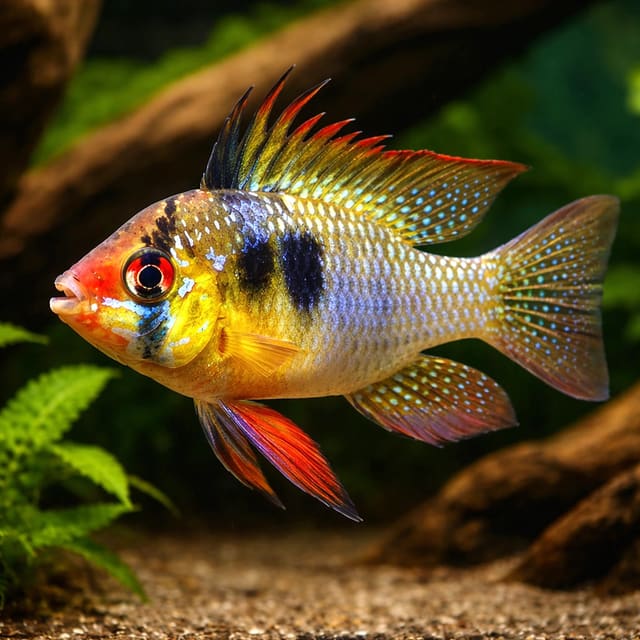
27–30°C · pH 5–7 · 54L
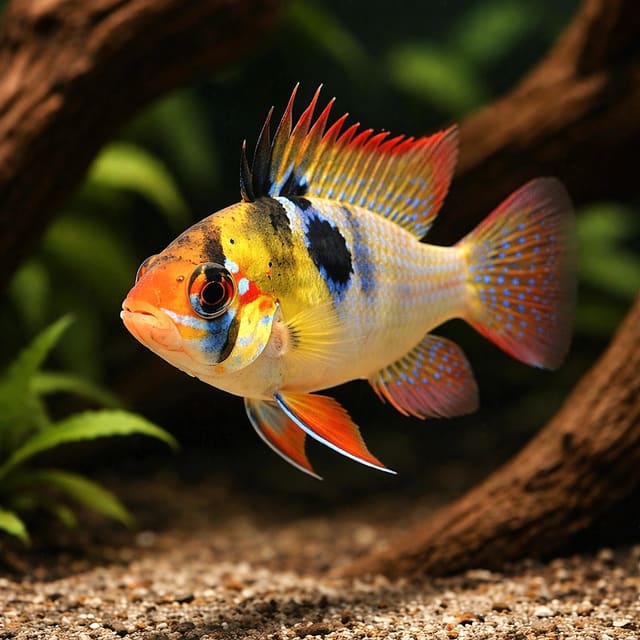
27–30°C · pH 4–7 · 54L

27–30°C · pH 5.5–7 · 60L
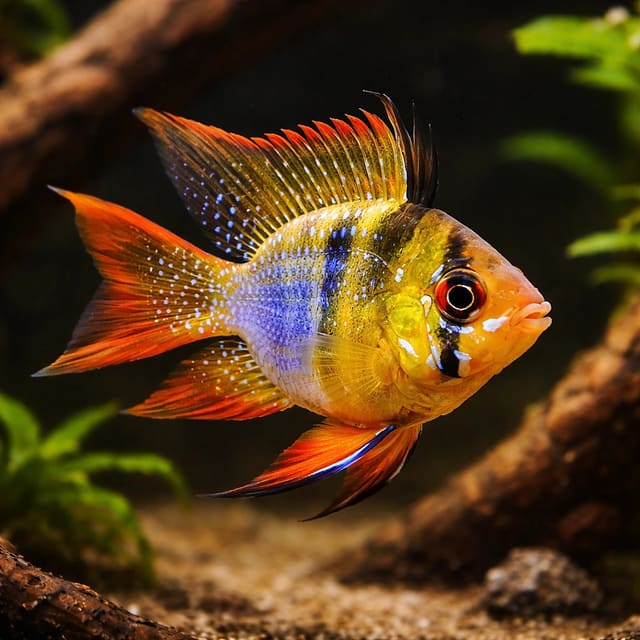
24–27°C · pH 6–7.5 · 60L

27–30°C · pH 4–7 · 54L
The shaded band shows the range electric blue ram is comfortable in. Match it to your tap water before you buy.
Our trained assistant knows this electric blue ram page inside out. Ask it anything — water parameters, tank mates, how many to buy — or have it read the guide aloud while you set up your tank.
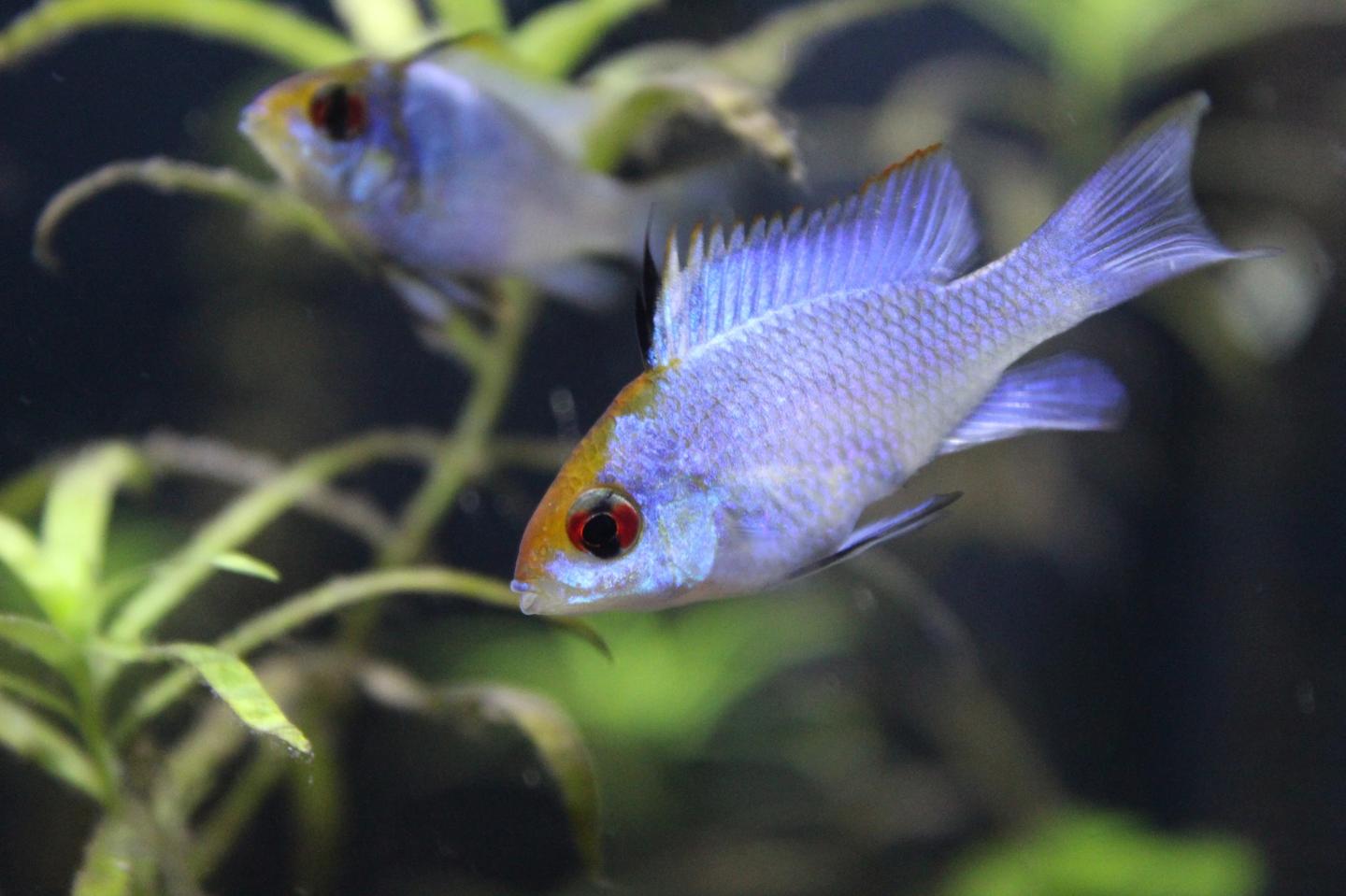
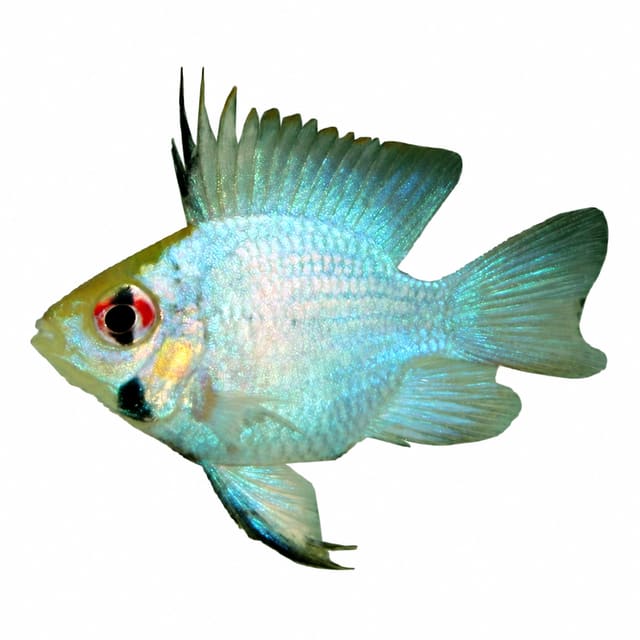
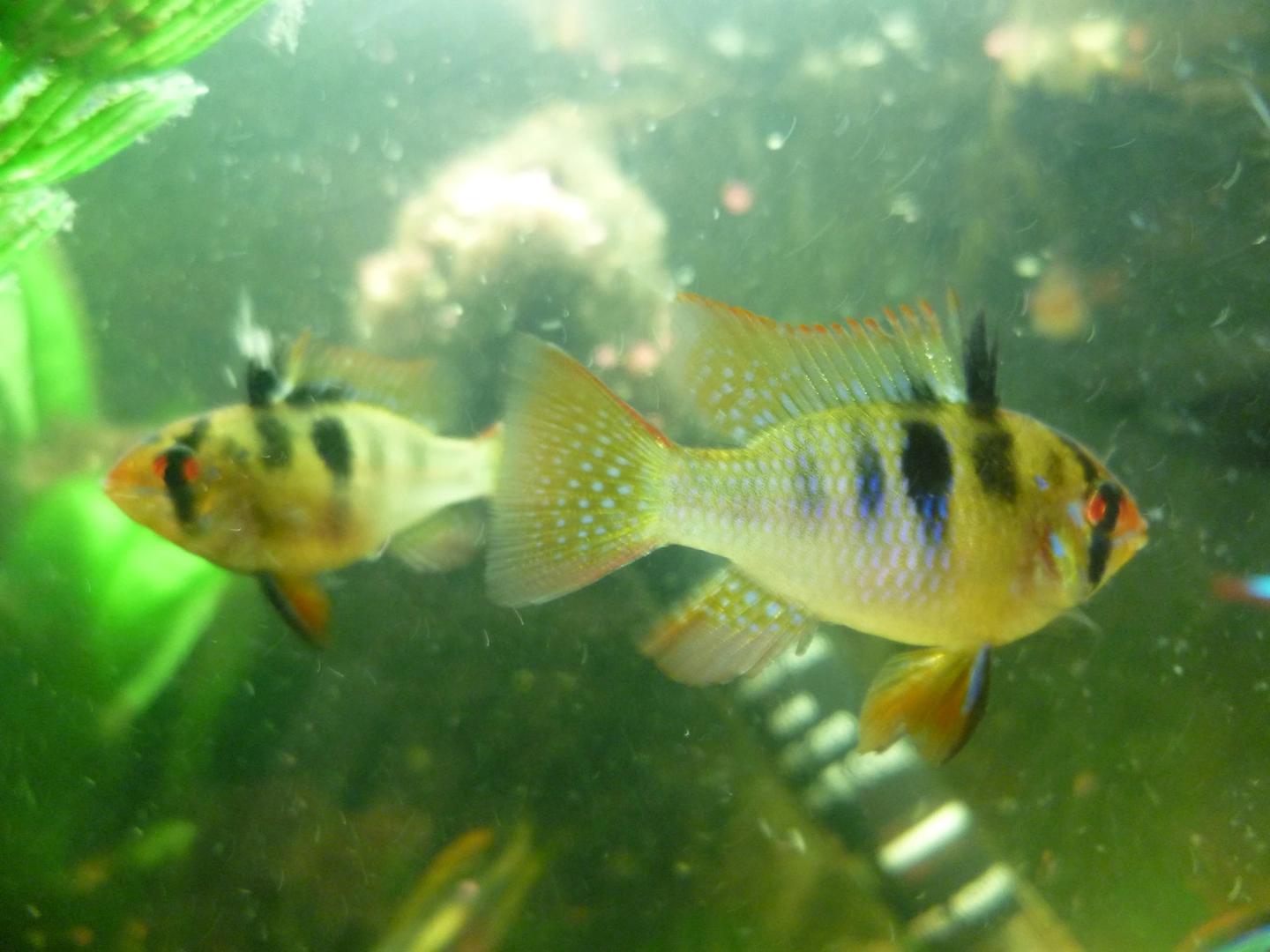
The electric blue ram is an aquarium colour morph of Mikrogeophagus ramirezi. It is not a separate species, and the accepted genus is spelled Mikrogeophagus with a “k” [1][3]. A specialist account in Tropical Fish Hobbyist dates development of the electric-blue trade morph to 2009 [4].
That history explains the fish's unusual near-solid turquoise appearance. It does not prove that every intensely coloured individual is healthy, that every seller uses morph names consistently, or that the colour changes the species' fundamental water needs.
For one established pair, start with a mature aquarium at 27–30°C. FishBase gives a 60 cm minimum aquarium length, while the morph-specific account uses a 20-US-gallon aquarium—about 75.7 litres—for one pair [2][4]. Tropical Fish Co combines those into a cautious buying screen of about 75 litres and at least a 60 × 30 cm base. This is our welfare policy, not a universal law or permission to fill every aquarium of that size with a pair and tank mates.
If you are shopping rather than researching, use the live cards already shown on this page when available, or browse current South American cichlids. Product cards own changing price and stock. The article does not promise that a photographed morph, sex, pair or size is available today.
Both names normally refer to aquarium forms of Mikrogeophagus ramirezi. The “electric blue” label describes extensive blue body colour; “German blue” usually describes the familiar gold, black, red and blue pattern. The labels describe appearance, not separate scientific species.
| Buying question | Electric blue ram | Standard / German blue ram |
|---|---|---|
| Scientific identity | Mikrogeophagus ramirezi | Mikrogeophagus ramirezi |
| Typical trade description | Extensive turquoise-blue body colour | Gold body, dark markings and blue spangling |
| Water and temperature screen | Same species evidence controls | Same species evidence controls |
| Sexing from appearance | Often difficult; use several clues | Several clues may be more visible, but none is infallible |
| Robustness | Specialist reports say the morph can be more demanding | Still needs warm, mature, stable water |
| What a label guarantees | Neither health nor exact adult colour | Neither health nor exact adult colour |
The specialist account reports that the electric-blue form can be slightly harder to maintain and may show breeding difficulties [4]. That is useful husbandry experience, but it is not a controlled population-genetic study. This page therefore makes no universal genetic-fitness claim and does not attach a shorter lifespan to the colour.
For the classic-colour buying intent, use the differentiated German blue ram guide. This page remains the owner of electric-blue-morph questions rather than duplicating the sibling page word for word.
FishBase records a maximum length of 4.2 cm standard length for M. ramirezi [2]. Standard length stops at the base of the tail fin. It is therefore not the same as total tip-to-tip length, and it is not a guarantee that every captive fish will reach exactly 4.2 cm.
A small body does not make a tiny unstable aquarium suitable. A pair uses bottom territory, may defend a spawning area and still needs clean, oxygenated water, feeding access and room to disengage. Aquarium footprint and biological maturity are more useful than dividing litres by the fish's current shop length.
Our pair screen requires both about 75 litres and at least a 60 × 30 cm base. It is derived from FishBase's 60 cm aquarium guidance and the specialist 20-US-gallon pair example [2][4]. It is deliberately conservative and should increase when other fish share the space.
Arrange the aquarium around usable territory rather than decoration alone:
American-cichlid guidance supports planning for adult size, filtration and individual behaviour [9]. It does not turn one successful setup into a universal stocking formula.
FishBase publishes 27–30°C, pH 5.0–6.0 and 5–12 dH for the species [2]. Use these as evidence-bounded screening ranges. Choose a stable value inside the overlap for every animal in the aquarium rather than repeatedly moving between the edges.
The morph-specific account also emphasises a mature aquarium, low organic waste, filtration and soft acidic water [4]. RSPCA guidance supports fishless cycling, routine testing, thermostatic heating and a separate thermometer before tropical fish are added [6].
Practical checks are simple:
Do not use a postcode as an aquarium test. UK source-water hardness varies with geology and supplier. The Drinking Water Inspectorate directs consumers to the local water company for source-water information [7]. That report is useful context, but the aquarium and replacement water still need their own tests. This guide does not prescribe an unmeasured tap-to-RO recipe.
There is no universally safe electric blue ram community. The same species can behave differently with age, territory, spawning state and feeding competition. The specialist account specifically warns that faster fish can take food before the ram feeds [4].
Assess every proposed companion with the same questions:
| Check | Why it matters |
|---|---|
| Do the stable temperature and chemistry ranges overlap? | Surviving a value is not the same as thriving at it. |
| Could either animal swallow or injure the other? | Small fish, fry and invertebrates may be prey. |
| Can the ram reach food before it is taken? | Hidden competition can cause weight loss without obvious fighting. |
| Can each fish leave another's line of sight? | Territorial pressure needs an escape route. |
| Is there a separation option available now? | Compatibility can change after growth or spawning. |
This is why the old table labelling named tetras, catfish and shrimp as “good” has been removed. A cardinal tetra care guide may help compare temperature and group needs, but a link is not a compatibility guarantee. Check the exact species and the whole adult community.
No fish-and-shrimp combination is guaranteed safe. Even when an adult shrimp is too large to swallow, shrimplets, eggs and newly moulted animals may be vulnerable. Dense refuge can reduce contact; it cannot create a zero-risk nursery. The same caution applies to fish fry.
Use a nutritionally complete food suitable for small cichlids as the staple, then add appropriately sized prepared, frozen or live variety. The specialist account describes electric blue rams as omnivorous and sometimes slow to feed after a move [4]. OATA's cichlid guidance likewise supports an appropriate varied diet rather than one food used indefinitely [9].
Offer portions the fish can take cleanly and remove persistent waste. In a community, watch each ram swallow food. “Food entered the aquarium” does not prove that a slower fish ate enough. A new fish refusing food can reflect transport stress, unsuitable water, social pressure or illness; it is not a diagnosis by itself.
The electric-blue morph can be difficult to sex from one trait. The specialist account treats dorsal-fin shape and body form as clues, not guarantees [4]. A controlled study found that males responded to animated female images and to the female's temporary pink nuptial belly colour [5]. That evidence does not validate every retailer's sex label, and it does not mean a pink abdomen always identifies a female under every condition.
The study calls M. ramirezi monogamous; specialist reports describe pairs depositing eggs on a prepared surface and both adults participating in care [5][4]. Do not translate “monogamous” into “any male and female will pair for life”. Two fish can reject or injure one another, and compatibility may change.
If breeding is attempted, provide stable mature water, more than one potential spawning surface, visual barriers and a separation plan. The specialist account reports lower fertility and inconsistent brood care in the electric-blue morph, but does not establish one expected clutch size, hatch time or success rate for every line. This guide makes no breeding guarantee.
Colour is the least reliable welfare shortcut. Aquarium lighting, transport stress, age and individual variation all change what you see. Inspect the exact fish where possible and ask the seller to confirm current information.
One photograph cannot diagnose disease or prove good health. It also cannot establish adult size, breeding status or current stock.
If a ram hides, darkens, breathes rapidly, clamps its fins or stops eating, record the change and test temperature, ammonia, nitrite, nitrate and pH. Review recent additions, maintenance, equipment, feeding and aggression. The MSD Veterinary Manual prioritises system history, water quality, quarantine and diagnosis before targeted treatment [8].
Do not assume cool water “caused ich”, diagnose parasites from pale waste, raise temperature automatically or copy a half-dose medicine recipe. Different conditions can produce similar signs, and treatment safety depends on the actual diagnosis, water volume, product label and every animal present. Persistent rapid breathing, loss of balance, spreading lesions, severe injury or continued refusal of food warrants prompt help from a fish-experienced veterinary professional; OATA provides a UK fish-vet directory [10].
The selected sources do not establish one dependable lifespan for the electric-blue morph. The old 2–3-year promise and the claim that line breeding causes it have therefore been removed.
Follow the seller's current arrival instructions because journey time, packing method and water can differ. Prepare the cycled aquarium before delivery, dim the room and photograph any concern while the bag remains sealed. RSPCA guidance supports temperature matching, transferring the fish with a net and discarding transport water rather than pouring it into the aquarium [6].
Avoid a universal 45-minute drip rule: the appropriate method depends on the shipment and the seller's current protocol. Quarantine is valuable where a keeper can maintain a separate mature, heated system with dedicated equipment. MSD advises a minimum 30-day quarantine for new fish in managed collections [8]; a poorly cycled emergency container is not safer simply because it is called quarantine.
The live product section on this page is the source for current availability. It resolves product data at page generation and shows cards only when listings meet the site's live-product conditions. A card is not a permanent stock, size, sex, pair or price promise.
Before ordering, open the exact product and confirm:
If no exact electric-blue card appears, browse the current South American cichlid collection rather than treating an old image or article sentence as inventory.
Do not ask only, “Will the colour look this blue in my tank?” Ask, “Can I keep this exact fish warm, stable and feeding well—and can I separate it if a proposed pair or community does not work?” The second question protects both the fish and the purchase.
If all eight are true, the electric blue ram can be considered as a small but demanding centrepiece. If the aquarium is new, the water is unmeasured or the backup plan is only “wait and see”, fix that first.
Visual route into the rest of our UK live-fish range.
Material factual claims cite the sources below; store policy and cautious inference are labelled in the article. Sources are grouped by type so you can judge their weight at a glance.
Primary nomenclatural analysis supporting Mikrogeophagus as the available genus and Papiliochromis as a junior synonym; not husbandry guidance.
Controlled behavioural evidence for male responses to animated females and female nuptial belly colour; not proof that two shop fish are a pair or pair for life.
Compiled source for 4.2 cm maximum standard length, 27–30°C, pH 5.0–6.0, 5–12 dH, Orinoco distribution and 60 cm aquarium guidance; not proof of a retail specimen's provenance or health.
Veterinary guidance for water-quality review, quarantine, observation, diagnosis and targeted treatment; not remote diagnosis from colour, waste or appetite alone.
UK welfare guidance for fishless cycling, thermostatic heating, testing, stable volume and transfer without shipping water; not species-specific ram parameters.
UK trade-body context for adult-size planning, filtration, varied food and cichlid behaviour; species-specific evidence controls this page's numerical ranges.
UK route for finding fish-health help; it is not a diagnosis or treatment source.
Current accepted combination, original name, synonyms, family and Orinoco-basin distribution; not aquarium-care or colour-morph guidance.
Morph-specific aquarium account for the 2009 trade history, 20-US-gallon pair context, mature stable water, cover, feeding observation, difficult sexing and reported breeding challenges. It is specialist experience, not population-genetic or clinical proof.
UK source-water context and route to the local water supplier; postcode and tap-water data do not replace aquarium testing.
Fishkeeping moves fast and we want every guide spot-on. If you think something here is wrong, out of date, or could be clearer, tell us — our team reads every message and updates the page.
Suggest an editCompare African lake, South American and Central American cichlids by adult size, water, social behaviour and aquarium footprint before choosing.
Keep cardinal tetras thriving in UK water: check tank size, group size, tank mates, temperature and cardinal vs neon differences before you buy.

Evidence-led aquarium editorial team
The Tropical Fish Co editorial team compiles care guidance from the sources cited on each page, separates published evidence from practical husbandry policy, and checks retail links against the current catalogue. First-hand experience is included only when a named contributor and the observation have been verified.